Quote of the Moment: Churchill’s Iron Curtain speech

March 19, 2007

Winston Churchill delivering the "Iron Curtain" speech, Westminster College, Fulton, Missouri, March 5, 1946 - Photo by George Skadding

Winston Churchill delivering the “Iron Curtain” speech, Westminster College, Fulton, Missouri, March 5, 1946 – Photo by George Skadding

“From Stettin in the Baltic to Trieste in the Adriatic, an iron curtain has descended across the Continent. Behind that line lie all the capitals of the ancient states of Central and Eastern Europe. Warsaw, Berlin, Prague, Vienna, Budapest, Belgrade, Bucharest and Sofia, all these famous cities and the populations around them lie in what I must call the Soviet sphere, and all are subject in one form or another, not only to Soviet influence but to a very high and, in many cases, increasing measure of control from Moscow.”

Sir Winston S. Churchill, in a speech at Westminster College, Fulton, Missouri, on March 5, 1946, titled “The Sinews of Peace.”

Some historians mark the beginning of the Cold War from this speech, in which a respected world leader first spelled out the enormous stakes at issue, and also pointed out that Russian, communist totalitarian governments were replacing more democratic governments in nations only recently freed from the spectre of Nazi rule, in World War II.

Oh, why not: Below the fold is the speech in its entirety, from the transcript at the Churchill Centre. Read the rest of this entry »


Blue Bell Ice Cream, a tastier part of Texas history

March 18, 2007

My first visit to Texas in the early 1980s, to visit friends in Houston and in-laws in Dallas, I met Blue Bell Ice Cream. It was love at first bite, of course.

Bluebell Creamery's ad, barn and blue sky

Blue Bell Creamery ad, barn and blue sky, and their memorable slogan

Ice cream plays an important role in my family. Family reunions, or just any celebration in summer, were excuses to pull out several hand-cranked ice cream makers, and freeze away. Homemade vanilla delights the palate, and family gourmands grind vanilla beans to add a little extra oomph. When grandfather Leo Stewart had peaches from his orchard, or later just peaches from our backyard tree in Pleasant Grove, Utah, fresh peaches went into the mix. Only someone who experienced my father’s peaches in my mother’s custard, frozen in a hand-cranked freezer, could fully appreciate Willie Stark‘s lines about peach ice cream in Robert Penn Warren’s book, All the King’s Men.

White Mountain 6-quart hand crank ice cream freezer

White Mountain 6-quart hand crank ice cream freezer, one of the better freezers

Homemade ice cream is a bother. Better freezers are not cheap, and they don’t travel well. My mother’s mini-freezer disappeared sometime in one of her later-life moves. My father’s much larger, two-gallon colossus simply wore out, with most of the ferrous metal parts rusting away, and even the wood of the barrel crumbling to dust. Proper salt to get the solution colder than freezing is sporadically available in city supermarkets. My mother’s recipe for the custard, unwritten as all her better recipes, died with her.

Bluebell Peaches and Homemade Vanilla

Bluebell Peaches and Homemade Vanilla

Utah is a haven for ice cream makers. Snelgrove’s on 33rd South in Salt Lake City is tradition in many families (Snelgrove is now owned by Dreyer’s, but still operates as Snelgrove in Utah) (Update, July 2008: Snelgrove’s is dead). My wife’s family is partial to Farr’s in Ogden, “Farr better ice cream” — and it is very, very good. Trips to visit family include stops at Farr’s.

Blue Bell Homemade Vanilla tastes like my mother’s custard frozen in a hand-cranked freezer. It is consistently the best-tasting ice cream, for a very reasonable price.

Blue Bell celebrates its 100th anniversary as a company in 2007, the “little creamery” in Brenham, Texas, where Blue Bell is made.

Even better, the company wants you to suggest new flavors, and is holding a contest to get good, local flavors. Winners of the Taste of the Country Flavor Contest get a trip to Brenham for the 100th anniversary celebration.

Plus, winners get a year’s supply of Blue Bell ice cream.

Blue Bell is a nice local company making good. Though the production is limited (and I believe it is still true that all the ice cream is made in Brenham), so it is available only in 17 states concentrated in the southeast, the brand is the third best-selling brand in the U.S.

If you’re near Houston, you would be well advised to make a side trip to Brenham to tour the Blue Bell ice cream factory (plus, the bluebonnets will be in bloom shortly).

North America is a big continent, with international brands that work for international consistency of products, so that the company’s customers get the same experience regardless where the customers are — think McDonalds, Burger King, and Coca-Cola. Large conglomerates often own even nominally regional brands. As I noted earlier, Snelgrove’s in Salt Lake City is now run by a national ice cream giant — even Ben & Jerry’s brand is now owned, produced and marketed by a national marketing giant. Blue Bell is a standout, an almost-local brand, with limited distribution. Part of the joy of a well-working free enterprise system is finding a well-run local company, with a unique product.

Blue Bell could make a fortune bottling their success formula, too, in addition to their ice cream.

Bluebell logo

Glen Dromgoole at the Abilene Reporter-News reviewed the book about Blue Bell’s history in his column February 18, 2007, “Blue Bell Ice Cream, a Texas Staple, Turns 100.”


Time capsule shaped like a ’57 Plymouth

March 18, 2007

1957’s heat and dust must have affected the movers and shakers of Tulsa, Oklahoma. How else to explain their burying a perfectly good 1957 Plymouth Belvedere?

They buried it, though, as a time capsule, to be dug up by those very advanced people of the 21st century, in 2007, for the centennial of Oklahoma’s statehood in 1907. (Quick quiz: How many states joined the union in the 20th century? What is the longest period the U.S. has ever gone without adding new states?)

Good heavens! This is 2007!

1957 Plymouth - buried car.com photo

1957 Plymouth - buried car.com photo

So, as promised, Tulsa will dig up a 1957 Plymouth Belvedere, in a ceremony on June 15, 2007. Get your tickets and can plan your trip to watch already.

Why a 1957 Plymouth?

The car was seen as a method of acquainting twenty-first century citizens with a suitable representation of 1957 civilization. According to event chairman Lewis Roberts Jr., the Plymouth was chosen because it was “an advanced product of American industrial ingenuity with the kind of lasting appeal that will still be in style 50 years from now.”

The contents of a women’s purse, including bobby pins, a bottle of tranquilizers, cigarettes and an unpaid parking ticket, were added to the glove compartment of the car shortly before burial.

Other items included in the time capsule were: Read the rest of this entry »


Texana & History Carnival

March 17, 2007

Chili pepper night light

Fiesta Texana!

Okay, Texas history fans: It’s time we got our stuff together for a Texas history carnival[Update:  The inaugural Fiesta de Tejas! is here, at the Bathtub, on April 2.]

Except, this being Texas, just calling it a “carnival” probably won’t cut it. It needs to be a fiesta.

Our friend and colleague David Parker over at Another History Blog mentions the Georgia History Carnival today (the carnival itself is at Provocative Church). If Georgia, with its dull, almost-landlocked, not-found-by-Europeans-until-the-17th-century and having-only-peaches-instead-of-peppers history can do it, Texas should be able to do it better.

Heck, we could almost do a carnival on Texas-shaped cooking gear and foods.

Texas-shaped grill from Texas Correctional Industries

Texas-shaped grill from Texas Correctional Industries.

Texas-shaped Bubba Burgers

Texas-shaped Bubba Burgers.

Nobody makes Georgia-shaped burgers. And contrary to popular belief, Wendy’s burgers are not really shaped like Colorado, or Wyoming.

So, what do you think? Should we have an internet carnival of Texas history and things Texan? If you think it’s a good idea, leave a comment saying so. If you have something to contribute, send it along to Fiesta Texana!, e-mail me at edarrell[AT]sbcglobal.net. Let’s see what happens.

(Chili pepper nightlight from Katsu Designs.)

Update: Okay, we’re registered as Fiesta de Tejas at the Blog Carnival. We’re off and rolling, accepting entries. Send in your best!

(We could also use a logo — something with an armadillo, or a pepper, or a cowboy hat, sideoats grama grass, or surprise us! No pay, of course — just glory.)


R.I.P.: HP Sauce (made in Birmingham, anyway)

March 16, 2007

This morning at 6:00 a.m. local time (GMT), the last shift finished work at the H. J. Heinz Co.’s plant in Birmingham, England, closing production in England of its famous HP Sauce. Production will be shifted to a plant in the Netherlands.

HP sauce, photo from BBCAbout 125 Britons will lose jobs.

HP is a vinegar-based sauce, used primarily on breakfast dishes if I understand it correctly. It is not available in the U.S. under that name, or at least, not available widely. I have been unable to get a description of what it tastes like.

HP was registered as a trademark before 1900, in what appears to be a reference to “Houses of Parliament,” where, the creator of the sauce said, it was quite popular. For a time it was called “Wilson’s sauce” after British Prime Minister Harold Wilson. According to a BBC story:

The closure has been opposed by unions and civic leaders but US owners Heinz decided the factory was not viable.

Businesses near to the factory launched a Save Our Sauce campaign and protests were held in Birmingham and outside the American Embassy in London in a bid to get the company to change its plans.

Birmingham City Council leaders met with Heinz managers to try to draw up fresh plans and MPs tried to get HP banned from tables inside the Houses of Parliament as it was no longer “a symbol of Britishness”, but all to no avail.

Production team leader Danny Lloyd, who has worked at the factory for 18 years, said it was “like the bottom had fallen out” of the workers’ worlds.

Heinz markets Heinz 57 sauce in the U.S, primarily intended for beef dishes, and competing with A.1. Sauce, a product now owned by Kraft Food, another monster, conglomerate food marketing organization. Heinz also owns the Lea & Perrins brand, which is famous in the U.S. for British-invented Worcerstershire sauce.

A high school class could make quite a meal of branded foods and sauces once made by small, local companies, now owned by large, global conglomerates.

Tip of the old scrub brush to Groves Media. Photo from BBC.

Update, March 16, 2007: How big is this thing? Courtesy of Paul Groves, check out this link: www.brownsauce.org


Banned in China: Millard Fillmore’s Bathtub?

March 16, 2007

greatfirewall-of-china-logo.JPG
Is it just technical, or is it something I said? Does the Chinese government have no use for Millard Fillmore, who sent an expedition to Japan to open up trade there, or is it the thought of bathtubs that puts them off?

Any way it is sliced, according to GreatFirewallofChina.org, this blog is not viewable in China.

Test your own, or someone else’s: Test.

Odd consideration: Fox News is also blocked from China. Who could object to that, except on principle? On the one hand, one appreciates the good taste shown in blocking the site. On the other hand, even garbage journalism has rights in the U.S.

Okay, we’ll stick with principle: Not even Fox News should be blocked.

And, just to be sure, if a site you test produces a result that suggests it is available in China, will you let me know? I found very few available.


Quote of the moment: Sunshine

March 16, 2007

Quote of the Day

“Gee, open meetings actually leading to better government. Now there’s an idea.”

— Political columnist Bob Bernick complimenting Utah House Republicans for opening their caucuses this year. He also writes about the SLC mayoral election. (Morning News)

[Presented here raw, with a tip of the the Bathtub’s old scrub brush, from the newsletter of Utah Policy Daily. Bernick is the long-time political reporter for the Deseret News, and a former classmate of mine from the University of Utah; Utah Policy Daily is operated by Bernick’s predecessor at the News, LaVarr Webb.]


Quote of the Moment: Nikita Khruschev, whose side is history on?

March 15, 2007

About the capitalist states, it doesn’t depend on you whether or not we exist. If you don’t like us, don’t accept our invitations, and don’t invite us to come and see you. Whether you like it or not, history is on our side. We will bury you.*

Nikita Sergeyevich Khruschev (1894-1971); reported statement at a reception for Wladyslaw Gomulka at the Polish Embassy, Moscow, November 18, 1956

Khruschev enjoys a hot dog in Iowa, 1959

Soviet Premier Nikita Khruschev enjoying a hot dog in Des Moines, Iowa, during his 1959 tour of the U.S. (Photo from American Meat Institute, National Hot Dog & Sausage Council, http://www.hot-dog.org)

* The exact phrasing of the last line is debatable. As Bartlett’s Familiar Quotations, 16th Edition has it, “Neither the original nor the translation of the last two sentences appeared in either Pravda or the New York Times, which carried the rest of the text. Another possible translation of the last sentence is: We shall be present at your funeral, i.e., we shall outlive you; but the above is the familiar version.”


Christian Seniors push bogus history

March 15, 2007

California Congressman Pete Stark answered a query about his religious beliefs, saying he does not believe in God. This is not unusual, really. Through history the U.S. has had people of many religious beliefs, and disbeliefs, serve in Congress.

A group calling itself the Christian Seniors Association, a division of Traditional Values Coalition, hit the panic button unjustly, issuing a press release noting a “Sad First in the History of Congress.”

“It is sad but not surprising that the current Congress has produced this historic first – one of its members has denied God,” said CSA Executive Director James Lafferty. “The liberals in Congress want to throttle any school child who bows his or her head in prayer, but they want to establish a right for liberals to bash Christians and berate God around the clock.

Would it be too much to ask such a group to actually study history? This is not a first, and probably not all that historic, either. Their claim is bogus history.

In 1846 an Illinois state representative ran for Congress, against a famous Methodist preacher, Read the rest of this entry »


Historic carnival season

March 15, 2007

Kurt Nordstrom photo of Texas State Fair

Early Modern Notes hosts the 50th History Carnival. Early Modern Notes was the inaugural host for the carnival, back in 2005. A lot of history under the bridge since then.

Posts at the Carnival include a small handful of tributes to the late Arthur Schlesinger, Jr., whose death should remind us how valuable can be the contributions of historians who get the ear of policy makers. The Carnival also features posts useful to teachers, on grading and plagiarism.

The host sprinkled “Bonus links” throughout the Carnival, including this link to the 21st Teaching Carnival at the Salt Box, which I had missed earlier this month.  Good ideas, nice presentation — you could learn something if you dropped by.


Strong hints that “Texas Chainsaw Massacre” is fiction

March 14, 2007

The DVD release of the Texas Chainsaw Massacre’s latest cinema episode is probably driving the traffic to the post I did a while ago noting that the movies are not based on any Texas incidents (see “Based on a true story, except . . .). The original movie, in 1974, was billed as “based on a true story.” “The film which you are about to see is an account of the tragedy which befell a group of five youths, in particular Sally Hardesty and her invalid brother, Franklin,” the Narrator says opening the film.

The latest enfilmations apparently carry the same claim (I say apparently because I have never seen any of them through, and only a few snippets on television of any of them — I go by what I hear and see from others).

We have the testimony of the author of the original screenplay that it is fiction, loosely based on a famous case in Wisconsin which was also, very loosely, the basis for Alfred Hitchcock’s Psycho and the later, more horrifying Silence of the Lambs. Other internet sites say it’s fiction, such as Snopes.com (a favorite and very good hoax and error debunking site).

Still, the kids ask.

Why not turn this into a geography and/or history exercise? Read the rest of this entry »


Quote of the Moment: Teddy Roosevelt on beating depression

March 14, 2007

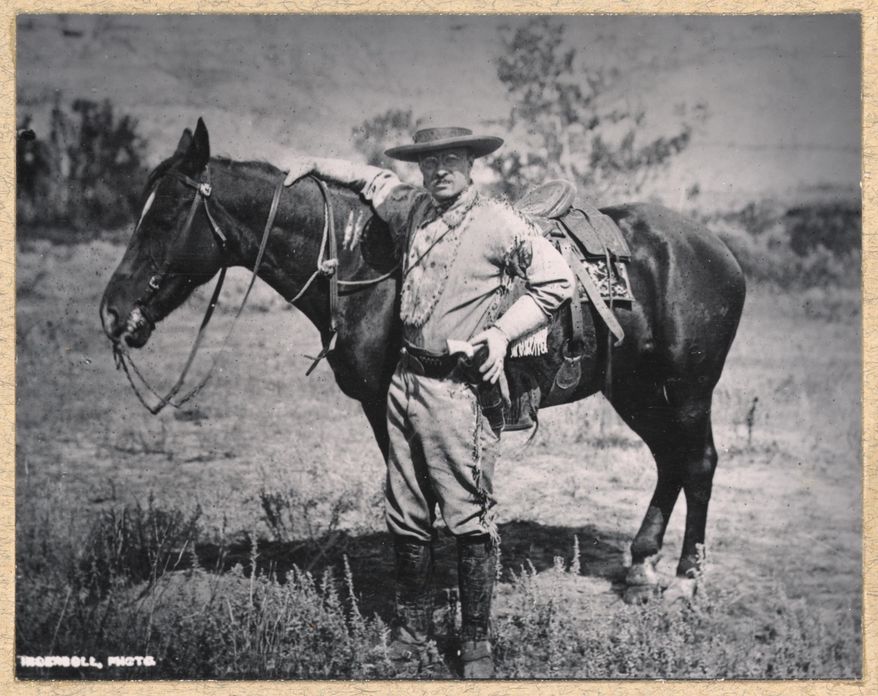
After the same-day deaths in 1884 of his beloved wife Alice, in childbirth, and his mother, who lived with the family, Teddy Roosevelt went into a depression. To beat the depression, he moved to South Dakota and became a cowboy, a very good cowboy.

TR with horse, in the Dakotas

Black care rarely sits behind a rider whose pace is fast enough.

— Attributed to Teddy Roosevelt by David McCullough, on the frontispiece for McCullough’s biography of Roosevelt, Mornings on Horseback (Simon & Schuster, 1981).

Save


Quote of the Moment: Charles Darwin, noble monkey ancestors

March 13, 2007

Charles Darwin, image from Deviant Art; Artwork : www.davidrevoy.com

Charles Darwin, image from Deviant Art; Artwork : http://www.davidrevoy.com

For my own part I would as soon be descended from that heroic little monkey, who braved his dreaded enemy in order to save the life of his keeper, or from that old baboon, who, descending from the mountains, carried away in triumph his young comrade from a crowd of astonished dogs — as from a savage who delights to torture his enemies, offers up bloody sacrifices, practices infanticide without remorse, treats his wives like slaves, knows no decency, and is haunted by the grossest superstitions.

– Charles R. Darwin,
The Descent of Man,
1871, ch. 6


Teacher and student history resources, from the Feds

March 13, 2007

Federal Resources for Educational Excellence (FREE) is a great idea. Federal agencies are loaded with information useful to teachers and students, formerly available in print if one could find the appropriate phone number or get lucky with a mail sweepstakes. Now a lot of the information is compiled specifically for education, and the U.S. Department of Education has compiled a user-congenial site to help educators find the stuff.

FREE image from home page

Under “U.S. History and Topics” you may find a good deal of support for most social studies disciplines. The Women’s History Month focus highlights two topics from the Library of Congress and two from the National Endowment for the Humanities.   Read the rest of this entry »


‘We could tell you how to save your life, but it’s secret, and we can’t tell you.’

March 12, 2007

Communications students at Brigham Young University (BYU) were assigned to test the public disclosure laws as practiced by Utah’s 29 county governments. They decided to use as their test, county emergency evacuation plans, critically important in the wake of terrorist attacks on the U.S. in the past 15 years, and especially critical after the disasters in evacuation failures during Hurricane Katrina and Hurricane Rita.

The Deseret Morning News reports:

Many Utah counties contacted by the BYU students outright refused public access to any information about their plans, while a good number of them said the plan was being revised and not available because it had not been officially adopted.

[Joel] Campbell [assistant professor in the department of communications,] said there were a few counties that at least tried to balance the public’s interest with security concerns by providing some information.

“In today’s world of threats of violence and terrorism, a county official charged with law enforcement responsibilities, as some who were contacted, could and probably should be suspicious about releasing such information,” said Brent Gardner, executive director for the Utah Association of Counties.

One might think that emergency evacuation plans would be spread as far and wide as possible, so that citizens could have at their fingertips the information they need to save their lives.

Not in Utah. Read the rest of this entry »