Texas Statehood, December 29, 1845 – 168 years ago

December 29, 2013

texas our texas

U.S. and Texas flags at the Texas Capitol – photo: jmtimages

168 years ago today: Rub your pet armadillo’s belly, slaughter the fatted longhorn, crank up the barbecue pit with the mesquite wood, put Willie Nelson and Bob Wills on the mp3 player, put the “Giant” DVD on the television, and raise your glass of Big Red, Dr. Pepper, or Lone Star Beer (or Pearl, or Shiner Bock, or Llano Wine).

U.S. Flag Code rules urge flying the U.S. flag on the anniversary of a state’s joining the Union — even as much as that will frost the tiny band of desperate Texas secessionists.  (Will the secessionists fly the Texas flag at half-staff?)

Texas was admitted to the union of the United States of America on December 29, 1845.

President Polk's authorization to affix Great Seal of the U.S. to Texas Statehood documents

President Polk’s Authorization to Affix the Great Seal to Texas Statehood documents – Texas Memorial Museum, University of Texas at Austin

The text of Polk’s message:

I hereby authorize and direct the Secretary of State to affix the Seal of the United States to an authenticated copy of “an act to extend the laws of the United States over the State of Texas and for other purposes” approved Dec. 29, 1845 dated this day, and signed by me and for so doing this shall be his warrant.

James K. Polk
Washington, Dec. 29, 1845

Seal of the U.S. affixed to Texas Statehood Proclamation

Great Seal of the United States of America, affixed to the Texas Statehood Proclamation – image from State Archives Division, Texas State Library

Resources:

More:

Much of this post appeared here before; it’s an annual event, after all.


A sign of some apocalypse in Dinosaur, Colorado?

December 28, 2013

It’s an interesting town, Dinosaur, Colorado 81610.  It’s on the south side of US Highway 40, a very short distance east of the Utah border.

And it touches on the Colorado part of Dinosaur National Monument.  The Wikipedia entry gives specifics:

The Town of Dinosaur is a Statutory Town located in Moffat County, Colorado, United States. The town population was 339 at the 2010 census.[5]

The town of Dinosaur was originally named Artesia; the current name was adopted in 1966, to capitalize on the town’s proximity to Dinosaur National Monument.[6] The monument headquarters is located just east of the town on U.S. Highway 40.

And:

Many streets in the town are named after dinosaurs, including Cletisaurus Circle, Tyrannosaurus Trail, and Antrodemus Alley.[8]

It’s a setup, a straight line waiting for a good comedian.

Brian Switek, the science writer now based in Salt Lake City, suggests one area ripe for comedy:

http://twitter.com/Laelaps/status/417128850762391553

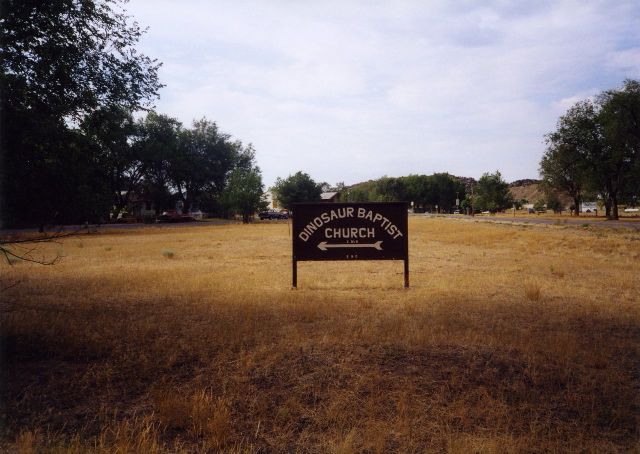
Wait. What?  Dinosaur Baptist Church?

Brian Tweeted that he wasn’t looking to ridicule, but: “I just imagined thyreophorans, maniraptorans, sauropodomorphs, and their ilk in the congregation.”

That might produce even more comedic situations.

It’s a Southern Baptist Convention-affiliated congregation.  Aren’t you curious how Sunday school goes for dinosaur-crazy kids in such a church, in such a town?

Signs of life, signs of the times, signs of something!

Another shot of the directional sign for Dinosaur Baptist Church, from earlier in 2011, I think.  From Text of the Day.

Another shot of the directional sign for Dinosaur Baptist Church, from earlier in 2011, I think. From Text of the Day.

From a different angle, one can see that the church is just a couple of blocks off of Stegosaurus Freeway.  Wow.

2007 photo of the sign showing street signs at the intersection of 6th Street and Stegosaurus Freeway.  Photo by Will Gelnaw, who has copyright to it.

2007 photo of the sign showing street signs at the intersection of 6th Street and Stegosaurus Freeway. Photo by Will Gelnaw, who has copyright to it.

Still, it’s fun to imagine a nice, small town church, with dinosaurs in the back pews singing along.  (Instead, Chris Clarke suggested, they are hiding in the Rocks of Ages . . .)

More:    

Welcome to Dinosaur, Colorado

Welcome to Dinosaur, Colorado (Photo credit: J. Stephen Conn)


Iowans, fly your flags today: Iowa Statehood, December 28, 1846

December 28, 2013

Iowans may fly their flags today in celebration of the anniversary of Iowa statehood.  Iowa’s admission to the Union came on December 28, 1846; Iowa was the 29th state admitted.

The Flag Code, 4 USC §6 (d), notes that the U.S. flag may be flown on “the birthdays of States (date of admission),” in addition to the other score of dates specifically written into law.

Randy Olson photo of flags at rodeo in Spencer, Iowa, 1996

American Flag, Spencer, Iowa, 1996caption from the National Geographic Society: A man rolls up U.S. flags at the end of the Clay County Fair in Spencer, Iowa. “Although the population of Spencer is only about 12,000, the fair draws some 300,000 visitors. Once a year, rising from the endless flatness of the Iowa countryside, a crowd forms—to stroll, to hear big country music acts like the Statler Brothers, to sell a grand champion boar, to buy a new silo.” (Photographed on assignment for, but not published in, “County Fairs,” October 1997, National Geographic magazine) Photograph by Randy Olson; copyright National Geographic Society

More:


Smashing December 27: Carry Nation’s “temperance” campaign comes to Wichita

December 27, 2013

Carry Nation is a character Texas students should be learning about, but there is rarely more than a paragraph’s mention of her in the usual high school history texts.  Students guided by smart teachers might find more about Ms. Nation, the Women’s Christian Temperance Union, the Temperance Movement in general as it played out against the Progressive era, the creation and passage of the 16th Amendment to the Constitution, authorizing an income tax, and the imposition of Prohibition after the passing of the 18th Amendment.

They’re all linked together in what I regard as a fascinating series of stories.

Two days after Christmas 1900, Carry Nation attacked the bar at the Carey Hotel in Wichita, Kansas, the town she was living in at the time, and exploded into history.

From Kansas Memory:  A photograph showing the Carey Hotel Bar in Wichita, Kansas after Carry Nation threw rocks to break the mirror during a temperance protest, December 27, 1900.  Kansas Historical Foundation

From Kansas Memory: A photograph showing the Carey Hotel Bar in Wichita, Kansas after Carry Nation threw rocks to break the mirror during a temperance protest, December 27, 1900. Kansas Historical Foundation

(Did I mention she was a school teacher at the time?)

Dickinson, Kansas Marshal Benham escorting Carry Nation out of a saloon, or fight, probably in 1901.  Photo from the Dickinson County Historical Society

Dickinson, Kansas Marshal Benham escorting Carry Nation out of a saloon, or fight, probably in early 1901, a few days after her attack on the saloon in the Carey Hotel in Wichita. Photo from the Dickinson County Historical Society

This part of the story below is completely cribbed from the Library of Congress’s “Today in History” feature, which you should be reading at least daily (Those guys do great work, and I usually can’t top it):

Temperance

From the Library of Congress:

From the Library of Congress: “Strike for the Cause of Temperance,” Words by A.W. Carr, music by W. F. Heath, 1878. Music for the Nation: American Sheet Music 1870-1885

Strike For The Cause Of Temp’rance,
Wield In Your Mightiest Blow…”Strike for the Cause of Temperance,”
Words by A.W. Carr, music by W. F. Heath, 1878.
Music for the Nation: American Sheet Music 1870-1885

On December 27, 1900, Carry Nation brought her campaign against alcohol to Wichita, Kansas, when she smashed the bar at the elegant Carey Hotel. Earlier that year, Nation had abandoned the nonviolent agitation of the Woman’s Christian Temperance Union in favor of direct action that she called “hatchetation.” Since the Kansas Constitution prohibited alcohol, Nation argued that destroying saloons was an acceptable means of battling the state’s flourishing liquor trade.

Born in Kentucky in 1846, Carry Amelia Moore accompanied her family to Missouri in the 1850s. Her first husband, a physician, died of alcohol-related illness early in their marriage, leaving her to support herself, her young daughter, and her mother-in-law. Carry earned a teaching certificate and taught primary school for four years, before losing her position. At this point, according to her autobiography, she prayed that she would find a suitable husband. In 1877, she met and married David Nation–in just six weeks.

Arriving in Kansas in the 1890s, she became active in mainstream temperance organizations. The failure of Kansas authorities to enforce the ban on alcohol initially rallied some support for Nation’s attacks. However, her extreme methods and unladylike behavior ultimately distanced Nation from state and national temperance societies.

Eventually, state fairs and medicine show tours became Nation’s pulpit and source of financial security. Dressed in stark black and white, she promulgated her equally unambiguous views against liquor, tobacco, fraternal orders, and excessive fashion. Freeman Willis of New Hampshire encountered her on the state fair circuit. He later recalled the incident for a WPA interviewer:

The Belknap County Fair at Laconia was a great time for Dr. Greene. He had Carrie Nation…yes, hatchet and all…out there, once, for advertising. He spent a pile of money on advertising. And while Carrie was there the town was hers…as much of it as Dr. Greene’s money could buy.”An Old Yankee Innkeeper; His Story,” New Hampshire
Henry H. Pratt, interviewer, ca. 1938-39.
American Life Histories: Manuscripts from the Federal Writers’ Project, 1936-1940

Yet, Nation’s celebrity was based more on her notoriety as a hatchet-wielding saloon buster than for an appreciation of her cause. Willis recounts that he saw Nation a second time at the Buffalo State Fair. There, she complained, “they don’t believe…a lot of them don’t…that I’m the real Carrie Nation. They think I’m a fake…dressed up to imitate Carrie. I wish you’d tell them I am the real Carrie.”

Many nineteenth- and early twentieth-century reformers supported the prohibition of alcohol. Suffragists such as Elizabeth Cady Stanton often urged adoption of temperance legislation. Lacking legal rights to their property, their wages, and even their children, women’s lives in the nineteenth century were easily devastated if the men they depended on “took to drink.”

Learn more about Carry Nation and the movement to prohibit alcohol in the United States:

More:

Carry Nation and her hatchet. Photo from the Kansas Historical Society

Carry Nation and her hatchet. Photo from the Kansas Historical Society


December 27, Great Beginnings Day: Darwin, Apollo, and more

December 27, 2013

December 27 is one of those days — many of us are off work, but it’s after Boxing Day, and it’s not yet on to New Year’s Eve or Day. We should have celebrated, maybe.

We should celebrate December 27 as a day of portent: A good embarkation, and a good, safe end to a nation-encouraging trip to almost touch the Moon.

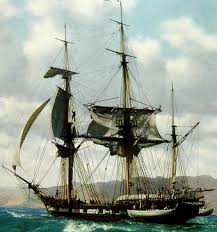
HMS Beagle, Darwin's ship

HMS Beagle, on a voyage of discovery

On December 27, 1831, Charles Darwin and H.M.S. Beagle set sail on an around-the-world voyage of discovery that would change all of science, and especially biology, forever.

December 27 1831
After a few delays, H.M.S. Beagle headed out from Plymouth with a crew of 73 under clear skies and a good wind. Darwin became sea-sick almost immediately.

Darwin never fully overcame his seasickness, but he fought it well enough to become the single greatest collector of specimens in history for the British Museum and British science, a distinction that won him election to science societies even before his return from the trip — and cemented his life in science, instead of in the church. Darwin’s discoveries would have revolutionized biology in any case. In analyzing what he had found, a few years later and with the aid of experts at the British Museum, Darwin realized he had disproved much of William Paley’s hypotheses about life and its diversity, and that another, more basic explanation was possible. This led to his discovery of evolution by natural and sexual selection.

Mini-sheet from the Royal Mail honoring Darwin's discoveries in the Galapagos Islands

Mini-sheet from the Royal Mail in 2009 honoring Darwin’s discoveries in the Galapagos Islands

On December 27, 1968, Apollo 8 splashed down after a successful and heartening trip to orbit the Moon. The three crewmen, Commander Frank Borman, James A. Lovell, Jr., and William A. Anders, had orbited the Moon, a very important milestone in the methodological race to put humans on the Moon (which would be accomplished seven months later). 1968 was a terrible year for the U.S., with the North Korean capture of the U.S.S. Pueblo, assassinations of Rev. Martin Luther King, Jr., and Sen. Robert F. Kennedy during the presidential campaign, riots in dozens of American cities, nasty political conventions with riots at the Democratic Convention in Chicago, a contentious and bitter election making sore the nation’s divide over Vietnam policy, and other problems. On Christmas Eve, Borman, Lovell and Anders broadcast from orbit around the Moon, a triumphant and touching moment for the Apollo Program and Americans around the world. Their safe return on December 27 raised hopes for a better year in 1969.

Motherboard.tv has a great write up from Alex Pasternack, especially concerning the famous photo taken a few days prior to splashdown:

In 1968, NASA engineers were scrambling to meet President Kennedy’s challenge to land a man on the moon by decade’s end. Because delays with the lunar module were threatening to slow the Apollo program, NASA chose to change mission plans and send the crew of Apollo 8 all the way to the moon without a lunar module.

Exactly 43 [45] years ago, the three astronauts of Apollo 8 became the first humans to orbit another celestial object. As they came around the dark side of the Moon for the third time, Frank Borman, the commander, finally turned their capsule around. And then they saw the Earth.

Borman: Oh my God! Look at that picture over there! Here’s the Earth coming up. Wow, is that pretty.
Anders: Hey, don’t take that, it’s not scheduled.
Borman: (laughing) You got a color film, Jim?
Anders: Hand me that roll of color quick, will you…

One of the resulting photos taken by Anders on a Hasselblad camera became one of the world’s most iconic images.

As Bill Anders recalls it:

I just happened to have one with color film in it and a long lens. All I did was to keep snapping… It’s not a very good photo as photos go, but it’s a special one. It was the first statement of our planet Earth and it was particularly impressive because it’s contrasted against this startling horizon… After all the training and studying we’d done as pilots and engineers to get to the moon safely and get back, [and] as human beings to explore moon orbit, what we really discovered was the planet Earth.

Plan to raise a glass today, December 27, 2012, to Great Beginnings Day for the human race. December 27 is a day we should remember, for these achievements.

Also on December 27:

Adapted from a post from 2010.

More:


Insta-Millard, photography and astronomy edition: South DakotaHenge

December 23, 2013

How much image manipulation, if any, was necessary to capture this enormous-looking Moon rising over a South Dakota “road to nowhere,” close to the 2013 Winter Solstice?

From @GlobePics:

From @GlobePics: “Road To Nowhere – Supermoon” – Supermoon rises over this road to nowhere in eastern South Dakota. pic.twitter.com/82AoFgPvWn

Who should get credit for the photo?  (I can’t quite read the name in the lower left corner.)

Buy a print here, from the photographer, Aaron J. Groen.

More:


Insta-Millard, education edition: Light on the problems of the Common Core State Standards

December 22, 2013

As if anyone were looking and needed light.  The heat is intense, and the light seems superfluous.

First, Jack Russell Weinstein, a philosopher in North Dakota, of all places, seems to me to have accurately found the issue in Common Core discussions, better than almost anyone else (including Diane Ravitch, at least for succinctness), in a short post at his blog PQED from which this is excerpted:

Jack Russell Weinstein presented the keynote a...

Jack Russell Weinstein presented the keynote address at the 2007 UND Undergraduate Philosophy Conference. (Photo credit: Wikipedia)

Philosophically then, the question is how to negotiate federal and local power in education. We are also concerned with what counts as expertise. If we combine the two, we are faced with a third issue: who negotiates all of this? When the National Governors’ Association created the new Common Core—the standards that many American school kids will now be evaluated against—they relied more heavily on business than on teachers. They asked Microsoft and the standardized testing companies what they thought, and minimized the input of those who actually teach. They then assumed a purpose that suited their needs: they concluded that students should graduate from high school career and college ready.

Now, these are good goals. Our students should be ready to move on to the next stage of life. But where is the love of literature, the ability to communicate needs and political ideas, the capacity to respect both difference and personal experience at the same time? Where is the understanding of the importance of math, science, and history, and the celebration of being alive, in the world, surrounded by art, music, comedy, and neighbors? Leaving these things out of schooling is a bit like teaching your child to kick a soccer ball while convincing her that she doesn’t deserve the chance. It’s like putting her on a soccer team only to teach her to despise the game. It’s like sending your kids to school while telling them that education and teachers have little value. Surely, the first goal of education, like the first goal of soccer, should be to show why it’s worth doing in the first place.

Looking for a general link to Ravitch’s blog, I stumbled on this post, “Why Teachers Don’t Like Common Core”:

Why do teachers resist the mandates of Common Core?

Dr. Diane Ravitch discussed education reform's problems in Dallas, in April 2010.  Photo by Ed Darrell

Dr. Diane Ravitch discussed education reform’s problems in Dallas, in April 2010. Photo by Ed Darrell

We suggest money spent on the development of these major unresearched and unfunded mandates to implement CCSS be used to alleviate the lack of resources — unequal staffing, support services, and restoration of school libraries, music and art classes, as well as enrichment programs in these schools. Research has shown that this is the way to help even the playing field for the districts in poverty.

Teachers are mind-molders. When they embrace, create and implement meaningful change with their students, they are helping every child reach his or her potential. Teachers embrace constructive, researched change that result in better, meaningful learning. Resistance to the Common Core standards should be understood in this context.

Rabid CSCOPE critics in Texas, dedicated to the tasks of destroying teaching while failing to recognize what they do, won’t understand.  First off they fail to recognize, as Dr. Weinstein explicitly does, that Common Core standards do not come from the federal government, botching the history of education and federal involvement from the get go.  More important, few discussions start out with seeking the common ground we might find by asking the question, what is the purpose of this education system we work on?

Do any of us fully understand?

More:


December 20, 1620: Mayflower passengers finally disembark at Plymouth, after agreeing to the Mayflower Compact

December 21, 2013

Item from The Associated Press‘s “Today in History” feature, for December 21:  “1620 – Pilgrims aboard the Mayflower went ashore for the first time at present-day Plymouth, Mass.”  Why in December?  The arrived at the place almost a month earlier, but because of delays in getting out of England due to the leaky second boat (which didn’t make the trip), and difficulties encountered en route, when the group anchored, they first had to come to an agreement how to govern the colony, so far out of the territory of the charter they had been granted, as explained below.  Originally, a version of this desultory ran here, on July 26, 2006.

Credit: Sarony & Major.

From the Library of Congress, one of the few illustrations of the event that makes it clear it was near winter: The Pilgrims landing on Plymouth Rock, December 1620 Credit: Sarony & Major. “The landing of the Pilgrims, on Plymouth Rock, Dec. 11th 1620.” c1846. Prints and Photographs Division, Library of Congress.

Dispatches from the Culture Wars features a set of comments on an interview right-right-wing pundit John Lofton did with Roy Moore, the former chief justice of Alabama’s Supreme Court who lost his job when he illegally tried to force his religion on the court and on Alabama. In 2006 Moore ran for governor of Alabama, losing in the primary election.

One of the grandest canards in current thought about U.S. history is that the Mayflower Compact set up a theocracy in Massachusetts. Lofton and Moore banter about it as if it were well-established fact — or as if, as I suspect, neither of them has looked at the thing in a long time, and that neither of them has ever diagrammed the operative sentence in the thing.

The Mayflower Compact was an agreement between the people in two religiously disparate groups, that among them they would fairly establish a governing body to fairly make laws, and that they would abide by those laws. Quite the opposite of a theocracy, this was the first time Europeans set up in the New World a government by consent of the governed.

That is something quite different from a theocracy.

I think people get confused by the run-on sentences, and the flattering, intended-to-be-flowery language in the clauses prefacing the meat of the document.

First, a very brief history: There were two groups aboard the ship in 1620, about 70 artisans and craftsman along to provide the real work to make sure the colony made money, and about 30 religious refugees. The London Company (accurately) thought the religious refugees lacking in key skills, like trapping, hunting and hide tanning, and barrel-making (barrels were needed to ship goods to England). So the London Company had insisted the craftsman go along, to make sure somebody knew how to harvest stuff and ship it back.

The London Company had a charter to establish a colony in Virginia. Because of delays with leaky ships and uncooperative winds, the Mayflower got to America late, and much farther north. The Mayflower landed well outside the territory the company was chartered to colonize, and the 70 craftsmen announced they were striking out on their own. Bradford realized his group would freeze, or starve, or both, and at gunpoint he kept both groups aboard ship to work out a compromise.

Here is the full text, from the University of Oklahoma’s College of Law site:

In the name of God, Amen. We, whose names are underwritten, the Loyal Subjects of our dread Sovereign Lord, King James, by the Grace of God, of England, France and Ireland, King, Defender of the Faith, e&.

Having undertaken for the Glory of God, and Advancement of the Christian Faith, and the Honour of our King and Country, a voyage to plant the first colony in the northern parts of Virginia; do by these presents, solemnly and mutually in the Presence of God and one of another, covenant and combine ourselves together into a civil Body Politick, for our better Ordering and Preservation, and Furtherance of the Ends aforesaid; And by Virtue hereof to enact, constitute, and frame, such just and equal Laws, Ordinances, Acts, Constitutions and Offices, from time to time, as shall be thought most meet and convenient for the General good of the Colony; unto which we promise all due submission and obedience.

In Witness whereof we have hereunto subscribed our names at Cape Cod the eleventh of November, in the Reign of our Sovereign Lord, King James of England, France and Ireland, the eighteenth, and of Scotland the fifty-fourth. Anno Domini, 1620.

See what I mean? It’s loaded with clauses that tend to obscure what is going on. Starting out with the standard contract language of the day, “In the name of God, Amen,” it loses modern readers. We tend to think that with so many mentions of God without a “damn” following, it must be a religious document. But it’s not.

Here’s the meat the the document, the money quote:

We, whose names are underwritten . . . do by these presents, solemnly and mutually in the Presence of God and one of another, covenant and combine ourselves together into a civil Body Politick, for our better Ordering and Preservation, and Furtherance of the Ends aforesaid; And by Virtue hereof to enact, constitute, and frame, such just and equal Laws, Ordinances, Acts, Constitutions and Offices, from time to time, as shall be thought most meet and convenient for the General good of the Colony; unto which we promise all due submission and obedience.

Got that? They promised to form a government, enact fair laws, and obey those laws — government by consent of the governed, by mutual compact, not by divine right.

Just because God is mentioned in the document doesn’t change its nature. It’s a secular compact, an agreement between men, outside the stricture of any church, outside any particular belief.

As we noted over at Ed Brayton’s site, Dispatches from the Culture Wars, many New England settlements and towns became little theocracies. But it wasn’t the Mayflower Compact which set that up, or encouraged it.

More:


Insta-Millard Pundit, economics edition: Adam Smith was a bleeding heart liberal

December 21, 2013

In a new book, author Jack Russell Weinstein argues that we should pay more attention to Adam Smith’s first book, The Theory of Moral Sentiments,  and not allow Smith’s humanitarian pleas for good community be hijacked by libertarians, conservatives or liberals.

Adam Smith’s Pluralism, Jack Russell Weinstein, Yale University Press, 360 pages

Adam Smith, updated. Illustration by Michal Hogue.

Adam Smith, updated. Illustration by Michal Hogue.

A review of the book explains further, at American Conservative, “Adam Smith, Communitarian:

Weinstein builds upon Smithian harmony, explaining that while life is not always commercial, it is always communal. Community, in turn, derives its lifeblood from “imagination,” because imagination creates the capacity for sympathy. Unlike Kant and other Enlightenment thinkers, Smith “presumes human difference” as a necessary and inherent aspect of civilization, rejecting the Kantian ideal of “noncontextual normativity.” Smith recognized that cultural, temporal, and social differences shaped norms and values, making it impossible to create a single, all-inclusive norm of human behavior. This is why sympathy is so important. It offers a means that is natural to the human condition—our desire to commiserate with our fellow man—to bridge the gap between our differences.

Smith believed that “political society is not derived from a social contract,” according to Weinstein. Instead, society is a natural expression of what it means to be human. The state of nature for Smith is one of community, and the ultimate questions related to human society are questions of morality and virtue, not economics and politics. Thus, a broad, morally robust education rooted in a particular community is essential to forming sympathetic individuals. While Smith did not idealize the role of education—it could not completely eliminate human selfishness and vanity—he believed it had the power to “direct vanity to proper objects” and to “convert competing passions into a harmonious character.”

[The blog post’s headline should be read with more than a hint of sarcasm; hate to have to explain that.]

More:


Insta-Millard Pundit, education edition: The very real war on experienced teachers

December 21, 2013

Veteran teachers take heavy hits from

Veteran teachers take heavy hits from “education reformers” who cut their pay, and reduce benefits, in misguided efforts to “drive poor teachers from the system.” In Photo: Karen Scharrer-Erickson reviews a new teaching tool Thursday with Lisa Schuk, a second-grade teacher at the Academy of Accelerated Learning in Milwaukee. Scharrer-Erickson, 64, said she reluctantly filed for early retirement from Milwaukee Public Schools recently. Read more from Journal Sentinel: http://www.jsonline.com/business/headlines/119892934.html#ixzz2o955nbXI Follow us: @JournalSentinel on Twitter

You should read this article, get angry, and fight education “reformers” who go after teachers.

Indeed, the level of respect afforded to those who have devoted their adult lives to the education of children has diminished to the point that the prevailing zeitgeist suggests that comparably junior members of the profession are somehow inherently superior to their more experienced colleagues.

If it seems like I have travelled down this road before, it because I have. Eighteen months ago, I wrote about how “tenure reform” was an attack on veteran teachers and their employment rights, wrapped in the cloak of “improving education” for kids.

But this new trend is far more sinister. Now, the “reform” crowd (including an alarming number that sell themselves as progressives) don’t merely want the ability to fire veteran teachers. They want to strip them of something that has greater intangible value: their status as mentors and role models for the profession.

File under “daily floggings of teachers will continue until morale improves.”


Who is Tim Pangos?

December 19, 2013

Ha. I am amused at people so anxious to take material from this blog, or complain about something I’ve written, that they can’t be bothered to look around for names of the blog, or author, or otherwise look for proper attribution.

I’ve been called “Tim Panogos” several times, “Tim Pagonos” a few.  I’ve had a few zombies from Santayana’s nightmares insist on calling me Millard.

This is to note that the humor will continue:  Now my photos are credited to “Tim Pangos.”  To be sure, it’s posted by LatinaMom.  Happy to be able to hold on to multicultural appeal.

Here's my photo, as featured at

Here’s my photo, as featured at “Funny Bumperstickers” by Latina Mom. ” Zombies. They’ll get you every time. Image via Tim Pangos.  Photo and original post by Ed Darrell at Millard Fillmore’s Bathtub — use of photos encouraged, with attribution.  This photo from my iPhone, by the way.

For the record, the URL of this blog features the name of that great Utah landmark, Mount Timpanogos.  I do not intentionally use the pseudonyms “Tim Panagos,” “Tim Pangos,” nor any other derivative from the mountain’s moniker.


USDA details damage GOP refusal to pass farm bill has on America — but politely

December 19, 2013

The case for a farm bill that we won’t get before January; press release from the U.S. Department of Agriculture (some links, and all images, added here).

Public relations campaigns from the federal government used to be quite a bit more robust than this.

USDA Office of Communications (202) 720-4623

FACT SHEET: Supporting Innovation That Boosts Agriculture and Creates Jobs in Rural America

Farm south of Withee, Wisconsin. Wikipedia image

Farm south of Withee, Wisconsin. Wikipedia image


Today, Agriculture Secretary Tom Vilsack hosted a national media call with Jack Payne, Senior Vice President for Agriculture and Natural Resources at the University of Florida. The Secretary emphasized the importance of Farm Bill research programs that enable the University of Florida and other Land Grant Universities across the nation to carry out groundbreaking discoveries, strengthen agriculture and grow business opportunity in rural America. Secretary Vilsack called on Congress to expedite passage of a new Food, Farm and Jobs Bill that continues record efforts to spur innovation and create jobs across rural America.

Amazing scientific breakthroughs have helped our farmers, ranchers and growers increase production on the same amounts of land, using fewer inputs. In fact, studies have shown that every dollar invested in agricultural research returns $20 to the economy.

Advanced new products are being created across the country using materials grown in America’s farm fields – with more than 3,000 U.S. companies creating advanced biobased products today.

And clean, renewable fuel energy and new energy efficiency technologies are helping families and businesses across the nation, reducing our reliance on foreign oil.

A farm in California; photo by karmadude

A farm in California; photo by karmadude

USDA is hard at work to support all of these efforts – and we depend on the Farm Bill to make possible much of our work to boost rural innovation. A new Farm Bill would:

  • Modernize and expand America’s capacity for agricultural research. The Farm Bill would enable public-private funding efforts to expand capacity for agricultural research, returning even more benefits to the economy.
  • Adequately invest in energy-saving efforts such as the Rural Energy for America Program, enabling even more projects to save energy on farms across the nation. Since 2009 alone, these projects have resulted in energy savings of more than 8.5 million MwH – but a new Farm Bill is needed for further progress.
  • Continue the work of the USDA BioPreferred Program, which depends on the Farm Bill to work with biobased companies across the nation, expand the Federal government’s use of their innovative products and ultimately create jobs.
  • Maintain support for research into wood-based products and energy. With a record level of forest restoration underway today, we need a Farm Bill that continues research and helps find new uses for forest-based products.

A Farm Bill would continue advances in agricultural technology that allow today’s producers to grow two, three of four times as much today as they were just 60 years ago. In the past few years alone:

  • USDA scientists have developed new techniques in the fight against Citrus Greening, a disease that seriously threatens citrus crops. Just this week, USDA announced a new Emergency Response Framework and provided $1 million to boost this multi-partner, coordinated strategy to fight Citrus Greening.
  • Researchers have mapped the genomes of numerous plants and animals in the past five years. This year, USDA made new discoveries into the genetic makeup of cotton, oats and watermelon. This builds on research efforts that have mapped the genomes of apples, pigs, turkeys, tomatoes, beans, and more.
  • Scientific discoveries have improved crop varieties to keep food safer and mitigate climate impacts. USDA has recently explored the use of peanut skins as a food ingredient to boost the nutritional value of foods; pinpointed ways to prepare beef cuts to reduce the risk of contamination with the foodborne pathogen E. coli O157:H7; produced new, flavorful, high-yielding varieties of strawberries, grapes, pecans and peanuts; and worked to improve drought-resistance crop varieties.

A Farm Bill would allow the National Institute of Food and Agriculture to continue work with Land-Grant University researchers across the nation to conduct research and train the next generation of scientists.

  • Since 2009, NIFA has invested more than $6 billion in agricultural research and extension activities. This funding was possible largely through programs authorized under the Farm Bill. NIFA partners have used this help to leverage more than $1 billion in additional research dollars.
  • Nearly 400 patent applications have resulted from NIFA research since 2009 – covering a wide range of topics and discoveries.
  • Over the course of more than 150 years of history, Land-Grant Universities have educated more than 20,000,000 students.

A Farm Bill would support the invention and creation of innovative new products from homegrown sources. Thanks to the USDA BioPreferred Program, provided by the Farm Bill:

  • More than 1,000 products today carry USDA’s “ Certified Biobased Product” label. Thanks to the new label, these innovative, American-made products are easier to find on store shelves than ever before – everything from cleaners and paint to motor oil.
  • Nearly 100 separate categories of homegrown biobased products are prioritized for use by the Federal Government. Today, Yellowstone National Park uses biobased lubricants and cleaning products throughout its 2.2 million acres. At the Statue of Liberty, biobased hydraulic oils are used in the elevator system. Multiple U.S. military bases across the nation are using biobased products. And there is further room for growth.
  • Researchers at the U.S. Forest Products Laboratory are revolutionizing wood products for use in materials we need. Body armor, auto parts and new building materials are being developed using homegrown products – and in many cases, they’re stronger and better than what we use today.

A new Farm Bill would continue advancing clean renewable energy that starts in rural America – creating jobs and boosting America’s energy security.

  • More than 9,250 renewable energy projects are underway today as a result of USDA help in the past five years, helping farmers and landowners install new energy-saving technology, along with energy generation tools such as anaerobic digesters.
  • Eight advanced biorefineries are creating the advanced renewable energy of the future, today. USDA was there to support their creation through loan guarantee efforts provided by the Farm Bill.
  • More than 220 Wood to Energy projects are helping find new uses for wood in renewable energy generation. This will provide even more market opportunities for wood byproducts generated during forest restoration, and ultimately will provide a new income sources in rural areas.
  • The U.S. Navy and others have partnered with USDA to create renewable energy to power our military. In fact, the military is our single largest consumer of petroleum – and by creating advanced renewable marine and aviation biofuels, we’re working together to increase America’s energy security. This week, Secretary Vilsack and Secretary of the Navy Ray Mabus announced a new Department of Defense Farm to Fleet Initiative that will further improve America’s capacity to create military-ready advanced biofuels.

American innovation is one of our most special traditions. Rural America has the capacity to help lead the way to even more amazing work in the years to come – creating good jobs and economic opportunity in the process. But we need Congress to get its work done and provide a new Farm Bill that recommits our nation to strong agricultural research, and continued development of amazing homegrown products.

U.S. Department of Agriculture, South Building, Washington, D.C.  Image from Thornton Thomasetti

Where the policies get made and programs are administered, U.S. Department of Agriculture, South Building, Washington, D.C. Image from Thornton Thomasetti

Number of Biobased Companies Operating in the United States

A map of U.S. biobased companies is available here.

States/Biobased Companies

  • Alabama – 16
  • Alaska – 5
  • Arizona – 54
  • Arkansas – 17
  • California – 391
  • Colorado – 79
  • Connecticut – 40
  • Delaware – 9
  • Dist of Columbia – 2
  • Florida – 161
  • Georgia – 92
  • Hawaii – 11
  • Idaho – 16
  • Illinois – 173
  • Indiana – 46
  • Iowa – 92
  • Kansas – 28
  • Kentucky – 21
  • Louisiana – 11
  • Maine – 22
  • Maryland – 36
  • Massachusetts – 73
  • Michigan – 80
  • Minnesota – 124
  • Mississippi – 21
  • Missouri – 56
  • Montana – 10
  • Nebraska – 29
  • Nevada – 14
  • New Hampshire – 25
  • New Jersey – 90
  • New Mexico – 17
  • New York – 151
  • North Carolina – 90
  • North Dakota – 6
  • Ohio – 138
  • Oklahoma – 9
  • Oregon – 79
  • Pennsylvania – 129
  • Rhode Island – 8
  • South Carolina – 19
  • South Dakota – 12
  • Tennessee – 35
  • Texas – 167
  • Utah – 14
  • Vermont – 11
  • Virginia – 57
  • Washington – 111
  • West Virginia – 3
  • Wisconsin – 95
  • Wyoming – 8

Total – 3003

Source: USDA BioPreferred Program

#

USDA is an equal opportunity provider and employer. To file a complaint of discrimination, write to USDA, Assistant Secretary for Civil Rights, Office of the Assistant Secretary for Civil Rights, 1400 Independence Avenue, S.W., Stop 9410, Washington, DC 20250-9410, or call toll-free at (866) 632-9992 (English) or (800) 877-8339 (TDD) or (866) 377-8642 (English Federal-relay) or (800) 845-6136 (Spanish Federal-relay).

#

Listening to the debates on Capitol Hill, one may wonder whether Members of Congress still employ staffers to track agriculture issues in their states and districts, to translate local needs into federal policy.  To what entity are Congress members loyal, with more allegiance than they owe their American constituents?

More:


Milton Friedman really said higher wages make a nation prosperous?

December 18, 2013

Chicago University and Nobel-winning economist Milton Friedman, inspecting fruits of free markets.

Chicago University and Nobel-winning economist Milton Friedman, inspecting fruits of free markets. (Photo found at Crooks and Liars, with quote of Friedman’s explaining the benefits of things like that Earned Income Tax Credit)

In Free to Choose, Milton Friedman wrote:

But when workers get higher wages and better working conditions through the free market, when they get raises by firm competing with one another for the best workers, by workers competing with one another for the best jobs, those higher wages are at nobody’s expense. They can only come from higher productivity, greater capital investment, more widely diffused skills. The whole pie is bigger – there’s more for the worker, but there’s also more for the employer, the investor, the consumer, and even the tax collector.

That’s the way the free market system distributes the fruits of economic progress among all people. That’s the secret of the enormous improvements in the conditions of the working person over the past two centuries.

What would Friedman say about higher productivity and greater capital investment, an increasing pie, when the increases are denied to the worker, and the employer, and the consumer, and the tax collector?  Somehow, I think even Mr. No-government-regulation would cry, “Foul!”

Heck, that’s a good argument for raising the minimum wage, and for fixing income inequality.

More:


Ashes to ashes, airplanes to spread them, Damon Runyon and silver bells: December 18

December 18, 2013

On December 17, Orville and Wilbur Wright got their heavier-than-air flying contraption to actually fly with motor driving it along.

First flight of the Wright Flyer I, December 1...

First flight of the Wright Flyer I, December 17, 1903, Orville piloting, Wilbur running at wingtip. Photo from Wikipedia

On December 18, Damon Runyon, Jr., got Eddie Rickenbacker to fly over Broadway to scatter the ashes of his father, Damon Runyon.

First Lieutenant E. V. [Eddie] Rickenbacker, 9...

First Lieutenant E. V. [Eddie] Rickenbacker, 94th Aero Squadron, American ace, standing up in his Spad plane. Near Rembercourt, France. Photo from Wikipedia. This photo dates near World War I; Rickenbacker remained a hero for a couple of decades. In 1946, he flew a DC-3 over New York City, and illegally scattered the ashes of raconteur Damon Runyon over his beloved Broadwary.

Not exactly the next day. 43 years and one day apart.  The Wrights first flew in 1903; Runyon died in 1946.

Today in Literature, for December 18:

On this day in 1946 Damon Runyon’s ashes were scattered over Broadway by his son, in a plane flown by Eddie Rickenbacker. Runyon was born in Manhattan, Kansas; he arrived at the bigger apple at the age of thirty, to be a sportswriter and to try out at Mindy’s and the Stork Club and any betting window available his crap-shoot worldview: “All of life is six to five against.” Broadway became his special beat, and in story collections like Guys and Dolls he developed the colorful characters — Harry the Horse, the Lemon Drop Kid, Last Card Louie — and the gangster patois that would swept America throughout the thirties and forties.

A lot of history packed in there.  Runyon’s early reportorial career included a lot of that history — he wrote the lead story for United Press on the inauguration of Franklin Roosevelt, for one example.  Runyon found a uniquely American vein of literary ore on Broadway in New York City, and in the ne’er-do-wells, swells, tarts and reformers who flocked to the City that Never Sleeps to seek fame, or fortune, or swindle that fortune from someone else.

As a reporter and essayist, he smoked a lot.  Throat cancer robbed him of his voice, then his life at 56.

Runyon’s ashes were spread illegally over Broadway, from a DC-3 piloted by Rickenbacker. Runyon would have liked that.

You couldn’t make this stuff up.

Factoids of history:

  • Twenty movies got crafted from Runyon stories, including “The Lemon Drop Kid” — in two versions, 1934 and 1951. Appropriate to the Christmas season, the 1951 version introduced the song, “Silver Bells” composed by Jay Livingston and Ray Evans. (Great explanation of the movie, and song, here.)
  • Runyon got fame first as a sports writer.  He was inducted into the writer’s wing of the Baseball Hall of Fame in 1967.
  • According to Wikipedia, Jerry Lewis and others owe a great debt to Damon Runyon:  “The first ever telethon was hosted by Milton Berle in 1949 to raise funds for the Damon Runyon Cancer Research Foundation.”
  • One might salivate over the varied fare offered in the theaters of Broadway in 1946, Runyon’s final year, “Annie, Get Your Gun” through Shakespeare, and everything in between and on either side
  • Runyon and H. L. Mencken both covered the trial of Bruno Hauptmann, the accused (then convicted) kidnapper of Charles Lindbergh’s baby son
  • Yes, of course, “Guys and Dolls.” Frank Loesser created it, but not of whole cloth, but from the stories of Damon Runyon; it is a masterpiece, perhaps in several realms.  In homage to Runyon, Adam Gopnik wrote:

    Just as Chandler fans must be grateful for Bogart, Runyon fans have to be perpetually happy that the pure idea of Runyon, almost independent of his actual writings, produced the best of all New York musicals: Frank Loesser’s “Guys and Dolls,” which made its début in 1950 and is just now reopening on Broadway in a lavish and energetic new production. But then “Guys and Dolls” is so good that it can triumph over amateur players and high-school longueurs and could probably be a hit put on by a company of trained dolphins in checked suits with a chorus of girl penguins.

    Your author here, Dear Reader, was once one of those trained dolphins. It was magnificent.

“Silver Bells,” from “The Lemon Drop Kid,” with William Frawley, Virginia Maxwell and Bob Hope (1951 version):

More:

A view of New York City in 1946:

Thomas Hart Benton (1889–1975)

Thomas Hart Benton (1889–1975) “The Artist’s Show, Washington Square,” painted in 1946

Times Square, showing part of Broadway, in November 1946, from the magnificent archives of Life Magazine:

Brownout Time Square.November 1946.© Time Inc.Herbert Gehr - See more at: http://kcmeesha.com/2011/11/29/old-photos-times-square-through-the-years/#sthash.ru9W0F9h.dpuf

Brownout Time Square.November 1946.© Time Inc.Herbert Gehr – See more at: http://kcmeesha.com/2011/11/29/old-photos-times-square-through-the-years/#sthash.ru9W0F9h.dpuf


“It’s a Wonderful Life,” Republican edit

December 17, 2013

It's a Wonderful Life

Movie house poster for “It’s a Wonderful Life” (from Wikipedia)

Jimmy Kimmel’s crew put together the trailer for the new, GOP-edition of “It’s a Wonderful Life.”

Tip of the old scrub brush to Frank Milewski, and the “real communists of Bedford Falls.”

It’s a wonderful life, Christmas, Capitalism, Communism in America Politics.

More: