Capturing stars and fireflies in the same shot takes some great skill and planning in a photographer.
From his Twitter feed:

Alex Wild @Myrmecos: And also trying more challenging lighting environments, like night shots of fireflies.
Capturing stars and fireflies in the same shot takes some great skill and planning in a photographer.
From his Twitter feed:
Alex Wild @Myrmecos: And also trying more challenging lighting environments, like night shots of fireflies.
 Leave a Comment » |
  Astronomy, Entomology, photography, Time-lapse photography | Tagged: Alex Wild, Astronomy, Entomology, photography, Time-lapse |
  Permalink
 Posted by Ed Darrell
Does the name, “Mosquito Creek,” discourage people from visiting? See what they miss.

Milky Way from Mosquito Creek, #olympicnationalpark A gorgeous night in a spectacular location. @NPCA , via Hudson Henry @Hudson_Photo
1 Comment | Astronomy, Milky Way, National Parks, photography, Travel | Tagged: Astronomy, Milky Way, Mosquito Creek, Olympic National Park, photography, Travel | Permalink
Posted by Ed Darrell
This is why experienced Scouts, the better Scouts, don’t use their flashlights at night.
No one wants to miss this light show.

Philmont Scout Ranch night sky. Philmont is home to some amazing views. Photo by Kaitlyn Chaballa.
One can get similar views all across northern New Mexico, of course.
More:
Leave a Comment » | Astronomy, Boy Scouts of America, Milky Way, Outdoor Recreation | Tagged: Astronomy, Boy Scouts of America, Milky Way, Outdoor Recreation, Philmont Scout Ranch | Permalink
Posted by Ed Darrell
Making those nice photographs of the Milky Way and stars isn’t so easy as it looks.
I made my most successful efforts on our recent swing through Colorado, New Mexico and West Texas. Here’s a shot I got that almost shows the Milky Way, probably has Polaris in it, and because it was a timed exposure, also captured star movement and an airplane flying overhead. Photo was taken from the Army Corps of Engineers campground at Abiquiu Reservoir, a few miles from Georgia O’Keefe’s home.

Abiquiu Stars – Time photograph of stars against a pinon pine, pointing north; Milky Way almost visible in the East.
Leave a Comment » | Astronomy, Milky Way, photography, Time-lapse photography, Travel | Tagged: Abiquiu, Astronomy, Camping, Milky Way, New Mexico, photography, Travel | Permalink
Posted by Ed Darrell
Who’d have thought of such an image, before we used satellites to look?

From NASA: Image info: This combination of three wavelengths of light from NASA’s Solar Dynamics Observatory shows one of the multiple jets that led to a series of slow coronal puffs on January 17, 2013. The light has been colorized in red, green and blue. Credit: NASA SDO
NASA’s press release, from June 27, 2014:
A suite of NASA’s Sun-gazing spacecraft have spotted an unusual series of eruptions in which a series of fast puffs forced the slow ejection of a massive burst of solar material from the Sun’s atmosphere. The eruptions took place over a period of three days, starting on Jan. 17, 2013. Nathalia Alzate, a solar scientist at the University of Aberystwyth in Wales, presented findings on what caused the puffs at the 2014 Royal Astronomical Society’s National Astronomy Meeting in Portsmouth, England.
The sun’s outermost atmosphere, the corona, is made of magnetized solar material, called plasma, that has a temperature of millions of degrees and extends millions of miles into space. On January 17, the joint European Space Agency and NASA’s Solar and Heliospheric Observatory, or SOHO, spacecraft observed puffs emanating from the base of the corona and rapidly exploding outwards into interplanetary space. The puffs occurred roughly once every three hours. After about 12 hours, a much larger eruption of material began, apparently eased out by the smaller-scale explosions.
By looking at high-resolution images taken by NASA’s NASA Solar Dynamics Observatory (Little SDO), or SDO, and NASA’s Solar Terrestrial Relations Observatory, or STEREO, over the same time period and in different wavelengths, Alzate and her colleagues could focus on the cause of the puffs and the interaction between the small and large-scale eruptions.
“Looking at the corona in extreme ultraviolet light we see the source of the puffs is a series of energetic jets and related flares,” said Alzate. “The jets are localized, catastrophic releases of energy that spew material out from the sun into space. These rapid changes in the magnetic field cause flares, which release a huge amount of energy in a very short time in the form of super-heated plasma, high-energy radiation and radio bursts. The big, slow structure is reluctant to erupt, and does not begin to smoothly propagate outwards until several jets have occurred.”
Because the events were observed by multiple spacecraft, each viewing the sun from a different perspective, Alzate and her colleagues were able to resolve the three-dimensional configuration of the eruptions. This allowed them to estimate the forces acting on the slow eruption and discuss possible mechanisms for the interaction between the slow and fast phenomena.
“We still need to understand whether there are shock waves, formed by the jets, passing through and driving the slow eruption,” said Alzate. “Or whether magnetic reconfiguration is driving the jets allowing the larger, slow structure to slowly erupt. Thanks to recent advances in observation and in image processing techniques we can throw light on the way jets can lead to small and fast, or large and slow, eruptions from the Sun.”
Van Gogh painted rather unusual images of the Sun and stars; Turner painted perhaps more life-like images. There are many interesting views of the Sun in art, by Monet, and many, many others.

Vincent van Gogh, “Sower with the Setting Sun”
But who conceived of any image like this one from NASA, above?
What private entity could ever do that?

J. M. W. Turner, “Caernarvon Castle,” 1799

Claude Monet, “Impression Sunrise”
British biologist J. B. S. Haldane said:
I have no doubt that in reality the future will be vastly more surprising than anything I can imagine. Now my own suspicion is that the Universe is not only queerer than we suppose, but queerer than we can suppose.
♦ Possible Worlds and Other Papers (1927), p. 286
Haldane may as well have added, the universe is not only more beautiful that we imagine, but more beautiful than we can imagine. Reality trumps fiction yet again.
2 Comments | Art, Astronomy, NASA, photography, Science | Tagged: Art, Astronomy, NASA, photography, Science, SDO, Solar Dynamics Observatory, Sun | Permalink
Posted by Ed Darrell
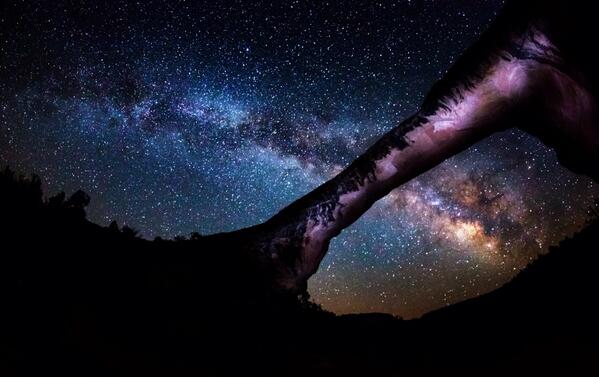
From the Department of Interior’s Twitter feed: Looking for a wow photo? This picture of the Milky Way over Natural Bridges Natl Monument should do the trick. pic.twitter.com/RfuDj7KXSA
Owachomo Bridge? Photographer? I wish Interior would put in all the details with their photos.
3 Comments | Astronomy, National Parks, photography, Travel, Utah | Tagged: Arches National Park, Astronomy, Milky Way, photography, Travel, Utah | Permalink
Posted by Ed Darrell
USA Today does some great graphics from time to time.
This set comes as a preview to a special meteor shower — maybe — this weekend.

USA Today chart of meteor showers left in 2014, with star map of how to find Camelopardalid Shower this weekend.
And just for this weekend:

Night of Shooting Stars, New meteor shower influenced by Jupiter’s gravity — USA Today starmap showing best place to look for meteoroids this weekend, the Camelopardalid Meteor Shower (first ever).
So, early Saturday morning, or early Sunday morning, we could be in for a meteor shower display more intense than we’ve seen in a long time, experts say.
Or maybe not.
NASA’s explanation should help you find them (we found this video via Space.com):
2 Comments | Astronomy, NASA, Science | Tagged: Astronomy, Camelopardalid Meteor Shower, NASA, Science, USA Today | Permalink
Posted by Ed Darrell

Milky Way over Monument Valley Navajo Tribal Park. Photo by Gavin Heffernan and Harun Mehmedinović, from the video (which also features Grand Canyon National Park)
Phil Plait’s column/blog at Slate, Bad Astronomy, put me on to this one. Wow.
You can see it at Vimeo, and read a lot more about the making of the film.
YIKÁÍSDÁHÁ (Navajo for Milky Way or “That Which Awaits the Dawn”)
And that they do. The Milky Way is the star of the show; the galactic bulge, disk, and dark fingers of vast dust lanes as clear as if this were taken from space. Well, sort of; I was impressed by the mix of clouds and sky, to be honest. The contrast was interesting, and it’s rather amazing the Milky Way could stand out so clearly above the cloud line.
One thing I want to point out specifically: At 2:10 in, a meteor flashes and leaves behind a curling wisp of what looks like smoke. This is called a persistent train, the vaporized remains of the meteoroid itself, and can glow for several minutes. The upper level winds from 60–100 km above Earth’s surface are what blow it into those curlicues.
More details, for more films from these guys:
Shot and Produced by: Gavin Heffernan and Harun Mehmedinović
Music: A Seated Night (Ambient) by Moby. Courtesy MobyGratis.com / Unknown Native Chant
Thanks: Northern Arizona University, Grand Canyon National Park, Monument Valley Tribal Park.See other Sunchaser Timelapses on Vimeo here: vimeo.com/album/189653
LIKE Sunchaser Pictures on Facebook! facebook.com/SunchaserPicturesPage
LIKE Bloodhoney on Facebook! facebook.com/blood.honey.by.harun.mehmedinovicFor more from the artists:
Leave a Comment » | Astronomy, National Parks, Nature, Navajo, Outdoor Recreation, photography, Time-lapse photography, Travel | Tagged: Arizona, Astronomy, Bad Astronomy, Milky Way, Monument Valley Navajo Tribal Park, Nature, Outdoor Recreation, Phil Plait, photography, Timelapse, Travel | Permalink
Posted by Ed Darrell
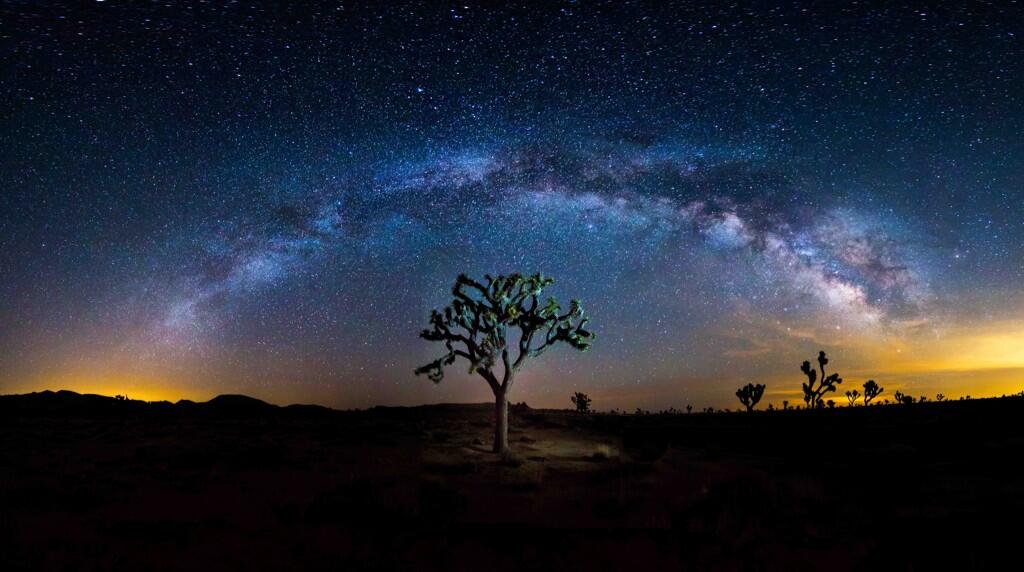
From the U.S Department of Interior Twitter feed: To celebrate being named to the @TIME #Twitter140, here is an amazing photo from @JoshuaTreeNP. pic.twitter.com/F4DS5Xv9vq
Milky Way in a long exposure with a light-painted tree in Joshua Tree National Park, California.
More:
1 Comment | Astronomy, National Parks, Outdoor Recreation, photography | Tagged: Astronomy, Joshua Tree NP, Milky Way, Outdoor Recreation, photography | Permalink
Posted by Ed Darrell

From the Arches National Park Facebook page: photo of Pine Tree Arch and meteoroid by Andy Porter)
A few minutes before 9:00 p.m. Central on Tuesday, I saw a sizable fireball falling north to south, appearing from my vantage on the top of Cedar Hill to be over south Grand Prairie, Texas. Best meteoroid I’ve seen for a while.
Part of the Lyrid Meteor Shower, perhaps? The Lyrids coincide with Dark Sky Week this year. Dark Sky Week’s egalitarian origins should inspire all of us to go outside and look up, no? The celebration was invented by a high school student, Jennifer Barlow, in 2003.
“I want people to be able to see the wonder of the night sky without the effects of light pollution. The universe is our view into our past and our vision into the future . . . I want to help preserve its wonder.” – Jennifer Barlow
The International Dark Sky Association promotes activities worldwide to encourage star-gazing and sky-watching.
Go out tonight, and look up!
More:
Leave a Comment » | Astronomy, National Parks, Science, Travel | Tagged: Arches National Park, Astronomers Without Borders, Astronomy, Dark Sky Week, Global Astronomy Month, Jennifer Barlow, Lyrid Meteor Shower, Outdoor Recreation, Science, Travel | Permalink
Posted by Ed Darrell

Passenger jet and Moon. Photo by Rodger Schmitt, from Lake Powell, Utah.
Handheld Nikon. Nikon stabilizing lens. Good hands, I’d say.
Third to last time I was out near Lake Powell, I was with Rodger (and about a dozen others) organizing hearings of the President’s Commission on Americans Outdoors. We flew into Page, Arizona, on an Otter II coming up from Phoenix flying low, looking for elk, and legally buzzing Rainbow Bridge (impressive from the air, too).
We had a luncheon meeting at Wahweap Marina, as I recall; no time for boating.
Then we were off to the South Rim of the Grand Canyon. There we inspected pine trees 30 feet tall, growing between the ties of the then-abandoned rail lines. (And did a lot of other stuff.)
Today trains carry tourists to the South Rim on those tracks, the trees gone. Progress, really.
Rodger carries on in the knowledge that use of the outdoors, especially these public lands, heals souls, and sometimes gives you great photos.
Rodger said I could borrow the photo. Thanks!
Leave a Comment » | Astronomy, Moon, Outdoor Recreation, Public Lands | Tagged: Astronomy, Lake Powell, Moon, Outdoor Recreation, photography, Public Lands, Rodger Schmitt | Permalink
Posted by Ed Darrell
Upper and Lower Antelope Canyon, near Page Arizona, get more visitors annually than just about any other canyon except the Grand Canyon. They cover only a few miles.
You’re not familiar with Antelope Canyon? You’ve seen the photos, even if you don’t know the name of the place — it’s a slot canyon, carved as with a wandering knife into the sandstone at the top of the cliffs leading to the Colorado River.
Over at EarthSky, I found a view you haven’t seen before.

Antelope Canyon at night by Sergio Garcia Rill. Stunning contrast of rock painted by light, and stars. From EarthSky.com. Visit Sergio’s website and read more about this adventure.
Details from EarthSky.com:
Sergio Garcia Rill captured this beautiful image from within Upper Antelope Canyon in Arizona, which is the most visited slot canyon in the United States. A slot canyon is significantly deeper than it is wide. It’s formed by water rushing through rock. Sergio wrote:
During my recent trip to Arizona, I stopped by Page to get a chance at touring the now famous canyons (Upper and Lower Antelope) and I also had a chance to visit Upper Antelope at night.
I couldn’t really get too many shots with the sky (since the openings were very narrow and limited) but I liked this one in particular since I got a chance to set it up and do the light painting myself a couple of chambers behind from where my guide and another participant were working on another shot.
Thank you, Sergio.
Visit Sergio Garcia Rill’s Facebook page.
Click here for info about traveling to Upper and Lower Antelope Canyon.
Readers here may remember Page was the final destination of my late oldest brother, Jerry. To his credit, he urged me to make a special trip to see Antelope Canyon, because most of the times I visited, it was closed, or impassable. Alas, I have not yet been to the place.
This is one of the gems of the Diné, the Navajo Nation, and another good reason to get familiar with redrock country.
1 Comment | Astronomy, Deserts, Navajo, photography, Travel | Tagged: Antelope Canyon, Astronomy, Deserts, EarthSky.org, Navajo, photography, Travel | Permalink
Posted by Ed Darrell
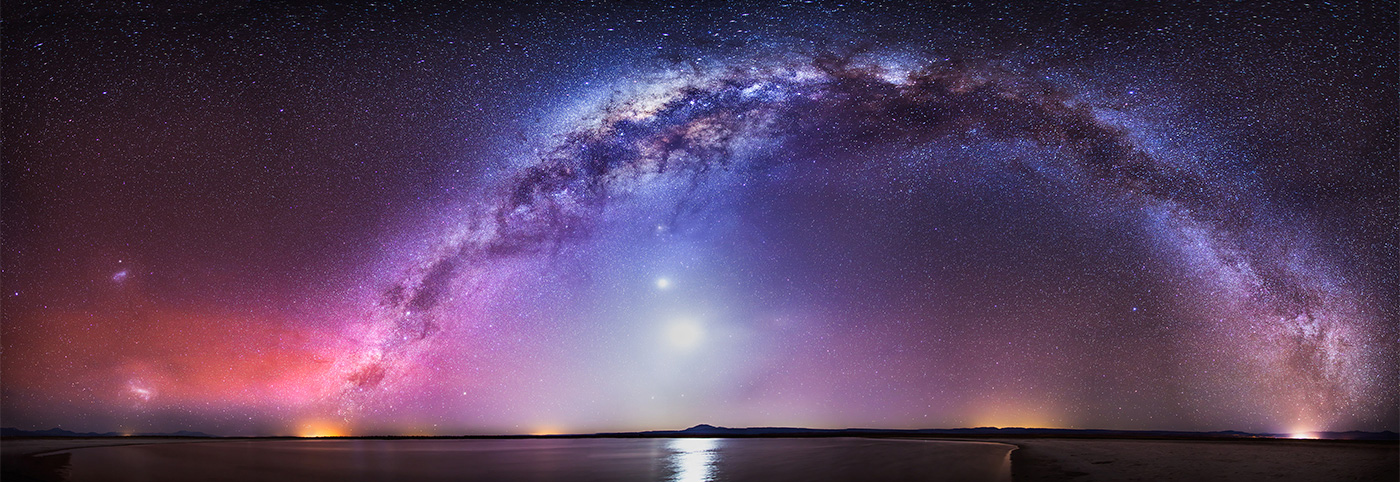
Found on Twitter, via @SciencePorn – One of the most beautiful pictures I’ve ever seen. Star photography by Nicholas Buer pic.twitter.com/RlwvSQNBAy. Much larger view here.
Nicholas Buer works hard to get these shots — a bit of a master, no?
This one was the Astronomy Picture of the Day (APOD) for January 27, 2014 (click that link for a much larger and more glorious view). Much more detail there, revealing that this is much more of the Milky Way than you’d usually see.
From the Northern to the Southern Cross
Image Credit & Copyright: Nicholas Buer Explanation: There is a road that connects the Northern to the Southern Cross but you have to be at the right place and time to see it. The road, as pictured above, is actually the central band of our Milky Way Galaxy; the right place, in this case, is dark Laguna Cejar in Salar de Atacama of Northern Chile; and the right time was in early October, just after sunset. Many sky wonders were captured then, including the bright Moon, inside the Milky Way arch; Venus, just above the Moon; Saturn and Mercury, just below the Moon; the Large and Small Magellanic Clouds satellite galaxies, on the far left; red airglow near the horizon on the image left; and the lights of small towns at several locations across the horizon. One might guess that composing this 30-image panorama would have been a serene experience, but for that one would have required earplugs to ignore the continued brays of wild donkeys.
Leave a Comment » | Astronomy, photography, Travel | Tagged: Astronomy, Astronomy Picture of the Day, Milky Way, Nicholas Buer, photography, Travel | Permalink
Posted by Ed Darrell

14 February 2004 NASA caption: “Happy St. Valentine’s Day from the Mars Global Surveyor (MGS) Mars Orbiter Camera (MOC) team! This collection of images acquired over the past 3 Mars years shows some of the heart-shaped features found on Mars by the MGS MOC.”
No kidding! Mars really ♥s us! Hope you had a happy Valentines Day.
- Original Caption Released with Image:
- 14 February 2004
Happy St. Valentine’s Day from the Mars Global Surveyor (MGS) Mars Orbiter Camera (MOC) team! This collection of images acquired over the past 3 Mars years shows some of the heart-shaped features found on Mars by the MGS MOC.
- The heart in E04-01788 is a low mesa located near 46.7°N, 29.0°W, and is about 636 m (2,086 ft) wide.
- The heart in R10-03259 is a depression located near 22.7°N, 56.6°W, and is about 378 m (1,240 ft) wide.
- The heart in R09-02121 is a small mesa on a crater floor located near 37.2°S, 324.7°W, and is about 120 m (395 ft) wide.
- The heart in R09-00918 is a depression located near 35.8°N, 220.5°W, and is about 525 m (1,722 ft) wide.
- The heart in R04-00395 is a depression in which occurs a low mesa located near 57.5°N, 135.0°W, and is about 1 km (~0.62 mi) wide.
- The heart in E11-00090 is a depression located near 0.2°N, 119.3°W, and is about 485 m (1,591 ft) wide.
- The heart in E12-00275 is a depression located near 32.7°S, 139.3°W, and is about 512 m (1,680 ft) wide.
- The heart in R06-01364 is a depression located near 8.4°S, 345.7°W, and is about 502 m (1,647 ft) wide.
- The heart in M11-00480 is a depression located near 1.9°N, 186.8°W, and is about 153 m (502 ft) wide.
- The heart in R08-00939 is a depression located near 12.1°S, 173.5°W, and is about 384 m (1,260 ft) wide.
Other heart-shaped martian landforms were featured in previous MGS MOC image releases:
- Image Credit:
- NASA/JPL/Malin Space Science Systems
- Image Addition Date:
- 2004-02-14
- ♥
Leave a Comment » | Astronomy, NASA | Tagged: Astronomy, Mars, NASA, valentines day | Permalink
Posted by Ed Darrell
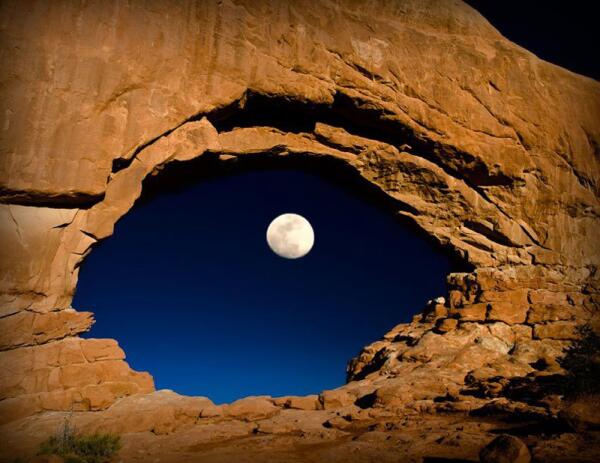
Photo by Lynn Sessions; “THE EYE OF THE #MOON: North Window arch at Arches National Park in #Utah. #NatGeo pic.twitter.com/XwHfdWK5Ft
It’s just a click of the shutter? Ha!
I’m assuming not a lot of post-photo processing on this. Lynn Sessions had to figure out when the Moon would be in the North Window Arch, calculate exposure, and shoot off enough of them to get a decent shot before the Moon moved. I suspect the rocks were “painted” with a flashlight during the exposure.
(Haven’t yet found the technical details of the shot. But I did find this about the photographer:
I’m a frustrated amateur photographer who is trying to visit every corner in Utah as well as hike/photograph every canyon in southern Utah. More at http://www.DreamBreeze.com )
Patience, planning, creativity — then just push the button.
More:
2 Comments | National Parks, Nature, photography, Travel, Utah | Tagged: Arches National Park, Astronomy, Nature, North Window Arch, photography, Utah | Permalink
Posted by Ed Darrell


Ed Darrell on Texas's Colorado River


Come on in, the water's fine. Come often: Cleanliness is next to godliness.


 Millard Fillmore's Bathtub
