Forgotten art, forgotten artists: Dick Sargent, and Cub Scouts in a phone booth

November 3, 2012

Years between 1900 and 1970-something, when computers, television and digital media started to bite into artists’ work, make up a golden age of magazine illustration.

Much of that art is essentially lost now.  It appeared in magazines no longer published, and therefore having no champion for digitizing the art and prose; and it appeared in magazines that libraries, now cramped for space, are tossing away after getting access to digitized text, or through microfiche — or not at all.

Many of the images are compelling, like this one from Dick Sargent (1911-1978):

Cub Scouts in phonebooth, Dick Sargent, via American Gallery

Cub Scouts crammed in a phonebooth, Dick Sargent image preserved by American Gallery

The image is archaic, technically antique, in so many ways.

  • Do any phonebooths remain in America, especially of this outdoor type?  The booths had already begun to fade in the late 1970s, comically chronicled in Superman movies where Clark Kent could not find a phone booth in which to change from his reporter’s disguise into Superman’s body suit and cape.  Rapid spread of cell phones, now digital communications, and the disappearance of T-1 lines to tap into for pay phones, all contribute to make this image seriously dated (could students put a date on it by tracking down clues in the image?).
  • Paper maps?  Not even a hold-alone GPS, but a paper road map (probably a freebie from a “service station).
  • Cub Scouts abandoned the blue beanie at least 20 years ago, probably more like 30.
  • One Scout leader?  Since at least the early 1990s, Scouting has a “two-deep leadership” rule, to prevent child molestation, under the Scouts’ tough Youth Protection rules.  At no time should one leader only be with one Scout or a group of Scouts.  Such a hike today would require a much larger phone booth, just to accommodate additional leaders.
  • The axe was out of place when the painting was made; it’s a tool for older Boy Scouts.  Today, axes trend to rarity even with Boy Scouts.  Wood fires depleted the woods near popular camping sites and Boy Scout camps.  Drought conditions create local fire bans in many Scout camps nationwide in most of the past two decades — a Scout needs to know how to fire up a WhisperLite or Jetboil stove, or even a Coleman propane or white gas stove (have I told you the story of Sheldon Coleman and the Alaskan Native with the 30-year-old Coleman stove?).  None of that requires a hand-axe.
  • No women leaders?  When the painting was made — early 1950s? — the only male in a direct leadership position in a Cub Scout Pack would be the Cubmaster, who is largely the ceremonial ring-leader for the once-a-month pack meeting.  Women would have been Den Mothers, meeting weekly with a Den of boys.  This is artistic license, of course — but a modern painting would look really odd without women in leadership roles, especially on an outing, and wholly apart from the two-deep leadership rule.
  • It’s Cub Scouting, but there’s a clear cross-message with the Boy Scout Motto, Be Prepared.  This group is not prepared for rain at all — nor much prepared for hiking.  See any water bottles?  In the 1950s, Scouts would have carried canteens instead — but even Cub Scouts could be counted on to carry a cool, military-looking canteen.

I’m guessing this was an illustration for a magazine.  For various reasons I think it was not a Boy Scout publication, like Boys’ Life or Scouting.  Sargent’s work appeared in publications like Saturday Evening Post.  It would be fascinating to know the publication, and whether there was an occasion for the painting.  Scouting and this form of realistic painting from the 20th century really go hand in hand.  One of America’s favorite painters, Norman Rockwell, got his first job at 19 as art director for Boy Scouts of America, including Boys’ Life.  He went on to a long and very productive career, including hundreds of magazine covers for many publications, including Saturday Evening Post.  Rockwell was followed by Joseph Csatari.

American Gallery specializes in rescuing collections of work from American painters and other visual artists.  Teachers and students looking for period art from the 20th century might do well to check out that site, and do a few searches.  History, education and the internet could use a few more sites like that.

More:


Why a campfire? (reprise)

October 26, 2012

It was more than five years ago I originally posted this?  Heck, I won’t even add links or a “More” section at the bottom.  I deserves to be repeated though, I think, especially in an election year when we wish we could gather more people around a campfire.  Here goes:

Training adult Scout leaders always produces a few puzzled looks, and occasional passionate, fearful rebukes, when I note that a campfire gives a boy or a girl an opportunity to play with fire.

No, I don’t mean, exactly, that we should let kids play with fire.  There are rules — what’s burning must be in the fire pit, is the chief rule.

There is some primal need to watch a fire, to study it, to experiment with it, and finally just to watch it go. If you camped as a kid, you probably know what I mean.

Camp fires are universal.  This one was outside Bangalore.

Camp fires are universal. This one was outside Bangalore.

Every kid needs to do that.  It’s a part of growing up.  It’s a necessary memory for healthy and sane adults.

Start a fire, and a kid will get a stick and poke the burning logs and, especially, the red-, yellow- and white-hot coals after the fire burns a while.  They’ll start the stick on fire, put it out, and light it again.  They’ll pull the stick out of the fire and watch the flame consume the stick.  Kids will experiment with different things on the fire, to see whether, how fast, and how they burn.

Just keep it in the fire pit.

A Scoutmaster can tell which kids have been camping. A Scoutmaster knows which kids have been able to sit around a campfire and play with fire in that way.  Kids who know fire are more mature, generally, more relaxed about the excitement of the stuff, and much more careful with it.  Scouts who have dabbled in the campfire respect fire for what it is and for what it can do, good and bad.

What you’ll remember 20 years later, or 30 years, or (God bless me!) 40 years, and I hope 50 and 60 years, is the watching of the fire as the flames die down to a red and pulsing bed of coals.

You’ll remember some of the stories — Freddy Jonas’s often-told story of racing down the Champs Elysee in horse-drawn carriages, bribing the driver of the other carriage to go slower to win the race; the story of Rulon Skinner, the best non-swimming canoe instructor on Earth, and the big canoe race in which his opponent finally tipped Skinner’s canoe, and then yelled “snake!” to appeal to Skinner’s other great fear; the night the bear invaded the camp at Ben de la Tour, a bear later found to have antlers and four hooves.  You’ll remember the s’mores, and you’ll forget how messy they are.  You’ll remember the time you waited for the cobbler to cook after someone forgot to start the charcoal, or the the time the story got so good you forgot to take the cobbler off the fire, and how the Dutch oven had to be thrown away because it never would come clean.

You may remember that little fox at Camp Carter, sneaking just beyond the light of the fire and carefully circling every chair, looking for something good to eat, to steal.  Or that stupid porcupine that, now that you think of it must have been rabid, heading straight for the fire there in the only stand of Ponderosa pine in Utah County, up Payson Canyon.  And that will trigger the story of the night the fire wouldn’t start in the Catskills, and what seemed like hundreds of giant porcupines convened in bacchanalian festivities while campers dared not sleep, in their tents.

Someone will mention retiring U.S. flags, and you’ll remember the retirement ceremony for the flag from the widow of the veteran, how she insisted that you promise the flag would be burned completely and honorably, and warned “he’ll be watching!”  You’ll remember the mass flag retirement after the lifting of the burn ban at Wisdom, and how you suddenly realized lots of flags put out lots of toxic fumes — but somebody ad libbed a part to the ceremony to add time to let the fumes clear, and no Scout noticed (you hope!).

We haven’t even gotten to the singing.

I was put in mind of the power of the campfire with a remembrance from Real Live Preacher writing at High Calling:

I remember how worried we were the first time we tried to set one of those brush piles on fire. We nervously stood before a ten-foot high, fifteen-foot wide mound with a can of lighter fluid and a couple of matches. I squirted a modest amount around the bottom of the pile and stood back while Michael threw the match. That’s when we discovered that it’s surprisingly difficult to set things on fire. Now I marvel at stories of people casually throwing cigarettes out of their cars and setting whole forests ablaze. Michael and I had a hard time starting fires even when we used diesel fuel and a blowtorch.

It takes about five hours to burn a giant pile of brush and cedar, so Michael and I would start a fire, then sit on the tailgate of the brown pickup truck and talk while we kept an eye on it. Apart from the searing heat and looking like chimney sweeps, it was fun. I’m always looking for guilt-free reasons to sit around and talk with friends. I don’t suppose I’ll ever have as good an excuse as I did back then.

A guilt-free reason to sit around and talk with friends?  A campfire is an automatic reason — guilt only obtains if there’s a ban on burning where you’re making the fire.

Carl Buell painted another one that took my breath away the first time I saw it.  Go see it. (I’m asking permission on this one; it may take a little while. Posted below with permission.)

That’s not a photograph, you can tell because it so well preserves what you remember — better than any photograph ever could —  it preserves what you remember from that campout up in the San Franciscos the night the sky was so blue so late and you could see the whole moon from the earthglow — or was it in New Mexico?  Probably not Colorado because there aren’t any mountains — oh, but if he’s looking east, it could have been south of Pueblo . . . no, maybe near Albion in the Sawtooths . . . Buell works in the east; it’s probably up in Maine . . . but he lived and painted in Marin County.

Didn’t he perfectly capture that night?

Campfire, by Carl Buell.  Copyright Carl Buell, all rights reserved; used with permission


Does anyone have a photo of the first woman Scoutmaster, Catherine Pollard?

September 27, 2012

In the order of an Author’s Query:  Do you, or does anyone you know, have a photograph of the first woman to be a Scoutmaster in the U.S., Catherine Pollard, of Milford, Connecticut?

Best if it’s already on line — otherwise I’m looking for a photo that can be posted, for the sake of history.

Any Scouts from Milford have a photo?

More:


100 years of Eagle Scouts

August 1, 2012

Today marks the 100th anniversary of the Eagle Scout rank, awarded first to Scout Arthur Eldred.  2.1 million Eagles so far.

Do you have an Eagle Scout in your family?  Tell us about it in comments.

Also:


Fire hoop dance at the Kwahadi Indian Dancers in Amarillo

July 22, 2012

Fire Hoop Dance, Kwahadi Indian Dancers, Amarillo, Texas, 7-21-2012

Fire hoop dance at the Kwahadi Indian Dancers event center in Amarillo, Texas, July 21, 2012. The dance troupe is off on a national tour over the next three weeks or so.

Venture Crew 9 in Amarillo, Texas, preserves traditional American Indian dances, and performs them literally around the world.  Troop 355 from Duncanville, Texas, stopped off to visit and view the performance — just in time, because the troupe starts a national tour tomorrow.

The performances range from very good to spectacular.  You ought to stop in Amarillo to see.

There’s a better sequence of photos at the Kwahadi dancers’ site.

Dancers belong to a Scouting organization, either Boy Scouts or Girl Scouts — and they continue about a 50 year tradition at their museum and performance center, just off of I-40 in Amarillo.

Probably 200 Boy Scouts in the audience tonight.


Scouting: In Baden-Powell’s footsteps

July 20, 2012


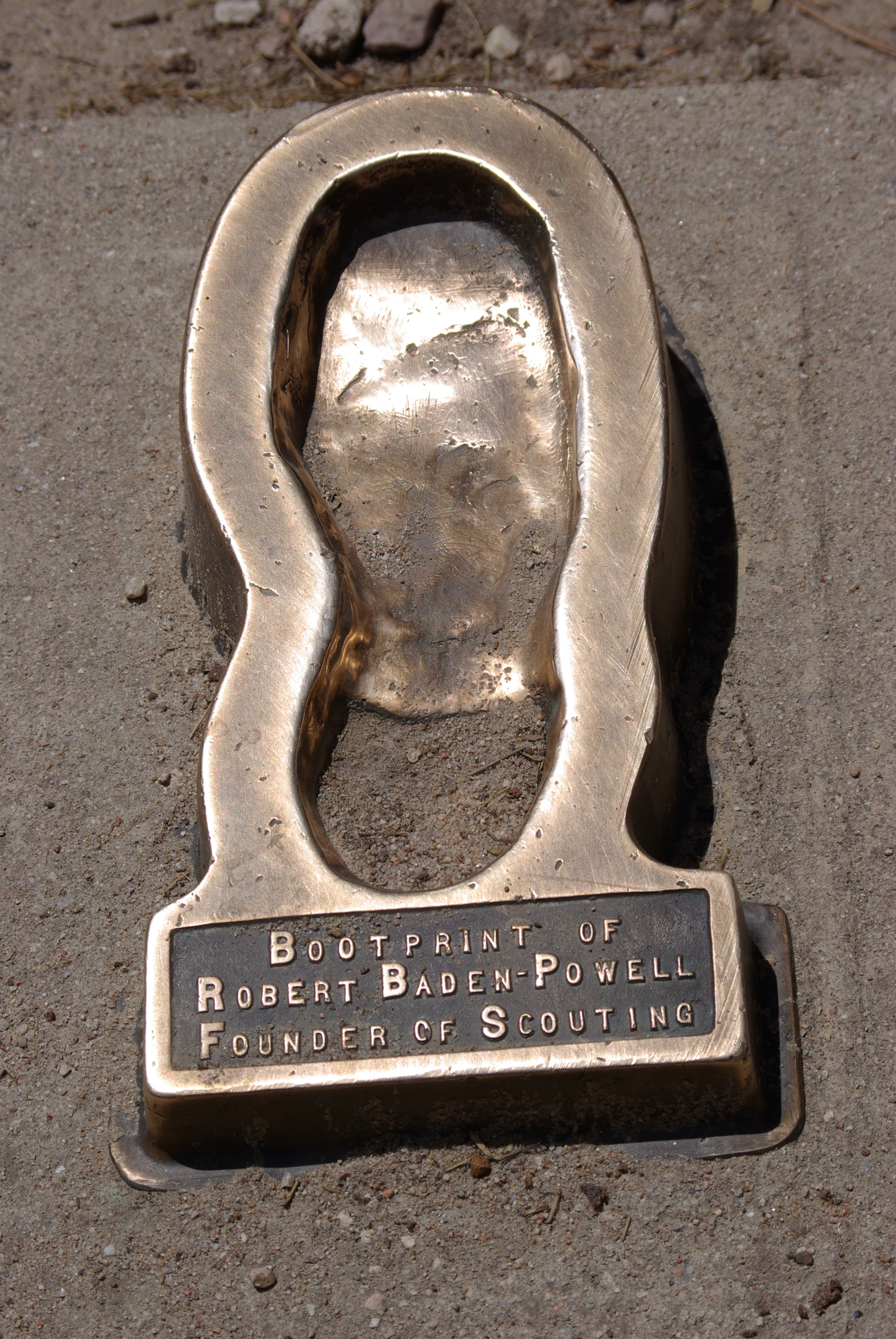
Cast of Baden-Powell's footprint, at Camp Chris Dobbins, Peaceful Valley Scout Ranch, Colorado

Cast of Baden-Powell’s footprint with the brass worn bright from Scouts seeing how they measure up, at Camp Chris Dobbins, Peaceful Valley Scout Ranch, Colorado

Another in a series of where and how people interact with sculpture.

At Peaceful Valley Scout Ranch in Colorado, at Camp Chris Dobbins, there is a cast of a footprint from Lord Robert Baden-Powell, the founder of the International Scouting Movement.

Of course, every Scout must check it out to see whether his or her foot measures up, you can tell from the bright brass color where the piece is touched by hundreds of boots.


1950 Boy Scout National Jamboree, on film

May 7, 2012

Turn up the sound, the recorded level is not high:  Film showing a Scout’s trip to the 1950 National Scout Jamboree in Valley Forge, Pennsylvania.

Scouts traveling to the new Summit Bechtel Reserve site in West Virginia in 2013 will have a much, much different experience.  How many differences can a student find, just watching the film?

http://www.scoutinghotfinds.com (turn up the volume all the way!) This great video was shot by the Boy Scouts and was released as an old strip on 1″ magnetic film after the 1950 National Scout Jamboree. The original film was digitized by Scouter Rick Maples and he has given me permission to post it on YouTube for all to see. There are lots of great pieces of history here and any Scout who has had the Jamboree experience will appreciate this tale of American history. Watching this it makes you wonder how much have changed as the 2013 National Scout Jamboree at the Summit is coming up soon.

189

(This is labeled “Part 1.”  Is there a Part 2?)

It’s almost 20 minutes of film, but fascinating to watch just to see how much is different.  Trains?  No sunscreen?

President Harry Truman appears about 13 minutes into the film.  His speech would probably be considered too political by today’s standards, and it’s interesting to see the reaction of the Scouts and leaders Truman (who was  awarded the Silver Buffalo, Scouting’s highest honor for a leader).

Interesting to see the re-enactment of the retreat of Washington’s forces to Valley Forge.  Interesting way to learn history.

47,000 Scouts participated in the 1950 National Jamboree.  2013 will be a bit bigger, and in a more wild location.


Oldest Scout in Las Vegas welcomes newest Scout

April 18, 2012

Yeah, this was last January, but it’s still a little Scout bon mot.  The oldest alumnus of Scouting in the Las Vegas Area Council welcomes the newest recruit in the Council — the montage of their repeating the oath is worth the viewing.  Nice shots of Vegas, too.

The ceremony occurred when Adventure Base 100 visited the area.

Thank you, Federal District Judge Lloyd George.

Good things boys learn in Scouting in Las Vegas don’t stay in Vegas — they spread across the globe, instead.


Oldest federal judge remembered: Followed the Boy Scout Oath

February 11, 2012

He served on the federal bench through his 104th birthday, slowing down only when death took him last month.

Federal Judge Wesley E. Brown, at 103, in Wichita, Kansas - photo by Larry Smith for the New York Times

Federal Judge Wesley E. Brown, then 103, at his desk in the courthouse in Wichita, Kansas, in 2010 - photo by Larry Smith for the New York Times. Note the computer pictured behind Judge Brown -- not a technophobe.

U.S. Federal District Judge Wesley Brown died last month.  At a memorial service, those who knew him paid homage to his lifelong devotion to the Boy Scout Oath.  At the risk of angering the copyright poobahs at Associated Press, I quote from the AP story from Wichita, Kansas, carried at the site of Fox 6 WBRC (somewhere in Alabama):

“He was truly a first among equals – an icon of all that is good and faithful and true, both as a person and as a judge,” said U.S. District Judge Katherine Vratil, now the chief judge for the federal district in Kansas.

Mike Lahey, Brown’s law clerk for the past 24 years, said the judge’s life was governed by two oaths: one that he took to be a district judge in 1962 and the other when he became a Boy Scout in 1920.

Lahey said the judge often would recite the oath to him from memory: “On my honor I will do my best to do my duty to God and my country and to obey the scout law; to help other people at all times; to keep myself physically strong, mentally awake and morally straight.”

“To Judge Brown those words were never a simple rite of passage,” Lahey said. “To him, they were the aspiration of what a man should be and he adopted them as a guide for the rest of his life.”

He was born three years before Scouting was incorporated in the U. S. and lived past Scouting’s 100th anniversary.  Any other Scouters out there with greater longevity in Scouting?

An article in The Wichita Eagle laid out the historical perspective of Brown’s astonishing service:

Brown served during an era of changing civil rights, equality for men and women in the workplace and legal battles over Internet privacy.

During the 1970s, Brown told a Wichita hospital it couldn’t fire a woman because she was single and pregnant and ruled that North High School had to let a girl on its golf team. During the 1980s, Brown ordered millions of dollars in payments to railroad workers denied promotions because they were Americans of African descent.

More recently, Brown presided over cases including a $3 million athletic ticket scandal at the University of Kansas, where he studied physical education under James Naismith.

Calvin Coolidge was president when Brown entered the University of Kansas as an undergraduate in 1925.

Brown studied by night and worked to support himself at the Ford Motor Co. factory in Kansas City. When the Great Depression hit, he found himself having to write pink slips notifying fellow workers that they were out of jobs. One of those pink slips was his own. He finished law school working as a secretary for a local attorney’s office for $15 a week.

At his first job for a Hutchinson law firm, Brown made $25 a month, before being elected as Reno County attorney from 1935 to 1939.

Brown never let age get in his way. When he joined the Navy in World War II he was 37 — the oldest in his unit.

He was a past president of the Kansas Bar Association. He became chief judge for the Kansas federal district in 1971.

Brown assumed senior status in 1979, which is seen in the federal court system as semi-retirement at full salary. Brown, however, continued to work full time for the next three decades.

More: 


Boys’ Life on YouTube, February issue preview

January 21, 2012

Every time I pick up an issue of Boys’ Life I think how much better students could perform if they just looked that this magazine once a month; you don’t have to be a Scout to subscribe, but why not live the adventures, too?

Will 30-second montages sell more magazines?  What more could/should Boys’ Life do on the web?

Here’s an example of the sorts of skills I wish my students had, again from the Boys’ Life YouTube offerings.  In “Cache Me If You Can,” these are young Scouts, I’m guessing ages 11 to about 13 from a Troop 6 somewhere in Colorado, out navigating a path through the woods using GPS and hand-held ham radios.  I fear most of my 16-18-year-old students would be challenged to do the stuff these younger kids are doing, if they could do it at all.

Of course, while those skills would make them better students more able to understand and use maps and charts, very little of those skills are listed in the Texas Essential Knowledge and Skills.  I’m given neither time nor resources to teach them.

More, resources: 

  • A feature at the Boys’ Life site I really like is the “Wayback Machine,” which allows viewing of many issues of the magazine dating back to 1911 — actualy from March 1911 through December 2009.  Alas, the features uses Google Books, so viewing at the site is about all you can do — no copying of the great covers by Boy Scouts of America art director Norman Rockwell, no copying of articles with teachable skills for use as illustrations in lessons.   This would be a good research site for high school history projects — Scouts in time of war, Scouting and education, map use, youth in exploration, etc.

Lightning? Don’t stand under a tree . . .

October 2, 2011

Talk in class turned to Ben Franklin’s kite experiment.  “Don’t try this at home,” I said.

Do students ever listen?

Here’s an amateur video showing why standing under a tree in a lightning storm could be a bad idea.  Can students extrapolate this to flying a kite in a storm?

Surely there is better video of such events somewhere . . . can you tell us where?

Found it at Wimp.com, with a tip of the old scrub brush to Thom Holland, Scouter with the 626 units at Penasquitos Lutheran Church, San Diego, California.


Why so few streets named after Vietnam veterans?

June 11, 2011

Junior Cruz of Salt Lake City was 15 when his Eagle Scout Project honored a fallen soldier from our war in Iraq, Adam Galvez.  You can read a stirring story from The Deseret News at Adam Galvez.com.

Junior Cruz, with Cpl. Adam Galvez's parents Tony and Amy Galvez, at Adam Galvez Street in Salt Lake City

Boy Scout Junior Cruz, with Cpl. Adam Galvez's parents Tony and Amy Galvez, at Adam Galvez Street in Salt Lake City

Marines honor fallen comrade Cpl. Adam Galvez, Salt Lake City, 2007

Marines honor their fallen comrade Cpl. Adam Galvez, at the ceremony naming a street after Galvez.7

Once upon a time I might have wondered about the utility of such a project, not because naming a street after a veterans isn’t a great idea, but because the actions required for naming streets might not measure up to the usual expectations for great service in an Eagle project.  This project and the stories about it quickly dispel such worries — for example, notice that the city required Cruz to raise the $2,000 required to change the street signs, such fundraising itself a major accomplishment.  Our son James’s project at the DFW National Cemetery required similar fundraising, and got at least as much in in-kind contributions — but it was major work.

Marines at the naming of Adam Galvez Street, 2007

Marines salute at the ceremony for the naming of Adam Galvez Street, 2007

Reading the news story, I thought back to a question that has plagued me for years:  Why didn’t we have the good sense to welcome back Vietnam vets with parades, and other welcome home activities?  That was one great lesson of Vietnam I think we, as a nation, learned well.  Today national news programs, like the PBS Newshour, honor each fallen soldier in our nation’s wars.  Here in Dallas, and at other cities I suspect, there is a formal volunteer program to make sure soldiers returning from Iraq and Afghanistan deployments get a flag-waving cheer when they get off the airplane.  Churches, schools, Girl Scouts and Boy Scouts volunteer to go wave the flags and cheer the soldiers.  The volunteers may get more out of it than the soldiers, but the message is clear all the way around:  These soldier men and women served their nation, and they deserve thanks and a cheer.

Ceremony naming Adam Galvez Street, February 2007

Ceremony naming Adam Galvez Street, February 2007

Is it too late to do that for Vietnam veterans?  A chief complaint over the years, especially from the war-hungry right wing, is that the Vietnam peace movement dishonored those veterans, chiefly by not honoring them more when they came home.

My brother, Wes, served four tours in Southeast Asia in that war, returning each time to no great celebration other than his family’s great gratitude at his return.  He’s too great a patriot to complain — as are most of the other Vietnam vets.  Our periodic patriotic celebrations now do better:  Vietnam vets get honored at July 4 and Veterans’ Day celebrations, and the fallen get special honors on Memorial Day, in most towns in America.

Junior Cruz hit on a great idea, though:  Name a street in honor of the fallen.

Why not do that for more Vietnam vets?  My hometown of Pleasant Grove, Utah, had a population of fewer than 10,000 people during the Vietnam conflict, but well I remember in my high school years when the list of fallen passed 11, including a recently-graduated studentbody president and basketball star and the brother of a woman in my French class.   Neither of them has a memorial other than their gravestone, that I’m aware.

Adam Galvez Street, Salt Lake City, Utah

Adam Galvez Street, Salt Lake City, Utah

Street names can tell us a lot about a town or city.  In the great booming times of 1950s through 1990s, a lot of streets in America were named after developers’ kids, wives and ex-wives.  More recently developers have taken to cutesy names on a theme designed to sell homes:  “Whispering Waters Way,” “Mountain View,” etc.   Those cities where history gets some note in street names do well, I think.  Ogden, Utah, named a bunch of streets after presidents, in order of their service, from Washington through the second Harrison (and as a consequence, a lot of people who grew up in Ogden can name the presidents in order from Washington through almost to Teddy Roosevelt).  New York has not suffered from renaming a stretch of road The Avenue of the Americas, Washington, D.C. has done well with both Independence Avenue and Constitution Avenue.

Why not rename some streets in American after Vietnam veterans?  While we’re at it, how about Korean War veterans?  We can’t recapture the time and do what we should have done about 58 years ago for Korea or about 45 years ago for Vietnam.  We can do noble things from now, forward.  Why not create memorials that remind us of the great service these people did for their nation, and name and rename streets in their honor?

Resources:


Scouts Shooting for the Moon: The story of twelve Moon walkers, and Scouting

April 30, 2011

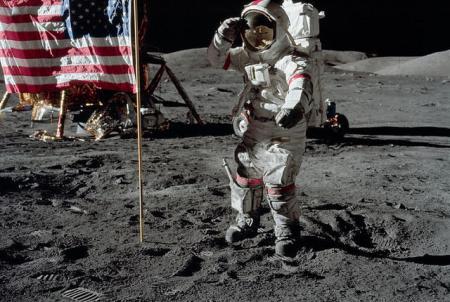
1cernan_jump_salutes_flag_-_gpn-2000-001273_0

Astronaut and 2nd Class Boy Scout Eugene Cernan saluted the U.S. flag on the Moon, on the last Apollo mission, Apollo 17. Photography by Astronaut and Tenderfoot Scout Harrison Schmitt. NASA image.

A short piece I presented this morning to the Tom Harbin Scout Museum Symposium on Scout History, a great morning organized by Bob Reitz, the curator of the Tom Harbin Scout Museum at Camp Wisdom, in Dallas, Texas. Of course the material is copyrighted, but by all means you have permission to use the material at Courts of Honor or in recounting the better history of Boy Scouting.

Scouts Shooting for the Moon:  The story of twelve Moon walkers, and Scouting

This is a recreation with modern numbers of a presentation first used a decade ago. Searching for material for a speech to honor Eagles at our District Dinner, several people suggested in a short period of time, ‘Why not talk about the astronauts who landed on the Moon. I hear they were all Eagle Scouts.’  Was that accurate?  It would have been a good story if so. Research revealed something quite different. The true story can carry just as much inspiration, however. Scouting is shown to be a program that can lead to a lifetime of adventure and accomplishment. Also, Eagles may take some inspiration in knowing they have accomplished something most of the men who walked on the Moon did not.

Speakers constantly need good material for Eagle Scout Courts of Honor and other events honoring Scouts and Scouters. For one event honoring a group of new Eagle Scouts, several people urged that I research the facts behind the story they had heard, that most, or all of the men who walked on the Moon were Eagle Scouts. New Eagles would find comfort in knowing they had soared into the midst of such company, they reasoned.

So it came to pass that, before the advent of Wikipedia and Google, I spent hours on the telephone until a press person at NASA pointed out to me a collection of information on astronauts that NASA had thoughtfully put on-line. At some high cost I printed out the few pages that dealt with the Scouting experience of astronauts, and worked to correlate it with information about which of them had gone to the moon, and which had not.

Anyone can find that book online with ease, today. The NASA Astronaut Fact Book provides information on almost every detail about NASA’s crew of astronauts, past and present. It includes one-and-a-half pages on the Scouting background of people working as astronauts and payload specialists for NASA, and others NASA has launched into manned missions. Cross-indexing that information with lists of Apollo Mission astronauts, I created four short tables showing the Apollo astronauts who went to the Moon, their missions, and the Scout rank they achieved, if any.

Lunar Astronauts and Scouting Experience

Twelve Moon Walkers

Name Mission Dates on the Moon Scout Rank
1 Neil Armstrong Apollo 11 July 21, 1969 Eagle Scout
2 Buzz Aldrin Apollo 11 July 21, 1969 Tenderfoot Scout
3 Pete Conrad Apollo 12 November 19-20, 1969 Cub Scout
4 Alan Bean Apollo 12 November 19-20, 1969 1st Class
5 Alan Shepard Apollo 14 February 5-6, 1971 1st Class
6 Edgar Mitchell Apollo 14 February 5-6, 1971 Life Scout
7 David Scott Apollo 15 July 31-August 2, 1971 Life Scout
8 James Irwin Apollo 15 July 31-August 2, 1971 None
9 John Young Apollo 16 April 21-23, 1972 2nd Class
10 Charles Duke Apollo 16 April 21-23, 1972 Eagle Scout
11 Eugene Cernan Apollo 17 December 11-14, 1972 2nd Class
12 Harrison Schmitt Apollo 17 December 11-14, 1972 Tenderfoot Scout

Apollo 13

Name Mission Dates on the Moon Scout Rank
1 Jim Lovell Apollo 13 Lunar Swingby Eagle Scout
2 Jack Swigert Apollo 13 Lunar Swingby 2nd Class
3 Fred Haise Apollo 13 Lunar Swingby Star

Lunar Missions That Did Not Land

Name Mission Dates on the Moon Scout Rank
1 Frank Borman Apollo 8 Orbited only None
2 Jim Lovell Apollo 8 (&13) Orbited only Eagle Scout
3 William Anders Apollo 8 Orbited only Life Scout
4 Tom Stafford Apollo 10 Orbited only Star Scout
5 John Young Apollo 10 (& 16) Orbited only 2nd Class
6 Eugene Cernan Apollo 10 (& 17) Orbited only 2nd Class

Others Who Did Not Land

Name Mission Dates on the Moon Scout Rank
1 Michael Collins Apollo 11 Capsule pilot None
2 Dick Gordon Apollo 12 Capsule pilot Star Scout
3 Stewart Roosa Apollo 14 Capsule pilot None
4 Al Worden Apollo 15 Capsule pilot 1st Class
5 Ken Mattingly Apollo 16 Capsule pilot Life Scout
6 Ronald Evans Apollo 17 Capsule pilot Life Scout

In all, 24 men flew to the Moon. Twelve set foot on the lunar surface. Of the twelve, eleven were Scouts, two were Eagles. Of the 24, 20 were Scouts, three were Eagles.

At the time I originally researched, about 70% of all astronauts were alumni of Scouting, men and women. Officially, BSA lists 181 NASA astronauts as being alumni, 57.4%

NASA lists the colleges and universities astronauts attended. NASA lists military service, hometowns, and states of birth. But with the possible exception of a generic category of “public schools,” no category of astronauts is larger than the category of Scouting experience. If we were advising a young person on how to get to become an astronaut, we would be remiss if we did not advise him or her to join Scouting.

What can we conclude?

Three things became apparent to me in tracking these figures down. One, I learned once again that the true stories most often carry great value, more value than the stories people make up, or assume.

Two, I learned that Scouting by itself carries great value, without a Scout’s having earned Eagle. We know that not all the Moon walkers earned the Eagle rank. But we also notice that no flight ever went to the Moon without at least two Scouts aboard. Three of the 24 lunar voyagers are Eagles, 12.5%. Two of the dozen who actually set foot on the Moon are Eagles, 16.7%. Eleven of the twelve Moon walkers were Scouts, 91.7%. 21 of 24 lunar voyagers were Scouts, 87.5%.

So, while it was not necessary to be an Eagle, it certainly seemed to help. But simply having Scouting experience seemed to be the biggest help. There may be some magic in a boy’s having taken that oath that carries through his entire life, and spurs him to do daring and great things. That is important. A trend begins to emerge. Scouting by itself, without earning the highest rank, provides great value. When a boy signs up, he signs on for the adventure of a lifetime, and often that leads to a lifetime of adventure. That venturesome spirit carries on well past his Scouting years.

The story of Jim Lovell might carry some great weight with Scouts. Lovell is the only person to have gone to the Moon twice, but never set foot on it. He was the commander of Apollo 13, whose near-disaster was chronicled in the movie of the same name. Among other lessons that might be pulled out of the story:  When your Moon-bound spaceship explodes and loses power on the way to the Moon, it is often good to have an Eagle Scout handy to help get through the experience and return safely.

Is there inspiration here?

When I first presented these figures at a Scout meeting, a parent asked me whether these numbers would discourage boys from working for any rank advancement, since just being a Scout seems to carry such weight. This should not discourage Eagles, nor discourage any Scout from working to get the Eagle rank. We should look at it this way:  Every Scout who earns an Eagle has done what ten of the twelve who walked on the Moon did not do, perhaps could not do. Nine more Moon walkers started on that path to Eagle, but did not finish, or could not finish.

Not every Eagle can go to the Moon, but every Eagle has already won an award that most of those who did go to the Moon wish they had.

Especially in the circles of corporate and government leadership, character, what it is and how to get it, concerns people. What sort of character does it take to go to the Moon? Every Scout has a glimpse of what is required, and every Eagle can say, “I know what it takes to get such character.”

Bibliography

Human Spaceflight, “The Apollo Program,” NASA, July 2, 2009; accessed April 28, 2011; http://spaceflight.nasa.gov/history/apollo/

Astronaut Fact Book, NASA,  NP-2005-01-001JSC, January 2005; accessed April 27, 2011; spaceflight.nasa.gov/spacenews/factsheets/pdfs/astro.pdf

BSA, “Facts About Scouting,” 2009; accessed April 28, 2011; http://www.scouting.org/about/factsheets/scoutingfacts.aspx

“Astronauts With Scouting Experience,” Eagle Scout Information, U.S. Scouting Service Project, April 6, 2011; accessed April 29, 2011; http://www.usscouts.org/eagle/eagleastronauts.asp

About the author:

Ed Darrell teaches U.S. History at Moises E. Molina High School in Dallas. He has taught economics, government, world history and street law in high schools; he also taught at the University of Utah, University of Arizona, and DeVry University. He is a former speech writer for politicians. His degree in Mass Communication came from the University of Utah, and his law degree from George Washington University. This was presented to the Jack Harbin Museum Symposium of Scout History, April 30, 2011.

World Scout badge carried to the Moon by Astronaut Neil Armstrong.

World Scout badge carried to the Moon by Astronaut Neil Armstrong.


Save


BSA awards Bill Gates the Silver Buffalo

September 15, 2010

News came out during the Jamboree, but yesterday in Seattle the Boy Scouts of America made it tangibly official.

Microsoft founder and philanthropist Bill Gates, Jr. received the Silver Buffalo Award, the highest honor BSA gives to any Scouter.

Gates was a Life Scout; his father, William Gates, Sr.,  is an Eagle Scout.  The awards ceremony was scheduled to include members of Gates’s Cub Scout Pack 144 and Boy Scout Troop 186.

Microsoft founder Bill Gates receiving the Silver Buffalo award from Boy Scouts of America. BBC image

Microsoft founder Bill Gates receiving the Silver Buffalo award from Boy Scouts of America. BBC image

More:


High rates of drowning: Why is there a racial disparity in drowning deaths?

August 16, 2010

Congress granted a national charter to the American Red Cross to perform emergency services, and to teach people to swim, to prevent drowning, as part of the disaster-readiness services of the organization originally founded in 1881.  Many of us got our first swim lessons under the direction of a Water Safety Instructor trained and certified by the Red Cross; some of us went on to get WSI certification to teach swimming and lifesaving.

But for some reasons, these drowning prevention measures are not working to save the lives of African Americans as well as for everybody else.

NPR’s Talk of the Nation carried a story about the problem in today’s edition (available on-line here, a 30-minute story):

Swimming Disparity
The drowning deaths of six black teens in Louisiana renewed questions about the long-standing disparity between those Americans who can swim and those who can’t. Neither the teens who drowned nor their families who watched from shore could swim.  According to the CDC the rate of fatal drowning is highest among African-American children ages 5-14 (three times that of white children in the same age range) due to a combination of social, economic and cultural issues. Neal Conan talks about what causes the dangerous disparity in swimming, and how to recognize and assist someone who’s drowning.

Drowning rates run even higher for Native Americans.

Race disparities in drownings in the U.S.; AP chart via NPR

Race disparities in drownings in the U.S.; AP chart via NPR

More than 30 people have died in drowning accidents already this year in Texas alone — victims of all races — after a terrible 2009 record.  About 3,500 people die in the U.S. from drowning every year.  Most of these accidental deaths could have been prevented with the use of personal flotation devices, and may have been preventable had the people involved had basic drownproofing, or swimming, or lifesaving instruction.

(Remember this mantra:  Reach; throw; row; go.  Only after attempts to reach for the victim, perhaps with a pole, or throw a flotation device, or row a boat, should anyone including a well-trained lifesaver, go into the water to retrieve someone drowning.)

Where can people get instruction on how to prevent drownings?  Red Cross courses are offered at countless community pools — those pools are, alas, generally the first services cut back when cities and counties trim budgets, as they have been trimming since the start of our nation’s financial woes in 2008.    Other good sources of anti-drowning instruction are the YMCA, Girl Scouts, and Boy Scouts.

I received lifesaving instruction at community pools, and in Red Cross sanctioned programs at Brigham Young University and the University of Utah.  I earned the Swimming, Lifesaving, Rowing and Canoeing merit badges in Scouting, and I taught rowing and canoeing at a Scout camp and another camp, and I taught Red Cross Lifesaving for several years as a WSI.

Even in Dick Schwendiman’s astounding Advanced First Aid course at the University of Utah, I didn’t learn the following stuff about drowning, however (another Red Cross certified course).  Regardless whether you can get a lifesaving course, or if you’ve had one, you need to go read Mario Vittone’s stuff on drowning, and how to recognize when someone in the water needs help:

Button, Drowning doesn't look like drowning

The new captain jumped from the cockpit, fully dressed, and sprinted through the water. A former lifeguard, he kept his eyes on his victim as he headed straight for the owners who were swimming between their anchored sportfisher and the beach. “I think he thinks you’re drowning,” the husband said to his wife. They had been splashing each other and she had screamed but now they were just standing, neck-deep on the sand bar. “We’re fine, what is he doing?” she asked, a little annoyed. “We’re fine!” the husband yelled, waving him off, but his captain kept swimming hard. ”Move!” he barked as he sprinted between the stunned owners. Directly behind them, not ten feet away, their nine-year-old daughter was drowning. Safely above the surface in the arms of the captain, she burst into tears, “Daddy!”

How did this captain know – from fifty feet away – what the father couldn’t recognize from just ten? Drowning is not the violent, splashing, call for help that most people expect. The captain was trained to recognize drowning by experts and years of experience. The father, on the other hand, had learned what drowning looks like by watching television. If you spend time on or near the water (hint: that’s all of us) then you should make sure that you and your crew knows what to look for whenever people enter the water. Until she cried a tearful, “Daddy,” she hadn’t made a sound.

You’ll find that life-saving article at Mario Vittone’s blog on boater safety. If you are a teen ager, a parent, a grandparent, or you ever swim, you need to read that article.  (Thanks to P. Z. Myers at Pharyngula for pointing the way to that post.)

Will you help save a life, please?

Resources: