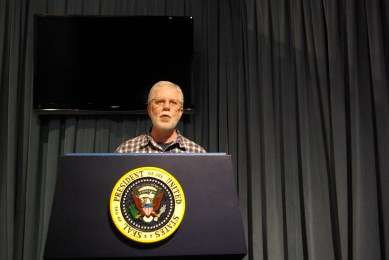
The Wendy Davis story — stay tuned

October 3, 2013

Two years ago this ad helped push Texas State Sen. Wendy Davis to victory in a district stacked against her.  I think it’s one of the more powerful political advertisements done in the last decade at least, considering the target audience.

Today Sen. Davis will announce she’s running for Governor of Texas.  Regardless the outcome of the race, it’s still a remarkable life story.

Polls show Davis only 8 points behind Republican Attorney General Greg Abbott, who usually enjoys an 80%-20% advantage in elections.  Davis is good enough to essentially wipe out the name identification, party identification and money advantage Abbott has, before she announces.

It could be a very exciting political year in Texas.  Stay tuned.

More:

Details: The entire conversation between Texas Senator Wendy Davis and James Henson, Director of the Texas Politics Project at UT Austin. Senator Davis discussed a range of topics including education, budget priorities in the 82nd Legislature, her filibuster in the final hours of the 82nd lege, and the future of the Democratic Party in Texas.

Recorded Dec 1, 2011 at The University of Texas at Austin.

Master of the Capitol:  Picture from Vogue Magazine; caption: Wendy Davis in a Carolina Herrera dress and Reed Krakoff pumps. Photographed by Eric Boman, Vogue, September 2013

Master of the Capitol, “I do hate losing”: Picture from Vogue Magazine; caption: Wendy Davis in a Carolina Herrera dress and Reed Krakoff pumps. Quote from the article: “I’m a very competitive person,” she says as the sun sets behind her and she packs up for the movie. “You won’t change things unless you are prepared to fight, even if you don’t win.” She pauses. “But I do hate losing.” Photographed by Eric Boman, Vogue, September 2013


VOTE! dammit!

September 5, 2013

I’m stealing this from Eli Rabett wholesale.

Confess:  Did you know before this moment that big elections loom in Germany (September 22) and Australia (September 7)?

Eli’s post:

In an ueber weird commercial the German Metalworkers Union puts up on YouTube what may be the single greatest get out the vote ad ever.

A rough transcript of the text to juice up the Aussies out there who also have an election coming up, even though they have to vote.

0:05   Germany chills out
0:13   All the important stuff in 2013 has been decided
0:30   Really, already decided?
0:48   On September 22 the cards will be mixed again
0:51   (Merkel)  This government has been the most successful in Germany since the reunification . .
0:57    (Steinbrueck SDP)  This government thinks that they can slide through . .
1:00    (FDP = libertarians) Only one thing can beat the, the FDP itself
1:04    National election 2013
1:07    Problems there are aplenty
1:12    No joy from a lousy job?
1:16    Too few nursery places?  R. Tol appears
1:23    Rather retire earlier?
1:29    Better education?
1:36    Equality?
1:38    It’s not so easy, first you have one house, and then another
1:40    You can never have enough
14:2    Right now we have an asocial market economy, not a social one
1:46    You have a voice, use it
1:56    September 22 is the election
2:01   It’s close
2:07   It’s difficult
2:11   It’s gonna be dirty
2:17   Unexpected coalitions will emerge
2:25   It’s time to beat on the table
2:32   Push!
2:39   Onwards to the election!
2:46   Vote!!
2:51   So, let’s discuss this a bit further

Maybe you’ll watch the G20 meetings with a little different perspective?

Who was the genius behind that compilation (file under “highest and best use of weird internet videos this year”)?  Can we hire her or him for the Texas elections next year?

It’s from the German Metalworkers Union, IG Metall.  Justification enough to revitalize America’s labor movement.  Rich Trumka, are you paying attention?

More:

A good get-out-the-vote (GOTV) poster, according to some design critics.  GRA 217/Intro to Design

A good get-out-the-vote (GOTV) poster, according to some design critics. GRA 217/Intro to Design


Getting a more complete picture of Herbert Hoover: His dog liked him

February 6, 2013

Not sure how to file this.  Should it go under “Things we didn’t know about Herbert Hoover,” or “Hoover the mensch,” or “Some campaign photo ops never change?”

This is a campaign photo from 1928, Herbert Hoover and his dog, King Tut:

Herbert Hoover and dog, King Tut, in 1928 campaign photo

Campaign photo from 1928, of Republican candidate Herbert Hoover and his dog, King Tut. Image from Hoover Presidential Library and Museum, National Archives.

Tip of the old scrub brush to The Hoover Blackboard, a blog of the Hoover Library.

More:

Hoover Library

Herbert Hoover was Secretary of Commerce in the Harding and Coolidge administrations. What else don’t we remember about Hoover, most of the time? Hoover Library display, photo by akasped.


Quote of the moment: Herbert Hoover, on credit, in Des Moines, Iowa, 1932

February 4, 2013

Herbert Hoover and crowd in West Branch, Iowa, 1932 - dedication of Hoover Library

Herbert Hoover, 88, attended the opening of the Hoover Library in West Branch, Iowa, on August 10, 1962, 30 years after his speech in Des Moines defending actions to shore up the credit of the U.S.  At this 1962 event, former President Harry Truman came to pay respects, mensch that he was; Truman is walking ahead of Hoover here.  Photo from Travel Iowa blog, and probably from the Hoover Library and Museum

Let me remind you that credit is the lifeblood of business, the lifeblood of prices and jobs.

  • Herbert Hoover, address at Des Moines, Iowa, October 4, 1932. — The Public Papers of the Presidents of the United States: Herbert Hoover, 1932–1933, p. 467.  (courtesy of Wikiquote)

_____________

Just a month before he would be crushed at the polls by Franklin Roosevelt, President Herbert Hoover returned to Iowa, his proud home state, to deliver this speech in Des Moines, detailing actions his administration had taken over the previous 18 months to save the U.S. and world economies.  Much of this action had been out of the glare of popular press.  Hoover hoped that by explaining the difficult battles his administration fought behind the huge oak doors of boardrooms and international diplomacy, Americans might appreciate more what he had accomplished, and not focus so much on the fact that the Great Depression still ravaged millions of Americans.

In today’s anti-credit political environment, it is interesting to see one of our most ardent businessman presidents defend credit. In an irony unappreciated in today’s political discussions, much of the discussion in 1932 between Hoover and Roosevelt was over which one could better manage to get to and keep a balanced budget.

The full speech is available at The American Presidency Project housed at the University of California – Santa Barbara. Politics wonks, history fans, and economists will want to look at the full speech this line is ripped from, contextually bereft. Context, in this case, does not change the meaning, but deepens the complexity of the issues and time.  Hoover bragged about keeping the U.S. on the gold standard, because so many contracts and mortgages were written to be payable in gold, and not currency.  So leaving the gold standard could have enormous disrupting influence on credit.

The first of these perils was the steady strangulation of credit through the removal of $3 billions of gold and currency by foreign drains and by the hoarding of our own citizens from the channels of our commerce and business. And let me remind you that credit is the lifeblood of business, the lifeblood of prices and of jobs.

Much of the rest of the speech defended Hoover’s use of government in ways that would cause apoplexy among Tea Partiers and a blizzard of critical press releases from Republicans, today:

Hoover addresses a large crowd in his 1932 cam...

Hoover addresses a large crowd in his 1932 campaign. (Photo credit: Wikipedia)

Now, we have fought an unending war against the effect of these calamities upon our people in America. This is no time to recount the battles on a thousand fronts. We have fought the fight to protect our people in a thousand cities from hunger and cold.

We have carried on an unceasing campaign to protect the Nation from those unhealing class bitternesses which arise from strikes and lockouts and industrial conflict. We have accomplished this through the willing agreement of employer and labor which placed humanity before money through the sacrifice of profits and dividends before wages.

We have defended millions from the tragic result of droughts. We have mobilized a vast expansion of public construction to make work for the unemployed. We fought the battle to balance the budget. We have defended the country from being forced off the gold standard, with its crushing effect upon all who might be in debt. We have battled to provide a supply of credits to merchants and farmers and industries. We have fought to retard falling prices. We have struggled to save homes and farms from foreclosure of mortgages, battled to save millions of depositors and borrowers from the ruin caused by the failure of banks, fought to assure the safety of millions of policyholders from failure of their insurance companies, and fought to save commerce and employment from the failure of railways.

We have fought to secure the disarmament and to maintain the peace of the world. We have fought for stability in other countries whose failure would inevitably injure us. And, above all, we have fought to preserve the safety, the principles, and the ideals of American life. We have builded the foundations of recovery.

Now, all these battles, related and unrelated, have had a single strategy and a single purpose. That was to protect your living, your comfort, and the safety of your fireside. They have been waged and have succeeded in protecting you from infinitely greater harm that might have come to you.

Thousands of our people in their bitter distress and losses today are saying that “things could not be worse.” No person who has any remote understanding of the forces which confronted this country during these last 18 months ever utters that remark. Had it not been for the immediate and unprecedented actions of our Government things would be infinitely worse today.

Instead of moving forward we would be degenerating for years to come, even if we had not gone clear over the precipice, with the total destruction of every ideal we hold dear.

Let no man tell you that it could not be worse. It could be so much worse that these days now, distressing as they are, would look like veritable prosperity.

In all these great efforts there has been a constant difficulty of translating the daily action into terms of public understanding. The forces in motion have been so gigantic, so complex in character, the instrumentalities and actions that we must undertake to deal with them have been so involved, the figures we must use are so astronomical as to seem to have but little relation to the family in the apartment or the cottage or on the farm.

English: Franklin Delano Roosevelt and Herbert...

Five months after Hoover’s Des Moines speech, Franklin Delano Roosevelt and Herbert Hoover in convertible automobile on way to U.S. Capitol for Roosevelt’s inauguration, March 4, 1933 (Photo credit: Wikipedia)

If Hoover made that speech today, every fellow at the Hoover Institution would sign a petition demanding his impeachment, never mind that he’s not president any more.

____________

A few notes about the photograph at the top:  This photo shows two former presidents, Herbert Hoover and Harry S Truman, walking through a crowd at the dedication of the Hoover Presidential Library and Museum, in West Branch, Iowa, in 1962.  One might pay careful attention to how lax security was, generally — the crowd is allowed within an arm’s length of the two former presidents — and this was after an assassination attempt had been made on Truman, in Washington, years before.  Insignia on the uniforms of the police are difficult to discern, but from the uniforms it looks as if there was a combination of local police, possibly a county sheriff’s staff, and Iowa state highway patrol troopers.  I found it interesting to note that several of the younger men appear to be Explorer Scouts, BSA — one wearing what appears to be an Eagle Scout neckerchief. Cameras were special event tools, but generally not of the quality that could get a decent photograph at an event like this, except for professionals with professional cameras.  Still, visible are double-lens reflex cameras held up in hope of a proper aim, small Kodaks, one man winding film in a 35-mm single-lens reflex, and a tiny handful of home movie cameras (with three lenses on the front — wide angle, normal and modest telephoto).  Click on the photo for an expanded view, and see what else you may.  If by chance you know anything about this photo, Dear Reader, please tell, in comments.

Tip of the old scrub brush to Henry Mowry at Mowryblog.

More, and resources:

Presidents Harry Truman and Herbert Hoover at the dedication of the Herbert Hoover Presidential Library and Museum on August 10, 1962 (Photo credit: Wikipedia)

Presidents Harry Truman and Herbert Hoover at the dedication of the Herbert Hoover Presidential Library and Museum on August 10, 1962 (Photo credit: Wikipedia)


Mr. Deity, on horns of a dilemma/election

November 1, 2012

Another great episode of “Mr. Deity.”  (Yeah, I’m several episodes behind.  Don’t even get me started on catching up on “The Wire.”)

Every parent will empathize with the problem here, letting the kids do things on their own so they can grow up, and then seeing again just what it is they actually want to do . . .

Watch all the way through.  The best stuff is in the fund raising plea at the end.

Tip of the old scrub brush to Pharyngula at FTB, for reminding me of this wonderful series.  Do you ever wonder what the producers of this thing could do if they turned their attention to on-line videos on history, or economics, or molecular biology?

More:


Got Obama’s back, he’s got ours . . .

July 29, 2012

Not sure why I love this photo so:

President Obama poses for snapshots with citizens in a midwest cafe . . . summer 2012

President Obama poses for snapshots with people in a midwest cafe, summer 2012 – via Instagram

Partly it’s the spontaneity of the event.  You know that Barack Obama grins broadly into the cellphone camera or other small, amateur electronic camera on the other side.  The people on either side of him grin, too.

Partly it’s the ease with which the President of the United States becomes just Barry posing for pictures when people ask him to.

Partly it’s the serendipity of someone being wholly out of location to take the grinning teeth photo, but having the presence of mind to snap a picture from the back, showing not only the president at ease, but the people posing with him wholly comfortable with the situation — ‘hold on to each other, everybody smile . . . [click].’

Partly it’s the completely unexpected nature of the happenstance photo.  Were it posed, the flags would be bigger, posted correctly; the hand sanitizer would be moved out of the way.  Were it posed, the notices under the mints for sale would be moved, so the camera could see the other side.

I’m also fond of the wallpaper border that makes the top frame of the picture.

Someone sent me a link to the photo a few weeks ago.  I wish I could pin it down to location and date, and to who took the photo.


Berryman’s cartoons on campaigns and campaigning, from the National Archives exhibit

March 6, 2012

Clifford Berryman drew some of the best and most famous political cartoons ever, for newspapers in Washington, D.C., over a career of more than 50 years. Berryman drew the cartoon of Teddy Roosevelt and the bear cub TR refused to shoot, that caused the story of TR and the bear to become famous, which led to the creation of the “Teddy bear” stuffed animal we all know today, for one example.

Our National Archives featured an exhibit of Berryman cartoons on running for office. The exhibit is long gone, but the materials from the exhibit live on, on line, waiting for students to study, and teachers to use for presentations, assignments, and tests.

Go check it out. Great resources. There’s a piece that describes some of the symbols and symbolism used in Berryman’s cartoons.

Some of the cartoons seem awfully prescient to today:

Nearing the End of the Primaries, May 3, 1920; cartoon by Clifford Berryman

"Nearing the End of the Primaries," cartoon by Clifford Berryman published May 3, 1920. Caption from the Archives: "Today candidates usually secure their party’s nomination during the primary season, and the nominating convention merely provides the party’s official stamp of approval. In 1920, however, when the primary process was still new, it did not produce a clear winner for the Republican Party. As the Republican convention neared, there was no front-runner for the G.O.P. Presidential nomination. This cartoon shows the frazzled Republican elephant surrounded by conflicting newspaper headlines while the Democratic donkey makes pressing inquiries. Warren G. Harding was eventually chosen as the Republican nominee. U.S. Senate Collection Center for Legislative Archives"

Borrowed with express permission from Mr. Darrell’s Wayback Machine.


Fruits of the Republican War on Education

January 16, 2012

You didn’t think it was working already?

This story appeared in the Los Angeles Times, which is why Republicans discourage newspaper publishing, and why they discourage programs to teach people to read well and remember history.

In South Carolina, a discrepancy on federal spending

Campaigning Republicans draw cheers with their calls for cuts to government programs. But the state benefits from such programs to a greater extent than many others.

By Alana Semuels, Los Angeles Times

January 14, 2012, 7:55 p.m.

Reporting from Beaufort, S.C.—

When Rick Santorum stood in front of voters at a yacht club in this small town and pledged to slash government spending, especially entitlement programs, Nancy Garvin knew she had found her candidate.

Garvin, 54, said she was sick of seeing government squander money through agencies that don’t do anything, and wants expenditures cut “in half.”

Washington is throwing money away through a lot of wasteful spending,” she said, sitting at a picnic table beneath trees draped in graying Spanish moss.

But Garvin, whose husband, a carpenter, has been out of work for four years, depends on the very government she wants to see cut back. She collects disability insurance — it is what she and her husband have survived on as he’s looked for work. Her mother is on Social Security. Garvin herself used to work as a nurse at a hospital where many patients paid for services through Medicaid, another program using federal money.

Garvin’s views are similar to those of many Republican voters in this conservative state, where candidates pledging to cut government spending were met with resounding applause last week, and where former Gov. Mark Sanford tried to refuse federal stimulus funding on principle.

South Carolina and its residents benefit from government spending, more so than many other states. For every dollar the state pays in federal taxes, it receives $1.35 in federal government benefits. By contrast, California receives only 78 cents for every dollar it pays in taxes.

“We get more back from the federal government than we send in terms of revenue,” said Doug Woodward, an economics professor at the University of South Carolina. “But I’m not sure that a lot of voters would even care if they heard that. When they say they want to see less spending in the state, they’re referring to entitlement programs.”

Much of the money spent in South Carolina goes to the programs that make up a big chunk of the federal budget — defense, Social Security and Medicaid. The state has seven military bases, and received $7 billion in Defense Department spending in 2010. One in five residents in South Carolina receives Social Security benefits — compared with just 13% in California. As an aging state, South Carolina will be more dependent on federal programs such as Social Security in the coming decade, according to AARP.

“People want to see lower government spending, especially on the Republican side,” said Karen Kedrowski, a politics professor at Winthrop University in Rock Hill, S.C. “But when they’re asked specifically about high-dollar items, including Social Security and defense, they are not willing to accept significant cuts.”

Kedrowski’s university recently polled South Carolina Republicans to ask about reducing the deficit by making cuts to government programs: 73% of voters said they weren’t willing to have their current Social Security or Medicare benefits reduced to address budget concerns. More than half said they weren’t willing to cut defense spending either.

It’s not just wealthy Republican voters in the Palmetto State who say they eschew entitlement programs, Kedrowski said.

“There’s also a disproportionate number of low-income people who vote Republican because they respond to the populist messages, even when it is against their economic interests to do so,” she said.

Sheila Barton, 56, runs a floral shop in Pickens, a town that Rick Perry visited recently to stroll down Main Street and shake hands with store owners and residents.

“Americans don’t want a government that’s playing a bigger role in their lives,” Perry had said at a speech earlier that morning. “No one’s ever come up to me and said, ‘We sure need to have more government in our lives.'”

Barton agrees — in principle.

“There’s a lot of things that are wasteful,” she said, but when pressed to name some, she said she couldn’t really think of any off the top of her head. Defense spending should be increased, she said, and people who have paid into Social Security should receive their benefits. And local government programs need more funding, she said — she’s currently a guardian for local children through the court system.

There is some evidence that South Carolina’s opposition to government spending might further strangle the state’s already weak economy — if it leads to cuts in Social Security. Roberto Gallardo of the Southern Rural Development Center says that economies in many small towns in South Carolina are increasingly dependent on Social Security payments.

The percentage of total personal income in South Carolina coming from Social Security’s Old-Age, Survivors and Disability Insurance programs was 7.6% in 2009, up from 3.8% in 1970. South Carolina ranks eighth in the nation on the group’s Social Security Dependency Index, which measures how reliant local economies are on Social Security payments for job creation and consumer spending. Neighboring North Carolina ranked 23rd.

That means candidates have to walk a fine line here — promising to cut government to alleviate voters’ fears, while still preserving the programs that require most of the spending. How else to appeal to such voters as Clifton Anderson of Camden, who went to see Rick Santorum speak in a diner in Ridgeway?

“His ideas of downsizing government are most important to me,” said Anderson, about Santorum. He continued, in the next breath: “I also like his idea about strengthening defense.”

alana.semuels@latimes.com

Copyright © 2012, Los Angeles Times


Constitutional right to be stupid: Birthers at it again

November 19, 2011

Where are the Republicans to stop this waste of time and money?

I get e-mail, from the Obama bunch; can you believe it?:

2012 Ed —

It’s no surprise that professional conspiracy theorists are still on the birth-certificate warpath — but now elected officials are getting their backs.

Yesterday, four Republicans in the New Hampshire State House supported a hearing requested by a group of birthers who want President Obama officially removed from the state’s primary ballot.

It’s not clear whether all this is a smokescreen or whether these dead-enders actually believe this stuff. But they aren’t letting the facts get in their way — one group in Arizona has even demanded that the President “release the microfiche” of his birth certificate.

Sadly, I don’t have any microfiches on hand, but we have the next best thing: In honor of birthers everywhere, we’re re-releasing the campaign’s limited-edition “Made in the USA” mugs.

Donate $20 or more today and we’ll send you one — complete with a reprint of the President’s birth certificate on the side for everyone to see.

Get your limited-edition mug

Here’s what one of the state representatives backing the effort had to say about yesterday’s hearing: “I’m not the sharpest knife in the drawer, but even I could take [the long-form birth certificate] apart and see that it was fraudulent.”

Well, I won’t argue with one part of that statement.

There’s clearly nothing we can do to satisfy this crowd — or anyone else who insists on wasting time and energy on nonsense like this.

But when it starts to make your head hurt, I’ve found the best remedy is to have some tea in my “Made in the USA” mug.

Works like a charm. I recommend Earl Grey:

https://donate.barackobama.com/Birth-Certificate-Mug

Thanks,

Julianna

Julianna Smoot
Deputy Campaign Manager
Obama for America

More:


Political cartoon of the moment: Kevin Siers on Republican flat tax proposals

October 30, 2011

Republican flat tax proposals and fat cats, Kevin Siers, 10-29-2011

Kevin Siers, Charlotte Observer, October 29, 2011

Kevin Siers is another obvious candidate for a Pulitzer Prize in cartooning, one of these coming years.


Perry’s lack of business experience noted — by Republicans

August 17, 2011

If you followed at all the teapot tempest over the false claims that President Obama’s cabinet lacked business experience (also here and here), this headline must have made you guffaw:

Kay Bailey Hutchison won’t endorse Rick Perry for president, says she wants someone with private-sector experience

No love lost between Hutchison and Perry.  Hutchison opposed Perry for the Republican nomination for governor of Texas in 2010.  Perry was brutal in his criticism of her, and he defeated her in the primary.

Texas Gov. Rick Perry should not count on the support of his state’s seniority senator (and his 2010 Republican gubernatorial rival) if he decides to run for president.

(Polaroid photo by Sarah Tung/Hearst Newspapers)

Sen. Kay Bailey Hutchison, R-Dallas, told NBC’s Andrea Mitchell today that she is looking for a Republican candidate with private-sector experience as her choice for the party’s 2012 presidential nomination.

Perry is a career politician who has held elective office since 1985.

“He certainly has got government experience,” Hutchison told Mitchell on MSNBC’s “The Daily Rundown” this morning, adding that “we need people who have been in the private sector, as well.”

The Republican senator’s comments hint strongly that she’d prefer one of the GOP candidates who has run a business: former Winter Olympics organizer (and venture capitalist) Mitt Romney, former Godfather’s Pizza CEO Herman Cain or former chemical company executive Jon Huntsman.

Hutchison said she has no immediate plans to endorse any candidate.


Texas to U.S.: Sorry about Bush. Perry is worse.

August 16, 2011

See MeetRickPerry.com.


Whenever she opens her mouth

June 27, 2011

After the Republican presidential candidates’ debate, observers of the pageant opined that Michelle Bachmann had little command of history (as usual, in her case), but a great command of turning phrases that telegraph to particular interest groups that she is one of them.  For example, somewhere in the debate Bachmann sneaked in a claim that “we are the head and not the tail.”  This was said to be a cryptic shout out to fundamentalist Christians, a reference to Deuteronomy 28.13.

So, if Bachmann is so thoughtful, so careful to send coded messages to her supporters, one may wonder:  What group is she giving a shout out to, here, in her appearance in Waterloo, Iowa:

Nominally, one might think she’s sending a note to all of us in the John Wayne fan club.  But some of us in the fan club remember that Marion Mitchell Morrison  (John Wayne’s non-screen name) was born — in Iowa, true — but in Winterset, in the southern part of the state.

Waterloo was the home of another man who was born with the name “John Wayne.”  But that was John Wayne Gacy, the serial murderer who moved to Waterloo, Iowa in the middle 1960s.

Oy.  Wrong John Wayne to affiliate with Waterloo, or even to remind Waterloo residents about.  History that is, regretfully, bogus.  Or voodoo history, depending on whether one thinks Bachmann is conscious, not on drugs, and meant what she said.

Bachmann told CBS News that she’s running because “People are tired of being told things that aren’t so.”  Practice what you preach, Ms. Bachmann?

Sunday I watched Bachmann vs. CBS’s veteran report Bob Schieffer.  Schieffer asked her about her tendency to tell extremely tall tales — like her claim that the Obama administration had failed to approve any oil leases, when the total approved at that point was 270 leases.  Bachmann went off on a tangent.  Schieffer asked the question a second time.  She went on another tangent.  Schieffer asked a third time, a third tangent.

History challenged, veracity challenged: Every time Michelle Bachmann opens her mouth, it’s an adventure.


Abrupt end

June 22, 2011

News reports say Sarah Palin quit her bus tour of America less than halfway through.

Sarah Palin's custom-painted bus, parked

Sarah Palin's custom-painted bus, parked -- is this abandoned parking lot the last stop?

That’s rather unusual, don’t you think?  Our Band of Merry History Teachers stuck to our bus tour last week until the bus wore out.  I’d expect Palin to keep it up so long as the air conditioning held out.

No, I’m not running.  I may be better prepared than some of the candidates, but I have a job to do, and I can’t speak Mandarin.

Ed Darrell practices with a teleprompter, to avoid writing on his hand.

Ed Darrell wrestling with the Presidential Seal and a balky teleprompter.


What did we learn from the first Republican debate?

June 18, 2011

I was traveling, learning about past presidents, and I missed did not see or hear the “debate” last week among Republican hopefuls for the presidency.

Old friend and commentator Pat Carrithers asked on Facebook:

What did we learn from the Republican debate last night?

We learned they all hate Obama.
We learned they have no new thoughts or ideas for economic recovery.
We learned that they still think “No” is a policy and a program.

So, I repeat, What did we learn from the Republican debate last night.

I look at the Republican field, and I worry.  I may have explained before that my experience is that we should hope for, and work to obtain, the best possible candidate from each party, because circumstances well may conspire to elect the lesser of those two candidates.  I cannot in good conscience hope for a clown like Bachmann or Palin to win the Republican nomination.

Pat Bagley's cartoon on the 2012 Presidential Debates - Salt Lake Tribune

The Salt Lake Tribunes great, sharp-penned Pat Bagley's view of the June 2011 Republican Presidential Debates. (When is Bagley going to win a Pulitzer?)

It seems odd to me that the two candidates who rate highest on my Qualified to Lead (QTL) criteria are both Mormons, both of whom have employed people I worked with.   (This contrasts sharply with Texas’s Rick Perry who is not in the campaign officially yet, but who, to my mind, has abandoned most standards of propriety in his false claims about his shepherding of Texas — remember he claimed we had a budget surplus a year ago, but this year announced deficits of nearly $30 billion, which led him to propose cutting essential functions of government; Perry would be at least a third clown in the Republican race, to me.)

Mick Jagger got it right:

Let’s think of the wavering millions
Who need leaders but get gamblers instead
.