Ben Sargent: “Are you better off . . . ?”

September 14, 2012

Pulitzer Prize winner, and retired (drat it!), Ben Sargent, in the Austin American-Statesman, September 9, 2012:

Ben Sargent, Austin American-Statesman, September 9, 2012

Ben Sargent, Austin American-Statesman, September 9, 2012

It could be a dangerous question for a Republican to ask; voters might actually remember four years ago.


Goodnight, Moon; farewell, Neil Armstrong; goodbye dream – Oliphant, and Tyson

September 9, 2012

Two thoughts:

Pat Oliphant cartoon, on death of Neil Armstrong, and dreams to go to the Moon

Pat Oliphant cartoon, upon the death of Neil Armstrong, the first human to set foot on the Moon.

And this one, with Neil de Grasse Tyson, “We stopped dreaming”:

Oliphant’s cartoon shows a future under Mitt Romney and continued GOP domination of the House and Senate — no more Neil Armstrongs doing peaceful work for NASA, like going to the Moon.  Tyson expresses hope for something different.

No, it’s not “time to come inside, Grampaw.”  It’s time to vote.  Vote for the guys whose budget doesn’t say “America cannot afford to be great anymore, American cannot afford to dream.”

Ha!  A third thought:

Cover of Goodnight, Moon

Cover of Goodnight, Moon, by Margaret Wise Brown, with illustrations by Clement Hurd

More:


The melting away of climate denialism?

August 2, 2012

Ben Sargent, on 2012 heat wave and views of global warming, Austin American-Statesman, July 24, 2012

Ben Sargent, Austin (Texas) American-Statesman, July 24, 2012

If only it were true that heat, weather, or any other data or information, could cause global warming denialism to melt away . . .


Mitt’s economic policy: Hair of the dog

July 7, 2012

As is often the case, Ben Sargent makes vague things crystal clear, in this case, Romney’s economic program:

Ben Sargent in the Austin American-Statesman, Romney's economic hair of the dog

Ben Sargent, in the Austin American-Statesman, May 17, 2012


Bush/Romney-onomics: Disaster redux?

July 2, 2012

BushRomney-onomics.  It worked so well in 2008, didn’t it?

Mike Peters in the Dayton Daily News - King Features Syndicate, "Miss me yet"

Mike Peters in the Dayton Daily News, and King Features Syndicate, May 25, 2012. Did your local newspaper carry this cartoon? Why not? Call them and ask.  More editorial cartoons, click the cartoon.

Peters’s editorial cartoons in the Dayton Daily News is one feature that distinguishes the newspaper, still, as one of America’s great daily papers.  Here’s to the editors who keep doing it right.


Tom Toles cartoon pegs ecoRomics

May 20, 2012

Tom Toles Cartoon

Tom Toles, for the Washington Post, May 18, 2012


Jim Morin at the Miami Herald demonstrates why gasoline prices rise

May 6, 2012

Jim Morin of the Miami Herald, via the National Journal.  Here’s  a near-real-time demonstration of why gasoline prices rise so dramatically.

Vodpod videos no longer available.

Jim Morin at the Miami Herald demonstrates why …, posted with vodpod

“And yet, here you stand.” Give Pat Bagley a hug, and a Pulitzer

May 1, 2012

Pat Bagley cartoon from the Salt Lake Tribune, May 2, 2012:

Pat Bagley cartoon, Salt Lake Tribune, May 2, 2012

Pat Bagley cartoon, Salt Lake Tribune, May 2, 2012

Wow.
More:


Berryman’s cartoons on campaigns and campaigning, from the National Archives exhibit

March 6, 2012

Clifford Berryman drew some of the best and most famous political cartoons ever, for newspapers in Washington, D.C., over a career of more than 50 years. Berryman drew the cartoon of Teddy Roosevelt and the bear cub TR refused to shoot, that caused the story of TR and the bear to become famous, which led to the creation of the “Teddy bear” stuffed animal we all know today, for one example.

Our National Archives featured an exhibit of Berryman cartoons on running for office. The exhibit is long gone, but the materials from the exhibit live on, on line, waiting for students to study, and teachers to use for presentations, assignments, and tests.

Go check it out. Great resources. There’s a piece that describes some of the symbols and symbolism used in Berryman’s cartoons.

Some of the cartoons seem awfully prescient to today:

Nearing the End of the Primaries, May 3, 1920; cartoon by Clifford Berryman

"Nearing the End of the Primaries," cartoon by Clifford Berryman published May 3, 1920. Caption from the Archives: "Today candidates usually secure their party’s nomination during the primary season, and the nominating convention merely provides the party’s official stamp of approval. In 1920, however, when the primary process was still new, it did not produce a clear winner for the Republican Party. As the Republican convention neared, there was no front-runner for the G.O.P. Presidential nomination. This cartoon shows the frazzled Republican elephant surrounded by conflicting newspaper headlines while the Democratic donkey makes pressing inquiries. Warren G. Harding was eventually chosen as the Republican nominee. U.S. Senate Collection Center for Legislative Archives"

Borrowed with express permission from Mr. Darrell’s Wayback Machine.


Sherffius cartoons from the mount

January 18, 2012

Mount Rushmore, that is:

John Sherffius cartoon, 11-1-2011, Mt. Rushmore advice

John Sherffius, Boulder Camera, November 1, 2011

Is John Sherffius channeling Mount Rushmore?  What do you think?

To understand political cartoons, one needs to understand the iconography used in them.  Certainly Mount Rushmore and the four presidents it portrays is one of the more powerful icons in the United States, a Great Depression-era monumental sculpting project, the genius of Gutzon Borglum writ very, very large, and now a part of the National Park System, as a National Memorial in South Dakota, one of our smallest states in population, and one of the last frontier states in America.

I don’t have a favorite — there are too many good versions, in cartoons, in parody, as patriotic symbol, as a backdrop for Hitchcock movies,  and as a representation of the heritage of Chicago blues, among others.  What is your favorite use of the Mt. Rushmore icon, or your favorite photo of the carvings?  Give us a link in comments, please.


Clay Bennett’s cartoon tops out the Lurie/UN Political Cartoon Awards

December 31, 2011

Clay Bennett of the Chattanooga Times-Free Press took the top prize and $10,000 in the 2011 UNCA and the United Nations Society of Writers and Artists Ranan Lurie Political Cartoon awards.

Clay Bennett, award-winning cartoonist for the Chattanooga Times-Free Press

Clay Bennett, award-winning cartoonist for the Chattanooga Times-Free Press

Bennett earned honorable mentions before in this competition.  His distinctive, almost simple style, and his sharp and incisive wit, make Bennett a great cartoonist, one of my favorites for a long time.

His 2011 Lurie Award winner depicted the breakdown in Palestinian/Israeli peace talks:

Clay Bennett's Lurie/UN Award winning cartoon, Chattanooga Times-Free Press

Clay Bennett's Lurie/UN Award winning cartoon, Chattanooga Times-Free Press; inspired by Escher, perhaps, it shows the difficulty in even getting started any talks on Mideast peace.

I especially like the ambidextrous feature:  The cartoon works upside down, too.

Congratulations, Mr. Bennett, and all the winners in the 2011 Lurie/UN Cartoon Awards.

More:


Cartoonist’s patent racism — disqualifier for New Jersey Hall of Fame?

December 24, 2011

What, exactly, are the requirements to be elected to the New Jersey Hall of Fame?

Thomas Nast is the great cartoonist whose pen launched crippling blows to the institutions of corrupt politicians including Tammany Hall’s Boss Tweed.  Nast generally gets the credit for inventing the symbols of the two major national parties, the donkey for the Democratic Party (or jackass, as in the first cartoon), and the elephant for the Republican Party, the party Nast favored.

Santa Claus’s commonly-accepted image owes a lot to Nast, who drew Santa Claus supporting the Union efforts in the Civil War.  Between 1855 and 1900, Nast supported the winning cause in at least seven presidential elections, illustrated the effects of America’s industrialization and rise as a world power, fought political corruption and campaigned for equal legal rights for immigrants and ex-slaves.

Thomas Nast's tribute to the Emancipation Proclamation in Harper's Weekly, 1863 - Ohio State University image

Thomas Nast’s tribute to the Emancipation Proclamation in Harper’s Weekly, 1863 – University of Michigan, Clements Library image; click image for a larger version

Lady Liberty?  Columbia?  An invention of Nast.  Nast’s image of Columbia was more than minor inspiration to the French friends of America who created the Statute of Liberty.  New Jersey is guarded, literally, with one of Nast’s creations.

Through it all, he clung to biases that, amplified by 1870s and 1880s politics, some people find less-than-acceptable today.  When Catholics raised money from Europe to establish schools in America so Catholic children would not undergo Protestant indoctrination, Nast sided with the public schools (and, perhaps, with the Protestants).  When immigrants, whose rights he defended, blindly turned the control of their votes over to corrupt political machines, he depicted those immigrants as louts, thugs and oafs.  On the issue of temperance, he sided with those who wanted to restrict alcoholic beverages, in opposition to German and Irish brewers and distillers.

Through it all, his pen brilliantly and clearly stated his positions, in images.  Nast’s work inspired Edgar Degas and Vincent van Gogh.

What should we make of the late-to-the-table complaints about Nast’s induction into the New Jersey Hall of Fame?  Opponents say Nast lampooned Catholics.  True.  Nast lampooned anyone whose policies he opposed.

Zeno presents a very good case that the opposition is wrong-headed, and ironic, coming from the voluble-and-usually obnoxious Bill Donohue of the Catholic League for Religious and Civil Rights (a self-proclaimed name that many people find inaccurate), a guy who might well be a target of Nast had Nast and Donohue occupied the same place in time.  (Though I quote Zeno at length here, go to his site to read the full piece.)

It was a theme to which the cartoonist returned whenever he wanted to inveigh against Romish influence (the Church was on record in opposition to the separation of church and state) or Irish immigration (Nast had decidedly nativist tendencies). Today we can look at Nast’s cartoons and see them as over the top. In high dudgeon, however, Bill Donohue cannot help but demonstrate once again his unerring instinct for avoiding le mot juste in favor of the words least apt:

[H]e demonized bishops by portraying them as crocodiles with miters for jaws; and he also depicted them as emerging from slime while prowling towards children.

Really, Bill? You had to go there? Silly man.

You just depicted Thomas Nast as a prophet.

Nast’s work provides us with a conundrum.  On one hand he ardently and fervently supported the Union against the Confederacy, especially with regard to emancipation of slaves.  On the other hand Nast ideologically opposed the Democratic Party — perhaps an easy thing to do in those days when the Democratic Party was on record supporting slavery — and portrayed anyone with Democratic links as a beast or thug.

Should Nast’s biases against Catholics and Irishmen who unthinkingly gave their poll power to Boss Tweed disqualify Nast from a spot in New Jersey’s Hall of Fame?

Here is a list of people elected to the New Jersey Hall of Fame over the past four years:

CLASS OF 2008

Buzz Aldrin
Clara Barton
Yogi Berra
Bill Bradley
Thomas Edison
Albert Einstein
Malcolm Forbes
Robert Wood Johnson II
Vince Lombardi
Toni Morrison
Norman Schwarzkopf
Frank Sinatra
Bruce Springsteen
Meryl Streep
Harriet Tubman

CLASS OF 2009

Bud Abbott & Lou Costello
F. Scott Fitzgerald
Althea Gibson
Jon Bon Jovi
Jerry Lewis
Guglielmo Marconi
Shaquille O’Neal
Phil Rizzuto
Paul Robeson
Carl Sagan
Walt Whitman
William Carlos Williams

Unsung Hero:
Captain Brian Brennan

CLASS OF 2010

Count Basie
Judy Blume
Justice William Brennan
Danny DeVito
Larry Doby
Michael Graves
Carl Lewis
Jack Nicholson
Alice Paul
Les Paul
Phillip Roth
Susan Sarandon
Wally Schirra
Frankie Valli
President Woodrow Wilson

Unsung Heroes:
Marc DiNardo & James D’heron

CLASS OF 2011

John Basilone
Tony Bennett
Governor Brendan Byrne
Mary Higgins Clark
Admiral William Halsey
Franco Harris
Leon Hess
Queen Latifah
Bucky Pizzarelli
Martha Stewart
Joe Theismann
John Travolta
Bruce Willis

Unsung Heroes:
9/11 Victims & First Responders

Generally a well-deserving group of heroes, don’t you think?

Careful students of history may blanche a bit at one name there, in consideration of the flap against Nast.  Woodrow Wilson had his own biases — he resegregated the White House as president.  He opposed civil rights for African Americans.  He invited the racist, pro-Ku Klux Klan movie, “Birth of a Nation,” into the White House and praised it for its accuracy and advocacy.

Wilson led the nation into World War I (after promising he would not), and he campaigned unsuccessfully for a peace treaty that might have prevented World War II, had he been listened to.  Wilson campaigned to create an international peace-keeping organization, the League of Nations, an agency doomed to failure because the U.S. Senate rejected Wilson’s every imprecation to ratify the treaty that ended the Great War and created the agency.

Can Bill Donohue actually make a case that the great cartoonist, Thomas Nast, does not belong in a pantheon that includes Frank Sinatra, Bruce Willis, John Travolta, and ex-con Martha Stewart?  Is Nast not at least as deserving as Woodrow Wilson, on the same grounds?

Nominations for the class of 2012 include Aaron Burr, the vice president candidate whose overweening ambition nearly derailed the nation’s Constitution in 1800, the man who shot Alexander Hamilton fatally, and a man who plotted the overthrow of the government of the U.S.

Nast is nominated in the “General” category.  The others nominated there are Alexander Calder, Alfred Stieglitz, Charles Addams, Doris Duke, Dorothy Parker, Dorothy Porter Wesley, Joyce Carol Oates, Milton Friedman, and Gov. Tom Kean.

Uh, Bill?  Did you see Milton Friedman there?  Yeah, he was a great economist and he made popular television and book explanations of economics (that Republicans eschew today, to the detriment of free markets and political freedom) — but should he be there considering his work for the Pinochet regime in Chile?  I mean, Bill, can we be consistent?  Chile is a chiefly Catholic nation, you know, and surely the murders of 10,000 Catholics should weigh in here, shouldn’t it?

(New Jersey’s ability to produce such a body of notables is, itself, notable.  Probably each of those people deserves commemoration in the New Jersey Hall of Fame.  Second place, two spots in the New Jersey Hall of Fame.)

Is this really what Catholics are reduced to, today — a pointless, silly campaign against commemorating a great cartoonist?  May we assume Donohue and the Catholic Church oppose Nast across the board, in Nast’s campaigns against corruption, his work against slavery and support for the Union, and his support of the rights for immigrants?

Perhaps Donohue should review the situation, like Fagin.

And you, Dear Reader, should go vote for Thomas Nast’s inclusion, warts and all.

More:


Human extinction? Nature doesn’t care

December 22, 2011

Some of the cartoonists get it.  Mother Earth will survive human extinction; it’s humans who will suffer if we don’t work to save ourselves.

Tim Eagan in Deep Cover, December 15, 2011:

Tim Eagan's Deep Cover, on Durban Climate Conference, December 15, 2011

Tim Eagan’s Deep Cover, on Durban Climate Conference, December 15, 2011; go to Eagan’s site for a larger view of the original

That’s right:  Contrary to conservative and warming denialist blather, it is environmentalists who are the humanitarians in this unfortunate-to-have, unnecessary discussion.

Eagan is another recovering lawyer, ten points to his favor.  Is there any publication that regularly features his work?  I don’t know.  There should be many.

Update:  If you’re visiting the Bathtub for the first time, be sure not to miss the link at the top, to go to this cartoon.

Tip of the frozen-but-thawing scrub brush to Devona Wyant.


How do we know? Who invented Santa Claus? Who really wrote “Account of a Visit from St. Nicholas?”

December 22, 2011

The annual retelling, a Christmas tradition; an encore post from 2007

Thomas Nast invented Santa Claus? Clement C. Moore didn’t write the famous poem that starts out, “‘Twas the night before Christmas, and all through the house . . . ?”

The murky waters of history from Millard Fillmore’s Bathtub soak even our most cherished ideas and traditions.

But isn’t that part of the fun of history?

Santa Claus delivers to Union soldiers, "Santa Claus in Camp" - Thomas Nast, Harper's Weekly, Jan 3, 1863

Thomas Nast’s first published drawing featuring Santa Claus; for Harper’s Weekly, “A Journal of Civilization,” January 3, 1863 Nast portrayed the elf distributing packages to Union troops: “Santa Claus in camp.” Nast (1840-1904) was 23 when he drew this image.

Yes, Virginia (and California, too)! Thomas Nast created the image of Santa Claus most of us in the U.S. know today. Perhaps even more significant than his campaign against the graft of Boss Tweed, Nast’s popularization of a fat, jolly elf who delivers good things to people for Christmas makes one of the great stories in commercial illustration. Nast’s cartoons, mostly for the popular news publication Harper’s Weekly, created many of the conventions of modern political cartooning and modeled the way in which an illustrator could campaign for good, with his campaign against the graft of Tammany Hall and Tweed. But Nast’s popular vision of Santa Claus can be said to be the foundation for the modern mercantile flurry around Christmas.

Nast is probably ensconced in a cartoonists’ hall of fame. Perhaps he should be in a business or sales hall of fame, too. [See also Bill Casselman’s page, “The Man Who Designed Santa Claus.]

Nast’s drawings probably drew some inspiration from the poem, “Account of a Visit from St. Nicholas,” traditionally attributed to Clement C. Moore, a New York City lawyer, published in 1822. The poem is among the earliest to describe the elf dressed in fur, and magically coming down a chimney to leave toys for children; the poem invented the reindeer-pulled sleigh.

Modern analysis suggests the poem was not the work of Moore, and many critics and historians now attribute it to Major Henry Livingston, Jr. (1748-1828) following sleuthing by Vassar College Prof. Don Foster in 2000. Fortunately for us, we do not need to be partisans in such a query to enjoy the poem (a complete copy of which is below the fold).

The Library of Congress still gives Moore the credit. When disputes arise over who wrote about the night before Christmas, is it any wonder more controversial topics produce bigger and louder disputes among historians?

Moore was not known for being a poet. The popular story is that he wrote it on the spur of the moment:

Moore is thought to have composed the tale, now popularly known as “The Night Before Christmas,” on December 24, 1822, while traveling home from Greenwich Village, where he had bought a turkey for his family’s Christmas dinner.

Inspired by the plump, bearded Dutchman who took him by sleigh on his errand through the snow-covered streets of New York City, Moore penned A Visit from St. Nicholas for the amusement of his six children, with whom he shared the poem that evening. His vision of St. Nicholas draws upon Dutch-American and Norwegian traditions of a magical, gift-giving figure who appears at Christmas time, as well as the German legend of a visitor who enters homes through chimneys.

Again from the Library of Congress, we get information that suggests that Moore was a minor celebrity from a well-known family with historical ties that would make a good “connections” exercise in a high school history class, perhaps (”the link from Aaron Burr’s treason to Santa Claus?”): (read more, below the fold)

Clement Moore was born in 1779 into a prominent New York family. His father, Benjamin Moore, president of Columbia University, in his role as Episcopal Bishop of New York participated in the inauguration of George Washington as the nation’s first president. The elder Moore also administered last rites to Alexander Hamilton after he was mortally wounded in a tragic duel with Aaron Burr.

A graduate of Columbia, Clement Moore was a scholar of Hebrew and a professor of Oriental and Greek literature at the General Theological Seminary in Manhattan. [See comment from Pam Bumsted below for more on Moore.] He is said to have been embarrassed by the light-hearted verse, which was made public without his knowledge in December 1823. Moore did not publish it under his name until 1844.

Tonight, American children will be tucked in under their blankets and quilts and read this beloved poem as a last “sugarplum” before slipping into dreamland. Before they drift off, treat them to a message from Santa, recorded by the Thomas Edison Company in 1922.

Santa Claus Hides in Your Phonograph
By Arthur A. Penn, Performed by Harry E. Humphrey.
Edison, 1922.
Coupling date: 6/20/1922. Cutout date: 10/31/1929.
Inventing Entertainment: The Motion Pictures and Sound Recordings of the Edison Companies

Listen to this recording (RealAudio Format)

Listen to this recording (wav Format, 8,471 Kb)

But Henry Livingston was no less noble or historic. He hailed from the Livingtons of the Hudson Valley (one of whose farms is now occupied by Camp Rising Sun of the Louis August Jonas Foundation, a place where I spent four amazing summers teaching swimming and lifesaving). Livingston’s biography at the University of Toronto site offers another path for a connections exercise (”What connects the Declaration of Independence, the American invasion of Canada, the famous poem about a visit from St. Nick, and George W. Bush?”):

Henry Livingston Jr. was born in Poughkeepsie, New York, on Oct. 13, 1748. The Livingston family was one of the important colonial and revolutionary families of New York. The Poughkeepsie branch, descended from Gilbert, the youngest son of Robert Livingston, 1st Lord of Livingston Manor, was not as well off as the more well-known branches, descended from sons Robert and Philip. Two other descendants of Gilbert Livingston, President George Walker Herbert Bush and his son, President-Elect George W. Bush, though, have done their share to bring attention to this line. Henry’s brother, Rev. John Henry Livingston, entered Yale at the age of 12, and was able to unite the Dutch and American branches of the Dutch Reformed Church. At the time of his death, Rev. Livingston was president of Rutgers University. Henry’s father and brother Gilbert were involved in New York politics, and Henry’s granduncle was New York’s first Lt. Governor. But the law was the natural home for many of Henry’s family. His brother-in-law, Judge Jonas Platt, was an unsuccessful candidate for governor, as was his daughter Elizabeth’s husband, U.S. Supreme Court Justice Smith Thompson. Henry’s grandson, Sidney Breese, was Chief Justice of the Illinois Supreme Court.

Known for his encyclopedic knowledge and his love of literature, Henry Livingston was a farmer, surveyor and Justice of the Peace, a judicial position dealing with financially limited criminal and civil cases. One of the first New Yorkers to enlist in the Revolutionary Army in 1775, Major Henry Livingston accompanied his cousin’s husband, General Montgomery, in his campaign up the Hudson River to invade Canada, leaving behind his new wife, Sarah Welles, and their week-old baby, on his Poughkeepsie property, Locust Grove. Baby Catherine was the subject of the first poem currently known by Major Livingston. Following this campaign, Livingston was involved in the War as a Commissioner of Sequestration, appropriating lands owned by British loyalists and selling them for the revolutionary cause. It was in the period following Sarah’s early death in 1783, that Major Livingston published most of his poems and prose, anonymously or under the pseudonym of R. Ten years after the death of Sarah, Henry married Jane Patterson, the daughter of a Dutchess County politician and sister of his next-door neighbor. Between both wives, Henry fathered twelve children. He published his good-natured, often occasional verse from 1787 in many journals, including Political Barometer, Poughkeepsie Journal, and New-York Magazine. His most famous poem, “Account of a Visit from St. Nicholas,” was until 2000 thought to have been the work of Clement Clarke Moore (1779-1863), who published it with his collected poems in 1844. Livingston died Feb. 29, 1828.

More on Henry Livingston and his authorship of the Christmas poem here.
Thomas Nast, Merry Old Santa Claus, Harper's Weekly, Jan 1, 1881

Our views of Santa Claus owe a great deal also to the Coca-Cola advertising campaign. Coca-Cola first noted Santa’s use of the drink in a 1922 campaign to suggest Coke was a year-round drink (100 years after the publication of Livingston’s poem). The company’s on-line archives gives details:

In 1930, artist Fred Mizen painted a department store Santa in a crowd drinking a bottle of Coke. The ad featured the world’s largest soda fountain, which was located in the department store of Famous Barr Co. in St. Louis, Mo. Mizen’s painting was used in print ads that Christmas season, appearing in The Saturday Evening Post in December 1930.

1936 Coca-Cola Santa cardboard store display

1936 Coca-Cola Santa cardboard store display

  • 1936 Coca-Cola Santa cardboard store display
1942 original oil painting - 'They Remembered Me'

1942 original oil painting - ‘They Remembered Me’

Archie Lee, the D’Arcy Advertising Agency executive working with The Coca-Cola Company, wanted the next campaign to show a wholesome Santa as both realistic and symbolic. In 1931, The Coca-Cola Company commissioned Michigan-born illustrator Haddon Sundblom to develop advertising images using Santa Claus — showing Santa himself, not a man dressed as Santa, as Mizen’s work had portrayed him.

  • 1942 original oil painting – ‘They Remembered Me’

For inspiration, Sundblom turned to Clement Clark Moore’s 1822 poem “A Visit From St. Nicholas” (commonly called “‘Twas the Night Before Christmas”). Moore’s description of St. Nick led to an image of Santa that was warm, friendly, pleasantly plump and human. For the next 33 years, Sundblom painted portraits of Santa that helped to create the modern image of Santa — an interpretation that today lives on in the minds of people of all ages, all over the world.

Santa Claus is a controversial figure. Debates still rage among parents about the wisdom of allowing the elf into the family’s home, and under what conditions. Theologians worry that the celebration of Christmas is diluted by the imagery. Other faiths worry that the secular, cultural impact of Santa Claus damages their own faiths (few other faiths have such a popular figure, and even atheists generally give gifts and participate in Christmas rituals such as putting up a decorated tree).

For over 100 years, Santa Claus has been a popular part of commercial, cultural and religious life in America. Has any other icon endured so long, or so well?

________________________
Below:
From the University of Toronto Library’s Representative Poetry Online

Major Henry Livingston, Jr. (1748-1828)

Account of a Visit from St. Nicholas

1 ‘Twas the night before Christmas, when all thro’ the house,
2 Not a creature was stirring, not even a mouse;
3 The stockings were hung by the chimney with care,
4 In hopes that St. Nicholas soon would be there;
5 The children were nestled all snug in their beds,
6 While visions of sugar plums danc’d in their heads,
7 And Mama in her ‘kerchief, and I in my cap,
8 Had just settled our brains for a long winter’s nap –
9 When out on the lawn there arose such a clatter,
10 I sprang from the bed to see what was the matter.
11 Away to the window I flew like a flash,
12 Tore open the shutters, and threw up the sash.
13 The moon on the breast of the new fallen snow,
14 Gave the lustre of mid-day to objects below;
15 When, what to my wondering eyes should appear,
16 But a miniature sleigh, and eight tiny rein-deer,
17 With a little old driver, so lively and quick,
18 I knew in a moment it must be St. Nick.
19 More rapid than eagles his coursers they came,
20 And he whistled, and shouted, and call’d them by name:
21 “Now! Dasher, now! Dancer, now! Prancer, and Vixen,
22 “On! Comet, on! Cupid, on! Dunder and Blixem;
23 “To the top of the porch! to the top of the wall!
24 “Now dash away! dash away! dash away all!”
25 As dry leaves before the wild hurricane fly,
26 When they meet with an obstacle, mount to the sky;
27 So up to the house-top the coursers they flew,
28 With the sleigh full of Toys — and St. Nicholas too:
29 And then in a twinkling, I heard on the roof
30 The prancing and pawing of each little hoof.
31 As I drew in my head, and was turning around,
32 Down the chimney St. Nicholas came with a bound:
33 He was dress’d all in fur, from his head to his foot,
34 And his clothes were all tarnish’d with ashes and soot;
35 A bundle of toys was flung on his back,
36 And he look’d like a peddler just opening his pack:
37 His eyes — how they twinkled! his dimples how merry,
38 His cheeks were like roses, his nose like a cherry;
39 His droll little mouth was drawn up like a bow.
40 And the beard of his chin was as white as the snow;
41 The stump of a pipe he held tight in his teeth,
42 And the smoke it encircled his head like a wreath.
43 He had a broad face, and a little round belly
44 That shook when he laugh’d, like a bowl full of jelly:
45 He was chubby and plump, a right jolly old elf,
46 And I laugh’d when I saw him in spite of myself;
47 A wink of his eye and a twist of his head
48 Soon gave me to know I had nothing to dread.
49 He spoke not a word, but went straight to his work,
50 And fill’d all the stockings; then turn’d with a jerk,
51 And laying his finger aside of his nose
52 And giving a nod, up the chimney he rose.
53 He sprung to his sleigh, to his team gave a whistle,
54 And away they all flew, like the down of a thistle:
55 But I heard him exclaim, ere he drove out of sight –
56 Happy Christmas to all, and to all a good night.

Online text copyright © 2005, Ian Lancashire for the Department of English, University of Toronto. Published by the Web Development Group, Information Technology Services, University of Toronto Libraries. Be sure to visit this site for more information on this poem, on Maj. Livingston, and on poetry in general.

Nota bene: By no means should readers assume that I’m saying the authorship of “A Visit from St. Nicholas” is settled. There remains much controversy, and many people convinced that Moore was, indeed, the author. See this comment from an earlier posting, for example.


Banksy’s modern Nativity, revisited

December 19, 2011

An encore post, from 2008.

Thomas Nast helped bring down the crooks at Tammany Hall with cartoons. Boss Tweed, the chief antagonist of Nast, crook and leader of the Tammany Gang, understood that Nast’s drawings could do him in better than just hard hitting reporting — the pictures were clear to people who couldn’t read.

But a cartoon has to get to an audience to have an effect.

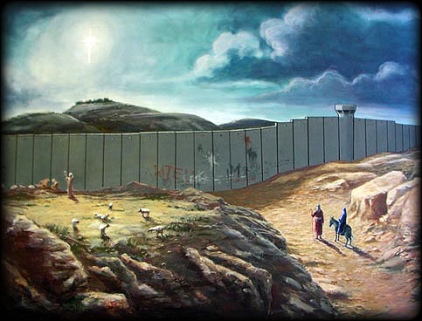
Here’s a cartoon below, a comment on the security wall being built in Israel, that got very little circulation in the west at Christmas time. Can you imagine the impact had this drawing run in newspapers in Europe, the U.S., and Canada?

It’s a mashup of a famous oil painting* related to the Christian Nativity, from a London-based artist who goes by the name Banksy. (Warning: Banksy pulls no punches; views shown are quite strong, often very funny, always provocative, generally safe for work unless you work for an authoritarian like Dick Cheney who wants no counter opinions.)

banksy-israels-wall-77721975_fda236f91a.jpg

Banksy's modern nativity -- does he ever bother to copyright his stuff, or would he rather you broadcast it?

*  At least I thought so in 2008.  I can’t find the painting now.  Anybody recognize a work underneath Banksy’s re-imagining?  Let us know in comments, eh?

Tip of the old scrub brush to Peoples Geography.

More, in 2011: