Just how much will YouTube affect this year’s campaigns?
The Sierra Club offers this spot on the politics of fixing global warming on YouTube. Would they even bother to produce it, if YouTube didn’t exist?
Just how much will YouTube affect this year’s campaigns?
The Sierra Club offers this spot on the politics of fixing global warming on YouTube. Would they even bother to produce it, if YouTube didn’t exist?
 Leave a Comment » |
  Climate change, Elections, Environmental protection, Global warming, History, Politics, Science | Tagged: CFLs, Climate change, Elections, Environmental protection, Politics, Science, Sierra Club |
  Permalink
 Posted by Ed Darrell
In a review of a couple of books on climate change, at the New York Review of Books, physicist Freeman Dyson concludes with these observations:
Unfortunately, some members of the environmental movement have also adopted as an article of faith the belief that global warming is the greatest threat to the ecology of our planet. That is one reason why the arguments about global warming have become bitter and passionate. Much of the public has come to believe that anyone who is skeptical about the dangers of global warming is an enemy of the environment. The skeptics now have the difficult task of convincing the public that the opposite is true. Many of the skeptics are passionate environmentalists. They are horrified to see the obsession with global warming distracting public attention from what they see as more serious and more immediate dangers to the planet, including problems of nuclear weaponry, environmental degradation, and social injustice. Whether they turn out to be right or wrong, their arguments on these issues deserve to be heard.
Too bad Dyson wasn’t in charge of organizing the skeptics. Dyson sounds so reasonable. Surely he would not have opened a discussion about global warming with attacks on the scientists, censoring of the science findings, and a crass political campaign maligning science and environmental protection, and especially the people who stand for conservation, as the campaign against action for global warming action actually unfolded.
My experience may be odd, but generally I find those who claim to be skeptics of global warming, and those opposed to action to clean our air, also are not much concerned with “problems of nuclear weaponry, environmental degradation, and social injustice.” If they were not running a Swift Boat Veterans-style campaign of calumny against Al Gore and anyone who calls for action, they’d be running similar campaigns against people who advocate control and non-proliferation of nuclear weaponry, or they’d be campaigning against people calling for clean water, or they’d be arguing that the poor, sick, aged, imprisoned or unemployed deserve the trouble they get.
Perhaps we should be grateful to the issue of global climate change for having attracted and occupied so many nuts who would be messing up affairs on other issues, if they weren’t already engaged in creating a massive, planetary cluster screw up to stop action against global warming.
Cynical Fridays.
An energetic shaking of a the wet scrub brush to RWDB.
2 Comments | Books, Climate change, Global warming, Politics, Science | Tagged: Books, Climate change, Freeman Dyson, Politics, Science | Permalink
Posted by Ed Darrell
I found such a fantastically wonderful parody of the way denialists think science works . . .
If it’s not parody, the author should stay alert for men in white with nets.
Maybe the author should just stay alert; who can tell parody these days? This thing is so good that I’ll bet it suckers in dozens of denialists.
It’s what you’d expect, after all. Lightning will strike the same lunacy twice, or three times.
5 Comments | Global warming, Hoaxes, Politics, Science, War on Science | Tagged: Al Gore, Climate change, Hoaxes, Humor, Politics, Science | Permalink
Posted by Ed Darrell
This time he’s targeting a textbook on government — and it happens to be one written by the most right wing of the semi-mainstream government text writers.
Education Gadfly has the story here, with the Official Fordham Foundation cynicism at anyone who professes to be the the left of Ayn Rand (it’s an endearing cynicism, really — it makes the stuff much more readable, and it indicates that there is gray matter in action behind the comments). CNBC has the Associated Press story here.
Matthew LaClair complains about the book’s slant on climate change and church-state relations — two hot-button issues, to be sure. One wonders why a government text has any view on climate change, and one wonders how anyone could get the church-state thing wrong without criminal intent — but go see for yourself. LaClair, you recall, recorded his U.S. history teacher going on about the glories of Christianity, and blew the whistle. For that Matthew got slapped around unjustly in the local media. He was correct, before, about church state relations, so we might cut him some slack on this complaint.
Read it all; and remember to trust your textbooks no farther than you can throw them. The Bathtub tends to agree with the Gadfly that texts should be accurate, and that the selection processes for texts is out of hand (as defined by Diane Ravitch). But on the other hand, it appears to me that James Q. Wilson and John Dilulio, the authors of the text in question, got some things wrong. They can fix it, and do so with a smile.
Will they?
See also the other bias on the issue, from the Center for Inquiry — with a detailed critique.
1 Comment | Academic freedom, Accuracy, Climate change, Government, History, Textbook Selection, Textbooks | Tagged: Accuracy, Climate change, Education, Politics, Religious Freedom, Textbooks | Permalink
Posted by Ed Darrell
Natural resources people — foresters, river masters, biologists, botanists, agronomists, farmers, rock climbers and miners — understand almost instinctively that wise management of natural resources takes a blend of wisdom in commercial sectors and by government. Still, every once in a while some newly-minted Ph.D. in economics, or some economist who recently learned that governments own 86% of the land in Nevada, put forth a “bold proposal” to let the markets resolve environmental issues. Let pricing do it, they say.
Sachs: Pricing plays a role. Certainly with carbon emissions we need a price. But it’s almost never enough when we’re talking about really big technological changes. When you think of the computer industry and its roots in defense, when you think of the Internet with its root in defense and the National Science Foundation, when you think about drug development and the crucial role of the National Institutes of Health – one major industry after another has always relied, and needed to rely, on a mix of public and private actions.
When we’re talking about something as basic as a sustainable technology this is going to be inevitable. Think about how we’re going to climb out of the mess on nuclear power for example. We need a nuclear power industry in this country but it’s tied up in knots. Pricing by itself isn’t going to do it. There has to be public acceptability, there has to be sense of security that a regulatory framework, safe storage and nonproliferation protection is in place. These are just too complicated to be solved by a price.
For many other things, such as watershed management, there isn’t even a price that turns them into a market. The issues of watershed management involve different rights of upstream and downstream users, and different types of users. [like agriculture, households and industry.] The right price is going to be different. Pricing plays a role, but so does basic science, eminent domain, right of passage and liability.
Sachs is widely experienced in international economics, and in alternative economics. As an advocate of free markets generally, he’s pretty deep into development ideas. You won’t always agree with his opinions, but you’d do well to pay attention to what he says and the data upon which he bases his opinions.
Teachers, this is a short answer that covers a wealth of issues in your economics courses.
7 Comments | Politics, Science | Tagged: Climate change, Economics, Environmental protection, Free Markets, Politics, pollution, Science | Permalink
Posted by Ed Darrell
Pay attention. Take notes. But be sure you read it. By a guy handled “Taavi,” at a LiveJournal site.
Pat Frank: When is your paper due out?
5 Comments | Accuracy, Climate change, Global warming, Science | Tagged: Accuracy, Climate change, Global warming, Science | Permalink
Posted by Ed Darrell
March 20 brought the Spring equinox, but our daffodils have been up for a couple of weeks. Spring comes a little earlier every year.
That fact, and news stories like these below must cause great angst in the bowels of the offices of U.S. Sen. Tom Coburn (R-Okla.) and other places climate change deniers hold sway. One can almost imagine some poor sap of a Coburn minion laboring away long into the night trying to devise legislation that will prevent Canadian thistles, redbuds, marigolds, wheat, soybeans and corn from reading about climate change or going to see Al Gore’s movie, and getting the wrong ideas.
I hope that minion is imaginary.
Here’s story #1: The Tuesday Science Section of the New York Times carried a story by Jim Robbins, “In a Warmer Yellowstone Park, a Shifting Environmental Balance.” Longtime readers probably know of my deep affection and ties to Yellowstone and the Mountain West. So of course this story catches my eye.
Robbins details an interesting set of changes being studied by Robert L. Crabtree, who is “chief scientist with the Yellowstone Ecological Research Center in Bozeman, Montana”: Invasive Canadian thistle, an exotic weed harries cattlemen throughout the world for the ways it destroys pasture land; despite its name, this thistle is an exotic from Asia, accidentally introduced to the Americas. The Lamar Valley in Yellowstone, formerly a wetland, continues to dry as a result of rising temperatures and lack of usual rainfall (a predicted effect of global climate change). Canadian thistle loves drying wetlands, and has invaded along the Lamar River. Officials fought the invasion for several years, but the fight seems lost.
The changes are dramatic, to observant ecologists:
Enter the pocket gopher, a half-pound dynamo that tunnels into the ground near the surface. The gophers love the abundant, starchy roots of the plant and burrow beneath it to harvest the tubers. What they do not eat they stockpile under plants or rocks.
The expansion of pocket gophers and thistle is not gradual, Dr. Crabtree said, but a rapid positive-feedback loop. As the gophers tunnel, they churn surface soil and create a perfect habitat for more thistle. In other words, the rodents help spread the plant. And more plants, in turn, lead to more pocket gophers.
“The pocket gophers are unconsciously farming their own food source,” said Dr. Crabtree. Their numbers here have tripled since the late 1980s, he said.
For their part, grizzly bears have discovered the gophers’ caches and raid them. As a result, the Lamar Valley is pockmarked with holes where grizzlies have clawed up bundles of roots. Bears also devour gophers and their pups.
Dr. Crabtree thinks the bears started feeding in earnest on the new food source in 2004 — a poor year for another bear staple, the white bark pine nut. Now, he adds, they seem to be eating the gophers and roots more routinely.
Tom Oliff, chief scientist for Yellowstone, confirms that the growing season for the park has expanded 20 days a year since the mid-1990s, which may explain the spread of Canada thistle. Mr. Oliff said the park reduced control efforts because evidence showed that the plant ebbed and flowed and that the range would probably shrink on its own.
One doesn’t have to be a fan of the Craigheads or a biologist to be dimly aware that the Yellowstone ecosystems are intensely studied and intensely threatened. Climate change played a contributing role in the cataclysmic fires in the park in 1988; reintroduction of wolves still sparks some controversy, though the return of a top predator has already produced other dramatic changes in Yellowstone ecosystems. Yellowstone is home and refuge to a wild bison herd, and beautiful and unique — generally revered as a “crown jewel” of America’s features.
Nor does one need to be a climate scientist to recognize the signs of warming listed in the article, and the dangers that are implied: Drying wetlands, invasive species, dying traditional foodstocks for grizzlies, population explosions that almost always are a symptom of serious trouble in an ecosystem.
So I was surprised, dumbfounded even, to see The Unbearable Nakedness of CLIMATE CHANGE claim this as a good story. Why?
Something absolutely unheard-of before: an entire New York Times article talking about Global Warming but… with no hint of impending doom or catastrophes:
In a Warmer Yellowstone Park, a Shifting Environmental Balance by Jim Robbins – published: March 18, 2008
Destruction of wetlands, displacement of native species, upset of the ecological apple cart — and this is “no hint of impending doom?” (While you’re at the NY Times site, also see this story, about how warmer temperatures threaten the grizzly.)
Here’s story #2:
Cherry blossoms in Washington, D.C., now appear weeks earlier than they used to. April 5 was the date of the debut of the blossoms 30 years ago, according to a story at National Public Radio, but they are out already and will have peaked by the end of March this year.
Washington’s blossomless Cherry Blossom Festivals (the dates for the festival have not kept pace) provide one more indicator that spring comes earlier. A geographer from Virginia Tech, Kirsten de Beurs, uses remote sensing satellite data to look at the dates plants spring forth, and has determined that spring is moving up 8 hours every year. (Go to the NPR site and listen to the story.) (This science is called “phenology,” the study of the timing of biological phenomena.)
Here’s the problem for climate change deniers: How can they convince the birds, bees, grizzlies, and especially the trees and flowers, that they shouldn’t be acting as if the climate were changing? How can the climate change skeptics get the Canadian thistles to stop invading, the Japanese blossoming cherry trees in the Tidal Basin to delay their blossoms, the bluegrass of Kentucky to delay its greening, the prairies of Kansas to delay the wildflowers and grasses?
Have all those plants been suckered in by Al Gore’s movie? Don’t those plants know that Anthony Watts has shown that the weather measuring stations across the U.S. are placed wrongly, and so there cannot be warmer weather?
Church authorities got Galileo to lie low on the issue of heliocentricity centuries ago; but according to the legend, as he left the room where he had agreed to keep quiet, he muttered, “but still, it moves,” referring to the motion of the Earth about the Sun. This is the problem of the climate change deniers: Still, the climate changes.
Canute couldn’t command the tides not to flow; climate change deniers cannot command the flowers not to bloom. That force that through the green fuse drives the flower? It’s the destroyer of skepticism, too. Climate change skeptics curse it today.

24 Comments | Climate change, Economics, Environmental protection, Geography - Economic, Geography - Physical, Global warming, Natural history, Science | Tagged: Climate change, Economics, geography, Global warming, Politics, Science, Yellowstone Park | Permalink
Posted by Ed Darrell
“Bergs and British Climate: That Old Yarn of the Effect of Greenland’s Floating Mountains,” reads a headline from the New York Times, April 26, 1908.
The story wanders about reports of icebergs floating far south of where people might expect them in 1908, what their drift tells us about various currents, and conjectures about hypotheses of climatic effects of the ice and the currents. Some of the icebergs would indeed be monsters, poking more than 400 feet above the waterline; some of the bergs might provoke discussion drifting as far south as Florida.
I mention this article because the archives of the New York Times is open and free for searchers, and many of the articles prior to 1922 are available in .pdf form for free. It took me five or six minutes to get a search that produced fewer than 10,000 stories to pick this one from.
And if I may, it tends to show the difficulties of climate change skeptics who yank a few old articles out of journals of 100 years ago to suggest that, since scientists and navigators wondered about the weather then, climate change is not occurring now. I can imagine there are a lot of stories available in various newspaper archives; if we make a methodological search of them, we may find data that can be turned into real information about climate.
I mention this because Anthony Watts at Watts Up With That? features a couple of articles relying on old weather reports to suggest that concern about warming in the 1920s and 1930s demonstrates that warming isn’t happening now. See this one, too, from a 1922 article, on ice retreating.
In the concluding remarks, the is the recognition of climate change to a warmer regime:
All of these confirm the general statement that we are in the midst of a period of abnormal warmth, which has come on more less gradually for many years.
Of course we all know what happened next, 1934 became the hottest year on record, the dust bowl and great depression occurred, followed by World War II. The climate changes again, a return to a colder phase lasting all the way until about 1978 when the “new ice age” was being discussed. Then the great PDO shift occurred and warming has been the norm since then.
Watts is a former television weatherman now making the big bucks with his own forecasting company. His blog continues among the most popular on WordPress with a regular feature showing photos of U.S. weather service weather stations that are positioned in less-than-optimum places to record cool weather, such as in asphalt parking lots, or near heat exhaust vents from the HVAC systems of nearby buildings. Watts engages in occasionally heated disputes on his blog, and he often highlights the work of some of the more suspect cynics of science like Tim Blair.
Watts has a cadre of faithful followers and defenders; poking at his posts generally produces a swift onslaught of invective from them.
Watts’s blog provides a good resource for counter examples to those offered by policy makers who urge more serious action to control pollution. I’m skeptical of Watts’s skepticism.
For one thing, the charts he shows with these historic articles show a long-term warming trend, which he dismisses. As evidence against global warming, though, these articles’ highlights fall more into the anecdote side than on the data side.
Anecdotal evidence abounds in that article from the New York Times that I note above, too. It’s anecdotal in opposition to Watts’ claims, but it’s still just anecdote.
This is a potentially rich area for local and amateur historians. Meteorologists and other climate scientists are hampered in their analysis by a lack of data, and often by a lack of context of the data they do have. Newspapers now buried in libraries and other archives may offer rich sources of data, and especially context. Mining these sources will be amateur operations, mostly. There is too much ground to cover, too many places to visit, for a major project coordinated out of one institution.
In 1908, stories of massive iceberg mountains were no older than a generation. They are anecdotes, sure — but they may be data points, too. When was the last time anyone sighted an iceberg 400 feet above the water? (The article claims one berg was 700 feet from waterline to peak; when was the last one of those sighted?) When was the last time a significant chunk of ice wandered as far south as Florida? Can you find some of these stories to calculate whether such things still occur, or if not, when they stopped?
My fear is that Watts is mining a rich lode of stories written by newsmen with no institutional memory of ice or other weather phenomena. The institutional memory becomes apparent only in retrospect, only in the archives of the stories, and only compared longitudinally, that is, over time. 20-year periods would probably provide two generations of reporters at a long-established news outlet; reporters in those generations would not be aware of the changes.
The New York Times archives are open. What others?
Historians? High school teachers with students who need projects? What do you have in your town that may shed light? Teachers, pay special attention to the comments on Watts’ blog; many readers write about their historical experiences, such as with the heat waves of the 1930s, and they provide links to news stories and history writings. Even if your town is landlocked, there is weather history to find.
2 Comments | Capturing history, Climate change, Global warming, History, Science, Student projects | Tagged: Climate change, Global warming, History, Science | Permalink
Posted by Ed Darrell
It’s just one more report to throw on the pyre of reports to be burned if it ever turns out as skeptics say and others hope, global climate change is just a momentary trend: From 1999 to 2006, the pace of glacier melting worldwide picked up.
We had a cold winter; skeptics will argue that the winter of 2007-2008 was not included, and it reverses the trend.
If only that were so.
9 Comments | Accuracy, Environmental protection, Global warming, Politics, Reason, Science | Tagged: Climate change, environment, Glaciers, Politics | Permalink
Posted by Ed Darrell
I love Thomas Nast cartoons, partly for their dated look. They look like they are 100 years old from the style of the art.
For much the same reason, I love Herblock cartoons. They look like the middle of the 20th century. And Pat Oliphant cartoons look like post-Kennedy modern ideas.

Clay Bennett, winner of the 2007 Curie UN Cartoon Award
Clay Bennett cartoons look like 21st century clean to me. There’s a smoothness, a silkiness of color that lends an immediacy to them. They really look good, and they look like they’d project well in a classroom (though I’ve not tried any of Bennett’s, actually).
All four of these cartoonists had or has something to say, too. I’ve enjoyed Bennett’s work in the Christian Science Monitor for some time. His work is clean, but it has a cutting edge that can’t be missed.
So, I was happy to see that he had won a commendation from the Ranan Lurie Cartoon Competition at the UN Correspondents’ Association dinner. Other people see good stuff in his drawings — I’m not alone.
Here’s his UN Lurie award-winning cartoon:
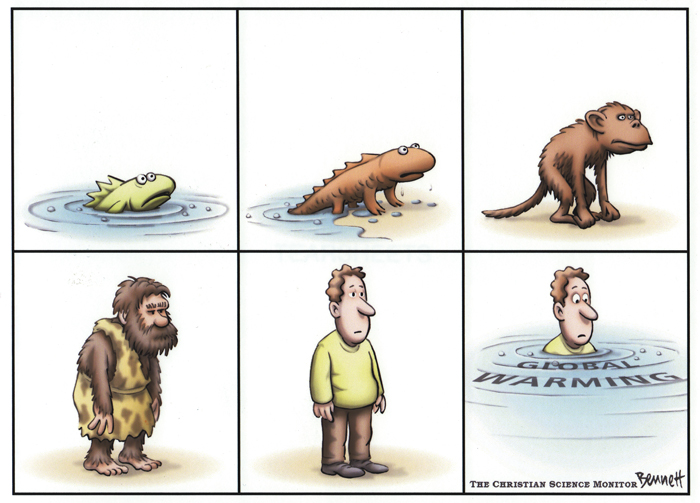
Cartoon winner of the 2007 Curie UN Cartoon Award
More of Bennett’s cartoons can be seen here, at the Clay Bennett Archives.
Bennett’s last cartoon in the Monitor was November 17. The good news: He’s moving to the Chattanooga Times-Free Press. We can hope that means one more opening is available for a cartoonist.
One more, below the fold. Read the rest of this entry »
2 Comments | Cartoons, Climate change, climate_change, Global warming, Political cartoons, Politics | Tagged: Cartoons, Clay Bennett, Climate change, Evolution, Global warming, Intelligent Design, Political cartoons, Politics | Permalink
Posted by Ed Darrell
Who will do something about global warming (weirding)?
Leave a Comment » | Climate change, Economics, Environmental protection, Famous quotes, Global warming, Leadership, Quotes, Student projects | Tagged: Business, Climate change, Global warming, Leadership, Quotes | Permalink
Posted by Ed Darrell
He did it to expose the climate change skeptics.
Nature‘s blog has the interview, here.
Why did you decide to construct the fake website? Was it purely a joke or did you set out to make people taking your paper at face value look foolish?
Its purpose was to expose the credulity and scientific illiteracy of many of the people who call themselves climate sceptics. While dismissive of the work of the great majority of climate scientists, they will believe almost anything if it lends support to their position. Their approach to climate science is the opposite of scepticism.
Are you surprised at the pick up your coverage has generated?
Not really. Equally ridiculous claims – like those in the paper attached to the “Oregon Petition” or David Bellamy’s dodgy glacier figures – have been widely circulated and taken up by the ‘sceptic’ community. But you can explain this until you are blue in the face. To get people to sit up and listen, you have to demonstrate it. This is what I set out to do.
Still waiting for someone to back up junk science purveyor Steve Milloy’s claim that the hoax was exposed by the skeptics it was aimed at. The hoaxer doesn’t think so.
[Yeah, I know — Nature is a British publication, and they use the British spelling for “skeptic.”]
2 Comments | Accuracy, Climate change, Global warming, Hoaxes, Reason, Science, Voodoo science | Tagged: Climate change, Global warming, hoax, lazy reporters, Rush Limbaugh, Science | Permalink
Posted by Ed Darrell

Here’s the word from Bob Parks’ great e-letter, “What’s New,”October 26, 2007 edition; I’ve highlighted some stuff:
2. ENVIRONMENT: MAJOR U.N. REPORT SAYS IT’S “UNSUSTAINABLE.” According to a story in the New York Times this morning, a report issued by the United Nations yesterday in Paris is so frightening that French President Nicolas Sarkozy immediately put $1.4 billion into new energy sources and biodiversity. Unsustainable consumption of resources and population growth is taking Earth beyond the point of no return. As an example, the report says, two and a half times as many fish are being caught as the oceans can produce in a sustainable manner. No word yet from Washington on the U.S. response. No steps taken to protect the environment will help in the long run if population continues to grow.
Denialists will start whining in just a few seconds. Three . . . two . . . one . . .
Considering the weather (everywhere), fires in California, droughts in Georgia, the Nobel Peace Prize this year, you’d think this would be front page news. Where did it run in your local paper?
Sources:
Leave a Comment » | Education, Environmental protection, Global warming, Globalization, History, Politics, Science | Tagged: Climate change, environmental disasters, oceans, Politics, sustainable harvest, UN | Permalink
Posted by Ed Darrell
Bush administration officials make the case more powerfully that we need to resurrect the Office of Technology Assessment (OTA).
Bushies, going against their earlier claims that they accept that the nation needs to do something about changing climate, “eviscerated” testimony of a government official designed to protect public health. More voodoo science from Bush. According to The Carpetbagger Report:
Dr. Julie Gerberding, director of the Centers for Disease Control and Prevention, told a Senate panel yesterday that climate change “is anticipated to have a broad range of impacts on the health of Americans.” If that sounds a little vague and non-specific, there’s a good reason — the White House refused to let her say what she wanted to say.
Sadly, Carpetbagger Report lists several other instances in which White House officials have gutted the release of important information on global warming’s dangers.
If Osama bin Laden did something like that, we’d invade a smaller nation to stop it. Preventing Americans from being prepared for disaster is a terroristic threat under the Homeland Security Act, isn’t it? Is there a clause for citizen suits in there somewhere? Who will stand up to the abuses by George Bush?
Here’s the Washington Post story on the event. Here’s my previous post, with links to Denialism and Pharyngula, and even John Wilkins (love that picture of Snowflake!).
Hillary Clinton specifically calls for the recreation of OTA, a clue some of us politicos use to indicate she really does know what government under the Constitution should be doing. Other Democrats are friendly to the idea, but so far I’ve not heard a peep from any of the Republican presidential candidates. Orrin? What about you?
Bring back the OTA. Exorcise the demons of totalitarian Bushism.
2 Comments | Accuracy, Junk science, Politics, Research, Santayana's ghost, Science, Technology, Voodoo science, War on Science, War on Terrorism | Tagged: Bush censorship, Climate change, Junk science, Office of Technology Assessment, Politics, Voodoo science | Permalink
Posted by Ed Darrell
Tim Lambert at Deltoid tracked down the facts in the really odd story about a court in Britain ruling that the film Inconvenient Truth contains errors — a case I noted in a post about Al Gore’s winning a Nobel Prize for his work on climate change. Deltoid said:
A UK High Court judge has rejected a lawsuit by political activist Stuart Dimmock to ban the showing of Al Gore’s An Inconvenient Truth in British schools. Justice Burton agreed that
“Al Gore’s presentation of the causes and likely effects of climate change in the film was broadly accurate.”
There were nine points where Burton decided that AIT differed from the IPCC and that this should be addressed in the Guidance Notes for teachers to be sent out with the movie.
Unfortunately a gaggle of useless journalists have misreported this decision as one that AIT contained nine scientific errors.
Got that? The British Court said Gore is right.
I’ll bet I’ve seen that case cited a half dozen times today, with claims that Gore’s film is generally wrong.
Tim’s detail on the case, and the nine allegations of “error” (scare quotes from the judge in the original opinion) should be read by anyone following the climate change debates. I doubt that any Gore critics will read, nor, just to be nasty, that many of them can.
This is another political hoax in the making. Bad reporting, caused largely because the news of the case hit as the announcement of Gore’s Nobel Prize win crossed the news wires, makes Gore a target for the denialist and right-wing spin machines. Though their charges are inaccurate, they will make the charges, and repeat them endlessly. Buckle up — it’s going to be a bumpy night.
3 Comments | Accuracy, Climate change, Jurisprudence, Law, Natural history, Natural resources, Science, Technology in the classroom, Video and film, War on Science | Tagged: Al Gore, Climate change, denialists, video in the classroom | Permalink
Posted by Ed Darrell


Ed Darrell on Texas's Colorado River


Come on in, the water's fine. Come often: Cleanliness is next to godliness.


 Millard Fillmore's Bathtub