What if the old curmudgeon teaching economics married that cute, brainy geography teacher?

April 23, 2010

Or, was it the cute curmudgeon teaching econ and the old cartographer in geography?

I think I’ll add this to my TAKS review.  What other classroom uses can you find for it?

I found it at Cool InfoGraphics.

Seriously, geography and economics teachers, this is big stuff:

Follow the Money” is a video summarizing the results from the project by Northwestern University grad students Daniel Grady and Christian Thiemann.  Using data from the website Where’s George?, they have been able to track the movement of U.S. paper currency.  What can you learn from this?  That there are natural borders within the U.S. that don’t necessarily follow state borders, and it can also be used to predict the spread of disease because it maps movement of people within the U.S.

From Maria Popova on BrainPickings.org: This may sound like dry statistical uninterestingness, but the video visualization of the results is rather eye-opening, revealing how money — not state borders, not political maps, not ethnic clusters — is the real cartographer drawing our cultural geography.  The project was a winner at the 2009 Visualization Challenge sponsored by the National Science Foundation and AAA.

Tip of the old scrub brush to VizWorld and Maitri’s VatulBlog


World Malaria Day, 2010 – April 25

April 18, 2010

April 25, 2010, is World Malaria Day.

Malaria plagues too many nations, still.  Between 400 million and 500 million people in the world get infected with one form of the malaria parasites every year.  About a million die, most of those children.  Death disproportionately strikes pregnant women, too.

Life cycle of malaria, from the World Health Organization (WHO)

World Health Organization (WHO) chart on the life cycle of malaria

Advances in medicines and advances in controls of the insects that help transmit the disease led to several campaigns to eradicate the disease over the past 60 years.  Malaria no longer torments most of Europe and most of North America, but it remains a serious, economy-crippling disease across Africa and Asia.

Malaria also poses as a political football.  Over the next couple of weeks you can find dozens of articles on valiant efforts to fight malaria, including the RollBack Malaria Campaign, and efforts by the Gates Foundation and histories of the work of the Rockefeller Foundation.  But you can also find a pernicious political campaign against malaria fighters and “environmentalists,” claiming that DDT is a magic potion that could have ridded the world of malaria by killing off all the mosquitoes, if only that great mass murderer, Rachel Carson, had not imposed her will on the unstable dictators of African nations who did all they could to prove to Ms. Carson that they were environmentally friendly by banning DDT.

All of that is a crock.  But we see it every year.

It’s already shown up in the formerly-known-as-accurate Wall Street Journal, European edition.  (Please watch — I may have more to say on that piece, later.)

Over the next two weeks I will ask myself a hundred times, why do these people fiddle with trying to impugn scientists, physicians and environmentalists, while fevers burn in the brains of children across Africa and Asia?

With action, hope is that we can save the million lives lost annually by stopping malaria, by 2015.  Please consider joining the effort.

You should wonder about that, too.  If you find a good answer, please let me know.

Roll Back Malaria World Malaria Day 2009

You’re not using this technology in your classroom?

April 12, 2010

Here’s another opportunity to put real, cutting edge technology in your classroom.  In fact, your kids could probably invent all sorts of new uses for it.

Have you even heard of this stuff?  Can you use it, live, with the equipment you’ve got?

Blaise Aguera y Arcas  of MicroSoft demonstrated augmented-reality maps using the power of Bing maps, Flickr, Worldwide Telescope, Video overlays and Photosynth, to an appreciative and wowed audience at TEDS:

My prediction:  One more advance in computer technology that classrooms will not see in a timely or useful manner.

But have you figured out how to use this stuff in your geography, history, economics or government classes?  Please tell us about it in comments. Give examples and links, please.


Education board shames Texas, part F: Clay Bennett, Chattanooga Times-Free Press

April 11, 2010

Clay Bennett in the Chattanooga Times Free Press:

Clay Bennett, Chattanooga Times-Free Press, March 16, 2010

Clay Bennett, Chattanooga Times-Free Press, March 16, 2010

Bennett remains one of my favorite cartoonists today.  His work is incisive, intelligent, and persuasive to the side of reason and light almost all of the time.  Why hasn’t he won a Pulitzer yet?

Bennett is generally a powerful supporter of U.S. education; see the two other recent cartoons, below the fold.

Read the rest of this entry »


Texas standards: Students in the dark about “capitalism”

March 19, 2010

Tony Whitson from Curricublog made the killing observation:

BookTV [C-SPAN] this weekend has Steve Forbes talking about his new book,

“How Capitalism Will Save Us.”


With these new Social Studies TEKS, TX students won’t know what such a
book is about.

Small bit of humor from a truly sad situation.  One of the leaders of the Texas State Soviet of Education defended the evisceration and defenestration of social studies standards saying they didn’t need to listen to liberal college professors.

In economics, the professor was a conservative, well-respected economics professor from Texas A&M University, one of the most conservative state universities in the nation (with a Corps of Cadets numbering in the thousands and tradition deeper than Palo Duro Canyon and broader than the Gulf of Mexico).   Calling these people “liberal” is tantamount to complaining about the communism espoused by Ronald Reagan and Dwight Eisenhower — that is, it demonstrates a divorce from reality and rationality.

In the grand scheme of things it’s not a huge problem, but it’s more than a trifle.  It’s difficult, if not impossible, to fully comprehend market economics in the U.S. without understanding what capitalism is, and how it works.  Teachers will be left to find their own materials to explain “free enterprise” and, if the students ever make it into a real economics course in college, they will discover “free enterprise” is a quaint, political term that is not discussed in serious economics circles.  Texas students will, once again, be pushed to the hindmost by Don McLeroy’s odd views of America and what he doesn’t want Americans to know.

For example, look at the Council for Economic Education — while “capitalism” is not the only word they use for market-based economies, you’ll have a tougher time finding any definition of “free enterprise.”  Or, more telling, look at the Advanced Placement courses, or the International Baccalaureate courses.  AP and IB courses are the most academically rigorous courses offered in American high schools.  The Texas TEKS step away from such rigor, however (while the Texas Education Agency rides Texas schools to add rigor — go figure).  IB courses talk a lot about enterprise, but they don’t censor “capitalism,” nor do they pretend it’s not an important concept.

At the very conservative and very good Library of Economics and Liberty (which every social studies teacher should have bookmarked and should use extensively), a search for “free enterprise” produces 77 entries (today).  “Capitalism” produces almost ten times as much, with more than 750 listings.

Which phrase do you think is more useful in studying American economics, history and politics?

Teachers will deal with it.  It’s one more hurdle to overcome on the path to trying to educate Texas students.  It’s one more roadblock to their learning what they need to keep the freedom in America.

Warren Buffett, Businessweek image

Capitalism - Warren Buffett - BusinessWeek image

Bernie Madoff (photo credit unknown)

Free Enterprise - Bernie Madoff

The real difference?  Literature on capitalism frequently address the issue of moral investments, and the need for some regulation to bolster the Invisible Hand in producing discipline to steer markets from immoral and harmful investments.  The essential history politics economic question of the 20th and 21st centuries is, can economic freedom exist without political freedom, and which one is more crucial to the other?  We know from every period of chaos in history when governments did not function well, but bandits did, that free enterprise can exist without either political freedom or economic freedom.  I think of it like this:

Capitalism

Free Enterprise

Adam Smith Blackbeard the Pirate
Warren Buffett Bernie Madoff
Investing Spending
Building institutions Taking profits
Retail Robbery
Wholesale Extortion
Save for a rainy day debt-equity swap
Antitrust enforcement to keep markets fair Don’t get caught, hope for acquittal
Milton Friedman P. T. Barnum
Ludwig von Mises Charles Ponzi
Friedrich von Hayek Richard Cheney, “deficits  don’t matter”
Paul Krugman Kato Kaelin
Stockholders Victims and suckers

SSOE member Dunbar: Aquinas led American revolution, not Jefferson

March 17, 2010

It’s astounding in its error.

Cynthia Dunbar told Chris Matthews today that Thomas Aquinas played a more important role in the American Revolution than Thomas Jefferson.

Jefferson, Texas students learn in other places, wrote the great body of the Declaration of Independence, and the Virginia Statute for Religious Freedom, which is the direct forebear of religious freedom in U.S. Constitutional law.

If you hurry, you can see it tonight (at 6:00 p.m and 11:00 p.m Central, I’m told) on Chris Matthews’ “Hardball.”

Isn’t it astounding people who claim to be Christian will tell such bold lies to children?  It’s as if they think Jesus said “make the children suffer” instead of what Jesus did say.  Voodoo history at its most voodoo; history revisionism of the rankest sort.  Where’s Mermelstein?

You can see it online here, at Hardball’s website.

Dunbar and her fellow travellers are effing idiots.  Strong post to follow.

______________

SSOE?  State Soviet of Education.  Why do you ask?


Happy Madison’s birthday! Nation expresses revulsion at Texas education follies, Part 1

March 17, 2010

Tuesday, March 16 was the 259th anniversary of the birth of James Madison, the Father of the Constitution, the sponsor of the Bill of Rights, the life-long campaigner for good government based on knowledge of the errors of history, especially in the area of religious freedom.

Under social studies standards proposed by the Texas State Board of Education, Texas students will never study Madison’s views, or Madison’s Constitution, without intervention by their parents or good teachers who run some risk to teach the glories of American history to students.

Newspaper stories across the nation concentrated on Madison’s birthday expressed revulsion and rejection of the crabbed and cramped views of the Texas SBOE, and the cup of revulsion runneth over.

For example, the attempted evisceration and hobbling of science standards occurred last year, but the editorial cartoon in USA Today reached back to remind us just what is going on in Austin.

By Scott Stantis, Chicago Tribune, for USA TODAY, March 16, 2010, on Texas education follies

By Scott Stantis, Chicago Tribune, for USA TODAY, March 16, 2010

More comment to come.

Tip of the old scrub brush to Christina Castillo Comer.


Sour grapes of wrath at the Texas State Board of Education

March 10, 2010

A couple of months can make a big difference.  Can.

A difference which way?

Two months ago the Texas State Board of Education suspended its revamping of social studies standards — the efforts to grind the standards into a right-wing crutch were so controversial that hearings, discussion and amending proposed standards took up more time than allotted.  SBOE delayed final votes until March 10.

Today.

Last week Texas voted in primary elections.  Several board members’ terms are up.  Two incumbents lost primary challenges, Don McLeroy, the Boss Tweed of the right wing cultural war ring, and Geraldine Miller, a long-term veteran from Dallas, whose very conservative views cast her as a moderate among SBOE members.  Both are Republicans.

How will those primary losses affect them and their work on the board?

In addition, other members of the culture war ring are retiring, including Cynthia Dunbar. Will the lame ducks be content to vote up the changes urged by history and economic professionals and professional educators, or will they do as McLeroy suggested they need to do earlier, and fight against the recommendations of experts?

How will the lame ducks walk and quack?

Stakes are high.  New York Times Magazine featured the culture wars on the cover on Valentine’s Day (you should read the article)Texas Monthly weighed in against the culture wars, too — a surprise to many Texans.

Cynicism is difficult to swim against.  I expect McLeroy to try as best he can to make social studies standards a monument to right wing bigotry and craziness.  We’ve already seen SBOE vote to delete a wonderful children’s book from even being mentioned because the text author shares a name with a guy who wrote a book on socialism earlier.

Most of us watching from outside of Austin (somebody has to stay back and grade the papers and teach to the test . . .) expect embarrassments.  On English and science standards before, the culture war ring tactics were to make a flurry of last-minute, unprinted and undiscussed, unannounced amendments apparently conspired to gut the standards of accuracy (which would not make the right wing political statements they want) and, too often, rigor.  Moderates on the board have not had the support mechanisms to combat these tactics successfully — secret e-mail and telephone-available friends standing by to lend advice and language on amendments.  In at least two votes opponents of the culture war voted with the ring, not knowing that innocent-sounding amendments came loaded.

In a test of the No True Scotsman argument, religious people will be praying for Texas kids and Texas education.  Meanwhile, culture warriors at SBOE will work to frustrate those prayers.

Oy.

Thomas Jefferson toyed with the idea of amendment the U.S. Constitution to provide a formal role for the federal government in guaranteeing education, which he regarded as the cornerstone of freedom and a free, democratic-style republic.  Instead, American primary and secondary education are governed by more than 15,000 locally-elected school boards with no guidance from the national government on what should be taught.  Alone among the industrial and free nations of  the world, the U.S. has no mechanism for rigorous national standards on what should be taught.

For well over a century a combined commitment to educating kids better than their parents helped keep standards high and achievement rising.  Public education got the nation through two world wars, and created a workforce that could perform without peer on Earth in producing a vibrant and strong economy.

That shared commitment to quality education now appears lost.  Instead we have culture warriors hammering teachers and administrators, insisting that inaccurate views of Jefferson and history be taught to children, perhaps to prevent them from ever understanding what the drive for education meant to freedom, but surely to end Jeffersonian-style influences in the future.

Texas’s SBOE may make the case today that states cannot be trusted with our children’s future, and that we need a national body to create academic rigor to preserve our freedom.  Or they will do the right thing.

Voters last week expressed their views that SBOE can’t be trusted to do the right thing.  We’re only waiting to see how hard McLeroy is willing to work to put his thumb in the eye of Big Tex.

More:


We need free marketeers in the White House

February 23, 2010

Who said this?

We are pro-growth. We are fierce advocates for a thriving, dynamic free market. But we do think that there have to be some rules of the road in place in the financial sector that will create an even playing field and allow businesses to raise capital and consumers to buy products with confidence.

Coming out of this past decade, there has been a sense on the part of a lot of middle-class families that they have been left behind, even when we were expanding. And I talked during the campaign about the need for us to restore a sense of balance to the compact between business, government, and employees all across the country.

If businesses are making record profits but employees are seeing their wages flatline—and in fact, incomes decline over the course of the decade—that puts enormous strains on families. It puts, I think, a dampening effect on consumers who help drive this economy. We are going to be better off if everybody feels like they have got a stake in growth and innovation moving forward. And I think that balance got lost.

Now, making sure that we restore that balance without tipping too far in the other direction in ways that squelch innovation and investment is going to be an important challenge, and one that we take very seriously. But the important message I would have for the business community—and this is something that I emphasize every time I have lunch with CEOs, and we have had a lot of them in here—is we have every interest in you succeeding.

Another big hint below the fold.

Read the rest of this entry »


Oh, but the conservatives will say it’s unfair . . .

February 5, 2010

Reagan on trickle-dowh economics (image at imgur)

Let 'em complain it's unfair.


More good rap for the schoolroom: Keynes vs. Hayek

January 26, 2010

This is really good.

It’s a pretty good rundown of the fight between Keynes and Hayek, conducted mostly after Keynes’ death in economics classrooms and central banks world wide.

Watch it, and hope for more soon, at Econstories, the blog of the guys who created the thing, John Papola and Russ Roberts.

Resources:


Texas social studies standards: Beware the ides of January

January 15, 2010

News reports in Texas this morning said that several of the right-wing, gut-education-standards changes proposed to social studies standards had failed in voting on Thursday, January 14.  But, much more was to be done, and the SBOE adjourned early last night to continue voting today.

In a pattern familiar to education advocates in Texas, board member Don McLeroy (R-Pluto) today proposed a long series of amendments, apparently off-the-cuff, but probably written up in earlier strategy sessions.  These last-minute amendments tend to pass having missed any serious scrutiny.

Will he be able to ruin Texas education for the next decade?  I cannot follow the live webcasts; Steve Schafersman is working to stop the amendments, rather than merely blog about them.  We probably won’t know the extent of the damage for weeks.  McLeroy cherishes his role as a Port-au-Prince-style earthquake to Texas education. (Pure coincidence, I’m sure — Ed Brayton summarizes McLeroy’s politics today.)

Watch that space, and other news sources.  I may provide updates here, as I can get information.


Social studies train wreck at Texas State Board of Education: Live! A Nation at Risk

January 13, 2010

Steve Schafersman will live blog the hearings on social studies standards before the Texas State Board of Education (SBOE) today, at Evo-Sphere.  Schafersman is president of Texas Citizens for Science, and a long-time activist for better education in Texas on all topics.

Rapid updates or live-blogging should be available at the blog of the Texas Freedom Network, TFN Insider.

It’s Item #6 on the SBOE agenda, with a title that tips off the trouble:

Item #6 — Public Hearing Regarding Proposed Revisions to 19 TAC Chapter 113, Texas Essential Knowledge and Skills for Social Studies, and Chapter 118, Texas Essential Knowledge and Skills for Economics with Emphasis on the Free Enterprise System and Its Benefits.

Schafersman e-mailed an introduction to the meeting:

Some say the Social Studies public testimony by the religious right, liberals, etc., then the SBOE debate, motions to amend, votes, etc. is a bigger circus than adopting the science standards. Judge for yourself. You can watch the entire circus, carnival, and sideshow on the webcast video at http://www.texasadm in.com/cgi- bin/tea.cgi

This is Texas democracy in action, when sullen and tight-lipped State Board members listen to public testifiers for 3 minutes each and profoundly ignore them since they already know what they are going to do. But I, at least, feel better after speaking so I don’t later feel responsible for the crappy amendments, changes, and policies that come out of this horrible Board because I did nothing. The proposed Social Studies standards written by the panels composed of teachers and professors are excellent (when have I heard this before), but the SBOE can’t wait to shamelessly impose their own Religious Right agenda on them.

You’ll recall that SBOE has at every possible turn disregarded the advice of famous and serious historians, respected free-market-advocating economists, geographers and educators on these standards.  Economists, for example, want Texas kids to learn about “capitalism,” since that’s what it’s called by economists and policy makers, and colleges.  SBOE thinks “capitalism” sounds too subversive, and wishes instead to require Texas kids to learn about “free enterprise” instead.

‘A rose by any other name’ you think, until you start thinking of how Texas kids do on standardized tests, college admission exams, and the punchline on the joke, about Texas kids being told not to study capitalism.  No siree, no capitalism in the fictional home of J. R. Ewing, never mind the real-life capitalists like T. Boone Pickens or H. Ross Perot (Jr. and Sr.).

In Dallas, the city prepares to name a street after Cesar Chavez, the great Hispanic union organizer and advocate for working Americans.  In Austin, SBOE works to strike all mentions of Chavez, because they dislike the politics of heroes of our ethnic minorities (soon to be a majority in Texas).  In Washington historians and policy-makers follow the legacy of Thurgood Marshall, the great civil rights attorney and first African-American to sit on the U.S. Supreme Court.  In Austin, SBOE thinks Marshall should be left out of history books.  Many of us suspect he’s anathema to the white right-wing in Austin:  A smart, successful and noble man of color.

Mel and Norma Gabler died years ago, but their history lingers in the halls of education policy in Austin.  It’s Shakespearean.

This is a massive battle.  David Barton worked for 30 years to gut history standards nationally to teach a history of America that never was, and as the official religionist appointee of the right-wing SBOE members, he stands on the brink of accomplishing much of the revisionism he’s advocated.  See the Texas Tribune story on the issue, “Hijacking History.”

Generally we shouldn’t negotiate with terrorists, Ronald Reagan said.  At the SBOE, we’ve put the terrorists in charge of history and economic curricula — if not the terrorist themselves, at least the terrorists’ camels’ noses.  Texas’s process has earned flashing red-light, claxon-sounding repeating of the words of Ronald Reagan’s Commission on Excellence in Education:  If a foreign nation did this to us, we’d consider it an act of war [excerpt below the fold].

Make no mistake about it.  SBOE’s goal is to roll back any of the reforms left from Reagan’s Commission’s work.  Our nation is more at risk from foreign competition than ever before.  SBOE plans to give away a bit more of our future to China, this week.

Our saving grace is the general incompetence of SBOE members to make significant reform in Texas’s wounded schools, reeling from unworkable and damaging requirements under the No Child Left Behind Act and a testing program that severely limits what can be taught in any social studies course other than those bastions of learning left in International Baccalaureate programs and Advanced Placement courses (estimates are that between 5% and 10% of Texas high school students can take one of those good courses).  Whatever silliness, craziness or lies SBOE orders to  be taught, it can’t be taught and tested well.  Inertia preventing change works to save America in this case.

In business, most CEOs at least appreciate the value of having good front-line employees who are the ones who really deliver the service or product and produce the profit of the enterprise (even if they don’t treat those employees so well as the employees deserve).  Education may be the last bastion of flogging the horse that should be pulling the cart instead.  In this case, having well-trained teachers in the classroom is the last hope for Texas, Texas parents and Texas students — and Texas’s economic future and future in liberty.  Teachers are the last defense of freedom in Texas.  Today SBOE will make another assault on the ramparts that protect the teachers in their work.

When will the French fleet arrive to lend aid?  Will it arrive at all?  And if it arrives, will Texas kids know better than to shoot at the ships?

Carol Haynes, who claims to have a doctorate in some discipline, told the board how to rewrite the standards to completely change the history of the civil rights movement in their last hearing on the topic.  According to Haynes, apparently, Dr. Martin Luther King, Jr., was opposed to civil rights and Barry Goldwater was in favor — the Board didn’t offer to correct her revisionism, but instead asked her to go beyond her three minutes in fawning acceptance. This appears to be SBOE’s approval of various Other Universe hypotheses offered by Star Trek, allowing any damned thing at all to be taught as history (except the right stuff).  Haynes is scheduled to testify again (#128), probably very late at night, but perhaps in time for the 10:00 p.m. Texas television news broadcasts.  Oy.

Excerpt from the Report of the Commission on Excellence in Education, A Nation at Risk, below the fold.
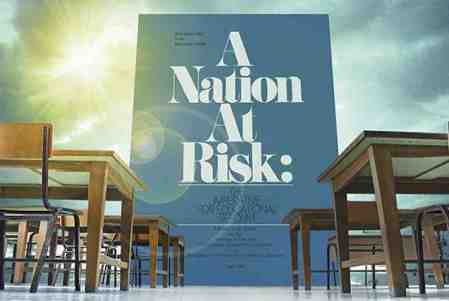
ae_summer2015mehta_opener-1100x736

Cover of A Nation at Risk: The Imperative for Educational Reform, the 1983 report that started the education reform mess. AFT graphic.

Stand up for your nation, it’s children and future; sound the alarm:

Add to FacebookAdd to NewsvineAdd to DiggAdd to Del.icio.usAdd to StumbleuponAdd to RedditAdd to BlinklistAdd to TwitterAdd to TechnoratiAdd to Furl


Read the rest of this entry »


Schafersman’s testimony on social studies standards, to Texas SBOE

January 13, 2010

Dr. Steve Schafersman will testify on proposed new standards for social studies in Texas public schools, at a hearing before the Texas State Board of Education (SBOE) scheduled for today, January 13, 2009.

Schafersman is president of Texas Citizens for Science and its driving force.  He’ll also live blog much of the hearing at his blog, Evo-Sphere.  You should probably watch TFN Insider, the blog of the Texas Freedom Network, too.

Schafersman’s testimony was released in advance, and reprinted below.

Public Testimony of
Steven D. Schafersman

Texas State Board of Education Public Hearing
Austin
, Texas; Wednesday, 2009 January 13

I am grateful for the opportunity to address you about Social Studies standards for which I am testifying as a private citizen. Tomorrow you will begin your work to adopt the new Social Studies TEKS. I closely read and evaluated the proposed Grade 8 Social Studies, High School U. S. History, U. S. Government, World History, and World Geography standards and found them to be quite satisfactory. The standards were extremely comprehensive, balanced, fair-minded, and honest. The members of the panels who wrote them did an outstanding job and I was very impressed by their knowledge and professionalism. I urge that you adopt these Social Studies standards without change.

My experience with this Board leads me to suspect that some of you don’t want to adopt these excellent standards–written by social studies curriculum experts and teachers–without change. After all, these standards were written by experts and some of you feel obliged to stand up to the experts. Some of you may want to change some of the standards to correspond to your own political and religious beliefs, such as the mistaken notions that the United States is a Christian nation, that we do not have a secular government, or that separation of church and state is a myth. Some of you may want to add more unnecessary information about Christian documents or Christian history in America. If some of you do wish to make such changes, I request that you restrain yourselves. Please resist the temptation to engage in the same behavior some of you exhibited last year when you perverted the Science standards and embarrassed the citizens of Texas by engaging in pseudoscientific anti-intellectual behavior. While the Texas State Board of Education has a long and proud history of anti-intellectualism, the economic conditions today demand that we stop that practice and return to professionalism and respect for academic achievement so that our children have a future in which they will use their minds to make a living in intellectual pursuits and not their limbs in a service economy.

During the adoption of the science standards, some Board members amended the Biology and Earth and Space Science standards by engaging in fast talking, omitting pertinent information about what was being changed, offering bogus “compromises” that were not really fair compromises, and referring to “experts” who were in fact pseudoscientists and not real experts at all. I hope to not witness the same behavior tomorrow but I am pessimistic. Two pseudo-historians, David Barton and Peter Marshall, were appointed as “experts” and there is plenty of evidence available that demonstrates that these two gentlemen are preachers and polemicists for their radical agendas, not legitimate history experts.

I urge the rational and conservative Board members–whom I hope still make up a majority of this Board–to resist proposed radical amendments that attempt to insert bogus histories of American exceptionalism, America’s presumed Christian heritage as the source of our liberties and Constitutional principles, and other historical myths perpetrated by the American Religious Right. I urge you to vote No to such radical amendments, not Abstain or your radical opponents will gain the same advantage that they enjoyed during the amendment process for the Science standards, where they were delighted when some of you abstained or did not vote since that made it easier for them to obtain majorities which allowed them to win several amendments that made changes detrimental to science education. Unlike last year, when you were prevented from consulting your legitimate Science experts during debate, please consult your genuine Social Studies experts, Texas Professors Kracht, Hodges, and de la Teja. Please try to avoid the same mistakes with the Social Studies adoption process that occurred with the Science standards adoption, so no one will be able to accuse you of being anti-intellectual.


Story of Cap and Trade – yes? no?

January 11, 2010

From the same woman who gave us the brilliant “The Story of Stuff” a while back, a new film that says cap-and-trade policies are destructing and not to be trusted. What do you think?

I think it’s a great explanatory piece, despite my disagreements with her policy.  It’s probably a great film to use in economics class, yes?
