Chicken or egg, teacher or cynic

February 17, 2009

Do only cynics become teachers, or does teaching make one cynical?

NYC Educator writes about being astounded to discover that the nation’s current economic woes can be cured by cutting teacher pay and benefits, as some propose.

Another teacher writes to the Bathtub complaining about printing progress reports on his computer at home — his district’s computer system is notoriously weird in remote access mode.  Why is he printing the reports at home?  “It’s been 11 months since we got a delivery of toner cartridges for teachers’ in-room printers, and we’re out of paper again.”

When do you think was the last time New York Mayor Bloomberg had to run the city budget on his home computer?

Is it really cynicism if it’s dead right?


Economics: Tracking layoffs

January 28, 2009

Economics students doing reports or projects on employment or unemployment rates?

Need something depressing?

Check out Layoff Daily.

Let’s hope they run out of news, very, very soon.

Tip of the old scrub brush to Californian in Texas.


Recession, or depression? Judge Posner sez . . .

January 12, 2009

Why beat around the bush?  Judge Richard Posner said at his blog:

I suspect that we have entered a depression. There is no widely agreed definition of the word, but I would define it as a steep reduction in output that causes or threatens to cause deflation and creates widespread public anxiety and a sense of crisis.

He has some interesting, and puckering, things to say about Bernanke’s actions, and Obama’s plans, too. His blogging colleague, Nobel-winning economist Gary Becker, has more tentative, still-Friedmanian remarks about crowding out tendencies of government spending.

It’s fun to read good economists trying to make sense of all of this.

I attended a session at the Dallas Fed a few weeks ago.  The VP who gave the main presentation talked about a meeting in which someone asked Bernanke, the great scholar of depressions, a highly technical, academic and potentially embarrassing question about the Fed’s work.  Bernanke closed off with an eye-twinkling comment:  “This would all be very interesting, if it were not happening to me.”

Yeah, if only it weren’t happening to us, now.


Killer county budget: “People will die”

November 27, 2008

How bad is our economic mess?

Ask county officials in Hamilton County, Kentucky (across the Ohio River from Cincinnati, Ohio).  According to Cincinnati.com, the website for the Cincinnati Enquirer:

County Administrator Patrick Thompson said Monday that the county may have to slash another $2.3 million from its already bare-bones budget proposed for 2009 because of tumbling sales tax collections and reduced funding from the state.

That means that the county will have to find more cuts on top of the more than $40 million it’s already cut from departmental requests.

The news comes as the county sheriff and other public safety officials say even the current recommendations will devastate their ability to do their jobs.

“It’s downright dangerous,” said Michael Snowden, director of Hamilton County’s Emergency Management Agency. “People will die. It’s as simple as that.”

He was referring to a recommendation to withdraw funding for the Greater Cincinnati Hazmat team, which responds to hazardous material spills.

The budget for 2009 has already been cut $31 million below the budget for 2008, to $241 million total.  Recommendations are already in place to lay off 500 workers.

What to do?

Project lower sales tax revenues.  Already done.

The county previously predicted $65 million, or a 0 percent growth, in sales tax receipts next year. Sales tax revenue typically accounts for about 25 percent of the county’s general fund budget. But because of the credit crunch and bailout fallout, all of which just came to a head in the past few months, spending has plummeted and the holiday shopping picture looks bleak. Thompson asked the board to revise that number to $63.9 million, a decrease of $1.1 million.

Maybe the state government can help out?

He also recommended reducing the amount of local money the county would receive from the state by 5 percent, or $1.2 million, to about $22.8 million because the state is in a similarly tough budget situation and likely won’t be able to fund the county adequately.

At least make sure that the public safety offices get funded.

Hamilton County Sheriff Simon Leis said the cuts will have a “dramatic impact” impact on his department. “In my career in law enforcement, this is the worst I’ve ever seen,” he said after the meeting about the budget situation. “We’ve got major problems.”

He said he may decide to cease providing security at the county buildings rather than take deputies off the road. If the county closes the Queensgate jail, 84 corrections officers and 25 support personnel would lose their jobs and 450 inmates would be released, said Leis. Because the county’s main jail has long been out of room, the Queensgate jail, meant for only low-level inmates, now also houses some of the more serious offenders, he said. Inmate charges include burglary, robbery and drug abuse.

“We do have violent offenders down there,” Leis said. “They’re not choir boys.”

The county says it can’t afford to staff or maintain the aging jail, which it leases from a corrections company.

By law, the Hamilton County, Ohio, budget needs to be locked in by January 1, 20 days prior to the inauguration of the new president. No one is talking about bail-outs for state and local governments, yet.

What would you do?


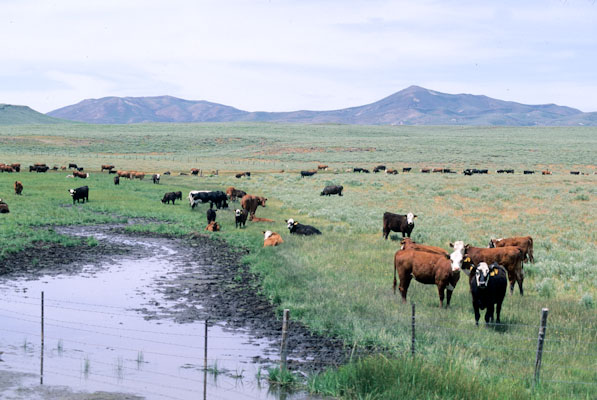
Public Lands insanity

November 16, 2008

Remember when Strange Maps “discovered” that so much of the 13 western states is owned by the Federal Government?  On the one hand, it was nice to see people paying attention to public lands in the west.

Public lands in a western state, with grazing cattle. Wild Earth Guardians image.

Public lands in a western state, with grazing cattle. Wild Earth Guardians image.

Public lands.  Photo from the Montana Wildlife Federation

Public lands. Photo from the Montana Wildlife Federation

At the Bathtub, we remarked on the history of the issue with a map that showed where the publicly-owned lands really are (the Strange Maps version only showed a dot in the middle of each state proportionate to the federal land held in the state.)  On the other hand, it was an open invitation for know-nothings and know-littles to jump in with silly ideas.  Remarkably, the post remained free of such folderol — until just recently.

None of these sites gives any serious thought to the idea.  None provides a scintilla of an iota of analysis to indicate it would be a good idea.

As one of the the principal spokesmen for the Sagebrush Rebellion in the early days, I want it known that I’ve thought these issues through, and argued them through, and followed the documentation for 30 years (Holy frijole!  I’m old!).  Issues with public lands revolve around stewardship.  Bad stewardship is not improved by a change in ownership.  Ownership change has all too often only led to worse stewardship.  Selling off the public lands is a generally stupid idea.

Certain local circumstances change the nature of a tiny handful of such deals — but not often, not in many places, and not enough to make a significant contribution to retiring any debt the federal government owns.

On the other hand, incomes from these lands typically runs a few multiples of the costs of managing them.  The Reagan administration discovered the lands were a great source of money to offset losses in other places, and for that reason (I suspect) never really got on the Sagebrush Rebellion band wagon — or, maybe Reagan’s higher officials just didn’t get it.

It’s troubling that such a flurry of stupidity strikes now, during a transition of presidents. This is how stupid ideas get traction, like kudzu on a cotton farm, while no one is paying deep attention.  Let’s put this idea back into its coffin with a sagebrush stake in its heart.

Bottom line:  Keep public lands in federal trust.  The Sagebrush Rebellion is over.  The sagebrush won.

_____________

Speaking of presidential transitions, who should be Secretary of Interior?  Stay tuned.

More:

Update 2014: The original GSA map showing percentages of federal holdings in each state (including Indian Reservations as federal holdings), as published in Strange Maps when it was still active.

Update 2014: The original GSA map showing percentages of federal holdings in each state (including Indian Reservations as federal holdings), as published in Strange Maps when it was still active.


Recession or depression: Anecdotal evidence

October 23, 2008

Schools and teachers in Dallas still scramble to deal with the layoff of just over a thousand, including several hundred teachers.  At our school, schedule changes will be effective Monday, we hope.  Hundreds of students will have new schedules; in one case, we’re abandoning one elective entirely.

Teachers, staff and administration are shaken at best, bitter in worse cases, struggling to catch up everywhere.

About a dozen other teachers now have dropped by my classroom, asking about comparisons to corporate layoffs, an area where I have more experience almost all on the survivor side.   If I had to typify their reactions, I’d say the corps of teachers in Dallas is just scared.

Other economic stories don’t help.  Supplemental retirement funds have been hammered by Wall Street’s woes.  I hear teachers saying they had hoped to retire in a year or two, but can’t now, especially with a child or grandchild in college and tuition costs rising.

Also, locally, Dallas is supposed to lose a score of Starbucks locations (600 across Texas).  The first to close was the closest to Molina High School, last spring.  Last night Starbucks shuttered the first location south of the Trinity River in Dallas, a partnership with Magic Johnson, on Camp Wisdom Road.  It’s about four miles from here, a site I visited often when it first opened, but lately only when I get the tires rotated at the shop across the street.

Both of my parents lived through the Great Depression.  My mother graduated from Salt Lake City’s West High in 1932, and plunged into the grim job market.  She said that, on the farm, they had little awareness of the depression.  On farms in the late 1920s, everyone was poor.  Off the farm, things were a lot worse.

My father spoke about catching the first job that comes along.  His series of jobs in the Depression came from big businesses collapsing about as often as he got a better job from jumping.  He said it was possible to stay in employment, but once one got knocked out of the employment market, it was very difficult to get back in.  He was happy to have the skills to get a job behind a drugstore or cigar store “fountain.”

What was the difference between a depression and a recession?  They couldn’t say.

Tuesday I dropped into our remaining local Starbucks (may it remain open) for the weekly purchase of the New York Times featuring the science section. The woman barista noted my identification badge.  “My husband was just fired from that school,” she said.

I said I was sorry, I said we miss him badly (true in all cases).  I told her I hope he finds something soon.

Then I had to leave fast.

She’s working in a location condemned to close.  He’s just been laid off.  I didn’t ask about children.


Immigrants learning English: Not so fast

October 22, 2008

Economics fans, pay attention:  Immigrants tend not to learn English when they move to America.  Moreover, they do well without it.

Greg Laden’s got a nice write up of a study on immigrants learning English.  I especially liked this story:

I once met … at a centenary celebration of some kind … the grandchild of a man who moved as a teenager from the old country to southern Wisconsin, ahead of his family, to learn the local customs, farming techniques, and language. After a few years in a small town in Wisconsin, his family arrived to start farming. The young man had indeed learned the local practices, the local farming techniques, and the local language. German. His family, arab speakers from Palestine, were well served by this young man because German was all they needed to get along in the US.

Not what the “English only” crowd wants to hear.

Here’s the citation on the study Greg Laden wrote about:

M. E. Wilkerson, J. Salmons (2008). “GOOD OLD IMMIGRANTS OF YESTERYEAR,” WHO DIDN’T LEARN ENGLISH: GERMANS IN WISCONSIN American Speech, 83 (3), 259-283 DOI: 10.1215/00031283-2008-020 [you’ll need a paid subscription for the full text]


Cut off your arm, move on

October 17, 2008

It will probably be several weeks before the full effects are known. Dallas ISD is about 500 teachers lighter today than it was two weeks ago. Yesterday the forced layoff notices went out, to teachers whose positions could not be saved by another teacher’s having retired, or simply resigned.

There is great irony. The year started with a mass meeting of Dallas’s 20,000 or so teachers, with an inspirational speech from a Dallas fifth grader. After nearly a decade of shaky leadership at the district office, most people thought Dallas ISD Superintendent Michael Hinojosa was close to established trim in the ship of educational state. Even Dallas Mayer Tom Leppart showed up to congratulate Hinojosa and cheer on the teachers.

News of an $84 million shortfall, the result of finance and payroll offices failing to integrate their systems, followed a couple of weeks later, and it’s been a downhill slide for teachers since then. NEA and AFT affiliates point to a lot of problems in Dallas ISD financial controls. How could they not notice an $84 million hemorrhage?

(Let me note here that I’ve been at private corporations that made errors of similar magnitude. Generally the problems were dealt with quietly. “Writeoff of bad investment” was what the annual reports usually said, or something like that.)

Originally, we heard 750 teachers would go. There are about 250 schools in the district — three teachers per school. Welcome to “Survivor, Dallas ISD.” Who gets to vote whom off the island?

Morale is low. It’s been interesting to see who used the turmoil as just an excuse to get out. It’s been interesting to see how many teachers had illnesses suddenly flare up. Requests for information or work from the central offices get a lot more sneers from teachers. In the teacher’s work areas, in meetings in the hallways, cynicism rose to all time highs.

Our department of about 20 people lost two — one position that was not yet filled, and one retirement. That’s a 10% hit. Overall, our school lost just under a dozen teachers. So much for the “three per school” hope. It’s still unclear how some classes will be covered come Monday. Some schools will have to shuffle their student/class assignments completely. We’re starting over on the year, eight weeks in.

Some of the effects are predictable, some are not.

  • Special education teachers laid off complain that they are paid from federal funds. At least one will sue.
  • Students whisper to other teachers, wondering whether their favorites will go (why don’t they as the teacher?); sometimes the students hope a teacher will be terminated.
  • Already noted, illnesses appear to be up.
  • Several teachers with offers from other districts resigned, collecting a double paycheck for the next few months. Many of the teachers leaving Dallas are among the best. One we lost had just started what promised to be a brilliant career teaching math.
  • Parents are confused. We had report card/parent-teacher conferences last Monday. One family asked me whether schools would open at all come next Monday.
  • Class reshufflings yield gaps in education, when a student moves from one class where subject A had not been covered, to another class where subject A was taught in a project three weeks ago.

So, damage is done that cannot be undone. Teachers who had spirited devotion to their jobs and the district less than two months ago, hunker down.

Remember that rock climber who got his arm stuck under a falling rock? In 2003, Aron Alston amputated his own arm to get to freedom after a few days with his arm stuck.

That’s a good metaphor for Dallas schools right now. We’ve amputated most of an arm. No time to mourn. Move on. Except, there was no rock, and there was no chance to make such a clear calculation.

Ask not for whom the bells toll.

Tally from the Dallas Morning News:

The cuts

About 375: Teachers laid off Thursday, representing 3 percent of the district’s 11,500 teachers

40: Assistant principals and counselors released Thursday

152: Number of noncontract employees laid off last week, including clerks, office managers and teacher’s assistants

About 100: Number of unfilled, noncontract positions eliminated last week

62: Central office members laid off

About 100: Number of vacant central office positions eliminated

More than 200: Number of employees who have voluntarily resigned

Total: More than 1,000 total positions eliminated

Projected savings

$30 million: Expected savings from job cuts and unfilled vacancies

$38 million: Expected savings from cutting various programs throughout the district

Total: $68 million

Resources:


Econ Nobel goes to Paul Krugman

October 13, 2008

His long-time readers of his columns for The New York Times were even surprised — not used to hearing the Nobel goes to someone you read a couple of times a week:  Paul Krugman of Princeton University won the 2008 Nobel Prize for Economics.

Congratulations!


Obama didn’t start the sub-prime mortgage crisis

October 12, 2008

The intensity of the rabid attacks on Barack Obama is troubling. The issues grow more bizarre, the links to Obama grow more tenuous, and the shouts more shrill.

And that’s from the reasonable opponents of Obama.

For example, over at the oddly-named IUSB Vision Weblog (Indiana University – South Bend), there is much yammering about how Barack Obama personally is responsible for the sub-prime mortgage industry collapse, because he represented an ACORN client in a redlining case and won the decision from the judge.

From there, the story trails off into a rabbit warren of wild conspiracy theories and the granting of supernatural powers to Obama (though the authors wouldn’t admit it’s supernatural). For example, there is this post about a letter Sen. McCain signed urging some action on oversight of federal mortgage refinancers.

The authors stoutly defend their bizarre claim that Congress is the agency responsible for the regulation of Fannie Mae and Freddie Mac through the OFHEO, Office of Federal Housing Enterprise Oversight. Congress maintains its usual oversight over the executive branch agency, but it is, after all, an executive branch agency. Think about your high school civics classes: Separation of Powers, Checks and Balances.

Congress is not the superintendent of OFHEO

Here is OFHEO’s mission statement — notice no reference to being in Congress’s chain of command:

OFHEO’s mission is to promote housing and a strong national housing finance system by ensuring the safety and soundness of Fannie Mae (Federal National Mortgage Association) and Freddie Mac (Federal Home Loan Mortgage Corporation). OFHEO works to ensure the capital adequacy and financial safety and soundness of two housing government-sponsored enterprises (GSEs) — Fannie Mae and Freddie Mac. Fannie Mae and Freddie Mac are the nation’s largest housing finance institutions. They buy mortgages from commercial banks, thrift institutions, mortgage banks, and other primary lenders, and either hold these mortgages in their own portfolios or package them into mortgage-backed securities for resale to investors. These secondary mortgage market operations play a major role in creating a ready supply of mortgage funds for American homebuyers. Combined assets and off-balance sheet obligations of Fannie Mae and Freddie Mac were $4.2 trillion at year-end 2005.

Fannie Mae and Freddie Mac are Congressionally-chartered, publicly-owned corporations whose shares are listed on the New York Stock Exchange. Under terms of their GSE charters, they are exempt from state and local taxation and from registration requirements of the Securities and Exchange Commission. Each firm has a back-up credit line with the U.S. Treasury.

OFHEO’s oversight responsibilities include:

Conducting broad based examinations of Fannie Mae and Freddie Mac; Developing a risk-based capital standard, using a “stress test” that simulates stressful interest rate and credit risk scenarios; Making quarterly findings of capital adequacy based on minimum capital standards and a risk-based standard; Prohibiting excessive executive compensation; Issuing regulations concerning capital and enforcement standards; and Taking necessary enforcement actions.

OFHEO is funded through assessments of Fannie Mae and Freddie Mac. OFHEO’s operations represent no direct cost to the taxpayer. In its safety and soundness mission, OFHEO has regulatory authority similar to such other federal financial regulators as the Federal Deposit Insurance Corporation, the Office of the Comptroller of the Currency, the Office of Thrift Supervision and the Board of Governors of the Federal Reserve System.

The legislation that established OFHEO also requires Fannie Mae and Freddie Mac to meet certain affordable housing goals set annually by the Secretary of Housing and Urban Development. These goals specify the share of mortgages that the two GSEs are required to purchase annually from low-income, moderate-income and central-city homebuyers.

And, explaining its role in mortgage refinance regulation:

OFHEO was established as an independent entity within the Department of Housing and Urban Development by the Federal Housing Enterprises Financial Safety and Soundness Act of 1992 (Title 13 of P.L. 102-550). The agency is headed by a Director appointed by the President for a five-year term.

OFHEO’s primary mission is ensuring the capital adequacy and financial safety and soundness of two government-sponsored enterprises, the Federal National Mortgage Association (Fannie Mae) and the Federal Home Loan Mortgage Corporation (Freddie Mac). Fannie Mae and Freddie Mac are congressionally-chartered, publicly-owned corporations whose shares are listed on the New York Stock Exchange.

Fannie Mae and Freddie Mac are the nation’s largest housing finance institutions. They buy mortgages from commercial banks, thrift institutions, mortgage banks, and other primary lenders, and either hold these mortgages in their own portfolios or package them into mortgage-backed securities for resale to investors. These secondary mortgage market operations play a major role in creating a ready supply of mortgage funds for American homebuyers. Combined assets and off-balance sheet obligations of Fannie Mae and Freddie Mac were more than $4.2 trillion at year-end 2005, which represents over 40 percent of mortgages outstanding.

In fulfilling its role in the secondary mortgage market, OFHEO promotes housing and a strong national housing finance system.

OFHEO’s oversight responsibilities include the following:
– Conducting broad-based and targeted examinations of Fannie Mae and Freddie Mac
– Making quarterly findings of capital adequacy based on a minimum capital standard and a risk-based capital standard
– Administering a risk-based capital standard, using a “stress test” that simulates interest rate and credit risk scenarios
– Prohibiting excessive executive compensation
– Issuing regulations concerning capital and enforcement standards
– Taking necessary enforcement actions
– Issuing an annual Report to Congress on the financial and operational condition of the Enterprises

OFHEO is funded through assessments on Fannie Mae and Freddie Mac. OFHEO’s operations represent no direct cost to the taxpayer.

The website for the agency is clear that it resides in the Department of Housing and Urban Development (HUD), though it is an independent agency whose director is appointed by the president for a five-year term. When I posted this information at IUSB Vision, however, it was censored. Instead, I got this charming response from the immoderator:

Ed – Stop lying,

You did not read the links. You need to start reading at OFHEO.gov and go and read the links I provided. OFHEO reports to Congress, not the administration. It is a fact. Deal with it. All you have to do is go read on their site THEY will tell you.

Charming fellow. He has censored all of my comments since then. At one point he was lecturing me that I didn’t know the organization. I pointed out to him that the Constitution makes clear the lines of organization in this case: OFHEO is an independent agency within the executive branch. It works closely with the Secretary of HUD. The organization charts show it is not a Congressional agency.

Similarly, this fellow is convinced that Obama, as a lawyer, made the federal courts dance to his tune. He appears to have no understanding for how federal courts work, nor for how a federal judge would regard any attorney acting as arrogantly as they claim Obama did.

Object lesson: You cannot reason a person out of a position he did not get to by reason in the first place.

Election, come soon!

Resources:


‘We don’t got no stinkin’ education. We don’t need no stinkin’ education!’

October 12, 2008

My family’s heritages are migrant and education. By that I mean that moving someplace else for a better life, and getting the kids into better schools, has been a tradition running back at least 6 generations. My paternal grandfather was a seaman in the British merchant marine. He married a woman in Guyana, then moved the family for a job in the stockyards in Kansas City, a better place to raise kids. His children became nurses, politicians, law enforcement officers, successful trucking magnates; his grandchildren are doctors, lawyers, nurses, business executives, and teachers — one Rhodes Scholar. I am second-generation American on my father’s side.

My maternal grandfather was a farmer of great skill. He moved from Provo, Utah, to the frontier town of Manila, Utah, then to Delta, then to Salt Lake City, in a quest for riches from farming. Deciding that wouldn’t work, he took a job with Utah Oil Co., a company that was eventually merged into Standard of Indiana and now, British Petroleum. His children all graduated from high school, except for the daughter lost in infancy. Several went on to college. They became construction company owners, contractors and engineers, railroad engineers, small company entrepreneurs and retailers. His grandchildren are physicians, lawyers, business executives, successful salesman, investors — and a couple of good old boys who scrape by (every family has some). My grandfather was second-generation from pioneers, people who moved their families west in wagons, or if necessary, on foot and pushcart. They were people who fought Indians sometimes, and died in those fights and in the migrations. They left legacies in the towns named after them, and in their records as educators — both my maternal grandparents were schoolteachers early on, many of their cousins were college professors, one a college president.

Education in our family was always viewed as a ladder to personal success, to a good life, if not always a key to economic well-being. Especially in the case of my maternal grandparents, there was great assistance from the Latter-day Saint emphasis on education.

If I had to typify their version of the American dream, certainly a huge part of that dream involved the kids getting educated well beyond their parents, and getting a better life as a result.

Education was a part of the American dream from pre-Revolution days. Foreign visitors often commented that in America the crudest of men read the newspapers and discussed politics with vigor and earnestness absent in other nations. Education was the cornerstone of freedom, in the view of Thomas Jefferson and James Madison, and as demonstrated by Benjamin Franklin, Alexander Hamilton, and George Washington.

Sometime in the 1980s, I think, the tide changed. Certainly the Reagan Revolution had something to do with it. Cuts in Pell Grants, the grants that got thousands of kids into college, were a signal that education was no longer valued as it once was. One by one the federal government stripped away some of the most important building blocks of our modern society, things like the GI Bill, which had provided America with a highly-trained, highly-skilled corps of engineers in the 1950s. Those engineers invented the infrastructure to our nation that now crumbles, and they invented the industrial processes, and sometimes the industries, that we now use daily. Transistors, which make computers possible on the scale we have today, were invented and developed into powerful “cogs” for machines that do what had not even been dreamed of 40 years earlier.

I can’t tell you exactly when the tide turned, but I can tell you when I first realized it had. After staffing the Senate Labor Committee for most of a decade, I escaped to the President’s Commission on Americans Outdoors, a good place for a budding environmental lawyer to work, I thought at the time. The chairman of the commission was Tennessee Gov. Lamar Alexander (now senator from Tennessee). Lamar had two big projects in Tennessee that he pinned his hopes for the state upon. Both were influenced in no small part by his work trying to recruit auto manufacturers to build production facilities in Tennessee.

Nissan and Toyota had levelled with him: Tennessee looked good, but for two things. First, there were few good ways to get products like automobiles out of the state to markets they needed to be sold in. Second, Tennessee’s education system wasn’t providing the highly-educated workers the car makers needed to run highly-sophisticated machinery in a fast-moving, just-in-time inventory system that produced high quality products at lowest cost.

Alexander responded with one initiative to build good roads out of Tennessee to major markets. He called that initiative “Good Roads.” He responded to the education needs with a program designed to plug money and support into Tennessee schools to improve education, bolstered by the report of the Excellence in Education Committee in 1983. He called that initiative “Good Schools.” In retrospect, those were good places to focus development efforts. Tennessee got at least one Japanese company to locate a plant there, and snagged the much-desired Saturn production plant of General Motors.

The Commission had some hearings in Tennessee. I was along on one of those hearings, and I was with Alexander when he was met by a Tennessee constituent who just wanted to talk to the governor. Alexander, being from Tennessee, hoping to keep his election chances good, and being a good governor, agreed to give the man and his wife a few minutes — I watched. The constituent complained about all the changes coming to Tennessee. He complained about the costs of the roads, and the costs of improving the schools. He worried about taxes, because, he said, he didn’t make a lot of money. Alexander assured him that his taxes would not rise much if any at all, and that especially the education part of the program would benefit all Tennesseans. “Do you have children?” Alexander asked the man.

He responded that he had two kids, both in their early teens. And then he said something that just stunned me: “You know, I’ve gotten by pretty good with my 8th grade education all these years, and I don’t see why my kids need to have any more than that. I’m not sure we need Good Schools.”

To Lamar Alexander’s everlasting credit — or shame, if you’re very cynical — he didn’t strike the man down. Alexander spent a few more minutes explaining the benefits the man’s children would have from better education, and he closed off telling about his meetings with car company executives who made it clear that they wanted to hire only good students who had graduated from good high schools, and maybe who had enough college that they could do the complex mathematics to run big machines. Alexander asked the man for his name and address, said his opinion was very important to him, and promised to get back in touch.

I suspect Alexander did contact the man later. His office tended to work very well on such matters as constituent contacts.

But I’ll wager he didn’t change the man’s opinion about education.

Sometime in the mid-1980s many Americans began to look on education as unnecessary, as expensive, and as “elitist” in a new, derogatory sense. Instead of education being something blue-collar workers hoped their children would earn, it became something blue collar workers felt oppressed by, somehow.

From that commission, I moved to the U.S. Department of Education, in Bill Bennett’s regime. Over the next few months I observed the same anti-education phenomenon playing out in debates about school reform in dozens of states. Then I got out of government and into private business, where education was demanded, and I only occasionally worried about the drama I had seen.

The past few weeks, especially since the nomination of Sarah Palin, have heightened my fears about the loss of the shared dream of better education for our children. It was part of the American psyche, woven into the fabric of our government from the “Old Deluder Satan” law in Massachusetts, which required towns of any size to set up some kind of school, through the Northwest Ordinances, which set aside sections of every township to be used for the benefit of public education, through the settlement of the west where nearly every town with a kid in it built a school — schools were built in Utah before many pioneers had houses to get them through the winter — through the dramatic rise of public education that helped knock out child labor, and that provided us with truly American armies and navies to get us out on top of two world wars.

Now comes conservative columnist David Brooks to explain how this process has been aided and abetted, if not intended, by the Republican Party, “The Class War Before Palin.”

In 1976, in a close election, Gerald Ford won the entire West Coast along with northeastern states like New Jersey, Connecticut, Vermont and Maine. In 1984, Reagan won every state but Minnesota.

But over the past few decades, the Republican Party has driven away people who live in cities, in highly educated regions and on the coasts. This expulsion has had many causes. But the big one is this: Republican political tacticians decided to mobilize their coalition with a form of social class warfare. Democrats kept nominating coastal pointy-heads like Michael Dukakis so Republicans attacked coastal pointy-heads.

Over the past 15 years, the same argument has been heard from a thousand politicians and a hundred television and talk-radio jocks. The nation is divided between the wholesome Joe Sixpacks in the heartland and the oversophisticated, overeducated, oversecularized denizens of the coasts.

What had been a disdain for liberal intellectuals slipped into a disdain for the educated class as a whole. The liberals had coastal condescension, so the conservatives developed their own anti-elitism, with mirror-image categories and mirror-image resentments, but with the same corrosive effect.

It’s a sobering piece. Please read it.

We remain a nation of migrants, a nation that migrates. We remain a nation that desires economic success and is willing to move to get it. Have we lost the good sense to remember that education improves our chances at success? Does Brooks explain the entire motivation for the War on Education?

What do you think?


McCain on Eisenhower’s two letters

September 27, 2008

In the first of the 2008 debates between presidential candidates, Sen. John McCain pointed to Gen. Dwight Eisenhower’s two letters, written on the eve of the D-Day invasion in June 1944.  One letter would be released.  The first letter, the “Orders of the Day,” commended the troops for their work in the impending invasion, giving full credit for the hoped-for success of the operation to the men and women who would make it work.

The second letter was to be used if the invasion failed.  In it, Eisenhower commended the troops for their valiant efforts, but said that the failure had been in the planning — it was all Eisenhower’s fault.  (It was not a letter of resignation.)

You can find the first letter, the one that was released, through links at this post at the Bathtub, “Quote of the Moment:  Eisenhower at D-Day Eve.”

The second letter, you’ll find in image and text with links to other sources at this Bathtub post, “Quote of the Moment:  Eisenhower, duty and accountability.”  Last year I wrote:

In a few short sentences, Eisenhower commended the courage and commitment of the troops who, he wrote, had done all they could. The invasion was a chance, a good chance based on the best intelligence the Allies had, Eisenhower wrote. But it had failed.

The failure, Eisenhower wrote, was not the fault of the troops, but was entirely Eisenhower’s.

He didn’t blame the weather, though he could have. He didn’t blame fatigue of the troops, though they were tired, some simply from drilling, many from war. He didn’t blame the superior field position of the Germans, though the Germans clearly had the upper hand. He didn’t blame the almost-bizarre attempts to use technology that look almost clownish in retrospect — the gliders that carried troops behind the lines, the flotation devices that were supposed to float tanks to the beaches to provide cover for the troops (but which failed, drowning the tank crews and leaving the foot soldiers on their own).

There may have been a plan B, but in the event of failure, Eisenhower was prepared to establish who was accountable, whose head should roll if anyone’s should.

Eisenhower took full responsibility.

Our landings in the Cherbourg-Havre area have failed to gain a satisfactory foothold and I have withdrawn the troops. My decision to attack at this time and place was based upon the best information available. The troop, the air [force] and the navy did all that bravery and devotion to duty could do. If any blame or fault attaches to the attempt, it is mine alone.

Who in the U.S. command would write such a thing today?

It was a case of the Supreme Commander, Allied Forces, taking upon himself all responsibility for failure.

McCain has called for the resignation of the chairman of the Securities and Exchange Commission, which he points to as part of his plan for accountability.  The analogy fails, I think.  The proper analogy would be George Bush taking blame for the current financial crisis.  In his speech earlier this week, Bush blamed homebuyers, mortgage writers, bankers and financiers.  If Bush took any part of the blame himself, I missed it.

I wonder if McCain really understands the Eisenhower story.  I still wonder:  Who in the U.S. command would write such a thing today?


Robert Reich: Prophet? Or just a very good observer?

September 21, 2008

Is Robert Reich a prophet, an economic and employment Jonah sent to Nineveh-on-the-Potomac?

Read Reich’s remarks, about the economics conditions of most Americans, including people in Pennsylvania, and Barack Obama’s observation that some people left behind by our economy are bitter.

Especially read the final three paragraphs, where he warns we are headed into even more turbulent economic waters.

Now notice the date of that piece.

What is your definition of “prophet?”


Just when you thought it was safe to go back into technology

September 18, 2008

Hewlett-Packard announced plans to cut thousands of jobs from tech consulting giant EDS, in Plano, Texas.

About 25,000 people will lose jobs in the next 36 months under plans from HP.


Frozen North economics: Where supply, demand and distribution are important problems

September 6, 2008

Especially you economics teachers, look at this very carefully:

Six cans of juice, at a store on Baffin Island - photo from Tales from the Arctic

Six cans of juice, at a store on Baffin Island - photo from Tales from the Arctic

How much do you pay for juice at your local market?

“The High Cost of Northern Living” at Arctic Economics points to Tales from the Arctic and “Believe me now?”

How much per ounce?

Kennie (at Tales from the Arctic) features a bunch of unbelievable prices.  Getting goods to towns in the far north of North America, in Canada and Alaska, is a major production.  Transportation and handling kick prices up a bit.

We’ll find out how alert Sarah Palin is when somebody asks her the price of a gallon of milk . . .

More seriously, economics teachers might find some object lessons in these photos, and a good presentation on supply and demand, and the costs of distribution.

Milk at $8.50 a gallon? Even in Canadian currency, that burns.

I wonder:  Do prices like these make economics any easier to teach to high school kids?  Does the urgency of high prices make the subject more relevant?

Tip of the frozen scrub brush to Arctic Economics, of course.