Education blogs: The second hundred most influential

August 30, 2013

Classroom blogs from David Reese Elementary in California -- how many classroom blogs made the lists of 200 most influential education blogs?  I'll guess it was zero.  Am I wrong?

Classroom blogs from David Reese Elementary in California — how many classroom blogs made the lists of 200 most influential education blogs? I’ll guess it was zero. Am I wrong? [Yes, I’m wrong. See Mr. Salsich’s classroom blog, for example.]

Round 2 of influential education blogs, from Onalytical.  Between this list, and the list of the top 100, which of your favorite and influential education blogs are NOT listed?  Numbers 101 to 200:

Further to our ranking of education blogs published last week, here is the list of the top 101 to 200 most influential education blogs, ordered by their Onalytica Influence Index.

Rank Name Influence Popularity Over-Influence
101 Research in Practice 14.2 10.3 1.0
102 Education Intelligence Agency 14.0 6.4 1.2
103 Stump The Teacher 13.8 20.5 0.6
104 Science teacher 13.8 10.3 1.0
105 LEADING IS LEARNING. 13.7 2.6 1.5
106 Educational Technology Guy 13.6 12.8 0.8
107 All Things Education 13.6 7.7 1.1
108 Doug Belshaw 13.4 15.4 0.8
109 English Raven 13.3 14.1 0.8
110 Hooked on Innovation 13.2 7.7 1.0
111 The Edge of Tomorrow 13.2 5.1 1.2
112 happy hooligans 13.1 3.8 1.3
113 Teach Preschool 12.8 5.1 1.2
114 Teach Children Well 12.8 10.3 0.9
115 The 21st Century Principal 12.6 7.7 1.0
116 Ed & Workforce Dems 12.6 5.1 1.2
117 21st Century Fluency Project 12.5 10.3 0.9
118 Fair Languages 12.5 3.8 1.3
119 educationrealist 12.4 6.4 1.1
120 Steve Sailer: iSteve 12.4 5.1 1.2
121 Kirsten Winkler 12.4 6.4 1.1
122 100 Scope Notes 12.4 9.0 0.9
123 leavingcertenglish.net 12.3 1.3 1.5
124 Teach them English 12.3 12.8 0.8
125 The Tech Savvy Educator 12.3 9.0 0.9
126 Bulldog Readers Blog 12.2 11.5 0.8
127 Primary Tech 12.2 14.1 0.7
128 Beyond School 12.2 5.1 1.1
129 edtech digest 12.1 11.5 0.8
130 Sherman Dorn 12.1 9.0 0.9
131 teachbytes 12.1 10.3 0.8
132 eFace Today 12.0 7.7 1.0
133 Anseo! 12.0 2.6 1.3
134 Watch. Connect. Read. 12.0 12.8 0.7
135 My Web 2.0 Journey 12.0 7.7 1.0
136 Successful Teaching 11.9 7.7 1.0
137 The Jose Vilson 11.9 6.4 1.0
138 Bill Boyd – The Literacy Adviser 11.9 1.3 1.5
139 Moturoa  11.9 3.8 1.2
140 PHSdirectorBLOG 11.9 3.8 1.2
141 21st Century Collaborative 11.8 7.7 0.9
142 Donald Clark Plan B 11.8 10.3 0.8
143 Creating Lifelong Learners 11.8 3.8 1.2
144 21k12 11.8 15.4 0.7
145 Education for Everyone 11.7 2.6 1.3
146 Love Learning…. 11.7 7.7 0.9
147 Principals Page 11.7 7.7 0.9
148 The Daily Riff 11.7 5.1 1.1
149 Reflections on Teaching 11.6 6.4 1.0
150 SCC English 11.6 2.6 1.3
151 TechChef 11.5 7.7 0.9
152 The Busy Librarian 11.5 9.0 0.9
153 Learning in Technicolor 11.5 12.8 0.7
154 teach from the heart 11.4 5.1 1.1
155 The Unquiet Librarian 11.3 7.7 0.9
156 Life is not a race to be first finished 11.3 3.8 1.1
157 Ozge Karaoglu’s Blog 11.2 15.4 0.6
158 New Tech Network 11.2 3.8 1.1
159 CristinaSkyBox 11.2 6.4 1.0
160 C-O Connections 11.2 3.8 1.1
161 Dr. Cook’s Blog 11.1 6.4 1.0
162 Blogging through the Fourth Dimension 11.1 15.4 0.6
163 Fearghal’s blog 11.1 3.8 1.1
164 Catlin Tucker 11.1 12.8 0.7
165 The Avery Bunch 11.1 12.8 0.7
166 Mr. Salsich’s Class 11.1 10.3 0.8
167 Venspired 11.1 12.8 0.7
168 The Number Warrior 11.1 10.3 0.8
169 Edukwest 11.0 7.7 0.9
170 kitchen table math, the sequel 11.0 7.7 0.9
171 Shifting Phases 11.0 7.7 0.9
172 An A-Z of ELT 11.0 21.8 0.5
173 Oliver Quinlan 11.0 9.0 0.8
174 Teaching Chemistry 10.9 2.6 1.2
175 #batttuk 10.8 2.6 1.2
176 Burcu Akyol’s BLOG 10.8 9.0 0.8
177 Educator, Learner 10.8 3.8 1.1
178 4C in ELT 10.8 14.1 0.6
179 21 st Century Educational Technology and Learning 10.8 12.8 0.7
180 Labour Teachers 10.7 9.0 0.8
181 Teacher Tom 10.7 9.0 0.8
182 Reading By Example 10.7 7.7 0.9
183 Geeky Mom 10.7 3.8 1.1
184 4KM And 4KJ @ Leopold Primary School 10.7 16.7 0.6
185 Mike Klonsky’s SmallTalk Blog 10.7 7.7 0.8
186 transformED 10.6 9.0 0.8
187 molehills out of mountains 10.6 5.1 1.0
188 West Hunter 10.6 2.6 1.2
189 Local Schools Network 10.6 7.7 0.8
190 Ecology of Education 10.5 3.8 1.1
191 Vicky Loras’s Blog 10.5 21.8 0.5
192 opencontent.org 10.5 7.7 0.8
193 Blogging about the Web 2.0 Connected Classroom 10.4 14.1 0.6
194 Penelope Trunk 10.4 3.8 1.1
195 Drape’s Takes 10.4 6.4 0.9
196 Clouducation 10.4 5.1 1.0
197 Lexical Linguist 10.4 5.1 1.0
198 The Speech Guy 10.4 2.6 1.2
199 speechie apps 10.4 5.1 1.0
200 Teachers At Risk 10.4 2.6 1.2

Posted: 24 June 2013 12:39 • By: Andreea Moldovan

More:


Econ blogs! What about the top education blogs?

August 30, 2013

Turns out Onalytica ranks education blogs, too — in fact, they’ve done it twice, with an update already.

“Education blog” graphic found at Natural by Design

Here are the top 100 education blogs (no surprise; Millard Fillmore’s Bathtub is not among them) — the second hundred, I’ll list in a separate post.

The methodology sounds solid — but isn’t it interesting that they missed so many education blogs in their first cut in January?  I wonder what that means.

Logo for Onalytical Indexes

Logo for Onalytical Indexes

Which of your favorites are not on the list at all?

In a previous post we published a list of the top 100 most influential education blogs, ranked by their Onalytica Influence Index. Six months on, we have made an updated list of the top influential bloggers.

For a detailed explanation of the methodology we refer to our previous post. As before, we report the following metrics: Onalytica Influence Index, Popularity and Over-Influence.

The Influence Index is the impact factor of the blogs, similar to the impact factor of academic journals; Popularity measures how well-known a blog is among other education blogs and Over-Influence seeks to capture how influential a blog is compared to how popular it is.

The movements in the ranking have been caused by a change in the quantity and quality of citations that a blog has received. If a blog has gone up it means that it has been cited by more influential blogs lately and/or has received a higher number of citations. Moreover, there are new influential blogs that we have only recently started monitoring.

Stay tuned for more updates on education blog rankings.

Change In Rank Rank Name Influence Popularity Over-Influence
1 Dan Meyer’s Blog 100.0 82.1 1.6
2 Hack Education 97.4 42.3 2.7
3 ↑ 3 Dangerously Irrelevant 63.7 59.0 1.3
34 ↑ 4 Diane Ravitch’s Blog 61.9 66.7 1.2
2 ↓ 5 The Principal of Change 61.8 56.4 1.3
3 ↑ 6 Free Technology for Teachers 58.2 93.6 0.8
17 ↑ 7 Will Richardson’s Blog 53.5 37.2 1.6
8 ↑ 8 Stephen Downes 48.2 25.6 1.9
New Entry ★ 9 Cool Cat Teacher Blog 47.9 46.2 1.2
New Entry ★ 10 Steve Hargadon’s blog 45.2 30.8 1.6
3 ↓ 11 The Blue Skunk Blog 44.8 33.3 1.5
8 ↓ 12 Larry Ferlazzo’s Websites of the Day … 44.2 70.5 0.8
1 ↑ 13 Getting Smart 42.3 34.6 1.4
New Entry ★ 14 for the love of learning 40.8 35.9 1.3
3 ↓ 15 Practical Theory 38.0 30.8 1.3
9 ↓ 16 Ideas and Thoughts 36.7 38.5 1.1
New Entry ★ 17 Computing Education Blog 35.9 9.0 2.7
8 ↑ 18 The Learning Spy 35.1 35.9 1.1
14 ↓ 19 The Learning Network 35.1 34.6 1.1
New Entry ★ 20 On an e-Journey with Generation Y 33.1 7.7 2.6
9 ↑ 21 Shanker Blog 32.4 28.2 1.2
29 ↑ 22 Kevin’s Meandering Mind 32.1 16.7 1.7
New Entry ★ 23 Granted, and…thoughts on education by Grant Wiggins 29.9 33.3 1.0
New Entry ★ 24 The Core Knowledge Blog 29.6 21.8 1.3
New Entry ★ 25 The Education Trust 29.1 11.5 1.9
4 ↓ 26 Around the Corner-Mguhlin.org 28.4 12.8 1.8
New Entry ★ 27 Angela Maiers’ Blog 28.1 34.6 0.9
6 ↑ 28 This Week in Education 27.5 17.9 1.4
14 ↓ 29 Ewan McIntosh’s edu.blogs.com 27.1 21.8 1.2
10 ↓ 30 Moving at the Speed of Creativity 26.9 37.2 0.8
21 ↓ 31 The Thinking Stick 26.3 21.8 1.2
4 ↓ 32 David Warlick 25.6 25.6 1
New Entry ★ 33 Lisa Nielsen – The Innovative Educator 25.1 30.8 0.9
New Entry ★ 34 Tech Transformation 24.8 5.1 2.3
4 ↓ 35 Continuous Everywhere But Differentiable Nowhere 24.7 19.2 1.2
New Entry ★ 36 f(t) 24.4 20.5 1.1
New Entry ★ 37 I Speak Math 24.1 12.8 1.5
20 ↓ 38 Cogdogblog 23.8 20.5 1.1
29 ↑ 39 Action-Reaction 23.8 16.7 1.3
New Entry ★ 40 Math Mistakes 23.7 14.1 1.4
New Entry ★ 41 The Daring Librarian 23.5 23.1 1.0
23 ↓ 42 Open Thinking 23.3 21.8 1.0
New Entry ★ 43 Shawn Cornally’s Blog 23.0 20.5 1.1
New Entry ★ 44 Larry Cuban on School Reform and Classroom Practice 22.8 34.6 0.7
10 ↓ 45 Nerdy Book Club 22.8 30.8 0.8
New Entry ★ 46 always learning 22.7 14.1 1.3
14 ↓ 47 Learning in Hand 22.3 17.9 1.1
23 ↓ 48 Doug – Off the Record 22.2 16.7 1.2
New Entry ★ 49 Gary Rubinstein’s Blog 22.0 16.7 1.2
New Entry ★ 50 edrethink 21.7 26.9 0.8
New Entry ★ 51 TonyBaldasaro.com 21.6 2.6 2.4
20 ↓ 52 Let’s Play Math! 21.2 9.0 1.6
New Entry ★ 53 Change Agency 20.5 5.1 1.9
New Entry ★ 54 The Edublogger 20.2 100.0 0.3
55 Eduwonk.com 20.0 17.9 1.0
11 ↑ 56 Linking and Thinking on Education 19.9 15.4 1.1
New Entry ★ 57 Daniel Willingham’s blog 19.6 24.4 0.8
New Entry ★ 58 Colossal 19.6 6.4 1.7
2 ↓ 59 The Wejr Board 19.2 15.4 1.1
6 ↓ 60 Jay P. Greene’s Blog 19.2 16.7 1.0
61 My Island View 19.0 29.5 0.7
New Entry ★ 62 Van Meter Library Voice 18.6 15.4 1.0
New Entry ★ 63 Lost in Recursion 18.3 11.5 1.2
New Entry ★ 64 Computer Science Teacher 18.2 7.7 1.5
54 ↓ 65 David Wees 17.8 15.4 1.0
New Entry ★ 66 @theresashafer 17.7 2.6 2.0
New Entry ★ 67 Teachers as Technology Trailblazers 17.7 11.5 1.2
New Entry ★ 68 Digital Leader Network 17.5 2.6 1.9
New Entry ★ 69 Tait Coles @totallywired77 – Punk Learning 17.5 14.1 1.0
New Entry ★ 70 School Finance 101 17.1 19.2 0.8
New Entry ★ 71 Dropout Nation 17.1 11.5 1.1
New Entry ★ 72 Quantum Progress 17.0 15.4 1.0
New Entry ★ 73 Constructing Modern Knowledge 16.7 3.8 1.7
New Entry ★ 74 6D 2012 – 2013 Happy learners blog well 16.6 1.3 2.0
New Entry ★ 75 Remote Access even from here 16.3 7.7 1.3
59 ↓ 76 Annie Murphy Paul 16.3 23.1 0.7
New Entry ★ 77 iLearn Technology 16.3 16.7 0.9
New Entry ★ 78 A Difference 16.2 14.1 1.0
New Entry ★ 79 Bianca Hewes 16.2 6.4 1.4
10 ↓ 80 Marisa Constantinides – TEFL Matters 16.2 17.9 0.8
New Entry ★ 81 Nebraska Change Agent 15.9 9.0 1.2
New Entry ★ 82 Rational Expressions 15.7 11.5 1.0
21 ↓ 83 User Generated Education 15.7 15.4 0.9
48 ↓ 84 Assortedstuff 15.6 10.3 1.1
New Entry ★ 85 Half an Hour 15.7 11.5 1.0
41 ↓ 86 David Truss :: Pair-A-Dime for Your Thoughts 15.3 15.4 0.9
40 ↓ 87 I’m a teacher, get me OUTSIDE here! 15.1 9.0 1.1
New Entry ★ 88 Bob Sprankle’s Blog 14.9 7.7 1.2
New Entry ★ 89 The Doc Is In 14.9 1.3 1.8
32 ↓ 90 NYC Educator 14.9 10.3 1.0
New Entry ★ 91 Culture of Yes 14.8 10.3 1.0
New Entry ★ 92 Mrs. Yollis’ Classroom Blog 14.8 19.2 0.7
New Entry ★ 93 Math Mama Writes… 14.5 12.8 0.9
New Entry ★ 94 The Hum of Language Acquisition 14.5 5.1 1.3
New Entry ★ 95 Always Formative 14.4 12.8 0.9
New Entry ★ 96 Bud the Teacher 14.4 10.3 1.0
New Entry ★ 97 edcetera 14.3 9.0 1.1
New Entry ★ 98 The Fischbowl 14.3 17.9 0.7
28 ↓ 99 Learning in Burlington 14.2 15.4 0.8
New Entry ★ 100 Concrete Classroom 14.2 5.1 1.3

Posted: 18 June 2013 16:32 • By: Andreea Moldovan

Tip of the old scrub brush to Flemming Madsen at Onalytica.

More:


Her last day of teaching first grade

August 25, 2013

Diane Ravitch gets much better e-mail than I do; Ravitch said (images added here):

This came in my private email:

Woman teaching geometry, from Euclid's Elements.

Woman teaching geometry from Euclid’s Elements. Wikipedia image

As many of you know, I just retired from teaching, having spent most of my career in first grade. Over the last few years, my teaching had become gradually more restricted. Instead of running a center-based day, I was required to run scheduled periods of Fundations, Writing Workshop, Reading Workshop, and (this year) of Envision math. To encourage me to retire, my district had made a financial offer that was difficult to refuse. Almost simultaneously, my daughter had announced that she was pregnant with twins. The decision became easier and easier. As the pressures in New York State increased,  I decided what I wanted to do after retire: support families, fight the tests, tutor children to learn DESPITE the tests. That would mean running workshops for parents about curriculum. But that’s not what I want to write about tonight. I want to tell you about my last few weeks of teaching, and about my last good lesson.  

The district isn’t replacing me next year due to shrinking numbers. Once I announced my retirement, the vultures began to circle – teachers  seeking furniture, leveled books, left over supplies. (All of a sudden, my hoarding had value!) Gradually, my room became emptier and emptier. You’d have thought that my teaching would have suffered, but — I LOVED IT, AND SO DID THE KIDS!!! Painting, gluing, research, math projects; WE ALL RELISHED THE CHANGE! It was a very special time – though teary, for some. I’m not sure why my retiring should result in so many sad children (since I wouldn’t have been their teacher the following year), but there you have it. 

Pamela teaching her children (1743–45)

Joseph Highmore’s illustration of Pamela teaching her children (1743–45); in volume four of Samuel Richardson’s novel, Pamela, Pamela endorses much of Locke’s educational program, while at the same time claiming a valuable new role for mothers: educator.

Driving to school on my last full day, I thought about what I could teach that day in my empty classroom. All I had was art paper, scotch tape, and crayons. The kids had already taken home their markers. I thought about how I could say good-bye. I wanted to help them gain some perspective. I wanted them to know they had each other. (I’d already told them they could email.)  I thought about how our paths had crossed and come together so arbitrarily, but how being together in this class had changed all our lives. And then I knew what I’d do! 

I gave each child one piece of 12″ x18″ paper. I told them that each child was to draw a path across the paper. It could be straight across or curved or jagged – whatever. We agreed that the paths would be about a fist wide, and had to be drawn in purple. The rest of the paper was to be decorated with whatever else they thought might have been on their paths this year. 

Everyone did as I requested after a few false starts. Some of the drawings were quite thoughtful and charming.  I then told the kids that we were now going to connect our paths together. I was having a small get together that night, and I told the children we needed something on the wall. Immediately, some of the kids became excited, and tried to put their papers together. I suggested that the kids get on the floor and connect their paths like a puzzle, assemble their work on the floor, and that we’d move it to the wall later. I’d never done this activity before, and had no idea how it would turn out. Over the course of the next half hour, I kept telling myself: Remember, it’s process over product.  

As the kids worked, I gradually stepped back. The children were making decisions about which paths connected, which looked best together, which should be moved to a different spot. There were no arguments, even though there were differences of opinion. I handed the kids scotch tape dispensers as needed. I mentioned to one little boy that it was great that there were no fights. He said to me, “Well, remember when I invented a game for the playground and then we all had a fight because I wanted to make all the rules? Remember how you explained to me how a true leader doesn’t make all the rules, but helps others to join in? Well – maybe that’s what we’ve all been doing.” 

I was absolutely floored. 

That’s when I knew how much I’d miss teaching. That feeling of molding a group and helping them become better together than singly – that’s amazing.

Empty first grade classroom.  From A Day in First Grade blog.

Empty first grade classroom. From A Day in First Grade blog.


Burqas forced on Texas students?

August 23, 2013

Come the CSCOPE critics from the wilds of Texas:

Of course, if you ask DanaSomething, or any other CSCOPE critic, when and where that burqa event took place, she produces no evidence.

For three weeks now I’ve made a practice of asking CSCOPE critics for evidence of the evils of Texas teachers and curriculum planners they claim occur.

Not a single example has checked out.

If you’re familiar with the “burqa” controversy in Lumberton, Texas, you know the facts don’t square with the CSCOPE critics’ shorthand version.

Monday, February 25th, 2013

Lumberton ISD Response to CSCOPE and Promotion of Islam

Recently a picture had surfaced showing five students dressed in burqas (Islamic attire) in a World Geography classroom at Lumberton High School. The lesson that was offered was not a written CSCOPE lesson; however it informed students to the customary culture of the people in the Middle East. The lesson that occurred was presented on February 1, 2013. As part of the curriculum from the World Geography TEKS (as prescribed by the state of Texas), the students are to study the culture (TEKS number 17):

“Culture. The student understands the distribution, patterns, and characteristics of different cultures.” The student is expected to:

(A)  describe and compare patterns of culture such as language, religion, land use, education, and customs that make specific regions of the world distinctive;

(B)  describe major world religions, including animism, Buddhism, Christianity, Hinduism, Islam, Judaism, and Sikhism, and their spatial distribution;

(C)  compare economic, political, or social opportunities in different cultures for women, ethnic and religious minorities, and other underrepresented populations; and

(D)  evaluate the experiences and contributions of diverse groups to multicultural societies.”

The lesson that was offered focused on exposing students to world cultures, religions, customs, and belief systems. A description on the whiteboard behind the students show the splits in religions: Islam (Sunni and Shia), Judaism (Reform, Conservatives, and Orthodox), and Christianity (Catholic, Orthodox, and Protestant). Clothing expresses the individual culture. The lesson is not teaching a specific religion, and the students volunteered to wear the clothing.

The portrait focused only on Middle Eastern attire and the students are wearing variations of this customary attire found in the Middle Eastern culture. This portrait does not reflect the entire aspect of the lesson. The lesson encompassed diversity education so students receive a firm understanding of our world and why people are motivated differently.

Lumberton ISD has purchased the CSCOPE curriculum however; the teachers are not required to teach the lessons that are provided. The school district follows the Year at a Glance, a scope and sequence of the adopted Texas Essential Knowledge and Skills, as well as the Instructional Focus Document which explains the Rationale, Common Misconceptions for students, TEKS, and the Key Academic Vocabulary that supports conceptual development. The district has great teachers and supports the teachers and their individuality in methods of instructional delivery.

Lumberton is a small  town of about 12,000 people (2010 Census) a few miles north of Beaumont.  Lumberton Independent School District (ISD) schools are “recognized” under the old, just-outdated school and district rating system Texas used, suggesting that student achievement was above average.  State test scores tend to show the same. If this is their example, we should note that in addition to characterizing the lesson wrong, getting wrong the facts of students trying on clothes of other cultures, and the fact that this exercise is not at all related to CSCOPE, the students seem to be learning well.

Kudos to Lumberton, and to CSCOPE, right? Not for the Right Wing Crazies.

Remember, when Glenn Back went on national unwatched television to complain about the “Marxist” lesson in economics, when we finally got the slide, it showed clearly that it favored free marketry.

On this burqa thing?  I’m willing to say no kid has ever been “forced” to wear a burqa for any school purpose — though some may have put on a costume for a report (is that bad?).

In short, I find the critics of CSCOPE to be at odds with the facts, making stuff up to yell about.  Almost every single one of the criticisms for how the Texas standards on Islam are taught, involves the fact that Islam is taught about at all.  CSCOPE critics claim “indoctrination” when it’s clear from lesson plans, support materials, texts, state standards, and test results, that students are simply learning about history, geography and culture.

Shame on any politician who acts on such unhinged, false rants.

There’s a “debate” between Texas State Sen. Dan Patrick, R-Bedlam, and the most sane member of the Texas State Board of Education, Thomas Ratliff, set for this Saturday, in Tyler. One wonders how absurd it can get. Will Patrick tell us which Texas school forced kids to wear burqas?  Don’t bet on it.  Will Patrick provide any other evidence of rampant socialism or Marxism in Texas schools?  No, don’t bet on that, either.

More (good and bad information here; caveat emptor:

The world is still safe for fairness.

The world is still safe for fairness.  Joseph McCarthy remains in his grave on the banks of the Fox River in Appleton, Wisconsin; Texas critics of schools and teachers should leave McCarthy’s scurrilous methods and false claims buried, too.


MzTeachuh’s secret to getting to know students (a life hack everyone should know and use)

August 23, 2013

MzTeachuh posted this last year, and Tweeted it this year — it’s good on the first days of school.  Quoting the entire post (links added here):

A Writing Prompt to Really Get To Know Your Students

“Three Things I Want You To Know About Me.”

Jim Abbott of the Yankees, pitching a no-hitter.

I came up with this prompt while teaching high school, but it works with younger kids, too. It gives the students a choice of what to comment on, and allows them to use their own voice to tell it like it feels. You may learn a lot about music, sports, and their dog; but sometimes you will also learn about very serious topics like family crisis or illness. And at times the school can help the families. But you will know the students better, especially if you actually read the essays and comment on them. The kids feel very validated, and more willing to write the remainder of the year no matter what the topic.
Jim Abbott of the Yankees, pitching a no-hitter.

I especially enjoyed when the students shared their dreams for their future. You would be amazed how many major league baseball players (of the future) were in my seventh grade classes. Far be it from me to say otherwise. Who knows, anyway? If Jim Abbott, who had only one hand due to a birth defect, became a major league pitcher, shouldn’t I be like his grown-ups and be filled with

– See more at: http://mzteachuh.blogspot.com/2012/09/a-writing-prompt-to-really-get-to-know.html?spref=tw#sthash.taTaa9nj.dpuf

I told MzTeachuh:

Stealing this in its entirety.

As a reporter, I got a lot of mileage from politicians, or anyone involved in a controversy, asking “what should readers know about [you/this issue] that most of us don’t know now?”

With grownups, it’s quite educational to find people who haven’t thought beyond the shouting.

Open questions are the best; open questions that get kids to write in class are the cream of the best. If not exactly the path to truth, it is clearing the path to knowledge that leads to truth.

More, maybe related stuff:


Wisdom, a checklist about students’ use of technology

August 18, 2013

Cheat Sheet:  What do you want kids to do with technology?  By Bill Ferriter

Cheat Sheet: What do you want kids to do with technology? By Bill Ferriter The Tempered Radical blog.williamferriter.com @plugusin

“Technology is a tool, not a learning outcome,” Bill Ferriter says.  He’s right, of course.

Tip of the old scrub brush to April Niemela@AprilJNiemela.

More, generally:


Campout Bingo cards, from the National Wildlife Federation

August 16, 2013

Found this via a stream of Pinterest and other blog posts:  National Wildlife Federation (NWF) put together four great camping bingo cards to use with your kids — depending on how wild your backyard is, you may not even need to go far to play.

Here in South Dallas County, you can see much of this stuff with a stroll through a local nature preserve.

Teachers, you can use this idea, with pictures and words, yes?

Camping Bingo card from the National Wildlife Federation (NWF)

Camping Bingo card from the National Wildlife Federation (NWF); it comes in a set of four, in .pdf format

Here’s the link to get the four cards NWF created in .pdf. If you want to create your own (history, geography, mathematics, language arts) teachers, here’s a blank form in .pdf.

Tip of the old scrub brush to Duncanville ISD’s Judy Henry.

More:


Old teacher returns to the classroom, April 1970

August 16, 2013

In 1970, Lyndon Johnson met with students (at the University of Texas)

In 1970, Lyndon Johnson met with students (at the University of Texas Southwest Texas State University, in San Marcos), in a science lecture hall. Did the TV class have to relocate?

Johnson’s first job out of college was teaching Hispanic students, an experience that brought him to see the wisdom of civil rights laws and great education.  Who was in TV 2301.01 — and did they realize they’d have met with a president if they’d stayed in their classroom?

The photo was taken on April 27, 1970.  It comes from the collection of the LBJ Presidential Library, in Austin, Texas, via Wikimedia.  The Lyndon Johnson School for Public Affairs was established in 1970, but this photo may have been too early in the year for a class there.

Anyone have more details?  (See update below.)

Update: This photo may have been taken at LBJ’s alma mater, now the Texas State University at San Marcos, judging by this other photo I found at Humanties Texas.

Lyndon Johnson in the classroom during an April 1970 visit to his alma mater. Photo courtesy Texas State University-San Marcos.

Caption from Humanities Texas: Lyndon Johnson in the classroom during an April 1970 visit to his alma mater. Photo courtesy Texas State University-San Marcos.


Update, September 10, 2014:  Thanks @c_banks.

B3725-18A
Date: 04/27/1970
Credit: LBJ Library photo by Frank Wolfe
Event: President Lyndon B. Johnson meets with college students
Description: President Lyndon B. Johnson addresses students
Location: South West Texas State University, San Marcos, Texas
Collection: LBJ Library
Rights: Public Domain: This image is in the public domain and may be used free of charge without permissions or fees.

New Boy Scout merit badge: Sustainability

July 25, 2013

It’s Eagle required, too — well, Scouts can choose either Environmental Science or Sustainability, but must earn one or the other to earn Eagle rank.

Image of the Sustainability merit badge, from MeritBadge.org

Image of the Sustainability merit badge, from MeritBadge.org

Requirements for the new Sustainability merit badge were released on July 16, concurrent with the 2013 National Scout Jamboree at the Summit.  A lot of people missed the announcement, I’ll wager.

It’s good news.  Conservation and nature-related merit badges have suffered a decline in Scouting, it seems to me.  The conservation series was very much the keystone of a trek to Eagle when I was a Scout, at least as important as the citizenship series.  But I don’t see that emphasis in Scouting today, sadly.

BSA recently created a Mining merit badge, which created some quiet grumbles among conservationists — this new, Eagle-path badge more than makes up for that, I think (though mining is a great topic for Scouts, especially in the western U.S., I think).  This will not set well with the anti-conservation, anti-Agenda 21 crowd and their merry hoaxsters.  But nothing BSA does is removed from political criticism from the right any more (see this odd photo choice for the Sustainability badge notice at the radical right-wing Daily Caller site).

This announcement gives me hope.

More:

Below the fold, the requirements and announcement from Bryan on Scouting, at Scouting Magazine’s site, verbatim and in total.

Read the rest of this entry »


They’re coming for the science textbooks, again; join me in speaking up

July 23, 2013

I get e-mail, sometimes from the Texas Freedom Network. In this case, I’m happy to share. You need to know this.

Would you sign the petition?

Stand Up for Science

SUFS-Tex and T-Rex

Click Here to Sign the Petition

Dear Ed,

I’m worried about my kids’ future because of six words.

The Texas State Board of Education.

The state board has already begun working on its once-a-decade adoption of science textbooks for Texas classrooms. And for years, an anti-science faction of that board has done all it can to undermine the science of evolution and climate change by giving equal weight to nonscientific beliefs like climate change denial and the idea that dinosaurs and humans coexisted.

We’ve got news for those folks: Big Tex and T-Rex didn’t ride the range together.

It’s time to Stand Up for Science.

Click here to sign our petition and help us reach our goal of 5,000 signatures of Texans demanding that the State Board of Education approve science textbooks that are based on sound, peer-reviewed scholarship.

This fight is personal for me because from an early age, both my kids have loved science. In fact, my oldest son is enrolled in the “tech academy” at his middle school, where he’s learning about cool high-tech careers and honing computer skills that already put me to shame.

But whether you have school-aged kids or not, this fight is too important to the future of Texas and the nation to ignore. With over 5 million students, Texas is one of the country’s biggest buyers of textbooks. And that has an impact on other states because book publishers often follow our lead so that they don’t have to create different versions of the same science books.

I want my kids and every child to have classroom materials based on modern, mainstream science that gets them ready for college and prepares them for those high-tech jobs my son is learning about. Anything less handicaps their future and sets them up to fail.

For our children’s future, let’s win this.

Sign our petition to Stand Up for Science.

Regards,
Ryan Valentine
Deputy Director, Texas Freedom Network

They’re coming for Texas science textbooks, again; please stand up and speak out for science, for accuracy, for good education.

More:


If class size doesn’t matter, why do the charter schools list it as a key selling point?

July 18, 2013

Classroom in Edgewood ISD, San Antonio, Texas, in 2010. Photo by Bob Daemmrich

Classroom in Edgewood ISD, San Antonio, Texas, in 2010. Republican legislators want more classrooms like this one, crowded, to save money paying teachers and heating the rooms. Or maybe they have a real reason — it can’t be a good one. What’s the ratio, three kids to one desk? Did one kid fail to shower this morning.  Texas Tribune photo, by Bob Daemmrich

Steven Zimmer, a member of the board of the under-assault Los Angeles Unified School District, lays it on the line:  Class size is important, and legislative efforts to expand class size in public schools are intended to sabotage public schooling — and that action harms students.

Description of the video at YouTube from the OTL Campaign:

Small class size isn’t about protecting teachers’ jobs or making their work easier — it’s about providing every student with quality attention in the classroom. Steve Zimmer, Board Member of the Los Angeles Unified School District and a former teacher, asks why we tolerate or dismiss crowded public school classrooms when charters and private schools use small class sizes as a selling point?

More:

 J. D. Crowe cartoon from the Mobile, Alabama, Press-Register.

“OK, Class . . . How many of you are students adn how many are teacher consultants?” J. D. Crowe cartoon from the Mobile, Alabama, Press-Register, August 18, 2009.

“It could be worse — this could be a public school classroom during budget cuts.” Cartoon by Mike Keefe, Denver Post, March 18, 2011


History of America, or art in America, or American art, or . . .

July 9, 2013

Brilliant piece from Grant Snider — history teachers, this should be a poster in your classroom, no?  Art teachers?

Grant Snider's

Grant Snider’s “American Art, exploring a country through its paintings”

In the course of a junior-level, high school U.S. history class, students should experience each of these works, and many others.  This is one whimsical way to work with serious and uplifting material, no?

Mr. Snider has a short essay — inspiring — and the information on each of the works he portrays, at the Modern Art site (I’ve added links below, here).

Since that formative vacation, the art museum is always one my of first stops in visiting a new city. In the comic above, I’ve curated my ideal collection of 20th-century American art. Here’s a list of works in order of appearance:

Jasper Johns, “Flag”

Edward Hopper,Morning Sun

Ellsworth Kelly, “Red Blue Green”

Wayne Thiebaud, “Refrigerator Pie”

Grant Wood, “Young Corn”

Roy Lichtenstein, “Whaam!”

Stuart Davis, “Colonial Cubism”

Andy Warhol, “Campbell’s Soup Cans”

George Bellows, “Dempsey and Firpo”

Jackson Pollock, “Autumn Rhythm”

Georgia O’Keeffe, “Sky Above Clouds III”

What are your favorite American art works, and what do they portray or demonstrate that you like?

More:


One more time: Basic climate science with Bill Nye

July 4, 2013

What year is this? 2013?

Shouldn’t the Sputnik Revolution in science education have obviated the need for this video, like 30 years ago?

One more time, the basics of climate change/global warming, with Bill Nye the Science Guy explaining; from the ClimateRealityProject.org:

http://vimeo.com/climatereality/climate101

climate change, CO2, global warming, science, Bill Nye, environmental protection, Clean Air, Air Pollution

More:

Newsweek, March 4, 1957,

Cover of Newsweek Magazine, from March 4, 1957; notice this concern about U.S. science competency came seven months before Sputnik was launched by the Soviet Union. Science deniers then delayed action until after the Soviets demonstrated clearly that the U.S. was behind. (Image from Computer History.org)


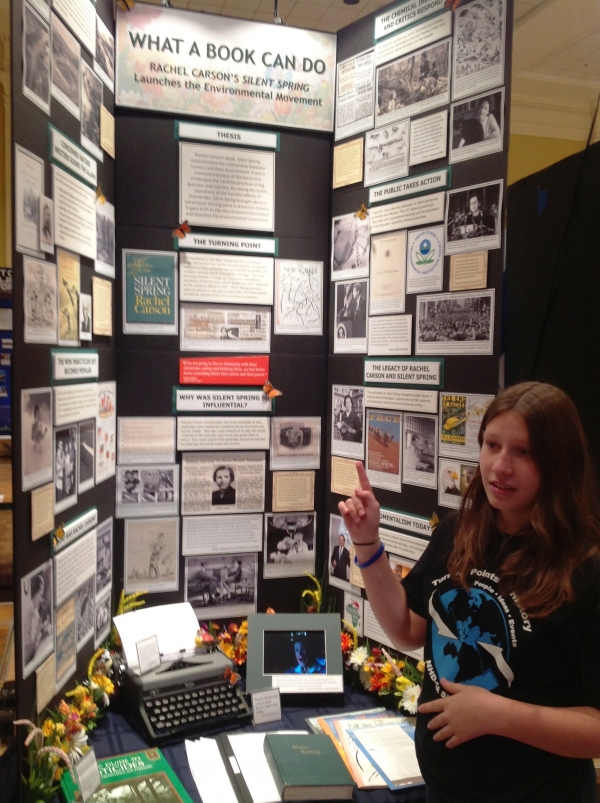
Rachel Carson project won first at National History Day competition

June 19, 2013

News from the San Ramon (California) Express [links added here, except for reporter’s contact]:

Julienne Sauer in front of her project,

Julienne Sauer in front of her project, “What a book can do — Rachel Carson‘s Silent Spring Launches the Environmental Movement.” (© 2013 San Ramon Express)

San Ramon student takes first at National History Day contest

by Jessica Lipsky

Windemere Ranch Middle School student was one of 30 recognized by the National Endowment for the Humanities (NEH) for their impressive use of historic newspapers in projects presented at National History Day.

Julienne Sauer, who graduated from eighth grade last week, took first place in NEH’s individual exhibit junior division for her project titled “What a book can do — Rachel Carson’s Silent Spring Launches the Environmental Movement.” This year’s National History Day theme was “Turning Points in History: People, Ideas, Events.”

Julienne was also named a National Endowment Humanities Scholar.

The annual event is the culmination of a year-long academic program in which students in middle and high school conduct original historical research for papers, exhibits, websites, documentaries and public performances. Each year more than 600,000 students compete in local, regional and state competitions for a chance to win a spot at the national finals.

This year was the first time NEH awarded prizes to students who incorporated into their projects research using Chronicling America, a free online database of 5 million pages of historic US newspapers dating from 1836 to 1922, digitized through a partnership between NEH and the Library of Congress.

Julienne won a national finalist award at the 2011 National History Day exhibit for her exhibit titled “The Cable Car Wars: A City Debates to Preserve its Character.”

Carson’s work was good enough that, even 49 years after her death, 51 years after the publication of Silent Spring, Carson and the book still inspire students to heights of excellence in study.

More:


How to tell testing is a monster in your local schools: “Test Menu”

June 18, 2013

This would be much funnier were it not so eerily close to stuff I’ve seen, even in great Texas school systems:

Details:

A :30 commercial created by The Canandaigua Film Society in Canandaigua, New York, to protest over-testing in schools in May 2013.

761

More: