And this one, which makes me happy we didn’t have this toilet when our kids were toddlers, and at war with each other, or just happy to study hydraulics with frequent flushes, frequently with stuff that shouldn’t be flushed:
Click image to test Kohler toilets [Update, August 2012: Alas, Kohler seems to have deactivated the interactive site.] [BUT, see update below.]
Kohler, clearly, had someone with Sen. Paul’s, er, um, problem, in mind!
So, Rand Paul no longer has a reason to be full of s—. It’s time he vote to endorse saving energy, as appliance and lightbulb manufacturers have done. Why is Paul so opposed to American business anyway?
Update: The Trophy Wife™ suggested somebody stage a showdown, or flush off between Jo the Plumber and Sen. Rand Paul. Jo the Plumber could see how well the Republican budget whacks flush away . . . “H.R. 1: Flushes cleanly! 382 pages gone! Appropriately disposed of! What do you want to flush next?”
Perhaps someone adept at editing flash videos could make that happen . . .
Update, May 2020: Fortunately, Kohler did a video of their interactive ad, and that still exists. I admit I enjoyed pointing to odd objects in the game, which Jo the Plumber then dutifully flushed. Video gives you an idea of what the toilet can handle, enough to handle Rand Paul and Donald Trump together, probably.
Spread the word; friends don't allow friends to repeat history.
Tuesday morning, March 8, the Republican-controlled House of Representatives Committee on Energy and Commerce opened hearings on global warming, staging an assault on science with a series of witnesses, some of whom recently have made a career out of mau-mauing scientists.
Dr. Donald Roberts’ testimony to the House Committee on Energy and Power, on March 8, 2011, presented a grand collection of Bogus History, coupled with Bogus Science. Roberts has an unfortunate history of presenting doctored data and false claims to Congress.
One witness took after the EPA directly and Rachel Carson by implication, with a specious claim that DDT is harmless. Donald Roberts is a former member of the uniformed public health service. Since retiring, and perhaps for a while before, he started running with a bad crowd. Of late he’s been working with the Merry Hoaxsters of the unrooted Astroturf organization Africa Fighting Malaria (AFM), a group dedicated to publishing editorials tearing down the reputation of Rachel Carson, the World Health Organization (WHO) and the Environmental Protection Agency (EPA).
(That would all be purple prose, were it not accurate in its description of people, organizations and their actions.)
Why was Roberts testifying at a hearing on global warming? He’s carrying water for the anti-science, “please-do-nothing” corporate crowd. It’s a tactic from the old tobacco lobbyist book: Roberts claims that scientists got everything wrong about DDT, and that the ban on DDT done in error has wreaked havoc in the third world. Therefore, he says, we should never trust scientists. If scientists say “duck!” don’t bother, in other words.
Roberts is in error. Scientists, especially Rachel Carson, were dead right about DDT. Because corporate interests refused to listen to them, the overuse and abuse of DDT rendered it ineffective in the fight against malaria, and DDT use as part of a very ambitious campaign to eradicate malaria had to be abandoned in 1965. The entire campaign had to be abandoned as a result, and more than 30 million kids have died since.
So don’t grant credence to Roberts now. He’s covering up one of the greatest industrial screw-ups in history, a screw up that, by Roberts’ own count, has killed 30 million kids. What in the world would motivate Roberts to get the story so wrong, to the detriment of so many kids?
Roberts said:
Putting issues of EPA budget aside, I want to introduce my technical comments with a quote from a recent Associated Press article with a lead statement “none of EPA’s actions is as controversial as its rules on global warming.” In my opinion, this is wrong.
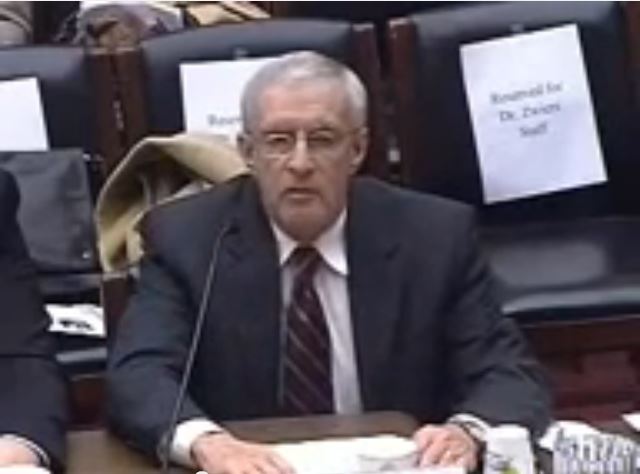
Dr. Donald Roberts testifying to the House Energy Committee, March 8, 2011. Screen capture from Committee video.
Roberts is correct here in his opinion. It is simply wrong that EPA’s rules on global warming and controls of the pollutants that cause it should be controversial. Among air pollution scientists the rules are not controversial. Among climate scientists the rules are not controversial. Roberts and his colleagues at the so-called Competitive Enterprise Institute, Africa Fighting Malaria (AFM), and American Enterprise Institute (AEI) work hard to manufacture controversy where the science does not support their case.
It is wrong. Roberts should be ashamed.
Roberts said:
Almost forty years ago EPA banned DDT in the United States. Its action against DDT was extraordinarily controversial, and still is. As activists advanced fearful claims against DDT, the EPA was warned, over and over again, a ban would destroy critically important disease control programs and millions upon millions of poor people in developing countries would die as consequence. Leaders of the World Health and Pan American Health Organizations, and even the U.S. Surgeon General warned against the ban. The EPA banned DDT anyway, and the doomsday predictions of those public health leaders proved prescient.
EPA’s ban on DDT in the U.S. was limited to the United States. Roberts doesn’t say it flat out, but he implies that the U.S. ban on spraying DDT on cotton fields in Texas and Arkansas — and cotton was about the only crop where DDT was still used — somehow caused a ban on DDT in Africa, or Asia, or South America, or other places where malaria still occurs.
I’m also not sure that health officials “pleaded” to stop the U.S. ban on any grounds, but certainly they did not plead with Ruckelshaus to keep spraying DDT on cotton. Roberts is making stuff up in effect, if not in intent.
Probably more to the point, health officials had stopped significant use of DDT in Africa in 1965, seven years before EPA acted in the U.S., because overuse of DDT on crops in Africa had bred mosquitoes that were resistant and immune to the stuff. Since 1955, in close cooperation with the malaria-fighting experts from the Rockefeller Foundation including the great Fred Soper, WHO carried on a methodical, militant campaign to wipe out malaria. The program required that public health care be beefed up to provide accurate malaria diagnoses, and complete treatment of human victims of the parasitic disease. Then an army of house sprayers would move in, dosing the walls of houses and huts with insecticide. Most malaria-carrying mosquitoes at the time would land on the walls of a home or hut after biting a human and getting a blood meal, pausing to squeeze out heavy, excess water to make flight easier. If the wall were coated with an insecticide, the mosquito would die before being able to bite many more people, maybe before becoming capable of spreading malaria.
DDT was Soper’s insecticide of choice because it was long-lasting — six months or more — and astonishingly deadly to all small creatures it contacted.
But, as Malcolm Gladwell related in his 2001 paean to Soper in The New Yorker, Soper and his colleagues well understood they were racing against the day that mosquitoes became resistant enough to DDT that their program would not work. They had hoped the day would not arrive until the late 1970s or so — but DDT is such an effective killer that it greatly speeds evolutionary processes. In the mid-1960s, before an anti-malaria campaign could even be mounted in most of Subsaharan Africa, resistant and immune mosquitoes began to stultify the campaign. By 1965, Soper’s crews worked hard to find a substitute, but had to switch from DDT. By 1972 when the U.S. banned DDT use on cotton in the U.S., it was too late to stop the resistance genes from killing WHO’s anti-malaria program. In 1969 WHO formally abandoned the goal of malaria eradication. The fight against malaria switched to control.
Roberts claims, implicitly, that people like those who worked with Soper told EPA in 1971 that DDT was absolutely essential to their malaria-fighting efforts. That could not be accurate. In 1969 the committee that oversaw the work of the UN voted formally to end the malaria eradication project. In effect, then, Roberts claims UN and other health officials lied to EPA in 1971. It is notable that Soper is credited with eradicating malaria from Brazil by 1942, completely without DDT, since DDT was not then available. Soper’s methods depended on discipline in medical care and pest control, and careful thought as to how to beat the disease — DDT was a help, but not necessary.
Interestingly, the only citation Roberts offers is to his own, nearly-self-published book, in which he indicts almost all serious malaria fighters as liars about DDT.
Can Roberts’ testimony be trusted on this point? I don’t think we should trust him.
In fact, DDT and the eradication campaign had many good effects. In 1959 and 1960, when DDT use was at its peak in the world, malaria deaths numbered about 4 million annually. The eradication campaign ultimately was ended, but it and other malaria-fighting efforts, and general improvements in housing and sanitation, helped cut the annual death toll to 2 million a year by 1972.
After the U.S. stopped spraying DDT on cotton, mosquitoes did not migrate from Texas and Arkansas to Africa. As noted earlier, the EPA order stopping agricultural use, left manufacturing untouched, to increase U.S. exports. So the ban on DDT in the U.S. increased the amount of DDT available to fight malaria.
Malaria fighting, under Soper’s standards, required great discipline among the malaria fighters — the sort of discipline that governments in Subsaharan Africa could not provide. Had WHO not slowed its use of DDT because of mosquito resistance to the stuff, WHO still would not have been able to mount eradication campaigns in nations where 80% of residences could not be sprayed regularly.
Advances in medical care, and better understanding of malaria and the vectors that spread it, helped continue the downward trend of malaria deaths. There was a modest uptick in the 1980s when the parasites themselves developed resistance to the drugs commonly used to treat the disease. With the advent of pharmaceuticals based on Chinese wormwood, or artemisinin-based drugs, therapy for humans has become more effective. Today, the annual death toll to malaria has been cut to under a million, to about 900,000 per year — a 75% drop from DDT’s peak use, a 50% drop from the U.S. ban on farm use of DDT.
With the assistance of WHO, most nations who still suffer from malaria have adopted a strategy known as Integrated Vector Management, or IVM (known as integrated pest management or IPM in the U.S.). Pesticides are used sparingly, and insect pests are monitored regularly and carefully to be sure they are not developing genetic-based resistance or immunity to the pesticides. This is the method that Rachel Carson urged in 1962, in her book, Silent Spring. Unfortunately, much of the malaria-suffering world didn’t come to these methods until after the turn of the century.
Progress against malaria has been good since 2001, using Rachel Carson’s methods.
Don Roberts’ blaming of science, EPA, WHO, and all other malaria fighters is not only misplaced, wrong in its history and wrong in its science, but it is also just nasty. Is there any way Roberts could not know and understand the facts?
These are the facts Roberts works to hide from Congress:
“Science” and scientists were right about DDT. DDT is a dangerous substance, uncontrollable in the wild according to federal court findings and 40 years of subsequent research. If we were to judge the accuracy of scientists about DDT, we would have to conclude that they were deadly accurate in their judgment that use of DDT should be stopped.
If the ban on DDT was controversial in 1972, it should not be now. All research indicates that the judgment of EPA and its director, William Ruckelshaus, was right.
EPA was not warned that a ban on agricultural use of DDT would harm public health programs, in the U.S., nor anywhere else in the world. In any case, EPA’s jurisdiction ends at U.S. borders — why would WHO say anything at all?
DDT use to fight malaria had been curtailed in 1965, years before the U.S. ban on farm use, because overuse of DDT on crops had bred DDT-resistant and DDT-immune mosquitoes. Consequently, there was not a huge nor vociferous lobby who warned that health would be put at risk if DDT were banned. Claims that these warnings were made are either false or grossly misleading.
Malaria death rates declined to less than 50% of what they were when DDT was banned from farm use in the U.S. — there was no “doomsday” because the U.S. stopped spraying DDT on cotton, and there never has been a serious shortage of DDT for use against malaria, anywhere in the world.
How much of the rest of the testimony against doing something about global warming, was complete hoax?
[Editor’s note: My apologies. I put this together on three different machines while conducting other activities. On proofing, I find several paragraphs simply disappeared, and edits to make up for the time of composing and fix tenses, got lost. It should be mostly okay, now, and I’ll add in the links that disappeared shortly . . . oh, the sorry work of the part-time blogger.]
Update, 2015: Video of the hearing, from YouTube:
Spread the word; friends don't allow friends to repeat history.
Roger Bate and Richard Tren, the Dynamic Duo of DDT, have been busy lately. Bate appears to have found additional funding from the radical right-wing American Enterprise Institute, where I gather he has been prowling the halls trying to sell others there on the idea that DDT is an easy solution to malaria, and only mad, despotic environmentalist megalomaniacs have stopped DDT from saving Africa from malaria, the American economy from depression, and Major League Baseball from the designated hitter rule. (I thought it odd that his bio doesn’t mention his work for tobacco interests as integral to his organizing.)
Graphic from a 1950s-era ad for DDT. No, it's not right -- it's Madison Avenue then, expressing the claims of the "DDT-is-good-for-you" hoaxsters of today.
I don’t exaggerate much, if at all.
So, I’ll bore you with rebuttals over the space of the next few days. Especially among the right-wing echo chambers, comments are frequently moderated to oblivion when they are allowed at all.
For example, there is a site that calls itself Minnesota Prager Discussion Group — a site for Dennis Prager groupies. Here’s a post that may have been prompted by a Dennis Prager broadcast, but which cites a scurrilous pamphlet written by Bates and Tren, with Donald Roberts, carrying all sorts of calumny against environmentalists, health care professionals, diplomats, environmentalists and scientists — cloaked in a high degree of disrespect for readers who, they hope, have never bothered to read Rachel Carson and have forgotten everything they may have ever read about DDT and environmental harms it causes.
DDT Still Critical in Fight against Insect-Borne Diseases
Through a mix of environmental fervor, self-interest and disregard for evidence-based policy, United Nations (UN) agencies are misleading the public about the insecticide DDT — mistakenly claiming it is not needed and can be eliminated globally by 2020, says Donald Roberts, emeritus professor of tropical medicine at Uniformed Services University of the Health Sciences, Roger Bate, the Legatum Fellow in Global Prosperity at the American Enterprise Institute, and Richard Tren, the executive director of Africa Fighting Malaria.
UN agencies are misleading the public by claiming that malaria can be controlled without insecticides, notably DDT; the stated aim is to stop DDT use globally by 2020.
UN agencies are committing scientific fraud by deliberately and incorrectly interpreting data on malaria control using noninsecticide methods.
While DDT is no panacea, it is still a critical weapon in the battle against malaria and other insect-borne diseases, say Roberts, Bate and Tren.
Source: Roger Bate, Donald Roberts and Richard Tren, “The United Nations’ Scientific Fraud against DDT,” American Enterprise Institute, January 21, 2011.
Above information came from the National Center of Policy Analysis
Dennis Prager regularly reminds his listeners that many tens of thousands of lives can be saved by approving DDT uses in certain areas in Africa.
Oy. Helluva lotta error and deception packed in a couple hundred words.
So, I tried to help the “discussion group” get to some more accurate understanding of DDT and malaria.
4. In actual practice over the last decade, bednets have proven to reduce malaria by 50% to 85% in areas where they are deployed; DDT is only 25% to 50% effective.
5. Bednets cost about $10 and last about five years — $2.00 per year. DDT costs upwards of $12 per application, and must be applied twice per year — $24.00 per year. Bednets stop mosquitoes cold. DDT depends on mosquitoes biting people first, then resting on a DDT-coated wall — and we hope that it’s a young mosquito that has not yet contracted malaria itself and is not shedding the parasites.
6. Malaria deaths, worldwide, are lower now than at any other time in human history. Since the U.S. stopped using DDT on cotton in 1972, the death rate to malaria has been cut in half. The death toll to malaria is, today, less than 25% of what it was when DDT use was at its peak. Statistically, it appears that cutting DDT use also cuts malaria.
7. We know that’s not the case, but those statistics prove that we can beat malaria without DDT — as indeed, the U.S. Army beat malaria without DDT to build the Panama Canal by 1915, 24 years before DDT was discovered to have any insecticidal properties. In the U.S., with the great aid of the Tennessee Valley Authority, malaria was essentially wiped out by 1939 — seven years before DDT became available for use against mosquitoes. No nation relying on DDT has been able to eradicate malaria.
Roger Bate, Donald Roberts and Richard Tren commit health care terrorism when they tell their fraud-laced stories against the UN and the health care professionals who fight malaria. Shame on them.
Did the author read anything I wrote? He responded, politely for a guy who didn’t quite get it:
Ed Darrell: Thank you very much for this information.
Let us assume every item you mention is accepted beyond debate..
Malaria still ravages populations in Africa. We are not beating malaria without DDT.
Dennis Prager agrees with you regarding the value of bed nets and from his visits to Africa, has encouraged financial support to increase their availability.
The question still remains, why is DDT still banned rather than being available for use where needed?
My responses:
Sometimes the facts stare us in the face and we can’t see them.
You said:
Malaria still ravages populations in Africa. We are not beating malaria without DDT.
We have cut malaria 75% from when DDT was heavily used. We are beating malaria as best we can since DDT advocates overused DDT and made it ineffective against most populations of mosquitoes. (WHO’s program to eradicate malaria was effectively ended in 1965 because overuse of DDT by large agricultural interests had bred mosquitoes resistant to and immune to DDT; today, every mosquito on Earth carries the alleles that make them resistant and immune to DDT.)
It doesn’t matter how much we whine about DDT being “banned,” DDT doesn’t work to beat malaria now, and it was never intended to be more than a very temporary solution while medical care, treating the humans, did the real work.
When we beat malaria (as in the U.S.), the fact that humans do not have the disease means that mosquitoes cannot catch it from humans. That means the mosquito bites go back to being annoyances, and we don’t need to worry about them.
Malaria is a disease of humans. If we concentrate on the mosquitoes, we can reduce it, temporarily. If we concentrate on treating the disease, and preventing the disease in humans, we can forget about mosquitoes.
Dennis Prager agrees with you regarding the value of bed nets and from his visits to Africa, has encouraged financial support to increase their availability.
Then why is he talking smack against them? He’s talking untruths about DDT, untruths carried by the anti-bednet lobby, like the so-called “Africa Fighting Malaria” lobbying group. Bednets are twice to almost four times as effective as DDT, if they are used exclusive of each other. You don’t get that impression from Prager. Bednets cost a fraction of what DDT treatments cost. Bednets are effective longer than DDT treatments.
We can beat malaria without DDT. We can’t beat malaria without bednets. If he has no truck against bednets, Prager should get out of the bed of the anti-bednet, pro-DDT lobby, and talk about beating malaria.
The question still remains, why is DDT still banned rather than being available for use where needed?
No, the question is, why aren’t you listening?
DDT is not banned anywhere in Africa, and never has been. DDT is freely available to any government who wishes to use it — or private groups who wish to use it.
DDT doesn’t work as it once did, plus, it’s a deadly poison to fish, amphibians, reptiles, birds and small mammals. DDT is unsafe in use outside of Indoor Residual Spraying, where it is increasingly less effective — and Africans are nervous about IRS because their children keep getting sick with strange new diseases even when the kids are safe from malaria. There may be no solid connection between the new syndromes and DDT, but since DDT is not a panacea, not as effective as untreated bednets, and much less effective than treated bednets — why take a chance?
Opposition to DDT today comes from Dennis Prager’s and AFM’s friends in business in Africa. The only serious opposition to DDT I’ve found in Africa was in Uganda, where businessmen sued to stop spraying two years ago.
What in the world makes you think there isn’t all the DDT out there that health workers need?
Any discussion of fighting malaria that involves DDT takes away from the serious fight to beat malaria. A lot of westerners think DDT is a magic potion, and that if we just poison the hell out of Africa with the stuff, we can beat malaria without serious effort, without serious research, without improving the lives of the poor people of Africa who are victimized by the disease.
We beat malaria in the U.S. by improving housing, beefing up public health services, and increasing incomes of families of victims. It took 20 years of concentrated work — all before DDT was even discovered to kill bugs.
To beat malaria in Africa, we must improve housing, beef up medical care, both diagnoses and treatment of the disease, and improve the lives of the families of victims to prevent new disease-causing bites.
It’s tough work. Prager appears not to have the stomach for it. If so, he should say so, instead of claiming, falsely, that DDT could do the job.
Malaria proves a tough foe, difficult to beat. DDT could play a very small role in the defeat of malaria, but more DDT won’t help, and malaria isn’t winning because DDT isn’t available. DDT is readily available. DDT doesn’t work anymore, and DDT was never intended to be a sole weapon.
And:
Lancet recently devoted most of an issue to fighting malaria, and how to beat it. Lancet is perhaps the world’s leading medical journal, certainly among the top three, with no axe to grind, and concerned with improving the condition of humans throughout the world — from a medical care perspective.
The articles come from the world’s leading malaria fighters and those in the vanguard of research on how to beat malaria.
Can you and Dennis Prager please get on board with the campaign to beat malaria? Howling about false, junk science claims that DDT should be used to poison Africa isn’t a ticket to get on that malaria-fighting train.
Mr. Ray responded again:
Thank you again for your interaction. It has been my understanding that many of the claims about the toxicity of DDT to the living groups you have listed has been exaggerated, particularly in regard to the bird populations.
As you might note, malaria control is not my field of expertise, but I have read this claim from two sources over the past decade, but I cannot refer you to them.
I shall remember your ‘corrections’ in any discussion I might have in the future about DDT.
I am certain Dennis has no connections with any businesses in Africa dealing with DDT.
Denial among people who admit that they don’t know much about the topic is really quite amazing, isn’t it?
I made one more comment, but Ray has held it in his site’s moderation queu for enough days I am convinced he plans to leave it there. Here is what I posted that he has not yet let through:
Thank you again for your interaction. It has been my understanding that many of the claims about the toxicity of DDT to the living groups you have listed has been exaggerated, particularly in regard to the bird populations.
Peer review research over the past 40 years has borne out the early research from 1945 through 1961 that showed DDT is a killer of birds, reptiles, fish, amphibians and small mammals. I am unaware of any study anywhere that denies this toxicity, except with regard to insects who produce new generations quickly enough to evolve resistance and immunity.
In fact, Carson may have underestimated the impact of DDT on birds, says Michael Fry, an avian toxicologist and director of the American Bird Conservancy’s pesticides and birds program. She was not aware that DDT—or rather its metabolite, DDE—causes eggshell thinning because the data were not published until the late 1960s and early 1970s. It was eggshell thinning that devastated fish-eating birds and birds of prey, says Fry, and this effect is well documented in a report (pdf) on DDT published in 2002 by the Department of Health and Human Services’ Agency for Toxic Substances and Disease Registry (ATSDR). The report, which cites over 1,000 references, also describes how DDT and its breakdown products accumulate in the tissues of animals high up on terrestrial and aquatic food chains—a process that induced reproductive and neurological defects in birds and fish.
DDT kills birds outright, through acute poisoning. That was what first sounded the alarms at Michigan State University, the University of Wisconsin, and a dozen other places across the U.S. DDT accumulates in fat tissues, and poisons the brains of migrating birds when they are under stress during migration. DDT poisons chicks of birds in the eggs, killing them outright, or making them unable to feed after hatching. DDT makes female birds unable to lay competent eggs (thins the eggshells), which means even if the chick is free of the toxins, the egg can’t protect it through incubation. DDT scrambles the sex organs of birds, making hermaphrodites, and making both genders unable to mate successfully.
Most of these death mechanisms apply in other species, too. The saving grace for humans is that we are so large. DDT doses required for much of this documented damage is much higher than we get. Still, in humans, modest amounts of DDT mimic estrogen, producing premature onset of menses in little girls, and swollen mammaries and shrunken testes in boys.
There are several studies that indicate the carcinogenic effects of DDT are weak in humans. Those studies frequently are touted as having “proven DDT harmless.” Not at all. They only show that DDT isn’t as bad as tobacco in causing cancers. That’s not an endorsement of health.
As you might note, malaria control is not my field of expertise, but I have read this claim from two sources over the past decade, but I cannot refer you to them.
Any source you have will trace back to the junk science promulgated by Steven Milloy, a former henchman of the tobacco lobby, and Gordon Edwards, a formerly respected entomologist who appears to have gone off the deep end with an obsession against Rachel Carson. Neither ever published any research to back up their claims. Edwards is dead, and Milloy is a long-time political propagandist — you won’t see any research from them.
Search Pub-Med. Check the ornithology and wildlife journals. Under U.S. law, were DDT not a deadly toxin, EPA could not ban it. DDT manufacturers sued EPA to overturn the ban, and they lost twice. The courts agree that the evidence against DDT is more than sufficient for regulation of the stuff as EPA did.
I shall remember your ‘corrections’ in any discussion I might have in the future about DDT.
The hoax case for DDT, and against Rachel Carson, the UN, the World Health Organization and all of science and medical care, is getting a significant set of boosts from Tren, Bate and Roberts this winter. Let us hope, if only for the sake of truth and accuracy, that their stuff doesn’t get any more traction than it already has.
Other recent postings on DDT and malaria and policy
Cover of Popular Science, February 1946; Google Books and Ebay image
Experiments in Ontario by the Dept. of Lands and Forests show what happens when DDT is used out of doors. Damage to trees was limited to burning of leaf edges. Carnivorous water beetles and some other aquatic animals were not greatly affected but died because the insects on which they fed were destroyed. Other aquatic insects were killed directly. Crayfish, which feed on insects and themselves serve as fish food, were very susceptible. Minnows were killed by contact and trout died from eating poisoned insects. Six kinds of frogs and two kinds of snakes were killed, either by contact or by eating poisoned insects. Any DDT field spray is likely to destroy more than half of these amphibians. (page 72)
There is an interesting reference to a case of several human deaths due to DDT — these reports of human deaths disappeared from research reports rather quickly, and today critics of environmental protection policies often say that no human ever died from DDT. What happened to those reports, and are there others?
A further objection to the wide use of DDT in larvae control is the dangers of contaminating the water supply. Fear of this led us to abandon plans to use DDT extensively at Bear Mountain Park. Heavy rains might wash the DDT into reservoirs. We were not fully aware of the deadly effects of the chemical then, but we received word from Okinawa later than several natives had died from eating DDT, and post-mortem examination revealed nerve lesions similar to those produced by strychnine. (p. 72)
Brownfielders working against Rachel Carson sometimes claim she manufactured controversy about DDT with the publication of her book in 1962. Go see this article from 16 years earlier, and see the warnings offered by the author, Dr. C. H. Curran, who was Associate Curator, Department of Insects and Spiders, at the American Museum of Natural History.
This is a petition for review of an order of the Secretary of Agriculture,1 refusing to suspend the federal registration of the pesticide DDT or to commence the formal administrative procedures that could terminate that registration.
Born in Wisconsin, David L. Bazelon grew up in Chicago and practiced law there. In 1949, President Truman named him to the United States Court of Appeals for the District of Columbia Circuit, often described as the country's most influential court, next to the Supreme Court. At 40, he was the youngest judge ever appointed to that court. From 1962-1978 he served as chief judge, retiring in 1986 as a senior judge.
* * * * *
We conclude that the order was based on an incorrect interpretation of the controlling statute, and accordingly remand the case for further proceedings. In this case the Secretary has made a number of findings with respect to DDT. On the basis of the available scientific evidence he has concluded that (1) DDT in large doses has produced cancer in test animals and various injuries in man, but in small doses its effect on man is unknown; (2) DDT is toxic to certain birds, bees, and fish, but there is no evidence of harm to the vast majority of species of nontarget organisms; (3) DDT has important beneficial uses in connection with disease control and protection of various crops. These and other findings led the Secretary to conclude ‘that the use of DDT should continue to be reduced in an orderly, practicable manner which will not deprive mankind of uses which are essential to the public health and welfare. To this end there should be continuation of the comprehensive study of essentiality of particular uses and evaluations of potential substitutes.’38
There is no reason, however, for that study to be conducted outside the procedures provided by statute. The Secretary may, of course, conduct a reasonable preliminary investigation before taking action under the statute. Indeed, the statute expressly authorizes him to consult a scientific advisory committee, apart from the committee that may be appointed after the issuance of a cancellation notice.39 But when, as in this case, he reaches the conclusion that there is a substantial question about the safety of a registered item, he is obliged to initiate the statutory procedure that results in referring the matter first to a scientific advisory committee and then to a public hearing. We recognize, of course, that one important function of that procedure is to afford the registrant an opportunity to challenge the initial decision of the Secretary. But the hearing, in particular, serves other functions as well. Public hearings bring the public into the decision-making process, and create a record that facilitates judicial review.40 If hearings are held only after the Secretary is convinced beyond a doubt that cancellation is necessary, then they will be held too seldom and too late in the process to serve either of those functions effectively.
The Secretary’s statement in this case makes it plain that he found a substantial question concerning the safety of DDT, which in his view warranted further study. Since we have concluded that that is the standard for the issuance of cancellation notices under the FIFRA, the case must be remanded to the Secretary with instructions to issue notices with respect to the remaining uses of DDT, and thereby commence the administrative process.
* * * * *
We stand on the threshold of a new era in the history of the long and fruitful collaboration of administrative agencies and reviewing courts. For many years, courts have treated administrative policy decisions with great deference, confining judicial attention primarily to matters of procedure.48 On matters of substance, the courts regularly upheld agency action, with a nod in the direction of the ‘substantial evidence’ test,49 and a bow to the mysteries of administrative expertise.50 Courts occasionally asserted, but less often exercised, the power to set aside agency action on the ground that an impermissible factor had entered into the decision, or a crucial factor had not been considered. Gradually, however, that power has come into more frequent use, and with it, the requirement that administrators articulate the factors on which they base their decisions.51
Strict adherence to that requirement is especially important now that the character of administrative litigation is changing. As a result of expanding doctrines of standing and reviewability,52 and new statutory causes of action,53 courts are increasingly asked to review administrative action that touches on fundamental personal interests in life, health, and liberty. These interests have always had a special claim to judicial protection, in comparison with the economic interests at stake in a ratemaking or licensing proceeding.
To protect these interests from administrative arbitrariness, it is necessary, but not sufficient, to insist on strict judicial scrutiny of administrative action. For judicial review alone can correct only the most egregious abuses. Judicial review must operate to ensure that the administrative process itself will confine and control the exercise of discretion.54 Courts should require administrative officers to articulate the standards and principles that govern their discretionary decisions in as much detail as possible.55 Rules and regulations should be freely formulated by administrators, and revised when necessary.56 Discretionary decisions should more often be supported with findings of fact and reasoned opinions.57 When administrators provide a framework for principled decision-making, the result will be to diminish the importance of judicial review by enhancing the integrity of the administrative process, and to improve the quality of judicial review in those cases where judicial review is sought.
Remanded for further proceedings consistent with this opinion.
(President Nixon’s Secretary of Agriculture Clifford M. Hardin reviewed DDT regulations and decided no further action was required — since 1958, USDA had been reducing and eliminating DDT from use on USDA lands, as was the Department of the Interior. Environmental Defense Fund sued, arguing more action should have been required. In a complex decision, the U.S. Court of Appeals for the District of Columbia ordered more study of the issue. By the time of the decision, the Environmental Protection Agency (EPA) had been established, and EPA Director William D. Ruckelshaus took Hardin’s place as defendant, with EPA assuming USDA’s position as defendant agency. EPA’s review resulted in a ban on use of DDT on crops in the U.S.)
Some historians and many critics of EPA’s decision to ban DDT from agricultural use in the U.S. fail to acknowledge the importance of this ruling. Judge Bazelon said that great caution alone is not sufficient on the part of administrators, and he ordered that the evidence against DDT be placed on the public record for public scrutiny. “Public scrutiny” in this case would mean analysis by scientists, pesticide manufacturers, farming and farm support organizations, health workers, policy makers, and reporters.
On one hand, this decision tends to favor DDT advocates. Judge Bazelon said the administrator in charge of carrying out FIFRA, the Federal Insecticide, Fungicide and Rodenticide Act, must give advocates of DDT the basis for the ruling: “On the basis of the available scientific evidence he has concluded that (1) DDT in large doses has produced cancer in test animals and various injuries in man, but in small doses its effect on man is unknown; (2) DDT is toxic to certain birds, bees, and fish, but there is no evidence of harm to the vast majority of species of nontarget organisms; (3) DDT has important beneficial uses in connection with disease control and protection of various crops.”
On the other hand, Bazelon’s order means that the significant harms of DDT must be spelled out in public — so that the administrator’s ruling can be contested if it does not do what FIFRA requires. In other places in the decision, Judge Bazelon notes that Congress had required, through FIFRA, that a pesticide determined to be uncontrollably dangerous must be taken off the market, under the justification that it was “mislabeled.” Lower courts had already made that determination on DDT. Bazelon’s order set the stage to require the administrator to ban DDT as a matter of law — the administrator being the Secretary of Agriculture originally, or the Director of EPA under the reorganization of the government that created EPA .
Critics of William Ruckelshaus’s decision to ban DDT miss this point of the law. Under the findings of the nearly year-long hearing in EPA’s administrative law courts, DDT was found to be an uncontrollable poison in the wild. FIFRA required such a pesticide to have its registration cancelled, with very little wiggle room to make a case for any continued use of the stuff. Ruckelshaus’s action stopped the immediate shutdown of DDT manufacturing in the U.S. This proved to be a mixed benefit decision. While the U.S. benefited financially from export of DDT, that the U.S. exported a chemical banned for most uses inside the U.S. proved to be a sore point in foreign relations with other nations; also most of the manufacturing sites were highly contaminated, so much so that the manufacturers declared bankruptcy rather than stick around to clean them up under the rules of the Superfund which took effect in 1984. Taxpayer dollars now pay for massive cleanup operations of DDT manufacturing sites in California, Michigan, and Alabama, and other places.
Spread the word; friends don't allow friends to repeat history.
Economics and environmental science teachers will want to view this and use it — it may be useful for world geography and world history, too:
Annie Leonard’s group tackles a huge, nasty problem, in an entertaining and informative style. At her website, The Story of Stuff, there is a lot more information, a more detailed presentation (you could stream it if you have a decent internet connection in your classroom), and ideas for classes.
For AP courses, be sure to look for point-of-view issues; for history, look to the drawbacks of technology; for economics and world history, note the heavy emphasis on global markets and world trade.
It’s almost a rant — but dead right, I think. We’re all culpable. Spread the word, will you?
Press release on the film:
FILM RELEASE:
New Story of Stuff Project movie demands a ‘Green Moore’s Law’ in the Electronics Industry
The Story of Electronics: Why “Designed for the Dump” is Toxic for People and the Planet
SAN FRANCISCO, CA – At midnight Pacific on November 9th The Story of Stuff Project will release The Story of Electronics, an 8-minute animated movie, at http://www.storyofelectronics.org. Hosted by Annie Leonard, the creator of the hit viral video The Story of Stuff, the film takes on the electronics industry’s “design for the dump” mentality and champions product takeback to spur companies to make less toxic, more easily recyclable and longer lasting products.
Co-produced with the Electronics TakeBack Coalition (ETBC)—a national coalition of over 30 environmental and public health organizations—and Free Range Studios, The Story of Electronics employs the trademark Story of Stuff-style to explain ‘planned obsolescence’—products designed to be replaced as quickly as possible—and its often hidden consequences for tech workers, the environment and us.
“Anyone who’s had a cell phone fritz out after six months already knows all about planned obsolescence,” said Ted Smith, Chair of ETBC. “Most of our electronics are laden with problematic substances like lead, mercury, PVC, and brominated flame retardants so when they break it‘s not just a bummer, it’s a global toxic issue. Instead of shipping our toxic trash across the world, product takeback ensures that electronics companies—not individual consumers, our governments, or worse, some poor guy in China—take responsibility for the stuff they put on the shelves.”
The film is being released in advance of the holiday season to get consumers thinking about the costs associated with that latest gadget and to show electronics companies that consumers want products that don’t trash people and the planet. The film concludes with an opportunity for viewers to send a message to electronics companies demanding that they “make ‘em safe, make ‘em last, and take ‘em back.”
“If we can figure out how to make an iPhone remember where you parked your car,” said Annie Leonard, the Director of The Story of Stuff Project, “then we can figure out how to make electronics that aren’t filled with toxic chemicals and en route to the trash can just months after we buy them. Let’s apply some of that creativity and innovation to making products that are safe and long lasting!”
The Story of Electronics companion website, http://www.storyofelectronics.org, will serve as an interactive launch pad for information and action steps for viewers. The site provides opportunities to learn more about the issue, find safer products and responsible recyclers, and get involved with the Electronics TakeBack Coalition. The site also houses downloadable resources and information about the film, including an annotated script.
The Story of Electronics is the fourth in a series of new movies that The Story of Stuff Project is releasing this year with Free Range Studios (www.freerangestudios.com) and more than a dozen of the world’s leading sustainability organizations. Our previous short films—The Story of Cap & Trade (December 2009), The Story of Bottled Water (March 2010) and The Story of Cosmetics (July 2010)—have collectively been viewed more than 2.2 million times since their releases.
To schedule an interview with the following experts, contact:
Allison Cook, Story of Stuff Project, at (213) 507-4713 or allison@storyofstuff.org
One of the key hoax points of the pro-DDT crowd claims that most early studies on the harms of DDT — from 1945 into the 1970s — must be dismissed because chemists then could not distinguish DDT from PCBs.
Chemically, were that the case at any point, modern methods of spectrophotometry would allow the retesting of tissues, or egg shells, or anything sampled years ago. Why not retest?
I stumbled into this interview with Art Cooley, one of the early activists with the Environmental Defense Fund (EDF) (now just “Environmental Defense”). In it, Cooley said that EDF had been able to establish that DDT can be distinguished from PCBs.
Which case is he talking about, in Wisconsin? What was its outcome? Which research papers, where, discuss how to tell DDT from PCBs? This appears to be one more point where the hoaxsters exploited a general lack of specific information about a case. What will the record show?
Art Cooley, one of EDF's founders, offers his perspective on the climate fight and the road ahead.
With the Senate apparently giving up on its efforts to pass a strong climate and energy bill this year, we took some time to talk with several EDF experts to help provide a broader perspective and describe some of the other important ways we are fighting to cut global warming pollution.
We begin this series with Art Cooley, who helped found EDF in 1967 to campaign against the use of DDT. Art remains on EDF’s board as a founding trustee.
Question: You helped found EDF more than 40 years ago. Can you tell us a bit about the early years and what EDF’s mission has been since?
We originally got started because we were concerned about the decline of ospreys on Long Island. We started by looking at the science and the case we put together — the effect on brown pelicans and peregrine falcons and bald eagles and ospreys — was compelling. It was DDT.
In one of our first cases in Wisconsin they tried to confuse the debate and tell us that we couldn’t differentiate between DDT and PCBs. Well, we plotted out evidence and showed that in fact yes we could tell the difference, and so weren’t confusing the effects from DDT with other chemicals.
That focus on science has always been central to our work. And getting the science right remains at the core of our mission today, which is why we are all so concerned about climate change.
Spread the word; friends don't allow friends to repeat history.
U.S. President’s Malaria Initiative (PMI) Africa Indoor Residual Spraying (AIRS) Project found this warehouse with 119 tons of leftover, surplus and expired DDT in Ethiopia. In total, PMI AIRS Progect found 930 tons of unused DDT in Ethiopia, in 1,600 tons of expired pesticides total. Other nations have other surplus DDT stocks. Africa never suffered a shortage of DDT.
Watch the video, and you can see God trying to stop her from talking, putting that frog in her throat.
I only respond to the first six minutes or so — you get the idea. McIlhinney leaves no falsehood untold, no crazy charge not leveled at Rachel Carson and “environmentalists.”
Here’s the film clip of McIlhinney misleading the masses:
Here is my quick and dirty response:
1. Environmentalists are not calling for a ban on coal, oil or gas. Fear talk. Why would anyone tell such a whopping lie? How do we know the film lies? Who is this “environmentalist” they fear to name?
2. Rachel Carson was right — DDT kills ecosystems. Carson said we needed to restrict the use of DDT in order to keep it viable as a pesticide. But few listened (not McIlhinney, that’s for sure). Consequently, DDT became ineffective against mosquitoes that carry malaria, scuttling the World Health Organization’s ambitious campaign to eradicate malaria. Had that not happened, and had we eradicated malaria by 1975 as planned, millions of lives could have been saved. McIlhinney is the one with blood on her hands.
3. DDT has never been banned worldwide, was never banned in Africa, and is still used in those places it still works, under a special treaty signed in 2001. McIlhinney hopes you won’t know about that treaty, and fails to mention it herself. What’s she trying to hide?
4. Carson did not say DDT was the sole culprit for the decline of birds — but by 1962, it was the sole culprit preventing their recovery. Bald eagles and brown pelicans have come off the endangered species list, populations recovering in almost lock-step with the decline of DDT in the birds’ flesh — proof that Carson was right.
5. Under U.S. law, no agency could ban a useful pesticide without mountains of evidence that the pesticide was dangerous. Four separate court proceedings looked at DDT, two before the EPA acted, and two appeals after EPA banned DDT use on crops. All four courts found DDT to be dangerous and uncontrollable in the wild. The two appeals of EPA’s labeling change were both decided on summary judgment — the science was so powerfully on Carson’s side. In May 1963 the President’s Science Advisory Council reported on their fact checking of Carson’s book — they said Carson was dead right in everything but one: Carson was too easy on DDT. That panel, with its significant population of Nobel winners, called for quick action against DDT. Why doesn’t McIlhinney give the facts here?
6. The claim that EPA’s ban influenced WHO is pure bullfeathers. WHO had to end its malaria eradication campaign, using DDT, in 1965 — the mosquitoes were immune to the stuff. EPA didn’t act until seven years later, and EPA’s jurisdiction extends only to the borders of the U.S. In fact, EPA’s “ban” left DDT to be manufactured in the U.S. for export to Africa. Can’t McIlhinney read a calendar? The “ban” in 1972 did not travel back through time to stop WHO from using DDT. (For that matter, WHO never completely stopped DDT — wherever it could work, they used it, and still do.)
7. DDT has always been available for any government in Africa to use. What that guy in the film is really saying is racist: He’s claiming Africans were too stupid to use DDT, though it was cheap and available, and though it would save their lives. Don’t listen to him. Africans are not stupid: They’d use DDT were it effective and safe. Shame on McIlhinney for entertaining such a claim.
8. Malaria did not skyrocket after DDT was banned in the U.S. Mosquitoes don’t migrate that far. There was an uptick in malaria 20 years later, when the pharmaceuticals that cure malaria in humans, ceased to be effective.
But today, malaria rates are the lowest they’ve been in recorded history, and malaria death rates are the lowest they’ve been in human history. When the U.S. banned DDT spraying on cotton in 1972, about 2 million people a year died from malaria. Today, the death toll is under 900,000. Don’t be frightened or stampeded by erroneous, large figures.
In the end, we can’t poison Africa to health, and if we could, it would be immoral to do that instead of building health care to fight diseases.
Children die because hard-hearted politicos like Ann McIlhinney frustrate the work of malaria fighters, and mislead policy makers away from solutions that would save children’s lives.
Shame on her.
Spread the word; friends don't allow friends to repeat history.
DDT doesn’t work against bedbugs, and hasn’t worked against them since the late 1950s.
Astroturf organizations, so-called “think-tanks” set up by corporate interests jumped on bedbugs as another way of attacking the 46-years dead Rachel Carson, environmentalists, scientists and government — falsely. The Heartland Institute is singled out as one group spreading false claims in favor of poison and against environmental protection.
The recent resurgence of bedbugs is more related to changes in fighting other pests than in the discontinuation of DDT against them. Had DDT been the magic answer, bedbugs should have made a resurgence in 1960 when DDT use against them was stopped, not 2010, a full half-century later.
The many screeds in favor of DDT are politically driven, not science driven.
Think about that — every claim that we need DDT to fight bedbugs is a planted, political advertisement, and not a fact-based policy argument. Each of those claims is based in a political smear, and not based on science.
The really weird part is that so many writers and bloggers spread the false claims without being paid. Selling one’s soul for money is understandable; giving one’s soul away for nothing is stupid, or evil, or both.
Newsweek reported:
DDT “devastated” bedbug populations when it was introduced in the 1940s, says Richard Cooper, technical director for Cooper Pest Solutions and a widely quoted authority on bedbug control. Mattresses were soaked in it, wallpaper came pre-treated with it. It also killed boll weevils, which fed on cotton buds and flowers (by far, the majority of DDT was applied to cotton fields), and, incidentally, it killed bald eagles and numerous other species of birds, the phenomenon that gave Carson her title. In the laboratory, DDT can cause cancer in animals; its effect on human beings has long been debated, but since it accumulates up the food chain, and stays in the body for years, the consensus among public-health experts was that it was better to act before effects showed up in the population. But long before the United States banned most uses of it in 1972, DDT had lost its effectiveness against bedbugs—which, like many fast-breeding insects, are extremely adept at evolving resistance to pesticides. “Bloggers talk about bringing back DDT,” says Bob Rosenberg, director of government affairs for the National Pest Management Association, “but we had stopped using it even before 1972.”
Can you imagine the contretemps had he announced he won’t enforce federal immigration laws, nor support their enforcement by federal officials?
Abbott is once again putting politics far, far ahead of science, no matter how it damages Texas (Texas pays premiums in home insurance already because of damage from global warming).
If it’s something in the water that generates such craziness, I hope it enters the water systems well south of Dallas.
Abbott’s opponent is a well-respected, deeply experienced, honorable attorney named Barbara Ann Radnofsky. Almost every big polluting corporation in America is supporting Abbott. You may want to consider that as you contribute to candidates this week (hurry!), and as you vote this fall.
Decades later, the site of Velsicol’s DDT manufacturing at St. Louis, Michigan, along the Pine River, remains a still-recovering-from-contamination site. Velsicol denied DDT is dangerous in a letter to the publisher of Silent Spring. In 1999 EPA began a $100 million Superfund clean-up of Velsicol’s site. Even with new, better cleanup methods, it’s still a hazard. Photo from Penny Park, by the Pine River Superfund Citizen Task Force
When it comes to the St. Louis area Superfund sites, there must be a thousand sidebars – those quirky little stories that all played a role in what happened at the Velsicol Chemical plant, in the city and indeed the country throughout the last several decades.
And, I suspect, there are a thousand more yet to come out.
Several years ago, the PBS series “American Experience” showcased Rachel Carson, the woman who wrote “Silent Spring,” published in 1962. That was the book which became the force that led to the ban, for the most part, of DDT use in the U.S.
Velsicol in St. Louis was the largest manufacturer of DDT in the country.
In the program, Carson recalled the bad old days.
To say the chemical company didn’t much care for her is an understatement. They flat out called her a liar.
Not only was she up to no good with her “sinister influence.” She was also a “tool of the Communist menace.”
Nor did they care much for the New Yorker magazine, which published excerpts from her book shortly before publication. At least the same could be said for her publisher Houghton Mifflin.
Alma College Professor Ed Lorenz had traveled to Yale and perused Carson’s papers that are kept there.
He found a five-page letter written to the publisher from Velsicol’s lawyer outlining in great detail all the discrepancies, misstatements and misunderstandings on Carson’s part as well as the inaccuracies found in the New Yorker series.
Letter from Velsicol Chemical to publisher of Silent Spring, threatening to sue if alleged errors in Silent Spring were not corrected. No changes were made, and Velsicol did not sue. Letter image from the archives of Alma College.
Certainly wouldn’t want to see all those errors in the book due out, so a letter from Velsicol was in order. A letter that would “call several matters to your attention from legal and ethical standpoints.”
Louis McLean, the attorney, requested a meeting with the publisher so they could discuss all that and more besides.
The editor in chief wrote back and thanked him for the letter, forwarding on a copy to Carson.
“We have reviewed carefully the sources for the statements in her book, in the light of the points you bring up in your letter,” Paul Brooks wrote in response. “While there may be room for differences of opinion, we still believe, after thorough examination, that Miss Carson’s presentation is accurate and fair. Since our concern as well as yours is factual accuracy, we do not believe that a meeting would serve any useful purpose.”
Velsicol didn’t sue.
E.B. White, then the publisher of the New Yorker wrote to Carson, remarking on her courage for, “putting on the gloves and going in with this formidable opponent. This will be an Uncle Tom’s Cabin of a book, I feel – the sort that will help turn the tide.”
It did, at least in the U.S.
And one last item for the “It’s a small world department:” Did you know that the mother of Bernie Davis, the former Alma College professor and former county commissioner, was Carson’s administrative assistant?
She too was interviewed on “American Experience,” Lorenz said.
America is vexed with a non-centrally organized, but persistent, campaign to smear Rachel Carson and her work, with inaccurate claims about her research and the science of environmental protection — smears that would be laughable were there not so many ill-informed people who give them credence. In contrast, there is no paid lobby to spread the good works of Rachel Carson — the truth simply stands on its own.
More about DDT and Alma, Michigan, at Millard Fillmore’s Bathtub:
50 days for businesses to register for carbon cutting scheme (Press Release)
With just 50 days to go until the end of registration for the Carbon Reduction Commitment Energy Efficiency Scheme (CRC), Greg Barker is calling on the remaining organisations to register now.
Currently 1229 of the organisations required to register have done so.
Launched in April 2010 the CRC requires large public and private sector organisations to register with the Environment Agency by 30th September 2010.
Greg Barker, Energy and Climate Change Minister, said;
“This new Coalition Government wants to boost energy efficiency in business because we know that saving energy saves money. The CRC will encourage significant savings through greater energy efficiency and importantly will make carbon a boardroom issue for many large organisations.
My message to businesses today is to register now. I understand the original complexity of the scheme may have deterred some organisations and I want to hear suggestions as to how we can make the scheme simpler in the future.”
With just 50 days to go until the end of registration for the Carbon Reduction Commitment Energy Efficiency Scheme (CRC), Greg Barker is calling on the remaining organisations to register now. The Minister visited Westminster Fire Station this month to meet fire fighters and see some of the measures recently installed to improve the station’s energy efficiency.
The London Fire Brigade is one organisation that has registered for the CRC. Energy efficiency projects put in place by the Brigade have led to savings of £260,000 in 2009/10 and over £1 million since the Brigade started focusing on the need to be greener. Despite the organisation growing overall carbon emissions on their buildings are down by over 18% on 1990s levels.
Greg Barker visited Westminster Fire Station this month to meet fire fighters and see some of the measures recently installed to improve the station’s energy efficiency. Chairman and Leader of London Fire and Emergency Planning Authority Councillor Brian Coleman AM, FRSA, said:
“This isn’t just about protecting the environment, it makes excellent business sense. Last year we saved the taxpayer over a quarter of a million pounds by making our fire stations greener and reducing our energy bills.”
The CRC will help to ensure that organisations play their full role in contributing to the UK’s emissions reductions of at least 34% on 1990 levels by 2020 through improved energy efficiency.
Or, until that account is unsuspended by the forces supporting Donald Trump: Follow @FillmoreWhite, the account of the Millard Fillmore White House Library
We've been soaking in the Bathtub for several months, long enough that some of the links we've used have gone to the Great Internet in the Sky.
If you find a dead link, please leave a comment to that post, and tell us what link has expired.
Thanks!
Retired teacher of law, economics, history, AP government, psychology and science. Former speechwriter, press guy and legislative aide in U.S. Senate. Former Department of Education. Former airline real estate, telecom towers, Big 6 (that old!) consultant. Lab and field research in air pollution control.
My blog, Millard Fillmore's Bathtub, is a continuing experiment to test how to use blogs to improve and speed up learning processes for students, perhaps by making some of the courses actually interesting. It is a blog for teachers, to see if we can use blogs. It is for people interested in social studies and social studies education, to see if we can learn to get it right. It's a blog for science fans, to promote good science and good science policy. It's a blog for people interested in good government and how to achieve it.
BS in Mass Communication, University of Utah
Graduate study in Rhetoric and Speech Communication, University of Arizona
JD from the National Law Center, George Washington University


 Posted by Ed Darrell









 Millard Fillmore's Bathtub