Poachers kill massive grizzly in Montana

August 24, 2009

Ralph Maughan’s Wildlife News reports that Maximus, an 800-pound grizzly bear thought to be Montana’s second largest, was illegally killed recently.

The poacher shot the bear about four weeks ago.  A reward has been offered for information leading to the capture of the poacher.

Can you tell a grizzly from a brown bear?  Chart from U.S. Fish and Wildlife Service

Can you tell a grizzly from a brown bear? Chart from U.S. Fish and Wildlife Service

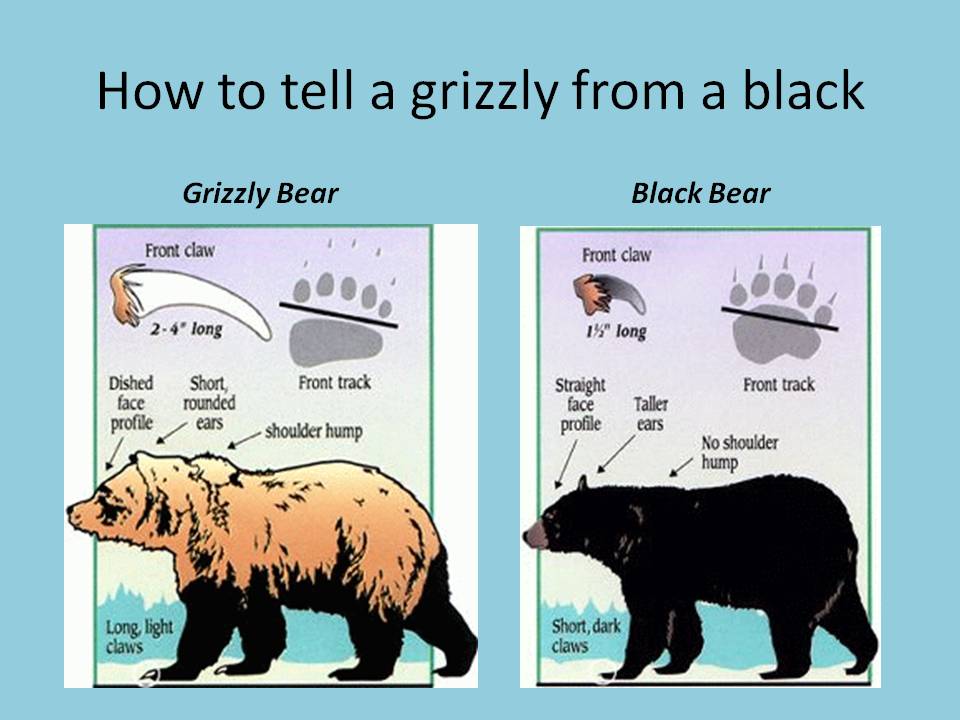
Update, 1-30-2010: The chart linked to above has disappeared in a website redesign.  Below is a crude representation of the chart I made from a U.S. Fish and Wildlife information sheet on grizzlies, here.

How to tell a grizzly from a black (.pdf download)

Grizzly bear/black bear identification chart, adapted from USFWS by Ed Darrell, Millard Fillmore's Bathtub

Grizzly bear/black bear identification chart, adapted from USFWS by Ed Darrell, Millard Fillmore's Bathtub


Alaska’s salmon go missing. Why?

August 21, 2009

It’s one of those environmental mysteries that would be fun and intrigueing, were it not so worrisome.

Alaska’s King Salmon disappeared from traditional river runs this year.  Again.

From Reuters:  A sockeye salmon scurries through shallow water in the Adams River while preparing to spawn near Chase, British Columbia northeast of Vancouver October 11, 2006.  REUTERS/Andy Clark

From Reuters: "A sockeye salmon scurries through shallow water in the Adams River while preparing to spawn near Chase, British Columbia northeast of Vancouver October 11, 2006. REUTERS/Andy Clark"

Reasons could be one of many, or several:  Changing ocean currents, pollock fishing accidental catches of salmon, plankton blooms, conditions on the rivers, competition from “ranched” salmon.

Consumers may see only the rise in price and a change in labeling in the supermarket.

Effects on employment and food supply in Alaska are huge, and crippling.

Canada fisheries are affected, too.

Climate change probably plays a role, in any scenario anyone poses:

“It’s quite the shocking drop,” said Stan Proboszcz, fisheries biologist at the Watershed Watch Salmon Society. “No one’s exactly sure what happened to these fish.”

Salmon are born in fresh water before migrating to oceans to feed. They return as adults to the same rivers to spawn.

Several theories have been put forward to try to explain the sockeye’s disappearance:

* Climate change may have reduced food supply for salmon in the ocean.

* The commercial fish farms that the young Fraser River salmon pass en route to the ocean may have infected them with sea lice, a marine parasite.

* The rising temperature of the river may have weakened the fish.

The Canadian government doesn’t know what’s killing the fish, but believes the sockeye are dying off in the ocean, not in fresh water, based on healthy out-migrations, said Jeff Grout, regional resource manager of salmon for the Department of Fisheries and Oceans.

In this case, even a small change in climate can have huge effects on ecosystems and specific populations of animals.  It’s one of those climate change issues that climate change skeptics and denialists prefer not to talk about at all.  If, as they allege, concern over climate change is entirely political, driven by bad information and false claims from over-active environmentalists, these problems should not exist at all.

But the problems do exist.  A fishery that had been stable for 50 years previously, the entire time it was tracked so carefully, suddenly becomes fishless.  Watch those rivers and fisheries.

Tip of the old scrub brush to Pamela Bumsted.

Help save the salmon; tell others:

Add to FacebookAdd to NewsvineAdd to DiggAdd to Del.icio.usAdd to StumbleuponAdd to RedditAdd to BlinklistAdd to TwitterAdd to TechnoratiAdd to Furl


Where did North Dakota go?

August 15, 2009

I think it was during the Los Angeles Olympics that I read a story about a guy in Albuquerque, New Mexico, who had called the toll-free number to purchase tickets to some Olympic events.  The seats were available and everything went fine, through the giving of the credit card number — until the woman asked him for his mailing address. [I’ll keep searching for that story . . .]

When he gave his mailing address in Albuquerque, New Mexico, the woman said, “I’m sorry, we can’t sell tickets outside the United States,” or words to that effect.

Despite the man’s pleas that New Mexico is part of the U.S., the woman refused to complete the sale.

Now, Google has lost North Dakota.

Photo below, from Art Hunt’s recent cross country driving extravaganza.

Art Hunt said:  The trip was not without its glitches, such as when we discovered we had apparently reached the end of the world

Art Hunt said: "The trip was not without its glitches, such as when we discovered we had apparently reached the end of the world"


48 years ago today, in Berlin

August 13, 2009

Soviet-bloc communism disabused us of a lot of ideas, including pointing out that when the amplification was turned up a lot, even Robert Frost could be wrong in the voice of his farmer and neighbor character, because high, concrete and concertina wire fences don’t make good neighbors.

A rock wall in Vermont, like the one Robert Frost wrote about -Wikimedia image

A rock wall in Vermont, like the one Robert Frost wrote about -Wikimedia image

Of course, even in demonstrating Frost in error, the communists made the opening clause of “Mending Fences” more poignant:  “Something there is that doesn’t love a wall . . .”

Residents of Berlin awoke on August 13, 1961, to discover that the Soviet-dominated East Germany had begun constructing a wall across Berlin, to keep East Berlin residents from escaping the clutches of communism and walking to freedom in West Berlin.

Go see other Bathtub posts on the topic:

And remember the poet’s telling, “Something there is that doesn’t love a wall.”

A wall Robert Frost would not love - Berlin Wall at Potsdamer Platz, November 1975, from West Berlin - Wikimedia photo

A wall Robert Frost would not love - Berlin Wall at Potsdamer Platz, November 1975, from West Berlin - Wikimedia photo


Bad guys of Baltimore

August 12, 2009

Or, “How a little study of history can make your visit to a city so much more entertaining and fun.”  At Clio Bluestocking Tales.

Why do visitors leave pennies at this gravesite?  Read the story at Clio Bluestocking Tales

Why do visitors leave pennies at this gravesite? Read the story at Clio Bluestocking Tales

For five weeks, I walked around the streets of Baltimore, or at least the distance between a certain major university known for its doctors, the Inner Harbor, and Fells Point — especially Fells Point — with some diversions elsewhere. As I walked, I began to notice landmarks of some very bad guys who have graced the streets of this interesting city.

Fans of “The Wire” will especially want to read it.  Did you catch the reason Clio is in Baltimore, for the full effect?

It’s not that history tells you how to live your life, or save it; it can make your life worth the living and saving.


Geographical lottery: Gambling with health care

August 4, 2009

Is it true that kids can’t get insured in Texas if their parents have two vehicles?  I mean, this is Texas, the anti-mass transit state — how can you get a kid to the emergency room for the high-cost health care if you don’t have two cars, one for work, one for the family?

Children’s Defense Fund will help you contact your legislators to recommend improving health care for children.

How is the insurance weather where you are? Share the news:

Add to FacebookAdd to NewsvineAdd to DiggAdd to Del.icio.usAdd to StumbleuponAdd to RedditAdd to BlinklistAdd to TwitterAdd to TechnoratiAdd to Furl


India today, in photos

August 3, 2009

Geography teachers, get out your PowerPoints and Keynotes.

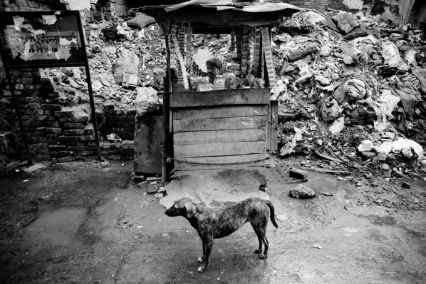
Photo of life in Delhi, India.  From a collection by Belgian photographer Frederik Buyckx, 2009

Photo of life in Delhi, India. From a collection by Belgian photographer Frederik Buyckx, 2009

Thought provoking, occasionally breath-taking photos from a 6:00 a.m. walkaround in Delhi, India; Belgian photographer Frederick Buyckx promises more photos from his recent trip to India and Pakistan, at his blog.

Please share:

Add to FacebookAdd to NewsvineAdd to DiggAdd to Del.icio.usAdd to StumbleuponAdd to RedditAdd to BlinklistAdd to TwitterAdd to TechnoratiAdd to Furl


Climate change denialism in bloom

July 28, 2009

It was a minor note, really — USGS released a series of satellite photos of ice in the Arctic Ocean.  The photos were taken with U.S. defense satellites (“spy” satellites, most likely) under an interesting agreement between the Department of Defense and science agencies to look at ice, essentially to look at the cold, not come in from it.

Part of that agreement is that the photos don’t get released until Defense says there is no reason to hold them secred anymore.  For some reason — skullduggery?  bureaucracy? — the photos weren’t released during the Bush years.  The Obama administration hustled out a series of photos for scientists to study.

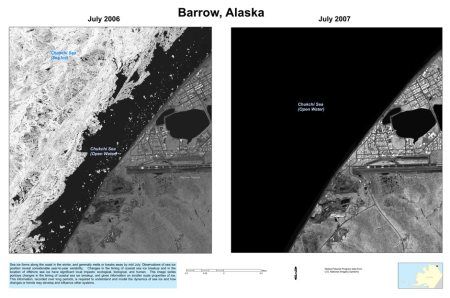
Very few news outlets picked up on the release of the photos.  The Guardian ran the most provocative, prepared-for-public-consumption set of two photos of the sea just off of Barrow, Alaska, which showed a dramatic contrast between 2006 and 2007.  The icy seas of July 2006 were replaced with miles of clear ocean in July 2007.

The Bathtub ran that poster.  And yesterday there was a surge of hits on the article, most going to other posts claiming the photos had been photoshopped.  A commenter here said the same.  Viewers find it odd that there is a stark contrast between land and sea inthe arctic.  Really.  No, really.

So, they said, those photos must be Photoshopped.  At least one radical right blog claimed the Guardian published a fake photo.

Now, I had expected someone to defend Bush, to say that the Bush administration hadn’t really suppressed the photos, just didn’t release them.

But photo fraud?

Denialists resorted to that solution first.

Here are reasons mitigating against fraud.

  1. The U.S. Geological Survey (USGS) released the poster with the photos.  USGS has a long, long history of accurate science, outside political interference.   On a few occasions, USGS reports have been delayed by political appointees — but the instances where one can say the data were corrupted on purpose are very few (if any — I can’t think of one off-hand).  USGS would be unlikely as a source of doctored photos.
  2. It is a crime to jigger the scientific results under U.S. law.   A few scientists have been caught, tried and jailed.  The reality is that most scientist strive to be well on the ethical side of the line of research laws — but it’s a federal crime for government or government-funded scientists to fake results.  I’ll wager every scientist at USGS knows that.
  3. USGS released four posters total, and a couple dozen other photos.  For Barrow, there were 18 photos from 2005 and 2006, and another 8 photos from 2007-2008.    While only four sites were chosen for poster, there are six sites with photos available for study.  Were anyone to jigger one photo, others would need to be jiggered to make them match.  Since Defense still has the originals, a fraud would probably be discovered.
  4. Government scientists have been champing at the bit for eight years to get rid of the fetters of bureaucrats interfering with their research; they wouldn’t risk a fraud just six months in to the new administration, nor would they be likely to risk a fraud at any time, since they think that the truth is of very high value.

MacsMind jumped on the photos:  “Almost so bad it’s laughable”. The blog offers no evidence of fraud, just the spiteful belief of the author.  Well, he does offer photos of a January 2006 ice surge, as if to suggest that the ice from January of 2006 should have stayed hugging the coast near Barrow even through 2007, so any photo that shows clear sea must be false.  Denialists will abandon all types of measure, even calendars and clocks, in their mad rush to cloak the science.  MacsMind even goes so far as to invent a story that the photo was taken at night, and since it shows no lights of ships at sea, they must have been cut out (photos of ice cover generally don’t work well at night — where did he get that?).

Critics of climate change and plans to do something to slow climate change reveal themselves here as not basing their views on the science — here they don’t need the science to “know that it’s wrong.”

Sometimes I wonder if we could cure global warming simply by getting the critics to shut up.

Oh, let’s make them crazy.  Here’s the poster showing the contrast in sea ice in the Beaufort Sea; the caption:

This site is near the edge of the ice pack. In summer, as shown here, ponds of meltwater form on the surface. These dark pools absorb more of summertime’s solar radiation than does the surrounding ice, enhancing melting. Observations of sea ice conditions reveal considerable year to year variability. These images, displaying the variability with regard to the amount of melting, are an example of the long term sequential record needed to support understanding and analysis of this dynamic system. Pond coverage monitored over time contributes to estimates of surface reflectivity that are needed to understand and model the dynamics of sea ice mass balance and temperature.

Beaufort Sea, showing ice in 2006 and in 200

Beaufort Sea, showing ice in 2001 and in 2007

More information:

Radar images of sea ice around Barrow, Alaska

Radar images of sea ice around Barrow, Alaska -"The animation below is from the radar record of the last three days. The images used to produce this animation are from the 10 kW X-band marine radar mounted atop the 4-story ASRC building in downtown Barrow, Alaska, pointed north."

Help cool discussion on climate change; share this post:

Add to FacebookAdd to NewsvineAdd to DiggAdd to Del.icio.usAdd to StumbleuponAdd to RedditAdd to BlinklistAdd to TwitterAdd to TechnoratiAdd to Furl


Great Arctic sea ice hoax exposed

July 26, 2009

Look at the photos and see for yourself.  From 2006 to 2007, did sea ice at Barrow, Alaska, increase or decrease?

A comparison of polar sea ice at Barrow, Alaska -- July 2006 on the left, July 2007 on the right - public domain photo from U.S. military satellites.

A comparison of polar sea ice at Barrow, Alaska -- July 2006 on the left, July 2007 on the right - public domain photo from U.S. military satellites. Click for larger view from The Guardian.

These photos appeared in The Guardian — did they appear in any U.S. papers? — with a story that said the photos had been withheld by the Bush administration, and were recently released by the Obama administration.  (Bet these photos never show up on Anthony Watts’s blog.)*

Graphic images that reveal the devastating impact of global warming in the Arctic have been released by the US military. The photographs, taken by spy satellites over the past decade, confirm that in recent years vast areas in high latitudes have lost their ice cover in summer months.

The pictures, kept secret by Washington during the presidency of George W Bush, were declassified by the White House last week. President Barack Obama is currently trying to galvanise Congress and the American public to take action to halt catastrophic climate change caused by rising levels of carbon dioxide in the atmosphere.

One particularly striking set of images – selected from the 1,000 photographs released – includes views of the Alaskan port of Barrow. One, taken in July 2006, shows sea ice still nestling close to the shore. A second image shows that by the following July the coastal waters were entirely ice-free.

The photographs demonstrate starkly how global warming is changing the Arctic. More than a million square kilometres of sea ice – a record loss – were missing in the summer of 2007 compared with the previous year.

Spin, from the presidency?  Who knew?

Climate change skeptics (read:  deniers) say that ice has come back in record amounts in 2008.  According to the news article, that isn’t exactly the case.

Nor has this loss shown any sign of recovery. Ice cover for 2008 was almost as bad as for 2007, and this year levels look equally sparse.

Science News noted the declassification, but without the hint of skullduggery on the part of the Bush administration.  The poster above comes from the USGS, which also included three more posters, one of the Beaufort Sea and two of glaciers — all of them showing declines in ice.

Stories that Arctic sea ice is expanding seem to be premature.

So all the claims that global warming has ended, that ice is threatening to extend its range and plunge us back into a cooling period — just hoax? Yep, just hoax.

Tip of the old scrub brush to Watching the World from Nicaraugua.

Update, 7-27-2009: A story going around the internet claims the poster at the top of this post is faked.  The poster comes from the U.S. Geological Survey, so I doubt it’s faked — they have no dog in the fight to fake it.  I think this goes to show that climate change “skeptics” have been sucked in by their own denial virus, and they will not even entertain information to the contrary of their beliefs.

*   Happy update, 8-2-2009: I’m happy to report I erred.  Actually, Anthony Watts reported on the release of the photos on July 15.  He didn’t use the Barrow photos, and he certainly did not claim that they are hoax photos.  He noted that the previously classified data have been released, and he seemed to think that there is no monkeying around with them.   It’ll be interesting to see how he deals with the photos from here on in.

Spread the news!

Add to FacebookAdd to NewsvineAdd to DiggAdd to Del.icio.usAdd to StumbleuponAdd to RedditAdd to BlinklistAdd to TwitterAdd to TechnoratiAdd to Furl


News flash: Texas has a second natural lake!

July 20, 2009

Years ago, in Virginia, I had learned that Virginia had only one natural lake, the Great Dismal Swamp.  Accompanying that chunk of information in that lecture was that Texas had only two natural lakes.

But upon arriving in Texas, I could find reference to only one natural lake, Caddo, and it had ceased being fully natural when its maintenance fell to a dam.

What happened to Texas’s second natural lake?

A Google search right now on “Texas +’natural lake'” produces ten listings on the first page, all of them pointing to the fact that Texas has just one natural lake.  Here are the first five:

I have found a second natural lake in Texas. It’s not a new discovery at all — it’s just a case of people not having the facts, and overlooking how to find the truth.  It’s especially difficult when the lake hides itself.

Our testing coordinator at Molina High School, Brad Wachsmann, spins yarns that belie his youth.  In the middle of one yarn last year, corroborated by other yarns, he mentioned that he has family in Big Lake, Texas; and he described visiting and having relatives urge people to run out and see the lake since it’s rebirth in torrential rains.

“A second natural lake in Texas?” I asked.  Wachsmann knew the drill.  Yes, Big Lake is a natural lake in Texas, and yes, people forget about it.

Texas teachers, listen to your testing coordinators, okay?

All of this came to mind reading the Austin American-Statesman, still a bastion of great journalism despite problems in the newspaper industry.  On Monday, July 7, the paper ran a story and an editorial about the clean up of the oil industry refuse that killed the shoreline of part of the lake; the springs that once fed the lake have mostly gone dry, but that’s likely due to agricultural water mining.

It’s a story of boom and bust, environmental degradation for profit, and eventual recovery we hope.

Looking at the landscape that surrounds the Reagan County seat, you wonder whether the name Big Lake was somebody’s idea of joke. It’s dry and dusty, where the flora sprouts reluctantly and lives precariously.

Yet, the West Texas town of Big Lake got its name from a natural lake that was fed by springs that have long since gone dry. While the area may not fit everyone’s definition of photogenic, it has its own brand of charm – charm that could be enhanced if the damage done to the fragile ecosystem by salt spills were reversed or even minimized.

As the American-Statesman’s Ralph K.M. Haurwitz reported in Monday’s editions, the University of Texas and Texas A&M systems have benefited from the $4.4 billion in royalty payments and mineral income produced by its West Texas acreage since Santa Rita No. 1 well came in on May 28, 1923.

The salt water byproduct of oil and natural gas production, however, contaminated 11 square miles near Big Lake, killing most everything that grows. The lack of vegetation allows wind and water erosion.

Hey, it gets better.  This is real Texas history, real American history — you can’t make this stuff up.  Haurwitz’s article talks about the heritage of Texas education.   Remember that old story about setting aside certain sections of townships to help fund education in lands on the American frontier?  Texas wasn’t a public lands state as farther west, but it still reserved sections of land for the benefit of education.

Rose petals blessed by a priest?  I’ll wager the priest didn’t make the trip to the top of the derrick.  Haurwitz wrote:

BIG LAKE — Investors appealed to the patron saint of impossible causes when oil drilling began on University of Texas System land in 1921. It didn’t hurt.

Santa Rita No. 1 blew in on May 28, 1923, after rose petals blessed by a priest were scattered from the top of the derrick at the behest of some Catholic women in New York who had purchased shares in the Texon Oil and Land Co., which drilled that first well.

Since then, the UT System’s 2.1 million acres in West Texas have produced $4.4 billion in royalty payments and other mineral income for the Permanent University Fund, an endowment that supports the UT and Texas A&M University systems.

But this long-running bonanza for higher education exacted a price from the remote, semiarid landscape where it all began. Millions of barrels of salt water, a byproduct of oil and natural gas production, contaminated 11 square miles, or more than 7,000 acres, killing virtually all vegetation and leaving the land vulnerable to wind and water erosion. Hundreds of mesquite stumps with three feet of exposed roots testify to the dramatic loss of topsoil.

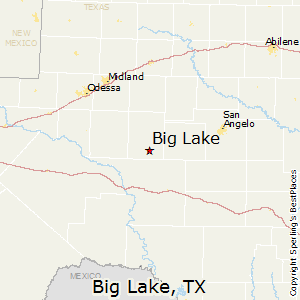
Texas, and Big Lake - from BigLakeTx.com

Where in Texas is Big Lake?

The town of Big Lake is just north of the lake itself, on State Highway 137 running north and south, and U.S. Highway 67 running east and west, approximately 65 miles west of San Angelo.   Big Lake sits about 10 miles north of Interstate 10, and about 75 miles south of Interstate 20.  Big Lake calls itself “the gateway to the Permian Basin.”

Big Lake is the home of Reagan County High School.  Jim Morris was baseball coach for the Reagan High Owls when his team persuaded him to try out for a major league baseball team.  His story was chronicled, with some artistic license, in the Disney movie “Rookie.”

Land managers are working to stop erosion on the often-dry shores of Big Lake using any trick they can find.  One trick:  Plant salt grass.

Salt grass?  Along Texas’s Gulf Coast, there are a few species of grass that, while not halophytes, are at least salt tolerant.  Salt grass.  This grass made it profitable to graze cattle on what would otherwise have been unproductive land in the Texas cattle boom.  This role in Texas history is memorialized in the Salt Grass Steakhouse chain, now found in five states.

And if planting salt grass works to control erosion, it will help clean up a large part of Texas other natural lake, Big Lake.

Big Lake’s being wet or dry is a whim of local climate.  You could say that half of all of Texas’s natural lakes are now dry as a result of continued warming; you could say that two good gully-washers or toad-stranglers could restore water to half of Texas’s natural lakes.

Big Lake Playa, from NightOwl Bakery and Roastery in Big Lake, Texas

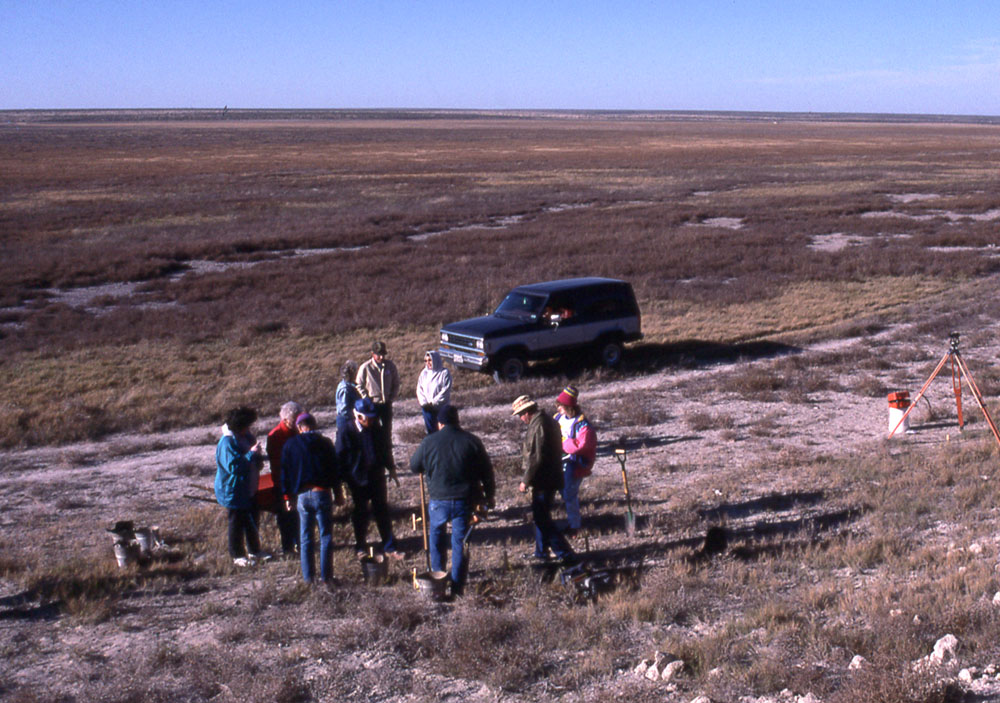
Field crew meeting at the outset of the 1992 excavations at the Big Lake Bison Kill site. The dry bed of Big Lake stretches for miles in the background. Big Lake is an intermittent saline lake or playa, an uncommon landform on the Edwards Plateau. Photo by Larry Riemenschneider, Concho Valley Archeological Society.

More details about Big Lake and prehistory, below the fold.

Read the rest of this entry »


Can your 9-year old kid help her rescuers?

June 23, 2009

This kid is from Heber, Utah — odds are he’s a Mormon, and he’s a Cub Scout.  Wolf elective #23 includes “Tell what to do if you get lost.”  But it’s an elective for a 7-year old, and in panic, a 9-year old may not remember.  We hope that this training will be part of the Outdoorsman requirement for a second-year Webeloes Scout, at age 10 or 11, but this kid wasn’t there yet.

Utah, showing Daggett County - from Pioneer, Utahs online library

Utah, showing Daggett County - from Pioneer, Utah's online library

So, this story from the Salt Lake Tribune is a morality tale.  One of the morals is that we need to drill our kids on what to do if they get lost, in the city, or in the wild:


Search crews found lost hiker, 9, after he left behind clues

Updated: 06/22/2009 10:51:25 AM MDT

Daggett County search crews found a missing 9-year-old hiker Sunday night thanks to a footprint, a granola bar wrapper, pieces of his raincoat and a backpack that he left behind as he wandered through the Ashley National Forest.Grayson Wynne’s first words to his father, Kynan: “Happy Father’s Day.”

Grayson, from Heber City, was hiking Saturday evening toward Daggett Lake to camp for a couple of days with his family when he was separated from the group.

Search and rescue teams, family members and volunteers — totaling more than 100 people — looked for Wynne on Saturday night and Sunday morning. Some rode horses or mules, others walked.

Grayson said he thought about his parents, prayed and cried while he was lost. He told searchers he spent the night under a log and didn’t get much sleep. He could hear searchers yelling his name but could not tell from which direction they were coming.

Searchers found a granola bar wrapper about 300 yards off of the main trail, and family members recognized the snack matched those Grayson had in his backpack. Rescuers also found a small footprint by a creek bed early Sunday, about 400 yards from the granola wrapper, the sheriff’s office said in a news release.

They later found Grayson’s black backpack, which he later told crews he left behind the night before because it was getting too heavy.

Based on Grayson’s belongings, Daggett County searchers said it appeared the boy was

following the creek, so they focused the rescue effort in specific areas along the water.A helicopter flew a bloodhound and her handler to the spot where the backpack was found. Before they could begin searching for Grayson, he heard the helicopter and headed for a meadow where he hoped the pilot would see him.

Grayson waved his last piece of yellow rain slicker to get the helicopter crew’s attention. He had been tearing the jacket apart and leaving behind chunks to trace his footsteps.

As he waved his slicker, two searchers rode up on horseback and found him in the meadow.

Grayson was taken to the command center, where he was checked by medical teams and reunited with his family. The boy’s feet were wet and cold, but he was in “good health and spirits,” the Sheriff’s Office said.

“This search was successful due to the many searchers and volunteers, and to Grayson for being such a strong little boy with a lot of common sense,” the Sheriff’s Office said in a news release.

I’m not entirely sure where the family was — in addition to the Ashley National Forest, there is the Flaming Gorge National Recreation Area in tiny Daggett County, in Utah’s northeast corner, for families to hike and camp in.

Daggett County was the last of the 29 counties in Utah to be organized, cut out of the much larger Uintah County.  I know the story well.  My maternal grandfather was one of the organizers of the county and the loser of the first election for sheriff (a great story of the power of women voting, for another time).  My mother was born in a the chicken coop her family lived in, in Manila, as her father was building what was to be the biggest house in the county (and the first with rooms set aside for indoor plumbing).


Bathtub reading on a warm June Sunday

June 7, 2009

I thought everybody does serious reading in the bathtub, no?

The Boneyard at Davis-Monthan Air Force Base near Tucson, Arizona; the Pima Air & Space Museum now offers bus tours of the 309th Maintenance and Regeneration Groups collection of scrapped and very historic airplanes

The Boneyard at Davis-Monthan Air Force Base near Tucson, Arizona; the Pima Air & Space Museum now offers bus tours of the 309th Maintenance and Regeneration Group's collection of scrapped and very historic airplanes

Can’t soak all day.


Is Texas the state most vulnerable to global climate change?

June 6, 2009

John Mashey occasionally graces these pages with his comments — a cool, reasoned head on hot issues like global warming/global climate change, despite his history in computers or maybe because of it (which would put the lie to the idea that computer programming explains why so many computer programmers are wacky intelligent design advocates).

Mashey offered a comment over at RealClimate on a post about hoaxer and science parodist Christopher Monckton — a comment you ought to read if  you think about Texas ever, and especially if you like the place.  It’s comment #413 on that Gigantor blog.

Monckton wrote a letter to the New York Times and attached to it a graph.  The graph, it turns out, probably would need to be classified in the fiction section of a library or book store, were it a book.  Much discussion occurs, absent any appearance by Monckton himself who does not defend his graphs by pointing to sources that might back what his graphs say, usually.

In short, the post and the extensive comments shed light on the problems of veracity which plague so many who deny either that warming is occurring, or that air pollution from humans might have anything to do with it, or that humans might actually be able to do anything to mitigate the changes or the damage, or that humans ought to act on the topic at all.

So I’ve stolen Mashey’s comment lock, stock and barrel, to give it a little more needed highlight.

If you follow environmental issues much, you probably know Count Christopher Monckton as a man full of braggadocio and bad information on climate.  He is known to have worked hard to hoodwink the U.S. Congress with his claims of expertise and policy legitimacy, claiming to be a member of the House of Lords though he is not (some climate change deniers in Congress appear to have fallen for the tale).  He pops up at denialist conferences, accuses scientists of peddling false information, and he is a shameless self-promoter.

After much discussion, Mashey turned his attention to claims that Texans don’t know better than Monckton, and other things; Mashey notes that denialists cite Monckton’s performance at a conservative political show in Texas, instead having paid attention to real climate scientists who were meeting just up the road, for free:

AGW’s impact depends on where you live
OR
Texas is Not Scotland, even when a Scottish peer visits

1) SCOTLAND
Viscount Monckton lives in the highlands of Scotland (Carie, Rannoch, 57degN, about the same as Juneau, AK, but warmer from Gulf Stream.)

a) SEA LEVEL, STORMS
Most of Scotland (esp the highlands) is well above sea level, and in any case, from Post-Glacial Rebound, it’s going up. [Not true of Southern England.]

b) PRECIPITATION
Scotland gets lots of regular precipitation. From that, he likely gets ~1690mm or more rainfall/year, noticeably more than Seattle or Vancouver.

Scotland has complex, variable weather systems, with more rain in West than in East, but has frequent precipitation all year.

c) TEMPERATURE
Scotland’s climate would likely be better with substantial warming. See UK Met Office on Scotland, which one might compare with NASA GISS Global Annual Mean Surface Air Temperature Change. Scotland average maximum temperatures are 18-19C in the summer, i.e., in most places it might occasionally get up to 70F, although of course it varies by geography. +3C is no big deal. The record maximum was 32.9C (91F), set in 2003. Maybe there is yet a good future for air-conditioning/cooling vendors.

If one does a simple linear regression on both sets of annual data, one finds that SLOPE(Scotland) = .0071C/year, SLOPE(world) = .0057C/year, i.e., Scotland is warming slightly faster than the world as a whole.

d) AGRICULTURE
The combination of b) and c) is, most likely *good* for agriculture in Scotland. There is plenty of rain, and higher temperatures mean less snow and a longer growing season. Great!

In addition, the British geoscientist/vineyard archaeologist Richard Selley thinks that while it may be too hot for good vineyards in Southern England by 2080, it will be fine for some areas of Scotland.
Future Loch Ness Vineyard: great!

e) OIL+GAS, ENERGY
Fossil fuel production (North Sea oil&gas) is very important to the Scotland economy. Wikipedia claims oil-related employment is 100,000 (out of total population of about 5M).

Scotland has not always been ecstatic to be part of the UK.

2) TEXAS
The Viscount Monckton spoke for Young Conservatives of Texas, April 28 @ Texas A&M, which of course has a credible Atmospheric Sciences Department. Of course, many of them were unable to hear the Viscount because they were in Austin at CLIMATE CHANGE Impacts on TEXAS WATER, whose proceedings are online. See especially Gerald North on Global Warming and TX Water.

Monckton delivered his message: “no worries, no problems” which might well fit Scotland just fine, at least through his normal life expectancy.

The message was delivered to Texans typically in their 20s, many of whom would expect to see 2060 or 2070, and whose future children, and certainly grandchildren, might well see 2100.

Texas is rather different from Scotland, although with one similarity (oil+gas).

a) SEA LEVEL, STORMS

Texas has a long, low coastline in major hurricane territory.
Brownsville, TX to Port Arthur is a 450-mile drive, with coastal towns like Corpus Christi, Galveston, and Port Arthur listed at 7 feet elevations. The center of Houston is higher, but some the TX coast has subsidence issues, not PGR helping it rise. The Houston Ship Canal and massive amounts of infrastructure are very near sea level. More people live in the Houston metropolitan area + rest of the TX coast than in all of Scotland.

Of course, while North Sea storms can be serious, they are not hurricanes. IF it turns out that the intensity distribution of hurricanes shifts higher, it’s not good, since in the short term (but likely not the long term), storm surge is worse than sea level rise.

Hurricane Rita (2005) and Hurricane Ike (2008) both did serious damage, but in some sense, both “missed” Houston. (Rita turned North, and hit as a Category 3; Ike was down to Category 2 before hitting Galveston).

Scotland: no problem
TX: problems already

b) RAINFALL
Texas is very complex meteorologically, and of course, it’s big, but as seen in the conference mentioned above (start with North’s presentation), one might say:

– The Western and Southern parts may well share in the Hadley-Expansion-induced loss of rain, i.e., longer and stronger droughts, in common with NM, AZ, and Southern CA. Many towns are dependent on water in rivers that come from the center of the state, like the Brazos.

– The NorthEast part will likely get more rain. [North’s comment about I35 versus I45 indicates uncertainty in the models.]

– Rain is likely to be more intense when it happens, but droughts will be more difficult.

Extreme weather in TX already causes high insurance costs, here, or here.

Scotland: no problem
Texas: problems.

c) TEMPERATURE

Texas A&M is ~31degN, rather nearer the Equator than 57degN.
Wikipedia has a temperature chart. It is rather warmer in TX, but is also more given to extremes.

Scotland: +3C would be dandy,
Texas: +3C not so dandy.

d) AGRICULTURE
Between b) and c), less water in dry places, more water in wet places, more variations in water, and higher temperatures (hence worse evaporation/precipitation difference) are not good news for TX agriculture, or so says Bruce McCarl, Professor of Agricultural Economics at TAMU.

For audiences unfamiliar with Texas A&M, the “A” originally stood for Agriculture, and people are called Aggies. One might assume that agricultural research is valued.
Politically, “Aggie-land” would not be considered a hotspot of hyper-liberal folks prone to becoming climate “alarmists”.

Scotland: warmer, great! Wine!
Texas: serious stress.

d) OIL+GAS, ENERGY
Here, there is more similarity: fossil fuels are economically important.

On the other hand, Scotland was settled long before the use of petroleum, and while places like the highlands are very sparse, cities like Edinburgh and Glasgow are relatively dense, and many villages are quite walkable. Warmer temperatures mean *lower* heating costs.

Texas has naturally developed in a very different style, and with forthcoming Peak Oil, this may be relevant. In 2006, according to EIA, Texas was #1 in energy consumption, 5th per-capita (after AK, WY, LA, ND) and uses 2X/capita of states like NY or CA. Some of that is inherent in different climate and industry.

Sprawling development in a state with water problems, subject to dangerous weather extremes, and already seriously-dependent on air-conditioning, may end being expensive for the residents.

Scotland: makes money from fossil energy, but it was mostly built without it. Warmer temperatures reduce energy use.
Texas: already uses ~2.5-3X higher energy/capita, compared to Scotland. Warmer temperatures likely raise energy use.

3. SUMMARY

Gerald North’s talk ended by asking:
“Is Texas the most vulnerable state?”

That sounds like an expert on trains, hearing one coming in the distance, standing on the tracks amidst a bunch of kids, trying to get them off the tracks before there’s blood everywhere.

On the other side, someone safely away from tracks keeps telling the kids that experts are wrong, there is no danger, so they can play there as long as they like.

You will be well informed if you also read Mashey’s comments at #120 and #132.


Insanity at Texas state school board – economics, geography and history

May 27, 2009

Tim Ritz cartoon, for Americans United

Tim Ritz cartoon, for Americans United

Texas Freedom Network’s Insider blog reports that embattled chairman Don McLeroy is working to create a panel of experts to review studies curricula.  The experts he has proposed so far are all well-known cranks in academia, people who bring their axes to grind on the minds of innocent children.

This panel is a bold insult to Texas’s community of economists, historians, and other practitioners of fields of social studies, not to mention educators.  A more qualified panel of experts could be assembled in the coffee break rooms of the history departments at most of Texas’s lesser known state colleges and universities.

Why does Don McLeroy hate Texas so?

I’ve been buried in teaching, grading, planning and the other affairs of the life of a teacher, and had not paid much attention to the movement on this issue (“movement” because I cannot call it “progress”).  My students passed the state tests by comfortable margins, more than 90% of them; this news from SBOE makes me despair even  in the face of the news that our achievements are substantial in all categories.

The panel lacks knowledge and experience in economics, geography and history.  The panel is grotesquely unbalanced — at least two of the panel members remind me of Ezra Taft Benson, who was Secretary of Agriculture for Dwight Eisenhower.  When he resigned from that post, he complained that Eisenhower was too cozy with communism.  Barton and Quist lean well to the right  of Ezra Taft Benson.  Quist has complained of socialist and Marxist leanings of Reagan administration education policy and policy makers.

Samuel Morse sent the first telegraphic message on May 24, 1844:  “What hath God wrought?”

Sitting here on the morning of May 27, 2009, I wonder what rot hath Don.


Bell Ringer: Bermuda Triangle, Area 51, Marfa, and other cool mysteries

May 17, 2009

If a day goes by that I don’t get a question about one of these sites, it’s a very slow day.

Those questions tell me something else:  Students have genuine interests in geography, and in mysteries.  Students will pay attention to lesson plans that include one or more of these sites in them, especially if you refer to the mystery.

How about just a geography search:  How close is the closest site to you?  Can students visit these sites on their summer vacations?  What airport is closest for tourists?  What arrangements need to be made to visit the place?

Wired.com provides the video — your students have the questions.  Can you provide the answers, or lead them to the answers?  How about listing your answers in comments?

Answers, or more information: