Clean energy bill needs your help

June 25, 2009

Call your Congressman, the person who represents you in the U.S. House of Representatives, and urge a “yea” vote on the comprehensive clean energy bill.

You can check your representative at several places, or follow the instructions through RePower America, listed below the video from our old friend Al Gore.

Repower America said in an e-mail:

Clean energy bill needs our support

Any moment now, the House will be voting on the boldest attempt to rethink how we produce and use energy in this country. The bill’s passage is not assured. Call your Representative today.

  • Call 877-9-REPOWER (877-9-737-6937) and we’ll connect you to your Representative right after providing you with talking points. (We’re expecting high call volume, and if you are unable to be connected please use our secondary line, 866-590-0971.)
  • When connected to your Representative’s office, just remember to tell them your name, that you’re a voter, and that you live in their district. Then ask them to “vote ‘yes’ on comprehensive clean energy legislation.”

They’d like you to report your contact, here.

What?  You haven’t been following the debate?  Here’s what the pro-pollution, give-all-your-money-to-Canada, Hugo Chavez, and the Saudis group hopesHere’s where the anti-pollution, pro-frog and clean environment people say the proposed act is way too weak as it stands.  Here’s the House Energy and Commerce Committee drafts and discussion of the billConsumer Reports analyzed the bill here (and said it can’t be passed into law fast enough despite its flaws).

Call now.  Pass the word to your friends.  Tell your children to call — their kids deserve better than the path we’re on now.

More information and discussion:


Maybe estimates of sea level increases are low; maybe climate change damage will be greater than expected

June 20, 2009

Eternal Hope at Daily Kos wonders what happens if the conservative estimates of sea level rise — the ones you usually see cited in the press — turn out to be way too conservative.  What happens if sea levels rise about double what some are estimating now?

If the severity and frequency of storms does not increase much, we may be able to accommodate the changes over time (though remember, some say we can do it easily).

How willing are the skeptics and denialists to tell cities and insurance actuaries that the fears of ocean-level increases are piffles?

Speaking of insurance:  Texas has been hammered over the past 20 years by unseasonal and much more-severe-than-usual thunderstorms, ice storms, straightline winds, tornadoes and hurricanes.  Home insurance rates skyrocketed.  State regulators argue with insurance companies about whether rate increases are justified.  Insurance companies cite claims for problems that did not exist earlier, and which may be blamed on climate change.  (How much excess mold will occur due to warming?)

Sometimes the arguments erupt into lawsuits and regulatory action.  One such argument drags on now, with up to a $1 billion in overcharges at stake.  How much of the fight from the insurance companies comes from their fears of the effects of global warming?


Can carbon dioxide be classed as a pollutant?

June 10, 2009

From Compound Interest

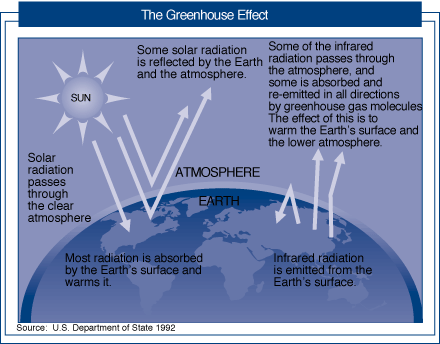
U.S. Department of State slide explaining the greenhouse effect, 1992. National Archives.

U.S. Department of State slide explaining the greenhouse effect, 1992. National Archives.

Sure.  Too much oxygen to a newborn baby can cause blindness; oxygen in that case is a pollutant.  Certainly, if an essential gas like oxygen can be classed as a pollutant, since too much carbon dioxide can be deadly as an acute poison, it’s fair to class it as a pollutant when it appears where it should not appear, or when it appears in concentrations too great to be safe for what we need it to do, or when it is destructive.

The tougher question is, can Congress do anything about it?

Arguments about whether carbon dioxide is a pollutant distract and detract from, and delay the critical arguments about how to act to mitigate harmful effects of climate change and how to prevent the most disastrous effects, if possible.

Barry Rabe teaches at the University of Michigan and studies policies of government on climate change, and the policy making of government on climate change.

Take a look at some of his work, under the title, “Can Congress Govern the Climate?”

Full report in pdf, here: “Can Congress Govern the Climate?” Or download 0423climatechange_rabe

Common atmospheric pollutants, from Compound Interest. CO2 is a pollutant

Common atmospheric pollutants, from Compound Interest. CO2 is a pollutant

See also:

Tip of the old scrub brush to U Town Blog.

Help cut through the fog of disinformation:


Add to FacebookAdd to NewsvineAdd to DiggAdd to Del.icio.usAdd to StumbleuponAdd to RedditAdd to BlinklistAdd to TwitterAdd to TechnoratiAdd to Furl


Is Texas the state most vulnerable to global climate change?

June 6, 2009

John Mashey occasionally graces these pages with his comments — a cool, reasoned head on hot issues like global warming/global climate change, despite his history in computers or maybe because of it (which would put the lie to the idea that computer programming explains why so many computer programmers are wacky intelligent design advocates).

Mashey offered a comment over at RealClimate on a post about hoaxer and science parodist Christopher Monckton — a comment you ought to read if  you think about Texas ever, and especially if you like the place.  It’s comment #413 on that Gigantor blog.

Monckton wrote a letter to the New York Times and attached to it a graph.  The graph, it turns out, probably would need to be classified in the fiction section of a library or book store, were it a book.  Much discussion occurs, absent any appearance by Monckton himself who does not defend his graphs by pointing to sources that might back what his graphs say, usually.

In short, the post and the extensive comments shed light on the problems of veracity which plague so many who deny either that warming is occurring, or that air pollution from humans might have anything to do with it, or that humans might actually be able to do anything to mitigate the changes or the damage, or that humans ought to act on the topic at all.

So I’ve stolen Mashey’s comment lock, stock and barrel, to give it a little more needed highlight.

If you follow environmental issues much, you probably know Count Christopher Monckton as a man full of braggadocio and bad information on climate.  He is known to have worked hard to hoodwink the U.S. Congress with his claims of expertise and policy legitimacy, claiming to be a member of the House of Lords though he is not (some climate change deniers in Congress appear to have fallen for the tale).  He pops up at denialist conferences, accuses scientists of peddling false information, and he is a shameless self-promoter.

After much discussion, Mashey turned his attention to claims that Texans don’t know better than Monckton, and other things; Mashey notes that denialists cite Monckton’s performance at a conservative political show in Texas, instead having paid attention to real climate scientists who were meeting just up the road, for free:

AGW’s impact depends on where you live
OR
Texas is Not Scotland, even when a Scottish peer visits

1) SCOTLAND
Viscount Monckton lives in the highlands of Scotland (Carie, Rannoch, 57degN, about the same as Juneau, AK, but warmer from Gulf Stream.)

a) SEA LEVEL, STORMS
Most of Scotland (esp the highlands) is well above sea level, and in any case, from Post-Glacial Rebound, it’s going up. [Not true of Southern England.]

b) PRECIPITATION
Scotland gets lots of regular precipitation. From that, he likely gets ~1690mm or more rainfall/year, noticeably more than Seattle or Vancouver.

Scotland has complex, variable weather systems, with more rain in West than in East, but has frequent precipitation all year.

c) TEMPERATURE
Scotland’s climate would likely be better with substantial warming. See UK Met Office on Scotland, which one might compare with NASA GISS Global Annual Mean Surface Air Temperature Change. Scotland average maximum temperatures are 18-19C in the summer, i.e., in most places it might occasionally get up to 70F, although of course it varies by geography. +3C is no big deal. The record maximum was 32.9C (91F), set in 2003. Maybe there is yet a good future for air-conditioning/cooling vendors.

If one does a simple linear regression on both sets of annual data, one finds that SLOPE(Scotland) = .0071C/year, SLOPE(world) = .0057C/year, i.e., Scotland is warming slightly faster than the world as a whole.

d) AGRICULTURE
The combination of b) and c) is, most likely *good* for agriculture in Scotland. There is plenty of rain, and higher temperatures mean less snow and a longer growing season. Great!

In addition, the British geoscientist/vineyard archaeologist Richard Selley thinks that while it may be too hot for good vineyards in Southern England by 2080, it will be fine for some areas of Scotland.
Future Loch Ness Vineyard: great!

e) OIL+GAS, ENERGY
Fossil fuel production (North Sea oil&gas) is very important to the Scotland economy. Wikipedia claims oil-related employment is 100,000 (out of total population of about 5M).

Scotland has not always been ecstatic to be part of the UK.

2) TEXAS
The Viscount Monckton spoke for Young Conservatives of Texas, April 28 @ Texas A&M, which of course has a credible Atmospheric Sciences Department. Of course, many of them were unable to hear the Viscount because they were in Austin at CLIMATE CHANGE Impacts on TEXAS WATER, whose proceedings are online. See especially Gerald North on Global Warming and TX Water.

Monckton delivered his message: “no worries, no problems” which might well fit Scotland just fine, at least through his normal life expectancy.

The message was delivered to Texans typically in their 20s, many of whom would expect to see 2060 or 2070, and whose future children, and certainly grandchildren, might well see 2100.

Texas is rather different from Scotland, although with one similarity (oil+gas).

a) SEA LEVEL, STORMS

Texas has a long, low coastline in major hurricane territory.
Brownsville, TX to Port Arthur is a 450-mile drive, with coastal towns like Corpus Christi, Galveston, and Port Arthur listed at 7 feet elevations. The center of Houston is higher, but some the TX coast has subsidence issues, not PGR helping it rise. The Houston Ship Canal and massive amounts of infrastructure are very near sea level. More people live in the Houston metropolitan area + rest of the TX coast than in all of Scotland.

Of course, while North Sea storms can be serious, they are not hurricanes. IF it turns out that the intensity distribution of hurricanes shifts higher, it’s not good, since in the short term (but likely not the long term), storm surge is worse than sea level rise.

Hurricane Rita (2005) and Hurricane Ike (2008) both did serious damage, but in some sense, both “missed” Houston. (Rita turned North, and hit as a Category 3; Ike was down to Category 2 before hitting Galveston).

Scotland: no problem
TX: problems already

b) RAINFALL
Texas is very complex meteorologically, and of course, it’s big, but as seen in the conference mentioned above (start with North’s presentation), one might say:

– The Western and Southern parts may well share in the Hadley-Expansion-induced loss of rain, i.e., longer and stronger droughts, in common with NM, AZ, and Southern CA. Many towns are dependent on water in rivers that come from the center of the state, like the Brazos.

– The NorthEast part will likely get more rain. [North’s comment about I35 versus I45 indicates uncertainty in the models.]

– Rain is likely to be more intense when it happens, but droughts will be more difficult.

Extreme weather in TX already causes high insurance costs, here, or here.

Scotland: no problem
Texas: problems.

c) TEMPERATURE

Texas A&M is ~31degN, rather nearer the Equator than 57degN.
Wikipedia has a temperature chart. It is rather warmer in TX, but is also more given to extremes.

Scotland: +3C would be dandy,
Texas: +3C not so dandy.

d) AGRICULTURE
Between b) and c), less water in dry places, more water in wet places, more variations in water, and higher temperatures (hence worse evaporation/precipitation difference) are not good news for TX agriculture, or so says Bruce McCarl, Professor of Agricultural Economics at TAMU.

For audiences unfamiliar with Texas A&M, the “A” originally stood for Agriculture, and people are called Aggies. One might assume that agricultural research is valued.
Politically, “Aggie-land” would not be considered a hotspot of hyper-liberal folks prone to becoming climate “alarmists”.

Scotland: warmer, great! Wine!
Texas: serious stress.

d) OIL+GAS, ENERGY
Here, there is more similarity: fossil fuels are economically important.

On the other hand, Scotland was settled long before the use of petroleum, and while places like the highlands are very sparse, cities like Edinburgh and Glasgow are relatively dense, and many villages are quite walkable. Warmer temperatures mean *lower* heating costs.

Texas has naturally developed in a very different style, and with forthcoming Peak Oil, this may be relevant. In 2006, according to EIA, Texas was #1 in energy consumption, 5th per-capita (after AK, WY, LA, ND) and uses 2X/capita of states like NY or CA. Some of that is inherent in different climate and industry.

Sprawling development in a state with water problems, subject to dangerous weather extremes, and already seriously-dependent on air-conditioning, may end being expensive for the residents.

Scotland: makes money from fossil energy, but it was mostly built without it. Warmer temperatures reduce energy use.
Texas: already uses ~2.5-3X higher energy/capita, compared to Scotland. Warmer temperatures likely raise energy use.

3. SUMMARY

Gerald North’s talk ended by asking:
“Is Texas the most vulnerable state?”

That sounds like an expert on trains, hearing one coming in the distance, standing on the tracks amidst a bunch of kids, trying to get them off the tracks before there’s blood everywhere.

On the other side, someone safely away from tracks keeps telling the kids that experts are wrong, there is no danger, so they can play there as long as they like.

You will be well informed if you also read Mashey’s comments at #120 and #132.


Desperation in AGW denial ranks?

May 17, 2009

One might hope it is a sign of desperation, and not just one more ratcheting up on the dishonesty scale.

Anthony Watts has a post that looks at Boston Harbor, a post borrowed from a sleepy blog called Climate Sanity, by Tom Moriarty.  Watts, a leader among denialists, notes the warnings about sea level rising, and then offers maps of Boston as evidence everyone is safe.

The maps show the shoreline expanding around the peninsula where the main part of Boston sits.

Consequently, the authors claim, rising sea levels won’t do damage anyone should worry about.

Changes in Boston Harbor, from the denialist blog Climate Sanity

Changes in Boston Harbor, animation from the denialist blog Climate Sanity

It’s an odd sort of claim.  Anyone with any knowledge of the growth of harbor cities will look at the maps and notice the extension of lands from fill. Watts and Moriarty do not specifically claim that ocean levels have no effect, though some reading the headlines alone may get that idea.  They argue that humans will respond to negate the bad effects of climate change. 

That’s not what the maps show at all. The maps show that, in the absence of wetlands protection, people will use fill to expand commercial opportunities at a busy harbor.  That is true whether the fill requires the destruction of local landmarks, or whether the fill arrives accidentally from other major natural events.

The climate change denialists’ claims make an argument based in deception.  Harbor areas are always better fortified against sea and weather changes than other areas.  Boston Harbor is a comparatively small area, when contrasted with the Atlantic coastline of North America.

Do they know they’re just pulling our leg?  Or is this one more sign of the desperation denialists get over the realization the facts are against them?

At root the argument fails, and fails offensively: Watts and company argue that climate change and rising sea levels are not a problem, if we have enough concrete and fill to expand land close to the water and harden seawalls.  We also would need a lot of commercial development to make it cost effective to fill in the threatened lands.  That sort of development will involve only a very small area of any nation’s coastline.

Of course, that sort of hardening of sites is exactly what the wetlands protection under Section 404 of the Clean Water Act aimed to slow or stop, and it is part of the cause of trouble in the Mississippi Delta and other places unhardened, where the effects of hardening ports are pushed.

Watts also fails to account for the more serious immediate issues:  It’s not permanent inundation that we need to worry about with ports, but rather, the effects of stronger storms with higher sea levels.  The U.S. Environmental Protection Agency has been on that issue for years.  Boston Harbor is an example of a place that we need to protect from effects of climate change, at great expense, in order to preserve the filling done in the past and the development on that filled-in land that once was sea.

For examples, consult the white paper from EPA in July 2008, “Planning for Climate Change Impacts at U.S. Ports.  From the very first lines, you can begin to see why the denialists’s claims don’t wash:

Over the coming decades, climate change is likely to cause sea levels to rise, lake levels to drop, more frequent and severe storms, and increases in extreme high temperatures. These effects can have mild to severe impacts on port infrastructure and operations, depending on their geographical setting and design. Ports are critical to the trade and transportation networks of the United States. Specifically, ports handle 78% of all U.S. foreign trade by weight and 44% by value.1 The United States’ ports also represent billions of dollars in capital improvements and new investments. While the risk that climate change poses to ports is unclear, what is clear is that ports need to better understand climate change, how it may impact them, and what they can do to ensure reliable services for their customers.

Stakes are too high for analysis so shallow as simple map overlays.  In reality many factors mean that ports and harbors are threatened from many different problems arising from climate change.  The EPA white paper lists specifics.

Changes in water level:

The most immediate concern related to rising sea levels is the need to raise the level of infrastructure to prevent flooding. Ports will need to consider anticipated sea levels when building new infrastructure. In cases where current infrastructure may not be high enough for its useful lifespan, ports will need to increase infrastructure heights.

Higher sea levels may threaten ports’ environmental mitigation projects. Also, many ports have contaminated or potentially contaminated industrial land on their premises.17 Higher water levels may require new containment methods to prevent leeching of contaminants.

Many climate models predict that climate change will cause water levels to drop in the Great Lakes and the Mississippi River Basin, which would make shipping there more difficult. When lake levels decreased from 1997-2001, ships in the Great Lakes were forced to carry less cargo. Future decreases in water level would again require cargo restrictions or perhaps the redesign of vessels. Either one would increase the cost of shipping on interior waterways. Decreased depths could be mitigated by increased dredging, but at a financial and environmental cost.

Storm events and precipitation:

Globally, extreme precipitation events are expected to become more frequent, and severe storms are expected to become more intense. Stronger wave action and higher storm surges, especially when coupled with higher sea levels, are the primary threat to ports. These impacts can damage bridges, wharfs, and piers, terminal buildings, ships, and cargo. Harbor infrastructure may need to be raised or reinforced to withstand these impacts.

In addition to contributing to storm surge, wind can also have its own damaging impacts. High winds particularly threaten unreinforced terminal structures. For example, Hurricane Katrina tore roofs and doors off warehouses at the Port of New Orleans. One possible response to these threats is to change design standards for terminals, cranes, lighting systems, and other infrastructure to incorporate the risk of stronger storms.

Higher temperatures:

Higher incidences of extreme high temperatures could also affect some auxiliary port infrastructure. For example, paved surfaces may deteriorate more quickly in hotter conditions. Cranes and warehouses made of metal may require design changes to withstand higher temperatures. Higher temperatures may also require more energy for cooling of goods stored at ports.

Higher temperatures could impact the human and natural environments associated with ports as well. Many employees at ports work primarily outdoors. Operational changes may be required to protect workers from extreme heat. Warmer temperatures may also increase the risk of transferring invasive species from region to region on cargo vessels.

For ports in northern states, including Alaska, higher temperatures could provide some benefits. Operating conditions may improve as ice accumulation on port infrastructure decreases. Shipping seasons would lengthen as more ports and waterways become ice free for more of the year. These effects could increase volume and reduce costs for northern shipping.

Indirect impacts, including insurance:

Ports are also likely to face changes in insurance coverage and possible higher insurance premiums because of climate change. The insurance industry is one of the leading commercial sectors expressing concern about and exploring adaptive responses to climate change. Several large companies that provide business insurance services are incorporating risk from climate change into insurance offerings. Strategies include shifting a greater share of risk onto customers and providing technical support and pricing incentives for customers to reduce their exposure to climate-related risks.

Denialist arguments frequently come with unintended irony.  Part of Boston Harbor was filled in by a the New England hurricane of 1938.  Castle Island, one of the areas the animation highlights as being filled out, ostensibly by humans, is connected to the mainland now as a testament, a warning of the potential for nature to change the place quickly, contrary to the plans of humans.  One day in 1938 a hurricane converted the place from an island to a peninsula.  Is this really the best the denialists have to persuade us that we shouldn’t be concerned about the power of nature now?

Climate warming is real.  The effects of warming are real and quite problematic already.  Filling in wetlands around busy harbors, even just to raise elevation, is not a viable solution to the problems, regardless their cause.

Resources:


Cargo cults in global warming, and Arthur Robinson

March 14, 2009

Cargo cult science has deep roots among those who deny global warming or who allow that warming is occurring, but claim we can do nothing about it.  So, it’s no surprise that, at the voodoo science 2nd International Conference on Climate Change, somebody would trot out the old falsehoods about DDT.

According to Traditional Catholic Reflections (you can tell its traditional Catholic because it brooks no comments — you can’t correct an error there):

Speaking at the conference hosted by the Heartland Institute in New York City,[Dr. Arthur Robinson, Director of the Oregon Institute of Science and Medicine] said, “There is a current example of genocide by the removal of technology, and that is the ban on DDT, and that has resulted in the deaths of 30 to 40 million people and has left half a billion infected with malaria.”

It’s malaria that kills people, not a lack of DDT.  The removal of DDT from spraying cotton crops  in Texas and California did absolutely nothing to promote malaria in Africa.  Dr. Robinson needs a basic geography course.  Mosquitoes do not migrate from the U.S. to Africa or Asia.

Stopping the spraying of DDT in the U.S. in 1972 wasn’t a factor in the cessation of usage of DDT in Africa seven years earlier, either.  Dr. Robinson could use some basic math sequencing and calendar reading remediation, too.

Dr. Robinson could use some history and public policy instruction, too.  DDT was never banned in Africa, nor was it banned in India or China which together now produce almost all the DDT used in the world, which is a lot.  There’s no ban on DDT in Uganda, where Dr. Robinson’s friends in the business world are suing to stop the spraying of DDT in huts in affected regions — because they are afraid it will harm their tobacco business.

It’s a heckuva lot easier to throw darts at health care workers and disease fighters than it is to talk about real solutions with these guys.

If Robinson is dead wrong on a one-liner about DDT, how wrong do you think he is in the rest of his presentation on climate change?

Is there any crackpot “scientist” who was not at the Heartland Institute’s wing-ding?


Basic climate skeptic’s pseudoscience

March 7, 2009

Anthony Watts want to make a case that rising ocean levels aren’t connected to human activities, there’s nothing we can do about it, there’s nothing we should do about it, or something.  Looking for a touchstone in history, Watts said:

In 2002, the BBC reported that a submerged city was found off the coast of India, 36 meters below sea level.  This was long before the Hummer or coal fired power plant was invented.  It is quite likely that low lying coastal areas will continue to get submerged, just as they have been for the last 20,000 years.

Submerged city?  Hmm.  Not in the textbooks published since 2002.  What’s up with that?

NASA Earth Observatory photo of the Gujarat Gulfs, including the Gulf of Cambay (Khambhat), where a lost city was thought to have been found in 2001; later research indicates no city underwater.

NASA Earth Observatory photo of the Gujarat Gulfs, including the Gulf of Cambay (Khambhat), where a "lost city" was thought to have been found in 2001; later research indicates no city underwater.

Oh, this is what’s up:  Watts links to a BBC news story, not a science journal — one of the warning signs of Bogus Science and Bogus History, both.   The news story talks about preliminary findings in 2002 that did not hold up to scrutiny.  Measurement error was part of the problem — the pattern of the scanning radar sweep was mistaken for structures found on the sea floor.  Natural formations were mistaken for artificial formations.  When the news announcement was made, archaeologists and other experts in dating such things had not be consulted (and it’s unclear when or whether they were ever brought in).  The follow-up didn’t support the story, notes Bad Archaeology.  Terrible archaeology to support pseudo climate science?  Why not?

This doesn’t deny Watts’ general claims in his post, but it is too indicative of the type of “find anything to support the favored claim of denial” mindset that goes on among denialists.  (There is evidence of a much lower waterline in the area during the last ice age; water levels have risen, according to physical evidence, but probably not inundating the what would be the oldest civilization on Earth.)

It will be interesting to watch what happens.  Will Watts note an oopsie and apologize, or will the entire group circle their Radio Super wagons around the issue and call it a mainstream science plot against them?  Will Watts correct his citation, or will they move on to cite the disappearance of Atlantis as evidence that warming can’t be stopped?

Anybody want to wager?

What sort of irony is there in a guy’s complaining about a scientific consensus held by thousands of scientists with hundreds of publications supporting their claims, and his using one news report almost totally without any scientific corroboration in rebuttal?

Resources:


Global warming? First, get the facts

February 28, 2009

In a move that is likely to panic climate change denialists (and others who claim not to be denialists, but oppose acting because they claim to be “skeptical”), federal agencies working under the new Obama budget might actually do some of the necessary research.  Bob Parks told the story in his weekly missive.

3.  NASA: THINGS HAVE NOT GONE WELL IN CLIMATE OBSERVATIONS.
First there was the Bush Administration’s shameful cancellation of the Deep Space Climate Observatory (DSCOVR) launch in 2000.  The only fingerprints on the cancellation belong to Dick Cheney.  It would by now have settled the critical issue of the role of solar variation in global warming.  Then, on Tuesday, the $278 million Orbital Carbon Observatory, designed to measure greenhouse gas emissions, crashed shortly after launch.  The good news is that the Omnibus Appropriations Bill that passed on Wednesday provides $9 million for NASA to refurbish DSCOVR, which has been shut up in a Greenbelt, MD warehouse for 9 years.


Can’t fool the birds: Migratory birds in North America react to climatic warming

February 12, 2009

Generally it would be an insult to call someone a bird brain.  We may need to revise that thinking.  In contrast to climate change denialists, 177 species of migratory birds in North America have adjusted their migrations because of a warming climate.  The birds know something the denialists don’t.

The news comes from the National Audubon Society, after analysis of 40 years of bird count data.

Migrations has the story, along with the map that is appearing in U.S. newspapers this week.  Cornell University’s ornithology blog, Round Robin, provides history to the study and a couple more links to science reports.

How will denialists spin this?  It’s difficult for them to claim that the birds have been hornswoggled by inaccurate newspaper accounts, since these are not the birds whose cages are lined with newspapers.

Eastern Meadowlark, photo by FWS/John and Karen Hollingsworth

Eastern Meadowlark, photo by FWS/John and Karen Hollingsworth

We don’t have a canary in a mine warning us, this time.  It’s the meadowlark on the prairie. Will we listen, in time?

Eastern and Western Meadowlark: These popular robin-sized grassland birds form winter flocks and always feed on the ground. Neither species has been wintering farther north over the past 40 years, probably because the quality of northern grasslands is not sufficient to support these birds through the winter. The Eastern Meadowlark is one of Audubon’s Common Birds in Decline; its population has plummeted 72% in population over the last 40 years.

Also see this earlier post, “Plants refuse to listen to climate change skeptics.”


Denialism doesn’t work: Polar bears still in trouble

February 9, 2009

Is there a climate change denialist blog that hasn’t tried to claim that the rest of the world is crazy, and that polar bears are in no danger at all?

As a tactic to save polar bears, denial doesn’t work.  Arctic Economics reports on research showing polar bears often go without food, a bad tactic for long-term survival.

Polar bear in the open ocean, Los Angeles Times photo

Polar bear in the open ocean, Los Angeles Times photo

You want that in English?  Sure:  Polar bears are starving to death because of climate change.  Shifts in the ice have ruined their hunting.

And, as often these days, I mention that here because it is one more case where “falsified data” or “badly placed measuring stations” can’t affect the outcome.  Polar bears don’t read The Economist. Last I checked ticket sales, no polar bear had ever seen Al Gore’s movie, let alone been misled by it.  It cannot be the case that polar bears starve because they believe hyped and false claims about global warming.  Polar bears starve because it’s really warmer.

___________

Update, 3-5-2009 — One of the signs of insanity among warming disbelievers is their practice of censoring comments on their blogs, when the blog owner edits the comments of opponents to make them look silly and, importantly, to keep contrary views backed by reason from infecting the blog.


Irony meter alert: Powerline slings mud at science

January 24, 2009

You may have to read this one a couple of times to see what’s going on.  It’s subtle.

Our farrightwingordie buddies at Powerline headlined the post, “Science dragged through the mud.”

Of course, the Powerline post itself slings mud at science and scientists, doing all the mud dragging itself. The post accuses climate scientists of dishonesty, conspiracy, incompetence, political bias and general un-apple-pie-ness.

Happer said he is dismayed by the politicization of the issue and believes the community of climate change scientists has become a veritable “religious cult,” noting that nobody understands or questions any of the science.

He noted in an interview that in the past decade, despite what he called “alarmist” claims, there has not only not been warming, there has in fact been global cooling. He added that climate change scientists are unable to use models to either predict the future or accurately model past events.

Do rightwingers even know how to operate an irony meter?


DDT falsehoods, taken as an article of faith

December 31, 2008

Brown pelican egg rendered uncapable of protecting the (now dead) chick when DDT prevented the mother pelican from forming an adequate shell for the egg.

Brown pelican egg rendered uncapable of protecting the (now dead) chick when DDT prevented the mother pelican from forming an adequate shell for the egg. Pelican Media image.

Just when you start thinking the world is safe for the facts — safe for the truth — some well-meaning-but-poorly-informed person comes along to remind you that it’s a constant struggle to keep the flame of truth from being snuffed out for no good reason.

Henry I. Miller didn’t publish a screed demanding DDT be misused against West Nile virus this year, which I count as a major victory.  As you know, DDT is the wrong stuff to use to fight West Nile, so calling for DDT in that case merely means you’re an ideologue who wants to slam science, and it probably means you wish disease victims would hurry up and die.  (“More statistics to use against libruls!”)

Henry I. Miller. How many years at the Hoover Institute before he finds the library at Stanford to check his claims on DDT?

Henry I. Miller. How many years at the Hoover Institute before he finds the library at Stanford to check his claims on DDT?

And even Oklahoma’s reigning Senate fool Tom Coburn lifted his hold on the bill naming for Rachel Carson the post office in her hometown.

But, on the second to last day of the year, comes Bob Mattes at Reformed Musings, to claim that climate change is a hoax, and say he knows it’s so because DDT is safe and Rachel Carson was wrong. Mattes is a deacon in a Presbyterian church in Virginia; the name of his site is a reference to reformed theology, I gather.

When someone claims as a matter of faith, things that are well known to be wrong and easily debunked, that someone is unlikely to be swayed by the facts. In fact, Mattes allows no criticism of his post at his blog — he’s turned off comments on that post.

Will he drop by here to read his errors?  Not likely.  Would he correct the errors if he knew?  It’s not good to gamble when the odds are long against you.

Reformed Musings said:

Want a concrete example of the impact of eco-socialism? Three letters – DDT.

Well, no, I don’t want an alleged example of eco-socialism from an eco-fascist, one whose mind is made up, incorrectly, and who will not let the facts sway him.  Notice that the authority he cites is that well-known purveyor of junk science, Junk Science, the ethically-challenged website run by the industry campaign in favor of DDT.  If one dances to the devil’s tune, one should not claim not to be doing the devil’s work.

If this be eco-socialism, it’s God-blessed, and we should revel in it and make the most of it.

In the 60’s, there was the big DDT scare, with activists claiming that the pesticide was killing off our birds and bees.

Right.  And it was true, DDT was killing our birds and bees.  It took more than 30 years of not using DDT to rescue our national symbol, the bald eagle, from DDT’s killer effects.  Is it fair to call it a “scare” if it’s true?

Rachel Carson sold the big lie in her famous book Silent Spring, which was full of misrepresentations.

See, here’s how we know Mattes doesn’t know what he’s talking about, and probably hasn’t read the book.  Carson was very careful in her book.  She offered more than 50 pages of citations to science papers and hard research to support what she wrote — a “don’t take my word for it, check it out for yourself” kind of honesty.

Discover magazine carried an article about DDT and Carson’s book in November 2007Discover said that, since 1962, more than 1,000 peer-reviewed publications support Carson’s conclusions, a record remarkable in any branch of science.

In fact, Carson may have underestimated the impact of DDT on birds, says Michael Fry, an avian toxicologist and director of the American Bird Conservancy’s pesticides and birds program. She was not aware that DDT—or rather its metabolite, DDE—causes eggshell thinning because the data were not published until the late 1960s and early 1970s. It was eggshell thinning that devastated fish-eating birds and birds of prey, says Fry, and this effect is well documented in a report (pdf) on DDT published in 2002 by the Department of Health and Human Services’ Agency for Toxic Substances and Disease Registry (ATSDR). The report, which cites over 1,000 references, also describes how DDT and its breakdown products accumulate in the tissues of animals high up on terrestrial and aquatic food chains—a process that induced reproductive and neurological defects in birds and fish.

Had Mattes been paying attention (was he even alive then?), he’d have noted that President John F. Kennedy tasked the President’s Science Advisory Council to check out Carson’s book, to see whether it was accurate, and whether the government should start down the path of careful study and careful regulation of pesticides as she suggested.  In May 1963 the PSAC reported back that Carson was dead right on every issue, except, maybe for one.  PSAC said Carson wasn’t alarmist enough, that immediate action against pesticides was justified, rather than waiting for later studies or delaying for any other reason.

So, here I issue a challenge to Bob Mattes:  Tell us where Rachel Carson was wrong.  Cite for us a page in Silent Spring where she made a significant error in science, a point that has not been borne out as correct in later studies.

I’ve been making this challenge for a year and half now, and not even Stephen Milloy has been able to offer a single error Carson made.  A few have said they “heard” Carson erred in one thing or another, but upon checking, we’ve always found that the claimed errors were nowhere to be found, or the errors alleged were misstated, or, more often, what was claimed as error simply was not.

It’s a very odd situation:  We have a deacon of the Presbyterians assaulting the honor of a distinguished scientist, using false claims as his ammunition.

As usual, the ignorant entertainment industry frothed at the mouth for the new fad cause. Joni Mitchell sang: “Hey, farmer, farmer, put away that DDT now. Give me spots on my apples but leave me the birds and the bees.” Cute, huh?

As a result, DDT was banned world-wide. Problem was, not only were the zealots wrong, but nothing killed deadly malaria-carrying mosquitoes better than DDT.

DDT has never been banned worldwide.  It’s still manufactured in several places — it’s still a deadly hazard in India.  It’s been in constant use in many nations, such as Mexico and South Africa.  Limitations on DDT use have always included a loophole allowing DDT to be used to protect against malaria — even the 2001 Persistant Organic Pesticides Treaty has a special clause allowing DDT to be used against malaria.

So it’s false to claim that DDT was banned worldwide, ever.  We might be much better to get to that position because it would keep nuts from claiming that all we have to do is poison Africa to make Aricans healthy — but in any case, there is no ban on DDT to fight malaria.

Use of DDT began to decline in the mid 1960s when mosquitoes began to exhibit resistance and even immunity to the stuff.  Genetic studies now find that almost all mosquitoes in the world have multiple copies of a gene that allows the bug to digest DDT more as a nutrient, rendering it ineffective as a pesticide.  The World Health Organization had begun an ambitious campaign to knock down mosquito populations long enough that malaria would die out; but by the mid 1960s, the burgeoning resistance to DDT rendered that campaign untenable.  DDT use against mosquitoes, which was never undertaken in much of Africa because some local governments were not stable enough to manage an anti-mosquito campaign, declined, and stopped in places where DDT simply did not work.

In fact it was gross overuse of DDT by agricultural interests that drove the resistance among insects.  Had that overuse been controlled earlier, we might have been able to kill of malaria.  It was not a ban on DDT that caused its use to decline.  It was that DDT stopped working.  No one in their right mind will spend money on a pesticide that doesn’t work, no matter how cheap the stuff is.

But it wasn’t popular culture that got DDT banned.  In the late 1960s litigation on DDT spraying worked through the courts.  By 1972, two federal courts ruled in separate cases that the federal government had failed to carry out its obligations to control the use of DDT as required by law, based on evidence presented in court that demonstrated clear harm.  Both courts ordered the government to promptly hold the administrative hearings necessary to alter the registration for DDT.  The hearings started in the Department of Agriculture, which moved slowly.  When the Environmental Protection Agency (EPA) was created, it got the authority to regulate pesticides from Ag.  The courts ordered EPA to get off its duff and speed the process.

In the midst of a nine-month-long hearing process that accumulated thousands of pages of scientific documentation of the harms of DDT, manufacturers of the pesticide voluntarily changed their labels to limit use of DDT essentially to emergency situations, not general broadcast applications. Judge Edmund Sweeney, the EPA administrative law judge, thought that change, which was what was pending, meant that EPA did not need to act, and he so ruled at the end of the process.  EPA Administrator William Ruckleshaus, a veteran of more recent environmental litigation, understood the courts had ordered a more ironclad change, and he imposed tighter registration standards on DDT that prohibited its use on agricultural crops, except in emergencies.  There was also a loophole built in to protect public health.

DDT manufacturers sued EPA to overturn the rule.  The courts ruled that the scientific evidence was overwhelming, and that EPA’s rule was firmly grounded.  The manufacturers did not appeal further.  So, DDT use in the U.S. was severely restricted by the end of 1972, following earlier restrictiosn in Sweden.

Can Mattes read a calendar?  How does a ban on DDT in Sweden in 1970, in the U.S. in 1972, make Africa stop using DDT in 1965?

Literally millions of poor have needlessly died from malaria in Third World countries as a result of the ban. Malaria is the 4th leading cause of death in the world. Drug-resistant strains are starting to dominate. Eradication is the real answer. Only recently have countries like South Africa defied the ban and started spraying DDT again to fight malaria. Ideas have consequences – eco-socialism routinely kills, just not in the comfy apartments of the self-serving eco-socialists.

What ban is he talking about? South Africa suspended DDT use only briefly at the end of the 20th century — but South Africa’s problems are not caused because South African mosquitoes roared back when they were not sprayed wholesale with DDT.  Malaria in South Africa rose when the disease came over the border from other nations where the disease was less controlled.  South Africa brought back DDT use, though in a more limited fashion.  There was no ban to defy.  Mattes is telling a whopper here.

Mattes cites the Centers for Disease Control when he says malaria is the fourth leading killer in the world.  He either fails to notice or fails to say that CDC does not ask for DDT to be brought back to fight malaria.  CDC calls for bednets, for draining of breeding areas, for better medical care and better diagnosis, but not for more DDT.  Why?  When the leading disease fighting organization in the world does not ask for DDT, we might assume it puts DDT way down on its list of priorities (as it does).  Remember, CDC’s origins were in the fight against mosquito-borne diseases.  CDC speaks with authority on mosquito eradication.  CDC does not ask for more DDT, anywhere.  His own authority — he should listen to them.

Health care professionals note that malaria made a serious resurgence when the malaria parasites themselves became resistant to the pharmaceuticals used to treat them.  This has nothing to do with DDT, because DDT is not given as a drug to humans (it’s a poison, mildly carcinogenic, and there is no demonstrated effectiveness against the parasite).

Can Bob Mattes read a map?  How do restrictions on spraying DDT on cotton fields in Texas, cause malaria to increase in Africa?

Mattes closes his post:

History shows that the eco-socialists have NEVER been right. EVERY scare prediction they’ve ever tried fails to materialize. Unfortunately, history starts today for most folks. We don’t teach logic or real science in public schools anymore, just the religion of political correctness. Ignorance breeds disaster, especially for those in developing countries who can’t speak for themselves and don’t have a George Soros funding their latest fad cause. Remember DDT. Remember global cooling. Remember the limitations of computer modeling. Don’t be duped.

Except, the “eco-socialists” as Mattes mislabels them were right about DDT, they were right about malaria, they were right on the science about wildlife damage from DDT, and they were right on the history.

Ignorance does indeed breed disaster, which is where Mattes’s views will take us.  He should carefully consider his closing trio of words, and follow them religiously.

If Mattes is so wrong on every claim about DDT, do you think we should trust anything he says about climate change?

Updates:


Waiting for the New President: Doctoring data on global warming

December 16, 2008

ArborDay.org map showing changes in hardiness zones between 1990 and 2006

ArborDay.org map showing changes in hardiness zones between 1990 and 2006, a map climate change denialists wish did not exist.

We need a new category of urban myth or urban legend.  Jan Brunvand’s inventions and development of the study of folk stories that people claim to be true long enough that they become legends, needs to be updated to include internet stupidity that just won’t die.  Especially, we need a good, two-word label for politically-motivated propaganda that should go away, but won’t.

Perhaps I digress.

One might be filled with hope at the prospect of the administration of President Obama. Science issues that have been ignored for too long may once again rise to due consideration.  Friends in health care worry that it will take four or eight terms of diligent work to undo the damage done to medical science by neglect of spending and budgeting during the last eight years.

I take a little hope in this:  Maybe we can get an update of the planting zones maps relied on by farmers, horticulturists, and backyard gardeners.

New maps were delayed through the Bush administration.  The last serious update, officially, was 1990.  Perhaps much has changed in climate in the last generation, and perhaps that is why the new maps were delayed, though they had been painstakingly prepared by the American Horticulture Society.

Why?

Plants cannot be fooled by newspaper reports.  Plants are not partisan in political issues. Plants both respond to and clearly demonstrate climate change.  To those who wished to suppress or deny climate change, suppressing the hardiness zone maps may have seemed like a good way to win a political debate.

Robust discussion based on the facts, a casualty of the past eight years, ready to be resurrected.

Resources:


A rationalist on climate change

December 7, 2008

Interesting voice on climate change, at Greenfyre.  For teachers, there are interesting sources that should work well in presentations.

If Anthony Watts slams the site, we’ll know it’s good.


Climate change skeptics, your Freudian slip is showing

August 21, 2008

Is the climate change debate about science, or politics?

Anthony Watts’s blog settled the question yesterday. Watts has been conducting surveys of U.S. weather reporting stations in a months-long campaign to make a case that data have been skewed by inappropriate sitings of the measuring equipment. Other posts on the blog celebrate every release of information that might be construed as contrary to warming or contrary to human effects on climate, or denigrating any release that supports a claim of change or that human activities cause the change.

The U.S. Climate Change Science Program released a draft report for public comment several weeks ago. Watts criticized the report for a tone he interpreted as advocacy instead of science. Since comments on the report are wide open, as required under the Administrative Procedures Act, comments like Watts’ can be submitted to the agency, and they must be answered. Watts’ invitation to people who disagree with any part of the report is a good encouragement for people to take a part in this important debate about public policy.

But then, yesterday, Watts posted the smoking gun showing political pushing of the science from the White House, unintentionally, I’m sure. In fact, Watts hailed the thing, with a headline claiming that the report was being “pulled.”

Reading through Watts’s post it is difficult to figure out what happened that prompted the headline — it’s hidden away in his quote of the attack-dog propaganda site at National Review On-line, Watts said:

Chris Horner writes on NRO Planet Gore:

…the U.S. Chamber pointed out that a preponderance of the 21 reports that had purportedly been “synthesized” had not actually been produced yet. Sure, that sequence sounds odd in the real world, but is reminiscent of the IPCC, to which the USP appealed as the authority for certain otherwise unsupported claims (though the IPCC openly admits that it, too, performs no scientific research). This is a point we also made in our comments. I’m informed that NOAA has now agreed to publish the underlying documents first and then put out their desired USP. The Chamber should have a release out soon.

Did you catch that? It’s in the line, “NOAA has now agreed.” So what is the document at NOAA referred to?

Oh, it’s not a document from NOAA. It is a memorandum from the anti-climate change science group set up by the U.S. Chamber of Commerce, from William Kovacs, an employee of the U.S. Chamber.

A few days ago I received a call from the administration informing me that, while they will not withdraw the notice for comments, it will in the next several weeks file another Federal Register notice providing for comment when all of the synthesis reports are public.

It seems to me that the APA rules and procedures are quite clear. Comments must be accepted, and generally they must be commented upon. Comments to the effect that not all the material backing the report was available are fair game, must be answered by the agency, and if true, might make a case for more careful scrutiny of any regulation coming from the report.

What did NOAA do? Nothing that we can see. Instead, what’s got Watts happy is a note from a hardball political group that they’ve heard from the White House, suggesting there will be political philandering with the science report.

Good scientists have significant science findings that would mitigate or contradict findings expressed in the draft report. Pointing those studies out to NOAA and the Climate Change Science Program would be the way to make a solid case.

The skeptics’ asking the White House to politically kill the report, and then celebrating a missive from a lobbying group that claims the report has been killed contrary to the law under the Administrative Procedures Act, doesn’t suggest that science is the concern of the skeptics — at least, that’s not the message I get.

In the wake of the news of one probably illegally suppressed report, it’s probably not wise to celebrate the suppression of another, legal or not.

______________________________

Update: As of Thursday afternoon (August 21), Watt’s Up With That? has changed the headline from “pulled” to “hold.”

The same criticisms apply from above, still.