Why you should be concerned about mercury pollution

December 28, 2011

Mercury poisoning marches through our culture with a 400-year-old trail, at least.  “Mad as a hatter” refers to the nerve damage hatmakers in Europe demonstrated, nerve damage we now know came from mercury poisoning.

In the 20th century annals of pollution control, the Minimata disaster stands as a monument to unintended grotesque consequences of pollution, of mercury poisoning.

A key Japanese documentary on the disaster is now available from Zakka Films on DVD, with English subtitles.

Anyone who scoffs at EPA’s four-decades of work to reduce mercury pollution should watch this film before bellyaching about damage to industry if we don’t allow industry to kill babies and kittens in blind, immoral pursuit of profit at public expense.

American Elephants, for example, is both shameless and reckless  in concocting lies about mercury pollution regulation (that site will not allow comments that do not sing in harmony with the pro-pollution campaign (I’d love for someone to prove me wrong)).  Almost every claim made at that post is false.  Mercury is not harmless; mercury from broken CFL bulbs cannot begin to compare to mercury in fish and other animals; mercury pollution is not minuscule (mercury warnings stand in all 48 contiguous states, warning against consumption of certain fish).  President Obama has never urged anything but support for the coal-fired power industry — although he has expressed concerns about pollution, as any sane human would.

Republicans have lost their moral compass, and that loss is demonstrated in the unholy campaign for pollution, the campaign against reducing mercury emissions.  It’s tragic.  Action will be required in November to stop the tragedy from spreading.  Will Americans respond as they should at the ballot boxes?

Can you watch “Minimata:  The Victims and Their World,” and not urge stronger controls on mercury emissions?  Can you support the murder of children and workers, for profit?


Save the babies. Oh, and fight global warming, too

December 3, 2011

I wonder exactly how the “warming skeptics” will complain about this?

Just a reminder, cleaning the air to fight global warming also has immediate health benefits.

From the American Lung Association:

You know they will  complain about, for some trumped up reason.

Tip of the old scrub brush to James Kaliway at Everything Wrong with Today’s Youth.  He’s got more to say at his blog.


Regulation works

September 21, 2011

Jim Weygand writing at the Twin Cities Daily Planet in Minnesota, defends government regulation:

For example there is not an industry today that is not safer than it was prior to the Occupational Safety and Health Act (OSHA) in 1970. Since OSHA was created in 1970, workplace fatalities have decreased 60% despite the more than doubling of the work force. Job related injuries and illness rates have decreased by 40%. And, yes government regulation has increased.

We can also credit the Environmental Protection Agency (EPA) for the restrictions on DDT that have brought our eagle and ospreys back from the edge of extinction as well as protecting us from its effects.

It has worked to prevent future Love Canal type environmental disasters. Government controls on nuclear power have prevented a Chernobyl disaster in this country.


Campbell’s soups – “Eww, Eww, toxic?” BPA for lunch?

August 4, 2011

I get e-mail — this time from Moms Rising, wondering whether Campbell’s soup should have Bisphenol-A in it:

Ed,

“Eww Eww Toxic”

That’s our new jingle for Campbell’s soup.  No more  “M’m M’m Good,” we now think “Eww Eww Toxic” is more appropriate.

Why the “Eww” jingle?

Because, according to experts, Campbell’s Soup Company still uses toxic Bisphenol A (BPA) in their canned goods, despite the fact that it’s proven harmful.[1] In April, MomsRising joined the Breast Cancer Fund and over 20,000 parents to ask three major canned food manufacturers, Campbell’s, Del Monte, and General Mills, what they are doing about Bisphenol A (BPA) in their canned goods.  Two companies replied, offering rough timelines for replacing BPA, or sharing details about which products are BPA-free.

We have yet to see the Campbell’s Soup Company respond to those 20,000 people. We’re not going to let the company that markets directly to kids with products like Dora the Explorer “Kidshape Soups” get away with ignoring parents. [2]  Especially when parents have questions about a toxic chemical linked to breast cancer, infertility, early onset puberty, ADHD, and obesity. [3]

Sign on now to our open letter to Campbell’s demanding a response to one key question: What are you doing to phase out BPA in your cans and what safe alternative are you replacing it with?

http://action.momsrising.org/go/1078?akid=2863.152249.ftacUO&t=4

With two billion pounds of BPA produced annually in the U.S., it’s no wonder that over 90% of Americans have detectable levels of BPA in their bodies.[4]

Removing BPA from all canned foods is a great first step in reducing our nation’s BPA exposure.  Canned goods are used in many ways.  And, even if you have the time and resources to get canned goods out of your kitchen, it’s super hard to keep them away from your family.  BPA exposure from canned goods shows up on your plate at the local pizza joint, at a five star restaurant, in your children’s school, or at the local food bank.

Let’s work together to make sure that Campbell’s is serving up some “M’m M’m Good” answers to consumers and taking real action on BPA!

Let Campbell’s know you want a response on how they’re going to phase out BPA today:

http://action.momsrising.org/go/1078?akid=2863.152249.ftacUO&t=6

*And please forward this email along to your friends and family!

Together we can build a safer and healthier nation for all of our children.

— Sarah, Claire, Kristin, and the whole MomsRising Team.

P.S Thank you to our partners on this important issue: Breast Cancer Fund! Learn more about their exciting new study & their work here: www.breastcancerfund.org/foodpackagingstudy

P.P.S. Tell us why you want toxins out of your family’s life.  The personal experiences and thoughts of real moms and dads across this country make a big impact on legislators and can help change the way our country handles toxins.  Share your experience today.

[1] Consumer Reports  and Breast Cancer Fund
[2] Campbell’s Soup Company, Kids Soups
[3] Safer Chemicals, Healthy Families
[4] Breast Cancer Fund

Like what we’re doing? Donate: We’re a bootstrap, low overhead, mom run organization. Your donations make the work of MomsRising.org possible–and we deeply appreciate your support. Every little bit counts.

What do you think?  Justified campaign?

Why isn’t there a government agency watching out for us on this issue?  Who stands up for the little mom?

_____________

Need more information?  BPA a new issue for you?

National Toxicology Program assessment of dangers of BPA

National Toxicology Program assessment of dangers of BPA – “The NTP reached the following conclusions on the possible effects of current exposures to bisphenol A on human development and reproduction. Note that the possible levels of concern, from lowest to highest, are negligible concern, minimal concern, some concern, concern, and serious concern.”

And, again from NIEHS’s NTP:

Number seven recycling symbol

Most plastic containers with BPA, but not all, feature a recycling symbol, #3 or #7.

If I am concerned, what can I do to prevent exposure to BPA?

Some animal studies suggest that infants and children may be the most vulnerable to the effects of BPA. Parents and caregivers, can make the personal choice to reduce exposures of their infants and children to BPA:

  • Don’t microwave polycarbonate plastic food containers. Polycarbonate is strong and durable, but over time it may break down from over use at high temperatures.
  • Polycarbonate containers that contain BPA usually have a #7 on the bottom
  • Reduce your use of canned foods.
  • When possible, opt for glass, porcelain or stainless steel containers, particularly for hot food or liquids.
  • Use baby bottles that are BPA free.

Poisoning the children: Study shows mothers give DDT to their children from breastmilk

July 29, 2011

Too many in the U.S. bury their heads in the sands about the issues, but researchers in Spain and Mozambique wondered whether indoor residual spraying (IRS) with DDT, to fight malaria-carrying mosquitoes, might produce harms to children in those homes.  They studied the issue in homes sprayed with DDT in Mozambique.

It turns out that young mothers ingest DDT and pass a significant amount of it to their children when the children breast feed.

The study itself is behind Elsevier’s mighty paywall, but the abstract from Chemosphere is available at no cost:

Concentration of DDT compounds in breast milk from African women (Manhiça, Mozambique) at the early stages of domestic indoor spraying with this insecticide

Maria N. Manacaa, b, c, Joan O. Grimaltb, Corresponding Author Contact Information, E-mail The Corresponding Author, Jordi Sunyerd, e, Inacio Mandomandoa, f, Raquel Gonzaleza, c, e, Jahit Sacarlala, Carlota Dobañoa, c, e, Pedro L. Alonsoa, c, e and Clara Menendeza, c, e

a Centro de Investigação em Saúde da Manhiça (CISM), Maputo, Mozambique

b Institute of Environmental Assessment and Water Research (IDÆA-CSIC), Jordi Girona 18, 08034 Barcelona, Catalonia, Spain

c Barcelona Centre for International Health Research (CRESIB), Hospital Clínic, Universitat de Barcelona, Rosselló 132, 4a, 08036 Barcelona, Catalonia, Spain

d Centre for Research in Environmental Epidemiology (CREAL), Doctor Aiguader 88, 08003 Barcelona, Catalonia, Spain

e Ciber Epidemiología y Salud Pública, Spain

f Instituto Nacional de Saúde, Ministerio de Saúde, Maputo, Mozambique

Received 6 November 2010;

revised 19 March 2011;

accepted 1 June 2011.

Available online 20 July 2011.

Abstract

Breast milk concentrations of 4,4′-DDT and its related compounds were studied in samples collected in 2002 and 2006 from two populations of mothers in Manhiça, Mozambique. The 2006 samples were obtained several months after implementation of indoor residual spraying (IRS) with DDT for malaria vector control in dwellings and those from 2002 were taken as reference prior to DDT use. A significant increase in 4,4′-DDT and its main metabolite, 4,4′-DDE, was observed between the 2002 (median values 2.4 and 0.9 ng/ml, respectively) and the 2006 samples (7.3 and 2.6 ng/ml, respectively, p < 0.001 and 0.019, respectively). This observation identifies higher body burden intakes of these compounds in pregnant women already in these initial stages of the IRS program. The increase in both 4,4′-DDT and 4,4′-DDE suggest a rapid transformation of DDT into DDE after incorporation of the insecticide residues. The median baseline concentrations in breast milk in 2002 were low, and the median concentrations in 2006 (280 ng/g lipid) were still lower than in other world populations. However, the observed increases were not uniform and in some individuals high values (5100 ng/g lipid) were determined. Significant differences were found between the concentrations of DDT and related compounds in breast milk according to parity, with higher concentrations in primiparae than multiparae women. These differences overcome the age effect in DDT accumulation between the two groups and evidence that women transfer a significant proportion of their body burden of DDT and its metabolites to their infants.

Highlights

► DDT increases in pregnant women at the start of indoor spraying with this compound. ► Rapid transformation of DDT into DDE occurs in women after intake of this insecticide. ► The DDT increases in breast milk of women due to indoor spraying are not uniform. ► Breast milk DDT content in primiparae women is higher than in multiparae women. ► Women transfer a high proportion of their DDT and DDE body burden to their infants.

“Primiparae” women are those with one child, their first; “multiparae” women are those who have delivered more than one child.

Without having read the study, I suggest there are a few key points this research makes:

  1. Claims that DDT has been “banned” from Africa and is not in use, are patently false.
  2. Spraying poisons in homes cannot be considered to have no consequences; poisons in in very small concentrations get into the bodies of the people who live in those homes.
  3. We should not cavalierly dismiss fears of harms to humans from DDT, because it appears that use of even tiny amounts of the stuff exposes our youngest and most vulnerable children.
  4. Beating malaria has no easy, simple formula.

Women, even poor women in malaria-endemic areas, should not have to worry about passing poisonous DDT or its breakdown products to their children, through breastfeeding.  The national Academy of Sciences was right in 1970:  DDT use should be stopped, and work should be hurried to find alternatives to DDT.

Resources: 


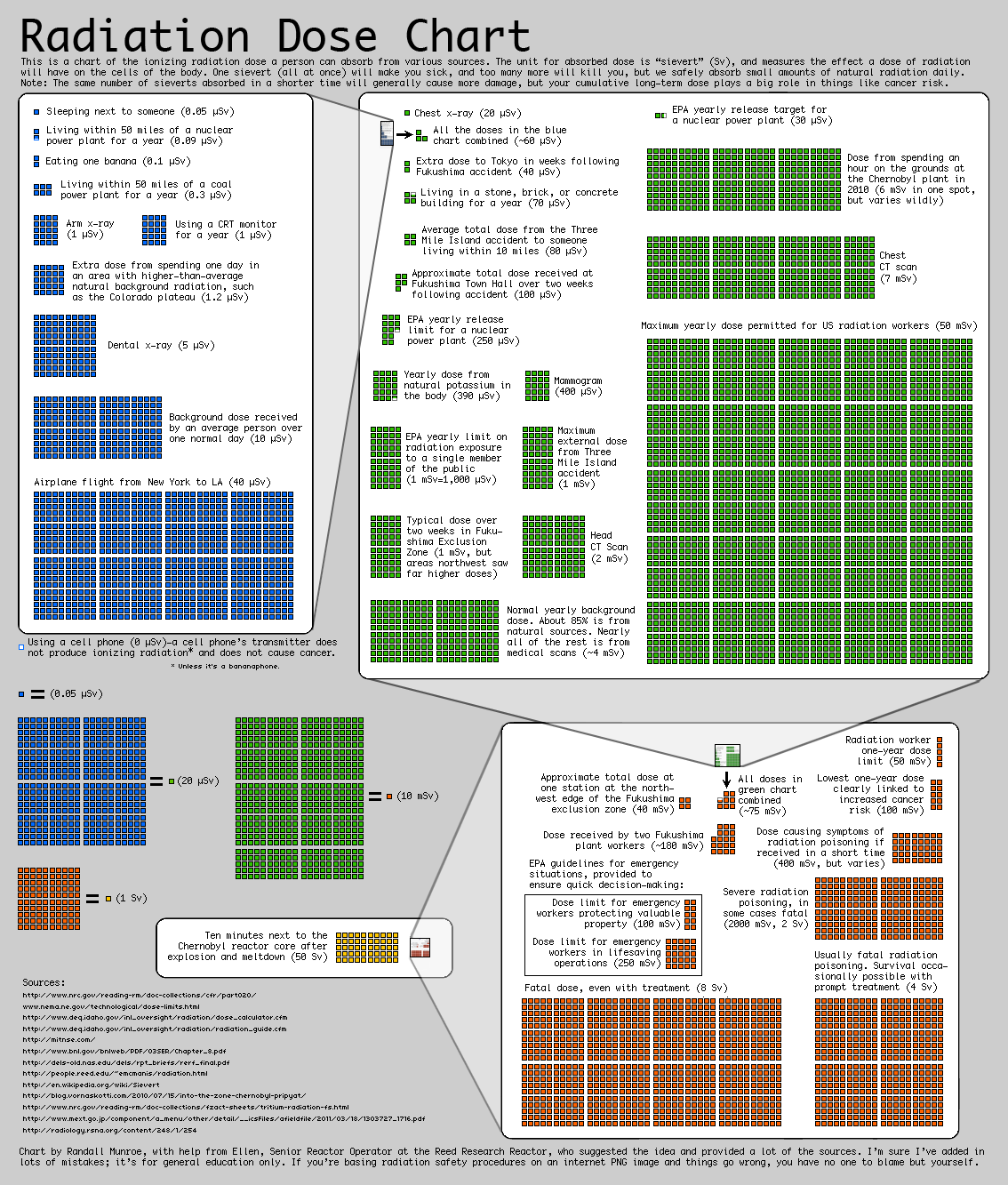
Radiation dose comparison charts from XKCD

March 20, 2011

No, there’s no humor in this thing — just good, solid information.

XKCD put together a chart that shows in geometric terms how various radiation doses work. With a tip of the pen to Bob Parks, the chart notes that cell phones don’t count here because cell phones don’t put out ionizing radiation, the type that causes cancer, but just radio waves.

The chart won’t be easy to read here — click on the image and go to the XKCD site for a bigger, more readable image:

Radiation Dose Chart from XKCD

Radiation Dose Chart from XKCD

It’s a good, clear graphic in its full size.  Go see.


Another study on human health and DDT: ADHD linked to DDT and other pesticides

July 7, 2010

Extravagant and way-too-enthusiastic claims that DDT is “harmless” to human health keep getting marginalized by new studies on the topic.

This week the Journal of the American Medical Association (JAMA) reported another study that links DDT to Attention Deficit Hyperactivity Disorder, “Increased Risk of ADHD Associated With Early Exposure to Pesticides, PCBs.”

I don’t have a full copy of the report yet.  Here is what is publicly available for free:

Individuals who are exposed early in life to organophosphates or organochlorine compounds, widely used as pesticides or for industrial applications, are at greater risk of developing attention-deficit/hyperactivity disorder (ADHD), according to recent studies. Previous studies had linked ADHD with very high levels of childhood exposure to organophosphate pesticides, such as levels experienced by children living in farming communities that used these chemicals. But a recent study using data from the National Health and Nutrition Examination Survey (NHANES) found that even children who experience more typical levels of pesticide exposure, such as from eating pesticide-treated fruits and vegetables, have a higher risk of developing the disorder.

JAMA. 2010;304(1):27-28.

Many of the chief junk science promoters will ignore this study, as they ignore almost all others — Steven Milloy, Roger Bate, Richard Tren, CEI, etc., etc.  How often does the junk science apple have to hit people before they figure out these people are malificent actors, when they claim DDT is harmless and we need more?

See also:


More schools jump on “no-recess” recess bandwagon

January 29, 2010

How long will the madness persist?

Via Lenore Skenazy at Free-Range Kids comes word that MommaLou has a meeting to find out why her kid’s school wants the kids to spend recess time engaged in something other than recess.

Excuse me?

They aim to “change the perception of recess from free time away from learning to a valuable learning experience that will teach them and will help them cope in all social settings and environments. When children view recess as “free time” they have a tendency to act in a less responsible manner and push the limits of irresponsible behavior. In order to change the perception of recess, children must see that its content is respected and valued.”

The absolute best memories I have of my childhood consisted of me and my sister on the loose in our backyard making mud pies and playing “lost kids”. When I was in college studying early childhood education, I spent countless hours in classrooms learning about how kids learn. Kids learn through play. They just need the resources. The tools. And time.

Well, yeah, that’s what recess is all about, isn’t it?

Kids need recess to stay healthy, the studies show. Recess keeps them healthy.  In my corporate consulting, we counseled managers to provide recess.  Creativity and corporate problem solving experts, like Dr. Perry W. Buffington, recommend business people take a recess and get away from work for a while when things get tense, or when problem solvers get dense.  In one session I watched with Buffington, one manager didn’t get it and kept coming up with all sorts of things to do to avoid taking a recess.  Buffington finally spelled it out for him:  Get away from the office; make sure that the activity is AWAY from the building . . .

Heck, do they have an “organizational health” survey at that school?  The teachers need recess for the kids, too.

Recall these resources from my earlier post:

Nota bene: Even just a little movement worksIt works for adults, too.

Resources:

  • PEDIATRICS Vol. 123 No. 2 February 2009, pp. 431-436 (doi:10.1542/peds.2007-2825) (subscription required for full text),  “School Recess and Group Classroom Behavior,” Romina M. Barros, MD, Ellen J. Silver, PhD and Ruth E. K. Stein, MD, Department of Pediatrics, Albert Einstein College of Medicine, Children’s Hospital at Montefiore and Rose F. Kennedy Center, Bronx, New York

    OBJECTIVES. This study examines the amount of recess that children 8 to 9 years of age receive in the United States and compares the group classroom behavior of children receiving daily recess with that of children not receiving daily recess.

  • See this year-old post at The Elementary Educator
  • Post in agreement from the venerable Trust for Public Lands, one of the best and best respected non-profits in America

Also, be sure to see this post from Ms. Cornelius at A Shrewdness of Apes.  If you’re having difficulty telling the difference between school and a prison — or if your school kid is having that difficulty, it’s time to act.

Cartoon - lawyers still get recess.  Andertoons

Via doxpop.com. See Andertoons.com, and buy it for your newsletter.


Cargo cults in global warming, and Arthur Robinson

March 14, 2009

Cargo cult science has deep roots among those who deny global warming or who allow that warming is occurring, but claim we can do nothing about it.  So, it’s no surprise that, at the voodoo science 2nd International Conference on Climate Change, somebody would trot out the old falsehoods about DDT.

According to Traditional Catholic Reflections (you can tell its traditional Catholic because it brooks no comments — you can’t correct an error there):

Speaking at the conference hosted by the Heartland Institute in New York City,[Dr. Arthur Robinson, Director of the Oregon Institute of Science and Medicine] said, “There is a current example of genocide by the removal of technology, and that is the ban on DDT, and that has resulted in the deaths of 30 to 40 million people and has left half a billion infected with malaria.”

It’s malaria that kills people, not a lack of DDT.  The removal of DDT from spraying cotton crops  in Texas and California did absolutely nothing to promote malaria in Africa.  Dr. Robinson needs a basic geography course.  Mosquitoes do not migrate from the U.S. to Africa or Asia.

Stopping the spraying of DDT in the U.S. in 1972 wasn’t a factor in the cessation of usage of DDT in Africa seven years earlier, either.  Dr. Robinson could use some basic math sequencing and calendar reading remediation, too.

Dr. Robinson could use some history and public policy instruction, too.  DDT was never banned in Africa, nor was it banned in India or China which together now produce almost all the DDT used in the world, which is a lot.  There’s no ban on DDT in Uganda, where Dr. Robinson’s friends in the business world are suing to stop the spraying of DDT in huts in affected regions — because they are afraid it will harm their tobacco business.

It’s a heckuva lot easier to throw darts at health care workers and disease fighters than it is to talk about real solutions with these guys.

If Robinson is dead wrong on a one-liner about DDT, how wrong do you think he is in the rest of his presentation on climate change?

Is there any crackpot “scientist” who was not at the Heartland Institute’s wing-ding?


Solid research on controlling malaria

October 20, 2008

Looking for other things, I stumbled into two research journal articles on the fight against malaria.  Neither calls for a return to broadcast spraying of DDT; neither claims the ban on agricultural use of DDT had any significant effect on the rise of malaria.

Both are loaded with serious research that exposes DDT advocates as charlatans.

First:  from Clinical Microbiology Reviews, October 2002, p. 564-594, Vol. 15, No. 4
0893-8512/02/$04.00+0; DOI: 10.1128/CMR.15.4.564-594.2002. “Evolutionary and Historical Aspects of the Burden of Malaria,” by Richard Carter and Kamini N. Mendis:

SUMMARY:  Malaria is among the oldest of diseases. In one form or another, it has infected and affected our ancestors since long before the origin of the human line. During our recent evolution, its influence has probably been greater than that of any other infectious agent. Here we attempt to trace the forms and impacts of malaria from a distant past through historical times to the present. In the last sections, we review the current burdens of malaria across the world and discuss present-day approaches to its management. Only by following, or attempting to follow, malaria throughout its evolution and history can we understand its character and so be better prepared for our future management of this ancient ill.

Second, from Joel G. Bremen, Martin S. Alilio, and Anne Mills, “Conquering the Intolerable Burden of Malaria:  What’s New, What’s Needed:  A Summary,” Am. J. Trop. Med. Hyg., 71(2 suppl), 2004, pp. 1-15 (The American Journal of Tropical Medicine and Hygeine).

High school kids, there are the sources you need for your papers on the fight against malaria.


Atomic history, nuclear future

October 19, 2008

We’re going to see more nuclear power plants in the U.S., it’s a safe bet.  Both presidential candidates support developing alternatives to oil and coal.  Nuclear power is one of the alternatives.

John McCain kept repeating his comfort words, that ‘storage of wastes is not a problem.’ There is not a lot of evidence to support his claims.  With turmoil in financial markets, however, the nuclear power issue has gotten very little serious attention or scrutiny.  From the push to get compensation for radiation victims of atomic weapons and development in the U.S., I learned that the issue is not really whether wastes and other materials can be safely used and wastes stored. The issues are entirely issues of will.

Advantage to Obama, I think.  He’s not claiming that the storage problems are all solved.  A clear recognition of reality is good to have in a president.

Son Kenny sent a link to a history site, Damn Interesting, and it tells the story of the Techa River in the old Soviet Union — a place condemned for generations by the nuclear excesses of the past.

To make the story briefer, in their rush to produce nuclear weapons, the Soviets did nothing to protect Russia from radioactive waste products until it was much too late.  Efforts to reduce radioactive emissions, by storing them in huge underwater containers, resulted in massive explosions that released more radiation than Chernobyl (What?  You hadn’t heard of that, either?).

It’s a reminder that safety and security with peaceful uses of nuclear power depend on humans doing their part, and thinking through the problems before they arise.

Can we deal with radioactive wastes?  We probably have the technology.  Do we have the will? Ask yourself:  How many years has the U.S. studied Yuccan Mountain to make a case to convince Nevadans to handle the waste?  How many more decades will it take?

How is our history of dealing with nuclear contamination issues?  Not good.

Last spring SMU’s history department sponsored a colloquium on a power generation in the southwest, specifically with regard to coal and uranium mining on the Navajo Reservation.   We’ve been there before.

One of the photos used in one of the lectures, by Colleen O’Neill of Utah State, showed two Navajo miners outside a uranium mine during a previous uranium boom.  Neither one had a lick of protective equipment.  Underground uranium mining exposes miners to heave concentrations of radon gas, and if a miner is unprotected by breathing filters at least, there is a nearly 100% chance the miner will get fatal lung cancers.

Of the 150 Navajo uranium miners who worked at the uranium mine in Shiprock, New Mexico until 1970, 133 died of lung cancer or various forms of fibrosis by 1980 ([Ali, 2003] ).

Our Senate hearings on radiation compensation, in the 1970s, produced dozens of pages of testimony that Atomic Energy Commission officials understood the dangers, but did nothing to protect Navajo miners (or other miners, either).  It is unlikely that anyone depicted in those photos is alive today.

AP Photo  (borrowed from ehponline.org)

"Mine memory - Navajo miners work the Kerr-McGee uranium mine, 7 May 1953. Today, uranium from unremediated abandoned mines contaminates nearby water supplies. image: AP Photo" (borrowed from ehponline.org) This photo is very close to the one used by Prof. O'Neill. It may have been taken at nearly the same time. If you know of any survivors from this photo, please advise.

At a refining facility on the Navajo Reservation, highly radioactive wastewater was stored behind an inadequate earthen dam.  The dam broke, and the wastes flowed through a town and into local rivers.  Contamination was extensive.

Attempts to collect for the injuries to Navajo miners and their families were thrown out of court in 1980, on the grounds that the injuries were covered under workers compensation rules (where injury compensation was also denied, generally).

Navajos organized to protest the power plant. One wonders whether they can win it.

Sen. McCain seems cock sure that radioactive wastes won’t kill thousands of Americans in the future as they have in the past.  The uranium mining and uranium tailings issues occurred in Arizona, the state McCain represents.  Does he know?

We regard ourselves in the U.S. as generally morally superior to “those godless communists.”  Can we demonstrate moral superiority with regard to development of peacetime nuclear power, taking rational steps to protect citizens and others, and rationally, quickly and fairly compensating anyone who is injured?

That hasn’t happened yet.

When [uranium] mining [on the Navajo Reservation] ceased in the late 1970’s, mining companies walked away from the mines without sealing the tunnel openings, filling the gaping pits, sometimes hundreds of feet deep, or removing the piles of radioactive uranium ore and mine waste. Over 1,000 of these unsealed tunnels, unsealed pits and radioactive waste piles still remain on the Navajo reservation today, with Navajo families living within a hundred feet of the mine sites. The Navajo graze their livestock here, and have used radioactive mine tailings to build their homes. Navajo children play in the mines, and uranium mine tailings have turned up in school playgrounds (103rd Congress, 1994 ).

Think of the story of Techa River as a warning.

Resources:


Carnival of Fighting Malaria (and DDT)

October 8, 2008

It’s been about a year since the first, completely impromptu Carnival of DDT.  Last fall, in October and November, there was enough going on about DDT to merit something like a blog carnival, with a second in November.

My news searches today turned up a number of items of interest in DDT and fighting malaria — enough to merit another summary post, IMHO.  Here goes.

First, Tim Lambert at Deltoid sets straight the history of the policy of the World Health Organization (WHO) with regard to DDT use, and whether WHO caved in to pressures from environmentalists to completely ban DDT, as Roger Bate had earlier, erroneously said.  Tim has a number of well-researched, well-reasoned posts on DDT and health; people researching the issue should be sure to visit the archives of his blog.  But for today, make sure you read “Roger Bates’ false history.

Ornithologist Tom Cade holds a gyrfalcon, which is larger than the peregrine falcons he helped to preserve. Now working to aid the revival of the California condors, he will speak Friday at Hawk Mountain Sanctuary.  Allentown (Pennsylvania) Morning-Call

Ornithologist Tom Cade holds a gyrfalcon, which is larger than the peregrine falcons he helped to preserve. Now working to aid the revival of the California condors, he will speak Friday (October 10) at Hawk Mountain Sanctuary. Allentown (Pennsylvania) Morning-Call

(Photo above has gone missing; see photo below)

Ornithologist Tom Cade, with a falcon; photo by Kate Davis, from Cade's biography at Global Raptors

Ornithologist Tom Cade, with a falcon; photo by Kate Davis, from Cade’s biography at Global Raptors

This Friday the Hawk Mountain Sanctuary presents an award to Tom Cade, the Boise, Idaho guy credited with doing much to save the endangered peregrine falcon. You can read about it in the Allentown, Pennsylvania, Morning Call.

Cade played a major role in reviving the nearly extinct peregrine falcon in the 1970s. As a graduate student, he studied how a pesticide contributed to their sharp population decline. He eventually founded a conservation group, The Peregrine Fund, which reintroduced captivity-bred birds to the wild.

. . . The falcon’s revival is widely considered one of the most successful recoveries of an endangered species. The species teetered on the brink of extinction in 1970, when as few as 39 known pairs of nesting falcons existed. A 2003 survey puts the number of nesting pairs at more than 3,100.

On Thursday Cade will receive the Sarkis Acopian Award for Distinguished Achievement in Raptor Conservation.  According to The Morning Call, “The award is given infrequently by Hawk Mountain officials and is named after the Kempton-area bird sanctuary’s primary benefactor, a late philanthropist who studied engineering at Lafayette College.”

Also, see this story about the recovery of peregrines in Canada, from the Sudbury Star.

Bug Girl tells the story of a new documentary on the Michigan State University professor who documented the deaths of songbirds made famous in Rachel Carson’s book, Silent Spring. Dr. George J. Wallace’s work became the subject of an article in Environmental Journalism in 2005.  Students and faculty at MSU’s Knight Center for Environmental Journalism produced the movie, “Dying to Be Heard.”  Be sure to check out the comments at Bug Girl, for more information.

International health care expert César Chelala argues that the “War Against Malaria Can Be Won, Without DDT” at the on-line Epoch Times. Chelala reports on a project in Mexico — where DDT use has never stopped since 1946 — a project now extended to other places in Central America, demonstrating that the tried and true methods of preventing mosquitoes from breeding and avoiding contact work well to fight malaria.  Plus, he says, it’s cheaper than using DDT.  Doubt that it could work?  Chelala points out that the Panama Canal could not be dug without controlling mosquito-borne illnesses, and the Canal was opened in 1914, 25 years before DDT was demonstrated to be deadly to insects, more than 30 years before widespread deployment of DDT.

Early detection and treatment is critical to eliminate the parasite carriers. An important aspect of this project has been the collaboration of voluntary community health workers who are taught to make an early diagnosis in situ and to administer complete courses of treatment not only to those affected but also to the patients’ immediate contacts.

The project was carried out in specific pilot areas called “demonstration areas” which had been selected due to their high levels of malaria transmission. In those areas, the number of malaria cases fell 63% from 2004 to 2007. In several demonstration areas I visited in Honduras and Mexico as a consultant for the Pan American Health Organization malaria had practically been eliminated. Plans are underway to expand the project to other regions where malaria remains a serious threat.

One of the advantages of not using DDT (besides avoiding its toxic effects) is the enormous savings realized from discontinuing its routine use. These savings can now be put to good use with other diseases.

You might also want to view Chelala’s description of solutions for public health crises in Africa, at The Globalist.

Chelala’s cool, clear and accurate reporting sadly contrasts with the hysteric and wrong reporting at Newsbusters and other polemical outlets on the web, seemingly bent on perpetration of the hoax that DDT is harmless and Rachel Carson was wrong.

Liz Rothchild’s one-woman play about Rachel Carson, “Another Kind of Silence,” got good reviews upon opening at the Warehouse Theatre, in Croydon, England.

Meanwhile, from Uganda comes news that DDT spraying failed to reduce malaria in spraying done in that nation. Proponents expected a sharp and steep decline in malaria, but numbers are not greatly reduced.  Even after taking account for the legal difficulties of spraying, after conservative businessmen sought an injunction to stop DDT use, the results do not speak well for DDT’s effectiveness.

Contrary to expectations, data collected by health departments in Apac and Oyam districts, which record the highest malaria incidence in the world, do not reflect significant improvements since DDT spraying ended prematurely. From May to July 2008, which is the period immediately following the spraying, between 400 and 600 clinical malaria cases per 100,000 of the population were reported per week in Oyam; and 600 to 800 such cases in Apac for the same period. These are almost exactly the same as the number of cases reported between January and April 2008.

Getting news out of Africa is not always easy.  Reading reports from Ugandan papers, it becomes clear that reporting standards differ greatly from the U.S. to Uganda.  Still, the saga from Uganda demonstrates that DDT is no panacea.  Uganda is a nation that had not used DDT extensively prior to the mid-1960s.  Resistance to use now comes from tobacco and cotton interests who speciously claim that potential DDT contamination of crops would result in the European Union banning vital Ugandan exports.  The legal issues all alone assume Shakespearean tragedy dimensions.  Or, perhaps more accurately, we could call the story Kafkaesque.

See also:

Happily, we have evidence that younger people show concern about DDT pollution, in a story about the stuff in Teen Ink magazine.

A study in the UK finds DDT present in colostrum, the vital pre-milk substance newly-lactating mothers create for their babies, as well as in later breast milk.

Bed bugs continue their own surge on Americans, and knee-jerk writers editorialize for the return of DDT, completely unaware that bed bugs are among those critters most resistant to DDT, and unaware that there are other, more effective solutions.

James McWilliams writes in The Texas Observer that most of us are ecological illiterates, which makes control of pollution more difficult, in a review of a new book, The Gulf Stream. Canny readers will recognize McWilliams as the author of the recently-published book, American Pests: Our Losing War on Insects from Colonial Times to DDT.

Sandra Steingraber will lecture on November 11 in Philadelphia on “The Many Faces of DDT,” part of a series of lectures sponsored by the Chemical Heritage Foundation, “Molecules That Matter.”  Steingraber is the author of Living Downstream:  An ecologist looks at cancer and the environment.

Canada’s Leader-Post reports that Chinese food processors have been caught using DDT in food to reduce insect infestations.  The cycle starts all over again.

Time for this carnival’s midway to shut down for the night.  Don’t let the bed bugs bite.


DDT results disappointing in Uganda

October 3, 2008

October 2008 — Uganda is nearing the end of the season when the national health service sprays DDT inside homes to discourage mosquitoes from biting, and spreading malaria.  Results from DDT use this year show no improvement over the previous year, and in some cases malaria rates are higher.

BBC map of Uganda, showing Apac Province. Apac is victim to terrorism by the

BBC map of Uganda, showing Apac Province. Apac is victim to terrorism by the “Lord’s Resistance Army” and other armed bandits, as well as being the most malaria-ridden area of the world.

The story from The Observer in Kampala, via All-Africa.com news, provides some of the details, but little analysis to be debated.  Is the failure of the program due to partial implementation, since implementation was resisted by businesses and cotton farmers?  Or is DDT simply ineffective?  It’s nearly impossible to tell from data available so far.

Below the fold, the story in its entirety.

Read the rest of this entry »


Trivia and waste of bandwidth – until it saves your kid’s life

August 31, 2008

Trivial information and internet communication make for bandwidth-wasting and brain-numbing exchanges — friendly, maybe, but your spouse will consider filing papers.

Until it saves your kid’s life with a dramatic diagnosis of a deadly disease across an ocean.

Look at the BBC report on the toddler in Florida whose life was saved by a transatlantic, e-mail suggested diagnosis.  Print story from BBC, here.

A toddler in Florida has been diagnosed with cancer after a Manchester woman saw early warning signs in a picture.

Madeleine Robb, from Stretford, who has never met her pen pal, spotted a shadow behind one of Rowan Santos’s eyes on pictures from her first birthday.

She then e-mailed her mother Megan advising her to get medical help.

The toddler was diagnosed with an aggressive form of cancer – Retinoblastoma – and underwent an operation and is having chemotherapy.

The two mothers became friends on an internet messageboard after their children were born on the same day.

But when Mrs Robb saw the pictures she said she knew something was not right.

Tip of the old scrub brush to Moments in Time.

[FireFox 3 doesn’t support the old video capture of VodPod; my apologies for sending you to the video, though sending someone to a BBC site is probably a great act of education.]


World Mosquito Day

August 21, 2008

Oops! Missed this one.

Anopheles gambiae mosquito biting.  A. gambiae is one of the several species of mosquito that is a vector for malaria.  EPA/Stephen Morrison photo

Anopheles gambiae mosquito biting. A. gambiae is one of the several species of mosquito that is a vector for malaria. EPA/Stephen Morrison photo

August 20 is World Mosquito Day:

Pause for a moment on World Mosquito Day to reflect on the little bloodsucker that probably causes more human suffering than any other organism. Observed annually today, August 20, World Mosquito Day originated in 1897 by Dr. Ronald Ross of the Liverpool School of Tropical Medicine, according to the American Mosquito Control Association, a nonprofit based in New Jersey.

Ross is credited with the discovery of the transmission of malaria by the mosquito, and was honored with a Nobel Prize for Medicine in 1902.

Each year 350-500 million cases of malaria occur worldwide, and over one million people die, most of them young children in sub-Saharan Africa, according to the Centers for Disease Control and Prevention.

But malaria is not the only disease spread by mosquitoes. There’s also West Nile virus, various strains of encephalitis, Dengue Fever, Rift Valley Fever, Yellow Fever.

Resources: