Election day encore: VOTE, then enjoy the art

November 6, 2018

I hope you’ve voted already. If not, go vote.

Then come back and contemplate U.S. art about voting, and what it tells us about us.

Interesting contrasts, at least.

I love the “County Election” painting of George Caleb Bingham, showing an election in 1852, the year incumbent President Millard Fillmore could not get even the nomination of his party. I love the tension of Norman Rockwell’s painting of the 1944 election in Cedar Rapids, Iowa, with tensions we see only in retrospect. (That post also shows real tensions in a family, in the election of 1948, in another Rockwell painting).

What else does the world of art show about elections in America? What do you think?

Illustration from Harper's Weekly, showing election persuasion at the polls. Library of Congress collection

Illustration from Harper’s Weekly, November 7, 1857, showing election persuasion at the polls – politicians trying to buy votes. Library of Congress collection

If bribery didn’t work, there was always plain old fisticuffs.

Fighting at the polls. Illustration from Harper's Weekly, November 7, 1857. Library of Congress collections

Fighting at the polls. Illustration from Harper’s Weekly, November 7, 1857. Library of Congress collections

Here’s an unusual ritual, portrayed about the 1892 contest between William Henry Harrison and Grover Cleveland. Did this really happen? Did the loser pull the winner on a cart through the city?

“Lost Bet,” by John Klir, Library of Congress. Pearson’s education materials say this was common in the 19th century.

Louis Dalrymple noted a twist on the tradition four years later.

Puck Magazine, November 11, 1896.

Puck Magazine, November 11, 1896. “Print shows a bloated businessman holding an American flag labeled ‘Victory,’ riding in a wheelbarrow being pushed by another man; in the background, a young boy is telling a stranger that his Dad had a bet with the other man regarding the outcome of the presidential election. The stranger is uncertain who lost the bet.” Drawing by Louis Dalrymple for Puck. Library of Congress collections

Not sure how long that tradition of the loser pushing or pulling the winner hung on, but by 1904 election night was an occasion to walk about, socialize, and watch fireworks, if this print from the William Randolph Hearst organization is accurate. Teddy Roosevelt won the presidency on his own that year.

“Election night illumination at the Flatiron Building [New York City].” New York Sunday American & Journal, a Hearst newspaper. Library of Congress collections

“Politics in the Oyster House,” 1848 by Richard Caton Woodville. Image found at Wikiwand

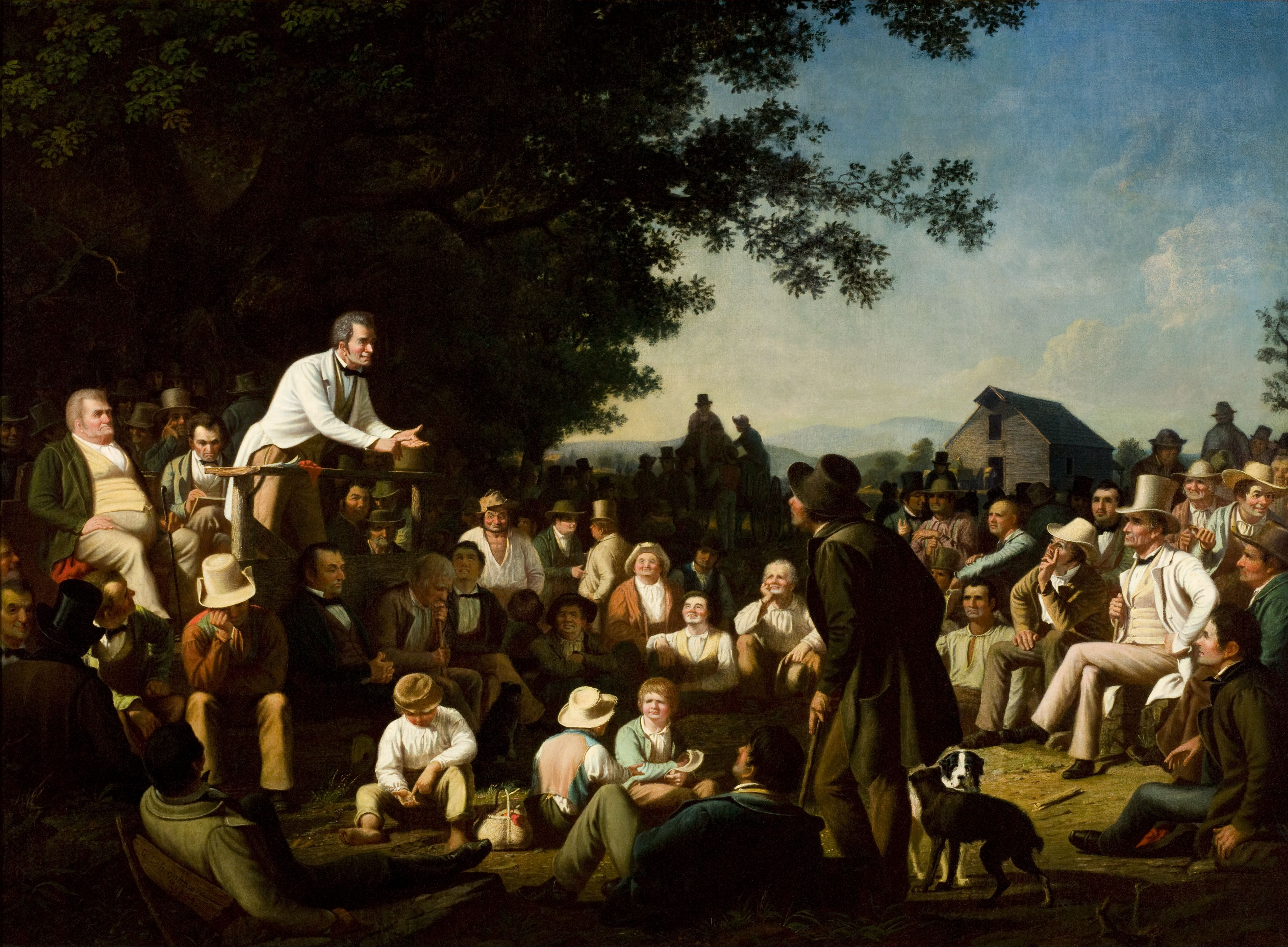
George Caleb Bingham's

George Caleb Bingham’s “Stump Speaking,” 1853-54. Image from Wikiwand

Not all election work involves a crowd.

George Caleb Bingham,

George Caleb Bingham, “Canvassing the Vote”

George Caleb Bingham,

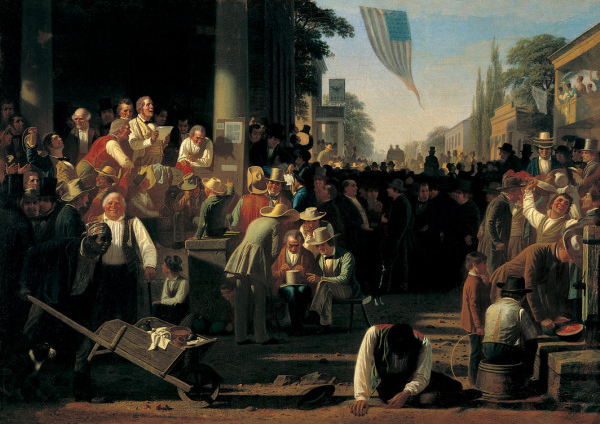
George Caleb Bingham, “The Verdict of the People,” 1854-55. Wikiwand image

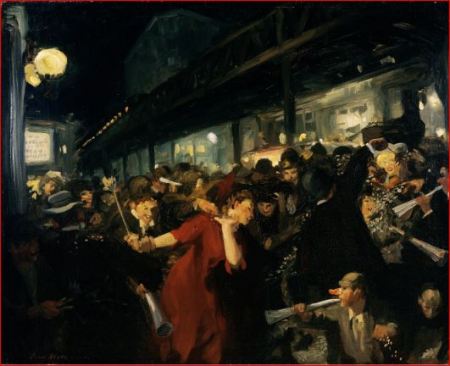
This looks more like the campaign party of a victorious candidate in the late 20th and early 21st centuries, though I’m not really sure this tradition survived much past the 2000 election.

John Sloan, "Election Night" 1907 Oil on canvas; University of Rochester

John Sloan, “Election Night,” 1907, an image from a New York drinking establishment. Collection of the Memorial Art Gallery of the University of Rochester.

Janie Price’s Evolution of American Painting said:

Here is the scene of Election Night written in Sloan’s Journal:

“Took a walk in the afternoon and saw boys in droves, foraging for fuel for their election fires this evening. . . . after dinner . . . out again and saw the noisy trumpet blowers, confetti throwers and the “ticklers” in use—a small feather duster on a stick which is pushed in the face of each girl by the men, and in the face of men by the girls. A good humorous crowd, so dense in places that it is impossible to control one’s movement.” (John French Sloan)

Women voted for the first time nationwide in 1920, after the ratification of the 19th Amendment. J. F. Kernan’s painting for The Country Gentleman magazine in 1922 shows some of the tensions that remained after the national amendment.

J. F. Kernan in Country Gentleman magazine, November 4, 1922

J. F. Kernan in Country Gentleman magazine, November 4, 1922. Wikimedia image

Rockwall made great use of his time and photographs in Cedar Rapids. In addition to the painting there, he used the setting for his famous “Undecided,” which became the cover of the Saturday Evening Post. 1944 was the last time prior to 2016 that both major candidates came from New York.

“Undecided,” Norman Rockwell, 1944. Copyright Curtis Publications

One might wonder if Rockwell considered himself undecided, when one sees this “son” of the painting, from 1960, featuring Rockwell in the same voting booth.

“Norman Rockwell at the Voting Booth” painted in 1960, based on his 1944 studies in Cedar Rapids, it seems to me. Image from The Easel

“Norman Rockwell at the Voting Booth” painted in 1960, based on his 1944 studies in Cedar Rapids, it seems to me. Image from The Easel

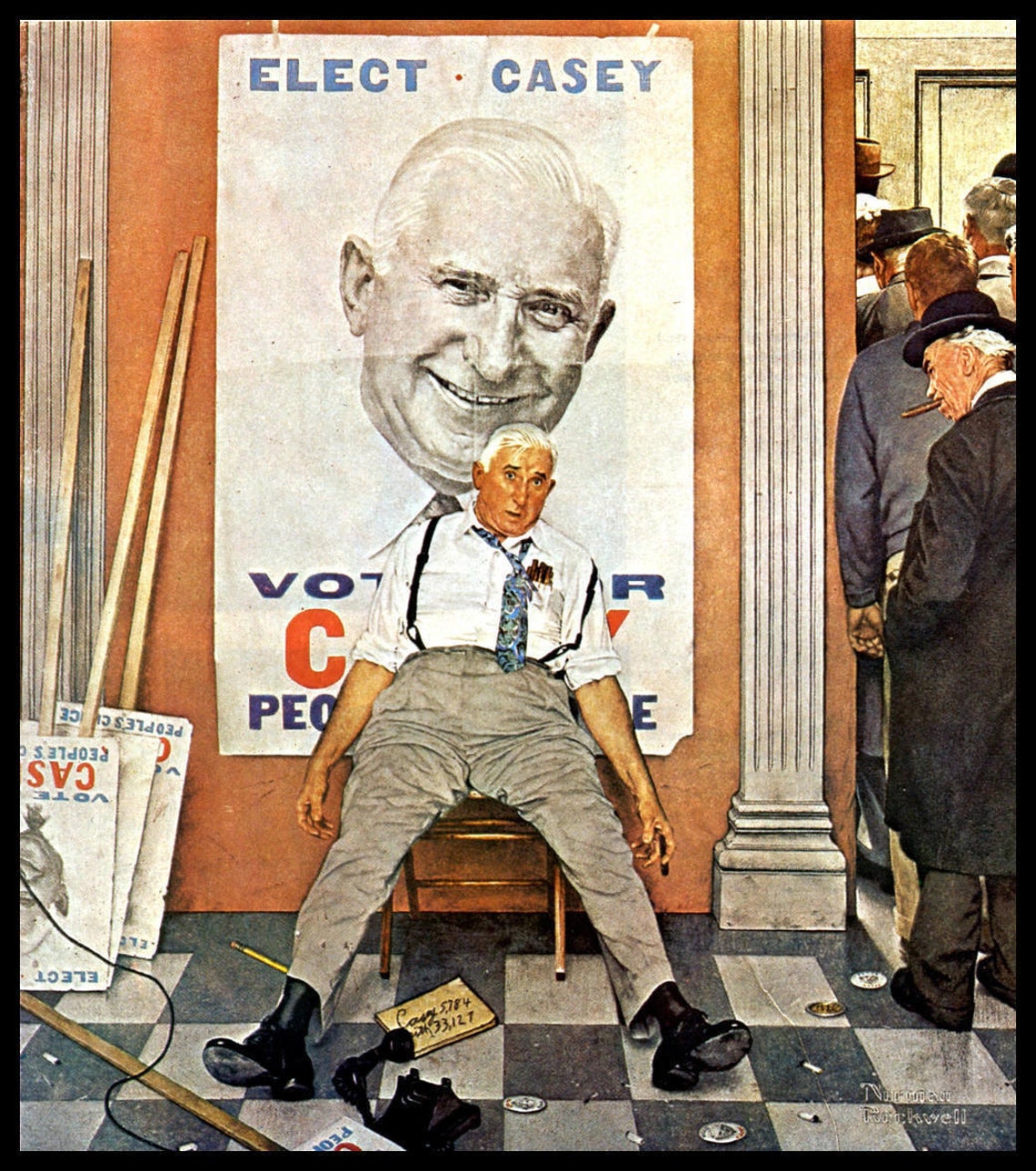
One last Rockwell to close out, one of my favorites, showing the happy candidate Casey, after having gotten the news that the voters were not so happy with him.

Norman Rockwall,

Norman Rockwall, “Elect Casey,” or “Before and After,” November 1958 for the Saturday Evening Post.

Legendary election jokester Dick Tuck once ran for the state legislature in California, on the slogan, “The job needs Tuck, and Tuck needs the job.” He lost, and he said what I can imagine the fictional Casey saying, “The people have spoken. The bastards!”

What are your favorite election day images? What are your memories of elections past?

This is an encore post.

Yes, this is an encore post. Defeating ignorance takes patience and perseverance.


November 2018 days for flying the flag

November 1, 2018

A polling place in Glasgow, Kentucky, in 2016. Photo by Kevin Willis, WKU Public Radio.

A U.S. flag flies at a polling place in Glasgow, Kentucky, in 2016. Photo by Kevin Willis, WKU Public Radio.

Nine events spread over seven different days come with urgings to fly the U.S. flag in November: Six states celebrate statehood, Veterans Day falls as always on November 11, and Thanksgiving Day on November 22.

Did I say eight? 2018 is an election year for Congress; we fly flags at polling places on election day, so that makes nine events. You may fly your flag at home on election day, too. (Yes, flags should be flown at all early polling places, on days of early voting, too — do you know of poll where that did not occur? Tell us in comments.)

Two states, North Dakota and South Dakota, celebrate their statehood on the same date. Washington’s statehood day falls on Veterans Day, November 11 — so there are only seven days covering nine events.

In calendar order for 2018, these are the seven days:

  • North Dakota statehood day, November 2 (1889, 39th or 40th state)
  • South Dakota statehood day, November 2 (1889, 39th or 40th state) (shared with North Dakota)
  • Election day, November 6 (Congress and several states) — Go vote!
  • Montana statehood day, November 8 (1889, 41st state)
  • Veterans Day, November 11
  • Washington statehood day, November 11 (1889, 42nd state) (shared with Veterans Day)
  • Oklahoma statehood day, November 16 (1907, 46th state)
  • North Carolina statehood day, November 21 (1789, 12th state)
  • Thanksgiving Day, fourth Thursday in November (November 22 in 2018)

Most Americans will concern themselves only with Veterans Day and Thanksgiving Day. Is flying the U.S. flag for statehood day a dying tradition?

More:

Polling station in South Carolina. SCETV image.

Polling station in South Carolina. SCETV image.

This is an encore post.

Yes, this is an encore post. Fighting ignorance takes longer than we hoped.


Navy Day 2018 – Fly your flag October 27

October 27, 2018

A Navy color guard unit parades the colors during Navy Day at the Alamo as part of Fiesta in downtown San Antonio. Ten different Navy commands in the San Antonio area gathered to celebrate with local military and community leaders. (This celebration was in April, but it fits with Navy Day.) (Photo by Petty Officer 1st Class Jacquelyn Childs)

A Navy color guard unit parades the colors during Navy Day at the Alamo as part of Fiesta in downtown San Antonio. Ten different Navy commands in the San Antonio area gathered to celebrate with local military and community leaders. (This celebration was in April, but it fits with Navy Day.) (Photo by Petty Officer 1st Class Jacquelyn Childs)

A reminder to fly your U.S. flags today in honor of the U.S. Navy.

We celebrate Navy Day each year on October 27, one of the score of dates designated in the U.S. Flag Code to fly Old Glory. Navy Day honors everyone who serves or served in the U.S. Navy.

Navy Day may be eclipsed by Armed Forces Day, Memorial Day and Veterans Day in modern life, but it’s still in the law and the Navy still notes it.

Plus, we celebrate Navy Day on the birthday of former Secretary of the Navy Theodore Roosevelt. It’s Teddy’s birthday today, too.

So should we. Fly your flag for the U.S. Navy.

More:

Theodore Roosevelt in his office as Assistant Secretary of the Navy. DOD image.

Theodore Roosevelt in his office as Assistant Secretary of the Navy. DOD image.


Look closely, you can (almost) see Teddy Roosevelt on his 160th birthday

October 26, 2018

Young Theodore Roosevelt, as a boxer and wrestler at Harvard University. Harvard University image.

Young Theodore Roosevelt, as a boxer and wrestler at Harvard University. Harvard University image.

Theodore Roosevelt was born in Manhattan on October 27, 1858. 160 years ago, today.

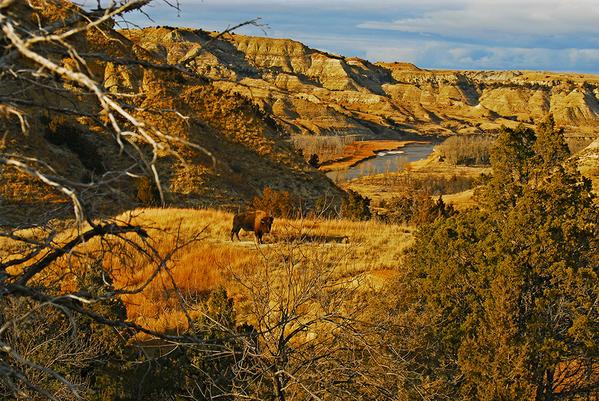
Among many other things in his life, he was for a time a cowboy in the Dakota Territory, in the area of North Dakota where today resides the Theodore Roosevelt National Park.

Look closely at the picture.  You can almost see Teddy.  He was a powerful, guiding force behind the movement to protect precious, historic, scientifically valuable and beautiful lands, by the federal government.

Happy birthday, Theodore Roosevelt! Let's celebrate with a great shot of @TRooseveltNPS #NorthDakota

Happy birthday, Theodore Roosevelt! Let’s celebrate with a great shot of @TRooseveltNPS #NorthDakota

In 1922, the U.S. Navy started celebrating Navy Day on Roosevelt’s Birthday, October 27, to honor Roosevelt. When he had been Secretary of the Navy, Roosevelt overhauled the entire fleet and brought the U.S. Navy onto the world stage as a modern, major fighting force worthy of deep respect. When we fly the flag for Navy Day, we also honor one of the Navy’s greatest leaders, Navy Secretary Theodore Roosevelt.

Happy Theodore Roosevelt’s birthday, America.

More:

A short, mostly accurate history of Teddy Roosevelt, from some guy named Jeremiah:

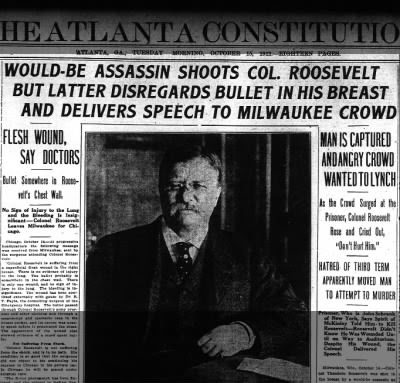
In his life, Teddy Roosevelt often lived outside the box, bigger than life. Running for election in 1912, Roosevelt was shot in the chest before a speech in Milwaukee. The copy of the speech and things in his pocket protected him, but it was still quite a blow to his chest. Roosevelt gave the speech before going to a hospital. Here’s a headline from the Atlanta Constitution on the affair.

Front page of the Atlanta Constitution, October 15, 1912, telling the story of Teddy Roosevelt's having been shot in Milwaukee the previous day.

Front page of the Atlanta Constitution, October 15, 1912, telling the story of Teddy Roosevelt’s having been shot in Milwaukee the previous day.


Ban of DDT did not cause a rise in malaria, or malaria deaths

October 23, 2018

Time to put that old canard to bed.

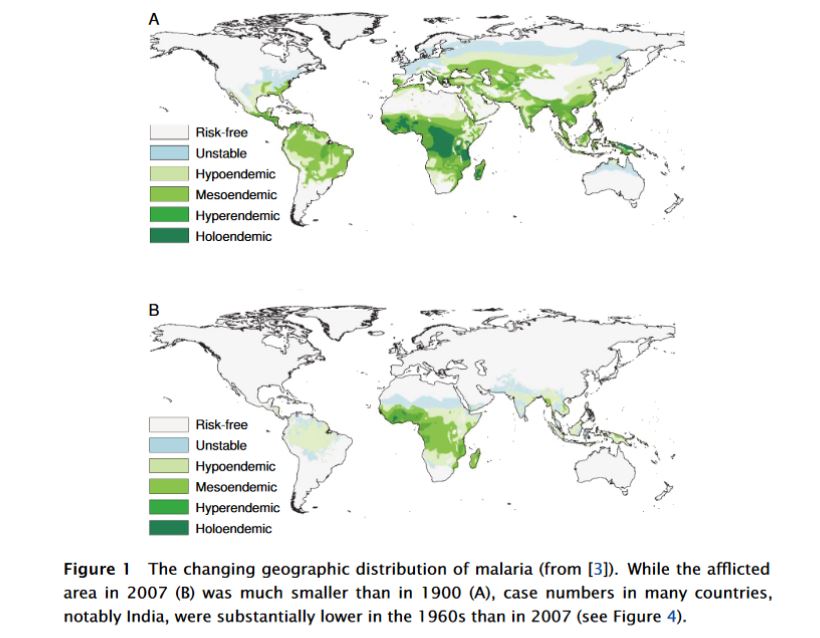
Malaria distribution was greatly reduced in the 20th century, reversing centuries of spreading. But malaria persisted into the 21st century. DDT helped reduce malaria, but the U.S. ban on DDT did not cause a rise in malaria infections or deaths. From a paper by Michael Palmer, M.D,. at Waterloo University.

Malaria distribution was greatly reduced in the 20th century, reversing centuries of spreading. But malaria persisted into the 21st century. DDT helped reduce malaria, but the U.S. ban on DDT did not cause a rise in malaria infections or deaths. From a paper by Michael Palmer, M.D,. at Waterloo University. Palmer’s source, Peter Gething in Nature.

The U.S. ban on DDT in 1972 did not cause millions of unnecessary deaths to malaria. In fact, the worldwide death toll to malaria dropped for at least 18 years after the ban, plateaued for most of a decade, and dropped from 1999 to 2017. Malaria deaths fell dramatically, after the U.S. banned DDT from U.S. farms.

Not sure why Dr. Palmer wrote his essay in 2013, but he got most of the major sources and got most of the history accurately, His title, “The ban of DDT did not cause millions to die from malaria.”

It’s a good paper to bookmark, because it doesn’t always show up in Google searches in the U.S. — Waterloo being a university in Canada, in Waterloo, Ontario

www.science.uwaterloo.ca/~mpalmer/stuff/DDT-myth.pdf

[Update, January 2023: If that link does not work, try the trusty old Wayback Machine: https://web.archive.org/web/20200625073336/http://www.science.uwaterloo.ca/~mpalmer/stuff/DDT-myth.pdf]

[And if that link doesn’t work well, Michael Palmer DDT-myth. Where did Palmer land after Waterloo? It appears he ran off his rails, began complaining about the COVID-19 policies of Waterloo University, and was fired (or had his contract not renewed). Sometime in 2021? Not sure if he’s still active; regret his papers were deleted from Waterloo U’s site. Palmer’s paper on DDT is easily verifiable with sources he cites well.]


October 2018 dates to fly Old Glory

October 18, 2018

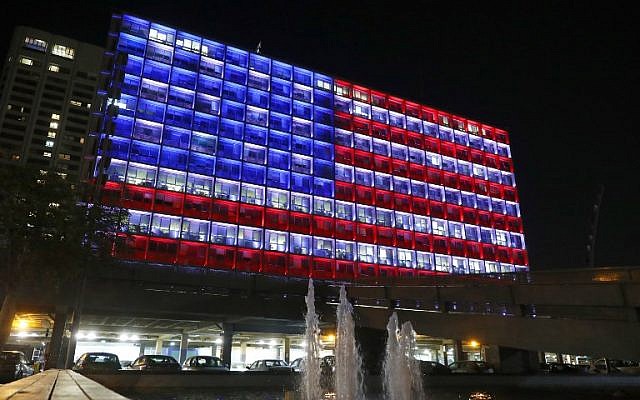
Solidarity with the United States:

Solidarity with the United States: “Tel Aviv city hall, lit up in the colors of the American flag to honor the victims of the mass shooting in Las Vegas, on October 2, 2017. (AFP Photo/Jack Guez)” – From the Times of Israel

October is not a big month for dates to fly the U.S. flag.  Only one state joined the union in October, and only two other dates received Congress’s designation for flag-flying.

Here are October’s three flag-flying days, in chronological order:

  • Columbus Day, October 8 —  tradition puts Columbus Day on October 12, but in law it is designated as the second Monday in October (to make a three-day weekend for workers who get a holiday); in 2017, October 8 is the second Monday of the month.
  • Navy Day, October 27
  • Nevada Statehood Day, October 31; Nevada joined the union during the Civil War, in 1864, the 36th state.

(Yes, I’m getting to this late this year; it’s an election year, you know.)

Federal law also designates October 9 as Leif Erickson Day, a concession to Scandanavian-descended Americans who argue Erickson beat Columbus to the Americas by a few hundred years. Congress’s recognition does not include an urging to fly the flag, though the President may issue such a proclamation.

October 6 is German-American Day, whose history I do not know.

October 27 is also the birth date of Theodore Roosevelt (1858), the Secretary of the Navy who led the dramatic updating of the fleet that preceded the U.S. push to become a major international power. Navy Day was set on October 27 partly to honor Teddy’s work, and Teddy himself — the “birth” date of the U.S. Navy is considered to be October 7. Here’s a brief history of TR before his presidency, at the Miller Center, written by Sidney Milkis.

Fans of Roosevelt may get an little extra kick flying the flag on his birthday.

Other notable stuff:

More:

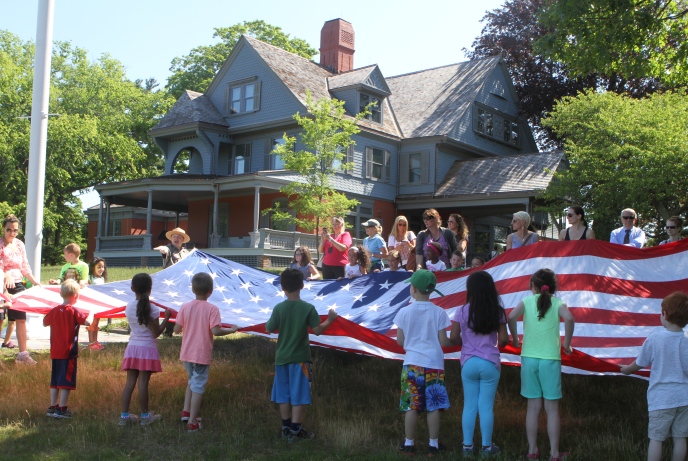
Fourth grade students practice U.S. flag etiquette with the help of National Park Service Rangers at Sagamore Hill National Historic Site in New York. Sagamore Hill, at Oyster Bay, was the home of Theodore Roosevelt and his family. National Park Service Photo

Fourth grade students practice U.S. flag etiquette with the help of National Park Service Rangers at Sagamore Hill National Historic Site in New York. Sagamore Hill, at Oyster Bay, was the home of Theodore Roosevelt and his family. National Park Service Photo

This is an encore post.

Yes, this is an encore post. Defeating ignorance takes patience and perseverance.

Save

Save

Save

Save

Save


Nobel Peace Prize winner pledges the award to making peace

October 10, 2018

Nadia Murad, in a photograph for her book, The Last Girl.

Nadia Murad, in a photograph for her book, The Last Girl.

It’s the same thing the Rev. Dr. Martin Luther King, Jr., did with the prize money he got from the Nobel Committee for winning the Nobel Peace Prize.

But when King did it, it was about $50,000.

Bloomberg news noted: “Nadia Murad, co-winner of the 2018 Nobel Peace Prize, says she will commit 100% of her share of the $1.01 million prize money to continue the work of ending sexual violence in war zones.”

In the press release announcing the prize for peace, on October 5, the Nobel Committee said:

The Norwegian Nobel Committee has decided to award the Nobel Peace Prize for 2018 to Denis Mukwege and Nadia Murad for their efforts to end the use of sexual violence as a weapon of war and armed conflict. Both laureates have made a crucial contribution to focusing attention on, and combating, such war crimes. Denis Mukwege is the helper who has devoted his life to defending these victims. Nadia Murad is the witness who tells of the abuses perpetrated against herself and others. Each of them in their own way has helped to give greater visibility to war-time sexual violence, so that the perpetrators can be held accountable for their actions.

*     *     *     *     *

Nadia Murad is herself a victim of war crimes. She refused to accept the social codes that require women to remain silent and ashamed of the abuses to which they have been subjected. She has shown uncommon courage in recounting her own sufferings and speaking up on behalf of other victims.

Nadia Murad is a member of the Yazidi minority in northern Iraq, where she lived with her family in the remote village of Kocho. In August 2014 the Islamic State (IS) launched a brutal, systematic attack on the villages of the Sinjar district, aimed at exterminating the Yazidi population. In Nadia Murad’s village, several hundred people were massacred. The younger women, including underage children, were abducted and held as sex slaves. While a captive of the IS, Nadia Murad was repeatedly subjected to rape and other abuses. Her assaulters threatened to execute her if she did not convert to their hateful, inhuman version of Islam.

Nadia Murad is just one of an estimated 3 000 Yazidi girls and women who were victims of rape and other abuses by the IS army. The abuses were systematic, and part of a military strategy. Thus they served as a weapon in the fight against Yazidis and other religious minorities.

After a three-month nightmare Nadia Murad managed to flee. Following her escape, she chose to speak openly about what she had suffered. In 2016, at the age of just 23, she was named the UN’s first Goodwill Ambassador for the Dignity of Survivors of Human Trafficking.

Below, a Twitter Moment prepared by Bloomberg News on Ms. Murad’s plans to dedicate her prize money to fighting sexual violence.


Encore: Powers of Ten – Charles and Ray Eames’ brilliant, before-its-time film

October 10, 2018

Images from

Images from “Powers of Ten,” 1977 edition. From IconEye

Back on October 10, 2010, we celebrated “Powers of Ten Day: 10/10/10.”

We’ve only got two tens in the date today, but the work of Charles and Ray Eames deserves remembering at least every October 10.

It’s a classic film, wonderful in its earliest versions in the 1970s, long before CGI. In 2018, I think it stands up very well.

Earlier I wrote:

AMNH’s “The Known Universe” is a cool film. Putting up that last post on the film, I looked back and noted that when I had previously written about the brilliant predecessor films from Charles and Ray Eames, “Powers of Ten,” the Eames films were not freely available on line.

That’s been fixed.

I like to use films like this as warmups to a year of history, and as a reminder once we get into studying the history of space exploration, of just how far we’ve come in understanding the universe, and how big this place is.

Of course, that means wer are just small parts.

The Eames’s genius showed the scale of things, from a couple picnicking in a park, to the outer reaches of the universe, and then back, zooming into the innermost reaches of a human down to the sub-atomic level.

There’s a series of these films; this one, published on YouTube by the Eames Office, was done in 1977, one of the later versions.

How can you use this in class, teachers? (I recommend buying it on DVD, as I did; better sound and pictures, generally.)

Film information:

Uploaded on Aug 26, 2010

Powers of Ten takes us on an adventure in magnitudes. Starting at a picnic by the lakeside in Chicago, this famous film transports us to the outer edges of the universe. Every ten seconds we view the starting point from ten times farther out until our own galaxy is visible only a s a speck of light among many others. Returning to Earth with breathtaking speed, we move inward- into the hand of the sleeping picnicker- with ten times more magnification every ten seconds. Our journey ends inside a proton of a carbon atom within a DNA molecule in a white blood cell. POWERS OF TEN © 1977 EAMES OFFICE LLC (Available at http://www.eamesoffice.com)

At the Eames Office Youtube site, you may find the film in with Mandarin Chinese, German, and Japanese translations (no Spanish?).  If you’re unfamiliar with the work of this couple — you would recognize much of the stuff they designed, I’m sure — check out a short film on an exhibit on Ray Eames (which has concluded, sadly):

More:

The very recognizable, famous Eames Chair, from Herman Miller. Ideally, you can sit in your Eames Chair while watching

The very recognizable, famous Eames Chair and Ottoman, from Herman Miller. Ideally, you can sit in your Eames Chair while watching “Powers of Ten.” Herman Miller image.

This is an encore post.

Yes, this is an encore post. Defeating ignorance takes patience and perseverance.


October 9, 2018 – St. Denis’s Day, patron saint for those who have lost their head

October 9, 2018

Dear Reader: My apologies. As Cecil might say, we’ve been fighting ignorance since 1974, and it’s taking longer than we thought.  My hopes to retire this post have not been realized.  Heck, it doesn’t even need much editing from past years. Saints save us, please!

We might pause to reflect, too:  Recent years have seen the media rise of actual beheadings. This practice, which now strikes many of us as barbaric, occurs in reality as well as memory and literature; unlike St. Denis, those beheaded do not usually carry on to do anything at all; like St. Denis, they are martyred. Vote well in your local elections, and national elections. Your vote should be directed at preventing anyone’s losing their head, even just figuratively.

October 9 is the Feast Day of St. Denis.

Who? He’s the patron saint of Paris (and France, by some accounts), and possessed people. Take a look at this statue, from the “left door” of the Cathedral of Notre Dame in Paris (Cathédrale Notre-Dame de Paris: portail de gauche). He was martyred by beheading, in about 250 C.E.

A later painting of the martyring of St. Denis. Though I can find a couple copies of this painting, neither lists who was the painter, nor where the painting is.

A later painting of the martyring of St. Denis. Though I can find a couple copies of this painting, neither lists who was the painter, nor where the painting is.

Our trusty friend Wikipedia explains:

According to the Golden Legend, after his head was chopped off, Denis picked it up and walked two miles, preaching a sermon the entire way.[6] The site where he stopped preaching and actually died was made into a small shrine that developed into the Saint Denis Basilica, which became the burial place for the kings of France. Another account has his corpse being thrown in the Seine, but recovered and buried later that night by his converts.[2]

Clearly, he is the guy to pray to about Donald Trump, Ben Carson, Rush Limbaugh, Todd Akin, Paul Ryan, intelligent design, and the Texas State Board of Education, no? In 2013, we added Ted Cruz, Mike Lee, Louis Gohmert, the entire Tea Party, and the entire GOP crew of the House of Representatives. You catch my drift. In 2018 we could add a raft of people: Marsha Blackburn, Ryan Zinke, Sid Miller, Denny Marchant, Jeff Sessions, Sarah Sanders, Mitch McConnell, Lindsey Graham. We’ve left 253 Republicans off for lack of space.

Perhaps you can use this factoid to some advantage, enlightenment, and perhaps humor.  In Catholic lore, St. Denis is one of the “14 Holy Helpers,” and his aid is sought to help people with headaches, or who have been possessed.

Crazy GOP members who I suspect of having been possessed give me and America a headache. St. Denis seems to be our man. Or saint.

Who else do you know of in this modern, vexatious time, who keeps talking after losing his/her head?

As Rod Stewart sang, just “let your imagination run wild.” Maybe St. Denis is listening.

More:

Statue to St. Denis, in Cluny

Another portrayal, in sculpture, of St. Denis. Notice how this one’s face doesn’t really look like the one above? Ouvre du Musée de Cluny, Wikipedia photo by Guillaume Blanchard (Aoineko), June 2001, FinePix 1400Z.

Yes, this is mostly an encore post. I had hoped to have to retire this post someday.  I still hope.  Perhaps this will be the last year we’ll have so many wackaloons running loose. Pray to St. Denis.


October 8, 2018: Fly your flags for Columbus Day, or Indigenous Americans Day

October 8, 2018

It’s another controversy over flying flags, but the flag itself isn’t involved.

U.S. Flag Code specifies that we fly the flag for Columbus Day, but on the rather-new legal day, the second Monday in October. For about a hundred years before that, tradition and law put it on October 12.

So my flag is flying. Many others fly, too. I hope you remembered to post yours.

Parade in Westerly, Rhode Island/Pawcatuck, Connecticut, for Columbus Day 2018.

Parade in Westerly, Rhode Island/Pawcatuck, Connecticut, for Columbus Day 2018. “Several youngsters enjoy the tractors entered in the 71st annual Westerly-Pawcatuck Columbus Day Parade on Sunday. Jackie Turner, Special to The Sun.” Westerly Sun photo.

Columbus Day history tells us the celebration is intended, in part, to offset ugly bias against Italian immigrants in America. Good for that.

But we remember and acknowledge a lot more about history than a century ago. Today, in many quarters Columbus is viewed as a villainous conqueror, an explorer who brought slavery and misery to indigenous Americans.

And there are protests against Columbus in some places. In other places, officials celebrate Indigenous Americans Day, instead of Columbus Day. South Dakota, Columbus, Ohio, and Berkeley and Los Angeles California celebrate indigenous Americans.

There is no doubt that Columbus’s explorations set off several centuries of intense culture clash, resource exploitation and genocide. Probably no one could have foreseen the results. It is also true that in the Americas today modern cultures contribute and lead the world in many fields.

Maybe we should rename it “Celebrate History (and be very sure you know what the history is!) Day.”

Fly your flag, welcome the opportunity to discuss history.

Do you agree?

More:

  • Navy Day is October 27, the next date listed in the Flag Code to fly the flag.

Annals of Global Warming: IPCC Special Report of Global Warming of 1.5°C

October 8, 2018

Are we doomed? This report is not optimistic — instead it quite starkly spells out the challenge that faces humans, as a total planetary population, if we are to have our species survive for another 100 years.

Cover of IPCC-CH report, Special Report of Global Warming of 1.5°C

Cover of IPCC-CH report, Special Report of Global Warming of 1.5°C

The language of the report is quite dry, as we expect from scientists. But the report, from the International Panel on Climate Change (IPCC), is really quite urgent. If the planet — meaning you and me — does not make dramatic progress in controlling carbon air pollution now, any child born now will face dramatic problems from climate warming.

From the executive summary of the report:

A. Understanding Global Warming of 1.5°C

A1. Human activities are estimated to have caused approximately 1.0°C of global warming above pre-industrial levels, with a likely
range of 0.8° C to 1.2°C. Global warming is likely to reach 1.5°C between 2030 and 2052 if it continues to increase at the current rate. (high confidence) {1.2, Figure SPM.1}

A1.1.
Reflecting the long-term warming trend since pre-industrial times, observed global meansurface temperature (GMST) for the decade 2006–2015 was 0.87°C (likely between 0.75°C and 0.99°C) higher than the average over the 1850–1900 period (very high confidence). Estimated anthropogenic global warming matches the level of observed warming to within ±20% (likely range). Estimated anthropogenic global warming is currently increasing at 0.2°C (likely between 0.1°C and 0.3°C) per decade due to past and ongoing emissions (high confidence). {1.2.1, Table 1.1, 1.2.4}

A1.2.
Warming greater than the global annual average is being experienced in many land regions and seasons, including two to three times higher in the Arctic. Warming is generally higher over land than over the ocean. (high confidence) {1.2.1, 1.2.2, Figure 1.1, Figure 1.3, 3.3.1, 3.3.2}

A1.3.
Trends in intensity and frequency of some climate and weather extremes have been detected over time spans during which about 0.5° C of global warming occurred (medium confidence). This assessment is based on several lines of evidence, including attribution studies for changes in extremes since 1950. {3.3.1, 3.3.2, 3.3.3}

Who will respond to the call to arms? Who will read this report?

I’m providing links to the report here, and the complete press release. Read it here (or at the UN site linked) to get the facts, and to see just how much distortion gets introduced by anti-Earth, anti-science propagandists.

Here is the unedited press release from IPCC on this report:

2018/24/PR
8 October 2018
Summary for Policymakers of IPCC Special Report on Global Warming of 1.5°C approved by governments

Incheon, Republic of Korea, October 8– Limiting global warming to 1.5°C would require rapid, far-reaching and unprecedented changes in all aspects of society, the IPCC said in a new assessment. With clear benefits to people and natural ecosystems, limiting global warming to 1.5°C compared to 2°C could go hand in hand with ensuring a more sustainable and equitable society, the Intergovernmental Panel on Climate Change (IPCC) said on Monday.

The Special Report on Global Warming of 1.5°C was approved by the IPCC on Saturday in Incheon, Republic of Korea. It will be a key scientific input into the Katowice Climate Change Conference in Poland in December, when governments review the Paris Agreement to tackle climate change.

“With more than 6,000 scientific references cited and the dedicated contribution of thousands of expert and government reviewers worldwide, this important report testifies to the breadth and policy relevance of the IPCC,” said Hoesung Lee, Chair of the IPCC.

Ninety-one authors and review editors from 40 countries prepared the IPCC report in response to an invitation from the United Nations Framework Convention on Climate Change (UNFCCC) when it adopted the Paris Agreement in 2015.

The report’s full name is Global Warming of 1.5°C, an IPCC special report on the impacts of global warming of 1.5°C above pre-industrial levels and related global greenhouse gas emission pathways, in the context of strengthening the global response to the threat of climate change, sustainable development, and efforts to eradicate poverty.

“One of the key messages that comes out very strongly from this report is that we are already seeing the consequences of 1°C of global warming through more extreme weather, rising sea levels and diminishing Arctic sea ice, among other changes,” said Panmao Zhai, Co-Chair of IPCC Working Group I.

The report highlights a number of climate change impacts that could be avoided by limiting global warming to 1.5°C compared to 2°C, or more. For instance, by 2100, global sea level rise would be 10 cm lower with global warming of 1.5°C compared with 2°C. The likelihood of an Arctic Ocean free of sea ice in summer would be once per century with global warming of 1.5°C, compared with at least once per decade with 2°C. Coral reefs would decline by 70-90 percent with global warming of 1.5°C, whereas virtually all (> 99 percent) would be lost with 2°C.

“Every extra bit of warming matters, especially since warming of 1.5°C or higher increases the risk associated with long-lasting or irreversible changes, such as the loss of some ecosystems,” said Hans-Otto Pörtner, Co-Chair of IPCC Working Group II.

Limiting global warming would also give people and ecosystems more room to adapt and remain below relevant risk thresholds, added Pörtner. The report also examines pathways available to limit warming to 1.5°C, what it would take to achieve them and what the consequences could be. “The good news is that some of the kinds of actions that would be needed to limit global warming to 1.5°C are already underway around the world, but they would need to accelerate,” said Valerie Masson-Delmotte, Co-Chair of Working Group I.

The report finds that limiting global warming to 1.5°C would require “rapid and far-reaching” transitions in land, energy, industry, buildings, transport, and cities. Global net human-caused emissions of carbon dioxide (CO2) would need to fall by about 45 percent from 2010 levels by 2030, reaching ‘net zero’ around 2050. This means that any remaining emissions would need to be balanced by removing CO2 from the air.

“Limiting warming to 1.5°C is possible within the laws of chemistry and physics but doing so would require unprecedented changes,” said Jim Skea, Co-Chair of IPCC Working Group III.

Allowing the global temperature to temporarily exceed or ‘overshoot’ 1.5°C would mean a greater reliance on techniques that remove CO2 from the air to return global temperature to below 1.5°C by 2100. The effectiveness of such techniques are unproven at large scale and some may carry significant risks for sustainable development, the report notes.

“Limiting global warming to 1.5°C compared with 2°C would reduce challenging impacts on ecosystems, human health and well-being, making it easier to achieve the United Nations Sustainable Development Goals,” said Priyardarshi Shukla, Co-Chair of IPCC Working Group III.

The decisions we make today are critical in ensuring a safe and sustainable world for everyone, both now and in the future, said Debra Roberts, Co-Chair of IPCC Working Group II.

“This report gives policymakers and practitioners the information they need to make decisions that tackle climate change while considering local context and people’s needs. The next few years are probably the most important in our history,” she said.

The IPCC is the leading world body for assessing the science related to climate change, its impacts and potential future risks, and possible response options.

The report was prepared under the scientific leadership of all three IPCC working groups. Working Group I assesses the physical science basis of climate change; Working Group II addresses impacts, adaptation and vulnerability; and Working Group III deals with the mitigation of climate change.

The Paris Agreement adopted by 195 nations at the 21st Conference of the Parties to the UNFCCC in December 2015 included the aim of strengthening the global response to the threat of climate change by “holding the increase in the global average temperature to well below 2°C above pre-industrial levels and pursuing efforts to limit the temperature increase to 1.5°C above pre-industrial levels.”

As part of the decision to adopt the Paris Agreement, the IPCC was invited to produce, in 2018, a Special Report on global warming of 1.5°C above pre-industrial levels and related global greenhouse gas emission pathways. The IPCC accepted the invitation, adding that the Special Report would look at these issues in the context of strengthening the global response to the threat of climate change, sustainable development, and efforts to eradicate poverty.

Global Warming of 1.5°C is the first in a series of Special Reports to be produced in the IPCC’s Sixth Assessment Cycle. Next year the IPCC will release the Special Report on the Ocean and Cryosphere in a Changing Climate, and Climate Change and Land, which looks at how climate change affects land use.

The Summary for Policymakers (SPM) presents the key findings of the Special Report, based on the assessment of the available scientific, technical and socio-economic literature relevant to global warming of 1.5°C.

The Summary for Policymakers of the Special Report on Global Warming of 1.5°C (SR15) is available at https://www.ipcc.ch/report/sr15 or www.ipcc.ch.

Key statistics of the Special Report on Global Warming of 1.5°C

91 authors from 44 citizenships and 40 countries of residence
– 14 Coordinating Lead Authors (CLAs)
– 60 Lead authors (LAs)
– 17 Review Editors (REs)

133 Contributing authors (CAs)
Over 6,000 cited references
A total of 42,001 expert and government review comments
(First Order Draft 12,895; Second Order Draft 25,476; Final Government Draft: 3,630)

For more information, contact:
IPCC Press Office, Email: ipcc-media@wmo.int
Werani Zabula +41 79 108 3157 or Nina Peeva +41 79 516 7068

Notes for editors The Special Report on Global Warming of 1.5 °C, known as SR15, is being prepared in response to an invitation from the 21st Conference of the Parties (COP21) to the United Nations Framework Convention on Climate Change in December 2015, when they reached the Paris Agreement, and will inform the Talanoa Dialogue at the 24th Conference of the Parties (COP24). The Talanoa Dialogue will take stock of the collective efforts of Parties in relation to progress towards the long-term goal of the Paris Agreement, and to inform the preparation of nationally determined contributions. Details of the report, including the approved outline, can be found on the report page. The report was prepared under the joint scientific leadership of all three IPCC Working Groups, with support from the Working Group I Technical Support Unit.

What is the IPCC?
The Intergovernmental Panel on Climate Change (IPCC) is the UN body for assessing the science related to climate change. It was established by the United Nations Environment Programme (UN Environment) and the World Meteorological Organization (WMO) in 1988 to provide policymakers with regular scientific assessments concerning climate change, its implications and potential future risks, as well as to put forward adaptation and mitigation strategies. It has 195 member states.

IPCC assessments provide governments, at all levels, with scientific information that they can use to develop climate policies. IPCC assessments are a key input into the international negotiations to tackle climate change. IPCC reports are drafted and reviewed in several stages, thus guaranteeing objectivity and transparency.

The IPCC assesses the thousands of scientific papers published each year to tell policymakers what we know and don’t know about the risks related to climate change. The IPCC identifies where there is agreement in the scientific community, where there are differences of opinion, and where further research is needed. It does not conduct its own research.

To produce its reports, the IPCC mobilizes hundreds of scientists. These scientists and officials are drawn from diverse backgrounds. Only a dozen permanent staff work in the IPCC’s Secretariat.

The IPCC has three working groups: Working Group I, dealing with the physical science basis of climate change; Working Group II, dealing with impacts, adaptation and vulnerability; and Working Group III, dealing with the mitigation of climate change. It also has a Task Force on National Greenhouse Gas Inventories that develops methodologies for measuring emissions and removals.

IPCC Assessment Reports consist of contributions from each of the three working groups and a Synthesis Report. Special Reports undertake an assessment of cross-disciplinary issues that span more than one working group and are shorter and more focused than the main assessments.

Sixth Assessment Cycle
At its 41st Session in February 2015, the IPCC decided to produce a Sixth Assessment Report (AR6). At its 42nd Session in October 2015 it elected a new Bureau that would oversee the work on this report and Special Reports to be produced in the assessment cycle. At its 43rd Session in April 2016, it decided to produce three Special Reports, a Methodology Report and AR6.

The Methodology Report to refine the 2006 IPCC Guidelines for National Greenhouse Gas Inventories will be delivered in 2019. Besides Global Warming of 1.5°C, the IPCC will finalize two further special reports in 2019: the Special Report on the Ocean and Cryosphere in a Chanhttps://twitter.com/IPCC_CH/status/1049127236564082689ging Climate and Climate Change and Land: an IPCC special report on climate change, desertification, land degradation, sustainable land management, food security, and greenhouse gas fluxes in terrestrial ecosystems. The AR6 Synthesis Report will be finalized in the first half of 2022, following the three working group contributions to AR6 in 2021.

For more information, including links to the IPCC reports, go to: www.ipcc.ch

Discuss away, comments are open.

More:

  • See the Tweet from IPCC, below


Second thoughts in Eatonville, Washington

October 6, 2018

We passed this garage on the way to Mt. Ranier National Park, on a day in August when smoke from global-warming aggravated fires in British Columbia almost obscured one of America’s biggest, mist obvious mountains. That’s part of the yellow tint to the light.

A lot of voters have second thoughts.

And this voter’s sign for candidate “Trump” has become a sign for candidate “TRump.”

Will you vote to fix things, this November?

Tip of the old scrub brush to Mr. Darrell’s Government and Politics, a sister blog


Lasting effects of powerful testimony often reach beyond the immediate result? Time’s cover

October 5, 2018

Time Magazine cover, October 14, 2018, featuring an image of Dr. Christine Blase Ford composed of words from her testimony to the U.S. Senate Judiciary Committee. Cover by Jon Mavroudis.

Time Magazine cover, October 14, 2018, featuring an image of Dr. Christine Blase Ford composed of words from her testimony to the U.S. Senate Judiciary Committee. Cover by Jon Mavroudis.

Cover art used to be absolutely necessary to sell magazines at the newsstand.

But who buys anything at a newsstand today?

The surge in great cover art over the past decade pleases me partly because it’s almost pointless, in the old sense. Great covers rarely increase circulation of print publications any more.

So why the surge?

A memorable cover still builds the reputation of a publication, and art is useful online, too.

Time Magazine is a skinny version of its old self, these days, no longer the foundation of the powerful Time/Life/Fortune/Money empire built by Henry Luce. Heck, are those four magazines even owned by the same company any more, even apart from Life having ceased publication decades ago?

The covers continue, and occasionally them come in an animated form. They still set expectations for news, and provide a visual shorthand for material on the inside, material the publishers hope we’ll read.

What is Time trying to tell us this week, with Dr. Christine Blasey Ford on the cover? (Look at this animated version; wish I could figure out how to embed it short of the Tweet.)


https://twitter.com/ZenPopArt/status/1047859739676139521

Perhaps more important, how will this cover, this moment in time captured there, affect politics in the future, say on November 6, or in 2020? Has the testimony of Dr. Christine Blasey Ford pushed America in any different direction on any issue?

Check out the article at Time, “How Christine Blasey Ford’s Testimony Changed America,” by Haley Sweetland Edwards.

More:

Please help fight ignorance, and share this post on your Twitter, Facebook, Reddit or other social media accounts. Thank you.


Important history not covered in the Texas standards: Electric bass, 1935 to 1969

October 4, 2018

Scott Devine and a blue Fender Bass. Scott's the guy behind the YouTube monster, Scott's Bass Lessons.

Scott Devine and a blue Fender Bass. Scott’s the guy behind the YouTube monster, Scott’s Bass Lessons.

It’s from Scott’s Bass Lessons — but history you need. Let Scott and the video speak for itself.

The Bass, 1935-1969: The Players You need to know.

Am I biased toward bass? Well, yeah — biased toward most stuff in the bass clef, really.

Larry Graham? Heck, in comments here, tell who your favorite bass player was, before 1970. And in hopes of actually stimulating a conversation, throw in any double-bass, stand-up bass players you want to add.

More:

Patent for the first electric bass built by the Fender company, March 24, 1953. Clarence L. Fender (Leo Fender) claimed a patent on the "ornamental design" of the "guitar." I see no mention that it's a bass. Interesting.

Patent for the first electric bass built by the Fender company, March 24, 1953. Clarence L. Fender (Leo Fender) claimed a patent on the “ornamental design” of the “guitar.” I see no mention that it’s a bass. This is the same drawing Scott shows in the video.  Interesting. Via Google Patent.


Quote of the moment: JFK, ‘Go with the United States; they represent the future’

October 2, 2018

President John Kennedy, a photo taken several months after his speech in Hamtramck, MIchigan. Photographer not identified.

President John Kennedy, a photo taken several months after his speech in Hamtramck, MIchigan. Photographer not identified.

The function of the President of the United States,
the President of the United States,
is to build a strong society here,
to maintain full employment,
to educate our children,
to provide security for our aged citizens,
to provide justice for our people,
to build an image of a society on the move,
so that people around the world who wonder what the future holds for them,
who wonder which road they should take, they decide,
“We want to go with the United States; they represent the future.”

As long as the United States lives, so freedom lives.
As long as we build our strength,
as long as we are on the move,
as long as we are a progressive society,
then the future belongs to us
and not to Mr. Khrushchev.

John F. Kennedy: “Remarks of Senator John F. Kennedy, Keyworth Stadium, Hamtramck, MI,” October 26, 1960. Online by Gerhard Peters and John T. Woolley, The American Presidency Project. http://www.presidency.ucsb.edu/ws/?pid=74225.