I get e-mail: PFAW on Texas social studies follies (“please help!”)

April 23, 2010

Jeff Danziger cartoon, for the New York Times Syndicate, on Texas State Board of Education

Jeff Danziger cartoon, for the New York Times Syndicate, on Texas State Board of Education “changes” to Texas social studies texts.

People for the American Way have joined the fight for good education in Texas, pushing better social studies education standards.  The Texas State Board of Education will conduct final votes on social studies standards in May.

Grotesque slashes damaged social studies standards in the last round of amendments.  Conservatives will probably try to keep secret their proposed changes, offering a flurry of last-minute amendments carefully designed to gut serious education and make the standards work as indoctrination for young conservatives instead.

PFAW has good reason to fear.  Here’s their letter. from PFAW President Michael Keegan:

Dear People For Supporter,

Thomas Jefferson banned in Texas schools? Maybe… if the Right has its way. The fight is still on to keep absurd changes out of the Texas social studies textbook standards, with the final standards set to be adopted by the Texas State Board of Education (SBOE) on May 21.

Right-wing members of the SBOE are using the textbook standards in Texas to rewrite history in a way that could impact students across the U.S., tossing out facts in favor of propaganda like:

  • America is a Christian country, founded on “Biblical principles.”
  • Conservative icons from Ronald Reagan to Newt Gingrich, Phyllis Schlafly, the Moral Majority and even Sen. Joseph McCarthy are history’s “good guys,” but progressives and progressive values are at odds with what it means to be “American.”
  • Words like “democracy” (sounds like “Democrat!”) have nothing to do with America — we’re a Republic — In fact, “capitalism” has sort of a negative connotation to some, so they want that word to be universally replaced with “free market.”
  • Some of the major contributions of Thomas Jefferson — arguably America’s greatest thinker — are on the chopping block, as are the contributions of other important figures not favored by the zealots on the Texas State Board of Education, like Cesar Chavez and Thurgood Marshall. (Who’s next? Martin Luther King? FDR?)

Texas is just ground zero for what is clearly a national effort. We need to make sure that whatever standards are adopted in Texas, they do not affect the social studies textbooks used by students in other states.

Please sign our petition to the major textbook publishers urging them to keep Texas standards in Texas and not to publish national textbooks based on Texas’ standards.

The Texas State Board of Education traditionally has tremendous power in determining the content of textbooks not only for Texas students but for students across the U.S. Texas reviews and adapts textbook standards for the major subjects every six years, and because of the size of the state’s market, textbook publishers often print books consistent with the Texas standards. Last year, they attracted national ridicule for trying to inject creationism into science textbooks. This year, they’re voting on social studies standards.

The right-wing majority on the State Board wants indoctrinate Texas students into this new perverse revisionist history. PFAW is supporting our allies on the ground in Texas who are working to make sure students have the chance to learn history as it occurred, not how the Far Right wish it had happened. But we need to do all we can to make sure this is not exported to other states and school districts as well. Help us take extremism out of textbook decision making and let our children learn the truth in the classroom.

Sign our petition to major textbook publishers urging them to keep Texas standards from spreading and not to offer Texas-style textbooks nationally by default.

Thank you for your activism and for your continued support of PFAW.

— Michael B. Keegan, President

Pass the word, will you?

Add to FacebookAdd to NewsvineAdd to DiggAdd to Del.icio.usAdd to StumbleuponAdd to RedditAdd to BlinklistAdd to TwitterAdd to TechnoratiAdd to Furl


Social studies insanity spreads through South

April 23, 2010

Texas isn’t the only state afflicted with people trying to gut social studies.

A Georgia legislator introduced a resolution to instruct the Georgia Supreme Court that our government is not a democracy, but is instead a republic.

See what the Texas State Board of Education wants to have happen?

Georgia House of Representatives H.R. 1770 (2010):

A RESOLUTION

Informing Georgia Supreme Court Chief Justice Carol W. Hunstein that Georgia is a republic, not a democracy; recognizing the great differences between these two forms of government; and for other purposes.

WHEREAS, on March 16, 2010, Georgia Supreme Court Chief Justice Carol W. Hunstein appeared before the Georgia General Assembly for the State of the Judiciary address, and in her speech Chief Justice Hunstein mistakenly called the State of Georgia a democracy; and

WHEREAS, the State of Georgia is, in fact, a republic and it is important that all Georgians know the difference between a republic and a democracy -– especially the Chief Justice of the Georgia Supreme Court; and

WHEREAS, the word “republic” comes from the Latin res publica, which means “the public thing” or “the law,” while the word “democracy” comes from the Greek words demos and kratein, which translates to “the people to rule”; and

WHEREAS, most synonymous with majority rule, democracy was condemned by the Founding Fathers of the United States, who closely studied the history of both democracies and republics before drafting the Declaration of Independence and the Constitution; and

WHEREAS, the Founding Fathers recognized that the rights given to man by God should not be violated by an unrestrained majority any more than they should be restrained by a king or monarch; and

WHEREAS, it is common knowledge that the Pledge of Allegiance contains the phrase “and to the Republic”; and

WHEREAS, as he exited the deliberations of the so-called Constitutional Convention of 1787, Founding Father Benjamin Franklin told the awaiting crowd they have “A republic, if you can keep it”; and

WHEREAS, a republic is a government of law, not of man, which is why the United States Constitution does not contain the word democracy and mandates that “the United States shall guarantee to every State in this Union a Republican Form of Government”; and

WHEREAS, in 1928, the War Department of the United States defined democracy in Training Manual No. 2000–25 as a “government of the masses” which “[r]esults in mobocracy,” communistic attitudes to property rights, “demagogism, … agitation, discontent, [and] anarchy”; …

NOW, THEREFORE, BE IT RESOLVED BY THE HOUSE OF REPRESENTATIVES that the members of this body recognize the difference between a democracy and a republic and inform Georgia Supreme Court Chief Justice Carol W. Hunstein that the State of Georgia is a republic and not a democracy….

Tip of the scrub brush to the Volokh Conspiracy, where you’ll find erudite and entertaining comment, and where Eugene Volokh wrote:

Now maybe this is just a deep inside joke, but if it’s meant to be serious then it strikes me as the worst sort of pedantry. (I distinguish this from my pedantry, which is the best sort of pedantry.)

Whatever government Georgia has, and whatever government the English language has, it is not government by ancient Romans, ancient Greeks, the War Department Training Manual, or even the Pledge of Allegiance. “Democracy” today includes, among other meanings, “Government by the people; that form of government in which the sovereign power resides in the people as a whole, and is exercised either directly by them (as in the small republics of antiquity) or by officers elected by them. In mod. use often more vaguely denoting a social state in which all have equal rights, without hereditary or arbitrary differences of rank or privilege.” That’s from the Oxford English Dictionary, but if you prefer the American Heritage Dictionary, try “Government by the people, exercised either directly or through elected representatives.” Government by the people’s representatives is included within democracy, as is government by the people directly.

“Joke” is an accurate description, but one that escapes the sponsors and irritates the impedants on the Texas SBOE.

Gavel to Gavel offers the insight that this is the legislative response to an address to the legislature by Georgia’s Chief Justice.

When legislatures have too much time on their hands, and engage in such hystrionics, one wonders whether the legislature wouldn’t be better off left in the dark by not inviting the views of the Chief Justice in the future.  Perhaps the Chief Justice should decline any invitation offered.

What we now know is that some Georgia legislators are all het up about the difference between a republic and a democracy, though I’ll wager none of them could pass an AP world history or European history quiz on Rome and Greece.  And what is really revealed is that some Georgia legislators don’t know their burros from a burrow.

You can also be sure of this:  Such action is exactly what the so-called conservatives on the Texas SBOE wish to have happen from their diddling of social studies standards.


Teaching poetry badly, denying the captains of our souls

April 20, 2010

At the Poetry Foundation’s blog, Harriet, Wanda Coleman wrote about running into a student who hated to write poems, because she’d been conditioned to think poetry is difficult and dense:

I am forever grateful for that nameless White female, who, in her clunky shoes and calf-length tweed skirts, passed out poems on mimeograph paper to her first-grade students. When talking to students myself, I often tell the story of the very prim and ebony Mrs. Covington who challenged her junior high school English class to memorize “Invictus” before telling us who had authored the poem.

Words to teach by.  “Invictus?”  You know it, even if you don’t think you do.

Out of the night that covers me,
Black as the pit from pole to pole,
I thank whatever gods may be
For my unconquerable soul.

In the fell clutch of circumstance
I have not winced nor cried aloud.
Under the bludgeonings of chance
My head is bloody, but unbowed.

Beyond this place of wrath and tears
Looms but the Horror of the shade,
And yet the menace of the years
Finds and shall find me unafraid.

It matters not how strait the gate,
How charged with punishments the scroll,
I am the master of my fate:
I am the captain of my soul.

A poem written in 1875 by William Ernest Henley.  Wikipedia describes it well enough:

At the age of 12, Henley became a victim of tuberculosis of the bone. A few years later, the disease progressed to his foot, and physicians announced that the only way to save his life was to amputate directly below the knee. It was amputated at the age of 25. In 1867, he successfully passed the Oxford local examination as a senior student. In 1875, he wrote the “Invictus” poem from a hospital bed. Despite his disability, he survived with one foot intact and led an active life until his death at the age of 53.

How is your National Poetry Month going?  Go read Harriet.


Concord Hymn, read by Bill Clinton

April 19, 2010

What came after Paul Revere’s ride?  The Battle of Lexington, and the Battle of Concord.

Longfellow’s poem, “Paul Revere’s Ride,” was written in 1860, 23 years after Emerson wrote “The Concord Hymn” for the dedication of the monument to the Minutemen at Concord Bridge.


World Malaria Day, 2010 – April 25

April 18, 2010

April 25, 2010, is World Malaria Day.

Malaria plagues too many nations, still.  Between 400 million and 500 million people in the world get infected with one form of the malaria parasites every year.  About a million die, most of those children.  Death disproportionately strikes pregnant women, too.

Life cycle of malaria, from the World Health Organization (WHO)

World Health Organization (WHO) chart on the life cycle of malaria

Advances in medicines and advances in controls of the insects that help transmit the disease led to several campaigns to eradicate the disease over the past 60 years.  Malaria no longer torments most of Europe and most of North America, but it remains a serious, economy-crippling disease across Africa and Asia.

Malaria also poses as a political football.  Over the next couple of weeks you can find dozens of articles on valiant efforts to fight malaria, including the RollBack Malaria Campaign, and efforts by the Gates Foundation and histories of the work of the Rockefeller Foundation.  But you can also find a pernicious political campaign against malaria fighters and “environmentalists,” claiming that DDT is a magic potion that could have ridded the world of malaria by killing off all the mosquitoes, if only that great mass murderer, Rachel Carson, had not imposed her will on the unstable dictators of African nations who did all they could to prove to Ms. Carson that they were environmentally friendly by banning DDT.

All of that is a crock.  But we see it every year.

It’s already shown up in the formerly-known-as-accurate Wall Street Journal, European edition.  (Please watch — I may have more to say on that piece, later.)

Over the next two weeks I will ask myself a hundred times, why do these people fiddle with trying to impugn scientists, physicians and environmentalists, while fevers burn in the brains of children across Africa and Asia?

With action, hope is that we can save the million lives lost annually by stopping malaria, by 2015.  Please consider joining the effort.

You should wonder about that, too.  If you find a good answer, please let me know.

Roll Back Malaria World Malaria Day 2009

Health care legislation as Waterloo – Oliphant (and Benson)

April 17, 2010

Pat Oliphant on health care legislation as Obama's Waterloo, March 23, 2010

Pat Oliphant on health care legislation as Obama's Waterloo, March 23, 2010 - Washington Post

How’s that “make health care Obama’s Waterloo” working out for you, Sen. Demint?

Didn’t expect Obama to be Wellington at Waterloo, eh?

See Steve Benson’s take, below the fold.

Read the rest of this entry »


“Paul Revere’s Ride” 150 years old, during National Poetry Month

April 17, 2010

Fitting and appropriate.

U.S. Postal Service stamp commemorating Longfellow and the poem about Paul Revere's Ride

U.S. Postal Service stamp commemorating Longfellow and the poem about Paul Revere's Ride, from 2007 - image from Bowdoin College: The stamp by artist Kazuhiko Sano features an older Longfellow based on a photograph taken around 1876. The background pictures evoke Paul Revere’s Ride with a glimpse of the steeple of the Old North Church, where “a second lamp in the belfry burns” to indicate the arrival of the British by sea.

Longfellow’s poem about the ride of Boston patriot Paul Revere turns 150 years old this month — and April is, as it is every year, National Poetry Month.  April 18 is the date for the ride given in the poem.

Better, there is a blog devoted to the 150th anniversary of the poem.  It’s covering the poem and activities to commemorate the anniversary.

Oh!  We’ve already missed this morning’s reenactment along the road — better hustle down there for this afternoon’s activities:

Saturday, April 17
8:30am

Battle Road Reenactment
WhenSat, April 17, 8:30am – 5:30pm
WhereMinute Man National Historical Park, Concord and Lincoln (map)
DescriptionMinute Man National Historical Park, in partnership with hundreds of Colonial and British reenactors, celebrates the opening battle of the American Revolution with a day full of exciting living history activities. At Hartwell Tavern in Lincoln, from 9:30 to 5:30, you will have the chance to talk with reenactors and park rangers, see a historic home and tavern that stood witness to the events of April, 19, 1775, and enjoy a variety of 18th-century activities including demonstrations of musket drill, artillery, crafts, and games. At 8:30 am, the Commemoration of the North Bridge Fight in Concord shatters the peace of the countryside with the sounds of marching men and musketry. British and Colonial Reenactors, Park Rangers and Volunteers bring the fateful morning of April 19, 1775, to life in this stirring commemoration of “the shot heard round the world.” Parking for North Bridge events is on Monument Street; the NPS staff will direct you. At 12:30 pm, the Bloody Angle Tactical Demonstration features hundreds of British and Colonial Reenactors encamped at the Hartwell Tavern and Captain William Smith house in Lincoln. They will stage a running tactical weapons demonstration along a half-mile of the original Battle Road. Hartwell Tavern is located on Rt 2A in Lincoln; NPS staff will direct you to parking.
1:00pm

Longfellow and “Paul Revere’s Ride”
1:00pm

Patriot Fife and Drum
WhenSat, April 17, 1pm – 3pm
WherePaul Revere House, 19 North Square, Boston (map)
DescriptionEnjoy a lively concert of music that accompanied colonists as they marched, danced, wooed their beloveds, and waged war. David Vose and Jim Snarski provide fascinating insight into each selection they perform. Free with museum admission: adults $3.50, seniors and college students $3.00, children ages 5-17 $1.00. Members and North End residents admitted free at all times.

Was the poem historically accurate?  No, and here’s the reason why.

Is the poem worth using in your classroom?

Of course it is.  Why else would I tell you?

Here, see my earlier post about the poem.  And this one about the “shot heard ’round the world.”


Civil War week, had I been on the ball

April 15, 2010

April would be a great month to study the Civil War, what with all the Civil War anniversaries of high import.

April 14 is the anniversary of the assassination of Abraham LincolnApril 9 is the anniversary of Lee’s Surrender at Appomattox Courthouse, and April 12 is the anniversary of the attack on Fort Sumter in Charleston Harbor.

But of course, we studied the Civil War in our U.S. history classes last fall, in the first six weeks, as a review of what the students were supposed to get in 8th grade.

In your classroom, how do you deal with anniversaries when they are out of the current course of study?  How have you seen it done well?

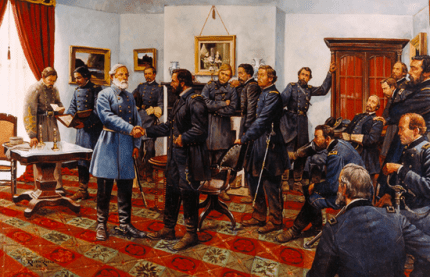
The Surrender, by Keith Rocco - image from National Park Service

The Surrender, by Keith Rocco – image from National Park Service, via Pillar to Post

Notes:

Help others remember history:

Add to FacebookAdd to NewsvineAdd to DiggAdd to Del.icio.usAdd to StumbleuponAdd to RedditAdd to BlinklistAdd to TwitterAdd to TechnoratiAdd to Furl

Below the fold, the identities of the soldiers in Rocco’s painting above.

Read the rest of this entry »


Quote of the moment, still: Oliver Wendell Holmes, Jr., on taxes as the price for civilization

April 15, 2010

The frequently quotable Oliver Wendell Holmes, Jr., circa 1930. Edited photograph from the Library of Congress Prints and Photographs Division. Original photo by Harris & Ewing. LC-USZ62-47817.  Copyright expired.

The frequently quotable Oliver Wendell Holmes, Jr., circa 1930. Edited photograph from the Library of Congress Prints and Photographs Division. Original photo by Harris & Ewing. LC-USZ62-47817. Copyright expired.

I like paying taxes. With them I buy civilization.

Justice Oliver Wendell Holmes, Jr., attributed. (see Felix Frankfurter, Mr. Justice Holmes and the Supreme Court, Harvard University Press, 1961, page 71.)

Did Holmes say that?

The quote was all over the internet in early October 2008 (and later), after New York Times op-ed writer Tom Friedman noted it in his column criticizing Alaska Gov. Sarah Palin for her assertion that paying taxes is not patriotic.

I found reference to the quote in a book about eminent economists, through Google Scholar:

Eminent Economists: Their Life Philosophies
By Michael Szenberg
Published by Cambridge University Press, 1993
320 pages

On page 201, Szenberg refers Holmes’s view of “taxation as the price of liberty.” In a footnote, he points to Justice Frankfurter’s book. The quote is dolled up a little. According to Szenberg’s footnote:

More precisely, he rebuked a secretary’s query of “Don’t you hate to pay taxes?” with “No, young fellow, I like paying taxes, with them I buy civilization.”

Frankfurter is a reliable source. It’s likely Holmes said something very close to the words Friedman used.

This is mostly an encore post.

Urge others to give a dime and give a damn for civilization:

Add to FacebookAdd to NewsvineAdd to DiggAdd to Del.icio.usAdd to StumbleuponAdd to RedditAdd to BlinklistAdd to TwitterAdd to TechnoratiAdd to Furl


Happy birthday, Mr. Jefferson

April 13, 2010

April 13 should be a holiday, don’t you think?  Religious Freedom Day, or Public Education Day, or Self-evident Truths Day — something to honor Thomas Jefferson.

Catherine Sherman wonderfully explains why we should celebrate Jefferson’s birthday.  Go see.


You’re not using this technology in your classroom?

April 12, 2010

Here’s another opportunity to put real, cutting edge technology in your classroom.  In fact, your kids could probably invent all sorts of new uses for it.

Have you even heard of this stuff?  Can you use it, live, with the equipment you’ve got?

Blaise Aguera y Arcas  of MicroSoft demonstrated augmented-reality maps using the power of Bing maps, Flickr, Worldwide Telescope, Video overlays and Photosynth, to an appreciative and wowed audience at TEDS:

My prediction:  One more advance in computer technology that classrooms will not see in a timely or useful manner.

But have you figured out how to use this stuff in your geography, history, economics or government classes?  Please tell us about it in comments. Give examples and links, please.


World War II, fought out on Facebook

April 11, 2010

It’s not exactly family safe, so I’ll link.  For a college class, I’d ask students to determine if the piece is accurate, and if not, what really happened.

What would it have looked like had World War II been fought with Facebook postings?


SBOE shames Texas, part G: Toles in the Washington Post

April 11, 2010

Pulitzer Prize-winner Tom Toles in the Washington Post, March 19, 2010

Pulitzer Prize-winner Tom Toles in the Washington Post, March 19, 2010

It’s pretty embarrassing when the State Board of Education’s actions leave Texas open to jokes about whether Texans remember the Alamo.  Remembering the Alamo is as much a Texas monument or icon as anything else — maybe moreso.

Tom Toles demonstrates why Texas should be embarrassed by the Texas State Board of Education’s work on social studies standards.


Education board shames Texas, part F: Clay Bennett, Chattanooga Times-Free Press

April 11, 2010

Clay Bennett in the Chattanooga Times Free Press:

Clay Bennett, Chattanooga Times-Free Press, March 16, 2010

Clay Bennett, Chattanooga Times-Free Press, March 16, 2010

Bennett remains one of my favorite cartoonists today.  His work is incisive, intelligent, and persuasive to the side of reason and light almost all of the time.  Why hasn’t he won a Pulitzer yet?

Bennett is generally a powerful supporter of U.S. education; see the two other recent cartoons, below the fold.

Read the rest of this entry »


SBOE shames Texas, part D: Mario Piperni and unintended consequences

April 10, 2010

Mario Piperni on Texas State Board of Education

Cartoon by Mario Piperni on the Texas State Board of Education, on any number of subjects

Have never seen this guy’s work before.  Does he publish in a newspaper that is lucky to have him?