Thoughts on Waterloo

August 6, 2009

Republicans and Sen. Jim Demint look forward to meeting Obama at Waterloo.

Obama Wellington at Waterloo, by Robert Alexander Hillingford

Obama Wellington at Waterloo, by Robert Alexander Hillingford

Napoleon looked forward to meeting Wellington at Waterloo, too.

It’s important to remember that at history’s great turning points, there are generally at least two sides.  The British don’t celebrate the Fourth of July, either.

Be careful what you hope for, Republicans.


Vikings in America, before Columbus!

August 5, 2009

Homeland Defense in the 9th and 10th century European settlements in America - Aardvarchaeology

Homeland Defense in the 9th and 10th century European settlements in America - Aardvarchaeology

Re-enactors in Canada bring alive two periods of Swedish immigration to the Americas, the Viking experiments of the 9th and 10th centuries, and later, in the 19th century.

Story at Aardvarchaeology.

From Aard regular Christina Reid (she started commenting less than a week after the blog opened, bless her heart!), a few pictures from Mid-summer Eve at the Scandinavian Cultural Centre in Burnaby, British Columbia. Tina and her hubby are active in the Reik Félag reenactment group. And her brother is the singer of Viking/Tolkienian metallers Amon Amarth!

How do Canadian public school curricula treat these events?  They are all but completely missing from the normal world history and U.S. history texts we use in Texas — of course, the U.S. history texts generally ignore the other two nations of North America in all contexts.

The town I mostly grew up in, Pleasant Grove, Utah, had been settled in large part by Scandanavians who had joined Mormonism and then migrated to Utah.  Generally looked down upon by English descendants, they rebelled by voting our high school’s mascot as Vikings.  The Christiansens, Fugals, Christesons, Larssons, Andersons, Andersens and others probably would have  enjoyed the idea of a Viking re-enactment.

Those wily Canadians figure out so many ways to have fun and hide learning in the activity.

Young Viking couple in Canada, 9th or 10th century, or 21st century reenactors - image at Aardvarchaeology

Young Viking couple in Canada, 9th or 10th century, or 21st century reenactors - image at Aardvarchaeology


Drought: Heckuva way to run the end to global warming

July 30, 2009

“This is a hell of a way to run a desert.”
Utah Gov. Scott Matheson, during floods in 1983

A new Dust Bowl?

A new Dust Bowl? (Image updated January 2013; old links dead)

No, I’m not repeating the error of many who take every snowflake as bizarre evidence that global warming has ended.

I think we need to stick to the facts.

2009 may be cooler than 1998, one of the hottest years on record, but that in no way suggests an end to the climate crisis scientists have been tracking for the past couple of decades.

Cooler weather in New York does not offset the rest of reality.

Reality is we have crushing droughts in California and Texas.

California drought explained by USA Today:

FIREBAUGH, Calif. — The road to Todd Allen’s farm wends past irrigation canals filled with the water that California‘s hot Central Valley depends on to produce vegetables and fruit for the nation. Yet not a drop will make it to his barren fields.

Three years into a drought that evokes fears of a modern-day dust bowl, Allen and others here say the culprit now isn’t Mother Nature so much as the federal government. Court and regulatory rulings protecting endangered fish have choked the annual flow of water from California’s Sierra mountains down to its people and irrigated fields, compounding a natural dry spell.

“This is a regulatory drought, is what it is,” Allen says. “It just doesn’t seem fair.”

For those like Allen at the end of the water-rights line, the flow has slowed to a trickle: His water district is receiving just 10% of the normal allocation of water from federal Bureau of Reclamation reservoirs. He says he’s been forced to lay off all his workers and watch the crops die on his 300 acres while bills for an irrigation system he put in are due.

“My payments don’t stop when they cut my water off,” Allen says.

Although some farmers with more senior water rights are able to keep going, local officials say 250,000 acres has gone fallow for lack of water in Fresno County, the nation’s most productive agriculture county. Statewide, the unplanted acreage is almost twice that.

Unemployment has soared into Depression-era range; it is 40% in this western Fresno County area where most everyone’s job is dependent on farming. Resident laborers who for years sweated in fields to fill the nation’s food baskets find themselves waiting for food handouts.

“The water’s cut off,” complains Robert Silva, 68, mayor of the farm community of Mendota. “Mendota is known as the cantaloupe capital of the world. Now we’re the food-line capital.”

Three years of dry conditions is being felt across much of the nation’s most populous state.

Gov. Arnold Schwarzenegger declared a water emergency in February and asked for 20% voluntary cuts in water use. The U.S. Department of Agriculture’s Drought Monitor lists 44% of the state as in a “severe” drought.

In arid Southern California, cities and water districts have raised rates to encourage conservation and imposed limits on use

Texas drought, detailed in the Dallas Morning News:

AUSTIN – The drought that has gripped Central Texas is approaching the severity of Texas’ most famous drought, the 1950s dry spell that lasted several years, Lower Colorado River Authority officials say.

But the current drought, which began in the fall of 2007, has seen more intense concentrations of high temperatures and less rainfall than the majority of the earlier drought.

“It was hot, yes, it was dry” in the 1950s, said LCRA meteorologist Bob Rose, “but it wasn’t crazy hot like this year.” Soil moisture is negligible now. And with spotty precipitation, “we haven’t been able to generate any runoff” to replenish reservoirs, he said.

“What makes our current drought unique is not the duration but the severity,” Rose said this week at a drought briefing for meteorologists and reporters.

With state officials warning of wildfire dangers, and water restrictions spreading rapidly across the state, Texas Gov. Rick Perry (R) issued disaster declarations for 167 of the states 254 counties.

Texas suffers more than California, across a broader area with deeper drought, according to the Associated Press:

According to drought statistics released by the U.S. Department of Agriculture, 77 of Texas’ 254 counties are in extreme or exceptional drought, the most severe categories. No other state in the continental U.S. has even one area in those categories.

John Nielsen-Gammon, the Texas state climatologist at Texas A&M University, said he expects harsh drought conditions to last at least another month.

In the bone-dry San Antonio-Austin area, the conditions that started in 2007 are being compared to the devastating drought of the 1950s. There have been 36 days of 100 degrees or more this year in an area where the total usually is closer to 12.

Among the most obvious problems are the lack of water in Lake Travis and Lake Buchanan near Austin, two massive reservoirs along the Colorado River that provide drinking water for more than 1 million people and also are popular boating and swimming spots. Streams and tributaries that feed the lakes have “all but dried up,” according to the Lower Colorado River Authority.

San Antonio, which relies on the Edwards Aquifer for its water, is enduring its driest 23-month period since the start of recorded weather data in 1885, according to the National Weather Service. The aquifer’s been hovering just above 640 feet deep, and if it dips below that, the city will issue its harshest watering restrictions yet.

Self-professed climate skeptics will argue that everything is hunky-dory and we can continue blundering along pollutiong willy-nilly because droughts alone are not evidence of warming, and so cannot rebut spot evidence of increased rainfall or local cooling.  Notice how they try to have the argument both ways?  Local weather counts for their side, but can’t count against it.

It’s more complex than that.  Much of the damage from climate change occurs in the upset of a balance in local ecosystems.  The Green Blog at the Boston Globe site discusses the subtle, ecosystem distorting effects and how easy they are to miss in the grand schemes of things.

A lot of the problem has to do with timing. About half of the water that recharges the [Northeast] region’s aquifer is from spring snowmelt, said [USGS hydrologist Thomas] Mack, allowing it to be plentiful to residents for summer lawn watering and other uses.

But global warming is causing the snow to melt earlier by around two to four weeks. At the same time, more rain, instead of snow, is expected to fall in the winter. That means the aquifer is filling up earlier in the spring.

The problem is the region’s bedrock aquifer can’t hold water for a long time – filling it up when it is needed the least and draining before the busy summer.

All environmental problems are complex, and global “warming” is massively more complex than any other environmental issue humans have recognized and dealt with.  Climate change deals with the entire Earth, and with the two great pools of fluids on the Earth, the oceans and the atmosphere, where the sheer physics of change are nearly impossible to understand, let alone predict.

Perhaps, as local conditions in more and more places demonstrate damages from climate change, skeptics can be brought around to understand that action is required even when we don’t have all the possible data points we’d like.

Resources:


An incalculable loss to history, and students of history – Werner E. Warmbrunn

July 25, 2009

Americans create great colleges. Our greatest national product is higher education. Within a few decades after Europeans landed in the Americas, colleges were created to spread knowledge to keep the colonies, and then the new nations, on the cutting edge of history and science.  Mostly they’ve worked well.  The world comes to our institutions of higher learning to learn, and to steal ideas about how to make that process work in their own nations.

In the 20th century we saw the founding in California of the Claremont Colleges, one of the most recent and most ambitious efforts to create a community of scholarship for undergraduates and graduates. The Claremont Colleges include Harvey Mudd College, Pomona College, Scripps College, Claremont McKenna College, Pitzer College, Claremont Graduate University, and Keck Graduate Institute.  Pomona College dates from 1887, but the other colleges in the community all arose after 1925 (Claremont Graduate University).   Harvey Mudd was founded in 1955, Pitzer in 1963, and the Keck Institute in 1997.

Werner Warmbrunn came to Pitzer College as one of the small pioneering group of original faculty in 1963, the first year of the school.   On one hand, it’s exciting to be in on the creation of a great institution.  On the other hand, the philosophy of the Claremont Colleges is that faculty, though of first rate intellect, will spend a great deal of their time with students.  Demands of working with undergraduates probably hinders some of the faculty from achieving the great renown they could have achieved at other universities.  Students grow to love that system.  Some faculty yearn for other pastures, and strike out after a while for other academic homes.

Warmbrunn stuck it out at Pitzer.

I found this press release, on his death on July 19, 2009:

Professor Emeritus Werner E. Warmbrunn Dies

Claremont, Calif (July 23, 2009) – Werner Warmbrunn, founding member of the Pitzer College faculty and founding dean of faculty, died peacefully at home on July 19, 2009 at the age of 89.

Professor Warmbrunn was born in Frankfurt, Germany in 1920. He and his family immigrated to the United States in 1941. After receiving his degree from Cornell University, he began his teaching career at Putney School in Vermont. He received his PhD from Stanford University, where he later served in a variety of administrative posts for 12 years. In 1963, he was recruited by Pitzer’s first president, John Atherton.

Professor Warmbrunn helped design the academic programs for the new college in months before and after the arrival of Pitzer’s pioneer class of students. He is perhaps best known for his work in developing Pitzer’s unique community governance structure. He served on many committees, including the Faculty Executive Committee and two presidential search committees. Professor Warmbrunn ensured that Pitzer’s history would be recorded by founding an archive where papers, announcements and documents were preserved.

A passionate and committed teacher, Professor Warmbrunn was a recipient, in 1985, of the Pitzer College Alumni Association’s Academic Excellence Award. He received a Fulbright Senior Research Fellowship to continue his research on Belgium under German occupation during World War II. He became a professor emeritus in 1991.

Warmbrunn’s published works include The Dutch Under German Occupation and The German Occupation of Belgium. In recent years, he was active in the Claremont Democratic Club, serving as a senior author of The Claremont Manifesto.

He is survived by his wife, Loretta; daughters Erika and Susan; his step-children Linda Schone, Wes Fretter, Dianna Davis and Cynthia Fretter; and his grandchildren Andrea, Breanna, Zach, Matt and Lindsey.

A private family memorial will be held. Donations in honor of Professor Warmbrunn can be made to Pitzer College, where a scholarship will be created in his name.

A public memorial will occur at Pitzer College this fall.

About Pitzer College

Pitzer College is a nationally top ranked undergraduate liberal arts institution. A member of The Claremont Colleges, Pitzer offers a distinctive approach to a liberal arts education by linking intellectual inquiry with interdisciplinary studies, cultural immersion, social responsibility and community involvement. For more information, please visit www.pitzer.edu.

Of course that’s not the whole story. You need more information about Prof. Warmbrunn — and you will find it in this touching remembrance at Rational Rant, from sbh in Portland, one of Warmbrunn’s students. Go read that account.

Not a class day goes by that a student does not ask, “Why do we study history?”  Every good history teacher has a patterned response, sometimes including quoting Santayana, sometimes just recounting a great failure that could have been avoided had someone who should have known better, actually known history.  Sometimes the answer involves a great victory or leap forward, made possible by understanding the past.

Reality is more complex.  Sometimes just the study of history itself is the object.  Studying history under a teacher like Warmbrunn will not be recorded in the history books per se, as the study of history.  We can never overestimate the effects of such careful tutelage on the course of history, on the making of history.  History flows like a river.  Studying history is like fording the river — and sometimes a student needs someone skilled at fording the river to get the student across.  Sometimes that river is a Rubicon, or a Vistula, or a Rhine, or Mississippi, or Delaware, or Missouri, or Colorado, and getting a student safely to the mouth or the other side, makes all the difference.

Nota bene:

And see:


Gray hair, Sonic Youth, Fender guitars

July 24, 2009

Am I the only one who sees a whiff of hopeful irony in a guitarist from Sonic Youth being gray?

From Fender:  Thurston Moore + Lee Ranaldo. Jazzmaster guitars slung across seminal shoulders. In the hands of both men, the sound of Sonic Youth is the sound of that guitar used as part paintbrush and part cluster bomb. Introducing the new Thurston Moore Jazzmaster and the Lee Ranaldo Jazzmaster guitars from Fender, releasing July 1st.

From Fender: "Thurston Moore + Lee Ranaldo. Jazzmaster guitars slung across seminal shoulders. In the hands of both men, the sound of Sonic Youth is the sound of that guitar used as part paintbrush and part cluster bomb. Introducing the new Thurston Moore Jazzmaster and the Lee Ranaldo Jazzmaster guitars from Fender, releasing July 1st." Photo from the Fender site.

That’s Lee Ranaldo on the right, with the teal guitar and gray hair.

Leon Anderson played a then-vintage Fender blond-neck Stratocaster in our bands back in Utah County, and it was a beautiful machine (and he an underappreciated guitarist).  I never could afford a Fender-brand bass.  I played two Vox devices, one of which I still own — but they played through an almost-original Fender Bassman amplifier, whose demise I still mourn.

Fender blonde-neck Stratocaster, a lot like the one Leon Anderson played - Guitar Village photo

Fender blonde-neck Stratocaster, a lot like the one Leon Anderson played, except Leon's wasn't nearly so beat up - Guitar Village photo

Watching the Fender company bend, dodge and run with the trends over the years has been a lot of fun.  One of my ex-brothers-in-law did the accounting and corporate legal work for Leo Fender way back when; as an indication of how stuffy the brother-in-law was, consider that he didn’t have any Fender guitars — or any guitars — when I knew him.  How could one work with a master like Leo Fender and not get hooked on the guitars?

Ultimately the guitars are the legacy and history of the company.  As with Stradivarius instruments, the music made on the guitars and the instruments themselves outshine the makers and any corporate entity required to get the instruments manufactured.  Corporate owners of the Fender name and legacy don’t drive that car, but only hold on for the ride and try to keep the moving parts lubricated and clean.

Any Sonic Youth fans out there?

Tip of the old scrub brush to Ufghanistan.


Moving Civil War Memory. No, I mean, it’s really moving.

July 22, 2009

Civil War Memory said:

This past weekend I mentioned that there are some big changes to Civil War Memory on the horizon.  Well, today is the day that I announce that Civil War Memory is moving to WordPress.org.  All the posts and comments have been moved to the new site, which can be found at http://cwmemory.com/.   Please update your blogroll as soon as possible.  In about a month I will unveil a brand new theme for the blog.


I’d give the kid a good grade, I think

July 22, 2009

Can any teacher recognize genius in the classroom?  Especially when I taught in alternative programs, I was frequently astounded by the great work students did that was just enough off the mark of the assignment that it might have gotten a zero were it not so brilliant, and had I not had a few extra minutes to grade (thanks to smaller classes).

Wee Mousie’s Cinema Burlesque — what do you do with stuff like that?

This is the stuff Creative Commons is made for, by the way.


Our nation’s first man in space

July 20, 2009

Our first man in space got there by a route most people can’t guess:  Balloon.

Joe Kittinger recounted his adventures to the CBS Morning Show, how he leaped from a balloon at the edge of space for the Air Force, to prove that humans could survive a fall from such distances, in the event of an emergency that required an astronaut to bail out.

Kittinger bailed out of the balloon at over 102,000 feet, nearly three times the height of Mt. Everest into the atmosphere.

But Elton John never wrote a song about “Balloon Man.”


News flash: Texas has a second natural lake!

July 20, 2009

Years ago, in Virginia, I had learned that Virginia had only one natural lake, the Great Dismal Swamp.  Accompanying that chunk of information in that lecture was that Texas had only two natural lakes.

But upon arriving in Texas, I could find reference to only one natural lake, Caddo, and it had ceased being fully natural when its maintenance fell to a dam.

What happened to Texas’s second natural lake?

A Google search right now on “Texas +’natural lake'” produces ten listings on the first page, all of them pointing to the fact that Texas has just one natural lake.  Here are the first five:

I have found a second natural lake in Texas. It’s not a new discovery at all — it’s just a case of people not having the facts, and overlooking how to find the truth.  It’s especially difficult when the lake hides itself.

Our testing coordinator at Molina High School, Brad Wachsmann, spins yarns that belie his youth.  In the middle of one yarn last year, corroborated by other yarns, he mentioned that he has family in Big Lake, Texas; and he described visiting and having relatives urge people to run out and see the lake since it’s rebirth in torrential rains.

“A second natural lake in Texas?” I asked.  Wachsmann knew the drill.  Yes, Big Lake is a natural lake in Texas, and yes, people forget about it.

Texas teachers, listen to your testing coordinators, okay?

All of this came to mind reading the Austin American-Statesman, still a bastion of great journalism despite problems in the newspaper industry.  On Monday, July 7, the paper ran a story and an editorial about the clean up of the oil industry refuse that killed the shoreline of part of the lake; the springs that once fed the lake have mostly gone dry, but that’s likely due to agricultural water mining.

It’s a story of boom and bust, environmental degradation for profit, and eventual recovery we hope.

Looking at the landscape that surrounds the Reagan County seat, you wonder whether the name Big Lake was somebody’s idea of joke. It’s dry and dusty, where the flora sprouts reluctantly and lives precariously.

Yet, the West Texas town of Big Lake got its name from a natural lake that was fed by springs that have long since gone dry. While the area may not fit everyone’s definition of photogenic, it has its own brand of charm – charm that could be enhanced if the damage done to the fragile ecosystem by salt spills were reversed or even minimized.

As the American-Statesman’s Ralph K.M. Haurwitz reported in Monday’s editions, the University of Texas and Texas A&M systems have benefited from the $4.4 billion in royalty payments and mineral income produced by its West Texas acreage since Santa Rita No. 1 well came in on May 28, 1923.

The salt water byproduct of oil and natural gas production, however, contaminated 11 square miles near Big Lake, killing most everything that grows. The lack of vegetation allows wind and water erosion.

Hey, it gets better.  This is real Texas history, real American history — you can’t make this stuff up.  Haurwitz’s article talks about the heritage of Texas education.   Remember that old story about setting aside certain sections of townships to help fund education in lands on the American frontier?  Texas wasn’t a public lands state as farther west, but it still reserved sections of land for the benefit of education.

Rose petals blessed by a priest?  I’ll wager the priest didn’t make the trip to the top of the derrick.  Haurwitz wrote:

BIG LAKE — Investors appealed to the patron saint of impossible causes when oil drilling began on University of Texas System land in 1921. It didn’t hurt.

Santa Rita No. 1 blew in on May 28, 1923, after rose petals blessed by a priest were scattered from the top of the derrick at the behest of some Catholic women in New York who had purchased shares in the Texon Oil and Land Co., which drilled that first well.

Since then, the UT System’s 2.1 million acres in West Texas have produced $4.4 billion in royalty payments and other mineral income for the Permanent University Fund, an endowment that supports the UT and Texas A&M University systems.

But this long-running bonanza for higher education exacted a price from the remote, semiarid landscape where it all began. Millions of barrels of salt water, a byproduct of oil and natural gas production, contaminated 11 square miles, or more than 7,000 acres, killing virtually all vegetation and leaving the land vulnerable to wind and water erosion. Hundreds of mesquite stumps with three feet of exposed roots testify to the dramatic loss of topsoil.
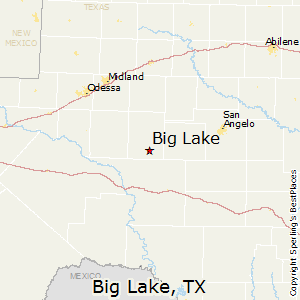
Texas, and Big Lake - from BigLakeTx.com

Where in Texas is Big Lake?

The town of Big Lake is just north of the lake itself, on State Highway 137 running north and south, and U.S. Highway 67 running east and west, approximately 65 miles west of San Angelo.   Big Lake sits about 10 miles north of Interstate 10, and about 75 miles south of Interstate 20.  Big Lake calls itself “the gateway to the Permian Basin.”

Big Lake is the home of Reagan County High School.  Jim Morris was baseball coach for the Reagan High Owls when his team persuaded him to try out for a major league baseball team.  His story was chronicled, with some artistic license, in the Disney movie “Rookie.”

Land managers are working to stop erosion on the often-dry shores of Big Lake using any trick they can find.  One trick:  Plant salt grass.

Salt grass?  Along Texas’s Gulf Coast, there are a few species of grass that, while not halophytes, are at least salt tolerant.  Salt grass.  This grass made it profitable to graze cattle on what would otherwise have been unproductive land in the Texas cattle boom.  This role in Texas history is memorialized in the Salt Grass Steakhouse chain, now found in five states.

And if planting salt grass works to control erosion, it will help clean up a large part of Texas other natural lake, Big Lake.

Big Lake’s being wet or dry is a whim of local climate.  You could say that half of all of Texas’s natural lakes are now dry as a result of continued warming; you could say that two good gully-washers or toad-stranglers could restore water to half of Texas’s natural lakes.
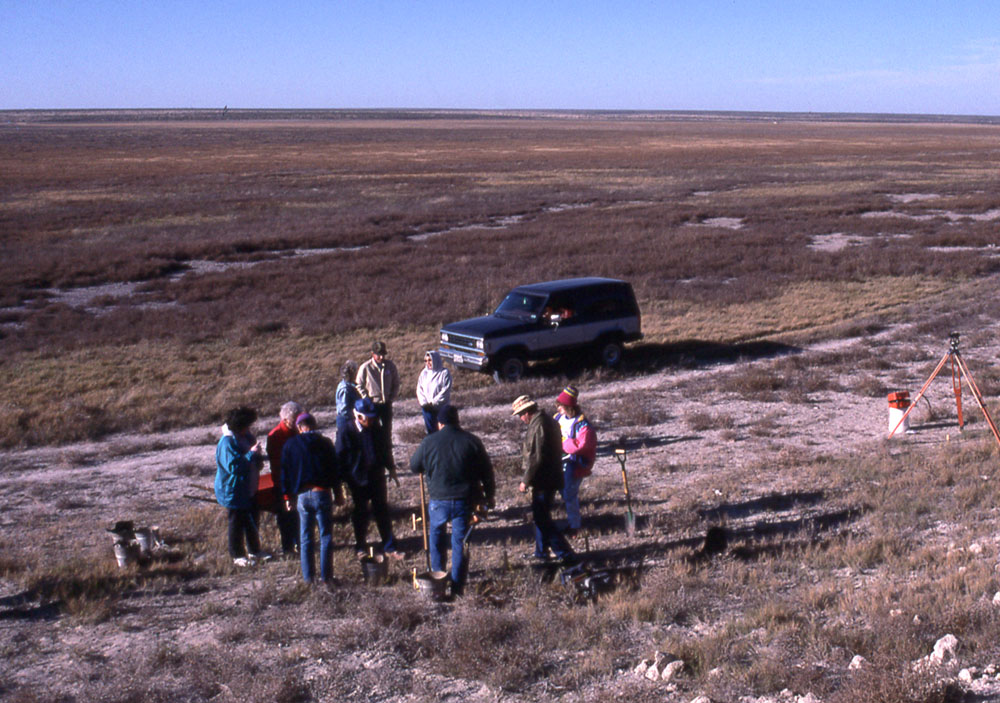
Big Lake Playa, from NightOwl Bakery and Roastery in Big Lake, Texas

Field crew meeting at the outset of the 1992 excavations at the Big Lake Bison Kill site. The dry bed of Big Lake stretches for miles in the background. Big Lake is an intermittent saline lake or playa, an uncommon landform on the Edwards Plateau. Photo by Larry Riemenschneider, Concho Valley Archeological Society.

More details about Big Lake and prehistory, below the fold.

Read the rest of this entry »


Carnival of the Liberals #95, at Neural Gourmet

July 18, 2009

Liberals in America struggle as they try to deal with the little bit of success in the last elections.  Used to sniping from the sidelines for the past eight years, and unused to having a president who doesn’t make them pull their hair out at least once a day, liberals might be excused for breathing a massive sigh of relief and taking a few weeks off.

Oh, but that few weeks’ vacation did serious damage to the liberal presence on the internet.

The Carnival of the Liberals is back in a new and improved constitution, with an eye on working for liberal, patriotic ideals with a majority in the U.S. House of Representatives and the U.S. Senate, and a president who might actually do some of the things that need to be done.

Carnival of the Liberals #95, at Neural Gourmet

Typical liberal concerns, you know:  Taxesfamily values; how to make torture work; waving the flag.

More seriously, there are some good articles there.  Go check it out.  The new format looks promising.  Liberals need to get back to the kicking and shoving that make politics work.


Alas, that’s the way it is: Walter Cronkite dead at 92

July 18, 2009

You can’t explain the influence of Walter Cronkite to a high school kid today.  They don’t have any experience that begins to corroborate what you’d say.

Walter Cronkite in the last decade - Texas Parks and Wildlife photo by Richard Roberts

Walter Cronkite in the last decade - Texas Parks and Wildlife photo by Richard Roberts

Along with Chet Huntley and David Brinkley on NBC, Mr. Cronkite was among the first celebrity anchormen. In 1995, 14 years after he retired from the “CBS Evening News,” a TV Guide poll ranked him No. 1 in seven of eight categories for measuring television journalists. (He professed incomprehension that Maria Shriver beat him out in the eighth category, attractiveness.) He was so widely known that in Sweden anchormen were once called Cronkiters. (from the New York Times)

I’m saddened at the death of Cronkite.  One of the things that saddens me is that he probably could have anchored for at least a decade past when he last signed off.  Nothing against Dan Rather, at least not from me — just that Cronkite was one of a kind.  He won’t be missed by too many people alive today who never had a chance to see him work.

So, go see him work. Media Decoder has a series of YouTube pieces showing what Cronkite could do, what Cronkite did.  It’s history go see.

Other posts on Cronkite at Millard Fillmore’s Bathtub:

More, probably better stuff


Zachary Taylor’s death, and Millard Fillmore’s ascendance to the presidency — in detail

July 17, 2009

Elektratig recounts President Zachary Taylor’s death, and Millard Fillmore’s swearing in as the 13th president, in deeper and more interesting detail than I had.

Bookmark that site, social studies teachers: It’s a great site for details on Millard Fillmore that your students won’t find easily anywhere else — and on Zachary Taylor, and on politics and history in general in the two decades prior to the Civil War.  Go see:  “Zachary Taylor is no more!”


Star-spangled voodoo history

July 16, 2009

Star-spangled Banner and the War of 1812 - The original Star-Spangled Banner, the flag that inspired Francis Scott Key to write the song that would become our national anthem, is among the most treasured artifacts in the collections of the Smithsonian’s National Museum of American History in Washington, D.C.

Star-spangled Banner and the War of 1812 – The original Star-Spangled Banner, the flag that inspired Francis Scott Key to write the song that would become our national anthem, is among the most treasured artifacts in the collections of the Smithsonian’s National Museum of American History in Washington, D.C.

(Hey, Dear Reader; this post got an update many months later — you may want to check it out for better links and more information.)

Every school kid learns the story of the “Star-Spangled Banner,” or should.

During the War of 1812, Georgetown lawyer Francis Scott Key, stood aboard a British ship in Baltimore Harbor to negotiate the release of his friend, Dr. William Beanes, who had been taken prisoner while the British stormed through Bladensburg, Maryland, after burning Washington, D.C.  Key witnessed the British shelling of Fort McHenry, the guardian of Baltimore’s harbor.  Inspired when he saw the U.S. flag still waving at dawn after a night of constant shelling, Key wrote a poem.

Key published the poem, suggested it might be put to the tune of “Anachreon in Heaven” (a tavern tune popular at the time) — and the popularity of the song grew until Congress designated it the national anthem in 1931.  In telling the story of the latest restoration of that garrison flag now housed at the Smithsonian Museum of American History, Smithsonian Magazine repeated the story in the July 2000 issue:  “Our Flag Was Still There.”

It’s a wonderful history with lots of splendid, interesting details (Dolley Madison fleeing the Executive Mansion clutching the Gilbert Stuart portrait of George Washington, the guy who had introduced Dolley to James Madison and then snubbed them after they were married; the British troops eating the White House dinner the Madisons left in their haste; the gigantic, 42 by 30 foot flag sewn by Mary Pickersgill, a Baltimore widow trying to support her family; the rag-tag Baltimore militia stopping cold “Wellington’s Invicibles;” the British massing of 50 boats and gunships; and much more).

It’s a grand and glorious history that stirs the patriotic embers of the most cynical Americans.

And it’s all true.

So it doesn’t deserve the voodoo history version, the bogus history created by some person preaching in a church (I gather from the “amens”) that is making the rounds of the internet, stripped of attribution so we cannot hunt down the fool who is at fault.

We got this in an e-mail yesterday; patriots save us, there must be a hundred repetitions that turn up on Google, not one correcting this horrible distortion of American history.

Horrible distortion of American history

(The full version is a mind-numbing 11 minutes plus.  Some people have put it on other sites.)

Why do I complain?

  1. It was the War of 1812, not the Revolutionary War — there were 15 states, not 13 colonies.
  2. There was no ultimatum to to Baltimore, nor to the U.S., as this fellow describes it.
  3. Key negotiated for the release of one man, Dr. Beanes.  There was no brig full of U.S. prisoners.
  4. It’s Fort McHenry, not “Henry.”  The fort was named after James McHenry, a physician who was one of the foreign-born signers of the Constitution, who had assisted Generals Washington and Lafayette during the American Revolution, and who had served as Secretary of War to Presidents Washington and Adams.
  5. Fort McHenry was a military institution, a fort defending Baltimore Harbor.  It was not a refuge for women and children.
  6. The nation would not have reverted to British rule had Fort McHenry fallen.
  7. There were 50 ships, not hundreds.  Most of them were rafts with guns on them.  Baltimore Harbor is an arm of Chesapeake Bay; Fort McHenry is not on the ocean.
  8. The battle started in daylight.
  9. Bogus quote:  George Washington never said “What sets the American Christian apart from all other people in this world is he will die on his feet before he will live on his knees.”  Tough words.  Spanish Civil War.  Not George Washington.  I particularly hate it when people make up stuff to put in the mouths of great men.  Washington left his diaries and considerably more — we don’t have to make up inspiring stuff, and when we do, we get it wrong.
  10. The battle was not over the flag; the British were trying to take Baltimore, one of America’s great ports.  At this point, they rather needed to since the Baltimore militia had stunned and stopped the ground troops east of the city.  There’s enough American bravery and pluck in this part of the story to merit no exaggerations.
  11. To the best of our knowledge, the British did not specifically target the flag.
  12. There were about 25 American casualties.  Bodies of the dead were not used to hold up the flag pole — a 42 by 30 foot flag has to be on a well-anchored pole, not held up by a few dead bodies stacked around it.

You can probably find even more inaccuracies (please note them in comments if you do).

The entire enterprise is voodoo history.  The name of Key is right; the flag is right; almost everything else is wrong.

Please help:  Can you find who wrote this piece of crap?  Can you learn who the narrator is, and where it was recorded?

I keep finding troubling notes with this on the internet: ‘My school kids are going to see this to get the real story.’  ‘Why are the libs suppressing the truth?’  ‘I didn’t know this true story before, and now I wonder why my teachers wouldn’t tell it.’

It’s voodoo history, folks.  It’s a hoax.  The real story is much better.

If Peter Marshall and David Barton gave a gosh darn about American history, they would muster their mighty “ministries” to correct the inaccuracies in this piece.  But they are silent.

Clearly, it’s not the glorious history of this nation they love.

More:

Please share that voodoo, as you do so well:

Add to FacebookAdd to NewsvineAdd to DiggAdd to Del.icio.usAdd to StumbleuponAdd to RedditAdd to BlinklistAdd to TwitterAdd to TechnoratiAdd to Furl

Save

Save


80/20 Day: July 15, 1848, birth of Vilfredo Pareto

July 15, 2009

Happy 80/20 Day!

Italian economist, engineer and political activist Vilfredo Pareto was born on July 15, 1848, in Paris, where his father had fled due to political difficulties.

Pareto should be more famous, for his explanation of the 80/20 rule, and for his contribution to making better things, the Pareto chart.  Many economic texts ignore his work almost completely.

Vilifred Pareto, Wikipedia image

Vilfredo Pareto, Wikipedia image

His contributions, as accounted at Wikipedia:

A few economic rules are based on his work:

Resources:


One less blog with history leanings

July 14, 2009

The Necromancer signed offFor several reasons including this informative discussion of dealing with creationism in the classroom, let’s hope the archives stick around online.
