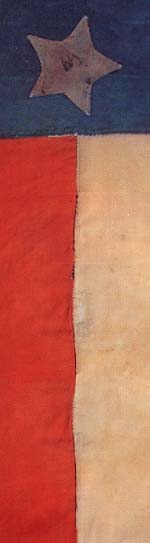
Texas Independence Day, March 2

March 2, 2008

Happy Texas Independence Day.

Tall flag, from Texas cooking

The Texas Declaration of Independence was produced, literally, overnight. Its urgency was paramount, because while it was being prepared, the Alamo in San Antonio was under seige by Santa Anna’s army of Mexico.

Immediately upon the assemblage of the Convention of 1836 on March 1, a committee of five of its delegates was appointed to draft the document. The committee, consisting of George C. Childress, Edward Conrad, James Gaines, Bailey Hardeman, and Collin McKinney, prepared the declaration in record time. It was briefly reviewed, then adopted by the delegates of the convention the following day.

As seen from the transcription, the document parallels somewhat that of the United States, signed almost sixty years earlier. It contains statements on the function and responsibility of government, followed by a list of grievances. Finally, it concludes by declaring Texas a free and independent republic.

Prior to statewide testing, this used to be a key part of 7th grade and other curricula in social studies.

There must be a celebration somewhere in Texas today, but I can’t find it.

Here’s one way to celebrate appropriately, from eHow to:

Things You’ll Need:

Step 1:
Visit Washington-on-the-Brazos, where the Texas Independence Convention signed the Republic into being. It’s now a state park with state-of-the-art interactive exhibits open year round, with plenty of rousing events during the week of March 2.

Step 2:
Travel to San Antonio and tour the Alamo.

Step 3:
Watch “The Alamo” starring John Wayne as Davy Crockett.

Step 4:
Throw a Happy Birthday Texas party. Suggest that guests come dressed as cowboys or Alamo freedom fighters; serve cowboy camp grub and Tex-Mex goodies, play songs about Texas and tell Texas jokes.

Sources:

Tall flag image from Texas Cooking.com.

Read the rest of this entry »


Tagged by Myers to do history! Meet James Madison

March 1, 2008

One of those memes. I’ve got a couple of them hanging fire still, I really do badly at this stuff.

So I have to start chipping away at them. Latest first.

P. Z. Myers at Pharyngula tagged me. As he describes it, it’s a meme of history; here’s what I’m to do:

  1. Link to the person who tagged you.
  2. List 7 random/weird things about your favorite historical figure.
  3. Tag seven more people at the end of your blog and link to theirs.
  4. Let the person know they have been tagged by leaving a note on their blog.

Okay, #1 is out of the way.

Now the trouble. A favorite “historical” figure? Maybe for Myers, a biologist, that’s easy. But I teach history. I like teaching the quirky stuff. The universe of possibilities is so enormous! Whom to choose? How to choose? Which seven little snippets?

Here are some of the possibilities — you may as well share in my misery.

I could designate Douglas Stringfellow. You’ve never heard of him, most likely. He was known most famously as a congressman from Utah’s 1st District in the 1950s. Stringfellow rose to prominence on the strength of his stories of behind-enemy-lines work, kidnapping physicist Otto Hahn, losing the other 29 members of his squad, escaping to France and losing the use of his legs from a land mine there. He was elected to Congress, joined the anti-Communist faction, and was zooming on the way to re-election when one of his old Army buddies got off the train in Salt Lake City, read the story, and blew the whistle. Stringfellow spent the war in the U.S. He wasn’t a spy, not a hero. His wounds were not from combat. Stringfellow resigned his candidacy at the insistence of the Mormon Church and Utah Republicans (perhaps the last time an organized religion and the Republicans acted nobly, together). It’s a story that should be made into a movie. There’s a good account published by the Taft Institute of Public Policy at the University of Utah, but it’s difficult to get (funding f0r the Taft Institute ran out, I hear, and it was replaced by the Huntsman Seminars on Politics — but that may be erroneous information, too).

Or I could talk about Richard Feynman, an inspiration to me, and to our two sons, both of whom fully enjoyed his books, and one of whom seems destined to follow Feynman into physics (the other works to understand neuroscience, still inspired by Feynman to do science). Everybody knows the story of Feynman, though.

Millard Fillmore is already covered pretty well here; adding more would be gilding the lily, or covering tracks, or something. I could write about one of my modern heroes of history, Mike Mansfield, one of the best bosses I ever had — but trying to find seven items that could be explained quickly might be difficult. I could write chapters about one of my other bosses, too, Orrin Hatch. Or I could write about Jefferson.

I’ll try to go right down the middle on this one: James Madison it is.

Seven items about James Madison, our fourth president, and “the Father of the Constitution”:

  1. See that scar on his nose? It’s from frostbite. When Gov. Patrick Henry blocked Madison’s appointment to the U.S. Senate, in order to fulfill his commitment to James Madison create a bill of rights, Madison had to run for election to the U.S. House of Representatives. Henry thought he could block that, too, by picking James Monroe to run against Madison, and getting lots of support for Monroe. In the last debate, a good buggy ride away from their homes, the two men decided to share the fare. Monroe said Madison won the debate handily; Madison wasn’t sure. On the buggy ride back to their homes, at night on a very cold winter, the two got involved in a long discussion about the new government, the new nation, and their hopes and dreams about the future. Discussion was so engrossing that Madison failed to notice his nose was freezing. Fast friends ever after, Madison won the election; Madison introduced Monroe to Jefferson. Patrick Henry’s plan to frustrate the Constitution and the new government was thwarted. And Madison bore the scar the rest of his life.
  2. Good government as religion — Long before the concept of an American secular religion, Madison attended the College of New Jersey (later to become Princeton), aiming for a career in the clergy. College President John Witherspoon, a Presbyterian minister, urged Madison to take not just any calling, but the highest calling. Madison went into politics and government. Religionists try to paint Madison as a secularist; early on, his drive for religious freedom was fueled by his faith. It’s an example more church people should follow.
  3. Egalitarian trends — On his trip to New York for the inauguration and opening of the 1st Congress, Madison stopped off at Mt. Vernon. (See notes about ghosting below — it was an eventful trip.) One of the topics of conversation was what form of address to use for the chief executive. Two camps were forming, one favoring “Your Highness,” the other favoring “Your Excellency.” Asked for his opinion, Madison suggested “Mr. President.” Some tried to make a more formal, more stuffy title official later in the year, but we still call our chief executive today by the unroyal sobriquet Madison suggested, “Mr. President.”
  4. Romance with George and Martha as cupids — Madison’s bachelorhood was a challenge to George and Martha Washington. Once the government got underway in Philadelphia, and after Aaron Burr introduced Madison to the woman, George and Martha worked to match up Madison with a vivacious widow, successfully. James Madison and Dolley Payne Todd were married in 1794.
  5. Great Madison’s Ghost! — Madison played ghost writer for George Washington, and others. On his way to the first inauguration, at his courtesy stop at Mt. Vernon, Madison was asked to draft a speech suitable for a president at inauguration. He happily complied. With some irony, whether it was known or not, once Washington delivered the address, Congress designated Madison to write Congress’s reply. Madison’s writing shows up under many other names, including that of “Publius,” in the Federalist Papers. Madison also contributed major parts of the farewell essay Washington planned to use in 1792; Madison and Washington were not on such good terms when Washington actually bid farewell in 1796. Alexander Hamilton got the last crack at ghosting the piece, and added some barbs aimed at Thomas Jefferson. Madison’s own ghosting had come back to haunt him, and John Adams won the election of 1796. (Madison got revenge, if you can call it that, in 1800, when Jefferson won the rematch, but not until the House of Representatives had to break a tie between Jefferson and his vice presidential slate-mate, Aaron Burr; it was Hamilton who finally had to eat some crow and urge the Federalists in the House to go for Jefferson over Hamilton’s more bitter enemy, Burr.)
  6. Offending the great man — Madison was off getting married when Washington and Hamilton headed the army and put down the Whiskey Rebellion. Madison suggested to Washington that alternative resolutions would have been possible. Washington took offense. It is unclear whether they ever spoke to each other after that, but that event breached the once-warm and cordial relationship that had produced the Constitution and got the new government off to a fine start, not to mention got Madison into a good marriage.  It’s fascinating Washington would show such pique, and fascinating that Madison stood for it.
  7. America’s greatest collaborator? Madison got to the Virginia Assembly late in the Virginia Bill of Rights process, but collaborated with George Mason to add a clause on religious freedom, helping to secure George Mason’s reputation. He collaborated with Thomas Jefferson, pushing Jefferson’s legislative ideas while Jefferson was in France, getting immortality for Jefferson with the Virginia Statute for Religious Freedom. He collaborated with Washington to resolve the Chesapeake dispute between Maryland, Virginia and Pennsylvania; he collaborated with Washington and Alexander Hamilton to get the Continental Congress to call the Philadelphia convention. He collaborated with Ben Franklin to convince Washington to attend the convention, and to get Washington elected president of the convention. When John Jay was physically beaten badly at a demonstration for ratification, Madison stepped in to collaborate with Hamilton on what we now call the Federalist Papers. He collaborated with Washington on the formation of the new government; collaborated with Jefferson on a bill of rights and foreign affairs. In an era when one did not run for office one’s self, Madison got Jefferson on the ballots in 1796 and 1800, essentially managing the campaigns that put Jefferson into office. He was with Jefferson on the butt-kicking they got from John Marshall on the Marbury v. Madison decision. At the end of their lives, and especially after Jefferson’s death, Madison followed through on the establishment of the University of Virginia, Jefferson’s prize project. In each case, Madison’s collaboration improved the project, and in several cases, the projects would have failed but for Madison’s work. Madison may take the title of the most successful legislator ever in U.S. history (competing perhaps with LBJ), but he definitely takes the crown as the best collaborator for the public good. Had Madison not been the collaborator on these things, would they have happened? In all of these projects, the people with whom he collaborated achieved their highest aims. Who wouldn’t want to collaborate with Madison?

Let’s get some good stuff in here in the tagging. Let’s tag some diverse blogs and bloggers who write a fair amount. I tag Pam at Grassroots Science, Bug Girl, Miguel at Around the Corner, Ron at Route 66 News, Curious Expeditions, Dorigo at Quantum Diaries Survivor, and Barry Weber at The First Morning.

Whew!  There’s good reading at those places even if they don’t do anything new.

Thanks, P.Z., for the kick in the rear to think about Madison, and to think about seven (out of dozens) of good blogs to refer people to.


Why real science is better in school than faux science

March 1, 2008

P. Z. Myers notes the silliness that anti-science types get involved in, especially when they attempt to make scientists look bad over something complex enough that it just can’t be worked out — leap years!

The two most amusing explanations for why we have leap years that I’ve heard came from creationists:

  1. Those scientists can’t even measure the length of the year accurately! They have to keep fudging their numbers every few years to make everything add up, so why should I trust them?
  2. We have leap years because the earth is slowing down in its orbit, which proves that the earth can’t be old — a million years ago the earth would have been whirling around the sun so fast it would have flown out of orbit!

Phil Plait at the misnamed (for this post) Bad Astronomy explains in glorious mathematical detail how leap year calculations work, and why we need wait around for more than three millennia to lobby for another calendar correction. Phil is really a remarkable story teller, for an astronomer:

We have two basic units of time: the day and the year. Of all the everyday measurements we use, these are the only two based on concrete physical events: the time it takes for the Earth to spin once on its axis, and the time it takes to go around the Sun. Every other unit of time we use (second, hour, week, month) is rather arbitrary. Convenient, but they are not based on independent, non-arbitrary events.

It takes roughly 365 days for the Earth to orbit the Sun once. If it were exactly 365 days, we’d be all set! Our calendars would be the same every year, and there’d be no worries.

But that’s not the way things are. There are not an exactly even number of days in a year; there are about 365.25 days in a year. That means every year, our calendar is off by about a quarter of a day, an extra 6 or so hours just sitting there, left over. After four years, then, the yearly calendar is off by roughly one day:

4 years at 365 (calendar) days/year = 1460 days, but4 years at 365.25 (physical) days/year = 1461 days.

These are mysteries that beg for explanations in social studies classes. For example, the differences in George Washington’s birth date, as recorded in the year he was born, and as listed today, are due to England’s and the English-speaking world’s late adoption of the Gregorian Calendar, switching from the Julian (England made the switch in 1752, about a half century after almost everyone else in the west, 170 years after Pope Gregory XIII proposed it).

Pope Gregory, who ordered new calendars, better to calculate religious feast days, like Easter. The Gregorian Calendar was introduced about 1583, with leap years. The actual time between two yearly solar events isn't 365 days exactly. It's actually 365.2422 days — so every four years there's approximately one extra day left over.  (NPR image and information)

Pope Gregory, who ordered new calendars, better to calculate religious feast days, like Easter. The Gregorian Calendar was introduced about 1583, with leap years. The actual time between two yearly solar events isn’t 365 days exactly. It’s actually 365.2422 days — so every four years there’s approximately one extra day left over. (NPR image and information)

If nothing else, social studies should be good for providing cocktail party trivia, shouldn’t it? And it won’t really matter to you unless one is a scientist launching rockets at a distant planet, or a churchman trying to fix the date of Easter, or a farmer trying to be certain the planting calendar is accurate to the season, or a commodities futures trader trying to figure out when agricultural goods come to market, or a mortgage banker working to make sure mortgages are calculated correctly for the next 30 years and that notices go out to homeowners as required by law, or a homeowner checking up on your mortgage bank, or an average investor checking up on your commodities futures traders and REIT investment advisor, or just a kid interested in the minutiae of how science really affects us in our every day lives.

Now we wonder: In comments, will some creationist bring up the old canard about Harold Hill and NASA’s calculations being off by the one day Joshua stopped the sun?

More:


Dallas could use California’s Willie Brown

February 28, 2008

Legendary California Assemblyman, and former Mayor of San Francisco Willie Brown is in Dallas tonight, speaking at the Dallas Public Library in promotion of his new book, Basic Brown: My Life and Times.

Willie Brown, photo by thomashawk, flickr

Update: Alas, the great photo of Willie Brown from thomashawk has been taken down since the original posting date; this one will have to do, from dogeatdogma


Orrin Hatch had some tussle with the Utah NAACP in the mid-1980s. By way of apology, he volunteered to go speak to one of their meetings on a topic of their choice.

Never say there is no humor in politics. The NAACP called to clear time on Hatch’s calendar, and once they got that secured, announced they wanted him to introduce Willie Brown.

At the time Brown was quite controversial, seen as a very partisan Democrat, and the opposite of the sort of guy a rising conservative like Orrin Hatch should ever introduce. Hatch saw disaster. I drew the assignment to draft an introduction and figure some way for Hatch to bow out.

Let me put in plugs for Terri Smith and Jeanne Lopatto here. Terri was secretary for the press office I ran at the Senate Labor Committee, Jeanne was press assistant. They made up a formidable political advance and research team that I would not hesitate to take on the campaign trail today, more than two decades later.

Smith and Lopatto put together the life history and legislative accomplishments of Brown, and when we looked at it, we thought Hatch had a great opportunity. Brown rose up from poverty, much as Hatch had. And while he was known as a partisan Democrat outside of California, he won election as Speaker of the California House by brilliant assembly of a coalition of Republicans and Democrats, beating out the favored candidates of both parties. He made legislative history when he kept that coalition alive to move legislation good for California.

Our press office was quite unpopular when we recommended a full-court press on getting reporters out to cover the affair. When Hatch read the introduction and understood Brown’s life, he told us he thought it was a big gamble, but he’d do it.

Hatch and Brown had a lot in common. Hatch came back from the dinner smiling, and extolling the virtues of Brown and bipartisan work.

That part of the genius of Willie Brown you don’t often hear: He’s a very likable guy, and he will work with people of all factions to get good laws. It’s also a side of Orrin Hatch you don’t often see: He’ll work happily with other factions, when he has the facts of the matters.

Terri Smith’s book is here. Jeanne Lopatto, late of the Department of Energy, toils away in Washington still. [Obama? Clinton? McCain? Bid for the team — it’s a sure bet you don’t want us working for your opposition . . .]

And Willie Brown’s promoting his biography in Dallas tonight. Details below the fold.

Read the rest of this entry »


February 21, John Quincy Adams, Malcolm X

February 21, 2008

Any connections?  Any correlations?

On February 21, 1848, Rep. John Quincy Adams suffered a stroke on the floor of the U.S. House of Representatives.  He died on February 23.  Adams is the only ex-president to have returned to elective office after his presidency.

On February 21, 1965, Malcolm X was assassinated at a rally in New York City.


Happy birthday, Frederick Douglass (a few days late)

February 17, 2008

Frederick Douglass didn’t know what day he was born — having been born a slave — so he picked a day, February 14. Timothy Sandefur at Freespace notes a new book on the way about Douglass, and a few other details.

Frederick Douglass

Douglass is to me the very model of an ideological reformer. He lived his beliefs 100 percent (even marrying a white woman in 1884; can you imagine?) and he, in his own words, agitated, agitated, agitated. But he was respectful, decorous, dignified, rebellious, and intelligent. He was eloquent and smart, but he knew the necessity of violence in some circumstances. And although he understood the need for occasional compromise, he compromised in the right way, never letting go of the ultimate vision and never letting his enemies forget that he knew why they were wrong, and that he would not rest until they were set right. Even then, his focus was not on defeating his opponents, but at getting to the right result. “The man who has thoroughly embraced the principles of justice, love and liberty,” he wrote, “like the true preacher of Christianity, is less anxious to reproach the world of its sins, than to win it to repentance. His great work on earth is to exemplify, and to illustrate, and to engraft those principles on the living and practical understandings of all men within the reach of his influence…. It is to snatch from the bosom of nature the latent facts of each individual man’s experience and with a steady hand to hold them up fresh and glowing, enforcing with all his power their acknowledgment and practical adoption.” That accurately describes Douglass’s own conduct in his life. He was a man of principles and a man of action.

Gotta note that for the calendar next year.

Years ago, the first significant piece I ever read on Douglass claimed that he was in the White House often enough to know his way around, and on more than one occasion was mistaken for President Lincoln by visitors unfamiliar with either man. It’s difficult to know how accurate such a claim could be, and I’ve not found it noted anywhere in the last decade or so. For my U.S. history class skeptics, however, I got a lucite cube that allowed two photos to be displayed, and displayed Douglass on one side and Lincoln on the other. Looking quickly, students often mistook which one was on display. I suppose such identity confusion is possible.

Douglass’s story is great inspiration, and a testament to the value of education. Every school kid should know it.

Resources:

Tip of the old scrub brush to Ed Brayton at Dispatches from the Culture Wars.


Sinclair Lewis on patriotism, the flag, and fascism

February 16, 2008

Oh, my.

Sun dog on US flag, Sinclair Lewis quote on fascism

When fascism comes to America, it will be wrapped in a flag and carrying a cross.

Sinclair Lewis

You can’t purchase the actual poster anywhere. It’s a photographic political cartoon. From our friends at Hot Dogs, Pretzels, and Perplexing Questions. (Bob, in Austin)

Did Lewis actually say that?  I’ve not sourced it yet.

Wave the flag for real:

Add to FacebookAdd to NewsvineAdd to DiggAdd to Del.icio.usAdd to StumbleuponAdd to RedditAdd to BlinklistAdd to TwitterAdd to TechnoratiAdd to Furl


America by Air, the promise of on-line history education

February 14, 2008

Looking for something else I found the Smithsonian Institution’s on-line history of air passenger travel in the U.S., America by Air.

I can easily see a time when a student with a computer terminal gets an assignment to look at some of the activities available at a site like America by Air, with on-line quizzes as the student progresses through the exhibits.

banner from Smithsonian exhibit, America by Air

How far away are we? Two questions: Does your school provide an internet-linked computer for each student? Do you have the software or technical support to give an on-line assignment and track results?

Teaching stays stuck in the 19th century, learning opportunities fly through the 21st.


Kia: Millard Fillmore down the drain

February 14, 2008

Millard Fillmore sent Commodore Matthew C. Perry to open trade with Japan, but his overtures and imprecations to trade proved less attractive to nearby Korea in 2008.

Kia Motors Co. appears to have sacked two executives responsible for the use of Millard Fillmore and Millard Fillmore soap-on-a-rope in the current Kia advertising campaign.

The 13th U.S. president was central to Kia’s upcoming “Unheard of President’s Day Sale,” honoring, in tongue-in-cheek fashion, the first commander in chief to have running water in the White House. The punchline of new TV ads promoting the sale is a soap-on-a-rope bust of President Fillmore; the automaker handed out the same soaps to reporters at its media dinner last week during the Chicago Auto Show.

New chairman not amused
But Byung Mo Ahn was not amused. The South Korea-born executive, who returned to Kia’s Irvine, Calif., headquarters nine days ago in the newly created position of chairman and group CEO of Kia Motors America and Kia Motors Manufacturing Georgia (the automotive plant currently under construction in West Point, Ga.), doesn’t like the current brand of humor in Kia’s ads, according to executives close to the matter. One of those executives said Mr. Ahn prefers to show the cars and trucks as serious contenders with good quality.

The offending ad:

Personally, I thought the offense of repeating the historical error about Fillmore and White House bathtubs was excusable for the courage to use Fillmore to advertise anything. You have to tip your back scrubbing brush to a company who thinks Americans have enough smarts to recognize historical humor, and who is brave enough to act on it.

(I wouldn’t exactly kill for one, but it sure would be nice to have one of those Millard Fillmore Soap-on-a-Rope thingies, for the Millard Fillmore’s Bathtub National Archives, of course. With my teacher’s salary, I ain’t paying the big bucks on eBay for one, either.  I’m sure the Smithsonian Institution, and the Buffalo and Erie County Historical Society would love to have examples, too.)

Tip of the old scrub brush to Questioning Reality.


Indians and energy: Public symposium on history, economics, politics and culture in the Four Corners

February 13, 2008

Norman Rockwell's painting, Glen Canyon Dam

Glen Canyon Dam
by Norman Rockwell (1894-1978)
Oil on canvas, 51″ x 77″
Glen Canyon Dam, Colorado River Storage Project, northern Arizona. Image courtesy of the Bureau of Reclamation.

Southern Methodist University’s Clements Center for Southwest Studies will host a high-powered symposium in April, “Indians and Energy: Exploitation and Opportunity in the American Southwest.”

The symposium is set for Saturday, April 12, 2008, at McCord Auditorium in SMU’s Dallas Hall, 8:30 a.m. to 5:00 p.m. Teachers and community college professors may earn up to 7 hours CEU credits. Registration is available on-line. The $20.00 fee includes a luncheon; conference-only registration is an amazingly inexpensive $5.00.

Conference organizers are looking at a second wave of energy resource development in the Four Corners region, especially, following on earlier development of uranium ore extraction, and coal-fired power generation.

The symposium and the resulting book of essays will provide an historical context for energy development on Native American lands and put forth ideas that may guide future public policy formation. Collectively, the presentations will make the case that the American Southwest is particularly well-suited for exploring how people have transformed the region’s resources into fuel supplies for human consumption. Not only do Native Americans possess a large percentage of the region’s total acreage, but on their lands reside much of the nation’s oil, coal, and uranium resources. Regional weather patterns have also enabled native people to take advantage of solar and wind power as effective sources of energy. Although presentations will document histories of resource extraction and energy development as episodes of exploitation, paternalism, and dependency, others will show how energy development in particular has enabled many Indians to break from these patterns and facilitated their social, economic, and political empowerment.

My second job out of high school, and through much of my undergraduate days, took me to Farmington, New Mexico, and far around the area for the Air Pollution Laboratory at the University of Utah’s Engineering Experiment Station, to measure air quality and effects of air pollution resulting from the Four Corners Power Plant, as the San Juan Generating Station was under construction.

I’m planning to attend the symposium.

Especially after last Saturday’s sessions for history teachers at SMU (the Stanton Sharp Symposium), I highly recommend these programs for their ability to charge up high school teachers to better classroom work. This is history, and economics, at its best, looking to improve public policy and help people.

Planned presentations are listed below the fold, copying the information from the website for the symposium.

Read the rest of this entry »


“Old iron pants” Cronkite

February 10, 2008

I noted a documentary on Texas water problems, narrated by Walter Cronkite. Okay, no kid in college today remembers Cronkite on the news every night; it’s likely that most of our high school students could not identify him in any way.

Walter Cronkite with NASA manned-flight capsules

Walter Cronkite anchoring coverage of a NASA manned space flight, for CBS News (Gemini Mission series?); CBS News Photo via NASA

Cronkite was the most respected man in news through the 1960s and 1970s. Recruited to CBS during World War II, Cronkite is famous for his sign-off — “And that’s the way it is . . .” — well remembered for his announcement of the death of President Kennedy, remembered among newsmen and space aficianadoes for his coverage of NASA’s glory days, and remembered for his post-Tet Offensive judgment announced in an on-air editorial that the American public had not been getting the facts about the Vietnam conflict, and that the U.S. could not “win” such a war. Because Cronkite’s credibility was so great, his turn on the view of the winability of Vietnam carried a lot of public opinion with him. When Cronkite’s views on the war turned against it, America turned against it.

So, it would be nice if students had a passing familiarity with the Cronkite story.

When I found Cronkite narrating a Texas Parks and Wildlife documentary, at 91, it pleased me.

But, looking for a short bio to link to for the post, I found this 1996 interview with Cronkite, introduced by a biographical sketch, including this piece of information:

Most recently, Cronkite, affectionately nicknamed “Old Iron Pants” for his unflappability under pressure, has recorded the many significant events of his distinguished career in his autobiography, A Reporter’s Life (Knopf, 1996).

What? How does “Iron Pants” relate to unflappability?

It doesn’t. Someone has cleaned up the story for public consumption. But the original story isn’t all that profane or racy, either.

During the political conventions of the late 1950s and 1960s, the three commercial networks, later joined by PBS, would camp out at the convention halls. Someone would anchor the broadcast for the network — Huntley and Brinkley for NBC, the current news anchor for ABC, and Cronkite for CBS — and the coverage frequently would take a couple of hours in the afternoon, and then go through the entire prime time hours (hey — it was late summer during rerun season; who cared?).

The anchor booths often were suspended capsules up in the rafters of the convention center; bathrooms were a long way from the anchor booths. Huntley or Brinkley, as a team, could take a break and take a stroll to relieve himself while his partner carried on. ABC sometimes brought in one of the roving reporters from the floor, or a guest anchor, to give their anchor some time out of the booth.

Cronkite soldiered on alone. He was called “Old Iron Pants” because he seemed to have no need to take a break to relieve himself.

This story was old by the time I covered the Democratic National Convention in New York City in 1976. One network reporter swore that, during the 1972 conventions, a group of reporters counted the coffees and waters going into Cronkite to see if he was doing some sort of fluidless sprint — he matched the other anchors drop for drop of consumption. So, in 1976, the rumor was that Cronkite had to have a private bathroom built into the anchor booth somewhere.

No one could find it.

One reporter for a New York station swore he’d met Cronkite in a restroom, but no one believed him. No one else in the room at the time could say they had also met Cronkite — no corroboration, no credibility.

And so the legend of “Old Iron Pants” grew, bolstered by stories from old reporters unfettered by Snopes.com. Cronkite’s on-air brilliance, and ability to cover hours of conventions at a stride, were made possible by a bladder of legendary strength, if you listened to the old reporters wax on about the issue. “Old Iron Pants” is a nickname that has nothing whatever to do with reportorial ability, talent or luck. It instead refers to the ability of Cronkite to stay in the game while everyone else had to make a visit to the, uh, clubhouse.

This biography says Cronkite was “unflappable?” No, that doesn’t begin to tell the real story. Cronkite was stalwart, a rock unmoved by waters, gauging the political tides while unaffected (on-air) by his own.

At least, that’s the way I got the story. Anybody got a citation to something more reliable, and different?

As Joseph Pulitzer once said, “Accuracy! Accuracy! Accuracy!” Let’s tell the whole truth.

Resources:

Immediate update: Good grief! “Affectionately named ‘Old Iron Pants’ for his unflappability under pressure” may appear more often than “Cronkite” on Google. Is this another case where the polite, euphemistic explanation has supplanted the more raw, more sensible real explanation?


1968: Good news from a Grenoble skating rink

February 10, 2008

1968 was not completely black. Good news, sometimes great news, sneaked through the otherwise bleak barrage of bad news.

While the Tet Offensive of the Viet Cong against the forces of the U.S. and South Vietnam continued in a few places, the Winter Olympics got underway in Grenoble, France.

On February 10, 1968, Peggy Fleming won the gold medal in women’s singles figure skating.

https://i0.wp.com/www.usolympicteam.com/photo_gallery/fleming-peggy/photo01.jpg

Photo: IOC photo, via AllSport

It was the only gold medal the U.S. team won at Grenoble, but it capped the dramatic return of the U.S. figure skating team after a 1961 airplane crash that killed many members and coaches of the team, including Peggy Fleming’s coach. Fleming was just 11 at the time of the crash (she was not aboard the airplane), but the recovery of U.S. skating fell on her shoulders.

Without a stable of older mentors, Fleming had to invent the grace and style for which she has remained famous.   40 years later, now a grandmother, Fleming is still in demand as a speaker, commentator, and symbol of grace under pressure.


Kosovo: Running it up the flagpole

February 10, 2008

Living through history: Independence for Kosovo looks more likely; residents work to pick a flag for the new nation. Several serious hurdles remain; Russia promises to block UN action to support Kosovo independence from Serbia, in the Security Council.

Proposed flag for Kosovo

That flag chart on your wall could be obsolete in the near future. What do your geography and world history students know about the new nation of Kosovo?

  • Image: One proposal for the new flag of Kosovo, with no national symbols, no Albanian red, no double-headed eagle; image from New Kosova Report

Resources:


100 biggest churches in America

February 4, 2008

Some students really struggle with the idea of the role of religion in the founding and settling of America. Among interesting misconceptions I’ve run into in the past 18 months: Spanish settlers of Texas were Baptists (since so many Texans are Baptist today); the religious fights in England leading to the English Bill of Rights was between “Christians and others.”

I’m not sure Outreach Magazine’s list of the top 100 church congregations in the U.S., by size, would do anything to disabuse students of any of their misconceptions. Do we adequately teach about the role of religion in U.S. history? Why are so many students so ill informed? Can these churches help out?

Are churches doing their part in teaching the importance of freedom of religion, and especially of the history of religious strife in the western world? It doesn’t appear so. Maybe that list is the 100 top places for educators to visit to ask for help in getting the kids straight on the history of religion.

By the way: Spanish settlers of Texas were Catholic; the religious fights in England tended to be between Catholics and Anglicans, both considered Christian sects, to the surprise of too many students. Oy.


Found: Last photo of Ernie Pyle

February 4, 2008

A reporter named Richard Pyle — no relation, he notes — writing for the Associated Press reports that a photograph of Ernie Pyle has surfaced, showing him dead, after he was hit by a Japanese machine gun bullet while reporting on U.S. troops, on the island of Ie Shima, on April 18, 1945.

Photos here, at the Dallas Morning News site. Story here.

Especially in black and white, the photo is not so macabre as to shock. Pyle looks peaceful, asleep, as Richard Pyle wrote. The value is historical. It’s a reminder that reporters, too, put themselves in harm’s way, to inform Americans about the world, providing the information our democratic republic needs to function well.

Remember to vote in your state’s primary elections this year. Deserve their heroism.

Earlier notes on Ernie Pyle:

Read the rest of this entry »