Bug Girl sleuthed around a bit, and found information from official sources that really demonstrates the critics of Rachel Carson are using Gillette Foamy to make us think “mad dog!”
Chart from US Fish and Wildlife Service (USFWS) illustrates biomagnification, by which a minuscule dose of DDT to small plankton gets magnified a few million times by the time the top predators in the food chain get it.
So the evidence continues to pile up that Rachel Carson was simply a fine writer, a good scientist, and correct about DDT’s dangers.
In Audubon magazine she wrote, “We do not ask that all chemicals be abandoned. We ask moderation. We ask the use of other methods less harmful to our environment” (4). Countering claims that she was advocating a back-to-nature philosophy, she said, “We must have insect control. I do not favor turning nature over to insects. I favor the sparing, selective and intelligent use of chemicals. It is the indiscriminate, blanket spraying that I oppose” (5).
Evidence mounts that claims against Rachel Carson are sheer calumny. While the political motivations of this smear campaign are not clear, we don’t need to know for certain who is telling lies about a great American hero, or why. As Americans, as concerned citizens, as teachers and parents — as patriots — we only need to know that the claims against Rachel Carson are false.
And now it is our duty to call on Oklahoma’s Sen. Tom Coburn to stop the campaign against Carson. Coburn is the point man in the smear campaign right now: He has put a committee hold on the well-intentioned, justified bill to name a post office in her hometown after Rachel Carson. It is time for Tom Coburn to stand up and do the right thing for a great American. Sen. Coburn needs to lift his committee hold and allow committee action on this minor honor.
Anti-environmental long-knives leave the impression that Rachel Carson knew little about science, and had a crabby disposition toward business and life in general.
She was a poet and a scientist. You won’t learn anything about the controversy, really, other than the fact that Rachel Carson was a genuine woman, a very nice person. But it’s worth the read.
While you’re at Mort Reichek’s site, noodle around and see what else he’s got. He is a retired journalist with a lot to say. Pay attention. [New Jersey history and economics teachers: Do you realize what a resource you could have in this guy? Washington correspondent for Business Week? Hello!!???]
Update: Sadly, Mort passed on in 2011. His blog remains up as a tribute to a great journalist and early blogger.
Spread the word; friends don't allow friends to repeat history.
The story could fuel jokes for years. Or it could cause tears, as indeed it did from the woman who organized the festivities around the unearthing of the 50-year-old Plymouth buried at Tulsa’s courthouse.
Now we know what 50 years in a hole does to a Plymouth Belvedere.
The tires go flat. The paint fades. Hinges and latches stiffen, upholstery disintegrates, the engine becomes a very large paperweight.
But what the heck. None of us is what we used to be.
1957? Eisenhower sent U.S. Marshalls, and then the U.S. Army, into Little Rock, Arkansas, so 9 African-Americans could register to go to Central High School. That was so long ago that the Little Rock 9 graduated, became doctors, lawyers and businessmen, and even an undersecretary of Labor, and got very gray; Central High is now a National Historic Monument (though still a high school).
Soldiers, Sailors, and Airmen of the Allied Expeditionary Force: You are about to embark upon the Great Crusade, toward which we have striven these many months. The eyes of the world are upon you.
The day is not formally listed by law as a day to fly the U.S. flag. Citizens may fly the flag on any day. Many veterans’ groups urge flying the flag today, especially in honor of the thousands who gave their lives in the invasion.
On the Allied side, 29,000 U.S. soldiers, 5,000 Canadian soldiers, 11,000 United Kingdom soldiers, died between June 6 and August 25, 1944, the formal end of the battle. France lost more than 12,000 civilians in the fight for freedom, too.
Photo: Assault landing One of the first waves at Omaha Beach as photographed by Robert F. Sargent. The U.S. Coast Guard caption identifies the unit as Company E, 16th Infantry, 1st Infantry Division.
Spread the word; friends don't allow friends to repeat history.
The story is that a poor farm kid in England Scotland saves a rich kid from drowning, and the rich family offers to pay for college for the poor kid. The poor kid goes to college, and later makes a great discovery, and that discovery later saves the life of a member of the rich family, who goes on to save the world.
Churchill in Tunisia, 1943, visiting New Zealand’s 2nd Division, with Bernard Freyberg, known as Tiny
In various forms I’ve seen this story, that a member of the Churchill family, or Winston Churchill himself, was saved by a member of the Fleming family, or Sir Alexander Fleming himself (the discoverer of penicillin). Then, years later Churchill has a deadly infection, but his life is saved by Fleming’s discovery.
The story apparently originated in Worship Programs for Juniors, by Alice A. Bays and Elizabeth Jones Oakberg, published ca. 1950 by an American religious house, in a chapter entitled “The Power of Kindness.”
It’s a delightful story I’ve heard dozens of times, and retold a few times myself: Abraham Lincoln faced with some thorny issue that could be settled by a twist of language, or a slight abuse of power, asks his questioner how many legs would a dog have, if we called the dog’s tail, a leg. “Five,” the questioner responds confident in his mathematical ability to do simple addition.
Sunrise at the Lincoln Memorial. National Park Service photo.
“No,” Lincoln says. “Calling a dog’s tail a leg, doesn’t make it a leg.”
But there is always the doubt: Is the story accurate? Is this just another of the dozens of quotes that are misattributed to Lincoln in order to lend credence to them?
Citations get lost on the internet. Not only do people send copies of e-mails to everyone on their list, not only is there spam beyond all measure, but good stuff gets stripped of attribution. Someone sends you a good poem, or a genuinely funny story — and if you want more of the same, you’re completely at sea about where to look. Author? That information got stripped away several forwardings earlier.
“Must be Lincoln, Einstein, or Jefferson,” some wag says, and the piece is misattributed ever after.
A fellow posted this interesting film on YouTube — The Civil War in Four Minutes. One second of the film equals one week of the war. It’s a fascinating pictorial map presentation, with a lot of information packed into 240 seconds.
Who did it? Are there others like it? How do we get the rights for classroom use?
YouTube can be likened to grave robbers who invade Egyptian royal tombs — they bring important material to light, but the context is lost, and perhaps the meaning.
Update, June 15, 2007: Every YouTube version of the video has been pulled — probably a copyright thing. In the interim, I’ve checked with the Abraham Lincoln Presidential Library and Museum to see if it is available. One person said there is discussion for making it available in the next two years. Ain’t that the way? Why not strike while the iron is hot and sell it now? Somebody, please wake me if it’s ever released.
Chris Rodda needs help supporting her research against all the old dogs of history revisionism, and the post from Troutfishing goes through most of the dishonor roll: D. James Kennedy, David Barton, Catherine Millard, and Chuck Norris
My interest in getting history done right was kindled when high school teachers mentioned early versions of David Barton’s work — stuff that showed up on tests, though anyone who had read our texts and had a passing knowledge of real history would have known was in error. As a staffer in the U.S. Senate I had to got to read letters from people who bought the Barton tales lock, stock, and monkey barrel, and who consequently felt that everyone else on Earth was lying to them.
I wish Rodda luck.
Spread the word; friends don't allow friends to repeat history.
San Jacinto Day is April 21. Texas history classes at Texas middle schools should be leading ceremonies marking the occasion — but probably won’t since it’s coming at the end of a week of federally-requested, state required testing.
Surrender of Santa Anna, painting by William Henry Huddle (1890); property of Texas State Preservation Board. The painting depicts Santa Anna being brought before a wounded Sam Houston, to surrender.
The San Jacinto Monument is 15 feet taller than the Washington Monument
How could Houston’s group have been so effective against a general who modeled himself after Napoleon, with a large, well-running army? In the 1950s a story came out that Santa Anna was distracted from battle. Even as he aged he regarded himself as a great ladies’ man — and it was a woman who detained the Mexican general in his tent, until it was too late to do anything but steal an enlisted man’s uniform and run.
April 16 marks the 60th anniversary of the Texas City Disaster. A large cargo ship being loaded with tons of ammonium nitrate caught fire and exploded, setting fire to other nearby ships, one of which exploded, and devastating much of the town. In all, 576 people died in Texas City on April 16 and 17, 1947.
View of Texas City from Galveston, across the bay, after the explosion of the French ship SS Grandcamp, April 16, 1947. Photo from International Association of Fire Fighters Local 1259
The incident also produced one of the most famous tort cases in U.S. history, Dalehite vs. United States, 346 U.S. 15 (1953). (Here is the Findlaw version, subscription required.)
The entire Texas City fire department was wiped out, 28 firefighters in all. The International Association of Fire Fighters, Local 1259 has a website dedicated to the history of the disaster, with a collection of some powerful photographs.
How teachers should address World War II in high school history classes continues to vex me, and others, too, I suppose. First is the problem that we have more than six decades of history after the war to cover in history classes, a problem my teachers didn’t have, or ignored.
More difficult is the connecting of the war to later events. Tom Brokaw’s book, The Greatest Generation, argues a strong case that America is better because of the of work of the people who survived the war, especially the veterans. But often I’ve thought that a simple recounting of history cannot adequately cover the struggle with existence and its meaning that so changed the world after the war, especially for veterans who saw combat. Kids ask why we didn’t just negotiate with the communists to end the Cold War, and why the Marshall Plan could even exist. Why build tract homes, and get an education?
Kurt Vonnegut’s Slaughterhouse Five provided some of the best answers to those questions, which is to say that the answers themselves lack clarity, and confuse. I wish students could read it just before we cover the Battle of the Bulge in a couple of classroom sessions, both to understand and empathize with the soldiers in the battle, and to understand how much that battle and the end of the war shaped events of the 1950s and Cold War.
Billy Pilgrim came unstuck in time, but was stuck forever with history, by history, remembering history in some cases even before it happened. Billy Pilgrim knew Santayana and Santayana’s ghost at the same time. Pilgrim, and Vonnegut, appeared to understand how hopeless life can be, but found reason to plod on anyway. There is hope at the bottom of Vonnegut’s work, or the hope that hope might be found just around the corner.
Churchill speaking at the Albert Hall in London, 1944, at an American Thanksgiving Celebration. Churchill Centre image
Never give in, never give in, never, never, never, never — in nothing, great or small, large or petty — never give in except to convictions of honour and good sense!
Soil erosion in Virginia, photo by W. C. Lowdermilk “Figure 15. — A formerly productive field in Virginia that has been cut to pieces by gully erosion. About 50 million acres of good farm land in the United States have been ruined for further practical cultivation by similar types of erosion.”
When in Palestine in 1939, I pondered the problems of the use of the land through the ages. I wondered if Moses, when he was inspired to deliver the Ten Commandments to the Israelites in the Desert to establish man’s relationship to his Creator and his fellow men — if Moses had foreseen what was to become of the Promised Land after 3,000 years and what was to become of hundreds of millions of acres of once good lands such as I have seen in China, Korea, North Africa, the Near East, and in our own fair land of America — if Moses had foreseen what suicidal agriculture would do to the land of the holy earth — might not have been inspired to deliver another Commandment to establish man’s relation to the earth and to complete man’s trinity of responsibilities to his Creator, to his fellow men, and to the holy earth.
When invited to broadcast a talk on soil conservation in Jerusalem in June 1939, I gave for the first time what has been called an “Eleventh Commandment,” as follows: Thou shalt inherit the Holy Earth as a faithful steward, conserving its resources and productivity from generation to generation. Thou shalt safeguard thy fields from soil erosion, thy living waters from drying up, thy forests from desolation, and protect thy hills from overgrazing by thy herds, that thy descendants may have abundance forever. If any shall fail in this stewardship of the land, thy fruitful fields shall become sterile stony ground and wasting gullies, and thy descendants shall decrease and live in poverty or perish from off the face of the earth.
Spread the word; friends don't allow friends to repeat history.
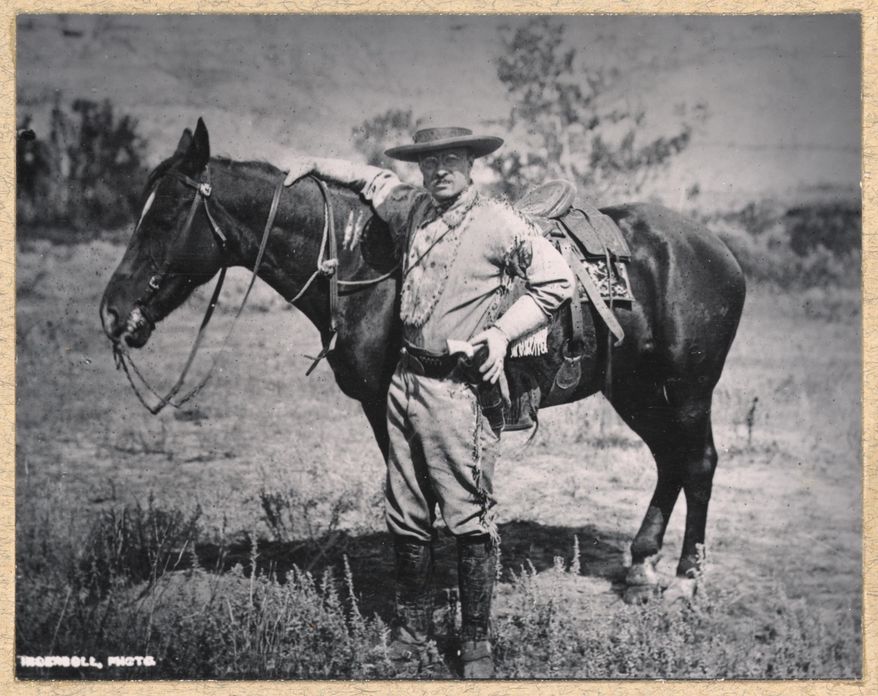
After the same-day deaths in 1884 of his beloved wife Alice, in childbirth, and his mother, who lived with the family, Teddy Roosevelt went into a depression. To beat the depression, he moved to South Dakota and became a cowboy, a very good cowboy.
Black care rarely sits behind a rider whose pace is fast enough.
Or, until that account is unsuspended by the forces supporting Donald Trump: Follow @FillmoreWhite, the account of the Millard Fillmore White House Library
We've been soaking in the Bathtub for several months, long enough that some of the links we've used have gone to the Great Internet in the Sky.
If you find a dead link, please leave a comment to that post, and tell us what link has expired.
Thanks!
Retired teacher of law, economics, history, AP government, psychology and science. Former speechwriter, press guy and legislative aide in U.S. Senate. Former Department of Education. Former airline real estate, telecom towers, Big 6 (that old!) consultant. Lab and field research in air pollution control.
My blog, Millard Fillmore's Bathtub, is a continuing experiment to test how to use blogs to improve and speed up learning processes for students, perhaps by making some of the courses actually interesting. It is a blog for teachers, to see if we can use blogs. It is for people interested in social studies and social studies education, to see if we can learn to get it right. It's a blog for science fans, to promote good science and good science policy. It's a blog for people interested in good government and how to achieve it.
BS in Mass Communication, University of Utah
Graduate study in Rhetoric and Speech Communication, University of Arizona
JD from the National Law Center, George Washington University


 Posted by Ed Darrell






 Millard Fillmore's Bathtub