She’s 11: America’s top young scientist works to help detect problems in Flint’s water supply, and yours

November 17, 2017

NPR caption: Gitanjali Rao, 11, says she was appalled by the drinking water crisis in Flint, Mich. — so she designed a device to test for lead faster. She was named

NPR caption: Gitanjali Rao, 11, says she was appalled by the drinking water crisis in Flint, Mich. — so she designed a device to test for lead faster. She was named “America’s Top Young Scientist” on Tuesday at the 3M Innovation Center in St. Paul, Minn. Andy King/Discovery Education 3M Young Scientist Challenge

Melinda Gates noticed; you should, too. (And check out the NPR story to which Gates links.)

NPR tells the story:

When the drinking water in Flint, Mich., became contaminated with lead, causing a major public health crisis, 11-year-old Gitanjali Rao took notice.

“I had been following the Flint, Michigan, issue for about two years,” the seventh-grader told ABC News. “I was appalled by the number of people affected by lead contamination in water.”

She saw her parents testing the water in their own home in Lone Tree, Colo., and was unimpressed by the options, which can be slow, unreliable or both.

“I went, ‘Well, this is not a reliable process and I’ve got to do something to change this,’ ” Rao told Business Insider.

Rao tells ABC that while she was doing her weekly perusal of MIT’s Materials Science and Engineering website to see “if there’s anything’s new,” she read about new technologies that could detect hazardous substances and decided to see whether they could be adapted to test for lead.

She pressed local high schools and universities to give her lab time and then hunkered down in the “science room” — outfitted with a big white table — that she persuaded her engineer parents to create in their home.

And she set about devising a more efficient solution: a device that could identify lead compounds in water and was portable and relatively inexpensive.

As she explains at lightning speed in her video submission for the Discovery Education 3M Young Scientist Challenge, her device consists of three parts. There is a disposable cartridge containing chemically treated carbon nanotube arrays, an Arduino-based signal processor with a Bluetooth attachment, and a smartphone app that can display the results.

(Film details:

Published on Jul 18, 2017
“Meet Gitanjali. Gitanjali hopes to reduce the time of lead detection in water by using a mobile app, to connect over Bluetooth to get status of water, almost immediately.”)

Stories like this should give you hope for our future. It’s clear that women should be encouraged to go into science and technology.

Stories like this should also get you out of your chair to yell at policy makers who cut funds for basic research, for education, and who rail against immigration. President Trump will not host the science fair that graced the White House for the past eight years. Time for you and me to stand up to demand support for science, and for women in science.

Tip of the old scrub brush to Melinda Gates.

More:


Oklahoma statehood, November 16, 1907; Oklahomans fly your flags today

November 16, 2017

U.S. Flag Code urges citizens of states to fly the U.S. flag on the anniversary of statehood.

We almost let the whole day slip away without reminding you: President Theodore Roosevelt signed the Oklahoma statehood proclamation on November 16, 1907. Oklahoma became the 46th state, with New Mexico and Arizona to come later to fill out the contiguous 48 states.

Mike Wimmer's 2003 painting of President Theodore Roosevelt's signing of the proclamation that made Oklahoma a member of the union. Oklahoma Arts Council image.

Mike Wimmer’s 2003 painting of President Theodore Roosevelt’s signing of the proclamation that made Oklahoma a member of the union. Oklahoma Arts Council image.

Oklahoma’s pre-history is long, complex and fascinating; the road to statehood is similarly complex and winding, lined with broken promises to Native Americans, tragedy and other drama. Does the state require Oklahoma history be taught in public schools?

And so we hope, you flew your flags today, Sooners!

Did anyone actually fly their flag? Does anyone other than Oklahoma newspapers even care any more?

More: 

Front page of the Daily Oklahoman on November 16, 1907, anticipating President Roosevelt's proclamation to come that morning. Daily Oklahoman image.

Front page of the Daily Oklahoman on November 16, 1907, anticipating President Roosevelt’s proclamation to come that morning. Daily Oklahoman image.

46-star flag used after Oklahoma became the 46th state in 1907. This flag remained in use for four years. RareFlags.com image

46-star flag used after Oklahoma became the 46th state in 1907. This flag remained in use for four years. RareFlags.com image

Yes, this is mostly an encore post. Fighting ignorance requires patience.

Yes, this is mostly an encore post. Fighting ignorance requires patience.

Save

Save

Save

Save


Annals of Global Warming: Ozone hole shrinks; success shows what can happen when world cooperates to end pollution; what’s the bad news?

November 14, 2017

(NASA caption) Ozone depletion occurs in cold temperatures, so the ozone hole reaches its annual maximum in September or October, at the end of winter in the Southern Hemisphere. Credits: NASA/NASA Ozone Watch/Katy Mersmann

(NASA caption) Ozone depletion occurs in cold temperatures, so the ozone hole reaches its annual maximum in September or October, at the end of winter in the Southern Hemisphere. Credits: NASA/NASA Ozone Watch/Katy Mersmann

Good news from NASA and NOAA: The ozone hole over Antarctica is shrinking, because policy makers heeded warnings from scientists, and they acted in the 1980s to stop the pollution that made the ozone hole grow into hazard.

In other words, cleaning up air pollution works to reduce problems.

If we apply those same principles to global warming climate change, we can save the planet: Listen to scientists, band together internationally, take effective action to stop the pollution.

BUT, much of the shrinkage in the past two years was due to warming atmosphere, which reduces the cold weather period during which the ozone hole grows. In other words, effects of the anti-pollution action isn’t yet clear.

This NASA video explains:

NASA discussed the events in a press release.

“The Antarctic ozone hole was exceptionally weak this year,” said Paul A. Newman, chief scientist for Earth Sciences at NASA’s Goddard Space Flight Center in Greenbelt, Maryland. “This is what we would expect to see given the weather conditions in the Antarctic stratosphere.”

The smaller ozone hole in 2017 was strongly influenced by an unstable and warmer Antarctic vortex – the stratospheric low pressure system that rotates clockwise in the atmosphere above Antarctica. This helped minimize polar stratospheric cloud formation in the lower stratosphere. The formation and persistence of these clouds are important first steps leading to the chlorine- and bromine-catalyzed reactions that destroy ozone, scientists said. These Antarctic conditions resemble those found in the Arctic, where ozone depletion is much less severe.

In 2016, warmer stratospheric temperatures also constrained the growth of the ozone hole. Last year, the ozone hole reached a maximum 8.9 million square miles, 2 million square miles less than in 2015. The average area of these daily ozone hole maximums observed since 1991 has been roughly 10 million square miles.

Although warmer-than-average stratospheric weather conditions have reduced ozone depletion during the past two years, the current ozone hole area is still large because levels of ozone-depleting substances like chlorine and bromine remain high enough to produce significant ozone loss.

Scientists said the smaller ozone hole extent in 2016 and 2017 is due to natural variability and not a signal of rapid healing.

First detected in 1985, the Antarctic ozone hole forms during the Southern Hemisphere’s late winter as the returning sun’s rays catalyze reactions involving man-made, chemically active forms of chlorine and bromine. These reactions destroy ozone molecules.

Thirty years ago, the international community signed the Montreal Protocol on Substances that Deplete the Ozone Layer and began regulating ozone-depleting compounds. The ozone hole over Antarctica is expected to gradually become less severe as chlorofluorocarbons—chlorine-containing synthetic compounds once frequently used as refrigerants – continue to decline. Scientists expect the Antarctic ozone hole to recover back to 1980 levels around 2070.

Ozone is a molecule comprised of three oxygen atoms that occurs naturally in small amounts. In the stratosphere, roughly 7 to 25 miles above Earth’s surface, the ozone layer acts like sunscreen, shielding the planet from potentially harmful ultraviolet radiation that can cause skin cancer and cataracts, suppress immune systems and also damage plants. Closer to the ground, ozone can also be created by photochemical reactions between the sun and pollution from vehicle emissions and other sources, forming harmful smog.

Although warmer-than-average stratospheric weather conditions have reduced ozone depletion during the past two years, the current ozone hole area is still large compared to the 1980s, when the depletion of the ozone layer above Antarctica was first detected. This is because levels of ozone-depleting substances like chlorine and bromine remain high enough to produce significant ozone loss.

More work to do; but at least the damage is not increasing dramatically. While it would be good to be able to report that human action to close the ozone hole had produced dramatic results, it is still useful to track the progress of this action, especially when global warming/climate change dissenters frequently argue falsely that the ozone hole never existed, and warming is a similar hoax.

NASA’s AURA satellite group said the ozone holes should be repaired and gone by 2040, 23 years from now.

We hope they’re right.

(NASA caption) At its peak on Sept. 11, 2017, the ozone hole extended across an area nearly two and a half times the size of the continental United States. The purple and blue colors are areas with the least ozone. Credits: NASA/NASA Ozone Watch/Katy Mersmann

(NASA caption) At its peak on Sept. 11, 2017, the ozone hole extended across an area nearly two and a half times the size of the continental United States. The purple and blue colors are areas with the least ozone. Credits: NASA/NASA Ozone Watch/Katy Mersmann

More:

Tip of Millard Fillmore’s old scrub brush to Sean Sublette at Climate Central

Save


Missing Carl Sagan, on his birthday, November 9

November 10, 2017

Carl Sagan would have been 83 on November 9. Image from Cornell University.

Carl Sagan would have been 83 on November 9. Image from Cornell University.

It’s been one of those weeks, and I missed posting anything early for Carl Sagan’s birthday, a day on which many work to keep his memory and wisdom alive.

Here are a few of the tributes, from Twitter.


https://twitter.com/ChrisEvans/status/928609317959462913

https://twitter.com/AreoLucy/status/928579842064384000

https://twitter.com/aaronhuertas/status/928611653641494529


Virginia’s Bicycle Woman

November 9, 2017

Caption at Raw Story: Juli Briskman flips off Pres. Donald Trump (copyright @b_smialowski/@AFP)

Caption at Raw Story: Juli Briskman flips off Pres. Donald Trump (copyright @b_smialowski/@AFP)

In ten years, will we regard this photo as iconic as the Tank Man in China?

Is this a photo of a brave citizen standing up to oppressive power?

Unlike Tank Man, whose name and fate remain unknown, the woman was fired from her job. We should track the story.

Or, is there a chance that, in a decade after President Trump is deposed by legal means, we will look back and regard this photo as a citizen bullying poor old Trump?

More:


Save

Save


Milky Way at the Canyon of the Ancients National Monument

November 7, 2017

Interior’s great photographer Bob Wick is at it again, this time in Colorado:

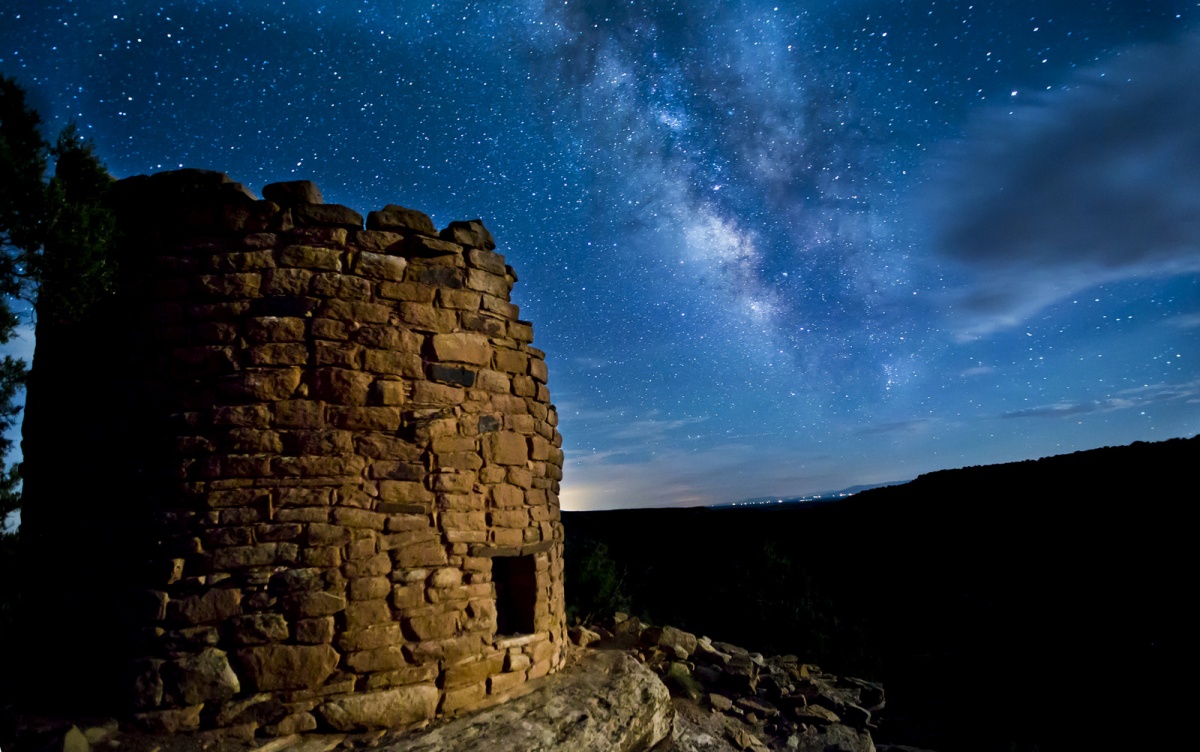
Archaeological site at Canyon of the Ancients National Monument in Colorado. Photo by Bob Wick, Bureau of Land Management.

Archaeological site at Canyon of the Ancients National Monument in Colorado. Photo by Bob Wick, Bureau of Land Management.

This photo is featured in a story from the National Park Service about celebrating Native American Heritage month, which is November.


2017 North Dakota and South Dakota statehood days – fly your flags

November 2, 2017

North Dakota's commemorative quarter depicts the American bison, perhaps the quintessential prairie symbol.

North Dakota’s commemorative quarter depicts the American bison, perhaps the quintessential prairie symbol.

South Dakota's commemorative quarter interestingly focuses on human alterations to the area -- the carved presidential busts on Mt. Rushmore, wheat introduced by immigrant farmers, and the Chinese pheasant, an exotic species introduced for hunting.

South Dakota’s commemorative quarter interestingly focuses on human alterations to the area — the carved presidential busts on Mt. Rushmore, wheat introduced by immigrant farmers, and the Chinese pheasant, an exotic species introduced for hunting.

Residents of North Dakota and South Dakota should fly their U.S. flags today in honor of their states’ being admitted to the union, on November 2, 1889.

Most sites note simply that both states were admitted on the same day; some sites, especially those that lean toward North Dakota, claim that state is Number 39, because President Harrison signed their papers first, after shuffling to avoid playing favorites.

Does anyone really care?

How much do you really know about the Dakotas?

Dakotans, fly your flags today in honor of statehood.

More:

Yes, this is mostly an encore post. Fighting ignorance requires patience.

Yes, this is mostly an encore post. Fighting ignorance requires patience. And, confess: Do you remember this post from last year?

Save

Save


October 31, remember the Reuben James

November 1, 2017

U.S.S. Reuben James (D-245) on the Hudson River in April 1939, over two years before she was sunk in the Battle of the Atlantic.

U.S.S. Reuben James (DD-245) on the Hudson River in April 1939, over two years before she was sunk in the Battle of the Atlantic. Photo from the Ted Stone Collection, Marines Museum, Newport News, Virginia, via Wikipedia

We shouldn’t let October steal away without a remembrance of the brave crew of the Reuben James. The ship was sunk on October 31, 1941, by a German submarine. 66 years ago.

It was a tragedy in 1941, but before the U.S. could develop a serious policy response to Germany’s action, Japan attacked Pearl Harbor.  Within a week after that, our policy towards Germany was set by Germany’s declaration of war on the U.S.

It’s important history for a couple of reasons.

  • The sinking was part of the massive, years-long Battle of the Atlantic, which the Allies won only by building ships faster than Germany could sink them.  Had the Allies lost this battle, the war would have been lost, too.
  • While the USS Reuben James was a Navy destroyer, the key weapons of the Battle of the Atlantic were Merchant Marine cargo ships, carrying goods and arms to Britain and other Allied nations.  “Civilians” played a huge role in World War II, supplying the soldiers, armies, navies and air forces.
  • Recently, politicians took to making claims that the U.S. declared war on Germany without any hostile action having passed between them, without Germany having perpetrated any hostilities toward the U.S.  Look at the dates, it’s not so.
  • Woody Guthrie wrote a song about the event, giving us a touchstone to remember.

Millard Fillmore’s Bathtub covered the event with longer, detailed articles in past years, including these, which you should see especially if you are a student in a history class or a teacher of one:

Europe has changed. The world has changed.  The U.S. has changed.  War has changed.  We should remember, especially those people who died defending the merchants who defended the idea of the Four Freedoms.

Where did the ship get its name? From a Barbary War hero:

Reuben James was born in Delaware, Ohio about 1776. He joined the U.S. Navy and served on various ships, including the frigate USS CONSTELLATION. It was during the infamous Barbary Wars that the American frigate PHILADELPHIA was captured by the Barbary pirates. Having run aground in the pirate capital of Tripoli on the southern shores of the Mediterranean Sea, the crew had to abandon ship and formulate a plan of attack. Lieutenant Stephen Decatur, along with a group of volunteers which included Boatswain’s Mate Reuben James, entered Tripoli harbor under the cover of darkness in an attempt to set the PHILADELPHIA to the torch so that the pirates could not make use of her.

The American volunteers boarded the PHILADELPHIA on 16 February 1804 and were met by a group of the savage Barbary pirates who were guarding their prize. A furious battle ensued, and during the bloody chaos of hand-to-hand combat, a villanous pirate made ready to end the life of Lieutenant Decatur. Reuben James, with both of his hands already wounded, in an act of selfless dedication and courage did throw his hand before the pirate’s cleaving blade! Willing to give his life in defense of his captain, Reuben James took the blow from the sword!

Having proved to the world over the courage and dedication of United States Sailors, Reuben James also hammered home the fact that US Sailors are undefeatable by not only surviving, but recovering from his wounds and continuing his career in the U.S. Navy! After spending many more years with Decatur, James was forced to retire in January 1836 because of declining health brought on because of past wounds. He died on 3 December 1838 at the U.S. Naval Hospital in Washington, D.C.

More:

A Weavers recording of “The Sinking of the Reuben James.”

Yes, this is mostly an encore post. Fighting ignorance requires patience.

Yes, this is mostly an encore post. Fighting ignorance requires patience.

Save

Save


November 2017 flag-flying dates

October 28, 2017

A giant American flag is unfurled at Wrigley Field before World Series Game 3, October 28, 2016 (Cubs won the Series, remember?) Will 2017's World Series push into November for the first time? Wikimedia Commons image

A giant American flag is unfurled at Wrigley Field before World Series Game 3, October 28, 2016 (Cubs won the Series, remember?) Will 2017’s World Series push into November for the first time? Wikimedia Commons image

Nine events spread over seven different days come with urgings to fly the U.S. flag in November: Six states celebrate statehood, Veterans Day falls as always on November 11, and Thanksgiving Day on November 23.

Did I say eight? 2017 is an election year in many states, like Texas; we fly flags at polling places on election day, so that makes nine events. You may fly your flag at home on election day, too.

Two states, North Dakota and South Dakota, celebrate their statehood on the same date. Washington’s statehood day falls on Veterans Day, November 11 — so there are only seven days covering eight events.

In calendar order for 2017, these are the seven days:

  • North Dakota statehood day, November 2 (1889, 39th or 40th state)
  • South Dakota statehood day, November 2 (1889, 39th or 40th state) (shared with North Dakota)
  • Election day, November 7 (several states)
  • Montana statehood day, November 8 (1889, 41st state)
  • Veterans Day, November 11
  • Washington statehood day, November 11 (1889, 42nd state) (shared with Veterans Day)
  • Oklahoma statehood day, November 16 (1907, 46th state)
  • North Carolina statehood day, November 21 (1789, 12th state)
  • Thanksgiving Day, fourth Thursday in November (November 24 in 2016)

Most Americans will concern themselves only with Veterans Day and Thanksgiving Day. Is flying the U.S. flag for statehood day a dying tradition?

More:

This is an encore post.

Yes, this is an encore post. Fighting ignorance takes longer than we hoped.


O, say! Does that woman’s lamp still burn beside the golden door in 2017?

October 28, 2017

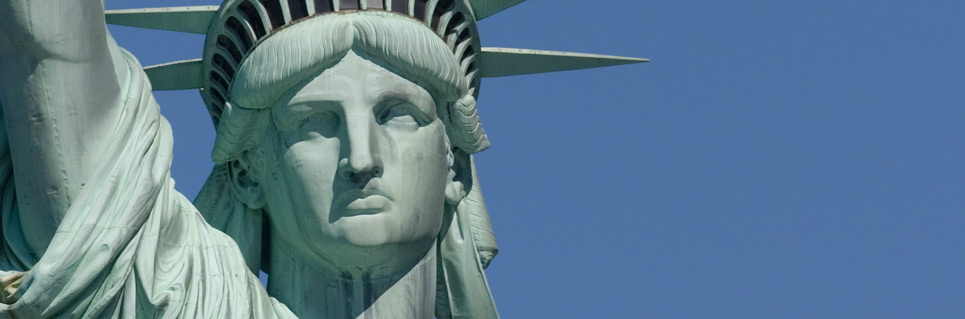
Liberty gazing out at about 265 feet above the water of New York Harbor. Image by Statue of Liberty Tickets

Liberty gazing out at about 265 feet above the water of New York Harbor. Image by Statue of Liberty Tickets

Liberty was dedicated to the people of the United States on October 28, 1886. She’s 131 years old today.

Liberty stands gazing out at about 265 feet* above the water of New York Harbor, a fixture there since construction in the 1880s.

The Statue of Liberty Enlightening the World was a gift of friendship from the people of France to the people of the United States and is a universal symbol of freedom and democracy. The Statue of Liberty was dedicated on October 28, 1886, designated as a National Monument in 1924 and restored for her centennial on July 4, 1986.

The Statue of Liberty has been a fixture in the U.S. and American psyche, too.  Excuse me, or join me, in wondering whether we have not lost something of our former dedication to the Statue of Liberty, and the reasons France and Americans joined to build it.

Poem-a-Day sent Emma Lazarus’s “The New Colossus” out this morning (Poem-a-Day is a wonderful service of the American Academy of Poets — you may subscribe and I recommend it).  There it was, waiting for me in e-mail.   My students generally have not heard nor read the poem, I discover year after year —  some sort of Texas-wide failure in enculturation prompted by too-specific requirements of federal law and state law, combining to make a slatwork of culture taught in our classrooms with too many cracks into which culture actually falls, out of sight, out of mind; out of memory.  I fear it may be a nationwide failure as well.

Have you read the poem lately?  It once encouraged American school children to send pennies to build a home for the statue.  Today it wouldn’t get a majority of U.S. Congressmen to sign on to consponsor a reading of it.  Glenn Beck would contest its history, Rush Limbaugh would discount the politics of the “giveaways” in the poem, John Boehner would scoriate the victims in the poem for having missed his meeting of lobbyists (‘they just missed the right boat’), and Sarah Palin would complain about “an air-bridge to nowhere,” or complain that masses who huddle are probably up to no good (they might touch, you know).

Have you read it lately?

The New Colossus

by Emma Lazarus

Liberty Enlightening the World; French: La Liberté éclairant le monde - Wikimedia Commons image

Liberty Enlightening the World; French: La Liberté éclairant le monde – Wikimedia Commons image

Not like the brazen giant of Greek fame,
With conquering limbs astride from land to land;
Here at our sea-washed, sunset gates shall stand
A mighty woman with a torch, whose flame
Is the imprisoned lightning, and her name
Mother of Exiles. From her beacon-hand
Glows world-wide welcome; her mild eyes command
The air-bridged harbor that twin cities frame.
“Keep, ancient lands, your storied pomp!” cries she
With silent lips. “Give me your tired, your poor,
Your huddled masses yearning to breathe free,
The wretched refuse of your teeming shore.
Send these, the homeless, tempest-tost to me,
I lift my lamp beside the golden door!”

AAP makes poems available for iPhones, too, and you can see how it appears, phrase by phrase.  “The New Colossus” takes on more of its power and majesty delivered that way.

Is the Academy of American Poets playing politics here?  In much of America, there is an active movement to nail shut the “golden door,” to turn out a sign that would say “No tired, no poor nor huddled masses yearning to breathe free; especially no wretched refuse, no homeless, and let the tempest-tost stay in Guatemala and Pakistan.”

Would Americans bother to contribute to build a Statue of Liberty today?  Or would they protest against it?

Does that lamp still shine beside the golden door?

Stereoscopic image of the arm and torch of Liberty, at the 1876 Centennial Exposition in Philadelphia

Stereoscopic image of the arm and torch of Liberty, at the 1876 Centennial Exposition in Philadelphia; Robert N. Dennis Collection, New York Public Library.  The arm was displayed to encourage contributions to the fund to build a pedestal for the statue, from private donations.

_____________

*  I’m calculating Liberty’s gaze at about 40 feet below the tip of the torch, which is just over 305 feet above the base of the statue on the ground.  The base is probably 20 feet higher than the water, but this isn’t exact science we’re talking about here.

Yes, this is mostly an encore post. Fighting ignorance requires patience.

Yes, this is mostly an encore post. Fighting ignorance requires patience.

Save


Fly your flag for Navy Day, October 27, 2017

October 27, 2017

NORFOLK – Sailors assigned to USS Gerald R. Ford (CVN 78) lower the ensign as the ship shifts colors from the fantail to the mast in preparation to get underway. (U.S. Navy file photo and caption)

NORFOLK – Sailors assigned to USS Gerald R. Ford (CVN 78) lower the ensign as the ship shifts colors from the fantail to the mast in preparation to get underway. (U.S. Navy file photo and caption)

A reminder to fly your U.S. flags today in honor of the U.S. Navy.

We celebrate Navy Day each year on October 27, one of the score of dates designated in the U.S. Flag Code to fly Old Glory. Navy Day honors everyone who serves or served in the U.S. Navy.

Navy Day may be eclipsed by Armed Forces Day, Memorial Day and Veterans Day in modern life, but it’s still in the law and the Navy still notes it.

So should we.

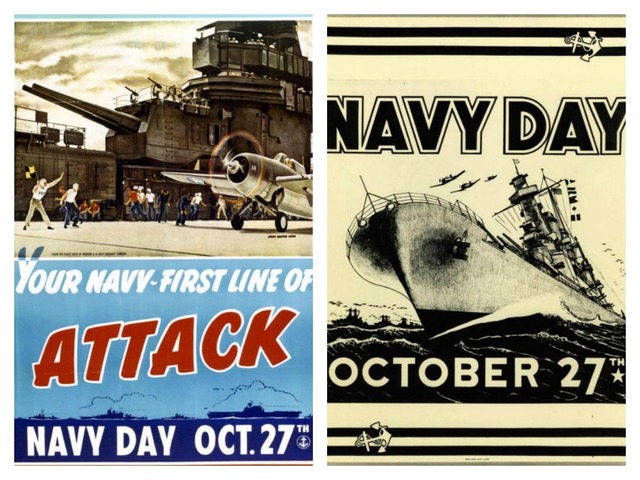
You get an idea of the celebrations from some of the old Navy Day posters. (If you can put a year on posters undesignated, please tell us in comments; if you know of a poster not shown here, please give a link in comments.)

Navy Day poster, after World War I

Navy Day poster, after World War I


This may have been used as a Navy Day poster after the death of Theodore Roosevelt, a former, popular Secretary of the Navy. Crasch McDuff blog

This may have been used as a Navy Day poster after the death of Theodore Roosevelt, a former, popular Secretary of the Navy. Crash MacDuff blog


Navy Day poster, post World War I, pre-World War II

Navy Day poster, post World War I, pre-World War II

Navy Day poster, 1931; Crash MacDuff blog

Navy Day poster, 1931; Crash MacDuff blog


Navy Day poster, early 1940s

Navy Day poster, early 1940s, featuring the battleship USS New Jersey.
Illustration by Matt Murphey


Navy Day poster, 1940s

Navy Day poster, 1940s


Two more 1940s Navy Day posters

Two more 1940s Navy Day posters


Navy Day poster, 1944

Navy Day poster, 1944


Billboard showing art similar to the poster, Navy Day 1944

Billboard showing art similar to the poster, Navy Day 1944. History 101 image


Navy Day Poster, 1945

Navy Day Poster, 1945


Navy Day Poster from after World War II (?)

Navy Day Poster from after World War II (?)


Navy Day poster, 1947, Crash MacDuff blog

Navy Day poster, 1947, Crash MacDuff blog. “Issued September 1947. Courtesy of the Naval Historical Foundation. NHHC Photograph Collection, NH 78860.”


Yes, this is mostly an encore post. Fighting ignorance requires patience.

Yes, this is mostly an encore post. Fighting ignorance requires patience.


Save


Americans want EPA’s environmental protections; Verge film tells why

October 19, 2017

Verge caption:  A woman holds a jar of undrinkable water from her well in Ohio in 1973. She filed a damage suit against the Hanna Coal Company, which owned the land around her house. Photo by Erik Calonius / US National Archives. From EPA's Documerica project.

Verge caption: A woman holds a jar of undrinkable water from her well in Ohio in 1973. She filed a damage suit against the Hanna Coal Company, which owned the land around her house. Photo by Erik Calonius / US National Archives. From EPA’s Documerica project.

Short film from The Verge:

It’s good to be reminded of the burning Cuyahoga River, from time to time. As a great example of EPA’s successes, the the Cuyahoga has not caught fire for many years.


October 2017 dates to fly Old Glory

October 1, 2017

The American flag blows in the wind as the moon rises over Joint Base Charleston – Air Base, S.C. Joint Base Charleston Public Affairs Office Photo by Senior Airman Dennis Sloan, October 2, 2012, Read more: dvidshub.net/r/zsbl6g

The American flag blows in the wind as the moon rises over Joint Base Charleston – Air Base, S.C. Joint Base Charleston Public Affairs Office Photo by Senior Airman Dennis Sloan, October 2, 2012, Read more: dvidshub.net/r/zsbl6g, and https://commons.wikimedia.org/wiki/File:Flickr_-_DVIDSHUB_-_American_flag_lit_by_a_full_moon_(Image_2_of_5)_Read_more,_http-www.dvidshub.net-image-675376-american-flag-lit-full-moon.UGyISa5jcdU%5Eixzz28GOdWQR5.jpg

October is not a big month for dates to fly the U.S. flag.  Only one state joined the union in October, and only two other dates received Congress’s designation for flag-flying.

Here are October’s three flag-flying days, in chronological order:

  • Columbus Day, October 8 —  tradition puts Columbus Day on October 12, but in law it is designated as the second Monday in October (to make a three-day weekend for workers who get a holiday); in 2017, October 8 is the second Monday of the month.
  • Navy Day, October 27
  • Nevada Statehood Day, October 31; Nevada joined the union during the Civil War, in 1864, the 36th state.

Federal law also designates October 9 as Leif Erickson Day, a concession to Scandanavian-descended Americans who argue Erickson beat Columbus to the Americas by a few hundred years. Congress’s recognition does not include an urging to fly the flag, though the President may issue such a proclamation.

The photograph by Senior Airman Dennis Sloan, above, may suggest a suitably spooky theme for flying Old Glory on Halloween. While you are free to fly your flag on any day, Halloween, a religious or holy day for Christians, Celts and perhaps a few others, is not designated by Congress as a day to fly the flag. If you fly it at night, it must be lighted, as is the flag in the photograph.

Other notable stuff:

More:

Yes, this is mostly an encore post. Fighting ignorance requires patience.

Yes, this is mostly an encore post. Fighting ignorance requires patience.

Save

Save

Save

Save

Save


September 14, 1901: McKinley died, Teddy Roosevelt ascended to presidency

September 14, 2017

September 14, 1901, front page of the Boston Morning Journal, announcing the death of President William McKinley. Image from Timothy Hughes Rare & Early Newspapers.

September 14, 1901, front page of the Boston Morning Journal, announcing the death of President William McKinley. Image from Timothy Hughes Rare & Early Newspapers.

Lincoln, Garfield, then McKinley.

September 14, 1901, President William McKinley died in Buffalo, New York, eight days after having been shot at Buffalo’s Pan American Exposition a sort of World Fair.

Within hours, Vice President Theodore Roosevelt took the oath as president.

Ken Burns explained the events of the day well in his long series of films on the Roosevelts:

Interesting to read the newspapers from an era before television, radio or especially internet.

Front page of the

Front page of the “3:00 p.m. edition” of the Buffalo Enquirer, September 14, 1901. Image from Nate D. Sanders Auctions

More:

Save

Save

Save

Save


9/11/2017 – Fly your flag today, honor the victims and heroes

September 11, 2017

Rose honoring a victim at the 9/11 Memorial, Manhattan, New York City. (Photo by Ed Darrell)

Rose honoring a victim at the 9/11 Memorial, Manhattan, New York City. (Photo by Ed Darrell)

Fly your U.S. flag today to honor the victims and heroes of the September 11, 2001, attacks on the U.S. The day is designated in U.S. law as National Patriot Day (36 USC § 144).

U.S. flag flies in front of construction restoring the sites of the World Trade Center in New York City (bus station opened a few weeks later).

U.S. flag flies in front of construction restoring the sites of the World Trade Center in New York City (bus station opened a few weeks later).

More: