Disney showed how to beat malaria in the Americas, without DDT

February 26, 2017

Still photo from Walt Disney's "Winged Scourge," a wanted poster for "Anopheles, alias Malaria Mosquito." The 1943 film short suggested ways to cut populations of the malaria-spreading mosquitoes of the genus Anopheles. Disease prevention would aid the war effort in 1943, it was hoped.

Still photo from Walt Disney’s “Winged Scourge,” a wanted poster for “Anopheles, alias Malaria Mosquito.” The 1943 film short suggested ways to cut populations of the malaria-spreading mosquitoes of the genus Anopheles. Disease prevention would aid the war effort in 1943, it was hoped.

Malaria’s scourge hobbled economic progress across the Americas, and critically in World War II, that hobbled the war effort to defeat the Axis powers, Germany and Japan.

U.S. government recruiting of Hollywood film makers to produce propaganda films hit a zenith in the war. Even animated characters joined in. Cartoonists produced short subject cartoons on seeveral topics.

In 1943 the Disney studios distributed this film starring the Seven Dwarfs, among the biggest Disney stars of the time. The film was aimed at Mexico, Central America and South America, suggesting ways people could actually fight malaria. Versions were made in Spanish and English (I have found no Portuguese version for Brazil, but I’m still looking.)

the lost Disney described the film:

The first of a series of health-related educational shorts produced by the Disney studios and the Coordinator of Inter-American Affairs for showing in Latin America. It was also the only one to use established Disney characters (the Seven Dwarfs).

In this propaganda short, the viewers are taught about how the mosquito can spread malaria. A young mosquito flies into a house and consumes the blood of an infected human. She then consumes the blood of a healthy human, transmitting the disease into him. It turns out that this is actually a film within a film and the Seven Dwarves are watching it. They volunteer to get rid of the mosquito by destroying her breeding grounds.

A Spanish-language version of the film:

Fighting malaria in the U.S. became a grand campaign in Franklin Roosevelt’s administration. Roosevelt administration officials saw malaria as a sapper of wealth, especially in the rural south. Part of the charge of the Tennessee Valley Authority was to wipe out malaria. By 1932, public health agencies in malaria-affected counties were beefed up to be able to promptly diagnose and treat human victims of malaria. TVA taught methods of drying up mosquito breeding places around homes and outdoor work areas. Sustained campaigns urged people to make their homes tighter, against weather, and to install screens on windows and doors to prevent mosquito entry especially at peak biting periods, dusk to after midnight.

U.S. malaria deaths and infections plunged by 90% between 1933 and 1942 — just in time to allow southern military bases to be used for training activities for World War II. After the war, the malaria-fighting forces of the government became the foundation for the Centers for Disease Control (CDC). With the introduction of DDT after 1945, CDC had another weapon to completely wipe out the remaining 10% of malaria cases and deaths.

It’s worth noting that in the end, it is the disease malaria that is eradicated, not the mosquitoes. In most places in the world, eradication of a local population of disease carriers is a temporary thing. A few remaining, resistant-to-pesticide-or-method mosquitoes can and do quickly breed a new population of hardier insects, and often surrounding populations will contribute new genetic material. Eradication of a vector-borne disease requires curing the disease in humans, so that when the mosquitoes come roaring back, they have no well of disease from which to draw new infection.

More:

Save

Save

Save


Typewriter of the moment: Milan Karanovic, Bosnian ethnographer

February 22, 2017

Ethnographer? It’s a person who makes a systematic study of a people and its culture, a subdivision of anthropology, sociology, history and geography all at once.

Milan Karanovic, trained as a priest, studied folk and cultural trends of Bosnians, roughly from 1900 to World War II.

And this is his typewriter:

Typewriter of Bosnian ethnographer Milan Karanovic. Take careful note of special keys to accommodate Bosnian spellings. Typewriter on display in the National Museum of Bosnia and Herzegovina. Photo courtesy of Jonathan Halabi.

Typewriter of Bosnian ethnographer Milan Karanovic. Take careful note of special keys to accommodate Bosnian spellings. Typewriter on display in the National Museum of Bosnia and Herzegovina. Photo courtesy of Jonathan Halabi.

Photo of Milan Karanovich, National Museum of Bosnia and Herzegovina. "Zivot i rad" translates to "life and work." Image by Jonathan Halabi.

Photo of Milan Karanovich, National Museum of Bosnia and Herzegovina. “Zivot i rad” translates to “life and work.” Image by Jonathan Halabi.

Milan Karanovic was born in 1883 in Great Novljansko Rujiška. In his teens he moved to Sarajevo, graduated high school and attended seminary, graduating by 1909 and assuming duties as a parish priest (Orthodox?) in the Krajina region village of Rujnić. We know he published a study of the “village” of Sarajevo in 1907. On the wrong side of local authorities in World War I, he spent much of the war in prison. His publications resumed by 1925, and proliferated through 1937. He died in 1955.

The typewriter is an Optima Elite. I’m guessing this model was made during or after World War II; Optima used the Olympia name into World War II. After the war, Olympia factories in the zones controlled by the Soviet Union changed to Optima. Judging from photos, this machine may have been built in the 1950s, giving Karanovic only a few years to use it. I’m open to the idea that the Optima name was used earlier — this history of corporations and machines is out of my range. If you have better information, please feel free to contribute in comments.


Annals of Global Warming: Mexican plums blooming early in Dallas

February 17, 2017

Spring comes a few hours earlier every year as the planet warms; plants that used to blossom in March and April, now blossom in February. Mexican plum blossoms in Dallas, Texas, February 17, 2017. Photo by Ed Darrell, please share with attribution

Spring comes a few hours earlier every year as the planet warms; plants that used to blossom in March and April, now blossom in February. Mexican plum blossoms in Dallas, Texas, February 17, 2017. Photo by Ed Darrell, iPhone 6; please share with attribution.

Spring comes earlier every year in Dallas. Our Mexican plums used to blossom in March and April; for the past three years, we’ve had blossoms well before spring even comes. Last year we had a cold snap that took the young fruit out, after a premature blossoming.

It’s a sign of creeping global warming. Every year I marvel at Al Gore’s powers to convince our Mexican plum to blossom early, part of the “global warming conspiracy” so many fear.

That is, this is a symptom of global warming that cannot be faked, that is from observation, and not from models.

With flowers on fruit trees come hopes of a bountiful harvest. Dreading the underlying meaning of such an early blossom does not change our hopes, nor the birds’ hopes, for a good plum harvest.

More:

Save


February 15 is Shoulders of Giants Day

February 15, 2017

February 15th is Shoulders of Giants Day (unless you’re still on the Julian calendar).

Or should be. 

Famous quotations often get cited to the wrong famous person. ‘Somebody said something about standing on the shoulders of giants — who was it? Edison? Lincoln? Einstein? Jefferson?’  It may be possible someday to use Google or a similar service to track down the misquotes.

The inspiration, perhaps

Robert Burton, author of "Anatomy of Melancholy"

Robert Burton, melancholy scholar at Oxford

A dwarf standing on the shoulders of a giant may see farther than a giant himself.

Robert Burton (February 8, 1577-January 25, 1640), vicar of Oxford University, who wrote The Anatomy of Melancholy to ward off his own depressions

The famous quote

Sir Isaac Newton, by Sir Godfrey Keller, 1689

Sir Isaac Newton, by Sir Godfrey Keller, 1689

If I have seen further (than you and Descartes) it is by standing on the shoulders of Giants.

Sir Isaac Newton, letter to Robert Hooke, February 5, 1675, Julian/February 15, 1676, Gregorian

Newton consciously paid tribute to others who had plowed his science fields before, even if he came up with different crops, er, answers. All science is based on something that comes before it, and in the modern world science advances, oddly, by trying to disprove what scientists thought happened before.

But the sentiment applies equally well in business, in politics, in raising children. We are products of what we learn, and what we learn is a result of culture, which is a result of history. We all stand on the shoulders of those who came before us.

It’s our job to try to see farther, and not just look down, at how far up we are.

Someone will ask (since we so often discuss it), ‘can we fly our flags today?’

Of course you may fly your U.S. flag today. It’s not a day designated by law, but you may fly it in honor of Sir Isaac Newton’s letter if you wish. The U.S. flag code suggests times Americans may fly their flags, but does not require it, nor does law forbid flying the flag for other occasions, or just for every day.

Maybe better, climb to the top of the flag pole. What can you see, aided by a giant’s height?

Other references:

Inscription on the edge of Britain's 2-pound coin; in this photo, four coins are used, to show the entire inscription. Flickriver image

Inscription on the edge of Britain’s 2-pound coin; in this photo, four coins are used, to show the entire inscription. Flickriver image, 1875Brian

Yes, this is mostly an encore post. Fighting ignorance requires patience.

Yes, this is mostly an encore post. Fighting ignorance requires patience. But, nanos gigantum humeris insidentes.


Save

Save

Save

Save

Save


Suicide with DDT: DDT can kill humans

February 13, 2017

Label on a can of DDT. BigPictureEducation image

Label on a can of DDT. BigPictureEducation image

It’s a footnote, but an important one right now, when the anti-science, anti-environmental protection, anti-learning wing of American culture again gears up to attack the memory of Rachel Carson, the science findings that led to the ban on crop use of DDT in America, and upon health care and medicine and science in general.

DDT kills. DDT can kill humans.

Daily Beast, usually a sober-enough, accurate enough online news organ that has absorbed the old print magazine Newsweek, recently carried a column by Paul Offitt, repeating the hoax claims that DDT was banned contrary to science, by a conspiracy of power-made environmentalists, that DDT is harmless to humans, and that had DDT not been banned, millions of humans would have survived malaria.

Long-time readers of this organ know each of those points is false, hoaxes ginned up to impugn science, leftists, environmental protection, or just for the hell of it. Offitt’s is just the first of several of these hoax-based articles which will cause us all grief this spring, I predict.

Probably the most difficult-to-explain hoax claim is the one that says DDT is “harmless” to humans.

DDT usually doesn’t come in a dose great enough to kill humans outright.  That should not be mistaken for safety. DDT was known to kill early on, and as it turns out, it has become a method of human suicide across Asia. Unfortunately for policy study, those cases rarely get reported in science journals.

Some medical researcher should study the issue, to determine how widespread DDT suicide might be, what physicians do to save a person so poisoned, if they ever can. And I often wonder, is any suicide by insecticide reported as “DDT,” though it may be some other toxin?

I stumbled across the story of a DDT suicide in India some time back. It was a short report. I found no follow ups.

Some time ago I was surprised to hear an author talking about DDT suicide, which she had mentioned in one of her stories. The story was published in The New Yorker, “A Sheltered Woman.” The magazine interviewed the author, Yiyun Li; Li explained why she mentioned DDT suicide in the story.

This week’s story, “A Sheltered Woman,” is about a baby nurse named Auntie Mei, a Chinese immigrant who has established a solid career for herself looking after infants and their breast-feeding mothers in the Bay Area. When did the character of Auntie Mei first come to you?

A year ago, while rummaging through old things, I found a notebook that I had bought at a garage sale in Iowa City when I first came to America—I had paid five cents for it. The notebook was in a good shape; though it remained unused. A character occurred to me: she paid a dime and asked if there was a second notebook so she did not have to have the change back. Such greed, the character said, laughing at herself. From that moment on I knew I had a story.

Auntie Mei keeps a distance between herself and her charges, rarely staying longer than the first month of a baby’s life and establishing an orderly regime in the households she enters. Yet her disciplined approach starts to falter when she’s faced with Chanel, a disgruntled young mother, and her son. Why is Chanel able to unsettle Auntie Mei? Did you know this would happen when you starting thinking of the way the two characters would interact?

Auntie Mei’s life has a reliable pattern: the moment she enters a house to take care of a new set of mother and infant she can already see the exit point. But any pattern is breakable. When I started the story, I knew that the situation would change for Auntie Mei. Chanel, by not being ready to be a mother, forces Auntie Mei into a dilemma: When the baby in her charge is not loved by his parents, should she step in and offer her love? And what danger would she find herself in if she does not suppress that love?

You said in a recent interview that your characters don’t struggle as immigrants but are concerned rather with internal struggles and with the problems they’ve brought with them from China. That’s certainly the case here, where Auntie Mei is haunted by the legacy of the two women who raised her, her mother and her grandmother, who rejected the men in their lives. Does Auntie Mei’s childhood reflect anything in particular about Chinese-village life? Could you imagine a similar situation had she grown up in America?

Part of Auntie Mei’s childhood reflects Chinese-village life. For instance, her mother threatened to kill herself with DDT. DDT was banned in the United States in 1972, but, when I grew up, it was widely used in China, and, in the countryside, suicides by DDT were common. The peculiarities of Auntie Mei’s grandmother and mother would have been less readily accepted had she grown up in America, or even in a big city in China. However, Auntie Mei’s struggle is not specific to China. I imagine it’s a situation that can happen in any country. Our knowledge of history in general is limited, but at least there are historians who strive to enlighten the public. The murkiest history is within one’s own family, and oftentimes things remain unexplored and unsaid, and what is said may be misrepresentation or even distortion. Auntie Mei is not alone in her struggle with a shadowy past. In fact, I wonder how many people are truly exempted from the past.

One more anecdote, but one we may put stock into. DDT suicide is a thing. DDT can kill humans acutely, when the dose is great enough. Statements that DDT is harmless are inaccurate.

It’s a good short story, by the way.


No, Rachel Carson didn’t cause an increase in malaria; bonus film to WGBH American Experience “Rachel Carson”

February 7, 2017

Rachel Carson at a microscope, American Experience/RetroReport image. Did Carson's work cause an increase in malaria? Is she to blame for continued malaria deaths? No, answers a short film bonus to "Rachel Carson," the 2017 PBS film.

Rachel Carson at a microscope, American Experience/RetroReport image. Did Carson’s work cause an increase in malaria? Is she to blame for continued malaria deaths? No, answers a short film bonus to “Rachel Carson,” the 2017 PBS film.

A straight up, historic look at the question of Rachel Carson’s fault in stopping malaria.

Anti-environmentalists and corporate hoaxsters argue that Rachel Carson should be blamed for an imaginary increase in malaria deaths, after the U.S. banned DDT use on crops.

In conjunction with WGBH’s American Experience film on Carson released early in 2017, this short film focusing on malaria as a continuing plague puts to rest the idea that Carson should be blamed at all.

Soaking in the bathtub, we find the film not strident enough in defense of Carson; but for those strident nuts who claim Carson a murderer, it may have some good effect. And of course, you, intelligent dear reader, will be persuaded more gently.

Where malaria is the question, DDT is not the answer. Where malaria still exists, it’s not Rachel Carson’s fault.

More:


Quote of the moment: Ann Richards, open doors of government, let people in

February 1, 2017

Texas Gov. Ann Richards in the Governor's Office, with the motorcycle she got on her birthday. Texas State Library image.

Texas Gov. Ann Richards in the Governor’s Office, with the motorcycle she got on her birthday. Texas State Library image.

Sarah Weddington wrote:

Ann now rests at the Texas State Cemetery in Austin. Her grave marker reads, “Today we have a vision of a Texas where opportunity knows no race, no gender, no color—a glimpse of what can happen in government if we simply open the doors and let the people in.”

Weddington wrote a remembrance to Richards in The Texas Observer, October 12, 2012. This quote comes from Richards’s speech at her inauguration as Texas Governor, January 15, 1991.

Richards served Texas as governor, 1991 to 1995.

Let the sunshine in, then!

Texas Gov. Ann Richards's grave marker in the Texas State Cemetery, Austin, Texas, reverse. Quote comes from her 1991 inaugural address. Image from Findagrave.com

Texas Gov. Ann Richards’s grave marker in the Texas State Cemetery, Austin, Texas, reverse. Quote comes from her 1991 inaugural address. Image from Findagrave.com

More:

Save


February 2017, dates to fly the U.S. flag

January 31, 2017

Photo #: 80-G-K-21225 (color)

Caption from the U.S. Navy, via Wikipedia: Photo #: 80-G-K-21225 (color) “First Recognition of the American Flag by a Foreign Government,” 14 February 1778. Painting in oils by Edward Moran, 1898. It depicts the Continental Navy Ship Ranger, commanded by Captain John Paul Jones, receiving the salute of the French fleet at Quiberon Bay, France, 14 February 1778. Earlier in the month, after receipt of news of the victory at Saratoga, France recognized the independence of the American colonies and signed a treaty of alliance with them. The original painting is in the U.S. Naval Academy Museum, Annapolis, Maryland. Official U.S. Navy Photograph, now in the collections of the National Archives. [A larger version is available for download at Wikipedia.]

You want to mark your calendar so you remember to put your U.S. flag up on those dates designated by law and tradition, right?

Which dates in February?

  • Massachusetts statehood, February 6 (6th state, 1788)
  • Lincoln’s birthday, February 12 (yes, it’s still designated in law as a date to fly the flag)
  • Oregon statehood, February 14 (33rd state, 1859)
  • Arizona statehood, February 14 (48th state, 1913)
  • Washington’s birthday, now designated President’s Day, the third Monday in February, February 20 in 2017

You may fly your flag on state holidays, too — which of those dates do we see in February?  Is there a good list?

Though we don’t mark it usually, February 14 is the anniversary of the first recognition of the Stars and Stripes by a foreign government, in 1778.  The French fleet recognized the ensign carried by Capt. John Paul Jones, at Quiberon Bay — painting of the event is at the top of this post.

February 23 is the anniversary of the raising of the U.S. flag on Iwo Jima, in 1945 — 72 years ago.  We should probably watch for proclamations to fly the flag on that date, an anniversary made more important simply because so few survivors of from among the veterans of that war and that fight can be expected to live to see the 80th anniversary. Regardless any official, formal proclamation to fly the flag for the Iwo Jima events, you may always fly your flag.

Please visit earlier posts at Millard Fillmore’s Bathtub, on the death of Joe Rosenthal, the photographer who took the widely-released iconic photo; on the death of Charles Lindberg, pictured in the first flag-raising on Mt. Suribachi; on the death of Raymond Jacobs, the last-surviving veteran from the flag raisings; and on my visit to the Sunset Parade at the Iwo Jima-themed U.S. Marine Memorial overlooking Washington, D.C.

A Youtube poster edited a part of the Army’s documentary, “To the Shores of Iwo Jima,” showing the flag raising on film, and added in some other images for a less-than-three-minute look.

Yes, this is mostly an encore post. Fighting ignorance requires patience.

Yes, this is mostly an encore post. Fighting ignorance requires patience.

Save

Save


January 30: A beginning, beginning of the end, end of the beginning, end

January 30, 2017

When students claim to find fantastic conjunctions of dates that they claim show worldwide conspiracies, sometimes centuries in existence, I point them to the internet to find what happened on that date (whatever date it is) and note coincidences “a suspicious mind” might find compelling.

Almost every date on the calendar produces astonishing coincidences. But that’s all they are.

Right? It’s not as if there are such conspiracies, or that the gods conspire to send us messages by making momentous things occur on the same day, right?

January 30 is a momentous date, according to the AP list of events that occurred on this day.
A suspicious mind might reel at these coincidences.

Franklin D. Roosevelt, National Portrait Gallery

Franklin D. Roosevelt, National Portrait Gallery

Beginning: Franklin Roosevelt, the only president of the U.S. to break the tradition of getting elected to two terms only, was born on January 30, 1882,  in Hyde Park, New York.  (Both Ulysses Grant and his cousin, Theodore Roosevelt, had tried to break the two-term tradition  before.)  Roosevelt served at the 32nd president, winning election in 1932, 1936, 1940, and 1944.  During his first term the date of presidential inaugurations was moved from March 21 to January 21, partly in appreciation for the period of time the nation drifted seemingly deeper into depression between Roosevelt’s election in November 1932 and his inauguration in March 1933.  Roosevelt contracted polio in 1921, won election as New York’s governor in 1928, and then won the 1932 presidential race.  His death on April 12, 1945, pushed Harry Truman into the presidency for three years before he had to face the electorate.

End of the beginning: On January 30, 1933, Adolf Hitler took office as chancellor of Germany.  A World War I veteran, Hitler had spent time in prison for trying to overthrow the government. Hitler was seven years younger than FDR, but their careers occasionally coincided on key years.  Hitler’s assuming power in January 1933 gave him a two-month jump on FDR; at the time, few people, if anyone noticed the coincidental rise, nor could see the significance of the events of the year.  According to The History Place:

Germany was a nation that in its history had little experience or interest in democracy. In January 1933, Adolf Hitler took the reins of a 14-year-old German democratic republic which in the minds of many had long outlived its usefulness. By this time, the economic pressures of the Great Depression combined with the indecisive, self-serving nature of its elected politicians had brought government in Germany to a complete standstill. The people were without jobs, without food, quite afraid and desperate for relief.

Now, the man who had spent his entire political career denouncing and attempting to destroy the Republic, was its leader. Around noon on January 30th, Hitler was sworn in.

“I will employ my strength for the welfare of the German people, protect the Constitution and laws of the German people, conscientiously discharge the duties imposed on me, and conduct my affairs of office impartially and with justice to everyone,” swore Adolf Hitler.

Democratic-based government in Germany was doomed for the foreseeable future.  Few foresaw that.

Beginning of the end: On January 30, 1968, during the Vietnamese new year celebration known as Tet, Vietcong and North Vietnamese army regulars kicked off the Tet Offensive, striking targets all over Vietnam simultaneously.  Caught nearly completely by surprise, U.S. and South Vietnamese forces lost control of Saigon, the South Vietnamese capital for a time.  While the U.S. and South Vietnamese eventually won these many battles and pushed out the invading forces,  the simple fact that the thought-to-be-decimated forces of Ho Chi Minh could pull of the offensive at all sent the chilling message that victory in this guerrilla did not yet belong to South Vietnam and the U.S., nor had a tide been turned.   After tumultuous elections in the U.S., Richard Nixon’s presidency could not turn the tide, either.  A “peace” was negotiated, mostly between North Vietnam and the U.S., in 1973, but it did not hold.  In 1975 relations between North Vietnam and South Vietnam hit crisis again, and the U.S. pulled out the last forces left in South Vietnam in April.  Vietcong and North Vietnamese forces defeated the rapidly dissipating military of the South, and the country was united under communist, North Vietnam rule.

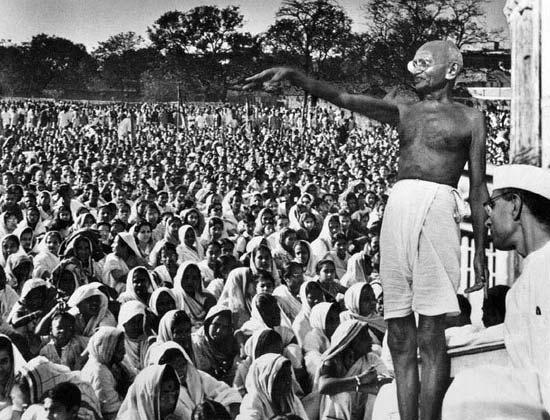
Mahatma Gandhi addresses Indians; image from Bins Corner, probably public domain

Mahatma Gandhi addresses Indians

An end: Hindu extremist Nathuram Godse shot and killed Mohandas K. Gandhi in India, on January 30, 1948.  Gandhi was known as “Mahatma,” which means “Great Soul.”  Gandhi campaigned for India’s independence and end of British colonial rule for most of the 1920s, including a period of time in prison for subversive activities.  Gandhi’s great contribution to political change is the massive use of non-violent, non-cooperation.  Non-violent tactics tend to highlight the moral positions of groups in conflict, and make the non-violent side appear to have the stronger case.  Such tactics expose hypocrisy and despotic government rules.  Though he resigned from his political party in 1934, Gandhi remained a key icon of the drive for India’s independence.  When violence broke out over the Mountbatten plan to grant independence in 1947, creating two nations of Pakistan and India divided along religious, Gandhi again appealed for peace, but became the most famous victim of the religious violence that still roils the region today.  Committed to peace and non-violence, Gandhi himself did not ever win the Nobel Peace Prize, perhaps because his life was cut short.  His work inspired other Nobel Peace laureates, including the Rev. Dr. Martin Luther King, Jr. (1964), the Dalai Lama (1989), Aung San Suu Kyi (1991), Nelson Mandela (with Frederik Willem deKlerk, 1993), and U.S. President Barack Obama (2009).

On January 30, 2011, when I first noted these coincidences here, much of the world held its breath, watching events in North Africa, including especially Tunisia and Egypt.  I wondered, which of these traditions would that day follow, to peace, or toward war?

On January 30, 2017, the installation of Hitler and the Tet Offensive remind us of hubris of world leaders and really bad decisions that can have disastrous results, soon, and for a long time after.

Coincidence? What do you think?


49 years ago, “Penetration however slight”: Remembering a good and noble hoax – the U.S.S. Pueblo

January 23, 2017

Official US Navy photograph of the U.S.S. Pueblo, taken shortly after it went into service as the AGER-2 intelligence gathering ship on May 13, 1967. Crypto Museum image.

Official US Navy photograph of the U.S.S. Pueblo, taken shortly after it went into service as the AGER-2 intelligence gathering ship on May 13, 1967. Crypto Museum image.

January 23 is the anniversary of the North Koreans‘ capture of the spy boat, U.S.S. Pueblo, in 1968 — a beginning of a momentous year for bad events.  The saga of the Pueblo and its crew, including especially Cmdr. Lloyd Bucher, is of special interest to me because it features a series of some of the grandest, best and most humorously-American hoaxes ever perpetrated by imprisoned people against their captors and wardens.  This is one of the great Kilroy stories of American history.  It should not be forgotten.  Especially with the role North Korea plays in contemporary angst, the Pueblo episode should not be forgotten. This is an encore post, with new links added.

1968 brought one chunk of bad news after another to Americans. The year seemed to be one long, increasingly bad disaster. In several ways it was the mark of the times between the feel-good, post-war Eisenhower administration and the feel-good-despite-the-Cold-War Reagan administration. 1968 was depressing.

Lloyd M. Bucher

USN Cmdr. Lloyd M. Bucher (Photo credit: Wikipedia)

What was so bad?

  • Vietnam manifested itself as a quagmire. Just when Washington politicians predicted an end in sight, Vietcong militia launched a nationwide attack in South Vietnam on the Vietnamese New Year holiday, Tet, at the end of January.
  • Civil rights gains stalled, and civil rights leaders came out in opposition to the Vietnam war.
  • President Johnson fared poorly in the New Hampshire primary election, and eventually dropped out of the race for the presidency (claiming he needed to devote time to making peace in Vietnam).
  • Labor troubles roiled throughout the U.S., including a nasty strike by garbage collectors in Memphis. It didn’t help to settle the strike that the sanitation workers were almost 100% African American, the leadership of Memphis was almost 100% white, and race relations in the city were not so good as they might have been – the strike attracted the efforts of the Southern Christian Leadership Conference, and Martin Luther King, Jr. – who was assassinated there in early April. In response, riots broke out in 150 American cities.
  • Two months later, in June, with the Vietnam War as a very divisive issue, the presidential campaign was marked by great distress of voters and increasing polarization. Sen. Robert F. Kennedy appeared to pull into the lead when he won the California primary in June, but he was assassinated that night.
  • Tens of thousands of anti-war protestors, angry at President Johnson, showed up at the Democratic National Convention in Chicago – with Johnson out of the race, the protests were essentially for show. Mayor Richard J. Daley took offense at the protestors, and Chicago policemen, who considered themselves the political opposites of the shaggy-haired protestors, attacked the protestors with clubs and tear gas. A national commission later called it a “police riot.”
  • Apart from Chicago, and the post-King assassination riots, America saw eight other massive riots in cities across the nation; riots also occurred around the world, notably in Paris, France.
  • Vice President Hubert Humphrey could not make his opposition to the Vietnam War known soon enough or broadly enough, and had a tough campaign against Republican, former Vice President Richard Nixon, who promised that he had a “secret” peace plan for Vietnam. Nixon won in a squeaker. Nixon had no secret peace plan.

At the end of the year, the U.S. got a feel-good story out of the Apollo Project, when NASA launched Apollo 8, which orbited the Moon on Christmas Eve. But when people remember 1968, it’s the strife most recall first.

Throughout 1968, there was the continuing sore of Americans held captive by the Republic of North Korea.

Commander Lloyd M. Bucher and the men of the U.S.S. Pueblo were captured by a superior force of North Korean gunboats on January 23, 1968, a few days before the Tet Offensive. Their capture and 11 months of captivity were a trial for the 84 men, and an embarrassment for the U.S.

Tortured and unable to effect an escape, Bucher and his men did the next best thing: They played hoaxes that made the North Koreans look silly.

Among other things, Cmdr. Bucher had signed a confession demanded (by torture) by North Korea. When news of this confession was revealed in the western press, observers were concerned that a U.S. citizen would succumb to making what was regarded as a false confession, but a coup for communist totalitarians. The texts of the confessions and other material from the captives, however, revealed something quite different. The confessions were written or edited largely by Bucher and the crew, and to an American with any familiarity with popular culture, they were hilarious.

My recollection was that at least one of the confessions was that the Pueblo had indeed penetrated North Korean territorial waters, but it was phrased to make it sound like the definition of rape offered in the Uniform Code of Military Justice (UCMJ). I could not find any record of that confession on the internet.

At some length, I succeeded in getting a copy of the out-of-print autobiography of Cmdr. Bucher, to check my memory of the confessions. The book is out of print. I found a couple of copies at a used book vendor, very inexpensive, through Amazon.com. However, shortly after ordering the books, I was informed by both the Post Office and the vendor that the books had been destroyed by sorting machinery. Fortunately, they had been shipped separately, and one finally arrived.

Unfortunately, the “Final, final confession” does not contain what I recall. However, the book revealed that after the writing of the “Final, final,” Bucher’s crew was asked to write more – apologies to the people of North Korea, and other propaganda documents. It was in those documents that the text I recalled, appeared.

2008 marks 40 years since that terrible year, 40 years since the Pueblo incident. For the sake of posterity, and to aid your lesson plans, here is the part of the confessions I recall which has not been available lately.

Bucher: My Story, Commander Lloyd M. Bucher, USN, with Mark Rascovich, Doubleday 1970, Dell 1971; p. 342

We did in fact get away with a composition that matched my Final, Final Confession for brazen kidding of the KORCOMS, and which far surpassed it in subtlety. Blended into the standard Communist verbosity were such lines of our own as:

“We, as conscientious human beings who were cast upon the rocks and shoals of immorality by the tidal waves of Washington’s naughty policies know that neither the frequency nor the distances of these transgressions into the territorial waters of this sovereign peace-loving nation matter because penetration however slight is sufficient to complete the act.” (Rocks and Shoals is Navy slang for the Uniform Code of Military Justice and the last line contains the essential definition of rape.)

This was both delivered over film and TV and published in the “Ping-pong Times.” The Glorious General was well pleased and set the same team to working on the next letter.

North Korea was anxious to cash in on the propaganda opportunities of the confessions and other material, and spread these documents as far as their naïve public relations offices could. Eventually, in late November or early December, a photograph of the captives, intended to show them healthy and having a good time, was distributed to newspapers. In the photo, the crew were shown smiling on a basketball court, holding a basketball, with a few of their North Korean guards. The photo was not published widely in the United States, however, because almost to a man, the crew were displaying what they had told the North Koreans was a Hawaiian good luck symbol – extended middle fingers. U.S. papers thought the photo inappropriate. European papers published it, however, and eventually Time Magazine ran the photo, with an explanation.

When news got back to Pyong Yang that the North Koreans had been hoaxed, the North Koreans instituted a week of beatings and torture. Within a couple of weeks, however, the North Koreans handed over the crew back to the U.S., at Panmunjon. U.S. officials were convinced that their signing an insincere confession got the Pueblo crew released. Anyone who ever read O. Henry’s Ransom of Red Chief suspected the North Koreans got the crew out of North Korea before the crew could hoax the government completely away.

Fortunately, Lloyd Bucher and the crew of the Pueblo did not follow H. L. Mencken’s advice after the Fillmore Bathtub hoax, and swear off hoaxes completely.

Sadly, the Navy brought charges against Bucher for having failed to avoid capture. The heroes welcome the crew should have gotten, never happened. In months of litigation in Navy courtrooms, the brilliance of the resistance of the crew of the Pueblo was lost, and forgotten. Bucher was cleared, but his reputation was never the same. Officially, the tale of the Pueblo crew is not celebrated.

In an era when hoaxes generally aid and abet the works of scoundrels, crooks and traitors, we should pause for a short time to remember when brave American sailors used hoaxes to let their nation know they were alive and resisting, and to embarrass their captors. It was a sterling show of American spirit, and humor.

We need more shows of American spirit and humor.

More:  

USS Pueblo after captured by North Korea, from...

USS Pueblo after being captured by North Korea, from A-12 spyplane Photo: Wikipedia

Good news update: Much more information on the Pueblo incident is available online now, than when I first wrote about it in 2008. Still no celebrations.

Yes, this is mostly an encore post. Fighting ignorance requires patience.

Yes, this is mostly an encore post. Fighting ignorance requires patience.

Save

Save

Save

Save


January 19 birthday olla podrida, 2017

January 19, 2017

Pick your cause for celebration — interesting list of birthday people for January 19:

Seems odd to me to think of Dolly Parton as younger than Janis Joplin, or the same age as Linda Ronstadt.  But Parton was a star by the age of 14.

Irritates me still that Baltimore hasn’t figured out a good way to fund the Edgar Allan Poe House there (National Park Service maintains Poe’s Philadelphia home). Enough funding came in to keep the Baltimore house open on weekends, in 2014. In a city with an NFL team named after his most famous poem,  could they just pass a hat at a couple of games, asking each fan to throw in $1.00?  Or pass the hat in the Ravens locker room?

Who else did we miss on birthday wishes today?

Linda Ronstadt & Emmylou Harris

Dolly Parton’s friends and Trio fellows, Linda Rondstadt and Emmy Lou Harris, in a celebratory mood – Image by armadilo60 via Flickr

Yes, this is mostly an encore post. Fighting ignorance requires patience.

Yes, this is mostly an encore post. Fighting ignorance requires patience.

Save

Save


January 16, 2017: Religious Freedom Day in the USA

January 16, 2017

Interesting timing in 2017, falling on the Martin Luther King, Jr., holiday:  January 16 is Religious Freedom Day in the U.S.  Not a holiday (sadly), Religious Freedom Day commemorates the heritage of religious freedom in the U.S.

Thomas Jefferson statue in Charlottesville, Virginia, by Computer Guy. CC license.

January 16 is the anniversary of the adoption of the Virginia Statute of Religious Freedom in 1786.  Thomas Jefferson drafted the law in 1779, in his work to create a body of new laws suitable for a new republic based on freedom.  After the Treaty of Paris ended the American Revolutionary War in 1783, the 13 independent states in America continued in a difficult federation.  Patrick Henry in Virginia proposed in 1785 to roll back part of the Virginia Bill of Rights, and reestablish government paychecks to the clergy — partly to fund educated people in towns who could organize schools  in their non-preaching hours, but partly to reestablish the church in government.  Fellow legislator James Madison managed to delay consideration of the bill, urging such important matters needed time to develop public support.

Madison had other ideas.  He composed a petition eventually signed by thousands of Virginians, the Memorial and Remonstrance, defending religious freedom and stating the necessity of separating church and state to preserve religious freedom.  When the legislature reconvened in 1786, Henry had moved on to another term as governor; the legislature rejected Henry’s proposal and instead took up the bill Jefferson proposed earlier, and passed it.

The Virginia Statute for Religious Freedom remains in effect, unaltered, today.  It is generally regarded as the best statement on separation of state and church in law.  Within a year Madison was shepherding the construction of a new charter for the 13 American states that would become the Constitution; and in 1789, Madison proposed a much-refined religious freedom amendment to the U.S. Constitution, which was ratified as the First Amendment in 1791.

Every January 16, we honor the work of defenders of religious freedom, Thomas Jefferson, James Madison, the Virginia Assembly, and all who work today to keep religious freedom alive.

President Barack Obama issued a proclamation for Religious Freedom Day:

RELIGIOUS FREEDOM DAY, 2017

– – – – – – –

BY THE PRESIDENT OF THE UNITED STATES OF AMERICA

A PROCLAMATION

Believing that “Almighty God hath created the mind free,” Thomas Jefferson authored the Virginia Statute for Religious Freedom after our young Nation declared its independence. This idea of religious liberty later became a foundation for the First Amendment, which begins by stating that “Congress shall make no law respecting an establishment of religion, or prohibiting the free exercise thereof…” On Religious Freedom Day, we rededicate ourselves to defending these fundamental principles, pay tribute to the many ways women and men of different religious and non-religious backgrounds have shaped America’s narrative, and resolve to continue forging a future in which all people are able to practice their faiths freely or not practice at all.

Religious freedom is a principle based not on shared ancestry, culture, ethnicity, or faith but on a shared commitment to liberty — and it lies at the very heart of who we are as Americans. As a Nation, our strength comes from our diversity, and we must be unified in our commitment to protecting the freedoms of conscience and religious belief and the freedom to live our lives according to them. Religious freedom safeguards religion, allowing us to flourish as one of the most religious countries on Earth, but it also strengthens our Nation as a whole. Brave men and women of faith have challenged our conscience and brought us closer to our founding ideals, from the abolition of slavery to the expansion of civil rights and workers’ rights. And throughout our history, faith communities have helped uphold these values by joining in efforts to help those in need — rallying in the face of tragedy and providing care or shelter in times of disaster.

As they built this country, our Founders understood that religion helps strengthen our Nation when it is not an extension of the State. And because our Government does not sponsor a religion — nor pressure anyone to practice a particular faith or any faith at all — we have a culture that aims to ensure people of all backgrounds and beliefs can freely and proudly worship without fear or coercion. Yet in 2015, nearly 20 percent of hate crime victims in America were targeted because of religious bias. That is unacceptable — and as Americans, we have an obligation to do better.

If we are to defend religious freedom, we must remember that when any religious group is targeted, we all have a responsibility to speak up. At times when some try to divide us along religious lines, it is imperative that we recall the common humanity we share — and reject a politics that seeks to manipulate, prejudice, or bias, and that targets people because of religion. Part of being American means guarding against bigotry and speaking out on behalf of others, no matter their background or belief — whether they are wearing a hijab or a baseball cap, a yarmulke or a cowboy hat.

Today, we must also remember those outside the United States who are persecuted for their faith or beliefs, including those who have lost their lives in attacks on sacred places. Religious liberty is more than a cornerstone of American life — it is a universal and inalienable right — and as members of a global community, we must strive to ensure that all people can enjoy that right in peace and security. That is why my Administration has worked with coalitions around the globe to end discrimination against religious minorities, protect vulnerable communities, and promote religious freedom for all. We have also worked to ensure that those who are persecuted for their religious beliefs can find safety and a new home in the United States and elsewhere.

America has changed a great deal since Thomas Jefferson first drafted the Virginia Statute for Religious Freedom, but religious liberty is a right we must never stop striving to uphold. Today, let us work to protect that precious right and ensure all people are able to go about their day in safety and with dignity — without living in fear of violence or intimidation — in our time and for generations to come.

NOW, THEREFORE, I, BARACK OBAMA, President of the United States of America, by virtue of the authority vested in me by the Constitution and the laws of the United States, do hereby proclaim January 16, 2017, as Religious Freedom Day. I call on all Americans to commemorate this day with events and activities that teach us about this critical foundation of our Nation’s liberty, and that show us how we can protect it for future generations at home and around the world.

IN WITNESS WHEREOF, I have hereunto set my hand this thirteenth day of January, in the year of our Lord two thousand seventeen, and of the Independence of the United States of America the two hundred and forty-first.

BARACK OBAMA

More: 


Fly your flag today for the 2017 holiday honoring Rev. Martin Luther King, Jr.

January 16, 2017

As on every federal holiday, citizens and residents of the U.S. should fly their U.S. flags today, on the holiday marking the birth of the Rev. Dr. Martin Luther King, Jr.

Rev. King, and the U.S. flag

Rev. King, and the U.S. flag. (No information on place or time of photo; please feel free to lend light and facts.)

Fly the U.S. flag today for the holiday for the birthday of Martin Luther King, Jr.  The holiday is celebrated on the third Monday in January.

King’s actual birthday is January 15. You could have flown your flag then, too — many Americans fly flags all weekend.

Many Americans will celebrate with a day of service. Perhaps you will, too.

In 2017, days before the inauguration of a new president, remembering and honoring the life and struggles of Martin Luther King, Jr., and serving others in real and symbolic ways, is more important than ever.

More:

The Martin Luther King, Jr. Memorial in Washington, D.C. Credit: architecture.about.com, via Saporta Report

The Martin Luther King, Jr. Memorial in Washington, D.C. Credit: architecture.about.com, via Saporta Report

Save


January 9, 2017 – Connecticut flies U.S. flags for statehood

January 9, 2017

Carol Highsmith photo of Connecticut's Hall of Flags

Love this photo: Hall of Flags in the Connecticut State Capitol Building; photo by the great photo-historian Carol Highsmith, from the Library of Congress collection; the statue is Connecticut’s Civil War Governor, William A. Buckingham (1804-1875), honored for his personal contributions to the equipping of Connecticut’s men fighting in the Civil War.

Technically, states didn’t exist at all, yet.

But on January 9, 1788, Connecticut became the fifth of the 13 colonies to ratify the proposed Constitution for the United States of America, and by that action set the date we count as Connecticut’s entery into the union.

Within 12 months, four more colonies ratified the document, totaling nine ratifications required to put the Constitution into effect.  When the government of the new nation started functioning in 1789, Connecticut was counted as the fifth state.

Connecticut capitol building, Hartford

Capitol building for Connecticut in Hartford; this photo is from the rear of the building, so the U.S. flag is flying correctly on its own right. The building was completed in 1878. The dome is covered in gold. Image from Wikimedia Commons

To avoid political scheming by anti-federalist colony governors, especially Patrick Henry in Virginia, in September 1787 James Madison proposed that the draft constitution be ratified not by legislatures in the colonies, but instead by a specially-called convention of the people of the colony.  Connecticut’s convention met first on January 3, 1788. With six days of discussion and debate, the convention passed a resolution of ratification on January 9.

So by tradition, January 9 is Connecticut’s statehood anniversary.  According to U.S. law, the Flag Code and tradition, citizens and residents of a state fly their flags on statehood anniversaries.

Happy birthday Connecticut, 228 years old.

Next date to fly the U.S. flag is January 16, 2016, to honor the birth of the Rev. Dr. Martin Luther King, Jr. January 16 is the official holiday; January 19 is the actual birthday. You may fly your colors on both dates.

More:


Quote of the Trump administration? “What’s the Constitution between friends?”

January 8, 2017

Timothy J. Campbell, Congressman from New York; photo from Mathew Brady negative circa 1870; Library of Congress, Prints and Photographs Division, http://www.loc.gov/pictures/item/2005691716/

Timothy J. Campbell, Congressman from New York; photo from Mathew Brady negative circa 1870; Library of Congress, Prints and Photographs Division, http://www.loc.gov/pictures/item/2005691716/

What’s the Constitution between friends?

–Timothy J. Campbell (1840-1904), Attributed, circa 1885

A little more below the fold? Certainly. Read the rest of this entry »