A sermon remembering Millard Fillmore’s second wife

March 18, 2014

This was delivered in January.  My search engines found it just a couple days ago, a story about a sermon featuring Millard Fillmore and his second wife, Caroline.

Interesting.  From the Newnan Times-Herald in the suburbs of Atlanta, Georgia:

Almost forgotten president focus at service

Millard Fillmore's second wife, Caroline, and Fillmore's official White House portrait.


Millard Fillmore was president for a few difficult years a decade before the Civil War split the nation into.

He is almost forgotten by most Americans today. When remembered, Fillmore is often the punchline of a joke — he is often erroneously remembered as the first president to have a bathtub in the White House.

Fillmore and his wife, Caroline, however, were points of beginning for a recent sermon at Allen-Lee Memorial United Methodist Church in Lone Oak. Winston Skinner, a member of the church and a staff member at The Newnan Times-Herald who has a great love for history, brought the message.

Skinner was a pastor for more than 24 years and often used events from history as touchstones for sermons and special services. Chad Hill, Allen-Lee’s pastor, asked Skinner to preach on Jan. 12.

“This sermon idea had been rolling around in my head,” Skinner said.

Skinner, who lives in Newnan, has been interested in presidents and first ladies since he was in elementary school. “I had been reading about Caroline Fillmore, who married the former president in 1858. Upon reflection, I saw several points that ‘will preach’ in her life story,” he said.

“The Fillmores were a religious couple. Their home was known as one of clean language and living. She was Baptist. He Unitarian. When the former president had died in 1874, ministers from three different faiths preached at his funeral,” Skinner noted in his sermon.

Caroline McIntosh “was the wife of a former president, but she had never lived in the White House, never experienced the power and burden of the presidency,” Skinner preached.

“In Caroline Fillmore’s story, we find glimpses of our own. We were not there to see Jesus speak to a multitude on the hillside. We did not taste the fish and bread multiplied from a little boy’s lunch. We did not hear the noises as Lazarus, dead three days, rose from his tomb in Bethany and walked into the sunlight,” Skinner said.

“We did not experience any of that, but we who believe know the one who worked those great miracles. We know Jesus intimately. He lives in our hearts. He accompanies us each moment of our lives,” he added.

The hymns used for the service were from Ira Sankey’s Gospel Hymns, published in the 1870s. A copy of the popular hymnal was among Caroline Fillmore’s belongings offered at auction last year.

Shelia Simpson sang “Sweet Hour of Prayer” during the service.

Church members invited visitors on Jan. 12, days after Millard Fillmore’s 214th birthday. A special effort was made to contact members descendants of Coweta County’s pioneer Carmichael family who may be distantly related to Caroline Fillmore.

After the service, a display of some of Skinner’s presidential memorabilia was displayed in the church fellowship hall. There were miniature figures of presidents, coins, stamps and items autographed by four presidents’ wives — Frances Cleveland, Mary Harrison, Rosalynn Carter and Barbara Bush.

I hope there’s an electronic copy of that sermon, and I hope I can get one.


Honoring James Madison, the go-to guy, on his birthday

March 16, 2014

James Madison, the fourth President of the United States, and the Father of the Constitution, was born March 16, 1751, in the Tidewater area of Virginia.

Is it sinful that we do not celebrate his birthday with a federal holiday, fireworks, picnics and speeches and concerts?

Maybe you could fly your flag to day.  If the neighbors ask why, tell them you’re flying it for freedom on James Madison’s birthday.  They’ll say, “Oh,” and run off to Google Madison.  You will have struck a blow for the education that undergirds democracy.

A few years ago I was asked to talk about freedom to a group of freedom lovers in North Texas.  I chose to speak about James Madison’s remarkable, and too-often unremarked-upon life. Later, when I started this blog, I posted it here, with an introduction.  All of that is below, in honor of the birth of James Madison.

Did you know that Madison is the shortest man ever to have been president?  His stature is measured in freedom, not in feet and inches.

(Originally a post on July 31, 2006)

James Madison, 1783, by Charles Wilson Peale.  Library of Congress collection

James Madison, 1783, miniature by Charles Wilson Peale. Madison would have been 32. Library of Congress collection

I don’t blame students when they tell me they “hate history.”  Heaven knows, they probably have been boringly taught boring stuff.

For example, history classes study the founding of the United States. Especially under the topical restrictions imposed by standardized testing, many kids will get a short-form version of history that leaves out some of the most interesting stuff.

Who could like that?

Worse, that sort of stuff does damage to the history and the people who made it, too.

James Madison gets short shrift in the current canon, in my opinion. Madison was the fourth president, sure, and many textbooks note his role in the convention at Philadelphia that wrote the Constitution in 1787. But I think Madison’s larger career, especially his advocacy for freedom from 1776 to his death, is overlooked.

Madison was the “essential man” in the founding of the nation, in many ways. He was able to collaborate with people as few others could, in order to get things done, including his work with George Mason on the Virginia Bill of Rights, with George Washington on the Constitution and national government structure, Thomas Jefferson on the structure and preservation of freedom, Alexander Hamilton on the Constitution and national bank, and James Monroe on continuing the American Revolution.

We need to look harder at the methods and philosophy, and life, of James Madison. This is an opinion I’ve held for a long time. Below the fold I reproduce a “sermon” I delivered to the North Texas Church of Freethought in November 2001.

James Madison White House portrait, John Vanderlyn, 1816

James Madison’s official White House portrait, by John Vanderlyn in 1816; in the White House collection

I have left this exactly as it was delivered, though I would change a few things today, especially emphasizing more the key role George Washington played in pushing Madison to get the Constitution — a view I came to courtesy of the Bill of Rights Insitute and their outstanding, week-long seminar, Shaping the Constitution: A View from Mount Vernon 1783-1789. The Bill of Rights Institute provides outstanding training for teachers, and this particular session, at Washington’s home at Mount Vernon, Virginia, is well worth the time (check with the Institute to see whether it will be offered next year — and apply!). I am especially grateful to have had the opportunity to discuss these times and issues with outstanding scholars like Dr. Gordon Lloyd of Pepperdine University, Dr. Adam Tate of Morrow College, and Dr. Stuart Leibiger of LaSalle University, during my stay at Mount Vernon.

James Madison by Gilbert Stuart c. 1821

James Madison, portrait by Gilbert Stuart c. 1821; National Portrait Gallery

My presentation to the skeptics of North Texas centered around the theme of what a skeptic might give thanks for at Thanksgiving. (It is available on the web — a misspelling of my name in the program carried over to the web, which has provided me a source of amusement for several years.)

Here is the presentation:

Being Thankful For Religious Liberty

As Presented at the November, 2001 Sunday Service of The North Texas Church of Freethought

Historians rethink the past at least every generation, mining history for new insights or, at least, a new book. About the founders of this nation there has been a good deal of rethinking lately. David McCullough reminds us that John Adams really was a good guy, and that we shouldn’t think of him simply as the Federalist foil to Thomas Jefferson’s more democratic view of the world. Jefferson himself is greatly scrutinized, and perhaps out of favor — “American Sphinx,” Joseph Ellis calls him. The science of DNA testing shows that perhaps Jefferson had more to be quiet about than even he confessed in his journals. While Jefferson himself questioned his own weakness in his not freeing his slaves in his lifetime, historians and fans of Jefferson’s great writings wrestle with the likelihood of his relationship with one of his own slaves (the old Sally Hemings stories came back, and DNA indicates her children were fathered by a member of the Jefferson clan; some critics argue that Jefferson was a hypocrite, but that was Jefferson’s own criticism of himself; defenders point out that the affair most likely was consensual, but could not be openly acknowledged in Virginia at that time). Hamilton’s gift to America was a financial system capable of carrying a noble nation to great achievement, we are told – don’t think of him simply as the fellow Aaron Burr killed in a duel. Washington is recast as one of the earliest guerrilla fighters, and in one book as a typical gentleman who couldn’t control his expenses. Franklin becomes in recent books the “First American,” the model after which we are all made, somehow.

Of the major figures of these founding eras, James Madison is left out of the rethinking, at least for now. There has been no major biography of Madison for a decade or more, not since Ralph Ketcham’s book for the University of Virginia press. Madison has a role in Joseph Ellis’s Founding Brothers, but he shares his spotlight with Hamilton and Jefferson. I think this is an oversight. As we enter into the first Thanksgiving season of the 21st century, we would do well to take a look back at Madison’s life. Madison gives us a model of reason, and more important, a model of action coupled to reason. America’s founding is often depicted as a time of great thunder — if not the thunder of the lightning Ben Franklin experimented with, an experiment he parlayed into worldwide respect for Americans, it is the thunder of the pronouncements of Thomas Jefferson in the Declaration of Independence, or of George Washington, just generally thundering through history.

The use of a bolt of lightning as a symbol for this group is inspired, I think. I’m a great fan of Mark Twain, and when I see that bolt of electricity depicted I think of Twain’s observation:

“Thunder is good; thunder is impressive. But it is lightning that does the work.”

Thunder at the founding is impressive; where was the lightning?

I’d like to point out two themes that run through Madison’s life, or rather, two activities that we find him in time and again. Madison’s life was marked by periods of reflection, followed by action as a result of that reflection.

We don’t know a lot about Madison’s youth. He was the oldest son of a wealthy Virginia planter, growing up in the Orange County area of Tidewater Virginia. We know he was boarded out for schooling with good teachers – usually clergymen, but occasionally to someone with expertise in a particular subject – and we know that he won admission to Princeton to study under the Rev. John Witherspoon, a recent Presbyterian transplant from across the Atlantic. Madison broke with tradition a bit in attending an American rather than an English school. And after completing his course of study he remained at Princeton for another year to study theology directly under Witherspoon, with an eye toward becoming a preacher.

Witherspoon is often held up as an example of how religion influenced the founders, but he was much more of a rationalist than some would have us believe. He persuaded the young Madison that a career in law and politics would be a great service to the people of Virginia and America, and might be a higher calling. After a year of this reflection, Madison returned to Virginia and won election to local government.

In his role as a county official Madison traveled the area. He inspected the works of government, including the jails. He was surprised to find in jail in Virginia people accused of — gasp! — practicing adult baptism. In fact Baptists and Presbyterians were jailed on occasion, because the Anglican church was the state church of Virginia, and their practicing their faith was against the common law. This troubled Madison greatly, and it directed an important part of his work for the rest of his life. In January of 1774, Madison wrote about it to another prominent Virginian, William Bradford:

“Poverty and Luxury prevail among all sorts: Pride ignorance and Knavery among the Priesthood and Vice and Wickedness among the Laity. This is bad enough. But it is not the worst I have to tell you. That diabolical Hell conceived principle of persecution rages among some and to their eternal infamy the Clergy can furnish their Quota of Imps for such business. This vexes me the most of any thing whatever. There are at this time in the adjacent County not less than 5 or 6 well meaning men in close Gaol for publishing their religious Sentiments which in the main are very orthodox. I have neither patience to hear talk or think of any thing relative to this matter, for I have squabbled and scolded abused and ridiculed so long about it, to so little purpose that I am without common patience. So I leave you to pity me and pray for Liberty of Conscience to revive among us.”

By April, Madison’s views on the matter had been boiled down to the essences, and he wrote Bradford again more bluntly:

“Religious bondage shackles and debilitates the mind and unfits it for every noble enterprise.”

Madison must have done a fine job at his county duties, whatever they were, because in 1776 when Virginia was organizing its government to survive hostilities with England, Madison was elected to the legislative body.

Madison was 25, and still raw in Virginia politics. He was appointed to the committee headed by George Mason to review the laws and charter of the colony. Another who would serve on this committee when he was back from Philadelphia was Thomas Jefferson. George Mason was already a giant in Virginia politics, and by the time Madison got to Williamsburg, Mason had already completed much of the work on a bill of rights to undergird the new Virginia government. Madison noted that freedom of religion was not among the rights enumerated in Mason’s version — but it was too late, Mason said. The work was done.

Madison quietly went to work on Mason, in committee, over dinner, during social occasions — noting the great injustice of jailing people solely because of their beliefs, and urging to Mason that it did Virginia no good to keep these fathers from providing for their families.

Mason ultimately agreed to accept the amendment.

The pattern was set.

Perhaps a better example of this reflection and action cycle occurred nearly a decade later. By 1785 the war was over, independence was won, but the business of government continued. While serving as governor of Virginia, Thomas Jefferson had drafted about 150 proposals for laws, really a blueprint for a free government. About half of these proposals had been passed into law. By 1785, Jefferson was away from Virginia, representing the Confederation of colonies in Paris. Jefferson had provided several laws to disestablish religion in Virginia, and to separate out the functions of church and state. With Jefferson gone, however, his old nemesis Patrick Henry sought to roll back some of that work. Henry proposed to bring back state support for the clergy, for the stated purpose of promoting education. (Yes, this is the same battle we fight today for church and state separation.) After Jefferson’s troubled term as governor, Virginia turned again to Henry – Henry ultimately served six terms as governor. His proposal was set for a quick approval in the Virginia assembly. It was late in the term, and everyone wanted to get home.

Henry was, of course, a thundering orator of great note. Madison was a small man with a nervous speaking style, but a man who knew the issues better than anyone else in almost any room he could be in. Madison came up with an interesting proposal. Picking the religion for the state was serious stuff, he said. A state doesn’t want to pick the wrong religion, and get stuck with the wrong god, surely – and such weighty matters deserve widespread support and discussion, Madison said. His motion to delay Henry’s bill until the next session, in order to let the public know and approve, was agreed to handily.

You probably know the rest of this story. With a year for the state to reflect on the idea, Madison wrote up a petition on the issue, which he called a “Memorial and Remonstrance.” In the petition he laid out 15 reasons why separation of church and state was a superior form of government, concluding that in the previous 1,500 years, every marriage of church and state produced a lazy and corrupt church, and despotic government. Madison’s petition circulated everywhere, and away from Patrick Henry’s thundering orations, the people of Virginia chose Madison’s cool reason.

When the legislature reconvened in 1786, it rejected Henry’s proposal. But Madison’s petition had been so persuasive, the legislature also brought up a proposal Thomas Jefferson had made six years earlier, and passed into law the Virginia Statue for Religious Freedom.

This was a great victory for Madison, and for Virginia. He celebrated by convening a convention to settle disputes between Virginia and Maryland about navigation on the Chesapeake Bay. Having reflected on the nature of this issue — a dispute between colonies — Madison had sought advice from others having the same problems, such as New York and New Jersey. In that effort he got the support of a New Yorker working on the same problems, Alexander Hamilton. In the course of these discussions Madison thought it clear that the difficulty lay with the form of government that bound the colonies together under the Articles of Confederation. Hamilton agreed, and they got their respective states and conferences to agree to meet in Philadelphia in 1787 to try to fix those problems. [Since I first wrote this, I’ve learned that it was George Washington’s desire to get a federal government, to facilitate the settling of the Ohio River Valley where Washington had several thousands of acres to sell, that prompted him to push Madison into the Annapolis Convention, and who made the introduction between Madison and Washington’s old aide and friend, Alexander Hamilton; Madison’s work with Washington runs much deeper than I orignally saw.]

James Madison, 1792 portrait by Charles Wilson Peale, Gilcrease Museum, Tulsa

James Madison, 1792 portrait by Charles Wilson Peale, Gilcrease Museum, Tulsa

Amending the Articles of Confederation was a doomed effort, many thought. The colonies would go their separate ways, no longer bound by the need to hang together against the Parliament of England. Perhaps George Washington could have got a council together to propose a new system, but Washington had stayed out of these debates. Washington’s model for action was the Roman general Cincinnatus, who went from his plow to lead the Romans to victory, then returned to his farm, and finding his plow where he had left it, took it up again.

Madison invited Washington, and persuaded Washington to attend. Washington was elected president of the convention, and in retrospect that election guaranteed that whatever the convention produced, the colonies would pay attention to it.

You know that history, too. The convention quickly decided the Articles of Confederation were beyond repair. Instead, they wrote a new charter for a new form of government. The charter was based in part on Jefferson’s Virginia Plan, with lots of modifications. Because the Constitution resembles so much the blueprint that Jefferson had written, and because Jefferson was a great founder, many Americans believe Jefferson was a guiding light at that Philadelphia convention. It’s often good to reflect that Jefferson was in Paris the entire time. While America remembers the thunder of Washington’s presiding, Franklin’s timely contributions and Jefferson’s ideas, it was Madison who did the heavy lifting, who got Washington and Franklin to attend the meeting Madison had set up, and got Jefferson’s ideas presented and explained.

It was Madison who decided, in late August of 1787, that the convention could not hang together long enough to create a bill of rights, and instead got approval for the basic framework of the U.S. government. In Virginia a few months later, while Patrick Henry thundered against what he described as a power grab by a new government, it was Madison who assembled the coalitions that got the Constitution ratified by the Virginia ratifying convention. And when even Jefferson complained that a constitution was dangerous without a bill of rights, it was Madison who first calmed Jefferson, then promised that one of the first actions of the new government would be a bill of rights. He delivered on that promise as a Member of the House of Representatives in 1789.

It is difficult to appreciate just how deeply insinuated into the creation of America was James Madison. In big ways and small, he made America work. He took the lofty ideas of Jefferson, and made them into laws that are still on the books, unamended and unedited, more than 200 years later.

When the ratification battle was won, when Madison had won election to the House over Patrick Henry’s strong objection, partly by befriending the man Henry had picked to defeat Madison, James Monroe, Madison could have savored the moment and been assured a place in history.

James Madison in 1804, by Gilbert Stuart

James Madison in 1804, by Gilbert Stuart. Colonial Williamsburg Foundation, Williamsburg, Virginia. Gift of Mrs. George S. Robbins

That’s not what a lightning bolt does. Journeying to New York for the opening of the First Congress and the inauguration of Washington as president, Madison stopped off at Mount Vernon to visit with Washington, apparently at Washington’s request. In what was a few hours, really, Madison wrote Washington’s inaugural address. While there at Mount Vernon, Madison stumbled into a discussion by several others on their way to New York, wondering what high honorific to apply to the new president. “Excellency” was winning out over “Your highness,” until Washington turned to Madison for an opinion. Madison said the president should be called, simply, “Mr. President.” We still do.

Once in New York, Madison saw to the organizing of the Congress, then to the organizing of the inauguration. And upon hearing Washington’s inauguration address — which Madison had ghosted, remember — Congress appointed Madison to write the official Congressional response.

Years later, in Washington, Madison engineered the candidacy of Thomas Jefferson for president, and after Jefferson was elected, Madison had the dubious honor as Secretary of State of lending his name to the Supreme Court case that established the Supreme Court as the arbiter of what is Constitutional under our scheme of government, in Marbury v. Madison.

Wherever there was action needed to make this government work, it seemed, there was James Madison providing the spark.

James Madison was the lightning behind the thunder of the founding of America. We should be grateful that he lived when he did, where he did, for we all share the fruits of the freedoms he worked to obtain. And in this Thanksgiving season, let us look for appropriate ways to honor his work.

James Madison circa 1829-1839, portrait by Chester Harding.  National Portrait Gallery

James Madison, 1829, portrait by Chester Harding. National Portrait Gallery. “In 1829, Madison came out of retirement to attend a convention for revising Virginia’s constitution. While there, he posed for this portrait by the Massachusetts painter Chester Harding.”

The Madisonian model of thoughtful reflection leading to action is one that is solidly established in psychological research. It is the model for leadership taught in business schools and military academies.

I would compare religious liberty to a mighty oak tree, under which we might seek shade on a hot summer day, from which we might draw wood for our fires to warm us in winter, or lumber to build great and strong buildings. That big oak we enjoy began its life long before ours. We enjoy its shade because someone earlier planted the seed. We enjoy our freedoms today because of men like James Madison.

How do we give thanks? As we pass around the turkey to our family, our friends, we would do well to reflect on the freedoms we enjoy, and how we got them.

Finally, remembering that someone had to plant those seeds, we need to ask: What seeds must we plant now for those who will come after us? We can demonstrate our being grateful for the actions of those who came before us by giving to those who come after us, something more to be grateful for. A life like Madison’s is a rarity. Improving on the freedoms he gave us might be difficult. Preserving those freedoms seems to me a solemn duty, however. Speaking out to defend those freedoms is an almost-tangible way to thank James Madison, and as fate would have it, there is plenty of material to speak out about. A postcard to your senators and representative giving your reasoned views on the re- introduction of the Istook Amendment might be timely now – with America’s attention turned overseas for a moment, people have adopted Patrick Henry’s tactic of trying to undo religious freedom during the distraction. I have had a lot of fun, and done some good I hope, in our local school system by asking our sons’ science and biology teachers what they plan to teach about evolution. Whatever they nervously answer — and they always nervously answer that question — I tell them that I want them to cover the topic fully and completely, and if they have any opposition to that I would be pleased to lend my name to a suit demanding it be done. We might take a moment of reflection to ponder our views about a proposed Texas “moment of silence” bill to be introduced, and then let our state representatives have our thoughts on the issue.

Do you need inspiration? Turn to James Madison’s writings. In laying out his 15-point defense of religious freedom in 1785, Madison wrote that separation of church and state is essential to our form of government:

“The preservation of a free Government requires not merely, that the metes and bounds which separate each department of power be invariably maintained; but more especially that neither of them be suffered to overleap the great Barrier which defends the rights of the people.”

How can we express our gratitude for such a foundation for religious liberty? Let loose a few lightning bolts, in remembrance of Madison.

Copyright © 2001 and 2006 by Ed Darrell. You may reproduce with attribution. Links added in May 2013.

More:


Happy birthday, Albert Einstein! 135 years, today

March 14, 2014

How many ways can we say happy birthday to a great scientist born on Pi Day?  So, an encore post.

E=mcc - logo from AIP

E=energy; m=mass; c=speed of light

Happy Einstein Day! to us.  Albert’s been dead since 1955 — sadly for us.  Our celebrations now are more for our own satisfaction and curiosity, and to honor the great man — he’s beyond caring.

Almost fitting that he was born on π Day, no? I mean, is there an E=mc² Day?

Albert Einstein was born on March 14, 1879, in Ulm, Germany, to Hermann and Pauline Einstein. 26 years later, three days after his birthday, he sent off the paper on the photo-electric effect; that paper would win him the Nobel Prize in Physics in another five years, in 1921. In that same year of 1905, he published three other papers, solving the mystery of Brownian motion, describing what became known as the Special Theory of Relativity and solving the mystery of why measurements of the light did not show any effects of motion as Maxwell had predicted, and a final paper that noted a particle emitting light energy loses mass. This final paper amused Einstein because it seemed so ludicrous in its logical extension that energy and matter are really the same stuff at some fundamental point, as expressed in the equation demonstrating an enormous amount of energy stored in atoms, E=mc².

Albert Einstein as a younger man - Nobel Foundation image

Albert Einstein as a younger man – Nobel Foundation image

Any one of the papers would have been a career-capper for any physicist. Einstein dashed them off in just a few months, forever changing the fields of physics. And, you noticed: Einstein did not win a Nobel for the Special Theory of Relativity, nor for E=mc². He won it for the photo electric effect. Irony in history.

106 years later Einstein’s work affects us every day. Relativity theory at some level I don’t understand makes possible the use Global Positioning Systems (GPS), which revolutionized navigation and mundane things like land surveying and microwave dish placement. Development of nuclear power both gives us hope for an energy-rich future, and gives us fear of nuclear war. Sometimes, even the hope of the energy rich future gives us fear, as we watch and hope nuclear engineers can control the piles in nuclear power plants damaged by earthquakes and tsunami in Japan.

English: Albert Einstein on a 1966 US stamp

Albert Einstein on a 1966 US stamp (Photo credit: Wikipedia)

If Albert Einstein was a genius at physics, he was more dedicated to pacifism. He resigned his German citizenship to avoid military conscription. His pacifism made the German Nazis nervous; Einstein fled Germany in the 1930s, eventually settling in the United States. In the U.S., he was persuaded by Leo Szilard to write to President Franklin Roosevelt to suggest the U.S. start a program to develop an atomic weapon, because Germany most certainly was doing exactly that. But while urging FDR to keep up with the Germans, Einstein refused to participate in the program himself, sticking to his pacifist views. Others could, and would, design and build atomic bombs. (Maybe it’s a virus among nuclear physicists — several of those working on the Manhattan Project were pacifists, and had great difficulty reconciling the idea that the weapon they worked on to beat Germany, was deployed on Japan, which did not have a nuclear weapons program.)

English: USSR stamp dedicated to Albert Einste...

Everybody wanted to claim, and honor Einstein; USSR issued this stamp dedicated to Albert Einstein Русский: Почтовая марка СССР, посвящённая Альберту Эйнштейну (Photo credit: Wikipedia)

Einstein was a not-great father, and probably not a terribly faithful husband at first — though he did think to give his first wife, in the divorce settlement, a share of a Nobel Prize should he win it. Einstein was a good violinist, a competent sailor, an incompetent dresser, and a great character. His sister suffered a paralyzing stroke. For many months Albert spent hours a day reading to her the newspapers and books of the day, convinced that though mute and appearing unconscious, she would benefit from hearing the words. He said he did not hold to orthodox religions, but could there be a greater show of faith in human spirit?

Einstein in 1950, five years before his death

Einstein in 1950, five years before his death

When people hear clever sayings, but forget to whom the bon mots should be attributed, Einstein is one of about five candidates to whom all sorts of things are attributed, though he never said them. (Others include Lincoln, Jefferson, Mark Twain and Will Rogers). Einstein is the only scientist in that group. So, for example, we can be quite sure Einstein never claimed that compound interest was the best idea of the 20th century. This phenomenon is symbolic of the high regard people have for the man, even though so few understand what his work was, or meant.

A most interesting man. A most important body of work. He deserves more study and regard than he gets.

More, Resources:


It’s π (pi) Day, 2014!

March 14, 2014

One might wonder when a good sociologist will write that book about how our vexing and depressing times push people to extreme measures, dwelling on one particular manifestation:  The invention of new celebrations on the calendar.

In my lifetime Halloween grew from one short dress-up night with candy for kids, to a major commercially-exploited festival, from an interesting social event to a religiously-fraught night of bacchanalia with a weeks-long buildup.  Cinco de Mayo grew into a festival of all things Mexican, though very few people can explain what the day commemorates, even among our Mexican neighbors.  (No, it’s not Mexico’s Independence Day.)

St. Patrick’s Day grew in stature, and Guinness products now are freely available in almost every state.  Bastille Day gets a celebration even in Oak Cliff, Texas.  I’ve pushed Hubble Day, and Feynman Day; this weekend I’ll encourage people to celebrate James Madison’s birthday — and in January, I encourage the commemoration of Millard Fillmore’s birthday.

It could be a fun book, if not intellectually deep.

It will explain why, on Einstein’s birthday, March 14, we celebrate the number π (pi).

That book has not been written down, yet.  So we’re left simply to celebrate.

Down in Austin, at SXSW, some performance artist used the sky as his canvas on π Day Eve; The Austin American-Statesman captured it:

Caption from the Austin American-Statesman: Austin American-Statesman  Tomorrow is pi day, aka March 14, aka 3.14 - which is why mathematical pi was spelled out in a circle over Austin today (Friday isn't supposed to be as good of a day for skywriting)

Caption from the Austin American-Statesman: Austin American-Statesman Tomorrow is pi day, aka March 14, aka 3.14 – which is why mathematical pi was spelled out in a circle over Austin today (Friday isn’t supposed to be as good of a day for skywriting)

Read more about San Francisco-based artist ISHKY’s project on MyStatesman: http://atxne.ws/1cWLF1e

Photo by Austin Humphreys / Austin American-Statesman — with Joseph Lawrence Cantu.

There’s too much good stuff, on Einstein and on pi, for one post.

Happy pi Day!

Here’s to Albert Einstein, wherever you are!

More:

A photo at Life in a Pecan Guild caught a much more informative photograph of the Austin skywriting:

Each letter, and digits (yes, they printed pi in the Sky!) was formed by five airplanes flying in formation.  Wow. Just wow. Photo at Life in a Pecan Guild.

Each letter, and digit (yes, they printed pi in the Sky!) was formed by five airplanes flying in formation. Wow. Just wow. Photo at Life in a Pecan Guild. (Go there for more photos.)

There will be some great photos of that Austin skywriting, I predict.  Will you point them out to us, in comments?


Nathan Bigelow on Woodrow Wilson, TODAY (March 5), at Austin College

March 5, 2014

Too late for most of us, but history teachers near Sherman, Texas, ought to zip out as soon as school is out this afternoon, and head over to Austin College.

From North Texas e-News:

Nathan Bigelow, Professor of Political Science at Austin College in Sherman, Texas; Bigelow will present

Nathan Bigelow, Professor of Political Science at Austin College in Sherman, Texas; Bigelow will present “The Evolving Political Thought of Professor [Woodrow] Wilson,” March 5, 2014.

Bigelow to share insight on political evolution of Woodrow Wilson

SHERMAN, TEXAS — Nathan Bigelow, Austin College associate professor of political science and chair of the Department of Political Science, will present “The Evolving Political Thought of Professor Wilson” on March 5 at 4:30 p.m. in Wright Campus Center, Room 231. A 4 p.m. reception in nearby Johnson Gallery precedes his presentation, which highlights his recent sabbatical study. The event, free and open to the public, is hosted by the Johnson Center for Faculty Development and Excellence in Teaching.

Bigelow said his talk will focus on the bookends of Woodrow Wilson’s academic career: Congressional Government (1880), in which he made a broad critique of the American constitutional system, and Constitutional Government (1908), written just before he left academia for a career in politics, in which he reassessed many of his original positions. “I contend that his evolving thought can be traced to changes in the political environment during this time – specifically, increased party discipline and invigorated presidential leadership,” Bigelow said.” I will use newly available quantitative measures of this time period to help support my argument.”

The Robert and Joyce Johnson Center for Faculty Development and Excellence in Teaching, is directed by Bernice Melvin, Margaret Root Brown Chair of Foreign Languages and Literatures and professor of French. Within the mission of the center is the encouragement of ‘bold exploration of intellectual frontiers” and “fostering lively intellectual dialogue within and across academic disciplines.”

Austin College is a leading national independent liberal arts college located north of Dallas in Sherman, Texas. Founded in 1849, making it the oldest institution of higher education in Texas operating under original charter and name, the college is related by covenant to the Presbyterian Church (USA). Recognized nationally for academic excellence in the areas of international education, pre-professional training, and leadership studies, Austin College is one of 40 schools profiled in Loren Pope’s influential book Colleges That Change Lives.

Texas history and social studies teachers have been working to bolster teaching of the Progressive Era, Imperialism, and important figures of those times including Woodrow Wilson, after testing indicated Texas students are too often unfamiliar with the times and events.  Sherman area history teachers are lucky to have this close by.

I’ve been unable to discover whether professional education credit will be offered.


Can dog whistle politics keep the GOP in power, or is America too smart to stay enthralled?

March 2, 2014

Especially if, by some grotesque misunderstanding, you don’t think you’re in the 47% Mitt Romney wrote off as undeserving of a vote and a life, you ought to listen to Ian Haney López describe what’s going on in GOP and conservative politics.

From Bill Moyers.

Transcript here.

Cover of Ian Haney Lopez's Dog Whistle Politics, How coded racial appeals reinvented racism and wrecked the middle class; Oxford Books

Cover of Ian Haney Lopez’s Dog Whistle Politics, How coded racial appeals reinvented racism and wrecked the middle class; Oxford Books

Moyers’s website describes this interview:

Ian Haney López on the Dog Whistle Politics of Race

February 28, 2014

What do Cadillac-driving “welfare queens,” a “food stamp president” and the “lazy, dependent and entitled” 47 percent tell us about post-racial America? They’re all examples of a type of coded racism that this week’s guest, Ian Haney López, writes about in his new book, Dog Whistle Politics.

Haney López is an expert in how racism has evolved in America since the civil rights era. Over the past 50 years, politicians have mastered the use of dog whistles – code words that turn Americans against each other while turning the country over to plutocrats. This political tactic, says Haney López, is “the dark magic” by which middle-class voters have been seduced to vote against their own economic interests.

“It comes out of a desire to win votes. And in that sense… It’s racism as a strategy. It’s cold, it’s calculating, it’s considered,” Haney López tells Bill, “it’s the decision to achieve one’s own ends, here winning votes, by stirring racial animosity.”

Ian Haney López, a professor of law at the University of California, Berkeley, is a senior fellow at the policy analysis and advocacy group, Demos.

Producer: Candace White. Segment Producer: Robert Booth. Editor: Sikay Tang.

Does revealing the existence of dog whistles help kill the cheap trick?  My fear is that those who hear the whistle clearly understand that they are responding to a racist call, and that is why they respond.  Exposing the racism, or exposing the subtle use of racism, only makes the politicians who use the whistle more appealing to those voter segments, and those policies more appealing to those voters (though they would not admit it).

If you think dog whistles don’t exist, consider the hot controversies surrounding education spending, vouchers to kill public schools, immigration reform needed to boost our economy, or health care reform.  Consider also the birther movement.

After hearing Mr. Haney López’s interview, what do you think?

More: 


Another hoax goes viral: No, Volkswagen is NOT closing Chattanooga plant

March 2, 2014

U.S. flag flies at a United Auto Workers  union hall (UAW).  Reuters photo, via The Economist

U.S. flag flies at a United Auto Workers union hall (UAW). Reuters photo, via The Economist

No, Volkswagen did not announce that it will pull out of Tennessee and close its billion-dollar automaking plant in Chattanooga. Those reports are based on a hoax.

Most people understand anything that comes from The Onion is parody at best, bad hoax at worst. It took me a while to catch on to The Daily Currant, another hoax site on the internet.

How long will it take others to catch on to the fact that “National Report” is a nasty hoax site, and nothing reported there can be taken at face value, since most of it is completely false?

National Report put up a parody post, quoting real statements from real people, but with a lead claiming Volkswagen decided to close down the Chattanooga plant.  Within a week or so, it had 63,000 shares on Facebook.

I started seeing the reports on Twitter last week, but they’ve been buzzing around for a few a while, since the union vote at the Chattanooga VW plant.  Here’s the earliest I found:

Union leaders in Europe, accustomed to good relationships with management and looking out for workers, announced they might oppose further expansion of VW in the American south without unionization — but that’s the closest real news comes to what “National Report” claims.

“Unfair labor praxis?”  What sorts of clues must a parody site drop before people start seeing through the hoax? Check out the author’s bio-line, while you’re at it.

Could we hope for a little bit of skepticism?  After the contentious, national headline-making union vote at the Chattanooga plant, wouldn’t it make sense that an announcement the plant would close, would also make headlines? But check the Chattanooga News-Free Press.  Stories there are about moving on, in Chattanooga, after the VW vote.

Nothing about closing the plant, from the newspaper that would surely be all over such a story. Or, check Volkswagen’s corporate website in the U.S. — closing their only U.S. plant would merit some mention there, don’t you think? What do we see:

Feb 21, 2014 VOLKSWAGEN GROUP SEEKS TO ACQUIRE ALL SHARES OF SCANIA

  • Volkswagen Group today resolved to make a voluntary tender offer of SEK 200 (approx. €22.26) per share to the shareholders of Scania Aktiebolag (“Scania”) for all Scania A and Scania B shares

Feb 21, 2014 ANDREAS RENSCHLER NAMED BOARD OF MANAGEMENT MEMBER FOR COMMERCIAL VEHICLES AT VOLKSWAGEN GROUP

  • At its meeting today, the Supervisory Board of Volkswagen Group appointed Andreas Renschler (55) as member of the Board of Management with responsibility for Commercial Vehicles effective February…

Feb 21, 2014 VOLKSWAGEN REPORTS SUCCESSFUL FISCAL YEAR 2013

  • With sales revenue of EUR 197.0 billion (previous year: EUR 192.7 billion), the Group’s operating profit of EUR 11.7 billion (EUR 11.5 billion) exceeded the record prior-year figure.

Feb 14, 2014 VOLKSWAGEN CHATTANOOGA EMPLOYEES VOTE AGAINST UNION REPRESENTATION

  • Volkswagen Chattanooga employees have voted in a secret ballot election against United Auto Workers (UAW) representation.

Nothing there. Google it, Bing! it, Yahoo! it, search on Twitter or Facebook, you’ll find repeats of the hoax story, but zero confirmation from any authoritative or official source, and no mentions on mainstream media who don’t deal in hoaxes. So, can we knock off the harmful hoax recirculation?

VW is in Chattanooga to stay.  VW built a $1 billion dollar, energy-efficient, state-of-the-car-making-art plant to use U.S. parts to make Volkswagens for sale in the Americas. VW is proud of it: “First and only LEED Platinum certified Auto Plant worldwide. LEED Platinum certified Volkswagen Academy.”  That’s not the sort of investment a company walks away from unless in extremis — and VW is doing okay.

VW may be troubled.  Their kanben manufacturing methods require active participation of the workers, and generally such a system works better when the workers are organized.  The Washington Post noted shortly before the vote:

If a majority of Volkswagen’s 1,570 hourly workers vote yes, it would mark the first time in nearly three decades of trying that the UAW has successfully organized a plant for a foreign brand in the United States. This time, the union has a powerful ally: Volkswagen itself, which is hoping the union will collaborate in a German-style “works council” and help manage plant operations.

Voting against a union, then, was a bit of a poke in the eye of management of Volkswagen in Chattanooga.  But it was also a poke in the eye the United Auto Workers and unions in the U.S., and conservatives are not disinclined to take a shot at friends, or work against the interests of the U.S., if they can take a shot at unions.  Tennessee conservatives like Sen. Bob Corker have sworn allegiance away from the U.S. already, promising never to increase taxes regardless how badly the nation might need it (consider how such a pledge would have crippled the U.S. in fighting either of the two world wars). So Republican elected officials let their hatred of unions overcome their love of economic development, Tennessee and the U.S. — and they interfered in the election trying to tilt it against the union, Volkswagen be damned.

But close the plant?  No.

Where does such a wild, and inflammatory story come from?

We’ve discussed “National Report” hoaxes here at Millard Fillmore’s Bathtub before.

This is just one more complete falsehood, designed to get people worked up unnecessarily and snare the unwary.  National Report created the hoax almost whole cloth, duping many by offering real quotes from real people, which do not say what the headline claims.

Do false reports cause any damage?  Sometimes.  Consider this: Tennessee U.S. Sen. Bob Corker promised VW would announce plant expansion in Tennessee almost immediately, if the workers rejected the union.  Oops.  Hasn’t happened.

What else did Corker fib about? Why are so many people giving credence to National Report, an admitted fib site?

More:

Caption from Nashville Tennessean: Sen. Bob Corker speaks to reporters in Chattanooga, Tenn., Saturday, Feb. 15, 2014, about the defeat of the United Auto Workers in a three-day election at the Volkswagen plant in the city. The multiyear effort to organize Volkswagen's only U.S. plant was defeated on a 712-626 vote Friday night amid heavy campaigning on both sides. (AP Photo/Erik Schelzig) / AP

Master hoaxer? Sen. Bob Corker, R-Tennessee, promised VW workers the company would announce an expansion in Chattanooga “within two weeks” if the unionization vote failed. March 1 marked the end of that two-week period. Caption from Nashville Tennessean: Sen. Bob Corker speaks to reporters in Chattanooga, Tenn., Saturday, Feb. 15, 2014, about the defeat of the United Auto Workers in a three-day election at the Volkswagen plant in the city. The multiyear effort to organize Volkswagen’s only U.S. plant was defeated on a 712-626 vote Friday night amid heavy campaigning on both sides. (AP Photo/Erik Schelzig) / AP


Texas Independence Day, March 2 – fly your Texas flag today

March 2, 2014

Texans writing the Texas Declaration of Independence, 1836

In a meeting hall at Washington-on-the-Brazos, Texans meet to write the Texas Declaration of Independence, released March 2, 1836; image from Portal to Texas History

So, put some barbecue in the smoker, get a Shiner for you and your pet armadillo, sit back and enjoy the holiday.  If you’re near Washington-on-the-Brazos, go to the ceremony.  You’d better be sure you’ve got plenty of Blue Bell Ice Cream.

What?  You don’t get the day off?  You know, Texas schools don’t even take the day off any more.  (In 2014, of course, it’s a Sunday.)

I thought things were going to change when the Tea Party got to Austin and Washington?  What happened?

For Texas Independence Day, it’s appropriate to fly your U.S. flag — or your Texas flag, if you have one.

Original Manuscript, Texas Declaration of Independence - Texas State Library and Archives Commission

Original Manuscript, Texas Declaration of Independence, page 1 – Texas State Library and Archives Commission

Text from the image above:

The Unanimous
Declaration of Independence
made by the
Delegates of the People of Texas
in General Convention
at the Town of Washington
on the 2nd day of March 1836

When a government has ceased
to protect the lives, liberty and property
of the people, from whom its legitimate
powers are derived, and for the advance-
ment of whose happiness it was inst-
ituted, and so far from being a guaran-
tee for the enjoyment of those inesti-
mable and inalienable rights, becomes
an instrument in the hands of evil
rulers for their oppression.

[Complete text, and images of each page, at the Texas State Library and Archives Commission site.]

Resources for Texas Independence Day

Resources at Millard Fillmore’s Bathtub

More:

This is mostly an encore post.


Happy 142nd birthday, Yellowstone National Park!

March 1, 2014

142 years ago today, @YellowstoneNPS became America's first national park. RT to wish them a very happy birthday! pic.twitter.com/drka6iq0Tc

Tweet from the Department of Interior: 142 years ago today, @YellowstoneNPS became America’s first national park. RT to wish them a very happy birthday! pic.twitter.com/drka6iq0Tc

Ken Burns called the National Parks probably the best idea America has had.

Certainly a great idea — really born on this day, 142 years ago, with the designation of Yellowstone National Park.

Yellowstone NP contains the world’s largest collection of geysers. It is the heart of the largest, nearly-intact temperate zone ecosystem on Earth as well, contained in 3,468 square miles (8,983 km²), a laboratory and playground for geologists, geographers, botanists, zoologists, and almost anyone else who loves the nature and the wild.

Only 142 years old?  In the U.S., we have more than 300 units in the National Park System, now, including National Historic Places as well as the best of the wild.  Around the world, how much land has been saved, for the benefit of humanity, by this idea?  Not enough.

What’s your favorite memory of Yellowstone? What’s your favorite feature?

More:

Great Fountain Geyser in Yellowstone, the first U.S. national park, erupts every 9 to 15 hours, shooting water up to 220 feet high.  Photograph by Michael Melford

From National Geographic: Great Fountain Geyser in Yellowstone, the first U.S. national park, erupts every 9 to 15 hours, shooting water up to 220 feet high. Photograph by Michael Melford


Carbon dioxide(CO²) emissions since 1820, Rosling visualization

February 23, 2014

Monthly average atmospheric carbon dioxide concentration at Mauna Loa Observatory, Hawaii (CDIAC)

Monthly average atmospheric carbon dioxide concentration at Mauna Loa Observatory, Hawaii (CDIAC)

Gee, while we’re exploring Hans Rosling‘s and Gapminder’s videos at Vimeo, let’s take a look at the animated chart showing CO² emissions since 1820.

Anything we can learn there?

What did we learn?

  • CO² emissions from humans rose a lot after the start of the industrial revolution
  • When nations industrialize, CO² output rises dramatically (But, what’s with Brunei? Flaring of oil wells?)

What else?

More:

Use this quiz to introduce subjects such as global health, the effects of HIV, population growth and carbon dioxide emissions, or as starting point to discuss what development is. What do the indicators in these quizzes say about the world?

Gapminder quiz on global development: “About the Quiz/Teacher’s guide Use this quiz to introduce subjects such as global health, the effects of HIV, population growth and carbon dioxide emissions, or as starting point to discuss what development is. What do the indicators in these quizzes say about the world?”


Hans Rosling says “Don’t Panic!” Defusing the population bomb?

February 23, 2014

Yes, that famous Rosling guy with the bouncing bubble, animated charts from TEDS.

TEDS star Hans Rosling, not in over his head.

TEDS star Hans Rosling, not in over his head.

Why not panic?  Rosling’s group, Gapminder, explains:

The world might not be as bad as you might believe!

Don’t Panic – is a one-hour long documentary produced by Wingspan Productions and broadcasted on BBC on the 7th of November 2013.

The visualizations are based on original graphics and stories by Gapminder and the underlaying data-sources are listed here.
Hans’s — “All time favorite graph”, is an animating bubble chart which you can interact with online here and download offline here.

Hans presents some results from our UK Ignorance Survey described here.

Director & Producer; Dan Hillman, Executive Producer: Archie Baron. ©Wingspan Productions for BBC, 2013.    A DVD version of this film is available to order from Wingspan Productions.

Alas, we can’t embed the film.  You must view the video — for free — at the Gapminder site, here.


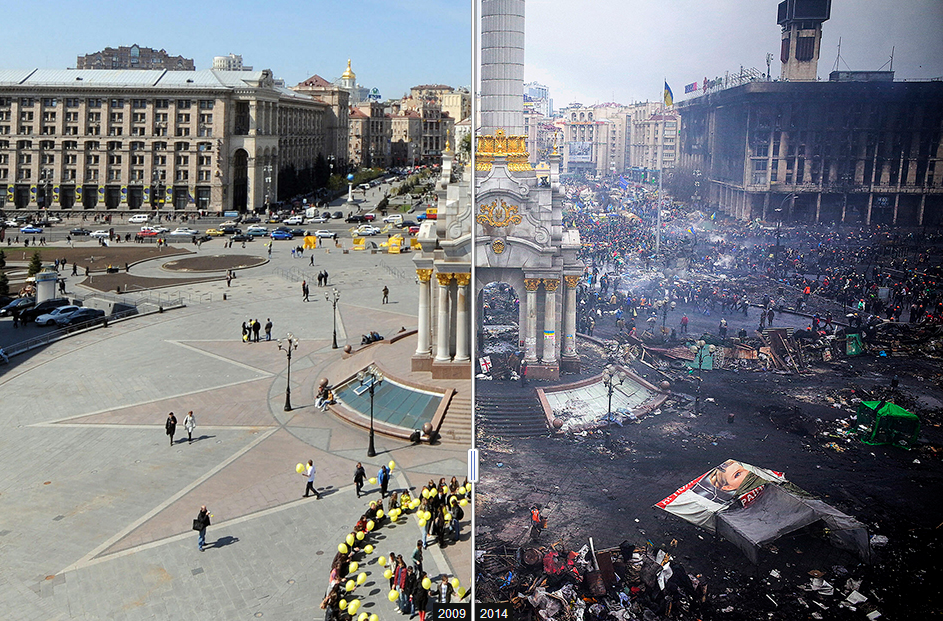
Photography as an instrument of history: Ukraine’s Independence Square

February 21, 2014

Tweet from the Wall Street Journal shows, in very dramatic form, how photographs can be used to record history and current events, telling a story that words just cannot.

 WSJ Wall Street Journal - #Ukraine's Independence Square: then and now http://on.wsj.com/1d9q7IL  pic.twitter.com/vzqPKj79Cb

WSJ Wall Street Journal – #Ukraine’s Independence Square: then and now http://on.wsj.com/1d9q7IL pic.twitter.com/vzqPKj79Cb

In Ukraine, there’s an enormous difference between 2009 and 2014.  In five years, Kiev is a different city.

Do we attribute the differences to corrupt government, to the assault on democratic institutions, or to the movement to end the corruption and boost democracy?

It’s more impressive that I can show in a link here; at the WSJ site, the two photos are interactive — you can grab the middle line with your mouse and move it to see the damage in 2014.  Check it out.

Are there similar photographic comparisons for Syria, Egypt, Yemen, Venezuela, Brazil, China, Britain, the United States?  If you know of some, or if you have created some, will you share?


Presidents Day 2014: Fly your flag today

February 17, 2014

Come on, you didn’t really need me to remind you, did you? It’s Presidents’ Day on most calendars, though the official U.S. holiday is Washington’s Birthday.

You’re already flying your flag today, right?  Let’s recapitulate from last year

Dr. Bumsted reminds us we need to emphasize that the federal holiday is Washington’s Birthday, not a day to honor presidents generically.  See the explanation from the U.S. National Archives.

Presidents Day is February 17, 2014 — fly your U.S. flag today.

National Park Service photo, Lincoln Memorial through flags at Washington Monument

The Lincoln Memorial, seen through flags posted at the Washington Monument, Washington, D.C.; National Park Service Photo via About.com

Oddly enough, some controversy arises from time to time over how to honor President Washington and President Lincoln, and other presidents.  Sometimes the controversy simmers over how to honor great Americans — if Lincoln deserves a day, why not FDR?  Why not Jefferson? — and sometimes the controversy covers more mundane ground — should the federal government give workers a day off?  Should it be on a Monday or Friday to create a three-day weekend to boost tourism?  About.com explains the history of the controversy:

Presidents’ Day is intended (for some) to honor all the American presidents, but most significantly George Washington and Abraham Lincoln. According to the Gregorian or “New Style” calendar that is most commonly used today, George Washington was born on February 22, 1732. But according to the Julian or “Old Style” calendar that was used in England until 1752, his birth date was February 11th. Back in the 1790s, Americans were split – some celebrated his birthday on February 11th and some on February 22nd.

When Abraham Lincoln became president and helped reshape our country, it was believed he, too, should have a special day of recognition. Tricky thing was that Lincoln’s birthday fell on February 12th. Prior to 1968, having two presidential birthdays so close together didn’t seem to bother anyone. February 22nd was observed as a federal public holiday to honor the birthday of George Washington and February 12th was observed as a public holiday to honor Abraham Lincoln’s birthday.

In 1968, things changed when the 90th Congress was determined to create a uniform system of federal Monday holidays. They voted to shift three existing holidays (including Washington’s Birthday) to Mondays. The law took effect in 1971, and as a result, Washington’s Birthday holiday was changed to the third Monday in February. But not all Americans were happy with the new law. There was some concern that Washington’s identity would be lost since the third Monday in February would never fall on his actual birthday. There was also an attempt to rename the public holiday “Presidents’ Day”, but the idea didn’t go anywhere since some believed not all presidents deserved a special recognition. [Take THAT you Franklin Pierce and Millard Fillmore fans!]

Even though Congress had created a uniform federal holiday law, there was not a uniform holiday title agreement among the individual states. Some states, like California, Idaho, Tennessee and Texas chose not to retain the federal holiday title and renamed their state holiday “President’s Day.” From that point forward, the term “Presidents’ Day” became a marketing phenomenon, as advertisers sought to capitalize on the opportunity for three-day or week-long sales.

In 1999, bills were introduced in both the U.S. House (HR-1363) and Senate (S-978) to specify that the legal public holiday once referred to as Washington’s Birthday be “officially” called by that name once again. Both bills died in committees.

Today, President’s Day is well accepted and celebrated. Some communities still observe the original holidays of Washington and Lincoln, and many parks actually stage reenactments and pageants in their honor. The National Park Service also features a number of historic sites and memorials to honor the lives of these two presidents, as well as other important leaders.

Fly your flag, read some history, enjoy the day.

More, Resources, and Related Articles:

English: Air Force One, the typical air transp...

President’s airplane, Air Force 1, flying over Mount Rushmore National Monument, in South Dakota – Image via Wikipedia; notice, contrary to Tea Party fears, the bust of Obama is not yet up on Rushmore (and also note there remains no room for another bust).

Yes, this is mostly an encore post.  This event occurs every year.


Millard Fillmore: Ready for his closeup with CBS Sunday Morning?

February 16, 2014

Millard Fillmore as

Millard Fillmore as “Bad President,” by jimmyemery at deviantart. How will Mo Rocca’s story portray Fillmore?

If other news doesn’t interfere, Millard Fillmore is scheduled to get a Presidents Day treatment from reporter and humorist Mo Rocca, on CBS’s “Sunday Morning with Charles Osgood,” on February 16.

What a fine collision!  Fillmore’s story is really pretty good.  Osgood and Sunday Morning are top of the genre.  Rocca is smart, and often funny.  Even if they perform below their par, the segment should be enlightening.

Blogging for the venerable Buffalo News, TV writer and critic Alan Pergament gives more details:

If you’re tired of me telling you how wonderful “CBS Sunday Morning” with Charles Osgood is, better look away now.

Correspondent Mo Rocca — whose chicken wing piece ran on Super Bowl Sunday — is back again this Sunday with a piece on President Millard Fillmore.

Rocca visited the Fillmore home in East Aurora on the same week he was here to sample chicken wings.

According to a CBS spokesperson, Rocca explains in the piece “why Fillmore should be remembered for more than just his unusual name.”

The spokesperson added that University at Buffalo professor Claude Welch is one of the experts that Rocca spoke to “about what made the 13th president stand out.”

“Sunday Morning” airs at 9 a.m. Sundays on Channel 4, the local CBS affiliate.

The timing of the Fillmore piece makes sense since this is President’s Day weekend.

Prof. Welch delivered the annual address at Fillmore’s grave this year, on Fillmore’s birthday, January 7 (delayed a couple of days this year because of cold and snow).

“Sunday Morning” runs from 8:00 to 9:30 a.m. on KTVT, Channel 11, in Dallas.  I’ll be ringing bells, and I’ll have to record the show.  Check your local schedule. 

You could do worse on Presidents Day Eve than to learn something more about Fillmore, arguably the man who set up World War II in the Pacific.

That’s something even H. L. Mencken didn’t blame Fillmore for.


Legacy of DDT abuse: Cleaning up old pesticide dumps

February 15, 2014

Contrary to science denialist claims, DDT is not harmless.  Users and abusers of DDT, abandoned stocks of DDT and other pesticides around the world, after the stuff had become essentially useless against insect or other pests originally targeted.

In the U.S., EPA moves in to clean up DDT dumps, under the Comprehensive Environmental Response, Compensation and Liability Act of 1980 (CERCLA), or Superfund.  In much of the world, various UN agencies find the old pesticides, and clean them up as funding allows.

The Food and Agricultural Organization (FAO) documents its cleanup efforts with photos of sessions training technicians to find and catalog dump sites, repackaging of old drums when necessary, extraction, packing and shipping to a disposal site.

Photos tell a story words on paper cannot.

Caption from FAO: TN (Tanzania) before: 40 tonnes of 50 year old DDT were found in Menzel Bourguiba Hospital, TN - : M. Davis

Caption from FAO: TN (Tanzania) before: 40 tonnes of 50 year old DDT were found in Menzel Bourguiba Hospital, TN – : M. Davis

Sometimes the toxic wastes did not stay neatly stacked.

FAO caption:  TN before: 40 tonnes of 50 year old DDT were found in Menzel Bourguiba Hospital, TN

FAO caption: TN before: 40 tonnes of 50 year old DDT were found in Menzel Bourguiba Hospital, TN View real size

DDT use against insect vectors of disease essentially halted in the mid-1960s.  The Rockefeller Foundation’s and UN’s ace mosquito fighter, Fred Soper, ran into mosquitoes in central Africa that were resistant and immune to DDT. Farmers and businesses had seized on DDT as the pesticide of choice against all crop pests, or pests in buildings.  By the time the UN’s malaria-fighting mosquito killers got there, the bugs had evolved to the point DDT didn’t work the malaria eradication campaign.

Also, there were a few DDT accidents that soured many Africans on the stuff.  Around lakes where local populations caught the fish that comprised the key protein in their diet, farmers used DDT, and the runoff killed the fish.

Use of DDT ended rather abruptly in several nations.  Stocks of DDT that had been shipped were abandoned where they were stored.

For decades.

FAO caption:    Obsolete DDT in Luanda, Angola - July 2008 -  : K. Cassam

FAO caption: Obsolete DDT in Luanda, Angola – July 2008 – : K. Cassam

Prevention and disposal of obsolete chemicals remains as a thorny problem throughout much of the world.  Since 2001, under the Persistent Organic Pollutants Treaty, (POPs), the UN’s World Health Organization (WHO) has coordinated work by WHO and a variety of non-governmental organizations (NGOs), as well as governments, to make safe the abandoned pesticides, and detoxify or destroy them to prevent more damage.  FAOs efforts, with photos and explanation, is a history we should work to preserve.

DDT provided powerful insect killing tools for a relatively short period of time, from about 1945 to 1965.  In that short period, DDT proved to be a deadly killer of ecosystems to which it was introduced, taking out a variety of insects and other small animals, on up the food chain, with astonishing power.  One of DDT’s characteristics is a long half-life — it keeps on killing, for months or years. Once that was thought to be an advantage.

Now it’s a worldwide problem.