Presidential proclamation for Veterans Day 2012

November 11, 2012

From the White House, November 7, 2012; note particularly the history:

Presidential Proclamation — Veterans Day, 2012

VETERANS DAY, 2012

– – – – – – –

BY THE PRESIDENT OF THE UNITED STATES OF AMERICA

A PROCLAMATION

Whether they fought in Salerno or Samarra, Heartbreak Ridge or Helmand, Khe Sanh or the Korengal, our veterans are part of an unbroken chain of men and women who have served our country with honor and distinction. On Veterans Day, we show them our deepest thanks. Their sacrifices have helped secure more than two centuries of American progress, and their legacy affirms that no matter what confronts us or what trials we face, there is no challenge we cannot overcome, and our best days are still ahead.

This year, we marked the 200th anniversary of the War of 1812. We began to commemorate the 50th anniversary of the Vietnam War. We welcomed our veterans back home from Iraq, and we continued to wind down operations in Afghanistan. These milestones remind us that, though much has changed since Americans first took up arms to advance freedom’s cause, the spirit that moved our forebears is the same spirit that has defined each generation of our service members. Our men and women in uniform have taught us about strength, duty, devotion, resolve — cornerstones of a commitment to protect and defend that has kept our country safe for over 200 years. In war and in peace, their service has been selfless and their accomplishments have been extraordinary.

Even after our veterans take off the uniform, they never stop serving. Many apply the skills and experience they developed on the battlefield to a life of service here at home. They take on roles in their communities as doctors and police officers, engineers and entrepreneurs, mothers and fathers. As a grateful Nation, it is our task to make that transition possible — to ensure our returning heroes can share in the opportunities they have given so much to defend. The freedoms we cherish endure because of their service and sacrifice, and our country must strive to honor our veterans by fulfilling our responsibilities to them and upholding the sacred trust we share with all who have served.

On days like this, we are called to reflect on immeasurable burdens that have been borne by so few. We pay tribute to our wounded, our missing, our fallen, and their families — men and women who have known the true costs of conflict and deserve our deepest respect, now and forever. We also remember that our commitments to those who have served are commitments we must honor not only on Veterans Day, but every day. As we do so, let us reaffirm our promise that when our troops finish their tours of duty, they come home to an America that gives them the benefits they have earned, the care they deserve, and the fullest opportunity to keep their families strong and our country moving forward.

With respect for and in recognition of the contributions our service members have made to the cause of peace and freedom around the world, the Congress has provided (5 U.S.C. 6103(a)) that November 11 of each year shall be set aside as a legal public holiday to honor our Nation’s veterans.

NOW, THEREFORE, I, BARACK OBAMA, President of the United States of America, do hereby proclaim November 11, 2012, as Veterans Day. I encourage all Americans to recognize the valor and sacrifice of our veterans through appropriate public ceremonies and private prayers. I call upon Federal, State, and local officials to display the flag of the United States and to participate in patriotic activities in their communities. I call on all Americans, including civic and fraternal organizations, places of worship, schools, and communities to support this day with commemorative expressions and programs.

IN WITNESS WHEREOF, I have hereunto set my hand this seventh day of November, in the year of our Lord two thousand twelve, and of the Independence of the United States of America the two hundred and thirty-seventh.

BARACK OBAMA

More:


Veterans Day 2012 – Fly your flag today

November 11, 2012

Veterans Administration poster for Veterans Day 2012, “Honoring All Who Served” (Click for link to high resolution download version)

Fly your flag today for Veterans Day 2012.

Veterans Day’s falling on Sunday will complicate local celebrations that conflict with local religious services, but national celebrations most often will continue apace, particularly the ceremonies at Arlington National Cemetery in Virginia, at 11:00 a.m. (in honor of the original armistice that ended World War I, “at the 11th hour, of the 11th day, of the 11th month”).

Voice of America gave a brief but thorough rundown:

November 11 is Veterans Day in the U.S. – a federal holiday to honor all military personnel who have served the U.S. in all wars.

This is the first Veterans Day since the last U.S. troops left Iraq in December. The holiday this year is also a chance for Americans to thank the rapidly shrinking population of World War Two veterans.

The U.S. president places a wreath every Veterans Day at the Tomb of the Unknowns at Arlington National Cemetery.

Communities across America traditionally hold Veterans Day observances and ceremonies. Federal offices will be closed Monday in recognition of the holiday.

Veterans Day – originally called Armistice Day – was first observed in 1919. One year earlier, on the 11th hour of the 11th day of the 11th month, an armistice between Germany and the Allied nations took effect.

Veterans Day honors all veterans of U.S. military service, living and dead.  The U.S. flag should be flown at full staff for the day.

More:


Carl Sagan Day, November 9, 2012

November 9, 2012

Electioneering cut into my planning — didn’t get anything done for Carl Sagan Day, today, November 9.  Here’s the post from last year, with a few links to sources including new sources at the bottom.  “Our species needs, and deserves, a citizenry with minds wide awake and a basic understanding of how the world works,” Sagan said.  Boy, howdy, now more than ever.

Have a happy Carl Sagan Day!

_________________________________________________________________________

Press release from the Center for Inquiry:

Carl Sagan Day: November 9 — Celebrate with us!
Event Ideas & Sagan Day Commemorative Posters

Carl Sagan Day Poster 2011Carl Sagan was a Professor of Astronomy and Space Science and Director of the Laboratory for Planetary Studies at Cornell University, but most of us know him as a Pulitzer Prize winning author and the creator of COSMOS. That Emmy and Peabody award-winning PBS television series transformed educational television and continues to affect the hearts and minds of over a billion people in over sixty countries.

No other scientist has been able to reach and engage so many nonscientists in such a meaningful way, and that is why we honor Dr. Sagan, remember his work, and revel in the cosmos he helped us understand.

Two years ago, CFI–Fort Lauderdale and other groups hostd the first Carl Sagan Day event in Florida.  It was a fantastic success and now individuals and groups around the world are planning their own tributes with science fairs, planetarium shows, teacher workshops, star parties, COSMOS marathons, and more—all to say “Thanks!” to Sagan and to bring his gifts to another generation of “starstuff.”

How can you celebrate Carl Sagan Day?

Whether you’re an independent skeptics group, an astronomy club, a science department, a researcher, a teacher, a student, or just a really big Sagan fan, there are plenty of ways to celebrate Sagan Day:

  • Host a COSMOS marathon—all 13 episodes are available for free at hulu.com.
  • Check out Sagan’s many books at your local library or bookstore using the thorough listings from WorldCat.org.
  • Enjoy the special collection of articles by or about Sagan, previously published in Skeptical Inquirer magazine.
  • Listen to Sagan’s last public address for the Committee for Skeptical Inquiry (formerly CSICOP) as replayed on CFI’s podcast, Point of Inquiry: “Wonder and Skepticism.”
  • Listen to Ann Druyan, writer, producer, and widow of Sagan, discuss life with Carl, his outlook on life, and his famous Gifford Lectures, “The Varieties of Scientific Experience,” also on Point of Inquiry.
  • Host your own apple pie baking contest (from scratch, of course).
  • Dress like Carl for a day!
  • Refresh your skeptic skills with a review of Sagan’s Baloney Detection Kit.
  • Invite your friends over and try to convince them you have a dragon in your garage.
  • Take in a star show at your local planetarium.
  • At the very least, seek out a dark sky, look UP, and reconnect with the grandeur of the cosmos.

Let us know how you’re planning to commemorate Carl Sagan Day 2011 and we’ll add your event to our Carl Sagan Day Event Calendar to help spread the word.  Please email your event information to grassroots@centerforinquiry.net.

Great collection of posters, featuring Sagan, the Very Large Array, and quotes from the good doctor, here.

November 9 is the anniversary of Sagan’s birth, of course.

More, for 2012:


Steve Schafersman, Texas State Board of Education District 15

November 6, 2012

District 15 for the Texas State Board of Education covers 77 counties in Texas’s northern Panhandle.  It’s oil (Midland), cotton, Texas prairie and small towns, and lots of schools, and some surprisingly good colleges and universities.

Texas State Board of Education District 15, TFN image

Texas State Board of Education District 15, TFN image – “District Overview
District 15 is huge, covering all of northwestern Texas. It is also arguably the most Republican SBOE district, giving more than 74 percent of the vote to Sen. John McCain in the 2008 presidential election and more than 70 percent to Gov. Rick Perry in the 2010 gubernatorial race.”

It’s a district where science plays a big role, and should play a bigger one.  The 15th includes those lands in Texas where the Dust Bowl got started, where unwise plowing based on inaccurate readings of climate contributed to one of the greatest man-made natural resources disasters in all of history.  It’s the home of Texas Tech University, where members of the chemistry faculty created a wine industry based on the chemistry of grape selection and fermentation, and where geologists learn how to find oil.

This area leads Texas in wind power generation, a considerable factor in the state that leads the nation in wind power generation.

In short, science, engineering and other technical disciplines keep this area economically alive, and vital at times.

Of the two candidates, Democrat Steve Schafersman is a scientist, and a long-time, staunch defender of science education (what we now cutely call “STEM” subjects:  Science, Technology, Engineering and Math).  If the race were decided by a test in STEM subjects, Schafersman would be the winner.  Schafersman lives in Midland.

The GOP candidate in the race is religiously anti-science, Marty Rowley of Amarillo.  As a good-ol’-boy, former pastor, he’s got a lot of support from the usual suspects.  Rowley’s views on science, technology, engineering and mathematics run contrary to the business and farming interests of his entire district.  Do his supporters look to the future?

Do you vote in Midland, Lubbock, Amarillo, Dalhart, Abilene, San Angelo, Dallam County, Tom Greene County, Cooke County or Montague County?  You need to vote for Steve Shafersman.  Do your children a favor, do your schools a favor, and do your region of Texas a favor, and vote for the guy who works to make education good.

Shafersman is the better-qualified candidate, and probably among the top two or three people with experience making the SBOE work well, in the nation.  He deserves the seat, and Texas needs him.

More:

Steve Schafersman campaign flier:

Shafersman for Texas State Board of Education District 15

Schafersman for Texas State Board of Education District 15 – click image for larger version


Election day art: Norman Rockwell

November 6, 2012

Can’t let election day go by without at least noting this great, undersung painting by Normal Rockwell, “Election Day (1944)”:

Norman Rockwell, Election Day, 1944, watercolor and gouache, 14 x 33 1/2 in., Museum purchase, Save-the-Art fund, 2007.037.1.

Norman Rockwell, Election Day, 1944, watercolor and gouache, 14 x 33 1/2 in., Museum purchase, Save-the-Art fund, 2007.037.1.

Remember when people used to dress up to go to the polls?

In 1944 President Franklin Roosevelt ran for an unprecedented fourth term.  Most Americans did not know it, but he was deathly ill at the time.  He dropped Vice President Henry Wallace from his ticket — some argue it was a mutual disaffection at that time — and selected the relatively unknown young Missouri U.S. Sen. Harry S Truman for the vice president’s slot.

In November 1944, D-Day was known to be a successful invasion, and most Americans hoped for a relatively speedy end to World War II in both Europe and the Pacific.  Within the next ten months, the nation would endure the last, futile, desperate and deadly gasp of the Third Reich in the Battle of the Bulge, the liberation of Berlin in April 1945, and end of the war in the European Theatre on May 8; the Battle of Leyte Gulf, the Philippines Campaign, and the bloody, crippling battles of Iwo Jima and Okinawa in the Pacific Theatre, and then the first use of atomic weapons in war, at Hiroshima and Nagasaki (and we hope, the last use).

Voters in Cedar Rapids could not have known that.  They did not know that, regardless their vote for FDR or his Republican challenger, New York Gov. Thomas Dewey, Harry S Truman would be president within six months, nor that the entire world would change in August 1945.

This painting captures a time of spectacular moment, great naivity, and it pictures the way history got made.

For a 2007 exhibition, the Cedar Rapids Museum of Art offered this history:

Norman Rockwell: Fact & Fiction

September 12, 2009 – January 3, 2010

In 2007, the citizens of Cedar Rapids rallied together to purchase a series of watercolors destined for the auction block in New York. These five watercolors, by acclaimed 20th century American artist Norman Rockwell, depicted scenes associated with an election day and were created specifically for the November 4, 1944 issue of the Saturday Evening Post. To complete the Post commission, Rockwell traveled to a quintessential Midwestern town, Cedar Rapids, to study local citizens as models for his series of images.

In the 65 years since his visit, numerous anecdotes and stories have arisen about the artist’s time in Cedar Rapids and the creation of this work. This exhibition uses these five, newly conserved and restored watercolors and a related oil painting from the Norman Rockwell Museum, along with numerous photographs taken by local photographer Wes Panek for Rockwell, to investigate the many facts and fictions associated with Rockwell’s visit and this set of watercolors.

Norman Rockwell: Fact & Fiction has been made possible in part by Rockwell Collins, Candace Wong, and local “Friends of Norman Rockwell.” General exhibition and educational support has been provided by The Momentum Fund of the Greater Cedar Rapids Community Foundation.

Friends of Norman Rockwell: Wilma E. Shadle, Howard and Mary Ann Kucera, Jean Imoehl, Ben and Katie Blackstock, Marilyn Sippy, Chuck and Mary Ann Peters, Phyllis Barber, Ann Pickford, Anthony and Jo Satariano, Barbara A. Bloomhall, Virginia C. Rystrom, Jeff and Glenda Dixon, Robert F. & Janis L. Kazimour Charitable Lead Annuity Trust, Fred and Mary Horn, Mrs. Edna Lingo, John and Diana Robeson, Jewel M. Plumb, Carolyn Pigott Rosberg, Mr. and Mrs. Robert J. Buchacek, Dan and Anne Pelc, Mary Brunkhorst, and John and Diana Robeson.

I am amused and intrigued that this scene also closely resembles the scene when I voted in Cheverly, Maryland, in 1984 — down to the dog in the picture.  Oh, and most of the women didn’t wear dresses, none wore hats, and I was the only guy in the room with a tie.

Roosevelt won the 1944 election in an electoral college landslide, 432 to 99, but Dewey won Iowa, and we might assume Dewey won Cedar Rapids, too.

More:


Election Day 2012: Fly the flag, vote

November 6, 2012

Saint Louis Art Museum, St. Louis, Missouri George Caleb Bingham (American, 1811–1879). The County Election, 1852. Oil on canvas. 38 x 52 in. (96.5 x 132.1 cm). Gift of Bank of America.

The County Election, 1852. Saint Louis Art Museum, St. Louis, Missouri George Caleb Bingham (American, 1811–1879).  Oil on canvas. 38 x 52 in. (96.5 x 132.1 cm). Gift of Bank of America.

Every polling place should be flying the U.S. flag today.  You may fly yours, too.  In any case, if you have not voted already, go vote today as if our future depends upon it, as if our nation expects every voter to do her or his duty.

Today the nation and world listen to the most humble of citizens.  Speak up, at the ballot box.

Did you notice?  In Bingham’s picture, there are no U.S. flags.  You may fly yours anyway.

The whole world is watching.

More:


Forgotten art, forgotten artists: Dick Sargent, and Cub Scouts in a phone booth

November 3, 2012

Years between 1900 and 1970-something, when computers, television and digital media started to bite into artists’ work, make up a golden age of magazine illustration.

Much of that art is essentially lost now.  It appeared in magazines no longer published, and therefore having no champion for digitizing the art and prose; and it appeared in magazines that libraries, now cramped for space, are tossing away after getting access to digitized text, or through microfiche — or not at all.

Many of the images are compelling, like this one from Dick Sargent (1911-1978):

Cub Scouts in phonebooth, Dick Sargent, via American Gallery

Cub Scouts crammed in a phonebooth, Dick Sargent image preserved by American Gallery

The image is archaic, technically antique, in so many ways.

  • Do any phonebooths remain in America, especially of this outdoor type?  The booths had already begun to fade in the late 1970s, comically chronicled in Superman movies where Clark Kent could not find a phone booth in which to change from his reporter’s disguise into Superman’s body suit and cape.  Rapid spread of cell phones, now digital communications, and the disappearance of T-1 lines to tap into for pay phones, all contribute to make this image seriously dated (could students put a date on it by tracking down clues in the image?).
  • Paper maps?  Not even a hold-alone GPS, but a paper road map (probably a freebie from a “service station).
  • Cub Scouts abandoned the blue beanie at least 20 years ago, probably more like 30.
  • One Scout leader?  Since at least the early 1990s, Scouting has a “two-deep leadership” rule, to prevent child molestation, under the Scouts’ tough Youth Protection rules.  At no time should one leader only be with one Scout or a group of Scouts.  Such a hike today would require a much larger phone booth, just to accommodate additional leaders.
  • The axe was out of place when the painting was made; it’s a tool for older Boy Scouts.  Today, axes trend to rarity even with Boy Scouts.  Wood fires depleted the woods near popular camping sites and Boy Scout camps.  Drought conditions create local fire bans in many Scout camps nationwide in most of the past two decades — a Scout needs to know how to fire up a WhisperLite or Jetboil stove, or even a Coleman propane or white gas stove (have I told you the story of Sheldon Coleman and the Alaskan Native with the 30-year-old Coleman stove?).  None of that requires a hand-axe.
  • No women leaders?  When the painting was made — early 1950s? — the only male in a direct leadership position in a Cub Scout Pack would be the Cubmaster, who is largely the ceremonial ring-leader for the once-a-month pack meeting.  Women would have been Den Mothers, meeting weekly with a Den of boys.  This is artistic license, of course — but a modern painting would look really odd without women in leadership roles, especially on an outing, and wholly apart from the two-deep leadership rule.
  • It’s Cub Scouting, but there’s a clear cross-message with the Boy Scout Motto, Be Prepared.  This group is not prepared for rain at all — nor much prepared for hiking.  See any water bottles?  In the 1950s, Scouts would have carried canteens instead — but even Cub Scouts could be counted on to carry a cool, military-looking canteen.

I’m guessing this was an illustration for a magazine.  For various reasons I think it was not a Boy Scout publication, like Boys’ Life or Scouting.  Sargent’s work appeared in publications like Saturday Evening Post.  It would be fascinating to know the publication, and whether there was an occasion for the painting.  Scouting and this form of realistic painting from the 20th century really go hand in hand.  One of America’s favorite painters, Norman Rockwell, got his first job at 19 as art director for Boy Scouts of America, including Boys’ Life.  He went on to a long and very productive career, including hundreds of magazine covers for many publications, including Saturday Evening Post.  Rockwell was followed by Joseph Csatari.

American Gallery specializes in rescuing collections of work from American painters and other visual artists.  Teachers and students looking for period art from the 20th century might do well to check out that site, and do a few searches.  History, education and the internet could use a few more sites like that.

More:


Romney, and Sandy: Res ipsa loquitur

November 3, 2012

Have you seen this?  Brought to you by Mitt Romney, the GOP 2012 Convention, and Sandy:

Res ipsa loquitur, a Latin term, used in law.  Means “the thing speaks for itself.”

Global Warming, Hurricane Sandy, Hubris,

More:


Typewriter of the moment: Sports broadcaster Red Barber

November 1, 2012

Sportswriter Red Barber at his typewriter - Florida State Archives photo

Sportswriter Red Barber at his typewriter – State Archives of Florida, Florida Memory, http://floridamemory.com/items/show/10011

The great Red Barber, when his hair was still red, working at his typewriter, with a volume of Roget’s Thesaurus close by.

Many of us knew Red chiefly through his weekly chats with Bob Edwards at NPR’s Morning Edition.  The biographies say Red died in 1992.  That was 19 years ago — it seems more recent than that.  (Edwards left Morning Edition in 2004.)

It may be ironic to show Barber at his typewriter.  He would be more accurately portrayed, perhaps, behind a microphone at a baseball park.

From 1939 through 1953 Barber served as the voice of the Brooklyn Dodgers. He was working for the New York Yankees when he retired in 1966. Barber had the distinction of broadcasting baseball’s first night game on May 24, 1935 in Cincinnati and the sport’s first televised contest on August 26, 1939 in Brooklyn.

During his 33-year career Barber became the recognized master of baseball play-by-play, impressing listeners as a down-to-earth man who not only informed but also entertained with folksy colloquialisms such as “in the catbird seat,” “pea patch,” and “rhubarb” which gave his broadcasts a distinctive flavor. (Radio Hall of Fame)

More:


Woody Guthrie’s “Sinking of the Reuben James”

October 31, 2012

Woody’s recording of the song, with some good photos of the DD 245 U.S.S. Reuben James, the German U-boat that sank her, and two later ships that carried the same name:

From the YouTube description:

Woody Guthrie‘s song written shortly after the sinking of the USS Reuben James DD-245; Slideshow of DD 245, DE 153, FFG 57 and U 552 with a few other notable photos included.

More:

English: PACIFIC OCEAN (July 8, 2010) The Oliv...

English: PACIFIC OCEAN (July 8, 2010) The Oliver Hazard Perry-class guided-missile frigate USS Reuben James (FFG 57) conducts training exercises supporting Rim of the Pacific (RIMPAC) 2010 exercises. RIMPAC is a biennial, multinational exercise designed to strengthen regional partnerships and improve interoperability. (U.S. Navy photo by Mass Communication Specialist 2nd Class Jeremy M. Starr/Released) (Photo credit: Wikipedia)


We remember: U.S.S. Reuben James sunk October 31, 1941

October 30, 2012

October 31 hosts several famous anniversaries. It is the anniversary of Nevada’s statehood (an October surprise by Lincoln for the 1864 campaign?). It is the anniversary of the cleaving of western, catholic Christianity, as the anniversary of Martin Luther’s tacking his 95 theses to the door of the church in Wittenburg, Germany in 1517, the formal start of the Reformation. Maybe the original Christian trick or treat.

U.S.S. Reuben James sinking, October 31, 1941 - National Archives photo

U.S.S. Reuben James sinking, October 31, 1941 – National Archives photo

October 31 is also the anniversary of the sinking of the World War I era Clemson-class, four-stack destroyer, U.S.S. Reuben James, by a German U-boat. Woody Guthrie memorialized the sad event in the song, Reuben James, recorded by the Almanac Singers with Pete Seeger (see also here, and here), and later a hit for the Kingston Trio. The Reuben James was sunk on October 31, 1941 — over a month before the Japanese attack on Pearl Harbor. Details via Wikipedia (just to make you school librarians nervous):

USS Reuben James (DD-245), a post-World War I four-stack Clemson-class destroyer, was the first United States Navy ship sunk by hostile action in World War II and the first named for Boatswain’s Mate Reuben James (c.1776–1838), who distinguished himself fighting in the Barbary Wars.

This history figured into the 2008 presidential campaign in a small way: One of the internet hoax letters complaining about Barack Obama claimed that the U.S. entered World War II against Germany although the Germans had not fired a single round against the U.S. The 115 dead from the crew of 160 aboard the James testify to the inaccuracy of that claim, wholly apart from the treaty of mutual defense Germany and Japan were parties to, which encouraged Germany to declare war upon any nation that went to war with Japan. After the U.S. declaration of war on Japan, Germany declared war on the U.S., creating a state of war with Germany.

This history also reminds us that many Americans were loathe to enter World War II at all. By October 1941, Japan had been occupying parts of China for ten years, and the Rape of Nanking was four years old. The Battle of the Atlantic was in full swing, and the Battle of Britain was a year in the past, after a year of almost-nightly bombardment of England by Germany. Despite these assaults on friends and allies of the U.S., and the losses of U.S. ships and merchant marines, the U.S. had remained officially neutral.

Many Americans on the left thought the sinking of the Reuben James to be the sort of wake-up call that would push Germany-favoring Americans to reconsider, and people undecided to side with Britain. The political use of the incident didn’t have much time to work. Five weeks later Japan attacked Pearl Harbor, and by the end of 1941, the U.S. was at war with the Axis Powers.

Letter to the U.S. Navy asking the fate of friends aboard the U.S.S. Reuben James, November, 1941

Letter to the U.S. Navy asking the fate of friends aboard the U.S.S. Reuben James, November, 1941

Telegram informing his family of the death of Gene Guy Evans, of Norfolk, Virginia, lost in the torpedoing of the U.S.S. Reuben James

Telegram informing his family of the death of Gene Guy Evans, of Norfolk, Virginia, lost in the torpedoing of the U.S.S. Reuben James

The Kingston Trio sings, as the names of the dead scroll:

This is mostly an encore post from 2008. Brad DeLong at Berkeley is “live blogging” World War II, and referred to the 2008 post for his entry for October 31, which drove a little traffic this way and reminded me to memorialize the crew again — tip of the old scrub brush to Dr. DeLong

http://delong.typepad.com/sdj/2011/10/liveblogging-world-war-ii-october-31-1941-1.html

More:

  • Entry for USS Reuben James in the U.S. Navy’s Dictionary of American Fighting Ships:
  • Reuben JamesReuben James was born in Delaware about 1776. During the Quasi-War with France, Boatswain’s Mate James participated in Constellation’s victories over the French ships L’Insurgente, 9 February 1799, and La Vengeance. During the Barbary Wars, he served aboard Enterprise and accompanied Stephen Decatur into the harbor at Tripoli on 16 February 1804, as Decatur and his men burned the captured American frigate Philadelphia to prevent Tripoli from using her in battle. In the ensuing skirmish, an American seaman positioned himself between Decatur and an enemy blade. This act of bravery was attributed to Reuben James and to Daniel Frazier. For the rest of the war, James continued to serve Decatur aboard Constitution and Congress. During the War of 1812, he served in United States, under Decatur, and in President. On 15 January 1815, however, President was defeated by the British and James was taken prisoner. After the war, he resumed service with Decatur, aboard Guerriere, and participated in the capture of the 46-gun Algerian flagship Mashoudaon 17 June 1815. After peace was made with the Barbary states, James continued his service in the Navy until declining health brought about his retirement in January 1836. He died on 3 December 1838 at the U.S. Naval Hospital in Washington, D.C.

    I

    (DD – 245: displacement 1,215; length 314’5”; beam 31’8”; draft 9’4”; speed 35 knots; complement 101; armament 4 4”, 1 3”, 12 21” torpedo tubes; class Clemson)

    Reuben James (DD-245) was laid down 2 April 1919 by New York Shipbuilding Corp., Camden, N.J.; launched 4 October 1919; sponsored by Miss Helen Strauss; and commissioned 24 September 1920, Comdr. Gordon W. Haines in command.

    Assigned to the Atlantic Fleet, Reuben James sailed from Newport, R.I., 30 November 1920 to Zelenika, Yugoslavia, arriving 18 December. During the spring and summer of 1921, she operated in the Adriatic and the Mediterranean out of Zelenika and Gruz, Yugoslavia, assisting refugees and participating in postwar investigations. In October 1921 at Le Havre, she joined Olympia (C-6) at ceremonies marking the return of the Unknown Soldier to the United States. At Danzig, Poland, from 29 October 1921 to 3 February 1922, she assisted the American Relief Administration in its efforts to relieve hunger and misery. After duty in the Mediterranean, she departed Gibraltar 17 July 1922.

    Based then at New York, she patrolled the Nicaraguan coast to prevent the delivery of weapons to revolutionaries in early 1926. In the spring of 1929, she participated in fleet maneuvers that foreshadowed naval airpower. Reuben James decommissioned at Philadelphia on 20 January 1931.

    Recommissioned 9 March 1932, she again operated in the Atlantic and the Caribbean. From September 1933 to January 1934 she patrolled Cuban waters during a period of revolution. Sailing for the Pacific from Norfolk 19 October 1934, she arrived at her new homeport of San Diego, Calif., 9 November. Following maneuvers that evaluated aircraft carriers, she returned to the Atlantic Fleet in January 1939. Upon the outbreak of war in Europe in September 1939, she joined the Neutrality Patrol, and guarded the Atlantic and Caribbean approaches to the American coast.

    In March 1941, Reuben James joined the convoy escort force established to promote the safe arrival of war materials to Britain. This escort force guarded convoys as far as Iceland, where they became the responsibility of British escorts. Based at Hvalfjordur, Iceland, she sailed from Argentia, Newfoundland, 23 October 1941, with four other destroyers to escort eastbound convoy HX-156. While escorting that convoy, at about 0525, on 31 October 1941, Reuben James was torpedoed by German submarine U-562. Her magazine exploded, and she sank quickly. Of the crew, 44 survived, and 115 died. Reuben James was the first U.S. Navy ship sunk by hostile action in World War II.


    25 September 2005

More:


Ouch! Warming denialists’ claims blown away by Sandy

October 30, 2012

Over at Rabbett Run:

tonylearns said…
Could someone go over to Goddard’s blog for me ( I have been banned three times most recently for having the gall to suggest he was wrong in ridiculing the possibility of a new record minimum SIE this year. ) and ask for his apology to Hansen for ridiculing the possibility of the West Side Highway being underwater. I just saw a video showing the West Side Highway underwater.
29/10/12 7:46 PM

No! Someone whose comments don’t show up at Steve Goddard’s blog? Must be some massive disruption in the force of the Tubes of the Interweb thingy.

What is this guy Tony on about?

At Steve Goddard’s blog — this is the same guy who said the western drought was over because Lake Powell rose a few feet, though the drought raged on everywhere else — Goddard and his flying and limping monkeys have been poking fun at something James Hansen is alleged to have said:

According to NASA’s top scientist, Manhattan has been underwater for the past four years, and is experiencing a horrific drought.

While doing research 12 or 13 years ago, I met Jim Hansen, the scientist who in 1988 predicted the greenhouse effect before Congress. I went over to the window with him and looked out on Broadway in New York City and said, “If what you’re saying about the greenhouse effect is true, is anything going to look different down there in 20 years?” He looked for a while and was quiet and didn’t say anything for a couple seconds. Then he said, “Well, there will be more traffic.” I, of course, didn’t think he heard the question right. Then he explained, “The West Side Highway [which runs along the Hudson River] will be under water. And there will be tape across the windows across the street because of high winds. And the same birds won’t be there. The trees in the median strip will change.” Then he said, “There will be more police cars.” Why? “Well, you know what happens to crime when the heat goes up.”

And so far, over the last 10 years, we’ve had 10 of the hottest years on record. [Quoting an article at Salon]

The West Side Highway under water?  Ha.

Goddard’s blog has used Hansen’s quote as a regular punchline, not noticing that Hansen said “in 20 to 30 years,” and assuming he was just awfully, comically wrong.  30 years from 1988 will be 2018.  This year is 2012, six years to go.  Goddard tried to ridicule Hansen a few times over the past couple of years, for example:

  1. Here on October 4, 2010;
  2. Here on October 10, 2010;
  3. Here on November 13, 2010;
  4. Here on December 19, 2010 (with a photo of Al Gore, Barack Obama and an unidentified guy, maybe Goddard himself?);
  5. Here on January 15, 2011;
  6. Again on March 14, 2011;
  7. A special St. Patrick’s Day posting, March 17, 2011;
  8. Here on April 9, 2011;
  9. Here on May 22, 2011;
  10. Here on May 30, 2011; and obviously running out of comedy material, Goddard went for two in one day,
  11. Here on May 30, 2011, and by this time it’s such a regular meme attempting to mock James Hansen with same old material, Goddard doesn’t refer to the actual quote from Hansen;
  12. Here on June 15, 2011;
  13. Here on July 20, 2011;
  14. Here on July 21, 2011;
  15. Here on August 25, 2011;
  16. Here on May 7, 2012;
  17. Here on May 8, 2012;
  18. Here on May 23, 2012;
  19. June 25, 2012;
  20. August 9, 2012;
  21. August 23, 2012;
  22. August 31, 2012;
  23. September 28, 2012.

AP may complain about this use, but this is an academic, learning exercise:

Photo showing West Side Highway underwater from Hurricane Sandy

Caption from Yahoo! News: This photo provided by Dylan Patrick shows flooding along the Westside Highway near the USS Intrepid as Sandy moves through the area Monday, Oct. 29, 2012 in New York. Much of New York was plunged into darkness Monday by a superstorm that overflowed the city’s historic waterfront, flooded the financial district and subway tunnels and cut power to nearly a million people. (AP Photo/Dylan Patrick) MANDATORY CREDIT: DYLAN PATRICK

Dylan Patrick got the photographic evidence that shows, once again, warming denialists really are a classless, fact-lacking bunch.  CNN has photos from Dylanphoto1 (the same guy, almost certainly), in a slide show, noting, “Most of the Westside Highway south of 49th street is flooded all the way down, and in front of the USS Intrepid.”  Across from Pier 88 and the USS Intrepid, the street is indeed underwater.

So we learn that, as a comedian, Steve Goddard has an extremely limited range and depends on a sympathetic room to get laughs; and as a climate scientist, he is even more limited, and wrong, with 6 years to go in the 20 to 30 year range James Hansen offered.  And we learn once again, sadly, that James Hansen was right back in 1988 when he hit the claxons to warn us of global warming.

23 times Goddard repeated the charge?  Do you get the idea that “climate skeptics” ran out of material years ago, and have been dancing a cover-up for a very, very long time?  Hurricane Sandy blew and floated his claim away.

More:

Even more, a bit later:


Creationism vs. Christianity (a reprise)

October 30, 2012

This is an encore post, a repeat post from about four years ago, back in 2008.  For some reason the post got a couple hundred hits one day this past week, probably from a reference at another blog that I could not track.  I reread it — still true, still good stuff.  In this campaign year of 2012, I am dismayed at how anti-science and the denial of reality haunts election discussions, especially on-line, but also in the newspapers and magazines, on television and radio, in diners and drugstore fountains, in churches and PTA meetings.  Denial of reality may or may not be a genuine ailment to humans.  When it becomes a core belief of a significant number of people, denial can cripple our nation, our states, cities and towns. We need to ask deep questions.  We need to have real answers, not fantasies nor dangerous delusions.
PhotonQ-Charles Darwin 's Office

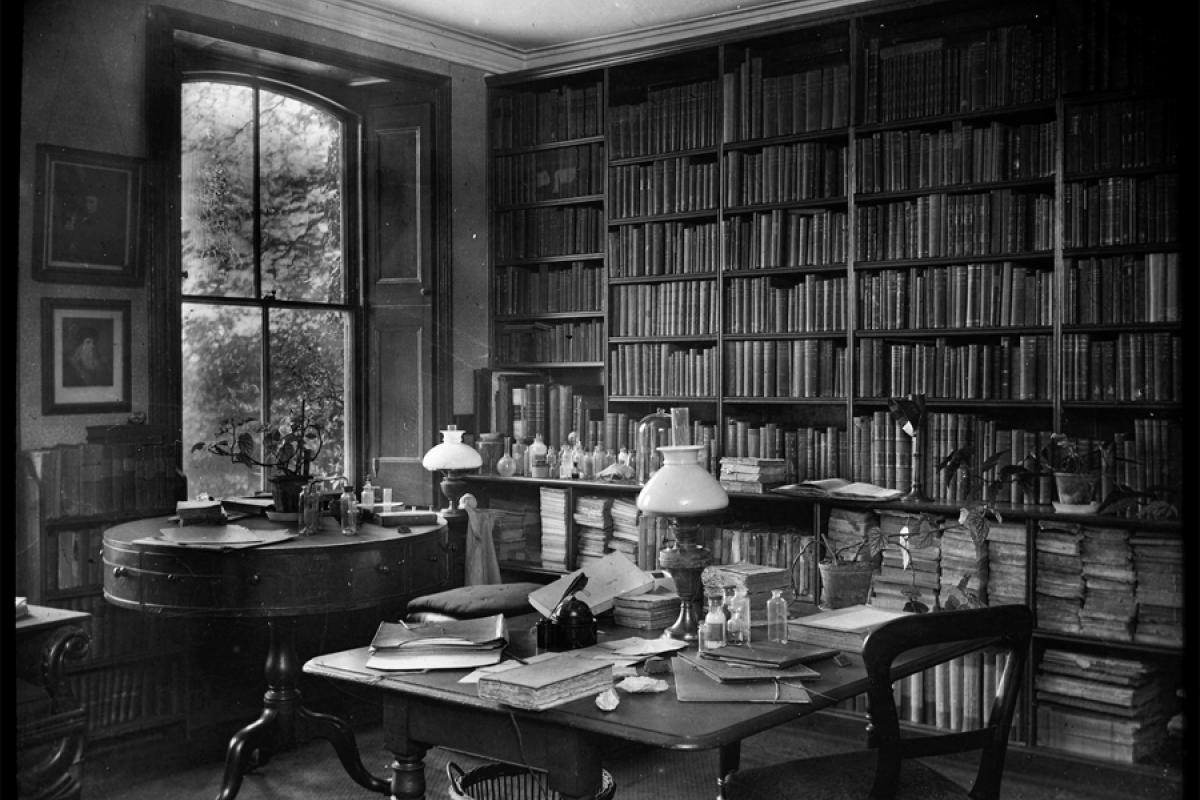
Charles Darwin’s study, where he conducted experiments and made many of the observations he wrote about. Photo: National Endowment for the Humanities

Denying reality plagues us as an actual political response to several problems.  Denialists wander so far down paths of disreality, they argue that we should ignore serious problems, and that the problems will then go away.

Should we teach the science of evolution to our children, or should we pretend fairy tales will substitute?  This has deep meaning to those who understand that Charles Darwin’s greatest contribution to science probably was his strict methodology, which required observation of things in nature before writing about them as if authoritative. 

Early in his life Darwin recognized that the natural world he saw, in Brazil, in the Galapagos Islands, in Australia and Tasmania, in South Africa, bore little resemblance to the world portrayed as authoritative by the great William Paley in his Natural Theology.  Throughout his science career Darwin observed real things in real time.  For his monograph on coral atolls, Darwin extensively observed the volcanic island phenomena throughout the South Pacific.  To write about barnacles, Darwin raised them in tanks in his study.  Looking at the mystery of exactly how the ivy twines, Darwin put a plant before him, and watched it, unraveling the secrets of how tendrils “knew” what to latch onto for support of the vine.  To write about leaf moulds, Darwin observed worms at work, in his lab and in his gardens.  To show the variation existing in what we now call the genome of a species, Darwin made extensive interviews and correspondence with animal husbanders of pigs, sheep and cattle, and he raised pigeons for generations himself, demonstrating how variations can be expressed that drive populations of one species to split into two through natural, everyday processes familiar to anyone who observed nature, and accessible by anyone who made methodical notes.

This familiarity with reality made Darwin a great scientist.  The methodology proved extendable into other areas when he carefully observed the mediums to whom his brother had cast great credence.  Charles revealed to Erasmus that spirit knocking on the tables at the séances did not occur so long as they held the hands of the mediums, who were then unable to feign the knocking. 

Ultimately it provided some despair to Darwin, too:  In the face of criticism from William Thompson, Lord Kelvin, that the Earth was not old enough to allow for evolution as Darwin suggested it must have occurred, Darwin had no answer.  Lord Kelvin calculated the ages of the Earth and Sun to be no more than 200 million years.  This was shown by the present temperatures and color of the Earth and the Sun, and calculated by Lord Kelvin from how long it would take the Earth, known to be composed of much iron and nickel, to cool from white hot to current temperatures.  Lord Kelvin ventured deep into coal mines to measure the temperatures of the Earth deep underground, to confirm his calculations.  At his death, though he defended his own observations of fossils and breeding of live animals, Darwin had no response for those arguments.  Darwin thought there must be other forces at play.  Only some years later did Ernest Rutherford find the secret of the Earth’s heat:  Radioactive decay in the mantle and core of the planet keeps it warm.  Measures of heat loss for such a large body had not accounted for continuous heating from within.  A short while later astronomers and physicists discovered problems with Lord Kelvin’s calculations of the age of the Sun:  The Sun is not composed of iron, cooling from white hot temperatures, but instead is hydrogen, fusing into helium, and making its own heat.

Darwin’s calculations of the age of the Earth were more accurate than Lord Kelvin’s, based on Darwin’s crude calculations of how long it might take animals and plants to have evolved from much more primitive forms.  History demonstrated by easily observable things provided greater accuracy than history devised without benefit of grounding in reality.

In what other realms might grounding in reality produce answers different from what some expect, even producing better questions that many ask?  Should we consider the migratory pattern changes of birds, fish and mammals, as indicators of a warming climate, over rebuttals provided by untested claims that measuring stations might not be placed correctly?  Can we actually “cool” atoms with lasers, and use individual atoms to store information, no matter how counterintuitive that might sound?  Can it be true that teaching people about contraception, and about sex, actually prompts teenagers (and others) to reduce sexual activity and look for love, rather than just sex?  Does extending medical coverage to an entire population actually decrease total health care costs as observed in all other nations where that solution has been tried, or will it increase costs because the only way to reduce medical costs is to ration it, either with a bureaucracy, or by cutting off access by backdoor, death panel means testing (no money, no health care)?  Is there any place Arthur Laffer‘s “curve” of increasing tax revenues by cutting tax rates, actually does not work — or any place it actually works?  Has any society in history ever gotten rich by showering riches on the rich, and ignoring the poor, the merchants, and the working class?

In short, how does reality we know, inform us about reality yet to be?  Which is the more potent predictor, observed reality, or hoped-for results to the contrary?

Our future hangs on how we answer the question, probably more than what the answer actually is.

I believe Christians, the largest faith group in the U.S., have a duty to stand for reality, and truth discovered by observation.  That was the issue in 2008, too.

Here is my post of four years ago.  I noticed a few of the links no longer work; I’ll replace them with working links as I can.  If you find a bad link, please note it in comments; and if you have a better link, note that, too.

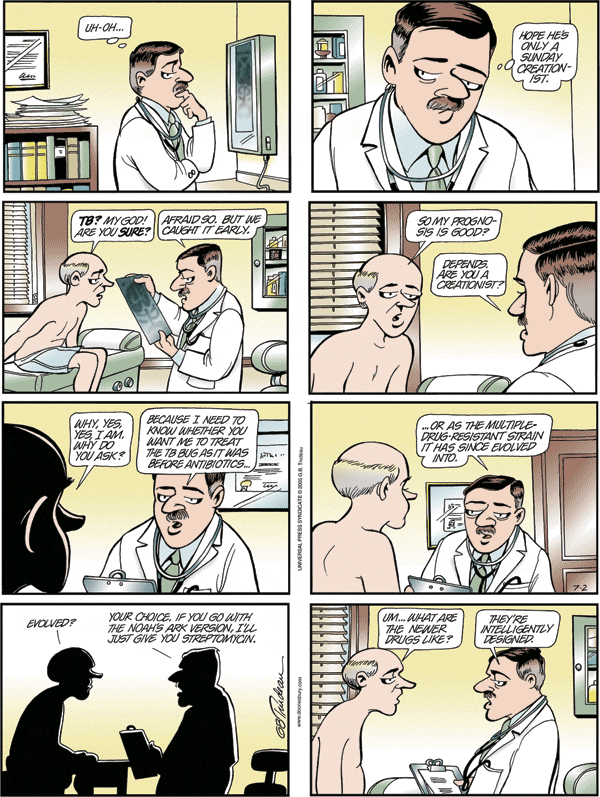
Several weeks ago [in 2008] I responded to a lengthy thread at Unreasonable FaithThe original post was Garry Trudeau’s “Doonesbury” cartoon of the guy in a doctor’s office, just diagnosed with an infection.  The physician asks the guy if he’s a creationist, explaining that if he is, the doc will treat him with old antibiotics in honor of his belief that evolution of bacteria doesn’t occur.

Charles Darwin's Study, Down House. Photo by and copyright held by Bob Radlinski. Radlinski's description: Darwin regularly spent about 5 hours a day here for 40 years and kept a chamber pot behind the partition so that he wouldn't have to trek to the toilet. But he still had time for an active family life with his wife Emma and their 10 children. The low stool with casters was used to spin himself from one desk where he dissected in front of the window to another where he took notes or wrote up labels—the stool the children were allowed to use for their games, punting themselves around the living room with long poles. The sitting room at the back of the house has large windows that go to the floor so that on nice days, the children (and dogs) could roam back and forth from house to garden at will.

Charles Darwin’s Study, Down House, where Darwin wrote all of his publications after his marriage. Photo by and copyright held by Bob Radlinski. Radlinski’s description: Darwin regularly spent about 5 hours a day here for 40 years and kept a chamber pot behind the partition so that he wouldn’t have to trek to the toilet. But he still had time for an active family life with his wife Emma and their 10 children. The low stool with casters was used to spin himself from one desk where he dissected in front of the window to another where he took notes or wrote up labels—the stool the children were allowed to use for their games, punting themselves around the living room with long poles. The sitting room at the back of the house has large windows that go to the floor so that on nice days, the children (and dogs) could roam back and forth from house to garden at will.

Point being, of course, that evolution occurs in the real world.  Creationists rarely exhibit the faith of their claims when their life, or just nagging pain, is on the line.  They’ll choose the evolution-based medical treatment almost every time.  There are no creationists in the cancer or infectious disease wards.

At one point I responded to a comment loaded with typical creationist error.  It was a long post.  It covered some ground that I’ve not written about on this blog.  And partly because it took some time to assemble, I’m reposting my comments here.  Of course, without the Trudeau cartoon, it won’t get nearly the comments here.

I’ll add links here when I get a chance, which I lacked the time to do earlier.  See my post, below the fold.

Read the rest of this entry »


What does Superstorm Sandy tell us about how to vote? Is disaster aid “immoral?”

October 29, 2012

Is it immoral for the federal government to coordinate disaster responses, and to provide aid for disasters, especially during and after superstorms like Sandy?

SUOMI view of Hurricane Sandy, early October 29, 2012 - NASA image

Caption from NASA: This night-view image of Hurricane Sandy was acquired by the Visible Infrared Imaging Radiometer Suite (VIIRS) on the Suomi NPP satellite around 2:42 a.m. Eastern Daylight Time (06:42 Universal Time) on October 28, 2012. In this case, the cloud tops were lit by the nearly full Moon (full occurs on October 29). Some city lights in Florida and Georgia are also visible amid the clouds.
CREDIT: NASA/Suomi NPP – VIIRS/Michael Carlowicz

I was troubled when GOP Louisiana Gov. Bobby Jindal called for cuts to disaster forecasting and especially our volcano monitoring systems, in 2009. I’ve been troubled by slams at NASA and NOAA with calls to cut budgets for orbiting satellites used to forecast storms and floods and other disasters, from the GOP.

And, with Sandy bearing down on the U.S. Northeast, Middle Atlantic and New England states (where older son Kenny lives in building that is, we hope, about 20 feet above sea level), I’ve been troubled by memories of calls for cuts to FEMA in the Republican presidential primaries.

Correspondent James Kessler tracked down a transcript from a campaign event in June, a presidential candidate cavalcade broadcast by CNN, with John King as moderator/anchor.  Look at this exchange:

KING: What else, Governor Romney? You’ve been a chief executive of a state. I was just in Joplin, Missouri. I’ve been in Mississippi and Louisiana and Tennessee and other communities dealing with whether it’s the tornadoes, the flooding, and worse. FEMA is about to run out of money, and there are some people who say do it on a case-by-case basis and some people who say, you know, maybe we’re learning a lesson here that the states should take on more of this role. How do you deal with something like that?

ROMNEY: Absolutely. Every time you have an occasion to take something from the federal government and send it back to the states, that’s the right direction. And if you can go even further and send it back to the private sector, that’s even better.

Instead of thinking in the federal budget, what we should cut — we should ask ourselves the opposite question. What should we keep? We should take all of what we’re doing at the federal level and say, what are the things we’re doing that we don’t have to do? And those things we’ve got to stop doing, because we’re borrowing $1.6 trillion more this year than we’re taking in. We cannot…

KING: Including disaster relief, though?

ROMNEY: We cannot — we cannot afford to do those things without jeopardizing the future for our kids. It is simply immoral, in my view, for us to continue to rack up larger and larger debts and pass them on to our kids, knowing full well that we’ll all be dead and gone before it’s paid off. It makes no sense at all.

Can you imagine how different the world would be today had Americans shared that view in 1936, or 1940, or 1942?  Immoral to do what is necessary to preserve the future, because we have to borrow to do some of it?

Has Romney changed his position in the last 24 hours?  I predict he will change it very soon, if he hasn’t already flip-flopped on it.  Of course, he may double down on crazy, and stand pat.   What do you think a rational patriot would do in this case?  [At about 1:00 p.m. Central Time, I heard an NPR radio news report — Romney urges private contributions to the Red Cross.  Meanwhile, President Obama has been working all morning to make sure the disaster response from the federal government is coordinated with affected states.] [Ha! But within hours, Romney has taken the almost-opposite position again.  World land speed record for flips on an issue?]

I erred, perhaps.  I had thought Mitt Romney the most capable and sober of the GOP candidates for president, and I urged by GOP friends to support Romney if they had no chance of completely recovering their senses by November.  Now I realize that, on the GOP side, “most capable” should be “most nearly capable,” and still means “incapable.”  And “sober” means nothing at all.  Perhaps worse, he’s still the best of the GOP lot this year.  Even worse, he has a chance to win.

Can we blame Romney?  Yes, we can blame people who reject science and don’t think of consequences past election day.  Yesterday Greg Laden offered a long post on what we should have learned from the “Storm of 1938” and the remnants of Hurricane Irene that slammed the Northeast in 2011, “What you need to know about Frankenstorm Hurricane Sandy”:

Here’s the thing. Imagine that a storm like Sandy came along in either of two years; 70 years ago or 35 years ago. Sandy is much larger and contains much more energy than the ’38 storm, or for that matter, of any known storm of the North Atlantic (we’ll get to that below). If Sandy hit the region in the 1930s, it would have been without warning, and it would have been prior to the reconstruction of seawalls and the development of flood mitigation measures inland that have happened in recent decades. Sandy, in ’38, would kill tens of thousands and destroy thousands of structures. That would be an average Sandy, a Sandy not being as bad as the most dire predictions we are considering today as the storm begins to take a grip on the eastern seaboard.

A Sandy of 35 years ago would have been predicted. The ability to see hurricanes coming was in place, but not as well developed as it is today. We would have seen Sandy coming, but her massiveness and extent, and her exact trajectory, would probably have been unknown. But at least there would be warning. Many of the seawalls and flood mitigation systems would have been in place, but the overbuilding on barrier islands and other vulnerable coastal regions would have been at or near a peak. With evacuations, Sandy would not kill 10s of thousands… probably only hundreds. But the number of buildings destroyed would be unthinkable. Most of those buildings are now gone or shored up. A Sandy in 1975 would have left some very interesting coastal archaeology for me to have observed during my trips to the shore in the 1980s. Very interesting indeed.

Mr. Laden always offers a good view of science, and his history is good here, too.

We can learn from the past.  FEMA is charged with learning from past disasters.  It’s a function of federal government we would be foolish to forego.  “Austere” shouldn’t mean “stupid.”

What do you think?  Is it immoral for the federal government to provide disaster assistance?

More:


Jefferson Memorial from above

October 27, 2012

Must be rare to get such a reflection of the sky in a calm Tidal Basin pool; from the Department of Interior‘s Instagram:

Jefferson Memorial from the air, Department of Interior photo

From Interior’s Instagram: Last night we posted an aerial photo of the #Washington #Monument, which everyone seems to really enjoy. So we are keeping it going today with a #photo of the #Jefferson #Memorial. #NationalMall #DC

One commenter noted the photo almost makes it appear that the Jefferson Memorial is floating in the clouds.

There are more than 300 units in the National Parks System.  In the past two days we’ve had two spectacular photos from almost the same place, two memorials about a half-mile apart.  How many thousands of great photos are possible from all of these properties?  NPS’s job, caring for all of that stuff, is monumental.