Bill Watterson’s Calvin, on the impossibility of getting homework to do itself. Copyright Bill Watterson. As Ms. Ashenhurst describes it: “SCH 4U is a university preparation course. As such some independent work is required for success.”
Do you ever get the feeling that President Donald Trump is speaking a foreign language? Or that he’s speaking what he thinks might sound like a foreign language, to cover for his not having done his homework?
Looking back now, we can see whatever it was he said about talking to families of fallen soldiers, he probably needed someone to translate it to himself.
Now Trump has, reluctantly, called the families of the fallen soldiers. Somehow, inexplicably, Trump managed to make things worse, to embarrass the entire nation. We couldn’t know that, then.
Bill Watterson’s Calvin figures out that obfuscation sometimes buys you a few minutes before the authorities and voters catch on to your game. Copyright Bill Watterson.
It’s graveyard humor. It seems to me Trump often leaves us fearful, and looking at great tragedy, with no coping mechanism apart from trying to find humor in what he’s done.
Which suggests, to me, it’s time for Trump to go away on his own. He’s damaging the nation.
What do you think?
Save
Spread the word; friends don't allow friends to repeat history.
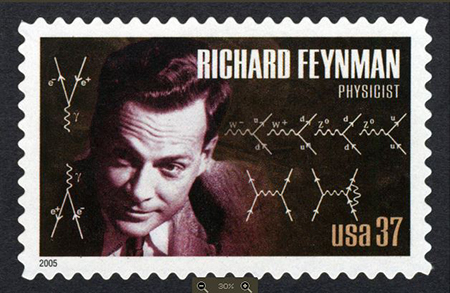
May 11 is the anniversary of the birth of Richard Feynman (born 1918, died 1988).
Richard Feynman. Borrowed from Luciano’s Tumblr, LikeaPhysicist
Feynman’s birthday falls on Statehood Day for Minnesota. You can fly your flag for both causes, if you wish, Minnesota’s statehood AND Feynman’s birthday. No proclamation will issue from the White House, but you can fly your flag any day.
Why Feynman Day? To celebrate invention, physics, interesting characters, and that essential, American quality of je ne sais quoi.
In addition to his winning the Nobel Prize for Quantum Electrodynamics (QED), Feynman popularized the critique of science and other enterprises with what we now call Cargo Cult science, or education, or whatever, where people follow the dance steps, but without the rhythm and music.
Those two things alone would make him a remarkable man. But, like a product offered for $19.95 as a good buy in a 2:00 a.m. infomercial, with Feynman, there’s more. With Feynman, there is always more.
I got alerted to Feynman in the first days of the old Quality Paperback Book Club, when they featured his new memoir, Surely You’re Joking, Mr. Feynman! QPBC was hot on the book, and with a title like that, how could I resist? When I got the book a week or so later, I read it within two days, while attending law school and working full time. I remember Feynman.
A New York Times bestseller—the outrageous exploits of one of this century’s greatest scientific minds and a legendary American original.
In this phenomenal national bestseller, the Nobel Prize-winning physicist Richard P. Feynman recounts in his inimitable voice his adventures trading ideas on atomic physics with Einstein and Bohr and ideas on gambling with Nick the Greek, painting a naked female toreador, accompanying a ballet on his bongo drums and much else of an eyebrow-raising and hilarious nature.
All true, and that’s not even the half of the outrageousness, all done with great good humor, about a life lived in great good humor through what should have been a memorable age, but often was just terrifying.
I think sometimes that Feynman’s calm, alone, borne of that great good humor and insatiable curiosity, may have gotten us through the birth of the atomic age and the Cold War.
Feynman was a giant, and we don’t revere him enough. Consider:
Feynman’s high school sweetheart, Arlene, came down with tuberculosis. He married her, and took her with him to New Mexico to make the atom bombs. The stories of her confinement to a hospital, and the laborious trekking he had to make between Los Alamos and her bedside in Santa Fe, are touching, and heartbreaking. It is one of the great love stories of the 20th century, certainly, and perhaps for all time. It also provided the title for his second memoir, What Do You Care What Other People Think?
Every single, college-age man should read Feynman’s stories of how to date, and how to seduce women. His approach was unique, and endeared him to women — in legend, to many women. Feynman’s dating must have been part of the inspiration for the comedy series, “Big Bang Theory.” Feynman’s stories are better. (Heck, it’s even the subject of a popular, classic XKCD comic — probably only Feynman and Einstein among Nobel-winning physicists have made so much money for so many cartoonists.)
USPS authorized a special postal cancel (United States Postal Service) to honor the 80th birthday of Richard Feynman. This cancel was used in Lake Worth, Florida. For this special day the post office was renamed “Feynman Station.”
The Feynman Diagram used for the postal cancel on this envelope depicts what is known as a “bubble process.” It shows a high energy particle, for example, a cosmic ray (a) from a distant supernova, which emits a high energy photon, for example, a gamma ray (b). The photon, in turn, creates a particle (c) and an anti-particle (d) that exists for a brief moment and then recombines.
As Feynman liked to point out, an anti-particle is the same thing as a particle with negative energy traveling backward in time (which is why the arrow at (d) points backwards, i.e. to the left). So you could say the photon created only one particle that, at first, traveled forward in time (the bottom semi-circle) and then reversed and went back in time (the top semi-circle) and annihilated itself! By inventing diagrams like this, Richard Feynman made it much easier to understand what is going on in the interactions between sub-atomic particles without getting lost in tremendous amounts of tedious math
Working at Los Alamos on the Manhattan Project, Feynman developed a keen appreciation for bureaucracy and all its follies. His vexations for the security managers are also legendary. Here’s a quick version of one story — he asked friends and family to write to him in code, but to not include a key to the code, so he’d have to crack the code to read the letter. Feynman could do it, but the security people couldn’t. Hilarity ensued.
Feynman developed a love for the still-relatively unknown, landlocked Asian nation of Tannu Tuva. It’s just the sort of place to appeal to a character like Feynman — so obscure most atlases didn’t, and don’t, show it at all — seemingly consumed by the Soviet Union, but held in a special status. Home of throat singing — and almost impossible to get to. During the Cold War, Feynman struck up correspondence with people in Tuva, to the concern of Soviet and American intelligence agencies, who seemed not to understand someone might do such thing out of curiosity. Feynman hoped to travel there to visit new friends, but his final bouts of cancer took him before it was possible. Tuva, famous among philatelists only, perhaps, honored Feynman with postage stamps and postcards.
Just try to find a photo of Feynman not smiling. The man was a joy to be around, for most people, most of the time.
Quantum electrodynamics? No, I can’t explain it, either — but his work had a lot to do with how particles wobble. I remember that because, according to Feynman, he got the inspiration for the work for which he won the Nobel while spinning plates, like a Chinese acrobat on the Ed Sullivan Show, to the delight of students in the Cornell University cafeteria, and the shock and horror of the food service people. Who else has yet confessed to such an inspiration for a Nobel?
There’s more — a lot more. Feynman outlined our current generation of computer memory devices — in 1959. No, he didn’t patent the idea. He did patent an idea for a nuclear-powered spacecraft. Another delightful story.
Feynman was featured in print and broadcast ads for Apple — not one, but two (did anyone else get that honor from Apple?). “Think Different.” This is one of Apple Computer’s most successful advertising campaigns. The theme of the campaign is one that celebrates figures in history who changed the world by thinking differently. Richard Feynman was among the chosen figures. Image from the Feynman Group.
Feynman served on the board that approved science books for the California school system –– his stories of that work will shock some, but it will make others shake their heads as they recognize the current crop of cargo-cultists and political bullies who dominate textbook approval processes, knowing nothing at all about what they are doing, or why.
No, I didn’t forget his brilliant work on the commission that studied the Challenger disaster, for NASA. There’s so much stuff to glorify!
In history, Feynman should be remembered much as we remember Thomas Jefferson, as a renaissance man in his time, a man who put great intellect to great work for his nation and all humanity.
The second Apple ad featuring Richard Feynman. An excerpt from Apple Computer’s campaign commercial: “Here’s to the crazy ones, the misfits, the rebels, the troublemakers, the round pegs in the square holes, the ones who see things differently. They’re not fond of rules and they have no respect for the status quo. You can quote them, disagree with them, glorify or vilify them… about the only thing you can’t do is ignore them, because they change things, they push the human race forward; and while some may see them as the crazy ones, we see genius, because the people who are crazy enough to think they can change the world are the ones who do.”
The sages say we shouldn’t have regrets, but I do have one. When the Challenger Commission was meeting in Washington, D.C., I was working on another commission up the street. I knew Feynman was ill, but our work was important, and we’d heard his disease was in remission. I didn’t goof off a day and go to any of the hearings to see him, to get an autograph, to meet the man. I though I’d have other opportunities to do that. Now I regret not having met him in person.
In print, and in film, I know him well. In our family, reading Feynman is something everybody does. Feynman’s memoir was one of the last books I read to our son, Kenny, as he was growing up, and growing into reading on his own. Even reading about Feynman, together, was an adventure. Our son, James, took us into the real physics of Feynman, and though I struggle with it more than James, we still read Feynman, for humor, and physics.
What would be appropriate ways to mark Feynman’s birth? At some future date, I hope we’ll have public readings of his books, showings of the documentaries about him, recreations of his lectures, perhaps. And then everyone can get in a circle, beating drums and singing about getting some orange juice, before sending postcards to our friends in Tuva.
Richard Feynman, we still need you, and miss you dearly.
Tuva’s capital is the delightfully-named Kyzyl. From this map, can you figure out where Tuva is, or how to get there — without Google, or Bing?
Tuva postcard, in honor of Richard Feynman — who loved to drum.
There will always be “More” about Richard Feynman, if we’re lucky:
Do not miss the Friends of Tuva site, which is as much a tribute to Feynman from his good friend Ralph Leighton as it is a tribute to the great little nation of Tuva.
Serena Williams portrait in the New York Times Magazine. Credit Christopher Griffith for The New York Times. Stylist: Sarah Schussheim. Hair: Johnnie Sapong. Makeup: Fiona Stiles
Tough to track down the original screen capture — genius in recognizing it, whoever did it first — but it’s clear that Serena Williams is one of the better things to come out of America, and to some, America’s only hope in a time of Trump.
Headlines make it appear Serena Williams has a more effective foreign policy and military deterrent than the U.S. under Trump’s regime.
Two copy editors in different departments write headlines, and they get mashed up by a third editor or some robot. Hope results. Not vain hope, we hope.
Didn’t know it was an old screen cap — hadn’t seen it before. It’s timely again, and I needed the laugh.
Today is March 14th, also known as “Pi Day” for us math geeks out there because March 14th (3/14) is the first 3 digits of π (3.14159…). To celebrate “Pi Day” I highly recommend doing something mathematical while having some pie at 1:59 pm. I recommend Yumology‘s S’mores Pie as it has 3 main ingredients (chocolate, marshmallow, and graham cracker) and about 0.14159 other ingredients like sugar, butter, and stuff. If you are not a math geek, its okay…you can still eat pie and count things like how many stop signs you pass on your way back to work from lunch. Or you could go to the library and take out a book on something fun like binary code. As we like to say, “There are only 10 types of people in the world: Those that understand binary and those that don’t.” Seriously, binary is as easy as 01000001, 01000010, 01000011.
So besides being the cause of much techie “irrational” exuberance, Pi Day is a great way to get some engagement with students.
Marymount High School has several activities, last year they had a design competition incorporating pi; the students then made and sold buttons of each design, proceeds going to the Red Cross.
Hmm- math subject matter, design, production, sales, accounting.
Sounds like what we do in manufacturing. Maybe celebrating Pi Day is not so irrational as first thought.
On March 12, 2009 your lawmakers passed a non-binding resolution (HRES 224) recognizing March 14, 2009 as National Pi Day. It is one of the more legit holidays we discuss here, and it is actually an homage to geeks everywhere who see the date as a reason to celebrate due to its mathematical implications. We say any reason to celebrate anything is just fine by us.
Since we are predominately about food we will suggest a few places to actually enjoy a pie.
If you followed us at all this week you may have seen the pie at Bowl and Barrel pop up on our pages. This is the uber delicious Butterscotch Pie served as the solo dessert at the bowling alley and restaurant. Go eat one of these.
He’s got more pi pie, if you click over there.
Gareth Branwyn at MakeZine offers more pie and a mnemonic:
Jamelle Bouie found this in the neighborhood. No, I’m not sure which neighborhood, but clearly it’s got some great neighbors. Details: Camera: Leica M5 with Canon LTM 35mm f/2 lens. Fuji Provia 100f. Copyright by Bouie, hope he doesn’t mind my using it here.
A more interesting neighborhood, perhaps, than most of us have. Or maybe not.
What’s in your neighborhood? Have you recorded it on film (or electrons), just for history’s sake? Why not?
Spread the word; friends don't allow friends to repeat history.
Peruvian guano has become so desirable an article to the agricultural interest of the United States that it is the duty of the Government to employ all the means properly in its power for the purpose of causing that article to be imported into the country at a reasonable price. Nothing will be omitted on my part toward accomplishing this desirable end. I am persuaded that in removing any restraints on this traffic the Peruvian Government will promote its own best interests, while it will afford a proof of a friendly disposition toward this country, which will be duly appreciated.
Did any other U.S. President spend so much time thinking about guano? Did any president ever mention it in a State of the Union Address? The curious case of Millard Fillmore, Seer, just grows.
Guano, or bird poop (and its relative, bat poop), contains phosphorus, which is an essential element for life. Consequently, it turns out to be a key ingredient in effective agricultural fertilizers. In international competition for supremacy in farming and farm exports, guano became a key resource to fight over, in the 19th century.
It’s almost safe to say the fights were economic; but guano did play a key role in wars in South America (see Andrew Leonard’s article, noted below).
Fillmore figured out that the substance had great importance, coupled that with the rather esoteric knowledge that sea birds tended to deposit guano in great abundance on certain islands, often unoccupied, and ordered the U.S. Navy to claim islands found to contain guano deposits that were not claimed by other nations.
By the American Civil War, the importance of phosphorus to the production of gun powder became an issue for the armies of the North and South. Millard Fillmore had set the stage for the North to win an important advantage in gun powder production, just one of many that led to the defeat of the South.
It’s one more thing we should thank Millard Fillmore for doing. Our study of history should inform us that it is, indeed, important for politicians to understand the importance of guano.
Fillmore knew his guano.
Take a moment on December 2 to toast Millard Fillmore’s prescience, on Guano Day!
Andrew Leonard tells more about how guano pushed the history of Peru than you perhaps wanted to know — but probably should know, if you are interested in how conservation of resources and wise use can save the future of a nation; at Salon: “When guano imperialists ruled the Earth,” February 29, 2008
Wikipedia said: The humanist scholar Desiderius Erasmus of Rotterdam may have coined the word. Painting by Hans Holbein the Younger (1497/1498–1543, Wikipedia Image
Mumpsimus. A description of the malady that plagues U.S. politics in 2016.
A mumpsimus is an action by a person who adheres to a routine, idea, custom, set of beliefs, or a certain use of language that has been shown to be unreasonable or incorrect. For example, a person may continue to say all intents and purposes as all intensive purposes,[1] even after being corrected. The term mumpsimus may also refer to the person who performs the action.
Definition
Mumpsimus has been defined as a “traditional custom obstinately adhered to however unreasonable it may be”,[2] as well as “someone who obstinately clings to an error, bad habit or prejudice, even after the foible has been exposed and the person humiliated; also, any error, bad habit, or prejudice clung to in this fashion”.[3] In other words, mumpsimus can describe the behavior, as well as the person doing it. Garner’s Modern American Usage says the word could describe George W. Bush because of his persistent habit of pronouncing “nuclear” as /noo-kyə-lər/ (“nucular”) instead of the standard /noo-klee-ər/, despite the error being widely reported.[4]
It’s a commercial and wag-created day of note, National Coffee Day. It’s not declared by Congress in a memorial resolution, nor honored by the President with a proclamation.
Doesn’t mean we can’t have fun
September 29 is National Coffee Day, or in many corners of the internet, #NationalCoffeeDay.
A few Twitterized thoughts.
Driving between Duncanville, Texas, and Appleton, Wisconsin, on one of those “visit the kid at college” trips, we encountered this truck. Despite its hopeful sign, it really carried gasoline, sort of a visual pun on coffee, I suppose.
We collect coffee mugs — not always consciously. They add up. There’s a story behind each mug pictured.
The nice oak racks were handcrafted by Kathryn’s father, Ken Knowles. Two of the racks hold 23 mugs, and a third holds 20. We also have a high shelf that holds the overflow mugs, including the seasonal favorites that get rotated in at appropriate times, like the Dracula and witch mugs for Halloween.
I used to be a tea guy. Off at college I didn’t take much pleasure in the cup o’ joe offered by the Huddle or Student Union at at the University of Utah (though I drank my share). Teas other than Lipton started showing up in small shops, Celestial Seasonings started up and took off. I had a variety of tea infusers, and cleaning the smaller tea paraphernalia was always easier than keeping up with a coffee pot or a Mr. Coffee with two years of rancid coffee oils built up on parts of the device.
Out in New York with the L. A. Jonas Foundation’s Camp Rising Sun (CRS), I ran into Greg Marley from Albuquerque (yeah, the irony), and we swapped methods and stories of brewing teas way out in the Southwestern deserts, where local “weeds” offered a variety of great things to supplement teas. They don’t call that plant “Mormon tea” without reason, you know? At CRS I often partook of Mama Glenn’s stout percolated brews, for the incredible caffeine jolts they offered. Mama Glenn always used sweetened condensed milk to lighten it, and if you tried it black, you understood why.
I’ve driven the length and width of the nation, had coffee over campfires, in diners and luxury hotels, in every state except Maine, North Dakota, Alaska and Hawaii. I’ve awakened to those tiny cups of dark, heavy Scandinavian brews in Denmark and Sweden; spent most of a week with English breakfast coffees and that infernal heated milk they lighten with. Tried some thick muds in Monterrey and Nogales, Mexico, and had pretty good cups from Vancouver to Toronto — coffee is almost always better in the mountains, by the way.
Tea still catches my fancy often, especially if I don’t want caffeine. But coffee is my drink of choice.
I was fortunate enough to get a trip to Seattle in the near-early days of the rise of the Northwest coffee culture that gave rise to Starbucks. In town for the Computer-Aided Manufacturing – International (CAM-I) convention (does the group still exist?), corporate consultant extraordinaire Roger Beynon and I sampled coffee all over town, and I knew things were looking up.
The successes of Peet’s, and the dramatic spread of Starbucks, put pressure on almost all commercial coffee sellers to step up their games. In most towns in America today, in most supermarkets, you can buy a very good cup of coffee or the beans and accoutrements to brew one on your own.
A couple of years ago son James and his wife Michelle took me to the weekly Friday fest in Louisville, Colorado. We had a grand night listening to the band, whose name I forget, and arguing with a couple of cheeky libertarians posing as the local Republican Party. On the way out, about 10:00 p.m. we stumbled on a woman brewing coffee in a Chemex drip, and giving out samples. What fortune!
The woman was Neige LaRue, proprieter of Snow Street Coffee, a roasting company. The coffee was an Ethiopian bean, Yirga Cheffe. It’s a medium roast, where I usually prefer a darker roast.
But that coffee! It was sweet, hot, aromatic, with only tasty hints of bitterness — struck me at the time as the best cup of coffee I’d ever had. Several pounds later, I think it still holds up, though Ms. LaRue can brew it better in her Chemex than I can in our Melitta (Kathryn’s brewing is better than mine, and I swear we do it exactly the same). In any case, I highly recommend it.
We may rankle at its corporateness, and its ubiquity, but Starbucks still does a good job of brewing a good cup. They’ve also changed how we think of coffee houses in America, and maybe around the world. I’m disappointed they don’t carry music CDs anymore. And I really wish they’d bring back that much maligned bit of putting controversial quotes on their cups. A hundred times I’ve wished I had a thousand of cup #289 in their “The Way I See It” series:
George Wiman, a jack-of-many-trades, provides a hopeful post on the issue of fighting Zika virus, in a world where DDT no longer works well against mosquitoes.
At least, I think he does.
The daily saga of Hank and Roy.
ok, DDT doesn't work on #Zika-carrying mosquitoes anymore, but maybe there is one man who can help https://t.co/aW5ULpKpkA
— George Wiman – design for humans (@georgewiman) June 5, 2016
Spread the word; friends don't allow friends to repeat history.
Today is March 14th, also known as “Pi Day” for us math geeks out there because March 14th (3/14) is the first 3 digits of π (3.14159…). To celebrate “Pi Day” I highly recommend doing something mathematical while having some pie at 1:59 pm. I recommend Yumology‘s S’mores Pie as it has 3 main ingredients (chocolate, marshmallow, and graham cracker) and about 0.14159 other ingredients like sugar, butter, and stuff. If you are not a math geek, its okay…you can still eat pie and count things like how many stop signs you pass on your way back to work from lunch. Or you could go to the library and take out a book on something fun like binary code. As we like to say, “There are only 10 types of people in the world: Those that understand binary and those that don’t.” Seriously, binary is as easy as 01000001, 01000010, 01000011.
So besides being the cause of much techie “irrational” exuberance, Pi Day is a great way to get some engagement with students.
Marymount High School has several activities, last year they had a design competition incorporating pi; the students then made and sold buttons of each design, proceeds going to the Red Cross.
Hmm- math subject matter, design, production, sales, accounting.
Sounds like what we do in manufacturing. Maybe celebrating Pi Day is not so irrational as first thought.
On March 12, 2009 your lawmakers passed a non-binding resolution (HRES 224) recognizing March 14, 2009 as National Pi Day. It is one of the more legit holidays we discuss here, and it is actually an homage to geeks everywhere who see the date as a reason to celebrate due to its mathematical implications. We say any reason to celebrate anything is just fine by us.
Since we are predominately about food we will suggest a few places to actually enjoy a pie.
If you followed us at all this week you may have seen the pie at Bowl and Barrel pop up on our pages. This is the uber delicious Butterscotch Pie served as the solo dessert at the bowling alley and restaurant. Go eat one of these.
He’s got more pi pie, if you click over there.
Gareth Branwyn at MakeZine offers more pie and a mnemonic:
Neither is part of the National Archives (NARA) presidential libraries programs. NARA operates libraries for Hoover, FDR, Truman, Eisenhower, Kennedy, Johnson, Nixon, Ford, Carter, Reagan, George H. W. Bush, Clinton, George Bush, and NARA will operate the Obama library from the start.
Other presidents are left out in the cold, mostly. There are informal facilities for Teddy Roosevelt, James Garfield, and Woodrow Wilson.
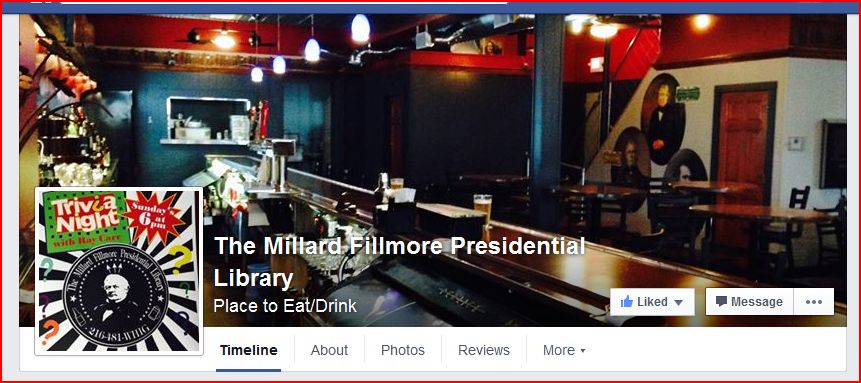
Photo of the interior of the Millard Fillmore Presidential Library, in Cleveland, Ohio. From Facebook page. Motto something like, “This ain’t the LBJ Library.”
A promising place for scholarship on our 13th president, perhaps. Photos of Fillmore, previously unknown, have been published by this establishment.
The new Millard Fillmore Presidential Library casts new light on the 13th president’s talents and methods of relaxation.
Finally, a place to properly celebrate Millard Fillmore’s 216th birthday anniversary, today!
Spread the word; friends don't allow friends to repeat history.
Kenny sent an e-mail, with a link to Donald Trump, saying “China.”
So, we went to see.
Among other things, Kenny’s brother James, our younger son, was getting married in Beijing. Good excuse to travel. Keeping with the rule that one should spend at least a day in a destination for every hour of travel it takes to get there, we planned 13 days.
I don’t think Donald Trump knows China.
After 13 days and a few thousand miles, and perhaps a few hundred supreme dumplings and two Beijing ducks, fugu, and noodles of nearly endless variety, with gallons of stout vinegars you won’t find in a U.S. supermarket, I know I don’t know China.
(I don’t think Trump knows much of anything, a very little in any depth; this is funnier now than it was when Kenny sent the link before the trip.)
Following, not always consecutively, some reports on some of the things we saw. Please stay tuned.
We saw the ancient city of Pingyao, Shanxi Province, where wheelers and dealers have been mincing people like Donald Trump for millennia. I’ll bet Trump didn’t go there. (This is a Wikipedia photo, by the way: “Pingyao-oldtown” by Benzh – Own work. Licensed under Public Domain via Commons – https://commons.wikimedia.org/wiki/File:Pingyao-oldtown.jpg#/media/File:Pingyao-oldtown.jpg)
Or, until that account is unsuspended by the forces supporting Donald Trump: Follow @FillmoreWhite, the account of the Millard Fillmore White House Library
We've been soaking in the Bathtub for several months, long enough that some of the links we've used have gone to the Great Internet in the Sky.
If you find a dead link, please leave a comment to that post, and tell us what link has expired.
Thanks!
Retired teacher of law, economics, history, AP government, psychology and science. Former speechwriter, press guy and legislative aide in U.S. Senate. Former Department of Education. Former airline real estate, telecom towers, Big 6 (that old!) consultant. Lab and field research in air pollution control.
My blog, Millard Fillmore's Bathtub, is a continuing experiment to test how to use blogs to improve and speed up learning processes for students, perhaps by making some of the courses actually interesting. It is a blog for teachers, to see if we can use blogs. It is for people interested in social studies and social studies education, to see if we can learn to get it right. It's a blog for science fans, to promote good science and good science policy. It's a blog for people interested in good government and how to achieve it.
BS in Mass Communication, University of Utah
Graduate study in Rhetoric and Speech Communication, University of Arizona
JD from the National Law Center, George Washington University


 Posted by Ed Darrell









 Millard Fillmore's Bathtub
