Blame global warming for wild weather? NASA says, “Blame La Nada”

June 27, 2011

Here’s what NASA said:

What’s to Blame for Wild Weather? “La Nada”

Such sheets of fire, such bursts of horrid thunder,
Such groans of roaring wind and rain, I never
Remember to have heard; man’s nature cannot carry
The affliction nor the fear
… from Shakespeare’s Tragedy of King Lear

June 21, 2011: Record snowfall, killer tornadoes, devastating floods: There’s no doubt about it. Since Dec. 2010, the weather in the USA has been positively wild. But why?

Some recent news reports have attributed the phenomenon to an extreme “La Niña,” a band of cold water stretching across the Pacific Ocean with global repercussions for climate and weather. But NASA climatologist Bill Patzert names a different suspect: “La Nada.”

“La Niña was strong in December,” he says. “But back in January it pulled a disappearing act and left us with nothing – La Nada – to constrain the jet stream. Like an unruly teenager, the jet stream took advantage of the newfound freedom–and the results were disastrous.”

Wild Weather (La Nina, 558px)

The blue and purple band in this satellite image of the Pacific Ocean traces the cool waters of the La Niña phenomenon in December 2010. (from Ocean Surface Topography Mission (OSTM)/Jason-2 satellite, Credit: NASA JPL)

La Niña and El Niño are opposite extremes of a great Pacific oscillation. Every 2 to 7 years, surface waters across the equatorial Pacific warm up (El Niño) and then they cool down again (La Niña). Each condition has its own distinct effects on weather.

The winter of 2010 began with La Niña conditions taking hold. A “normal” La Niña would have pushed the jet stream northward, pushing cold arctic air (one of the ingredients of severe weather) away from the lower US. But this La Niña petered out quickly, and no El Niño rose up to replace it. The jet stream was free to misbehave.

“By mid-January 2011, La Niña weakened rapidly and by mid-February it was ‘adios La Niña,’ allowing the jet stream to meander wildly around the US. Consequently the weather pattern became dominated by strong outbreaks of frigid polar air, producing blizzards across the West, Upper Midwest, and northeast US.”1

The situation lingered into spring — and things got ugly. Russell Schneider, Director of the NOAA-NWS Storm Prediction Center, explains:

“First, very strong winds out of the south carrying warm, moist air from the Gulf of Mexico met cold jet stream winds racing in from the west. Stacking these two air masses on top of each other created the degree of instability that fuels intense thunderstorms.”

Extreme contrasts in wind speeds and directions of the upper and lower atmosphere transformed ordinary thunderstorms into long-lived rotating supercells capable of producing violent tornadoes.2

Wild Weather (La Nada, 558px)

This satellite image, taken in April 2011, reveals La Niña’s rapid exit from the equator near the US coast. The cool (false-color blue) water was gone by early spring. (from Ocean Surface Topography Mission (OSTM)/Jason-2 satellite, Credit: NASA JPL)

In Patzert’s words, “The jet stream — on steroids — acted as an atmospheric mix master, causing tornadoes to explode across Dixie and Tornado Alleys, and even into Massachusetts.”

All this because of a flaky La Niña?

“La Niña and El Niño affect the atmosphere’s energy balance because they determine the location of warm water in the Pacific, and that in turn determines where huge clusters of tropical thunderstorms form,” explains Schneider. “These storms are the main energy source from the tropics influencing the large scale pattern of the jet stream that flows through the US.”

In agreement with Patzert, he notes that the very strong and active jet stream across the lower US in April “may have been related to the weakening La Niña conditions observed over the tropical Pacific.”

And of course there’s this million dollar question: “Does any research point to climate change as a cause of this wild weather?”

“Global warming is certainly happening,” asserts Patzert, “but we can’t discount global warming or blame it for the 2011 tornado season. We just don’t know … Yet.”3

What will happen next? And please don’t say, “La Nada.”

Author: Dauna Coulter | Editor: Dr. Tony Phillips | Credit: Science@NASA

End Notes

(1) Other atmospheric factors also contributed to the inflow of frigid polar air, says Patzert. One of the most significant was a weakening in the whirlpool motion of the air around the North Pole. As a result of this weakening, more cold air flowed away from the pole and down toward the states. Climatologists call this an “arctic oscillation.”

(2) Imagine a paddle wheel oriented like a Ferris wheel and placed in winds that that are much stronger at the top than at the bottom. The wheel will spin in the direction of the strong winds above. This spring, these strong, turning winds led to ongoing rotation of the supercells themselves. So we ended up with intense rotation and updraft close to Earth’s surface — conditions ripe for strong tornadoes.

(3) On May 26, 2011, Patzert posted a comment about this topic on Andrew Revkin’s The New York Times’ DOT EARTH Blog, “Demography, Design, Atom Bombs and Tornado Deaths.” See comment 6 at this URL.

Looks to me as if the people at NASA are saying we should go slow, and not rush to blame our weather woes on climate change. Climate change “skeptics” should be so skeptical.


Cool solar flare this week

June 9, 2011

Old Sol spoke out this week:  Huge solar flare on June 7.

For scientists, it was a cool deal — especially since the flair was on the side of the Sun facing us, and there were cameras of various types trained on the action.

But just watch:  The internet will light up with concerns about 2012, and those who deny warming occurs or that humans cause it, will find some reason to claim the solar flare shows that Al Gore is fat and Rachel Carson is a mass murderer, plus Darwin was the inspiration for Adolf Hitler.

If the Sun knew it would get such a reception, would it bother?

Take a look:

June 7, 2011 solar flare -- NASA/SDO

Still shot of the June 7, 2011 solar flare -- NASA/SDO via PopSci

Here’s a pixillated video of the event in UV at 304 Angstroms — it runs under 30 seconds, but the time covered is about two-and-a-half hours; from SOHO – SDO via TheSunToday.org:

Another view, again UV, but at 171 Angstroms:

Tip of the old scrub brush to PopSci.

Resources:


Annals of global warming: Al Gore didn’t invent it, Isaac Asimov explained in 1989

June 8, 2011

Amber Jenkins wrote over at NASA’s site:

I stumbled upon this video earlier today. It’s Isaac Asimov, famous science fiction writer and biochemist, talking about global warming — back in January 1989. If you change the coloring of the video, the facial hair style, and switch out Asimov for someone else, the video could pretty much have been made today.

Asimov was giving the keynote address at the first annual meeting of The Humanist Institute. “They wanted me to pick out the most important scientific event of 1988. And I really thought that the most important scientific event of 1988 will only be recognized sometime in the future when you get a little perspective.”

What he was talking about was the greenhouse effect, which, he goes on to explain, is “the story everyone started talking about [in 1988], just because there was a hot summer and a drought.” (Sound familiar, letting individual weather events drive talk of whether the Earth’s long-term climate is heating up or cooling down??)

The greenhouse effect explains how certain heat-trapping (a.k.a. “greenhouse”) gases in our atmosphere keep our planet warm, by trapping infrared rays that Earth would otherwise reflect back out into space. The natural greenhouse effect makes Earth habitable — without our atmosphere acting like an electric blanket, the surface of the earth would be about 30 degrees Celsius cooler than it is now.

The problem comes in when humans tinker with this natural state of affairs. Our burning of fossil fuels (coal, oil and gas) constantly pumps out carbon dioxide — a heat-trapping gas — into the atmosphere. Our cutting down of forests reduces the number of trees there are to soak up some of this extra carbon dioxide. All in all, our atmosphere and planet heats up, (by about 0.6 degrees Celsius since the Industrial Revolution) with the electric blanket getting gradually thicker around us.

“I have been talking about the greenhouse effect for 20 years at least,” says Asimov in the video. “And there are other people who have talked about it before I did. I didn’t invent it.” As we’ve stressed here recently, global warming, and the idea that humans can change the climate, is not new.

As one blogger notes, Asimov’s words are as relevant today as they were in 1989. “It’s almost like nothing has happened in all this time.” Except that Isaac Asimov has come and gone, and the climate change he spoke of is continuing.

Asimov’s full speech can be seen here.

Scientists have been on the job that long, yes.  Al Gore didn’t invent global warming or climate change, contrary to the working beliefs of much of the “no human warming” crowd.

One of the commenters at Jenkins’ blog put things in perspective:

Jim
January 8, 2011 – 10:22 PST

Interestingly, 1988 was
• the last year that we were not in ecological overshoot
• the last year we were at 350 Parts per million CO2
• the publication date of Joseph Tainter’s he Collapse of Complex Societies http://intersci.ss.uci.edu/wiki/index.php/The_Collapse_of_Complex_Societies


Scouts Shooting for the Moon: The story of twelve Moon walkers, and Scouting

April 30, 2011

1cernan_jump_salutes_flag_-_gpn-2000-001273_0

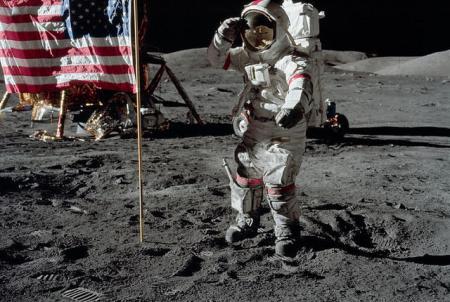
Astronaut and 2nd Class Boy Scout Eugene Cernan saluted the U.S. flag on the Moon, on the last Apollo mission, Apollo 17. Photography by Astronaut and Tenderfoot Scout Harrison Schmitt. NASA image.

A short piece I presented this morning to the Tom Harbin Scout Museum Symposium on Scout History, a great morning organized by Bob Reitz, the curator of the Tom Harbin Scout Museum at Camp Wisdom, in Dallas, Texas. Of course the material is copyrighted, but by all means you have permission to use the material at Courts of Honor or in recounting the better history of Boy Scouting.

Scouts Shooting for the Moon:  The story of twelve Moon walkers, and Scouting

This is a recreation with modern numbers of a presentation first used a decade ago. Searching for material for a speech to honor Eagles at our District Dinner, several people suggested in a short period of time, ‘Why not talk about the astronauts who landed on the Moon. I hear they were all Eagle Scouts.’  Was that accurate?  It would have been a good story if so. Research revealed something quite different. The true story can carry just as much inspiration, however. Scouting is shown to be a program that can lead to a lifetime of adventure and accomplishment. Also, Eagles may take some inspiration in knowing they have accomplished something most of the men who walked on the Moon did not.

Speakers constantly need good material for Eagle Scout Courts of Honor and other events honoring Scouts and Scouters. For one event honoring a group of new Eagle Scouts, several people urged that I research the facts behind the story they had heard, that most, or all of the men who walked on the Moon were Eagle Scouts. New Eagles would find comfort in knowing they had soared into the midst of such company, they reasoned.

So it came to pass that, before the advent of Wikipedia and Google, I spent hours on the telephone until a press person at NASA pointed out to me a collection of information on astronauts that NASA had thoughtfully put on-line. At some high cost I printed out the few pages that dealt with the Scouting experience of astronauts, and worked to correlate it with information about which of them had gone to the moon, and which had not.

Anyone can find that book online with ease, today. The NASA Astronaut Fact Book provides information on almost every detail about NASA’s crew of astronauts, past and present. It includes one-and-a-half pages on the Scouting background of people working as astronauts and payload specialists for NASA, and others NASA has launched into manned missions. Cross-indexing that information with lists of Apollo Mission astronauts, I created four short tables showing the Apollo astronauts who went to the Moon, their missions, and the Scout rank they achieved, if any.

Lunar Astronauts and Scouting Experience

Twelve Moon Walkers

Name Mission Dates on the Moon Scout Rank
1 Neil Armstrong Apollo 11 July 21, 1969 Eagle Scout
2 Buzz Aldrin Apollo 11 July 21, 1969 Tenderfoot Scout
3 Pete Conrad Apollo 12 November 19-20, 1969 Cub Scout
4 Alan Bean Apollo 12 November 19-20, 1969 1st Class
5 Alan Shepard Apollo 14 February 5-6, 1971 1st Class
6 Edgar Mitchell Apollo 14 February 5-6, 1971 Life Scout
7 David Scott Apollo 15 July 31-August 2, 1971 Life Scout
8 James Irwin Apollo 15 July 31-August 2, 1971 None
9 John Young Apollo 16 April 21-23, 1972 2nd Class
10 Charles Duke Apollo 16 April 21-23, 1972 Eagle Scout
11 Eugene Cernan Apollo 17 December 11-14, 1972 2nd Class
12 Harrison Schmitt Apollo 17 December 11-14, 1972 Tenderfoot Scout

Apollo 13

Name Mission Dates on the Moon Scout Rank
1 Jim Lovell Apollo 13 Lunar Swingby Eagle Scout
2 Jack Swigert Apollo 13 Lunar Swingby 2nd Class
3 Fred Haise Apollo 13 Lunar Swingby Star

Lunar Missions That Did Not Land

Name Mission Dates on the Moon Scout Rank
1 Frank Borman Apollo 8 Orbited only None
2 Jim Lovell Apollo 8 (&13) Orbited only Eagle Scout
3 William Anders Apollo 8 Orbited only Life Scout
4 Tom Stafford Apollo 10 Orbited only Star Scout
5 John Young Apollo 10 (& 16) Orbited only 2nd Class
6 Eugene Cernan Apollo 10 (& 17) Orbited only 2nd Class

Others Who Did Not Land

Name Mission Dates on the Moon Scout Rank
1 Michael Collins Apollo 11 Capsule pilot None
2 Dick Gordon Apollo 12 Capsule pilot Star Scout
3 Stewart Roosa Apollo 14 Capsule pilot None
4 Al Worden Apollo 15 Capsule pilot 1st Class
5 Ken Mattingly Apollo 16 Capsule pilot Life Scout
6 Ronald Evans Apollo 17 Capsule pilot Life Scout

In all, 24 men flew to the Moon. Twelve set foot on the lunar surface. Of the twelve, eleven were Scouts, two were Eagles. Of the 24, 20 were Scouts, three were Eagles.

At the time I originally researched, about 70% of all astronauts were alumni of Scouting, men and women. Officially, BSA lists 181 NASA astronauts as being alumni, 57.4%

NASA lists the colleges and universities astronauts attended. NASA lists military service, hometowns, and states of birth. But with the possible exception of a generic category of “public schools,” no category of astronauts is larger than the category of Scouting experience. If we were advising a young person on how to get to become an astronaut, we would be remiss if we did not advise him or her to join Scouting.

What can we conclude?

Three things became apparent to me in tracking these figures down. One, I learned once again that the true stories most often carry great value, more value than the stories people make up, or assume.

Two, I learned that Scouting by itself carries great value, without a Scout’s having earned Eagle. We know that not all the Moon walkers earned the Eagle rank. But we also notice that no flight ever went to the Moon without at least two Scouts aboard. Three of the 24 lunar voyagers are Eagles, 12.5%. Two of the dozen who actually set foot on the Moon are Eagles, 16.7%. Eleven of the twelve Moon walkers were Scouts, 91.7%. 21 of 24 lunar voyagers were Scouts, 87.5%.

So, while it was not necessary to be an Eagle, it certainly seemed to help. But simply having Scouting experience seemed to be the biggest help. There may be some magic in a boy’s having taken that oath that carries through his entire life, and spurs him to do daring and great things. That is important. A trend begins to emerge. Scouting by itself, without earning the highest rank, provides great value. When a boy signs up, he signs on for the adventure of a lifetime, and often that leads to a lifetime of adventure. That venturesome spirit carries on well past his Scouting years.

The story of Jim Lovell might carry some great weight with Scouts. Lovell is the only person to have gone to the Moon twice, but never set foot on it. He was the commander of Apollo 13, whose near-disaster was chronicled in the movie of the same name. Among other lessons that might be pulled out of the story:  When your Moon-bound spaceship explodes and loses power on the way to the Moon, it is often good to have an Eagle Scout handy to help get through the experience and return safely.

Is there inspiration here?

When I first presented these figures at a Scout meeting, a parent asked me whether these numbers would discourage boys from working for any rank advancement, since just being a Scout seems to carry such weight. This should not discourage Eagles, nor discourage any Scout from working to get the Eagle rank. We should look at it this way:  Every Scout who earns an Eagle has done what ten of the twelve who walked on the Moon did not do, perhaps could not do. Nine more Moon walkers started on that path to Eagle, but did not finish, or could not finish.

Not every Eagle can go to the Moon, but every Eagle has already won an award that most of those who did go to the Moon wish they had.

Especially in the circles of corporate and government leadership, character, what it is and how to get it, concerns people. What sort of character does it take to go to the Moon? Every Scout has a glimpse of what is required, and every Eagle can say, “I know what it takes to get such character.”

Bibliography

Human Spaceflight, “The Apollo Program,” NASA, July 2, 2009; accessed April 28, 2011; http://spaceflight.nasa.gov/history/apollo/

Astronaut Fact Book, NASA,  NP-2005-01-001JSC, January 2005; accessed April 27, 2011; spaceflight.nasa.gov/spacenews/factsheets/pdfs/astro.pdf

BSA, “Facts About Scouting,” 2009; accessed April 28, 2011; http://www.scouting.org/about/factsheets/scoutingfacts.aspx

“Astronauts With Scouting Experience,” Eagle Scout Information, U.S. Scouting Service Project, April 6, 2011; accessed April 29, 2011; http://www.usscouts.org/eagle/eagleastronauts.asp

About the author:

Ed Darrell teaches U.S. History at Moises E. Molina High School in Dallas. He has taught economics, government, world history and street law in high schools; he also taught at the University of Utah, University of Arizona, and DeVry University. He is a former speech writer for politicians. His degree in Mass Communication came from the University of Utah, and his law degree from George Washington University. This was presented to the Jack Harbin Museum Symposium of Scout History, April 30, 2011.

World Scout badge carried to the Moon by Astronaut Neil Armstrong.

World Scout badge carried to the Moon by Astronaut Neil Armstrong.


Save


Depending on your perspective, the world looks pretty good

January 2, 2011

If you’re a few dozen miles from the Earth, for example:

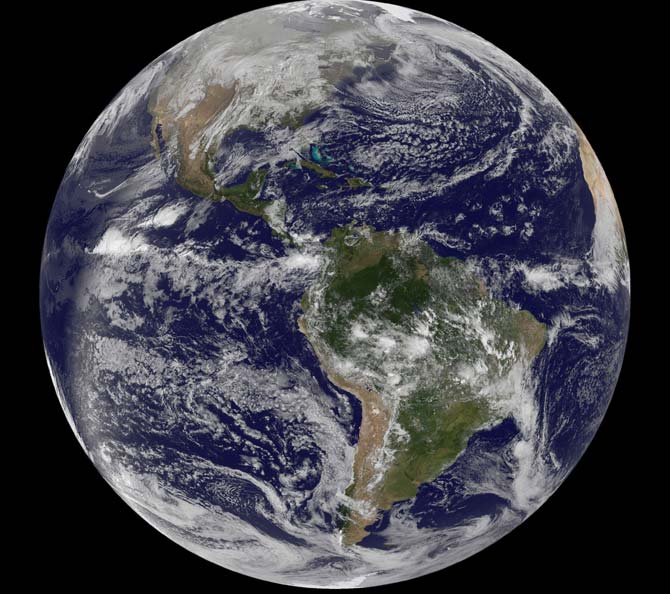
Earth full disc, December 30, 2010 - NASA, GOES

From NASA: The GOES-13 satellite captured a "full-disk image" of North and South America in an image created December 30 at 1445 UTC (9:45 a.m. EST), as the world awaits the new year. Credit: NOAA/NASA GOES Project; click on picture for larger view

Press information from NASA:

As the World Turns to 2011 GOES Satellites Watch its Approach and Look Back at 2010

The GOES series of satellites keep an eye on the weather happening over the continental U.S. and eastern Pacific and Atlantic Oceans and had a busy time with wild weather in 2010. Today, GOES-13 captured one of the last images of North and South America in 2010 as the world continues to turn toward 2011.

The Geostationary Operational Environmental Satellite called GOES-13 satellite captured a “full-disk image” of North and South America in an image created December 30 at 1445 UTC (9:45 a.m. EST) as the world awaits the new year. The stunning image shows cloud cover associated low pressure areas over the upper Midwestern U.S. and Colorado’s Rocky Mountains.

NASA’s GOES Project, located at NASA’s Goddard Space Flight Center in Greenbelt, Md., procures and manages the development and launch of the GOES series of satellites for NOAA on a cost-reimbursable basis. NASA’s GOES Project also creates some of the GOES satellite images and GOES satellite imagery animations. NOAA manages the operational environmental satellite program and establishes requirements, provides all funding and distributes environmental satellite data for the United States.

NASA’s GOES Project was very busy this year. GOES-13 monitors the eastern continental U.S., Atlantic Ocean, Gulf of Mexico and Caribbean, while GOES-11 monitors weather conditions over the western U.S. and the Eastern Pacific Ocean.

In 2010, GOES satellites were busy providing images and animations of weather systems from nor’easters to tropical cyclones that caused blizzards, flooding and wind damage.

Most recently, the GOES project used satellite data to create an impressive animation of the great Christmas weekend blizzard that pummeled the northeastern U.S. Prior to that, GOES imagery showed travel conditions for the holiday weekend when that low was over the Colorado Rockies.

On Dec. 19, the GOES-11 satellite captured an image of the famous “Pineapple Express.” Occasionally in the winter, a large jet stream forms across the mid-Pacific, carrying a continuous flow of moisture from the vicinity of Hawaii to California, bringing heavy rain and snow to the Sierra-Nevada for several days.

On Dec. 8 GOES-13 satellite imagery revealed a snow-covered, winter-like upper Midwest, several weeks before astronomical winter. On Nov. 24, GOES satellites helped Thanksgiving travelers figure out where delays may be happening.

During the summer, on July 25, GOES-13 imagery tracked one of the most destructive storms in years to strike Washington, D.C. and the surrounding area. Strong winds downed trees and power lines, leaving hundreds of thousands of residents without power, stopping elevators, and darkening malls and movie theaters. Falling trees killed at least two people. The NASA GOES Project created a satellite animation of the storm as moved through the region.

GOES-13 was busy in the Atlantic during the 2010 hurricane season. The Atlantic season started on June 1 and ended on November 30. The Atlantic season tied for third with two other years (1995 and 1887) as having the largest number of named storms at 19, and tied with two other seasons (1969 and 1887) for the second largest number of hurricanes, with 12. GOES-13 covered all of those tropical cyclones. GOES-11 didn’t see the action in the Eastern Pacific tropics that GOES-13 did, however. Because of a La Niña event, the 2010 Pacific hurricane season (which began May 15 and ended Nov. 30) was the least active season in terms of the number of named storms and hurricanes on record. All tropical cyclones can be seen at NASA’s Hurricane page archives for 2010 at: http://www.nasa.gov/mission_pages/hurricanes/archives/index.html.

On April 14, months before hurricane season started, GOES-13 became the official GOES-EAST satellite. GOES-13 was moved from on-orbit storage and into active duty. It is perched 22,300 miles above the equator to spot potentially life-threatening weather, including tropical storm activity in the Atlantic Ocean and Gulf of Mexico..

Before GOES-13 moved into the position previously occupied by GOES-12, GOES-12 captured a parade of three large storms the flooded the upper Midwest and Northeast in the second half of March. In the first half of March, GOES-12 covered storms as they dumped heavy rainfall in the Northeastern U.S.

On March 12, GOES-12 captured a very rare event in the tropics: the second–ever known tropical cyclone called Tropical Storm 90Q formed in the South Atlantic Ocean off the coast of Argentina.

During the first two weeks of February 2010, the GOES-12 weather satellite also observed a record-setting series of “Nor’easter” snow storms which blanketed the mid-Atlantic coast in two blizzards.

Whatever and wherever the weather in 2011, the GOES series of satellites will always go.

Related Links:

› GOES-POES web site
› NOAA web site

Rob Gutro
NASA’s Goddard Space Flight Center, Greenbelt, Md.


Celestial holiday ornament – I mean, supernova bubble

December 28, 2010

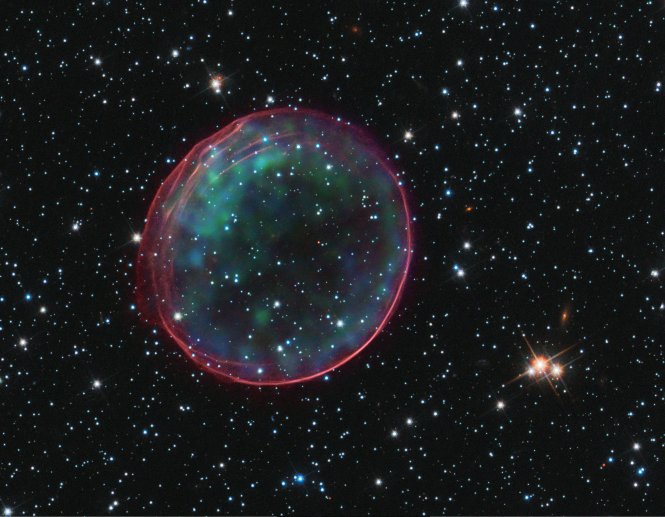
Supernova SNR 0509-67.5, image a composite of Hubble Space Telescope and CHANDRA X-ray Observatory images - image from NASA (click on image for larger view)

Supernova SNR 0509-67.5, image a composite of Hubble Space Telescope and CHANDRA X-ray Observatory images - image from NASA (click on image for larger view)

Press release from NASA:

This colorful creation was made by combining data from two of NASA’s Great Observatories. Optical data of SNR 0509-67.5 and its accompanying star field, taken with the Hubble Space Telescope, are composited with X-ray energies from the Chandra X-ray Observatory. The result shows soft green and blue hues of heated material from the X-ray data surrounded by the glowing pink optical shell which shows the ambient gas being shocked by the expanding blast wave from the supernova. Ripples in the shell’s appearance coincide with brighter areas of the X-ray data.

The Type 1a supernova that resulted in the creation of SNR 0509-67.5 occurred nearly 400 years ago for Earth viewers. The supernova remnant, and its progenitor star reside in the Large Magellanic Cloud (LMC), a small galaxy about 160,000 light-years from Earth. The bubble-shaped shroud of gas is 23 light-years across and is expanding at more than 11 million miles per hour (5,000 kilometers per second).

Data from Hubble’s Advanced Camera for Surveys, taken in 2006 with a filter that isolates light from glowing hydrogen were combined with visible-light images of the surrounding star field that were imaged with Hubble’s Wide Field Camera 3 in 2010. These data were then merged with X-ray data from the Chandra X-ray Observatory taken with the Advanced CCD Imaging Spectrometer (ACIS) in 2000 and 2007.

Credits: X-ray: NASA/CXC/SAO/J.Hughes et al, Optical: NASA/ESA/Hubble Heritage Team (STScI/AURA)


Annals of Global Warming: Lakes warming in temperate regions worldwide

November 24, 2010

While we were trying (unsuccessfully) to find the criminals who hacked the e-mails of scientists, and trying (unsuccessfully for the most part) to point out that being victims of a crime does not mean a group’s research is faulty, and watching the disastrous results of the cynical assault on American politics by e-mail thieves and modern enemies of Hypatia, the world continues to spin.  Galileo so aptly described the news:  Eppur si muove!

Lake Tahoe, Emerald Bay - one of the world's warming lakes - NASA photo

Lake Tahoe, seen here from Emerald Bay, was one of the primary validation sites for the global lake study. The lake, which straddles the borders of California and Nevada, is the largest alpine lake in North America. Image credit: NASA-JPL

Against those religiously inclined to ignore the facts, a modern Galileo could say:  Eppure, lei si scalda!

Just a few months ago critics of science told us that the Copenhagen conference on climate change was unnecessary, because the world is cooling, and not warming.  Eleven months ago, supporters of the theft of e-mails from the Hadley Climate Research Unit in Britain claimed that researchers had goofed about global warming, and then covered it up.  The sad old Earth kept turning and orbiting . . .

Comes now this news from NASA:

November 23, 2010

Jet Propulsion Laboratory, Pasadena, Calif.

RELEASE : 10-308

NASA Study Finds Earth’s Lakes Are Warming

WASHINGTON — In the first comprehensive global survey of temperature trends in major lakes, NASA researchers determined Earth’s largest lakes have warmed during the past 25 years in response to climate change.

Researchers Philipp Schneider and Simon Hook of NASA’s Jet Propulsion Laboratory in Pasadena, Calif., used satellite data to measure the surface temperatures of 167 large lakes worldwide.

They reported an average warming rate of 0.81 degrees Fahrenheit per decade, with some lakes warming as much as 1.8 degrees Fahrenheit per decade. The warming trend was global, and the greatest increases were in the mid- to high-latitudes of the Northern Hemisphere.

“Our analysis provides a new, independent data source for assessing the impact of climate change over land around the world,” said Schneider, lead author of the study published this week in the journal Geophysical Research Letters. “The results have implications for lake ecosystems, which can be adversely affected by even small water temperature changes.”

Small changes in water temperature can result in algal blooms that can make a lake toxic to fish or result in the introduction of non-native species that change the lake’s natural ecosystem.

Scientists have long used air temperature measurements taken near Earth’s surface to compute warming trends. More recently, scientists have supplemented these measurements with thermal infrared satellite data that can be used to provide a comprehensive, accurate view of how surface temperatures are changing worldwide.

The NASA researchers used thermal infrared imagery from National Oceanic and Atmospheric Administration and European Space Agency satellites. They focused on summer temperatures (July-September in the Northern Hemisphere and January-March in the Southern Hemisphere) because of the difficulty in collecting data in seasons when lakes are ice-covered and/or often hidden by clouds. Only nighttime data were used in the study

The bodies studied were selected from a global database of lakes and wetlands based on size (typically at least 193 square miles or larger) or other unique characteristics of scientific merit. The selected lakes also had to have large surface areas located away from shorelines, so land influences did not interfere with the measurements. Satellite lake data were collected from the point farthest from any shoreline.

The largest and most consistent area of warming was northern Europe. The warming trend was slightly weaker in southeastern Europe, around the Black and Caspian seas and Kazakhstan. The trends increased slightly farther east in Siberia, Mongolia and northern China.

In North America, trends were slightly higher in the southwest United States than in the Great Lakes region. Warming was weaker in the tropics and in the mid-latitudes of the Southern Hemisphere. The results were consistent with the expected changes associated with global warming.

The satellite temperature trends largely agreed with trends measured by nine buoys in the Great Lakes, Earth’s largest group of freshwater lakes in terms of total surface area and volume.

The lake temperature trends were also in agreement with independent surface air temperature data from NASA’s Goddard Institute for Space Studies in New York. In certain regions, such as the Great Lakes and northern Europe, water bodies appear to be warming more quickly than surrounding air temperature.

For more information about NASA and agency programs, visit:

http://www.nasa.gov

– end –


Warming trends in temperate zone lakes, 1985-2009 - NASA image, JPL

Global trends in seasonal nighttime lake surface temperatures, 1985-2009. Image credit: NASA/JPL-Caltec

World wide, a few lakes show not a great deal of warming, but none of the lakes sampled showed any cooling over the past two-and-a-half decades.


Last Space Shuttle mission: Help NASA pick the wake-up tunes

August 21, 2010

How about, “The Party’s Over” for the very last Shuttle wake-up call?

Press release from NASA, August 20, 2010:

RELEASE : 10-193

NASA Asks Public for Final Shuttle Missions’ Wakeup Songs

HOUSTON — If you like music, the space program and are a little nostalgic, NASA has the perfect opportunity for you. For the first time, the public can help choose songs to wake up the astronauts during the last two scheduled space shuttle missions.

Traditionally, the songs played to wake up the astronauts are selected by friends and family of the crews. For the last two scheduled missions, NASA is inviting the public to visit the “Wakeup Song Contest” website to select songs from a list of the top 40 previous wakeup calls or to submit original tunes for consideration. To vote or submit a song, visit:

https://songcontest.nasa.gov

The two songs with the most votes from the top 40 list will be played as crew wakeup calls on the final scheduled flight of space shuttle Discovery. Discovery’s STS-133 mission is targeted to launch on Nov. 1.

“We’re looking forward to hearing which songs the public wants played for us,” STS-133 Commander Steve Lindsey said. “It’s going to be a difficult choice, because there have been so many great songs played over the years.”

Original songs must have a space theme and be submitted to NASA by 4 p.m. CST on Jan. 10, 2011. The songs will be reviewed by agency officials and the top finalists put to a public vote. The top two songs will be used to wake space shuttle Endeavour’s STS-134 crew.
Endeavour’s mission is the last scheduled space shuttle flight. It is targeted to launch on Feb. 26, 2011.

“Space shuttle crews really enjoy the morning wake-up music,” STS-134 Commander Mark Kelly said. “While we don’t have the best quality speaker in the space shuttle, it will be interesting to hear what the public comes up with. We are looking forward to it.”

The song contest campaign follows NASA’s ongoing “Face in Space” project. It invites the public to send electronic images of their faces into orbit aboard one of the final remaining space shuttle missions. To submit your image, visit:

http://faceinspace.nasa.gov

For more information about the Space Shuttle Program and the STS-133 and STS-134 missions to the International Space Station, visit:

http://www.nasa.gov/shuttle

For more information about the space station, visit:

http://www.nasa.gov/station

– end –


NASA awards Global Climate Change Education grants

August 18, 2010

NASA announced a series of awards totaling $7.7 million to 17 agencies who will work to improve education on climate change. One of NASA’s goals and duties is to educate about NASA research.

These grants have been in the mill for a while, and should be welcomed by the winners of the awards. Wait for people convinced climate change isn’t happening or shouldn’t be prevented, to howl up a storm. 

Here’s the press release:

NASA Announces 2010 Global Climate Change Education Awards

WASHINGTON — NASA has awarded $7.7 million in cooperative agreements to 17 organizations across the United States to enhance learning through the use of NASA’s Earth science resources. The selected organizations include colleges and universities, nonprofit groups, and a community college. The winning proposals in the Global Climate Change Education Awards illustrated innovative approaches to using NASA content in elementary, secondary and undergraduate teaching, and lifelong learning. The proposals emphasized engaging students in NASA Earth observation data and Earth system models, and providing climate-related research experiences for teachers and undergraduate students. Each cooperative agreement is expected to leverage NASA’s unique contributions in climate and Earth system science. The grants support NASA’s goal of engaging students in the critical disciplines of science, technology, engineering and mathematics, and inspiring the next generation of researchers and explorers. The 17 proposals will fund organizations in Washington, D.C., and 13 states: California, Colorado, Florida, Idaho, Massachusetts, Minnesota, Nebraska, New Hampshire, New York, North Carolina, Ohio, Oregon and Pennsylvania. Winning proposals were selected through a merit-based, peer-reviewed competition. The performance period is up to three years and awards range in value from $300,000 to $700,000. For a list of selected organizations and projects descriptions, click on “Selected Proposals” and look for “Global Climate Change Education” at: http://nspires.nasaprs.com For information about NASA’s education programs, visit: http://www.nasa.gov/education

– end –

Winning proposals came from organizations across the nation (home state listed in parentheses; last name of principal investigator after the dash). Selected proposals in Funding Category D/M: Using NASA Earth system data, interactive models and simulations to Strengthen Teaching and Learning about Global Climate

  • American Meteorological Society – Brey
  • Columbia University – Chandler
  • Cayuga Community College (New York) – Coughlin
  • University of Toledo (Ohio) – Czajkowski
  • University of California at Riverside – Droser
  • University of North Carolina – Gray
  • Florida Atlantic University – Lambert
  • University of New Hampshire – Martin
  • Colorado State University – Moore
  • University of Idaho – Mulkey
  • University of Minnesota – Roehrig
  • University of Massachusetts – Rooney-Varga
  • SRI International (California) – Zalles

Selected proposals in Funding Category R: Global Climate Change Science Research Experiences for Pre- or In-Service Teachers

  • Institute for Earth Science Research and Education (Pennsylvania) – Brooks
  • Harvard University – Ellison
  • University of Nebraska – Gosselin
  • Oregon State University – O’Connell

Details of the winning proposals can be found here.


Too true for fiction: French fund creationism in U.S., to cripple U.S. science

August 5, 2010

Talk about your plots!

Could it possibly be real?  [Note to the gullible:  No, it couldn’t.]

Jason O’Mahony reports:

France to fund Creationism in US schools.

The French Ministry of Science and Technology has surprised many by announcing that it is to commit €50 million to a campaign to encourage anti-science teaching in American schools. A spokesman told us: ” This is a wonderful opportunity for France and Europe. We would like to help American conservatives turn a whole generation of American schoolchildren against science, and instead obsess about stuff in a 2,000 year old book. Today, it’s evolution, but we are confident that within five years we can have them teaching that gravity is a communist idea, and that bio-technology is something to do with the Devil and homosexuality. We have one schoolboard in Alabama voting tomorrow to teach that the Sun revolves around the United States. NASA aren’t happy, but the director of commercial satellite launching of the European Space Agency actually weed himself, he was laughing so much. Sent us a lovely hamper. It had cake.”

The ministry ruled out extending the policy to France. “Absolutely not. we’re building a modern economy here. We need kids who can write software and develop new medicines, not wonder if God designed Zebras to look like they’re wearing pyjamas.”

It must be true, according to Birther Standards of Truenessivity, and the Josh McDowell Rules of Specious Evidence — see the earlier documentation.

Besides, the release spelled “pyjamas” correctly.

Tip of the old scrub brush to correspondent Richard Thomas.

[Serious question:  Is there any way we could persuade O’Mahony to put together a pub guide to global warming?]

Add to FacebookAdd to NewsvineAdd to DiggAdd to Del.icio.usAdd to StumbleuponAdd to RedditAdd to BlinklistAdd to TwitterAdd to TechnoratiAdd to Furl


Power Line, on NASA and Islam: When you start believing your own fictions, you’re in trouble

July 8, 2010

Astronaut Charles Bolden, veteran of four space missions. President Barack Obama appointed Bolden to be NASA Administrator. NASA image.

Astronaut Charles Bolden, veteran of four space missions. President Barack Obama appointed Bolden to be NASA Administrator. NASA image.

Let go of the power line, step back, and no one else will get hurt.

Paul Mirengoff at the much-read, and as we shall see, too-much-trusted PowerLine, asks a heckuva a question:

As Scott points out in the post immediately below, the news that President Obama tasked NASA head Bolden, as perhaps his foremost mission, with raising Muslim self-esteem is entirely absent from the New York Times and the Washington Post, as well as the nightly newscasts of ABC, NBC, and CBS. Why?

It might be, as Mirengoff goes on to speculate wildly and without reason, because the news agencies are taking payoffs from Obama, or just so enthralled with him that they can’t bring themselves to report bad news.

Think about that for a moment:  News agencies unwilling to report bad news?  Is your Hemingway Sh__ Detector working yet?  Mine’s clanging something fierce.

Does Mirengoff seriously think the Poobahs at Disney sit around issuing orders that ABC news gatherers ignore bad news about Obama?  Has Mirengoff been in some sort of plastic bubble, deprived of newspapers and television for the past four years?

Why the silent treatment?  Because it’s very much a not-much-news story, Paul.  It doesn’t say what you think it says, or worse, what you know it doesn’t say, but claim it does for whatever trouble you can stir up.

Charles Bolden, NASA’s administrator, explained for a news channel that broadcasts to the Middle East, what his job is with regard to the Arabic and Islamic populations (this is the version reported by York):

“When I became the NASA administrator, [Obama] charged me with three things,” NASA head Charles Bolden said in a recent interview with the Middle Eastern news network al-Jazeera. “One, he wanted me to help re-inspire children to want to get into science and math; he wanted me to expand our international relationships; and third, and perhaps foremost, he wanted me to find a way to reach out to the Muslim world and engage much more with dominantly Muslim nations to help them feel good about their historic contribution to science, math, and engineering.”

Good reporters would look at the interview, and realize the PowerLine guys got the story dead wrong.  Not bothering to speculate on why part-time yahoos misreported the story, they’d go on to real news.

Note carefully what Bolden said, and then note carefully what he did not say.  Bolden didn’t say the mission of NASA had changed.  Bolden didn’t say Obama told him to ignore the mission of NASA.  Bolden said NASA, arguably our nation’s most famous and vanguard science agency, has a top duty to inspire children to do well in science in math, to cooperate with other nations in exploring space as we have done since at least the Reagan administration, and, for audiences in Arabic nations, to help them understand Arabic contributions to science.

“Let go of the power line, step back, and no one else will get hurt.” Downed powerline in New Jersey, in summer 2011. Photo by Saed Hindash, The Star-Ledger

Bolden did not say, as Hot Air misreported, “NASA’s spaced-out mission no longer includes  . . . space.”  Hot Air isn’t reporting.  This is a time-tested propaganda technique they engage in:  MSU, “making [stuff] up.”

Which of those goals does Power Line disagree with?  Each of them is a noble enterprise on its own.

But, pausing for just a moment to make liars out of Power Line and the Examiner, and others, ABC News got it right. How soon do you think Mirengoff or Scott Johnson at Power Line will update their story to note ABC reported it?  How much longer before others do?

Media Matters, who tend to be more careful and much, much more accurate, tells most of the story in the headline of their story:  “Yet again, an Obama official says ‘Muslim,’ right-wing media freakout follows.”

If ABC can get it right, why not these other guys?

Yellow journalism was bad enough the first time around.  PowerLine, could you at least take the time to get the story right?  If you don’t have a Hemingway to help you out, you can always use the old Cheech and Chong Excrement Detection Method.  I don’t recommend it, but it tends to make reporters more careful if they ever use it once.

You gotta wonder why these people spread easily-falsified, malignant rumors.  Who are they working for?  It’s pretty clear they don’t have much respect for their readers.

This is a hoax, people.  NASA has not changed its mission.  The president cannot change NASA’s mission since that is dictated by law (it requires an “act of Congress,” literally).  NASA’s chief did not say that stupid thing others claim — he’s not stupid. Don’t pretend it’s news, don’t pretend it’s a problem when the head of NASA says he’s trying to promote interest in science, math and history, and international cooperation.  That’s his job.

No one was assigned the job to get the story wrong.  I wish people would quit working so hard at it.

What is Obama’s policy on NASA?  Here’s the 2011 Budget Message.

Here’s the full Al Jazeera interview these guys misreported:

Here’s the Wall of Shame of blogs, reporters and news outlets who screwed up the reporting, in addition to Powerline, twice.

Also see this:  Obama:  A bold new course for NASA

Save

Save


Ken Ham and Atlantis

May 16, 2010

Uh-oh.  Did P. Z. Myers see the name of the commanding officer of the space shuttle Atlantis on the current flight, STS-132?

Short press release from NASA:

Sun, 16 May 2010 06:48:08 -0500

Commander Ken Ham [emphasis added] and the crew of Atlantis performed the Terminal Initiation burn at 7:40 a.m. EDT, firing the left Orbital Maneuvering System engine for nine seconds to place the shuttle on the final path for its 10:27 a.m. docking to the International Space Station. When Atlantis is about 600 feet from the station, Ham will maneuver Atlantis through a backflip rotation to expose the heat shield to station crew members who will use digital cameras to photograph Atlantis’ upper and lower surfaces through windows of the Zvezda Service Module. Oleg Kotov will use a 400mm lens, and T.J. Creamer, Soichi Noguchi and Tracy Caldwell Dyson all will use 800mm lenses. The photos will be transmitted to Mission Control for evaluation by imagery experts and mission managers to determine whether the heat shield sustained any damaged during launch.

Not only is it not the same Ken Ham, I’ll wager they are completely unrelated, and that they’ve never met.  I wonder how the astronaut lives with people confusing him with the Ken Ham of the creationism cult.  Perhaps creationists stray into the real process of space exploration so rarely that no one has made the connection yet.

Ken Ham, creationist

. . . this Ken Ham, who doesn't "believe" in much of the science that gets the other Ken Ham into orbit.

Ken Ham, commander of Space Shuttle Atlantis, on STS-132 - NASA photo

This Ken Ham, the astronaut (NASA photo), is not to be confused with . . .


Remembering Christa McAuliffe: Teacher talks with North Carolina school kids, from space

April 13, 2010

Sometimes progress is so strong that we forget to note the milestones.

I’m remembering Christa McAuliffe today.

Tomorrow, April 14, Mission Specialists Dottie Metcalf-Lindenburger is scheduled to talk with students at Eastern Guilford High School in North Carolina, and all of the 71,000 students in Eastern Guilford School District.

Astronaut Dorothy Metcalf-Lindenburger, former teacher - NASA photo

Caption from NASA: STS-131 Mission Specialist Dorothy Metcalf-Lindenburger, attired in a training version of her shuttle launch and entry suit, poses for a photo prior to the start of an ingress/egress training session in the Space Vehicle Mock-up Facility at NASA's Johnson Space Center. Photo Credit: NASA

Metcalf-Lindenburger is one of three teachers selected in 2004 as astronauts.  NASA is committed to help education out.  After the Challenger disaster, and the death of “teacher in space” Christa McAuliffe, NASA finally determined to make teachers into astronauts rather than fly “civilians.”

Bittersweet, but there it is.

Press release from NASA:

Stephanie Schierholz
Headquarters, Washington
202-358-4997
stephanie.schierholz@nasa.gov

Jenna Maddix
Johnson Space Center, Houston
281-244-0185
jenna.c.maddix@nasa.gov

Haley Miller
Guilford Public Schools, Guilford, N.C.
336-370-3200
millerh3@gcsnc.com

April 12, 2010

MEDIA ADVISORY : M10-048

Orbiting Space Shuttle Astronauts — Including Former Teacher — Call North Carolina Students

WASHINGTON — Astronauts orbiting 220 miles above Earth will speak with students in Gibsonville, N.C., on Wednesday, April 14. The call with the students and space shuttle Commander Alan Poindexter and Mission Specialists Dottie Metcalf-Lindenburger, Stephanie Wilson and Clay Anderson will take place at 1:06 p.m. EDT at Eastern Guilford High School in Gibsonville.

Eastern Guilford High School is hosting students from Eastern Guilford Middle School, Gibsonville Elementary, McLeansville Elementary, Rankin Elementary and Sedalia Elementary for the downlink. The school also will broadcast the event to the entire Guilford County Schools district, which serves more than 71,000 students.

The astronauts launched Monday, April 5, aboard space shuttle Discovery from NASA’s Kennedy Space Center in Florida. During the 13-day mission to the International Space Station, the crew will deliver science experiments and supplies; take three spacewalks to switch out a gyroscope on the station’s truss, or backbone; install a spare ammonia storage tank and return a used one; and retrieve a Japanese experiment from the station’s exterior.

Metcalf-Lindenburger is one of three teachers selected to fly as shuttle mission specialists in the 2004 Educator Astronaut Class. She operates the shuttle’s robotic arm. Without robotics, major accomplishments like building the station, repairing satellites in space and exploring other worlds would not be possible.

Students have been preparing for the downlink by conducting NASA engineering design challenges and implementing agency robotics resources and activities into K-12 classrooms. A science, technology, engineering and math, or STEM, club was organized to increase participation and interest, particularly by female students.

The school’s guidance department also is collaborating with local universities to help students investigate and explore STEM opportunities beyond graduation. During follow up in-district workshops in April and May, a NASA Aerospace Education Services Program specialist will demonstrate how to access and use NASA resources in K-12 curricula.

Eastern Guilford High School employee Michael Woods, a former Aerospace Education Services Project specialist at NASA’s Goddard Space Flight Center in Greenbelt, Md., and the agency’s Langley Research Center in Hampton, Va., is leading the downlink effort. In December 2009, NASA awarded Guilford County Schools a two-year grant of nearly $1 million to help middle and high school teachers develop science lessons using the space agency’s content.

The event is part of a series with educational organizations in the U.S. and abroad to improve teaching and learning in science, technology, engineering and mathematics. The in-orbit call is part of Teaching From Space, a NASA project that uses the unique environment of human spaceflight to promote learning opportunities and build partnerships with the kindergarten through 12th grade education community.

NASA Television will air video of the astronauts during the downlink. For NASA TV downlink, schedule and streaming video information, visit:

http://www.nasa.gov/ntv

Even Bob Park will pipe down for a day for this (though he’s right, you know).


One more way to know Apollo 11 landed on the Moon

April 4, 2010

Every year at this time . . .

In a discussion of the Cold War, the Space Race, and the Race to the Moon, we get to a photo about Apollo 11’s landing on the Moon.

Like clockwork, a hand goes up:  “Mr. Darrell, wasn’t that landing a hoax?  They didn’t really go to the Moon then, did they?”

There are a lot of ways to know that Apollo 11 landed on the Moon.  Among other things, students could talk to people alive at the time who have the slightest bit of technological savvy:  With lots of other people, I tracked part of the trip with my 6-inch reflecting telescope.  Ham radio operators listened in on the radio broadcasts.  And so on.

But I really like this chunk of evidence:  How about a photograph of the landing site?

Holy cow!  You can see the tracksof Neil Armstrong’s footprints to the lip of Little West crater (see arrow below).

Tranquility Base, from the LROC -- showing evidence of Apollo 11's landing -

Tranquility Base, shot from the Lunar Reconnaissance Orbiter Camera (LROC), showing the traces left by Apollo 11's landing on the Moon. It really happened. Credit: NASA/GSFC/Arizona State University

According to the LROC website:

The astronaut path to the TV camera is visible, and you may even be able to see the camera stand (arrow). You can identify two parts of the Early Apollo Science Experiments Package (EASEP) – the Lunar Ranging Retro Reflector (LRRR) and the Passive Seismic Experiment (PSE). Neil Armstrong’s tracks to Little West crater (33 m diameter) are also discernable (unlabeled arrow). His quick jaunt provided scientists with their first view into a lunar crater.

Check out this video made from the photos, “High Noon at Tranquility Base”:

Fox News?  What’s your story now?

More:

Tip of the old scrub brush to Collect Space forum, and the Carnival of Space #147 at Weird Sciences.  Thanks to ScienceBlips for telling us about Carnival of Space.


Where’s that global cooling the denialists promised?

January 20, 2010

Forgetting that the planet has seasons, climate denialists for months have been hoo-hooing  about snowfalls and cold weather.  Some of the more serious propagandists among them claim that the Earth is now in a cooling cycle, and that temperatures have been falling since the record hot year of 1998.

Really?

Head on over to Open Mind, and take a look at the facts.

NASA GISS [Goddard Institute for Space Studies] has released the estimated monthly temperature for December 2009, which closes out the year 2009, which closes out the decade of the 2000s. The result: 2005 is still the hottest calendar year, 2009 is the 2nd-hottest year ever, although it’s really in a statistical tie with 1998, 2002, 2003, 2006, and 2007.

They’ve confused weather with climate.  They’ve failed to keep score.  Perhaps they’ve spent wasted their time hacking e-mails instead of measuring climate.

RealClimate carries the news in a post by some of NASA’s top scientists, including James Hansen:

The past year, 2009, tied as the second warmest year in the 130 years of global instrumental temperature records, in the surface temperature analysis of the NASA Goddard Institute for Space Studies (GISS). The Southern Hemisphere set a record as the warmest year for that half of the world. Global mean temperature, as shown in Figure 1a, was 0.57°C (1.0°F) warmer than climatology (the 1951-1980 base period). Southern Hemisphere mean temperature, as shown in Figure 1b, was 0.49°C (0.88°F) warmer than in the period of climatology.

How will the critics treat this news?  And, what were they doing during the past decade when all those warm days rolled into weeks, rolled into months and years, and finally, to the warmest decade ever?

Global land  temperature mean for the decade ending 2009, plus hemispheric comparisons

Caption from RealClimate: Figure 1. (a) GISS analysis of global surface temperature change. Green vertical bar is estimated 95 percent confidence range (two standard deviations) for annual temperature change. (b) Hemispheric temperature change in GISS analysis. (Base period is 1951-1980. This base period is fixed consistently in GISS temperature analysis papers. . . Base period 1961-1990 is used for comparison with published HadCRUT analyses in Figures 3 and 4.)

Heat things up a bit, and spread the alarm:

Add to FacebookAdd to NewsvineAdd to DiggAdd to Del.icio.usAdd to StumbleuponAdd to RedditAdd to BlinklistAdd to TwitterAdd to TechnoratiAdd to Furl