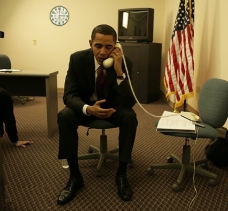
George C. Wallace, and Barack Obama

November 5, 2008

Would George Wallace, the late segregationist Governor of Alabama and one-time threat to win the presidency, have voted for Barack Obama?

Ask George Wallace’s daughter, Peggy Wallace Kennedy.  You might be surprised.

Wallace’s politics were a southern response to what was perceived as Washington’s abandoning of the southern states.  Bush’s policies, especially in the wake of hurricanes that destroyed New Orleans and many other communities in the south, look the same to many southerners.

So, which way would Wallace have voted?


Is our children learning science? O, woe is Texas

November 5, 2008

So, last week or so I commented on the woes of Kentucky, where, the polls showed, 28% of voters were yoked with the millstone belief that our president-elect is Muslim. Someone commented, and sent me the link that showed 23% of Texans carry a similar burden in their own swim.

Can it get much more weird, more divorced from reality?

How about we marry bizarre, untrue beliefs about religion with bizarre, untrue beliefs about science? And then — God save us, please — how about let’s put that person on the state school board during a rewrite of science standards?

Meet Cynthia Dunbar, member of the Texas State Board of Education.

Cynthia Dunbar, Texas State Board of Education member

At the tinfoil hat website “Christian Worldview” (as if Christians are unable to see normally), Dunbar posted this bizarre statement:

So we can imagine the blatant disregard for our Constitution, but what other threats does an Obama administration pose? We have been clearly warned by his running mate, Joe Biden, that America will suffer some form of attack within the first 6 months of Obama’s administration. However, unlike Joe, I do not believe this “attack” will be a test of Obama’s mettle. Rather, I perceive it will be a planned effort by those with whom Obama truly sympathizes to take down the America that is threat to tyranny.

Challenged by the Texas Freedom Network to do the American, patriotic thing and take the comments down, Dunbar refuses.

Dunbar was not worried about martial law when President George W. Bush actually took the steps she claims to worry about now, assigning troops to domestic crowd control in the U.S. It’s the marriage of presidential power with the bizarre phantasms of “the Christian worldview” that makes Ms. Dunbar’s views so nutty. It’s her position on the Texas State Board of Education that makes her views troubling, if not downright dangerous.

Her statement is as crazy as if she had accused John McCain of being a communist sympathizer, and Manchurian candidate, for ‘having spent so much time schmoozing with North Vietnamese officials.’ It’s also every bit as offensive as such a claim would be.

One mystery remains: Do wacko views produce creationism, or does creationism produce these wacko views? We await the creationist who can make an argument in favor of creationism without making a detour off the deep end.

It’s going to take more than tinfoil to protect Texas’s children, and Barack Obama, from these nuts.

If you want to pray, pray that God grants us reason, to save us and our children from such nuts, and this one especially.

Tip of the old scrub brush to Chris Comer.

_________________


Slinging mud, losing elections

November 1, 2008

Encouraging reports from North Carolina, not-so-encouraging reports from Kentucky.

In North Carolina, Sen. Elizabeth Dole’s campaign dived into negative campaigning, with a crude and inaccurate campaign ad against her rising-in-the-polls opponent, state Sen. Kay Hagan.  It appears many voters are disgusted with the negative ads.  In any case, the Charlotte Observer wrote an editorial condemning Dole’s ad and negative tone, “Dole’s desperate turn to Big Lie advertising.” Good on them.

In Kentucky, however, we learn that negative campaigning can still pack a punch among poorly educated or bigoted groups.  The Lexington Herald-Leader has a poll showing significant portions of Kentucky voters think Barack Obama is Muslim.

One might recall Dumas Malone’s description of the election of 1800, between John Adams and Thomas Jefferson.  Jefferson thought it beneath his dignity, and not part of American politics, to discuss a candidate’s religious faith.  Alexander Hamilton, on behalf of Adams, led a campaign of calumny in newspapers throughout the U.S. saying that because Jefferson was atheist, as president he’d send the army to confiscate Bibles.  Jefferson refused to respond.  Malone notes that on election day, fully half of all American voters were convinced Jefferson was atheist.

They voted for Jefferson anyway, rather than stick with the failed policies of Adams.  There’s a lesson in there somewhere.


Federal judge dismissed the challenge to Obama’s birth certificate

October 26, 2008

As expected, a federal judge in Philadelphia late Friday dismissed a challenge to the campaign of Barack Obama to produce yet another copy of his birth certificate. District Judge R. Barclay Surrick ruled that the plaintiff, screwball attorney Philip J. Berg, lacked standing to sue.

Appearing to take his inspiration from the Monty Python character, the Black Knight, Berg promised to appeal the decision to the Supreme Court of the U.S.

Among reputable media, only the Philadelphia Daily News took note of the dismissal early on:

Obama and the Democratic National Committee had asked Surrick to dismiss Berg’s complaint in a court filing on Sept. 24.

They said that Berg’s claims were “ridiculous” and “patently false,” that Berg had “no standing” to challenge the qualifications of a candidate for president because he had not shown the requisite harm to himself.

Surrick agreed.

In a 34-page memorandum and opinion, the judge said Berg’s allegations of harm were “too vague and too attenuated” to confer standing on him or any other voters.

Surrick ruled that Berg’s attempts to use certain laws to gain standing to pursue his claim that Obama was not a natural-born citizen were “frivolous and not worthy of discussion.”

The judge also said the harm Berg alleged did “not constitute an injury in fact” and Berg’s arguments to the contrary “ventured into the unreasonable.”

For example, Berg had claimed that Obama’s nomination deprived citizens of voting for Sen. Hillary Clinton in November. (Berg backed Clinton in the primaries.)

Berg could not be reached for comment last night.

Obama was born in Honolulu on Aug. 4, 1961, and the campaign posted a document issued by Hawaii on its Web site, fight thesmears.com, confirming his birth there.

Berg said in court papers that the image was a forgery.

The nonpartisan Web site FactCheck.org examined the original document and said it was legitimate.

Further, a birth announcement in the Aug. 13, 1961, Honolulu Advertiser listed Obama’s birth there on Aug. 4.

Dozens of bloggers bought new rolls of aluminum foil to make protective hats, and questioned the dismissal, or jumped to other equally unwarranted conclusions. Near total insanity.

Resources:

________

Update, 10-27-2008:  Here’s an example of how lunatic this issue is, and how bizarre are the arguments.  This blog argues that Judge Surrick had the decision dictated to him from someone else in the Obama camp — the same lunatic argument creationists made against the decision of Judge Jones in the Dover, Pennsylvania, “intelligent design” trial.  Could it be that all lunatics are creationists?  Or is it just that lunatics all stumble into the same lunatic arguments?


Dad the Mechanic, vs. Joe the Plumber

October 22, 2008

Ms. Cornelius at A Shrewdness of Apes nails things down again. Tip of the old scrub brush, with extra bubbles, to JD2718.

My father tended to vote Republican, too.  For the first nine years of my life he remained a small business owner, in Burley, Idaho.  When the workers at J. R. Simplot went out on strike one November (1961 as I recall, but I was a child), it doomed several furniture stores in and around Cassia County, and my parents’ was just one.  For the rest of my life my father worked for other people, until he retired.

Still he voted Republican.  He even had a union card, from the old plumbers and pipefitters union in Los Angeles, from when he worked on Liberty Ships during World War II.  I never could figure it.

I do recall the stern lecture I got when I went to the Democrats’ mass meeting my first election, and then when I got elected as a delegate for McGovern and — the only one in my town, as I recall — I put up the McGovern bumpersticker (McGovern finished third in parts of Utah County, behind the American Party candidate).  My father told me that no one in the family had ever voted Democratic before.

It was a great comic scene, somthing right out of Woody Allen.  My father lecturing me about how voting Republican was rather a family duty, with my mother behind him shaking her head “no,” and mouthing “Don’t believe him.  Not true.  No.”

The only president I ever smuggled him in to see was Jimmy Carter.  Carter showed up in Salt Lake City, and spoke in the Latter-day Saints’ Tabernacle on Temple Square, as I recall.  I wangled the tickets, got Dad there and sat with him.  Better than Christmas.  Almost as good as when we watched Henry Mancini from nearly the same seats.

I don’t really know how my father would vote in this election, though.  He was nervous about the civil rights campaigns, about Martin Luther King, Jr.  He’d tell the stories about why he had problems with unions, about how the unions kept him from promoting African Americans he’d hire at United Cigar Stores in Los Angeles (before the Liberty Ship gig).  And he’d say that he wouldn’t have any problem voting for a black man who had a history of accomplishment in areas outside of civil rights, too.   He said he could vote for a black man from Harvard, someone who had the educational background of Kennedy, though he voted for Nixon against Kennedy (and Nixon twice more). Barack Obama might be the guy my father would have voted for.

Life sometimes imitates Thomas Kuhn’s observations about scientific revolutions.  Sometimes the children have to go vote the interests of the parents, especially when the parents don’t, or won’t.

My father voted against Lyndon Johnson, too — twice.  Johnson’s reforms of Social Security, designed to keep American senior citizens out of the county poor houses, kept my father out of poverty after he finally retired (at 75?  77?).  The Republican businessmen he’d put his faith in managed to squander the pension funds he might have had, or cheat him out of the share of the business that would have kept him from having to rely on Social Security.  My father put his faith in Republicans, but Lyndon Johnson rescued him.

I don’t know this “Joe the plumber.”  I knew my father, the former plumber and pipefitter, the erstwhile small business owner, the man who worked from the time he was 14 to help his family get enough education to get out of poverty, first his sisters in college, then his own family.  He never made enough to benefit from tax cuts for the rich.  My father was real, and deserved better.

Go read Mrs. Cornelius’s story.


Atomic history, nuclear future

October 19, 2008

We’re going to see more nuclear power plants in the U.S., it’s a safe bet.  Both presidential candidates support developing alternatives to oil and coal.  Nuclear power is one of the alternatives.

John McCain kept repeating his comfort words, that ‘storage of wastes is not a problem.’ There is not a lot of evidence to support his claims.  With turmoil in financial markets, however, the nuclear power issue has gotten very little serious attention or scrutiny.  From the push to get compensation for radiation victims of atomic weapons and development in the U.S., I learned that the issue is not really whether wastes and other materials can be safely used and wastes stored. The issues are entirely issues of will.

Advantage to Obama, I think.  He’s not claiming that the storage problems are all solved.  A clear recognition of reality is good to have in a president.

Son Kenny sent a link to a history site, Damn Interesting, and it tells the story of the Techa River in the old Soviet Union — a place condemned for generations by the nuclear excesses of the past.

To make the story briefer, in their rush to produce nuclear weapons, the Soviets did nothing to protect Russia from radioactive waste products until it was much too late.  Efforts to reduce radioactive emissions, by storing them in huge underwater containers, resulted in massive explosions that released more radiation than Chernobyl (What?  You hadn’t heard of that, either?).

It’s a reminder that safety and security with peaceful uses of nuclear power depend on humans doing their part, and thinking through the problems before they arise.

Can we deal with radioactive wastes?  We probably have the technology.  Do we have the will? Ask yourself:  How many years has the U.S. studied Yuccan Mountain to make a case to convince Nevadans to handle the waste?  How many more decades will it take?

How is our history of dealing with nuclear contamination issues?  Not good.

Last spring SMU’s history department sponsored a colloquium on a power generation in the southwest, specifically with regard to coal and uranium mining on the Navajo Reservation.   We’ve been there before.

One of the photos used in one of the lectures, by Colleen O’Neill of Utah State, showed two Navajo miners outside a uranium mine during a previous uranium boom.  Neither one had a lick of protective equipment.  Underground uranium mining exposes miners to heave concentrations of radon gas, and if a miner is unprotected by breathing filters at least, there is a nearly 100% chance the miner will get fatal lung cancers.

Of the 150 Navajo uranium miners who worked at the uranium mine in Shiprock, New Mexico until 1970, 133 died of lung cancer or various forms of fibrosis by 1980 ([Ali, 2003] ).

Our Senate hearings on radiation compensation, in the 1970s, produced dozens of pages of testimony that Atomic Energy Commission officials understood the dangers, but did nothing to protect Navajo miners (or other miners, either).  It is unlikely that anyone depicted in those photos is alive today.

AP Photo  (borrowed from ehponline.org)

"Mine memory - Navajo miners work the Kerr-McGee uranium mine, 7 May 1953. Today, uranium from unremediated abandoned mines contaminates nearby water supplies. image: AP Photo" (borrowed from ehponline.org) This photo is very close to the one used by Prof. O'Neill. It may have been taken at nearly the same time. If you know of any survivors from this photo, please advise.

At a refining facility on the Navajo Reservation, highly radioactive wastewater was stored behind an inadequate earthen dam.  The dam broke, and the wastes flowed through a town and into local rivers.  Contamination was extensive.

Attempts to collect for the injuries to Navajo miners and their families were thrown out of court in 1980, on the grounds that the injuries were covered under workers compensation rules (where injury compensation was also denied, generally).

Navajos organized to protest the power plant. One wonders whether they can win it.

Sen. McCain seems cock sure that radioactive wastes won’t kill thousands of Americans in the future as they have in the past.  The uranium mining and uranium tailings issues occurred in Arizona, the state McCain represents.  Does he know?

We regard ourselves in the U.S. as generally morally superior to “those godless communists.”  Can we demonstrate moral superiority with regard to development of peacetime nuclear power, taking rational steps to protect citizens and others, and rationally, quickly and fairly compensating anyone who is injured?

That hasn’t happened yet.

When [uranium] mining [on the Navajo Reservation] ceased in the late 1970’s, mining companies walked away from the mines without sealing the tunnel openings, filling the gaping pits, sometimes hundreds of feet deep, or removing the piles of radioactive uranium ore and mine waste. Over 1,000 of these unsealed tunnels, unsealed pits and radioactive waste piles still remain on the Navajo reservation today, with Navajo families living within a hundred feet of the mine sites. The Navajo graze their livestock here, and have used radioactive mine tailings to build their homes. Navajo children play in the mines, and uranium mine tailings have turned up in school playgrounds (103rd Congress, 1994 ).

Think of the story of Techa River as a warning.

Resources:


What if Obama carried Alaska?

October 6, 2008

Just wondering, after reading the latest news from Mudflats:  “McCain Palin Rally vs. Obama Biden Rally in Anchorage!  The blow by blow.


Governors with broad foreign policy experience? Here’s a short list, Sen. Hutchison

September 14, 2008

Sen. Kay Bailey Hutchison, R-Texas, joined a panel on CBS’s “Face the Nation” this morning, discussing the qualifications to be vice president of Alaska Gov. Sarah Palin.

She said, “Four of the last presidents have been governors, and they have come in, every one of them, without an in-depth foreign policy experience.”  Hutchison suggested that Palin reads the newspapers and knows as much as the average governor about foreign policy, but doesn’t need significant knowledge in foreign affairs.

Hutchison challenged:  “Name one governor who has become president who has had in-depth foreign policy experience.”

It pains me when public officials demonstrate such a vast lack of knowledge about American history.  Because you’re from Texas, Sen. Hutchison, let me give you the facts, so you can avoid gaffes in the future.

1.  Thomas Jefferson, former governor of Virginia, assumed the presidency after having served as the American Ambassador to France, after extensive travels through Europe specifically to study government and foreign affairs, and after having served as both Secretary of State to George Washington, and vice president to John Adams.  If we ignore Jefferson’s service after his governorship, we would note that he read fluently in both Greek and Latin before he was 20, and had read extensively of the histories of Rome, Greece, France, Britain and the rest of Europe.  By the time he assumed the presidency he had added fluent French, passing Italian, and Hebrew to his catalog of languages.

Jefferson was a Democratic-Republican (the first of that party), the party that is today known as the Democratic Party.  Perhaps Sen. Hutchison is party blind.

2.  Theodore Roosevelt — you remember him, the guy with the glasses on Mt. Rushmore? — came to the vice presidency in 1901 from being governor of New York.  Prior to that he had been Assistant U.S. Secretary of the Navy, a post from which he wrote the book on naval power in the new age, for foreign affairs.  When the Spanish American War broke out, Roosevelt thought his desk job as head of the Navy too tame, so he created an elite corps of cavalrymen, recruiting almost equally from his old cowboy friends in the Dakotas and his Harvard friends, and insisted on service in the front lines.  His 1st U.S. Volunteer Cavalry Regiment, the “Rough Riders” were deployed to Cuba.  Coming under fire, they stormed San Juan Hill and pushed better-trained, veteran Spanish troops off, thereby winning the battle (Roosevelt was awarded the Congressional Medal of Honor for this action, though many years after his death).  Among the more interesting facts:  Their horses had not made it to Cuba; Roosevelt led the charge on foot.  He always was impatient.

Roosevelt’s experience came in handy.  He was the guy who pushed the Japanese and Russians to a peace treaty, ending the Russo-Japanese War, in 1906.  Roosevelt was awarded the Nobel Prize in Peace for this work (he’s the only person ever to have won the Congressional Medal of Honor and been president, and the only Congressional Medal of Honor winner to win a Nobel Prize, and vice versa.  If we’re making a case that one doesn’t need foreign affairs experience to be vice president, for fairness, we should consider that vice president’s with foreign affairs experience provide great advantages to the nation, and have advanced the cause of peace, and readiness.

New York City, the major city in New York, was in 1900 one of the world’s greatest cities, a major trading center, and one of America’s largest ports (Roosevelt had been police commissioner there, earlier).  The population of the city alone was 3,437,202.  The population of the entire state was 7,268,894.  Alaska’s population today is about 670,000

3.  Franklin D. Roosevelt arrived at the White House after four years as governor of New York. Like his cousin before him, Roosevelt had served as Assistant Secretary of the Navy, during a period of frequent intervention in Central America and Caribbean nations.  It is reputed that FDR wrote the constitution imposed on Haiti in 1915.  In his Navy post, Roosevelt visited England and France, and made the acquaintance of Winston Churchill.  Roosevelt played a key role in the establishment of the Navy Reserve, and fought to keep the Navy from decommissioning after the end of World War I.  FDR came from a privileged family.  They made frequent trips to Europe, and by the time he was 18 FDR was conversant in both French and German.  A philatelist, his knowledge of the world’s business and trade was rather legendary.

4.  Jimmy Carter graduated high in his class at the U.S. Naval Academy, where the required curriculum includes extensive instruction in foreign affairs.  He was chosen by Adm. Hyman Rickover for the elite nuclear submarine corps.  As Georgia’s governor, Carter was elected to the Council on Foreign Relations, a non-governmental group whose intention is to create knowledge about foreign relations in the U.S. in order to aid in defense and trade, and the Trilateral Commission, a group founded on the idea that trade between the U.S., Japan and Europe can be a basis for improving international relations and trade.

5. Bill Clinton graduated from Georgetown University with the degree of Bachelor of Science in Foreign Service (BSFS), from the Edmund A. Walsh School of Foreign Service.  Phi Beta Kappa, he won a Rhodes Scholarship, designed to pick from the next generation of great leaders, and got a degree in government in his studies at University College, Oxford.  He also traveled Europe during that time.

Hutchison’s point may apply to two Republican governors who won the White House, Ronald Reagan and George W. Bush.  They brought other gifts, but their lack of foreign policy experience nearly led to a nuclear war with the Soviet Union in Reagan’s first term, and Bush’s lack of foreign policy knowledge probably led to the unfortunate invasion of Iraq, which has led our nation too close to the brink of national calamity.

And for good measure, let’s list this guy at #6:  Bill Richardson, the current governor of New Mexico, has a sound reputation in international relations, as a former Secretary of Energy, and former U.S. Ambassodor to the United Nations.  Among other things, Richardson talked the North Koreans into shutting down their nuclear bomb plans and operations in 1994.  When the Bush administration squirreled that deal, it was Bill Richardson again who stepped in (at the request of the North Koreans — they trust him), and got them to agree to back off the most recent bomb plans and development.  “Richardson has been recognized for negotiating the release of hostages, American servicemen, and political prisoners in North Korea, Iraq, and Cuba.”  In 14 years as a congressman representing New Mexico, Richardson “visited Nicaragua, Guatemala, Cuba, Peru, India, North Korea, Bangladesh, Nigeria, and Sudan to represent U.S. interests.”  He previously staffed the Foreign Relations Committee of the U.S. Senate, and worked for Henry Kissinger’s State Department in the Nixon Administration.

Contrary to Hutchison’s claim, of the four “recent” governors to gain the White House, two (both Democrats) had foreign relations education or experience far beyond that of Gov. Sarah Palin of Alaska, and at least three other governors brought extensive foreign relations experience with them; one other has foreign relations experience a Secretary of State might envy.

Those are the facts.

Sen. Hutchison:  Can you earmark about $200,000 for education in foreign affairs for Dallas high schools?  Perhaps you can see, now, that experience and education in foreign affairs is useful for high office.  My students will be seeking those offices sooner than we may expect.

I wouldn’t want them wandering the world thinking lack of knowledge about foreign affairs is a good thing.

Update:  Calvin Coolidge was governor of Massachusetts before being elected to the vice presidency on a ticket with Warren G. Harding.  Coolidge’s foreign relations experience could be said to be lacking.  However, Coolidge’s experience as a mayor and governor differed greatly from Palin’s:

[From Wikipedia’s entry on Coolidge] Instead of vying for another term in the state house, Coolidge returned home to his growing family and ran for mayor of Northampton when the incumbent Democrat retired. He was well-liked in the town, and defeated his challenger by a vote of 1,597 to 1,409.[29] During his first term (1910 to 1911), he increased teachers’ salaries and retired some of the city’s debt while still managing to effect a slight tax decrease.[30] He was renominated in 1911, and defeated the same opponent by a slightly larger margin.[31]

And, later:

Coolidge was unopposed for the Republican nomination for Governor of Massachusetts in 1918. He and his running mate, Channing Cox, a Boston lawyer and Speaker of the Massachusetts House of Representatives, ran on the previous administration’s record: fiscal conservatism, a vague opposition to Prohibition, support for women’s suffrage, and support for American involvement in the First World War.[49] The issue of the war proved divisive, especially among Irish– and German-Americans.[50] Coolidge was elected by a margin of 16,773 votes over his opponent, Richard H. Long, in the smallest margin of victory of any of his state-wide campaigns.[51]

*   *   *   *   *   *

By the time Coolidge was inaugurated on January 1, 1919 the First World War had ended, and Coolidge pushed the legislature to give a $100 bonus to Massachusetts veterans. He also signed a bill reducing the work week for women and children from fifty-four hours to forty-eight, saying “we must humanize the industry, or the system will break down.”[65] He signed into law a budget that kept the tax rates the same, while trimming four million dollars from expenditures, thus allowing the state to retire some of its debt.[66]

Update:  Lisa has a series of interesting posts on presidents and their executive experience, at As If You Care.

“I-have-gall” (not “I got Gaul”) update:  Some clown actually compared Palin to Roosevelt in a letter to the Wall Street Journal, according to Snopes.comSnopes’s response was much kinder, and less flattering to Roosevelt, than I would have been.  WSJ left off the San Juan Hill episode, the Medal of Honor, and the Nobel Peace Prize (though he won that for his actions as president).


Why science matters in the campaign

September 7, 2008

Dr. Art Hunt at The RNA Underworld explains why Obama’s plan to double NIH research funding is a good idea.

Big bang for the buck:  Hunt’s analysis suggests doubling the research budgets might drive as much as a trillion dollar increase in our economy. Sure it’s optimistic — but read what he says.  And then consider:  Which platform offers the greatest hope of cures or treatments for cancers?  Which platform offers the best hope for a cure or treatments for Alzheimer’s disease?

The two industries I mention here – pharma and biotech – are intimately interwoven with the basic biomedical research enterprise, and a significant amount of the innovation that drives these industries originates (or originated) in the NIH-funded biomedical research laboratory. In this respect, the NIH budget is an investment, and a wildly-successful one. Even if we don’t take the face-value numbers I have pulled from Wiki here (that show an annual return of some 1000%, and more than 750,000 high-paying jobs the tax receipts from which would probably pay much of the NIH tab by themselves), and instead factor in that some of these receipts and jobs are not American, it is still easy to see that basic biomedical research returns considerably more than the investment made by the government. (And this doesn’t begin to weigh the intangibles, the ways that the research enterprise gives back to society as a whole.)

Science bloggers have been not so noisy as this issue might need:  The closest John McCain came to supporting science, the driver of our economy, was when he offered to assault education, and that’s the opposite of supporting science. Obama’s mentions are encouraging, but not frequent enough nor strident enough.

Think of just three of the issues that are affected by basic science research, that will be yelled about during the campaign:

The silence on science should make us very, very concerned.

Have you read Obama’s response to the 14 big questions on science policy?  McCain has not answered.

Other reading:


Obama hoaxers crawl out of the woodwork, onto the internet

August 31, 2008


Dennis at Thinking in a Marrow Bone — not an Obama supporter, mind you — posted a conversation he had with a guy who posted a hoaxed photo of Barack Obama, purporting to show him holding a landline telephone upside down.

This is the hoax photo

Dennis called him on the hoax.  After a few rounds of weak defense, and then moral waffling of significant proportion, the hoaxer deleted the comments from his blog.  Dennis preserved the conversation at TMB.

Moral of the story:  Don’t believe much of what you hear or see, without corroboration.  If a claim casts aspersions on someone, and comes on the internet, check it out before granting credence. Thanks to Dennis, an honest guy, for exposing the hoax and preserving the record of it.

Hoaxers are malicious and will do almost anything to damage Obama, even if it requires bringing down the U.S. and burning the flag.  No wonder George Washington wanted out of this sort of politics.

Question:  What’s the deal with the clock in the doctored photo?  [Oh – it says “3:00 o’clock”]

Honor roll:  Bloggers and others who exposed the hoax:

Dishonor roll, the Little List, bloggers who tried to perpetrate and perpetuate the hoax, or who got suckered themselves:

Special Consideration:


McCain sticks it to the PUMAs

August 29, 2008

Ya gotta feel for the die-hard PUMAs, the people who were so much for Hillary Clinton that they couldn’t bring themselves to vote for Obama, so they defected to George Bush’s party and hope to sign on with John McCain. (PUMA is an acronym:  “Party Unity My [mild profanity dealing with gluteal muscles]”)

“That will show Obama he can’t trample a good woman in an election race,” they were muttering until about 11:00 a.m. Central Time today.

Then, John McCain picked one of those classic Republican women office holders, one who is female in gender only, who looks at the good politics and wisdom of genuine feminism and instead does her best to act like Attila the Hun with a streak of intolerance, though occasionally acting rational enough to hold on to the few rational conservatives who vote.  John McCain is so certain of their support that he can spit on their issues and kick dust in their faces. Or worse.

McCains boys and former supporter of Hillary Clinton?

McCain's boys and former supporter of Hillary Clinton?

McCain must figure the PUMAs will only love him more for it.

Gov. Sarah Palin, R-Alaska.  That’s about as far from Hillary Clinton as Vladimir Putin is from Harry Truman.

What will the PUMAs do? Maybe they should follow Hillary’s example, and endorse Obama.

What do you think?


Obama leads the Pledge of Allegiance

August 8, 2008

Got another e-mail today, alleging that Illinois Sen. Barack Obama refuses to salute the U.S. flag or say the Pledge of Allegiance.

I was surprised to discover that the U.S. Senate has added the pledge to their opening exercises — new from when I staffed the Senate. But, what that means, with C-SPAN televising the proceedings, is that there is video evidence of Sen. Obama leading the pledge, if he does, when he substitutes for the presiding officer (the Vice President) in the Senate.

On June 21, 2007, for example, Obama presided over the Senate. See for yourself.


Carnivals for the mind and soul

June 11, 2008

For the mind: Encephalon 47 is up at Channel N.  Lots of videos this time, eating disorders, rembrances of lunches past, and a lot, lot more.

For the soul: Carnival of the Liberals #66 at The OtherWhirled.  Ten good items there, including a response to the bizarre claim running on conservative blogs and minds that Obama is a Marxist.

2008 is going to be one of those years when we need to keep our minds sharp and our emotional banks with sufficient funds.   I hope we can.


Double standard

May 28, 2008

George W. Bush was famously untravelled as a candidate for the U.S. Presidency.  He had spent more time hanging out in bars just over the border in Juarez than hanging with diplomats anywhere.  In 2000, conservatives found this lack of care about foreign nations, U.S. interventions, and foreign people to be “charming,” sort of a poke-in-the-eye to the Rhodes scholar-rich Democratic Party who worried about things like peace in Palestine and getting the North Koreans to agree to stop building nuclear devices (who could be afraid of a bad-hair guy like Kim Jong-Il anyway?).

That was then.  Now they desperately have to find something about Barack Obama to complain about.  Never mind that Obama has spent more time overseas and in Iraq than George W. Bush, still.  While John McCain can get his information in a one-day, flack-jacketed, armored personnel-carrier tour of Iraq, Obama’s two days isn’t enough to please Glenn Reynolds at Instapundit nor Jim Geraghty at National Review Online.

Observation:  Conservatives are really, really desperate to find mud on a nice guy; Reynolds and others really are losing badly on issues, to make so much of so little.  Also, William F. Buckley has been dead for just over three months, and NR has already gone to hell, deteriorating to a barking-dog cutout of its former intellectual heft.


Dick Hussein Cheney. John Hussein McCain.

March 30, 2008

The Dallas Morning News bloggers reported from the Senate District 16 Democratic Convention (held yesterday):

Funniest thing I’ve seen all day:  Obama supporters wearing name tags co-opting Barack Obama’s middle name.

Things like:
“Bob Hussein Smith.”
“Janet Hussein Finklestein.”

Good Times.

Karen Brooks, at Moody Coliseum at Southern Methodist University, the site of the convention.

As blog reports go, the newspaper’s reporters got some snark, but the blog reports are remarkably bare of information.  The stories this morning are a bit better, but missing much.

My reports in a bit — if I can figure out how to download the Pentax photos to this computer.

Clinton’s challenges at our district (Royce West’s Senate District 23) picked up 22 delegates for Clinton.  That’s about 1% of those still standing after 9 hours of credentials wrangling.

Not worth it in District 23.  The Obama people spent the day converting a few Clinton delegates, but mostly making hard plans to dominate the state convention.  It became an 8-hour planning session for Democrats to win Texas, sure, but mainly for Obama to beat Clinton.   This was not from the Obama campaign, mind you, but spontaneous work by mostly first-time delegates.

My recollection is that four years ago we had about 600 people at this convention, and 400 two years ago.  More than 5,000 this year.  An increase of roughly 10 times in participation.

Is John Cornyn scared yet?