A Scout camp absorbed William McKinley’s boyhood home

November 5, 2014

From the photo archives of the Boston Public Library, we get this postcard:

Scout camp with home of Wm McKinley, circa 1940 post card from Boston PL

Post card from the archives of the Boston Public Library: “Boyhood Home of President Wm. McKinley, Lisbon, Ohio. Now Part of Columbiana County Boy Scout Reservation. Built in 1808.

From the Boston Library’s Flickr files, we learn a little more:

Boston Public Library

Boyhood home of President Wm. McKindley, Lisbon, Ohio. Now part of Columbiana County Boy Scout Reservation, built in 1808

File name: 06_10_016732
Title: Boyhood home of President Wm. McKinley, Lisbon, Ohio. Now part of Columbiana County Boy Scout Reservation, built in 1808
Created/Published: Tichnor Bros. Inc., Boston, Mass.
Date issued: 1930 – 1945 (approximate)
Physical description: 1 print (postcard): linen texture, color; 3 1/2 x 5 1/2 in.
Genre: Postcards
Subjects: Historic buildings

Notes:
Collection: The Tichnor Brothers Collection
Location: Boston Public Library, Print Department
Rights: No known restrictions

Is this historic building still part of a Scout camp?

According to Buckeye Council, BSA, the home is still part of what is now Camp McKinley.  It’s the home of the camp ranger.

Camp McKinley is located in Columbiana County, near Lisbon, Ohio. The 300 acre camp has been owned and operated by the Boy Scouts of America since 1934.

Camp McKinley is the Buckeye Council’s most historic camp. The modern history of the area began back in 1807 when Ohio was a new state of only three years. Gideon Hughes, a local businessman, built a blast furnace in “new Lisbon” to supply the needs of the settlers heading west. The remains of the Rebecca Furnace are still visible on the camp property. Mr. Hughes also built a stone “mansion” across from his furnace. The house, known as the McKinley homestead, was the home of President William McKinley’s grandparents for a number of years. President McKinley no doubt spent many summers wandering the hills of the present Camp McKinley. The Stone House is now the residence of the Camp Ranger.

President McKinley slept here, as a boy.

Scout camp ranger’s house does not seem to you to be a respectful enough use of a president’s boyhood home?  Buckeye Council has preserved the home at least in its exterior appearance.

Another of McKinley’s boyhood homes is now a bank parking lot.


Milky Way at Philmont National Scout Ranch

November 2, 2014

The Tooth of Time is visible in the lower right corner.  We have a Canon 5D Mark II with a 16-35 2.8 lens. The exposure was 30 seconds. Bryan Hayek took the photo.

Philmont caption: A view of the Philmont sky this weekend! The Tooth of Time is visible in the lower right corner. We have a Canon 5D Mark II with a 16-35 2.8 lens. The exposure was 30 seconds. Bryan Hayek took the photo.

Milky Way viewed from the National Scout Ranch at Philmont, New Mexico.

More: 


Bright lights far away, small lights close by

October 23, 2014

Capturing stars and fireflies in the same shot takes some great skill and planning in a photographer.

Alex Wild did it.

From his Twitter feed:

Alex Wild @Myrmecos

Alex Wild @Myrmecos: And also trying more challenging lighting environments, like night shots of fireflies.


Moose in the sun

October 8, 2014

Moose in the sunlight - Back lit bull moose on the Seedskadee National Wildlife Refuge, Wyooming.  Photo: #USFWS

Moose in the sunlight – Back lit bull moose on the Seedskadee National Wildlife Refuge, Wyooming. Photo: #USFWS

How could you miss a moose in broad daylight? Easy to miss, if you’re not looking with thought.

Do moose think about coming at you from out of the sun?

If you’re looking for that particular moose, the Seedskadee National Wildlife Refuge is near Green River, Wyoming.


Curing malaria in the USA, 1938

September 26, 2014

Photo from the collections of the Library of Congress:

“Groves Bromo Quinine,” sign on a shack advertises a treatment for malaria, and other products; near Summerville, South Carolina. Photo by Marion Post Wolcott, December 1938. Library of Congress.

This photo was taken by Marion Post Wolcott for the Farm Security Administration, documenting how farmers and other Americans lived during the Great Depression.

1938 was a year before DDT’s insecticidal properties were discovered, and at least six years before DDT became available for civilian work against malaria and the mosquitoes who spread the parasites.


Milky Way from Mosquito Creek, Olympic National Park

September 25, 2014

Does the name, “Mosquito Creek,” discourage people from visiting?  See what they miss.

Milky Way from Mosquito Creek, #olympicnationalpark A gorgeous night in a spectacular location. @NPCA , via Hudson Henry @Hudson_Photo

Milky Way from Mosquito Creek, #olympicnationalpark A gorgeous night in a spectacular location. @NPCA , via Hudson Henry @Hudson_Photo


Scotland in time-lapse

August 30, 2014

Neat views of Scotland, as the nation steams toward a vote on independence from the United Kingdom.

A still capture from the film, Dynamic Scotland.

A still capture from the film, Dynamic Scotland.

Roger Jackaman created it:  Dynamic Scotland

Jackaman said:

Please subscribe to the channel for future films and follow me on facebook:  https://www.facebook.com/Dy…

I took more than 10,000 photos during the making of this of which 6-7000 made the final cut. Itwas filmed mainly in and around Edinburgh but also includes some scenes from the Glencoe area.Music licensed by: “Moonlight Reprise” by Kai Engel (http://kaiengelmusic.wix.co…)

Tip of the old scrub brush to CBS News Twitter feed.  Thanks to Mr. Jackaman for putting it up on YouTube, also. It deserves more than 3,196 views.


Sunshine on Harry Truman’s place

August 20, 2014

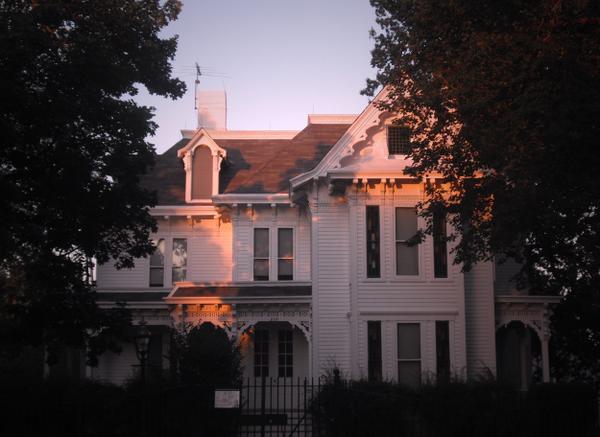
Sunset at the home of President Truman. @GoParks @Interior #POTUS

Sunset at the home of President Truman. @GoParks @Interior #POTUS

In the late afternoon light, one gets a better view of just why Harry Truman was so fond of this house.  Who wouldn’t be?

Something to visit when you’re next in Independence, Missouri.

More:


Abiquiu stars

August 11, 2014

Making those nice photographs of the Milky Way and stars isn’t so easy as it looks.

I made my most successful efforts on our recent swing through Colorado, New Mexico and West Texas.  Here’s a shot I got that almost shows the Milky Way, probably has Polaris in it, and because it was a timed exposure, also captured star movement and an airplane flying overhead.  Photo was taken from the Army Corps of Engineers campground at Abiquiu Reservoir, a few miles from Georgia O’Keefe’s home.

Abiquiu Stars - Time photograph of stars against a pinon pine, pointing north; Milky Way almost visible in the East.

Abiquiu Stars – Time photograph of stars against a pinon pine, pointing north; Milky Way almost visible in the East.


You won’t believe this double rainbow at Crater Lake National Park

August 4, 2014

U.S. Department of Interior said: Our most popular photo on social media last week: this pic of a double #rainbow over @CraterLakeNPS.

Technically a rainbow can form anytime there are water droplets in the air, and sunlight to shine through them. Pragmatically, there’s a better chance of the sunlight getting the right angle in the earlier morning and late afternoon.  Since most summer rainstorms happen in the afternoon, most rainbows probably get formed in the afternoon, too.

If the field of droplets is thick enough, a vantage point may get more than one rainbow.

So there’s a good deal of chance in this photo.  A good photographer is ready, when the chance presents itself.

Did you notice the colors are reversed in the secondary rainbow?

More:


Busy, unproductive summer; some photos and rambles a-coming

August 3, 2014

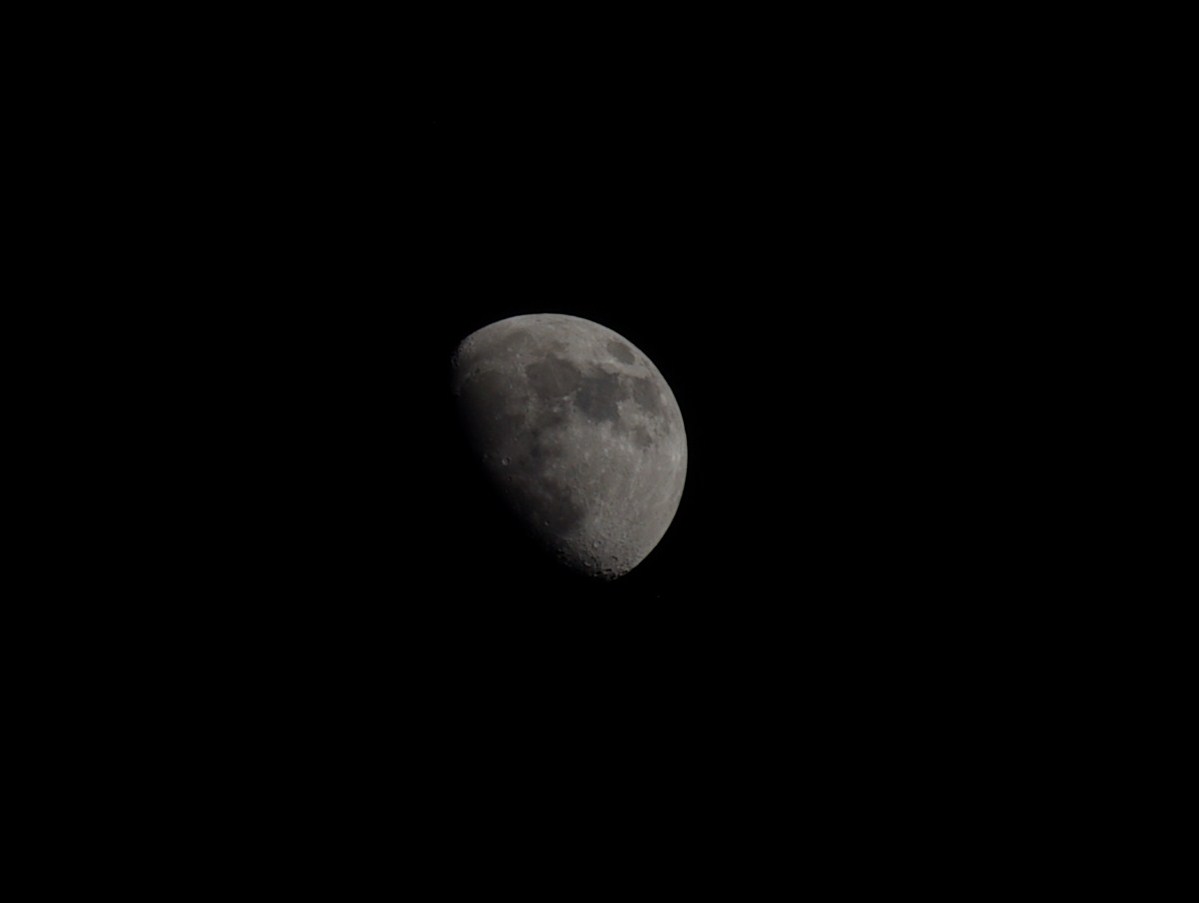
Dallas Moon, June 7, 2014

Dallas Moon, June 7, 2014; sure it’s copyrighted, but please use it with abandon.

I got a pretty good shot at the Moon back in June, considering it’s just a 200 mm telephoto, and I was shooting handheld, without the tripod.  You can’t tell from the picture, but the sky was blue.  One of the issues of getting a good Moon shot concerns exposure — and this time, I got the Moon right.  Sky is black, but there you go.  We were walking the dog.

I’ve made a lot of photographic experiments over the summer, none of which I’ve posted.  I’m also fighting computer issues with both the laptop and desktop, and downloads have been uncertain.  The shot above, for example, shows up in some indices, but not in others.  Can’t post it if I can’t tell WordPress what to upload, you know?  Who really understands computer logic?

I’ve made two trips to Colorado to visit James and Michelle.  None of the photos are up yet — and there are, actually, thousands.  None of the thought rambles are up, either.  I got ambushed by a fellow with “the easiest political quiz in the world” while drinking beer and listening to the Bodeans in Louisville, Colorado; there’s a photo somewhere of my pointing out the errors of the guy’s quiz, and his confessions that he’s a libertarian in GOP clothing; and then there were our visits to those temples to the failures of libertarianism, including the Florissant Fossil Beds National Monument, and the Black Canyon of the Gunnison National Park and Mesa Verde N.P.  Colorado libertarians live among the disasters and ruins of libertarian thought, but think and claim they are held back by the ropes their rescuers throw to them.

I hope I’ve got the streams of posts flowing again, Dear Reader.  Your past patience is greatly appreciated.


Glorious images of the Sun, from NASA

July 3, 2014

Who’d have thought of such an image, before we used satellites to look?

NASA SDO images of the Sun

From NASA: Image info: This combination of three wavelengths of light from NASA’s Solar Dynamics Observatory shows one of the multiple jets that led to a series of slow coronal puffs on January 17, 2013. The light has been colorized in red, green and blue. Credit: NASA SDO

NASA’s press release, from June 27, 2014:

A suite of NASA’s Sun-gazing spacecraft have spotted an unusual series of eruptions in which a series of fast puffs forced the slow ejection of a massive burst of solar material from the Sun’s atmosphere. The eruptions took place over a period of three days, starting on Jan. 17, 2013. Nathalia Alzate, a solar scientist at the University of Aberystwyth in Wales, presented findings on what caused the puffs at the 2014 Royal Astronomical Society’s National Astronomy Meeting in Portsmouth, England.

The sun’s outermost atmosphere, the corona, is made of magnetized solar material, called plasma, that has a temperature of millions of degrees and extends millions of miles into space. On January 17, the joint European Space Agency and NASA’s Solar and Heliospheric Observatory, or SOHO, spacecraft observed puffs emanating from the base of the corona and rapidly exploding outwards into interplanetary space. The puffs occurred roughly once every three hours. After about 12 hours, a much larger eruption of material began, apparently eased out by the smaller-scale explosions.

By looking at high-resolution images taken by NASA’s NASA Solar Dynamics Observatory (Little SDO), or SDO, and NASA’s Solar Terrestrial Relations Observatory, or STEREO, over the same time period and in different wavelengths, Alzate and her colleagues could focus on the cause of the puffs and the interaction between the small and large-scale eruptions.

“Looking at the corona in extreme ultraviolet light we see the source of the puffs is a series of energetic jets and related flares,” said Alzate. “The jets are localized, catastrophic releases of energy that spew material out from the sun into space. These rapid changes in the magnetic field cause flares, which release a huge amount of energy in a very short time in the form of super-heated plasma, high-energy radiation and radio bursts. The big, slow structure is reluctant to erupt, and does not begin to smoothly propagate outwards until several jets have occurred.”

Because the events were observed by multiple spacecraft, each viewing the sun from a different perspective, Alzate and her colleagues were able to resolve the three-dimensional configuration of the eruptions. This allowed them to estimate the forces acting on the slow eruption and discuss possible mechanisms for the interaction between the slow and fast phenomena.

“We still need to understand whether there are shock waves, formed by the jets, passing through and driving the slow eruption,” said Alzate. “Or whether magnetic reconfiguration is driving the jets allowing the larger, slow structure to slowly erupt. Thanks to recent advances in observation and in image processing techniques we can throw light on the way jets can lead to small and fast, or large and slow, eruptions from the Sun.”

Van Gogh painted rather unusual images of the Sun and stars; Turner painted perhaps more life-like images.   There are many interesting views of the Sun in art, by Monet, and many, many others.

Vincent van Gogh,

Vincent van Gogh, “Sower with the Setting Sun”

But who conceived of any image like this one from NASA, above?

What private entity could ever do that?  

J. M. W. Turner,

J. M. W. Turner, “Caernarvon Castle,” 1799

Claude Monet,

Claude Monet, “Impression Sunrise”

British biologist J. B. S. Haldane said:

I have no doubt that in reality the future will be vastly more surprising than anything I can imagine. Now my own suspicion is that the Universe is not only queerer than we suppose, but queerer than we can suppose.

♦   Possible Worlds and Other Papers (1927), p. 286

Haldane may as well have added, the universe is not only more beautiful that we imagine, but more beautiful than we can imagine.  Reality trumps fiction yet again.


Glacier National Park, 104 years old and looking good

June 26, 2014

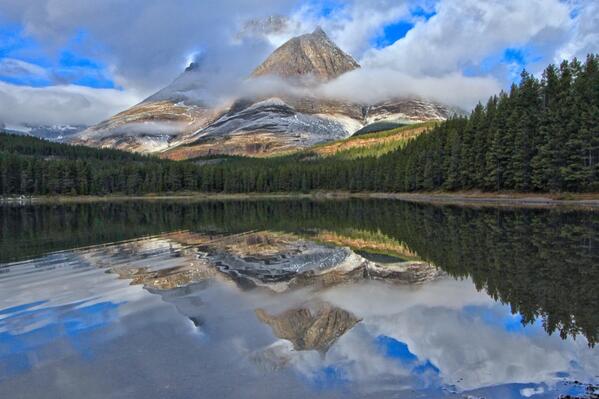
Department of Interior, May 18, 2014 -- Here's our most popular photo on social media last week celebrating @GlacierNPS 104th birthday. pic.twitter.com/JNaYYNnfcH

Department of Interior, May 18, 2014 — Here’s our most popular photo on social media last week celebrating @GlacierNPS 104th birthday. pic.twitter.com/JNaYYNnfcH

Glacier National Park marks its 104th year in 2014. Glacier offers views this spectacular every day of the year.


Starry, starry night over Mt. Fuji

June 7, 2014

Time exposure of Mt. Fujiyama in Japan, from the south. Who was the photographer?

Time exposure of Mt. Fuji in Japan, from the south via @SciencePorn  Photo by Prasit Chansareekorn

[Photographer and National Geographic protested use of the photo by “Science Porn;” to see the photo, check it at the National Geographic site, it’s well worth the click.]

As best I’ve determined, the photographer is Prasit Chansareekorn, of Thailand.  Obviously an amazing photographer.  We might also presume the star over the summit is Polaris.

Thai photographer Prasit Chansareekorn

Thai photographer Prasit Chansareekorn

Fujiyama is the single most-visited tourist spot in Japan. (“Fujiyama” translates to “Mt. Fuji.”)  It’s the tallest mountain in Japan, at 3,776 meters (12,380 feet).  In Japanese, there is a special word for a sunrise viewed from the mountain:  Goraiko.  About 200,000 people climb the mountain every year.

It’s an active volcano, though its last eruption was 1707.  Vulcanologists discuss the possibility the mountain is overdue for an eruption.

Who would be in the best spot to get a photo of such an eruption?  What would van Gogh have made of this view?


Grand Falls, near Flagstaff, at sunset

June 7, 2014

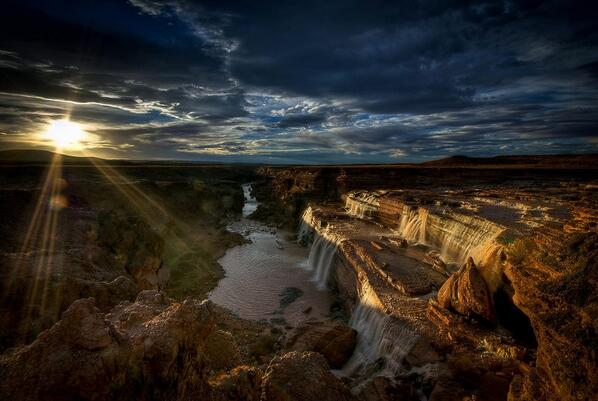
Grand Falls, Flagstaff, Arizona by Scott Wood. pic.twitter.com/L0WDJmqhFr

Grand Falls, Flagstaff, Arizona by Scott Wood. pic.twitter.com/L0WDJmqhFr