Michael Kinnamon on Cordoba House and mosque at Ground Zero

August 14, 2010

An essay from a thoughtful Christian about the controversy over building a mosque in Manhattan; Kinnamon notes some of the history that should be considered:

For thousands of families, Ground Zero in southern Manhattan is holy ground. Thousands lost someone they love in the terror attacks of September 11, 2001, and hundreds of thousands know someone who was directly or indirectly scarred by the collapse of the World Trade Center. The emotional investment in Ground Zero cannot be overestimated.

That is precisely why Ground Zero must be open to the religious expression of all people whose lives were scarred by the tragedy: Christians, Jews, Sikhs, Buddhists, Hindus, and more. And Muslims.

No one knows how many Muslims died on 9/11, but they number in the hundreds. One was Salman Hamdani, a 23-year-old New York City police cadet, emergency medical technician and medical student. When Salman disappeared on September 11, law enforcement officials who knew of his Islamic faith sought him out among his family to question him about the attacks. His family lived with the onus of suspicion for six months until Salman’s body was identified. He was found near the North Tower with his EMT bag beside him, situated where he could help people in need.

The point of this now famous story is simple. Not every Muslim at Ground Zero was a terrorist, and not every Muslim was a hero. The vast majority were like thousands of others on September 11: victims of one of the most heinous events of our times.

But for the family of Salman Hamdani and millions of innocent Muslims, the tragedy has been exacerbated by the fact that so many of the rest of us have formed our opinions about them out of prejudice and ignorance of the Muslim faith.

It is that narrow-minded intolerance that has led to the outcry against the building of Cordoba House and Mosque near Ground Zero. It is the same ignorance that has led many to the outrageous conclusion that all Muslims advocate hatred and violence against non-Muslims. It is the same ignorance that has led to hate crimeand systematic discrimination against Muslims, and to calls to burn the Qur’an.

On the eve of Ramadan on August 11, the National Council of Churches, its Interfaith Relations Commission and Christian participants in the National Muslim-Christian Initiative, issued a strong call for respect for our Muslim neighbors.

“Christ calls us to ‘love your neighbor as yourself’ (Matthew 22:39),” the statement said. “It is this commandment, more than the simple bonds of our common humanity, which is the basis for our relationship with Muslims around the world.”

The statement supported building Cordoba House “as a living monument to mark the tragedy of 9/11 through a community center dedicated to learning, compassion, and respect for all people.”

Now the National Council of Churches reaffirms that support and calls upon Christians and people of faith to join us in that affirmation.

The alternative to that support is to engage in a bigotry that will scar our generation in the same way as bigotry scarred our forebears.

Three-hundred years ago, European settlers came to these shores with a determination to conquer and settle at the expense of millions of indigenous peoples who were regarded as sub-human savages. Today, we can’t look back on that history without painful contrition.

One-hundred and fifty years ago, white Americans subjugated black Africans in a cruel slavery that was justified with Bible proof-texts and a belief that blacks were inferior to whites. Today, we look back on that history with agonized disbelief.

Sixty years ago, in a time of war and great fear, tens of thousands of Japanese-Americans were deprived of their property and forced into detention camps because our grandparents feared everyone of Japanese ancestry. Today that decision is universally regarded as an unconscionable mistake and a blot on American history.

Today, millions of Muslims are subjected to thoughtless generalizations, open discrimination and outright hostility because of the actions of a tiny minority whose violent acts defy the teachings of Mohammed.

How will we explain our ignorance and our compliance to our grandchildren?

It’s time to turn away from ignorance and embrace again the words of Christ: Love your neighbor as yourself.

In that spirit, we welcome the building of Cordoba House and Mosque near Ground Zero.

Michael Kinnamon's signature

Michael Kinnamon
General Secretary
National Council of Churches

The Rev. Dr. Michael Kinnamon

The Rev. Dr. Michael Kinnamon, a Disciples of Christ minister who is the General Secretary of the National Council of Churches of Christ in the USA.

The Rev. Dr. Michael Kinnamon, a Christian Church (Disciples of Christ) clergyman and a long-time educator and ecumenical leader, is the ninth General Secretary of the National Council of Churches of Christ in the USA.

The NCC is the ecumenical voice of America’s Orthodox, Protestant, Anglican, historic African American, evangelical and traditional peace churches. These 36 communions have 45 million faithful members in 100,000 congregations in all 50 states.

More:

Also, at Millard Fillmore’s Bathtub:


Moral math of climate change, on Speaking of Faith

August 5, 2010

Speaking of Faith is carried on many public radio stations nationally, perhaps on one in your area.  If, as I do, you live in an area where the program is not carried, you can pick up a podcast or .mp3 at the program’s website.  (Here’s a list of stations that carry the broadcast.)

Host Krista Tippett posts a weekly message on the scheduled program — this week, an interview with Bill McKibben, whose book, The End of Nature, was a popular introduction to climate change, when it was published in 1989 (!).

Yes, this program is about woo and how we deal with it in our daily lives.  This particular program looks at how even woo followers may find it to their advantage to pay attention to the science, and act to protect their families and communities as a result.  This is a moral side of climate change that too many people simply deny.

Ms. Tippett wrote:

This week on public radio’s conversation about religion, meaning, ethics, and ideas:

The Moral Math of Climate Change

Bill McKibben’s first book, The End of Nature, was the first popular book on climate change, and he is one of the most insightful figures of our time on ecology and life. We’ll explore his hopeful sense that what is good for the environment also nourishes human relationship. And we’ll seek his perspective on knowledge we can trust as we orient our minds and lives to changing realities of the natural world.

Krista Tippett, host of Speaking of Faith

History Tends to Surprise Us
It’s been striking how, across the past few years, the environment has found its way inside my guests’ reflections on every subject, as they say, under the sun. And we do need fresh vocabulary and expansive modes of reflection on this subject that, we’ve come to realize, is not just about ecology but the whole picture of human life and lifestyle.

Here are some pieces of vocabulary and perspective I’ve loved and used in recent years.

Starting with the basics, Cal DeWitt — a scientist, conservationist, and Evangelical Christian living in Wisconsin — pointed out to me that “environment” was coined after Geoffrey Chaucer used the term “environing.” This was a turning point in the modern Western imagination — the first time we linguistically defined ourselves as separate from the natural world, known up until then as the Creation. This helps explain why the language of “creation care” is so animating for many conservative Christians — as a return to a sacred insight that was lost. But from quantum physics to economics, too, we are discovering new existential meaning in terms like interconnectedness and interdependence.

Many people, but most recently the wonderful geophysicist Xavier le Pichon, have made the simple yet striking observation that climate change is the first truly global crisis in human history. In other words, just as we make newfound discoveries about old realities, they are put to the ultimate test. It is easy to be overwhelmed by the signs that we are not up to this test as a species. So it was helpful for me to have Matthieu Ricard, a biologist turned Buddhist monk, remind me that evolutionary change, which is what we need now in our behavior, always comes precisely at the moment where survival — not just betterment — is at stake.

Such ideas can make the task of integrating, or reintegrating, environmental and human realities sound far away and abstract. But it’s not.

The most redemptive and encouraging commonality of all the people I’ve encountered who have made a truly evolutionary leap is that they have come to love the very local, very particular places they inhabit. They were drawn into environmentalism by suddenly seeing beauty they had taken for granted; by practical concern for illness and health in neighborhood children; by imagining possibilities for the survival of indigenous flora and fauna, the creation of jobs, the sustainability of regional farms. The catchword of many of our most ingenious solutions to this most planetary of crises is “local” — local food, local economies. Ellen Davis and Wendell Berry illuminate this with poetic, biblical wisdom, each in their way reminding us that the health of our larger ecosystem is linked to knowing ourselves as creatures — “placed creatures.”

There is so much in my most recent conversation about all of this with Bill McKibben that will frame and deepen my sense of the nature and meaning of climate change moving forward. Among them is an exceedingly helpful four minutes, a brief history of climate change that we’re making available as a separate podcast. But what has stayed with me most of all, I think, is a stunning equation he is ready to make after two decades of immersion in the scientific, cultural, and economic meaning of our ecological present. He points out that cheap fossil fuels have allowed us to become more privatized, less in need of our neighbor, than ever in human history. And he says that in almost every instance, what is good for the environment is good for human community. The appeal of the farmers market is not just its environmental and economic value but the drama, the organic nature, of human contact.

I also gained a certain bracing historical perspective from my conversation with Bill McKibben. He and I were both born in 1960. He was waking up to the environment in years in which I was in divided Berlin, on the front lines of what felt like the great strategic and moral battle of that age. He published The End of Nature in 1989, the year the Berlin Wall fell. And as I learned from that book, the science of climate change had already begun to emerge at the height of the Cold War. In 1957, two scientists at the Scripps Institution described their findings that humanity initiated an unprecedented “geophysical experiment” that it might not survive.

So I’ve been chewing on this thought lately: If humanity is around to write history in a century or two, what was happening with the climate in 1989 may dwarf what we perceived as the great geopolitical dramas of that time. Living through the fall of the wall and the reunification of Europe emboldened my sense that there is always more to reality than we can see and more change possible than we can begin to imagine. I draw caution as well as hope from the fact that history tends to surprise us. And I draw caution as well as hope from the knowledge that humanity often surprises itself on the edge of survival.

The End of Nature by Bill McKibben I Recommend Reading:
The End of Nature
by Bill McKibben

This was the first book to introduce the notion and science of climate change to a non-scientific audience. It is passionately and beautifully written. And while Bill McKibben’s updated introduction in recent printings adds relevant new knowledge, it also highlights just how prescient and powerful the original book remains.

Add to FacebookAdd to NewsvineAdd to DiggAdd to Del.icio.usAdd to StumbleuponAdd to RedditAdd to BlinklistAdd to TwitterAdd to TechnoratiAdd to Furl


Religious nut new on the scene, “explains origins of life”

July 14, 2010

“Darwinism” is doomed, Perry Marshall says. The entire theory will crumble in 2013 (like the Berlin Wall — may as well start with an offensive comparison to totalitarianism since everyone knows it will get there eventually), if you just suffer through his lessons, send him some money, suspend all logic and reason, send him some money, forget everything you learned in science, and send him a ltittle money.

Plus, he’s figured out how to reconcile Christianity and science. (Call the Templeton Prize committee.)  (No, call James Randi and the FBI fraud squad instead.)  You can take his course at Coffeehouse Theology (no Mormons need apply, but hey, they teach evolution at their colleges, so they can’t be real saints, can they?).

Perry Marshall, publicity photo

According to Perry Marshall, "Perry Marshall's books on Google AdWords are the most popular in the world." No hyperbole, no ego here.

Did I mention he’s an engineer?

Yes, Spunky, that’s your Hemingway solid-gold S–t Detector™ clanging in your holster, if you’re using the handy, lithium-battery-powered version.  If the rest of the story didn’t set your device off, the lack of an immediate plea for money should have.

Mr. Marshall asks you to turn off your Hemingway, and your mind, relax and float downstream (apologies to the Beatles).  You being a Wise Human, should just reset the device, and go back to ignoring Perry Marshall.

Do you remember when people had to do a lot of dope to get these kinds of hallucinations?  People like Marshall do damage to Carlos Casteneda and famous hoakum.

The only mystery to me is, why is Marshall bursting out on the scene now, with on-line ads that run even next to P. Z. Myers’ blog Pharyngula?  (That’s where I found him; the elves of the internest may give you different ads.)  Marshall appears to be a follower, if not disciple, of Hugh Ross.  Perhaps he’s really prospecting for leads for his business.

Ignorance abounds in the world.  The cure is knowledge and study, not more ignorance and bovine excrement.


Creationism crash covered

June 24, 2010

Judge Sam Sparks’ rebuke of the Institution for Creation Research (“Biblical.  Accurate.  Certain.”)  appeared in a number of venues, in addition to those I mentioned earlier (go see here); for the record, you ought to go see:

An ICR spokesperson sent the following statement via e-mail:

The Institute for Creation Research has received the ruling of Judge Sam Sparks from the U.S. District Court in Austin in the case ICR Graduate School v. Texas Higher Education Coordinating Board et al. The attorneys and leadership of ICR associated with this case are currently reviewing Judge Sparks’ ruling and we are weighing our options regarding future action in this matter.  In addition to other options, ICRGS has 30 days in which to file an appeal with the 5th Circuit Court of Appeals. ICR has no further comment at this time.


Cynthia Dunbar’s sham marriage of God and politics

June 7, 2010

Tony Whitson’s Curricublog has a rather lengthy, and very troubling, post about Texas State Board of Education member Cynthia Dunbar and her wilder gyrations on the issues of religion in education.  Go read it.  It’s got quotes, it’s got video, and if you don’t find it troubling you’re not paying attention.  There is an astounding smear of  Thomas Jefferson, the Constitution, and the principle of separation of state and church.

There’s a line usually attributed to Euripides, “Whom the gods destroy, they first make mad.”  That’s mad-crazy, not mad-angry.

What’s Dunbar done to upset the gods so?


Remembrance

May 31, 2010

I heard a sermon Sunday that made me stop to think.

Glenn Martin filled in at the pulpit of First Christian Church (Disciples of Christ) of Duncanville while Dr. Mike Oden is “vacationing” (preparing to move).  Glenn grew up in this congregation.  He’s a year away from a masters degree from Brite Divinity School at Texas Christian University. I’ve sung with him in the choir for several years, and been privileged to play bells with him — he’s a good musician on the bells, and he can make saves in an  astounding number of ways.  So I was interested in what he had to say just because he’s a friend.

It was a good sermon, even were he not my friend.  He threw in some good historic references, which always gets my attention.

For the Memorial Day weekend, this is Glenn’s sermon:

May 5, 1868, General John Logan, national commander of the Grand Army of the Republic issued general order number 11 specifying May 30 to be designated for the purpose of placing flowers or otherwise decorating the graves of Union and Confederate soldiers at Arlington National Cemetery.  This was the first official recognition of Decoration Day or what we now know as Memorial Day.  Unofficially, the practice likely began years earlier in a number of places as communities recognized and honored those who had fallen in war.

Some even attribute such a memorial service to Abraham Lincoln at Gettysburg.  Do you remember the reason the President was there?  There had been a battle at Gettysburg on [in July], and on November 19, 1863, and President Lincoln had come there to dedicate a portion of the field as a cemetery.  How long has it been since you thought of the some 260 words of Lincoln’s Gettysburg address which he would have delivered in about two minutes?

Four score and seven years ago our fathers brought forth on this continent a new nation, conceived in liberty, and dedicated to the proposition that all men are created equal.  Now we are engaged in a great civil war, testing whether that nation, or any nation so conceived and so dedicated, can long endure. We are met on a great battle-field of that war. We have come to dedicate a portion of that field as a final resting-place for those who gave their lives that that nation might live. It is altogether fitting and proper that we should do this.  But, in a larger sense, we cannot dedicate, we cannot consecrate, we cannot hallow, this ground. The brave men, living and dead, who struggled here, have consecrated it far above our poor power to add or detract. The world will little note nor long remember what we say here, but it can never forget what they did here. It is for us, the living, rather, to be dedicated here to the unfinished work which they who fought here have thus far so nobly advanced. It is rather for us to be here dedicated to the great task remaining before us; that from these honored dead we take increased devotion to that cause for which they gave the last full measure of devotion; that we here highly resolve that these dead shall not have died in vain; that this nation, under God, shall have a new birth of freedom; and that government of the people, by the people, for the people, shall not perish from the earth.

My topic for today is remembering.  That, in and of itself, deserves some attention.  What do I mean by remembering?  It is not so much the mental exercise of recalling factual details such as what you had for lunch yesterday or if you went to the grocery store on Monday or Tuesday.  The kind of remembering I’m getting at is much deeper than that.  It is the kind where you essentially choose to re-experience something or participate in a kind of reenactment.  Reminiscing after the death of a loved one is a good example of this kind of remembering.  We tell stories, stories that we have likely told many times before.  Stories that those who are reminiscing with us may be able to tell as well as we can.  Our intent is not to convey new information.  In some way, we are reliving or re-experiencing that story.

There is a formal word for this kind of remembering.  The word is anamnesis.  It derives from Greek, big surprise for those who know me.  The prefix means to go up or to come up; the root of the word is the word for mind; quite literally then we have the idea of coming up to the mind or as we say it, remembering.

Why do we remember?

First, it allows us to stay connected with our past.  This seems pretty obvious.  I wonder though if there might be something more to staying connected with our past than just the obvious.  Do you ever tell your children or grandchildren stories about your parents or grandparents?  Do they necessarily need to have known all the people in the story?

We occasionally talk of history and I know there are some people in this room that are history buffs.  I don’t personally put myself in this category.  There are elements of history that I find quite fascinating and a few topics that I have researched in much greater detail.  For me though, this has largely been a result of my interest in that other topic and researching some of its history was a natural part of exploring that topic.  The history buffs I’m talking about seem to exude history.  If you were to ask them about the Civil War for instance, they can tell you about military history, economic history of the time period, distinctions between the North and the South, things that were going on in the church, and even world events of the time.  Not only can they tell you details of these different kinds of histories, they can even suggest ways in which these details relate.

Every once in a while, someone will talk about “what really happened.”  I understand what they are getting at when they say that but is history what really happened or might it be more of what we remember of what happened?

Why do we remember?  The first reason is that it allows us to stay connected with our past.  The second reason is that it allows us to better understand our present.  Here again, this is fairly obvious though perhaps not quite as obvious as the first reason.

I think it is reasonably safe to say that most of us believe the idea of cause and effect.  We even have sayings about it.  For example, “What goes up must… come down” or how about “Look before you… leap” Exactly.

Have you ever thought of tracing cause and effect backwards? This thing over here was caused by such and such.  But that was the result of this other event.  And that event needed these other things to happen for it to occur.  Some of you are interested in genealogy.  This is a perfect example of cause and effect.  We wouldn’t be here if it weren’t for our parents.  Our grandparents had to be here for our parents to be here.  Our great-grandparents had to be here before our grandparents could be.  You get the idea.  What was the very first cause?  Science tends to point to the Big Bang.  I don’t think this is the first cause at all.  I am not advocating for or against this particular theory, I just don’t think the logic holds that this would be first.  If all the matter currently in our universe were contained in this alleged singularity, what caused it to go bang?  Even my question suggests a prior action of some sort.  It seems much more reasonable to me to locate the beginning point in God.  This is a separate thought however and we’ll have to leave it for another time.

Remembering gives us a way of understanding and interpreting our past so that we can then understand better why things are now the way they are.  Consider for a moment people who get amnesia.  The cause of the amnesia isn’t really important for the illustration.  Some of you have already recognized the Greek origins of this word too. There is same root for mind that I mentioned earlier plus the prefix “a” meaning without so we have without the mind.  People with amnesia have lost that connection with their past.  They have lost their sense of story and have the question of who am I.  Did you note the tense of the question?  It isn’t “who was I” as it would be for the past tense; it is “who am I.”  Very much the present tense, it suggests our self-identity is linked to remembering our past and where we have been.

The third reason we remember is that remembering allows us to look ahead to the future.

Today is the tomorrow we wondered about yesterday and tomorrow will then become the today we wonder about now.  In much the same way that we understand our present in light of our past, we similarly perceive the upcoming future as our past plus the actions we take.  Here is that cause and effect thing again.  I’m not going to dwell too long here.  I want to move to more of a practical example from our faith.

Let’s summarize quickly.  I’ve said that we remember for 3 reasons.
1. It allows us to stay connected with our past
2. It allows us to better understand our present
3. It allows us to look ahead to the future

More importantly, remembering allows us to see God.

The scripture I chose for today was in the context of the Passover.  The Israelites were to remember this day when God delivered them from bondage in Egypt.  Every year, they would celebrate the feast of unleavened bread and reenact the story.

For us, this story is part of the past.  It is also part of the past that we recognize that Jesus added to this narrative.  We remember it every Sunday.  Because we do remember it every Sunday, this story is part of our present.  Jesus was celebrating the Passover with his disciples.  While they were eating, Jesus took the bread, gave thanks, and gave it to them saying “This is my body.  Do this in remembrance of me.” In the same way after supper, he took the cup saying “This cup is the new covenant in my blood.  Do this as often as you drink it, in remembrance of me.”  You remember the word anamnesis that I mentioned earlier.  The Greek word we translate as remembrance here is this same word.  It is as though Jesus was saying that we should experientially reenact, relive, and remember every time we come to communion.

The apostle Paul further states in 1 Cor 11 that when we eat this bread and drink this cup we proclaim the Lord’s death until he returns.  This addresses both the present and the future.  I know a number of you took Dr. Mike’s class on Revelation.  The marriage supper of the Lamb (Revelation 19) also addresses the future.

In remembering, we can recall God’s mighty deeds.  We can be assured of God’s continuing and abiding presence with us.  And we can anticipate a future with numerous possibilities.

I started off recalling some of the history around Memorial Day.  In 1971, federal observance of Memorial Day was changed from May 30 to the last Monday in May.  Hooray for 3 day weekends.

By 2000, a number of Americans had lost the sense of the true meaning of the day.  In an effort to reeducate and remind us, the National Moment of Remembrance resolution was passed.  It asks that at 3:00 p.m. local time, for all Americans “To voluntarily and informally observe in their own way a Moment of remembrance and respect, pausing from whatever they are doing for a moment of silence or listening to Taps.”  Since we are Christians, I will give you another alternative to consider.  Place commemoration of the day under the auspices of God and share a communion service with whomever is with you and remember.  Thanks be to God.

Nota bene: I said it made me think.  That’s why I’ve asked Glenn for permission to post it here, to keep me thinking, and maybe make you think, too.  For example, Glenn lists three reasons remembering is valuable.  They parallel the tactic business consultants use to get businesses to think ahead — look back at what happened in the past, consider the condition of the company today, then look ahead to see what is in store for the company, and think about how the company can face challenges identified.

What do you think about remembrance, and remembering, and Glenn’s advice?

1 SermonScript5/30/2010 1
1 1
M ay 5,1868,GeneralJohn Logan,nationalcom m anderofthe G rand Arm y ofthe Republic issued generalordernum ber11specifying M ay 30 to be designated for the purpose ofplacing flow ersorotherw ise decorating the gravesofUnion and Confederate soldiersatArlington NationalCem etery.Thisw asthe firstoficial recognition ofDecoration Day orw hatw e now know as M em orialDay. Unoficialy,the practice likely began yearsearlierin a num berofplacesas com m unities recognized and honored those w ho had falen in w ar. Som e even attribute such a m em orialservice to Abraham Lincoln atGettysburg. Do you rem em berthe reason the Presidentw asthere? There had been a battle at Gettysburg on Novem ber19,1863,and PresidentLincoln had com e there to dedicate a portion ofthe field asa cem etery. How long has itbeen since you thoughtofthe som e 260 w ordsofLincoln’sGettysburg addressw hich he w ould have delivered in abouttw o m inutes? Fourscore and seven yearsago ourfathers broughtforth on thiscontinenta new nation,conceived in liberty,and dedicated to the proposition thatalm en are created equal. Now w e are engaged in a greatcivilw ar,testing w hetherthat nation,orany nation so conceived and so dedicated,can long endure.W e are m et on a greatbattle-field ofthatw ar.W e have com e to dedicate a portion ofthat field asa finalresting-place forthose w ho gave theirlivesthatthatnation m ight live.Itisaltogetherfitting and properthatw e should do this. But,in a larger sense,w e cannotdedicate…w e cannotconsecrate…w e cannothalow …this ground.The brave m en,living and dead,w ho struggled here,have consecrated it farabove ourpoorpow erto add ordetract.The w orld w illittle note norlong rem em berw hatw e say here,butitcan neverforgetw hatthey did here.Itisfor us,the living,rather,to be dedicated here to the unfinished w orkw hich they w ho foughthere have thusfarso nobly advanced.Itis ratherforusto be here dedicated to the greattask rem aining before us…thatfrom these honored dead w e take increased devotion to thatcause forw hich they gave the lastfulm easure
2 SermonScript5/30/2010 2
2 2
ofdevotion;thatw e here highly resolve thatthese dead shalnothave died in vain;thatthis nation,underGod,shalhave a new birth offreedom ;and that governm entofthe people,by the people,forthe people,shalnotperish from the earth. M y topicfortoday is rem em bering.That,in and ofitself,deservessom e attention. W hatdo Im ean by rem em bering? Itis notso m uch the m entalexercise of recaling factualdetailssuch asw hatyou had forlunch yesterday orifyou w entto the grocery store on M onday orTuesday.The kind ofrem em bering I’m getting at is m uch deeperthan that. Itisthe kind w here you essentialy choose to re- experience som ething orparticipate in a kind ofreenactm ent. Rem iniscing after the death ofa loved one isa good exam ple ofthis kind ofrem em bering.W e tel stories,storiesthatw e have likely told m any tim es before.Storiesthatthose w ho are rem iniscing w ith us m ay be able to telasw elasw e can.O urintentis notto convey new inform ation. In som e w ay,w e are reliving orre-experiencing that story. There isa form alw ord forthis kind ofrem em bering.The w ord isanam nesis. It derivesfrom G reek,big surprise forthose w ho know m e.The prefix m eansto go up orto com e up;the rootofthe w ord isthe w ord form ind;quite literaly then w e have the idea ofcom ing up to the m ind orasw e say it,rem em bering. W hy do w e rem em ber? First,italow s usto stay connected w ith ourpast.Thisseem s pretty obvious. I w onderthough ifthere m ightbe som ething m ore to staying connected w ith our pastthanjustthe obvious. Do you evertelyourchildren orgrandchildren stories aboutyourparentsorgrandparents? Do they necessarily need to have know n al the people in the story? W e occasionaly talkofhistory and Iknow there are som e people in this room that are history bufs. Idon’tpersonaly putm yselfin thiscategory.There are
3 SermonScript5/30/2010 3
3 3
elem entsofhistory thatIfind quite fascinating and a few topicsthatIhave researched in m uch greaterdetail. Form e though,this has largely been a resultof m y interestin thatothertopicand researching som e ofits history w asa natural partofexploring thattopic.The history bufs I’m talking aboutseem to exude history. Ifyou w ere to askthem aboutthe CivilW arforinstance,they can telyou aboutm ilitary history,econom ic history ofthe tim e period,distinctions betw een the North and the South,thingsthatw ere going on in the church,and even w orld eventsofthe tim e. Notonly can they telyou detailsofthese diferentkindsof histories,they can even suggestw ays in w hich these details relate. Every once in a w hile,som eone w iltalkabout“w hatrealy happened.” I understand w hatthey are getting atw hen they say thatbutis history w hatrealy happened orm ightitbe m ore ofw hatw e rem em berofw hathappened? W hy do w e rem em ber? The firstreason isthatitalow s usto stay connected w ith ourpast.The second reason isthatitalow s usto betterunderstand ourpresent. Here again,this isfairly obviousthough perhaps notquite asobviousasthe first reason. Ithink itis reasonably safe to say thatm ostofus believe the idea ofcause and efect.W e even have sayingsaboutit. Forexam ple,“W hatgoes up m ust… com e dow n” orhow about“Look before you… leap” Exactly. Have you everthoughtoftracing cause and efectbackw ards?Thisthing overhere w ascaused by such and such. Butthatw asthe resultofthisotherevent.And that eventneeded these otherthingsto happen foritto occur.Som e ofyou are interested in genealogy.This isa perfectexam ple ofcause and efect.W e w ouldn’tbe here ifitw eren’tforourparents.O urgrandparents had to be here forourparentsto be here.O urgreat-grandparents had to be here before our grandparentscould be.You getthe idea.W hatw asthe very firstcause? Science tendsto pointto the Big Bang. Idon’tthinkthis isthe firstcause atal. Iam not
4 SermonScript5/30/2010 4
4 4
advocating fororagainstthis particulartheory,Ijustdon’tthinkthe logic holds thatthisw ould be first. Ifalthe m atercurrently in ouruniverse w ere contained in thisaleged singularity,w hatcaused itto go bang? Even m y question suggestsa prioraction ofsom e sort. Itseem s m uch m ore reasonable to m e to locate the beginning pointin God.This isa separate thoughthow everand w e’lhave to leave itforanothertim e. Rem em bering gives usa w ay ofunderstanding and interpreting ourpastso that w e can then understand betterw hy thingsare now the w ay they are.Considerfor a m om entpeople w ho getam nesia.The cause ofthe am nesia isn’trealy im portantforthe ilustration.Som e ofyou have already recognized the G reek originsofthisw ord too.There issam e rootform ind thatIm entioned earlierplus the prefix “a” m eaning w ithoutso w e have w ithoutthe m ind. People w ith am nesia have lostthatconnection w ith theirpast.They have losttheirsense of story and have the question ofw ho am I. Did you note the tense ofthe question? Itisn’t“w ho w as I” as itw ould be forthe pasttense;itis “w ho am I.” Very m uch the presenttense,itsuggestsourself-identity is linked to rem em bering ourpast and w here w e have been. The third reason w e rem em beristhatrem em bering alow s usto lookahead to the future. Today isthe tom orrow w e w ondered aboutyesterday and tom orrow w ilthen becom e the today w e w onderaboutnow . In m uch the sam e w ay thatw e understand ourpresentin lightofourpast,w e sim ilarly perceive the upcom ing future asourpastplusthe actionsw e take. Here isthatcause and efectthing again. I’m notgoing to dw eltoo long here. Iw antto m ove to m ore ofa practical exam ple from ourfaith. Let’ssum m arize quickly. I’ve said thatw e rem em berfor3 reasons. 1.Italow s usto stay connected w ith ourpast
5 SermonScript5/30/2010 5
5 5
2.Italow s usto betterunderstand ourpresent 3.Italow s usto lookahead to the future M ore im portantly,rem em bering alow s usto see God. The scripture Ichose fortoday w as in the contextofthe Passover.The Israelites w ere to rem em berthisday w hen God delivered them from bondage in Egypt. Every year,they w ould celebrate the feastofunleavened bread and reenactthe story. Forus,thisstory is partofthe past. Itisalso partofthe pastthatw e recognize thatJesusadded to this narrative.W e rem em beritevery Sunday. Because w e do rem em beritevery Sunday,thisstory is partofourpresent.Jesusw ascelebrating the Passoverw ith hisdisciples.W hile they w ere eating,Jesustookthe bread,gave thanks,and gave itto them saying “This is m y body. Do this in rem em brance of m e.” In the sam e w ay aftersupper,he tookthe cup saying “Thiscup isthe new covenantin m y blood. Do thisasoften asyou drink it,in rem em brance ofm e.” You rem em berthe w ord anam nesisthatIm entioned earlier.The G reekw ord w e translate as rem em brance here isthissam e w ord. ItisasthoughJesusw assaying thatw e should experientialy reenact,relive,and rem em berevery tim e w e com e to com m union. The apostle Paulfurtherstates in 1 Cor11thatw hen w e eatthis bread and drink thiscup w e proclaim the Lord’sdeath untilhe returns.Thisaddresses both the presentand the future. Iknow a num berofyou took Dr.M ike’sclasson Revelation.The m arriage supperofthe Lam b (Revelation 19)also addressesthe future. In rem em bering,w e can recalGod’s m ighty deeds.W e can be assured ofGod’s continuing and abiding presence w ith us.And w e can anticipate a future w ith num erous possibilities.
6 SermonScript5/30/2010 6
6 6
Istarted ofrecaling som e ofthe history around M em orialDay. vaoccIrBMlineooosynbsatadnmlse2ouyesn0nnmlr.irudee0tivntHasuef0aigfpoonrr,noie.ointlacoyrocetrPwntnaalT,toayuansoapcfemsdfaperoMrepsubvicrna.eseei”ocf3sdirmoenmsSudogerowicmamfdnfaryAicri.aettaoewehmlmIllmtywDweaeoaoeanewrrhsidybakckoahestaswmrraeinoenettardeshmenvCssvaveho.hiectenafirhradrnditastitshttunlh3oeihwsagese,epndytititdsmarthah,yohefrIyleerwouwooNcsdnnmuaiaedoltlwlaneiiMgtonsnariiegvndmayteayhfoaeroleefy3,MrMotmf0aaohuouoetersmomammaptnoteerlibolchumnneAeteettrhsem.olomeanoeffTrstfeIrtRnharoaGieceaMlfn1toammne9sidonnkeir7elsngsneam1mda”nbon,TtabcebdffioyeevrrtatsaedhioohnnneetacrGcoredraeoealdya..

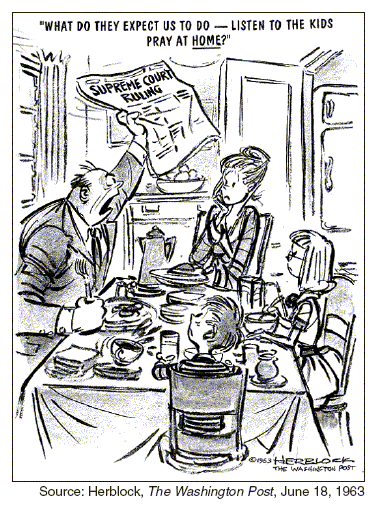
Stupid teacher tricks: No, teachers can’t lead prayers

May 26, 2010

What devilry gets into a tiny few teachers to make them think they alone are immune from the First Amendment?

In a public classroom, teachers are the government.  They may not lead prayers, not even if all the students consent.

Down in Meadville, Mississippi, a Franklin County High School teacher, Alice Hawley,  lost her teaching contract because she led daily prayers in her classes.

She agreed to stop the illegal practice, and has been invited back.

I understand fans on Facebook have come unglued.  I haven’t found that link.

Herblock cartoon of June 18, 1963 - school prayer

Probably still under copyright - Herblock in the Washington Post, June 18, 1963 (school prayer)


Faith like a cannonball

April 6, 2010

Oh, this will cause a lot of consternation in church offices across the world.


Quote of the moment: Martin Niemöller, “. . . I did not speak out . . .”

February 26, 2010

First they came for the communists, and I did not speak out—because I was not a communist;
Then they came for the trade unionists, and I did not speak out—because I was not a trade unionist;
Then they came for the Jews, and I did not speak out—because I was not a Jew;
Then they came for me—and there was no one left to speak out for me.

— Pastor Martin Niemöller

Martin Niemoller on a postage stamp, painted by Gerd Aretz in 1992 - Wikipedia

German theologian and Lutheran Pastor Martin Niemöller on a postage stamp, painted by Gerd Aretz in 1992 – Wikipedia

It’s spring, and school curricula turn to the Holocaust, in English, in world history, and in U.S. history.

Martin Niemöller’s poem registers powerfully for most people — often people do not remember exactly who said it.  I have seen it attributed to Deitrich Bonhoeffer (who worked with Niemöller in opposing some Nazi programs), Albert Einstein, Reinhold Niebuhr, Albert Schweitzer, Elie Wiesel, and an “anonymous inmate in a concentration camp.”

Niemöller and his actions generate controversy — did he ever act forcefully enough?  Did his actions atone for his earlier inactions?  Could anything ever atone for not having seen through Hitler and opposing Naziism from the start?  For those discussion reasons, I think it’s important to keep the poem attributed to Niemöller.  The facts of his life, his times, and his creation of this poem, go beyond anything anyone could make up.  The real story sheds light.

Resources:

Save

Save


Texas social studies standards: Beware the ides of January

January 15, 2010

News reports in Texas this morning said that several of the right-wing, gut-education-standards changes proposed to social studies standards had failed in voting on Thursday, January 14.  But, much more was to be done, and the SBOE adjourned early last night to continue voting today.

In a pattern familiar to education advocates in Texas, board member Don McLeroy (R-Pluto) today proposed a long series of amendments, apparently off-the-cuff, but probably written up in earlier strategy sessions.  These last-minute amendments tend to pass having missed any serious scrutiny.

Will he be able to ruin Texas education for the next decade?  I cannot follow the live webcasts; Steve Schafersman is working to stop the amendments, rather than merely blog about them.  We probably won’t know the extent of the damage for weeks.  McLeroy cherishes his role as a Port-au-Prince-style earthquake to Texas education. (Pure coincidence, I’m sure — Ed Brayton summarizes McLeroy’s politics today.)

Watch that space, and other news sources.  I may provide updates here, as I can get information.


Trouble at Texas Board of Education: Social studies

January 11, 2010

Here is a news rundown of stories on the Texas State Board of Education, who have been planning for a year now to mess up social studies standards for Texas public schools, this week.

Get on your horse and warn Texans:  The Idiots are coming to get your good schoolbooks:

Add to FacebookAdd to NewsvineAdd to DiggAdd to Del.icio.usAdd to StumbleuponAdd to RedditAdd to BlinklistAdd to TwitterAdd to TechnoratiAdd to Furl


Merry Christmas, to the “right” people (not you, Mr. President)

December 25, 2009

You can’t make this stuff up.

Here’s a generally mean-spirited post trying to make hay from the general disinformation about about Obama’s faith and otherwise trying to stir hatred.  (Here’s more of the flap on the ornaments on the White House’s Blue Room tree, and I’ve got a response in comments at this post.)

Followed by this “glowing” cross.

Merry Christmas.  “We dare you,” the Right Perspective says.

Make the right wing extremely angry today:  Have a good and merry Christmas.  Be tolerant.  Think.  Smile.  Act kindly.  It’ll make ’em crazy.

Also:


Christian pastor “wants his country back”

December 21, 2009

I get e-mail — sometimes because I belong to a list-serv.  Some of those provoke thought.

Bill Longman sent some thoughts from Jan Linn, a Disciples of Christ pastor and author of The Jesus Connection and What’s Wrong With the Christian Right.

Bill wrote, “I’m going to foward this seasonal meditation from pastor Jan Linn reflecting thoughts about our lack of concern for the common good as seen in the battle for health care legislation.”

A Christmas Wish

By Jan Linn

This past summer I heard a woman attending a town hall meeting tearfully say, “I want my country back.” So do I. That is my Christmas wish this year. I want my country back.

I want to experience the pride I used to feel at the sight of the American flag being raised as a sign of victory as a proud American athlete stood tall on the center platform at the Olympics.

I want to feel that catch in my throat I used to feel when the star spangled banner was played just before the start of a football game.

I want to experience again the excitement I felt when our college team had the chance to meet the governor of our state before the season started and to hear him speak about his pride in the kind of university we were representing.

I want to see the workers of our nation valued as they once were for all they do to make their companies a success.

I want to take my grandson fishing so he can enjoy the excitement and fun of  telling everyone about the fish he caught that gets bigger every time he tells it.

I want to go to church on Christmas Eve and give thanks to God for all people who come to the Communion Table, regardless of creed, nationality, or sexual orientation.

I want to be able to tell children of all different races, religion, sizes and shapes, that all of them have an equal chance to do whatever they can with the abilities they have

I want the rest of the world to know that we appreciate who they are just as we want them to appreciate who we are.

Yes, my Christmas wish this year is to have my country back, too, only I know based on what this woman said before she said she wanted her country back that her reasons and mine are very different.

You see, I want my country back so our nation’s top athletes will once again want to compete fairly and live up to the responsibilities of being the role models they are to our youth.

I want my country back so that the loyal opposition will once again be part of how we understand the meaning of patriotism.

This Christmas my wish is to have my country back so that politicians from opposing parties and ideologies will stop demonizing one another and respectfully disagree about what is best for our country.

I want my country back so that honest work is rewarded rather than exploited by those for whom enough is never enough.

I want my country back so the water I take my grandson to fish in will not be contaminated by toxic runoff, and that companies with chemical and nuclear waste will know they will be shown no mercy if they do not ensure it is stored safely.

I want my country back so all Christians can know that our faith has a place among the religions of the world without having to prove they are wrong and we are right.

I want my country back so every child in this nation will know he or she is loved and valued, secure and protected as every child should be.

My Christmas wish is to have my country back so that America can once again be a beacon of hope and light to other nations, not because we think we are better than they are, but because we understand the responsibilities that go with being the heirs of those who have sacrificed so much to give us the land we now have.

I want my country back so I can help make room for everyone who agrees with me and everyone who does not, knowing that it is only when we keep our differences from becoming divisions that we can be a strong and enduring democracy.

Most of all, my Christmas wish is to have my country back so we can be a people who don’t just talk about justice and peace, but work for both, and to do everything we can to preserve our nation, make it better, and pass on its enduring values to the next generation.

So, yes, my wish this Christmas is to have my country back, because for me what that means to me goes to the heart of how I understand what celebrating the birth of Jesus is truly means.

Amen.


Jesus knocks on Dobson’s door: No room at the Dobson Inn

December 15, 2009

Dr. James Dobson profits from his image as a great Christian leader.  His campus of enterprises in Colorado Springs is one of the largest businesses in the city.

But this does not compute:  Colorado Springs has several hundred people homeless in the city, with no place to sleep but public parks and other public places.  There are more homeless than there are facilities to help them.

Colorado Springs officials consider a law to make it illegal to “camp” in a public place inside the city.  One person died from the cold recently.  Whole families are camping in some places.  [Good news before I hit the “send” button:  Colorado Springs decided to shelve action on the ordinance now, and work to find solutions instead, until February.]

Colorado Springs Salvation Army officials have a shelter,  but it can’t handle the homeless population.

Robert Moran, an advocate for the homeless, said the city this year has been doing a “great job” showing compassion toward homeless people. Among the examples is the Police Department’s Homeless Outreach Team, he said. But the proposed no-camping law would take those efforts in a “completely opposite” direction, Moran said.

“It would be criminalizing homelessness,” he said. “People have the right to survive, and people that are homeless are part of our community as much as anybody else.”

The Salvation Army’s shelter only has 220 beds, he said.

“We have more people than that living in tents in the Springs,” he said.

James Dobson, you with that big campus of buildings:  What do you think Jesus would do in this situation?

Focus on the Family's visitor center in Colorado Springs - photo by David Shankbone - Wikimedia image

Focus on the Family's visitor center in Colorado Springs - photo by David Shankbone - Wikimedia image

Why are there hungry and homeless families freezing to death in the city where James Dobson has lots of space?  What about the other national religious organizations?

Other information:

Help in Colorado Springs

Other news

Somebody’s knockin’; let ’em in:

Add to FacebookAdd to NewsvineAdd to DiggAdd to Del.icio.usAdd to StumbleuponAdd to RedditAdd to BlinklistAdd to TwitterAdd to TechnoratiAdd to Furl


Rick Warren trips over commandment against murder

December 11, 2009

Under Pressure, Rick Warren Condemns Uganda Anti-Gay Bill.”

Why so much trouble?  Isn’t there, like, a commandment against murder?

Still, I suppose it’s progress.  Now if we could just get the Congressional Christian Caucusthe ominously-named “Family” — to come out against murder, we’ll be making real progress.