Santayana’s Ghost

January 28, 2011

George Santayana was a Spanish-born (Madrid, December 16, 1863), American-educated philosopher who practiced education at Harvard University (died September 26, 1952, in Rome).  In an almost-off-hand comment in a book, he wrote the statement which is this blog’s unofficial motto:

Those who cannot remember the past are condemned to repeat it.

(The Life of Reason, vol. 1: Reason in Common Sense)

Who or what is Santayana’s Ghost?  It’s the shade of Santayana, watching us, watching those condemned to repeat history as they repeat the bad parts over and over.  The shade smiles when a student learns a valuable lesson from history, and laughs with delight when those lessons find application to prevent further tragedies that could so easily be prevented, if policy makers only made the effort to avoid the errors of the past.

Why does the ghost haunt us?  Because he knows, as Santayana also wrote, “only the dead have seen the end of war.” (Soliloquies in England and Later Soliloquies, number 25 (1922))


“WTF?” Palin completely misunderstands what “Sputnik Moment” means

January 28, 2011

Vodpod videos no longer available.

“WTF?” Palin completely misunderstands what “S…, posted with vodpod

Some bloggers have sworn off comments on Sarah Palin. Good on them.

This fruit is too low-hanging.

Palin doesn’t appear to have a clue about what the phrase “Sputnik moment” refers to — and mistakes it with the much later financial difficulties of the Soviet Union.  You’d think, since she was so close to the U.S.S.R. in Alaska, she’d know something about Sputnik.

And what’s with the “WTF” on television?  Has she no composure, no decency?

Here, Sarah; a primer:

Sputnik was the first artificial satellite launched from Earth, in October 1957.  (Palin wasn’t born for another seven years . . . arguments about teaching history, anyone?)

Please note that the launch of the satellite scared the bejeebers out of Americans.  Most people thought — without knowing anything about how heavy a nuclear device might be, nor how hard it might be to target one — that if the Russians could orbit a satellite the size of a beach ball, they could certainly launch missiles with nuclear warheads to rain down on America.  Maybe, some thought, Russians had already orbited such nukes, which could just fall from space without warning.

That was the spooky, red scary part.  Then there was the kick-American-science-in-the-pants part.  A lot of policy makers asked how the Russians could surpass the U.S. in the race for space (wholly apart from the imported German rocket scientists used by both the U.S. and the U.S.S.R.).  Looking around, they found science and technology education in America sadly lacking.  Congress passed a law that called science education necessary for our defense, and appropriated money to help boost science education — the National Defense Education Act.

The Cold War stimulated the first example of comprehensive Federal education legislation, when in 1958 Congress passed the National Defense Education Act (NDEA) in response to the Soviet launch of Sputnik. To help ensure that highly trained individuals would be available to help America compete with the Soviet Union in scientific and technical fields, the NDEA included support for loans to college students, the improvement of science, mathematics, and foreign language instruction in elementary and secondary schools, graduate fellowships, foreign language and area studies, and vocational-technical training.

(See the Wikipedia entry on NDEA, too.)

The National Science Foundation (NSF) history points to the genuine advances in science the Soviets had made, and the need for the U.S. to quickly catch up:

Sputnik once again elevated the word “competition” in the language of government officials and the American public. Sputnik threatened the American national interest even more than the Soviet Union’s breaking of America’s atomic monopoly in 1949; indeed it rocked the very defense of the United States because Russia’s ability to place a satellite into orbit meant that it could build rockets powerful enough to propel hydrogen bomb warheads atop intercontinental ballistic missiles.  Perhaps more importantly, however, Sputnik forced a national self-appraisal that questioned American education, scientific, technical and industrial strength, and even the moral fiber of the nation. What had gone wrong, questioned the pundits as well as the man in the street. They saw the nation’s tradition of being “Number One” facing its toughest competition, particularly in the areas of science and technology and in science education.

With its ties to the nation’s research universities, the Foundation of course became a key player in the unfolding events during this trying time. An indication is shown by the large increase in Foundation monies for programs already in place and for new programs. In fiscal year 1958, the year before Sputnik, the Foundation’s appropriation had leveled at $40 million. In fiscal 1959, it more than tripled at $134 million, and by 1968 the Foundation budget stood at nearly $500 million. Highlights of this phase of the agency’s history cannot be told in a vacuum, however, but must be placed within the broad context of American political happenings.

The Congress reacted to Sputnik with important pieces of legislation and an internal reorganization of its own committees. Taken together, the action announced that America would meet the Soviet competition.  The National Aeronautics and Space Act, more than any other post-Sputnik law, had great impact on increasing federal funding of scientific research and development. Signed by the president in July 1958, the law created the National Aeronautics and Space Administration (NASA) and gave it responsibility for the technological advancement of the space program. NASA became a major contracting agency and boosted tremendously the extra mural research support of the federal government. NASA not only symbolized America’s response to the Soviet challenge, but also dramatized the federal role in support of science and technology.

Among other things, the National Science Foundation looked at science textbooks used in elementary and secondary schools, and found them badly outdated.  NSF and other organizations spurred the development of new, up-to-date books, and tougher academic curricula in all sciences.

So, when President Obama refers to a “Sputnik moment,” he isn’t referring to a foolish expenditure of money for space junk that bankrupts the nation.  He’s referring to that time in 1957 when America woke up to the fact that education is important to defense, and to preparing for the future, and did a lot about improving education.  Between the G.I. Bill’s education benefits and the NDEA, the U.S. became the world’s leader in science and technology for the latter half of the 20th century.

But we’ve coasted on that 1958 law for too long.  Now we are being lapped by others — India, China, France, Japan, and others — and it’s time to spur progress in education again, to spur progress and great leaps in science.

One gets the impression Palin does not think much of science, nor education, nor especially science education.  She could use some lessons in history, too.  Sputnik didn’t bankrupt the Soviet Union.  Ignoring Sputnik might have bankrupted the U.S.

Santayana’s Ghost is shaking his head in sad disbelief.  And he has a question for Sarah Palin:  Santayana’s Ghost wants to know from Ms. Palin, can the U.S. compete with the Russians?

Tip of the old scrub brush to P. Z. Myers and Pharyngula, and another shake to DailyKos.

More, resources:


Tea Party symbols: Forgetting history and science

July 13, 2010

From the Los Angeles Times blogs, Opinion, from February 2010:

Tea Party footnotes

February 7, 2010 |  7:39 am

A couple of musings about the Tea Party convention in Tennessee:

I’m puzzled by the disgruntled reaction among Tea Partiers to the fact that the convention charged money to attend — about $550, it’s been reported — and that the convention organizer was a for-profit company. Yeah, it’s expensive, all right, but isn’t profit-making quintessentially American?

And I’ve seen photos of conventioneers wearing T-shirts with the image of a bald eagle on the back, the national bird, symbol of the nation. When the Founding Fathers were drawing up the blueprints for the United States, there were hundreds of thousands of bald eagles, coast to coast, clime to clime.

But then humans began crowding them out and shooting them down in such numbers that a law protecting them was put into place in 1940. But that was just about the time that DDT began to be used in vast quantities, and there went the bald eagle population again. DDT in the food chain rendered bald eagle shells too thin to incubate or hatch and perhaps rendered some adult birds infertile.

Rachel Carson’s seminal book ”Silent Spring” raised the public’s awareness of the risks of DDT. In 1967, bald eagles were ruled an endangered species in much of the U.S. — a status that was made national on the nation’s bicentennial, in 1976 — and they weren’t declared to be a thriving species once again until 2007.

Which means that, if it hadn’t been for all those tree-hugging pinko environmentalists, the bird of prey on all those T-shirts, the proud bald eagle, might very well have been a dead duck.

— Patt Morrison

Audubon watercolor of bald eagle - Library of Congress image

Audubon watercolor of bald eagle – Library of Congress image

Help save the bald eagle from Tea Party sniping:

Add to FacebookAdd to NewsvineAdd to DiggAdd to Del.icio.usAdd to StumbleuponAdd to RedditAdd to BlinklistAdd to TwitterAdd to TechnoratiAdd to Furl


Utah report: More false “founders’ quotes” plague American discourse

April 25, 2010

Utah has a movement out to slander education and the Constitution, with a pointless claim that the Constitution cannot be called a “democracy,” damn Lincoln, Hamilton, Madison, Washington, both Roosevelts, and Reagan.

Sadly, it started in my old school district, the one where I got the last nine years of public school education, Alpine District, in the north end of Utah County.

They even have a website, Utah’s Republic. (No, Utah was never an independent republic before it was a state — it’s not like the Texas Republic wackoes, except in their wacko interpretations of law and history, where they are indistinguishable.)

At the blog from that site, there is a silly discussion on how a republic is a much superior form of government to a democracy.  Never mind that sheer numbers in our nation have always made democracy impossible (can’t get 150 million voters in one hall), or that distance makes it impossible to work (vote tomorrow in Washington, D.C.?  Everybody call the airlines, see if you can make it.)

So, I pointed out how a republic can also suggest tyranny.  And the response?  A flurry of “quotes from the founders.”

Can you vouch for any of these “quotes?”  Is any one of them accurate?

The Jefferson “mob rule” quote isn’t in any Jefferson data base that I can find. I find it also attributed to George Washington — but almost always without any citation, so you can’t check.

That maneuver is one of the key indicators of Bogus Quotes, the lack of any citation to make it difficult to track down.  All of these quotes come without citation:

As for a moral people, Washington said there could be no morality without religion and called it the “indispensable support,” not education. Obviously Jefferson and the Founders wanted education of the constitution to take place but we are very far removed from it in our education system.

Democracy… while it lasts is more bloody than either aristocracy or monarchy. Remember, democracy never lasts long. It soon wastes, exhausts, and murders itself. There is never a democracy that did not commit suicide. – John Adams

A democracy is nothing more than mob rule, where fifty-one percent of the people may take away the rights of the other forty-nine. – Thomas Jefferson

The democracy will cease to exist when you take away from those who are willing to work and give to those who would not. – Thomas Jefferson

Democracy is two wolves and a lamb voting on what to have for lunch. Liberty is a well-armed lamb contesting the vote. – Benjamin Franklin

Democracy is the most vile form of government… democracies have ever been spectacles of turbulence and contention: have ever been found incompatible with personal security or the rights of property: and have in general been as short in their lives as they have been violent in their deaths. – James Madison

As I would not be a slave, so I would not be a master. This expresses my idea of democracy. – Abraham Lincoln

The last one is probably accurate, but irrelevant to this discussion (nice red herring, there, Oak).  Can you offer links to verify any of them?

Is this what I suspect?  The “Utah Republic” drive is not only a tempest in a teapot (though perhaps caused by other more serious maladies), but also a tempest based on false readings of history?

The website for “Utah Republic” is maintained by a guy named Oak Norton, who is obviously in thrall to the voodoo histories of David Barton and Cleon Skousen (I think Barton stole a lot of his voodoo history from Skousen, but that’s another topic for another day).

Funny:  Nowhere do these guys discuss one of the greatest drivers of the republic, over more egalitarian and more democratic forms of government.  Remember, Hamilton preferred to have an aristocracy, an elite-by-birth group, who would rule over the peasants.  He didn’t trust the peasants, the people who he saw as largely uneducated, to make critical decisions like, who should be president.  Norton doesn’t trust the peasants to get it right, and so he wants to dictate to them what they are supposed to know, in Nortonland.

Just because Oak Norton slept through high school history and government is no reason to shut down Utah’s Alpine School District or any other school; he’s not offered much evidence that everyone else missed that day in class, nor evidence that it has any significant effect.

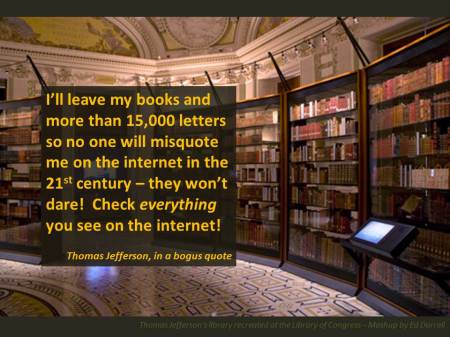
Jefferson's advice on quotes found on the internet

Jefferson’s advice on quotes found on the internet, backdropped by his books now held by the Library of Congress.


Health care legislation as Waterloo – Oliphant (and Benson)

April 17, 2010

Pat Oliphant on health care legislation as Obama's Waterloo, March 23, 2010

Pat Oliphant on health care legislation as Obama's Waterloo, March 23, 2010 - Washington Post

How’s that “make health care Obama’s Waterloo” working out for you, Sen. Demint?

Didn’t expect Obama to be Wellington at Waterloo, eh?

See Steve Benson’s take, below the fold.

Read the rest of this entry »


Why more kids should study world history, harder

November 20, 2009

Jon Taplin explains why knowing world history is valuable. The sad thing is that, of course, the story that makes his reason doesn’t appear in the Texas Essential Knowledge and Skills list for world history, nor in any other social studies course.

Now that the Texas State Board of Education has taken off the cloak of education and made it clear that social studies in Texas is considered a political free-fire zone, and that they plan to vitiate anything but the propaganda value for the Republican Party, Taplin’s piece has all the more poignance.

The Renaissance, and Florence, were more than just a minor question on the TAKS test.  Santayana’s Ghost weeps bitterly.

Why isn’t Jon Taplin’s blog required reading in more places, by more people in government and politics?  We know why the Texas State School Board doesn’t want anyone to read it — that alone should make people fight to see what Taplin says.

Promote this idea in your own study group:

Add to FacebookAdd to NewsvineAdd to DiggAdd to Del.icio.usAdd to StumbleuponAdd to RedditAdd to BlinklistAdd to TwitterAdd to TechnoratiAdd to Furl


Killer CO2 cloud – the story climate change “skeptics” hope you won’t read

October 14, 2009

From Neat-o-rama: Grazing cattle killed in the 1986 Lake Nyos disaster (Image Credit: Water Encyclopedia)

From Neat-o-rama: Grazing cattle killed in the 1986 Lake Nyos disaster (Image Credit: Water Encyclopedia)

It’s not even secret.  But those propagandists who run advertising claiming that carbon dioxide is natural and, therefore, harmless, hope against hope that you don’t know the true history, that you’ve never heard of Cameroon, that you don’t know about volcanic emissions, and that you forgot the story of the killer CO2 cloud of 1986.

Read it here, “Cameroon:  The Lake of Death.”

More information:

Lake Nyos, in Cameroon, shortly after the 1986 killer CO2 cloud. Image from Neat-o-rama.

Lake Nyos, in Cameroon, shortly after the 1986 killer CO2 cloud. Image from Neat-o-rama.

Help make a cloud of witnesses:

Add to FacebookAdd to NewsvineAdd to DiggAdd to Del.icio.usAdd to StumbleuponAdd to RedditAdd to BlinklistAdd to TwitterAdd to TechnoratiAdd to Furl

Save


“The GOP used to be the party of business”

September 10, 2009

Santayana’s Ghost notes there’s an 1852 Whiggy smell about the Republican Party these days.

Thomas L. Friedman writes at the New York Times:

The G.O.P. used to be the party of business. Well, to compete and win in a globalized world, no one needs the burden of health insurance shifted from business to government more than American business. No one needs immigration reform — so the world’s best brainpower can come here without restrictions — more than American business. No one needs a push for clean-tech — the world’s next great global manufacturing industry — more than American business. Yet the G.O.P. today resists national health care, immigration reform and wants to just drill, baby, drill.

“Globalization has neutered the Republican Party, leaving it to represent not the have-nots of the recession but the have-nots of globalized America, the people who have been left behind either in reality or in their fears,” said Edward Goldberg, a global trade consultant who teaches at Baruch College. “The need to compete in a globalized world has forced the meritocracy, the multinational corporate manager, the eastern financier and the technology entrepreneur to reconsider what the Republican Party has to offer. In principle, they have left the party, leaving behind not a pragmatic coalition but a group of ideological naysayers.”

Drum up some business:

Add to FacebookAdd to NewsvineAdd to DiggAdd to Del.icio.usAdd to StumbleuponAdd to RedditAdd to BlinklistAdd to TwitterAdd to TechnoratiAdd to Furl


Wirtism? Summer political crazies explained in history

August 30, 2009

Santayana’s Ghost has been restless these past two months.  Now we know why:  Summer 2009 replayed summer 1934.

Micheal Hiltzik explained it in a column in the Los Angeles Times:

To me they’re merely the latest examples of a phenomenon that might be called Wirtism.

If you find the term unfamiliar, that’s because I just coined it to honor the memory of William A. Wirt. Wirt’s day in the sun came back in 1934, when the obscure Midwestern blowhard placed himself at the center of a political maelstrom by “discovering” a plot by members of Franklin Roosevelt’s Brain Trust to launch a Bolshevik takeover of the United States.

That Wirt’s yarn was transparently absurd didn’t keep it from being taken seriously on the front pages of newspapers coast to coast, including the Los Angeles Times and the New York Times. He gave speeches, wrote a book and went to Washington to give personal testimony at a standing-room-only congressional hearing.

If that reminds you of the overly solicitous treatment given by the press, cable news programs and Republican office holders to purveyors of such lurid claptrap as the Obama birth certificate story or the fantasy of healthcare “death panels,” now you know why it pays to study history.

How did it end?  Not soon enough, or well enough, but it ended:

“Roosevelt is only the Kerensky of this revolution,” he quoted them. (Kerensky was the provisional leader of Russia just before the 1917 Bolshevik revolution.) The hoodwinked president would be permitted to stay in office, they said, “until we are ready to supplant him with a Stalin.”

Those words caused an immediate sensation. Wirt hedged on naming the treasonous “Brain Trusters” — which only intensified the public mania. Into the vacuum of information poured supposition masquerading as fact (certainly a familiar phenomenon today). This newspaper, then a pillar of Republicanism, gave Wirt the benefit of the doubt on the grounds that “the activities of the ‘brain trust’ during the past year fit neatly into the Communistic scheme” he described — a reminder that the most potent fabrications are those that confirm what the listener wants to believe.

For that’s what Wirt’s story was — a fabrication. Hauled before Congress, he said he heard of the plot during a party at a friend’s home in Virginia. The other guests, mostly low-level government employees without any connection to the Brain Trust, subsequently testified that none of them could have mentioned Kerensky or Stalin even if they wished, because Wirt monopolized the dinner-table conversation with a four-hour harangue about monetary policy.

Now you know.  So don’t act stupidly.


Rick Warren and George Washington

August 17, 2008

At American Creation, Tom Van Dyke looks at the questions paster Rick Warren asked Sen. John McCain and Sen. Barack Obama, with an eye to history.

George Washington probably would have flunked the test, had he been on the dais yesterday, Van Dyke notes.

Santayana’s Ghost shifts nervously.

Washington Bible - image from the Masonic Library and Museum

"Washington Bible" - image from the Masonic Library and Museum


Olympic history FAIL!, or great PhotoShop

May 11, 2008

Ed Brayton found it.

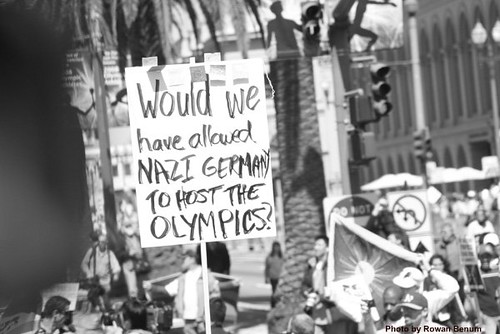
Olympic torch relay protestor with really dumb sign

Do you think the sign maker was jesting? Or do you think the sign maker genuinely didn’t know? (See: 1936 Olympics in Berlin)

While we wait to see whether someone will confess to PhotoShopping this picture, we teachers might consider using this photo as a hook for a lesson on the differences between the rising totalitarian state of Nazi Germany in 1936, and the rising, increasingly economically free state of the People’s Democratic Republic of China today.

One more lesson plan for this year — it’s reusable next fall, with the added bonus then that by then you’ll have the headlines of the actual Olympics to add to the discussion.

Update: The photo is said to have been was taken by Rowan Benum at a California site (see Mr. Benum’s comment). Since it’s all the rage on conservative sites, where the history ignorance is condemned but the conservative bloggers can’t quite bring themselves to endorse the Communist Chinese, I strongly suspect wondered about a PhotoShop origin. The torch was run through San Francisco; there are few palms in San Francisco (Californians: Can you identify the location?).

Update 5-13-2008: The photographer kindly dropped by comments to note the authenticity of the photo. I agree, the Tibetan prayer flags suggest authenticity; would a hoaxer think of such details?

Discussion questions for the classroom:

Students should look at the photo, and read coverage of the torch relay, such as CNN’s story about the San Francisco relay where Mr. Benum took the photo. Students should have access to information about the International Olympic Committee and its organization, especially the tradition of Olympic Truce. The Charter of the Olympics is probably too long for practical classroom use, but Paragraph 2 can be copied for the students, or perhaps the full page of the “Fundamental Principles of Olympism”:

“Olympism is a philosophy of life, exalting and combining in a balanced whole the qualities of body, will and mind. Blending sport with culture and education, Olympism seeks to create a way of life based on the joy found in effort, the educational value of good example and respect for universal fundamental ethical principles.”
Olympic Charter, Fundamental principles, paragraph 2

There is a wealth of information for classroom use at the website of the IOC. If you’re particularly adventurous, or deep into this topic, check out the podcasts of Olympic history from amateur historian Eli Hunt.

Students should also have some information about Tibet, and the Dalai Lama and Tibet’s government in exile, about the history of Tibet and China’s actions since World War II. Students should have some history of the 1936 Olympics, and they should be familiar with the stories of Jesse Owens’ accomplishments there and his return to a segregated U.S. You may want to provide an article about the U.S. protest of the 1980 Olympics in Moscow, and the Soviet protest of the 1984 Olympics in Los Angeles, and other Cold War moments of Olympic tension.

  1. Since the International Olympics Committee (IOC) is an avowedly non-political international agency, is it fair or rational to protest the siting of an Olympics on political grounds?
  2. What do the protesters ask the IOC to do? What do the protesters ask others to do?
  3. Under international law, what are the rights and duties of the Peoples Republic of China (PRC)?
  4. Did the IOC ask anything of the government of the Peoples Republic of China of a political nature? Would such requests be fair, or rational?
  5. Other international organizations function in other nations where governments do not have good records on human rights, such as the Red Cross/Red Crescent, Scouting, UNICEF, and others (can you add to this list?). What considerations must such organizations give to local politics where human rights are at issue?
  6. Compare and contrast the issues surrounding the Beijing Olympics with issues surrounding the Myanmar relief efforts after Cyclone Nargis (2008).
  7. Look at other protests involving the Olympics, especially in 1980 and 1984. Did those protests achieve what the protesters had hoped? Does the success or failure of past protests augur well for current protests?
  8. The creator of the protest sign in the photograph appears to have not known about the 1936 Olympics, which were hosted in Berlin, then under the control of the Nazi government of Germany. The Olympics were sited in Berlin prior to the rise of the Nazi government. Does the protester’s ignorance of history affect the message of the sign? Does it reflect well on the cause the protester advocates?
  9. What other famous or notorious examples of ignorance of history can you find?
  10. Do you ever get embarrassed for the people captured in Jay Leno’s “Jaywalking” segments?
  11. Georges Santayana (1863-1952) famously said, “Those who cannot remember the past are condemned to repeat it.” Do you find that statement to be true? Does this affect the course of history? (Students may want to explore the history of invasions of Russia by Napoleon and Hitler, or the history of invasions of Afghanistan by Britain, the Soviet Union, and the U.S.)

Quote of the moment: Price of repeating history

November 3, 2007


“Each time history repeats itself, the price goes up.”

Ronald Wright, A Short History of Progress, (House of Anansi Press, 2004) (Carroll and Graf, 2005)

Cover of Ronald Wright's A Short History of Progress(This book resulted from Ronald Wright’s 2004 lectures in the famous Canadian series, the Massey Lectures. The lectures are broadcast on radio by the Canadian Broadcasting Company (CBC), whose website features an excerpt from the Wright lectures. You may get a podcast of Wright’s lecture 1, here; and lecture 2, here. Wright suggests that, after 10,000 years of experimenting with civilization, generally leading to failure, we have a chance to get things right, now, if we act wisely. “It describes in particular how four historical civilisations – those of Easter Island, Sumer, the Maya and Rome – self-destructed due to a lack of foresight and to wrong choices. Wright argues ‘each time history repeats itself, the price goes up.'” Martin Scorsese is developing the movie rights.)

Wright’s use of the phrase is the earliest I’ve been able to document quickly; but it’s a popular phrase now. Please note in comments if you know of an earlier use that can be tracked down.


Have a good Texas Independence Day

March 2, 2007

Independence from what? “Do you mean the Alamo stuff?”

March 2 formerly was celebrated widely in Texas. Today, not so much.

Marshall Doke, Dallas attorney and chairman of the Texas Historical Foundation lectures Texas educators and parents today, on what should be done, in an opposite-editorial page piece in the Dallas Morning News.

Our Texas story helps us learn from the great men and women of the past that the one element essential for success (and possibly survival) is character. In the words of John Quincy Adams in the movie Amistad, “Who we are is who we were.”

Pray Texans never forget.

What does Texas Independence Day commemorate, again?

Update: Looking for more material, teachers? Go here, to Grits for Breakfast. You’ll find a list of other blogs that discussed the event today, and over the past couple of years. Interesting views.