Thunder is impressive, but it’s lightning that does the work

July 11, 2013

Nice photo from Texas Storm Chasers:

David Reimer's great shot of lightning, about 10:00 p.m. in Norman, Oklahoma, July 11, 2013

David Reimer’s great shot of lightning, about 10:00 p.m. in Norman, Oklahoma, July 11, 2013

Good luck, and keep ’em coming, David!

(Mark Twain observed:  “Thunder is good, thunder is impressive; but it is lightning that does the work.” (Letter, August 28, 1908))


What rocks Yosemite? Granite

July 7, 2013

Yosemite’s Nature Notes #20 (I’m behind):  A short film discussing the astonishing manifestations of granite in Yosemite National Park.

English: El Capitan in Yosemite National Park ...

El Capitan in Yosemite National Park viewed from the Valley Floor — one of the more famous granite formations in the Park. Wikipedia image

The film is simply named, “Granite.”  Steven Bumgardner produced the film.

Yosemite’s chief formations are granite, an igneous rock.  Much of the terrain was carved in the granite by glaciers and glaciation — so what Yosemite shows is how fire and ice combine to make rock, to make rock formations, and to make rocks of astonishing beauty.

(This is not a place to bolster creationist ideas.  This is real science, looking at God’s handiwork first hand.)

A North Carolina university makes field trips to Yosemite?  I’d love to take that class!

Watching this film, you get a sense of how important it can be to the education of our children to travel in the summers, to take vacations to our National Parks, and to places like Yosemite.

Where are you taking your kids this summer?  Kids, where are you going?

Enjoy it.  Geology lessons are often fun, and this one, on film, is more fun than most.

More:

Close-up of granite from Yosemite National Par...

Close-up of granite from Yosemite National Park, valley of the Merced River – Wikipedia image


Annals of global warming: Arizona wildfires 2013 and “the new normal”

July 6, 2013

A burned home is seen in an unidentified neighborhood west of Highway 89 in Yarnell, Arizona July 3, 2013. Reuters

A burned home is seen in an unidentified neighborhood west of Highway 89 in Yarnell, Arizona July 3, 2013. Reuters, via International Business Times

From a much longer story you should read by Felicity Barringer and Kenneth Chang  in The New York Times, Tuesday, July 2, 2013, page A13 of the National Edition:

Since 1970, Arizona has warmed at a rate 0.72 degrees per decade, the fastest among the 50 states, based on an analysis of temperature data by Climate Central, an independent organization that researches and reports on climate. Even as the temperatures have leveled off in many places around the world in the past decade, the Southwest has continued to get hotter.

“The decade of 2001 to 2010 in Arizona was the hottest in both spring and the summer,” said Gregg Garfin, a professor of climate, natural resources and policy at the University of Arizona and the executive editor of a study examining the impact of climate change on the Southwest.

Warmer winters mean less snowfall. More of the winter precipitation falls as rain, which quickly flows away in streams instead of seeping deep underground.

The soils then dry out earlier and more quickly in May and June. “It’s the most arid time of year,” Dr. Garfin said. “It’s windy as well.”

The growing season also starts earlier, so there is more to burn.

“The fire season has lengthened substantially, by two months, over the last 30 years,” said Craig D. Allen, a research ecologist at the United States Geological Survey station at Bandelier National Monument in New Mexico.

The fire potential is exacerbated by the past policy, beginning around 1900, of putting out all fires. Fires are a natural way of clearing out the underbrush. With that natural rhythm disrupted, the flammable material piled up, so when it did catch fire, it ignited a giant fire that burned hotter and wider.

This total-suppression policy began to ease as early as the 1950s, when scientists began to see fire’s role in ecosystems. It was completely abandoned nearly two decades ago.

But in the 1970s, the Southwest entered a wet period, part of a climate cycle that repeats every 20 to 30 years. “That wet period helped keep a lid on fires,” Dr. Allen said. “And it also allowed the forests to fluff up.”

Since 1996, the climate pattern, known as the Pacific decadal oscillation, has swung to the dry end of the spectrum, and the region is caught in a long-term drought.

Stephen J. Pyne, one of the nation’s leading fire historians and a professor at Arizona State University, said, “How we live on the land, what we decide we put on public and private lands, how we do things and don’t do things on the land, changes its combustibility.”

In many landscapes, he added, “you’ve enhanced the natural combustibility” by building hundreds of thousands of homes in fire-prone areas, and for years suppressing natural fires, allowing a buildup of combustible materials like the “slash” debris left behind by logging.

The article explains how this is the dry phase of the Pacific Decadal Oscillation; so we can hope the wet phase will be wet enough to suppress fires.  However, the simple fact of additional effects brought on by PDO does not mean warming goes away when the PDO switches phases.  Note especially the lengthening fire season over three decades; incrementally, warming is making these well-known cycles, warmer, and too often, destructive or more destructive.

More: 

Sign welcoming visitors to Yarnell, Arizona:

Sign welcoming visitors to Yarnell, Arizona, with wildfire in the background: “Elevation 4,850 ft., ‘Where the desert breeze meets the mountain air.'” Sedonaeye.com image


English: Monthly values for the Pacific decada...

Monthly values for the Pacific decadal oscillation index, 1900 – 2010 Black line:121-month smooth Data source: http://jisao.washington.edu/pdo/PDO.latest (Photo credit: Wikipedia)


One more time: Basic climate science with Bill Nye

July 4, 2013

What year is this? 2013?

Shouldn’t the Sputnik Revolution in science education have obviated the need for this video, like 30 years ago?

One more time, the basics of climate change/global warming, with Bill Nye the Science Guy explaining; from the ClimateRealityProject.org:

http://vimeo.com/climatereality/climate101

climate change, CO2, global warming, science, Bill Nye, environmental protection, Clean Air, Air Pollution

More:

Newsweek, March 4, 1957,

Cover of Newsweek Magazine, from March 4, 1957; notice this concern about U.S. science competency came seven months before Sputnik was launched by the Soviet Union. Science deniers then delayed action until after the Soviets demonstrated clearly that the U.S. was behind. (Image from Computer History.org)


For the birds, scientists at work

July 2, 2013

A scientist at work:

Amanda Holland with one of her research subjects, in South Carolina

Amanda Holland with one of her research subjects, in South Carolina

Kathryn’s cousin, Amanda Holland, moved from researching condors in California, to buzzards in Georgia and South Carolina (for the University of Georgia, I think).

Here she is with one of her research subjects.  Much lore is out there about handling carrion-eating birds for research — they vomit on you only if they like you, for example — but wholly apart from that, how great is this photo of a scientist at work?

I told her to copyright the photo (it is), and to hand on to the meme.  Can’t you see a character in Game of Thrones, or some other fantasy, who carries her own vultures to clean up after she devastates some other army in battle?

Eagles and falcons and owls are okay, but what other bird could conceal the results of the battle, so the warrior princess could move on in stealth?

Science field work looks like great stuff.  My experience is that it’s tiring, and sometimes lonely (though in very beautiful locations) — but the psychic rewards of actually increasing knowledge keep a lot of scientists going.  There’s not a lot of money in it.

Look at the friends you could make!


Can a person of science really appreciate beauty? (Feynman!)

June 28, 2013

Don Prothero posted this on his Facebook feed, from Unearthed Comics:

Scientists' view of vacations, Unearthed Comics, Sarah Zimmerman, copyright 2013

Unearthed Comics, Sarah Zimmerman, copyright 2013

It’s an old question:  Can one understand the science behind the beauty, and still be in awe of the beauty?

Can one understand evolution in biology, or geology, or physics, and still be in awe of the universe?

About a year ago I wrote on this issueMark Twain said no; Richard Feynman says yes, and the scientist appreciates the beauty more.

What do you think?

From my earlier post:

Mark Twain wrote about how too much knowledge can spoil beauty for a beholder. In Life on the Mississippi, Twain described how the natural beauty of the river changed for him once he started serious study to be a river pilot. That wonderful sunset revealed the river was high, hiding objects of danger. That beautiful little ripple told him a snag waited underwater to pierce his boat.

Cover of

Cover via Amazon

. . . The face of the water, in time, became a wonderful book — a book that was a dead language to the uneducated passenger, but which told its mind to me without reserve, delivering its most cherished secrets as clearly as if it uttered them with a voice. And it was not a book to be read once and thrown aside, for it had a new story to tell every day. Throughout the long twelve hundred miles there was never a page that was void of interest, never one that you could leave unread without loss, never one that you would want to skip, thinking you could find higher enjoyment in some other thing. There never was so wonderful a book written by man; never one whose interest was so absorbing, so unflagging, so sparkingly renewed with every re-perusal. The passenger who could not read it was charmed with a peculiar sort of faint dimple on its surface (on the rare occasions when he did not overlook it altogether); but to the pilot that was an ITALICIZED passage; indeed, it was more than that, it was a legend of the largest capitals, with a string of shouting exclamation points at the end of it; for it meant that a wreck or a rock was buried there that could tear the life out of the strongest vessel that ever floated. It is the faintest and simplest expression the water ever makes, and the most hideous to a pilot’s eye. In truth, the passenger who could not read this book saw nothing but all manner of pretty pictures in it painted by the sun and shaded by the clouds, whereas to the trained eye these were not pictures at all, but the grimmest and most dead-earnest of reading-matter.

Now when I had mastered the language of this water and had come to know every trifling feature that bordered the great river as familiarly as I knew the letters of the alphabet, I had made a valuable acquisition. But I had lost something, too. I had lost something which could never be restored to me while I lived. All the grace, the beauty, the poetry had gone out of the majestic river! I still keep in mind a certain wonderful sunset which I witnessed when steamboating was new to me. A broad expanse of the river was turned to blood; in the middle distance the red hue brightened into gold, through which a solitary log came floating, black and conspicuous; in one place a long, slanting mark lay sparkling upon the water; in another the surface was broken by boiling, tumbling rings, that were as many-tinted as an opal; where the ruddy flush was faintest, was a smooth spot that was covered with graceful circles and radiating lines, ever so delicately traced; the shore on our left was densely wooded, and the somber shadow that fell from this forest was broken in one place by a long, ruffled trail that shone like silver; and high above the forest wall a clean-stemmed dead tree waved a single leafy bough that glowed like a flame in the unobstructed splendor that was flowing from the sun. There were graceful curves, reflected images, woody heights, soft distances; and over the whole scene, far and near, the dissolving lights drifted steadily, enriching it, every passing moment, with new marvels of coloring.

I stood like one bewitched. I drank it in, in a speechless rapture. The world was new to me, and I had never seen anything like this at home. But as I have said, a day came when I began to cease from noting the glories and the charms which the moon and the sun and the twilight wrought upon the river’s face; another day came when I ceased altogether to note them. Then, if that sunset scene had been repeated, I should have looked upon it without rapture, and should have commented upon it, inwardly, after this fashion: This sun means that we are going to have wind to-morrow; that floating log means that the river is rising, small thanks to it; that slanting mark on the water refers to a bluff reef which is going to kill somebody’s steamboat one of these nights, if it keeps on stretching out like that; those tumbling ‘boils’ show a dissolving bar and a changing channel there; the lines and circles in the slick water over yonder are a warning that that troublesome place is shoaling up dangerously; that silver streak in the shadow of the forest is the ‘break’ from a new snag, and he has located himself in the very best place he could have found to fish for steamboats; that tall dead tree, with a single living branch, is not going to last long, and then how is a body ever going to get through this blind place at night without the friendly old landmark.

No, the romance and the beauty were all gone from the river. All the value any feature of it had for me now was the amount of usefulness it could furnish toward compassing the safe piloting of a steamboat. Since those days, I have pitied doctors from my heart. What does the lovely flush in a beauty’s cheek mean to a doctor but a ‘break’ that ripples above some deadly disease. Are not all her visible charms sown thick with what are to him the signs and symbols of hidden decay? Does he ever see her beauty at all, or doesn’t he simply view her professionally, and comment upon her unwholesome condition all to himself? And doesn’t he sometimes wonder whether he has gained most or lost most by learning his trade? (From Life on the Mississippi, Chapter 9; from the University of Virginia Library, Electronic Text Center)

Oh, it’s great literature. But I’ve always been troubled by the anti-science nature of Twain’s complaint, that if you know something really well, you’ll lose respect for its beauty. What better way to discourage a young person from learning science, from learning about the stars, the trees, the rivers and mountains?

It was not so for me. The more I learned about western trees, and grasses and wildflowers, the better I grew to love the dry, hot western desert mountains. The more I yearned to learn about the geology that carved spectacular canyons and isolated pinyon pines from ponderosa with a sea of sagebrush — and the more I learned, the more I appreciated how delicately balanced the whole thing was.

Then I found Feynman. He put into a few words what I felt. He described a continuing discussion he had with artists, about beauty and the relationship of science to the appreciation of it. He recorded an interview for the BBC in which he reiterated much of the story, with the added advantage of his wry delivery.

I have a friend who’s an artist, and he sometimes takes a view which I don’t agree with. He’ll hold up a flower and say, “Look how beautiful it is,” and I’ll agree. But then he’ll say, “I, as an artist, can see how beautiful a flower is. But you, as a scientist, take it all apart and it becomes dull.” I think he’s kind of nutty. […] There are all kinds of interesting questions that come from a knowledge of science, which only adds to the excitement and mystery and awe of a flower. It only adds. I don’t understand how it subtracts. (From What Do You Care What Other People Think? page 28)

What do you think? Can scientists appreciate beauty as well as artists?  How about the rest of us?

Does learning improve our appreciation of beauty as we increase our understanding of nature, or is learning a barrier to awe?


Annals of global warming: Keeling Curve gone vertical

June 22, 2013

What is the Keeling Curve?

What does it look like now?  See this graphic from the New York Times:

Keeling Curve graph and grahic, New York Times, May 11, 2013

New York Times, May 11, 2013

See the daily update of the Keeling Curve at the Scripps Institute site, University of California at San Diego.

More:


Rachel Carson project won first at National History Day competition

June 19, 2013

News from the San Ramon (California) Express [links added here, except for reporter’s contact]:

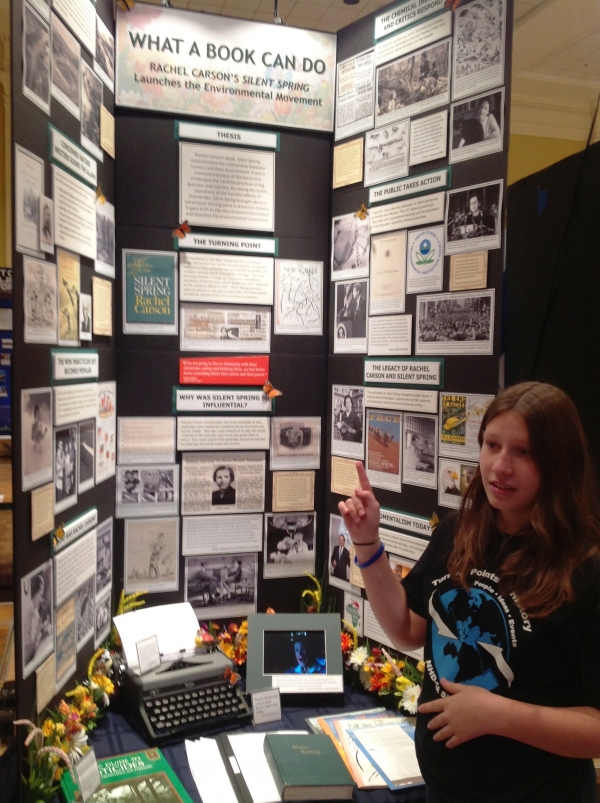
Julienne Sauer in front of her project,

Julienne Sauer in front of her project, “What a book can do — Rachel Carson‘s Silent Spring Launches the Environmental Movement.” (© 2013 San Ramon Express)

San Ramon student takes first at National History Day contest

by Jessica Lipsky

Windemere Ranch Middle School student was one of 30 recognized by the National Endowment for the Humanities (NEH) for their impressive use of historic newspapers in projects presented at National History Day.

Julienne Sauer, who graduated from eighth grade last week, took first place in NEH’s individual exhibit junior division for her project titled “What a book can do — Rachel Carson’s Silent Spring Launches the Environmental Movement.” This year’s National History Day theme was “Turning Points in History: People, Ideas, Events.”

Julienne was also named a National Endowment Humanities Scholar.

The annual event is the culmination of a year-long academic program in which students in middle and high school conduct original historical research for papers, exhibits, websites, documentaries and public performances. Each year more than 600,000 students compete in local, regional and state competitions for a chance to win a spot at the national finals.

This year was the first time NEH awarded prizes to students who incorporated into their projects research using Chronicling America, a free online database of 5 million pages of historic US newspapers dating from 1836 to 1922, digitized through a partnership between NEH and the Library of Congress.

Julienne won a national finalist award at the 2011 National History Day exhibit for her exhibit titled “The Cable Car Wars: A City Debates to Preserve its Character.”

Carson’s work was good enough that, even 49 years after her death, 51 years after the publication of Silent Spring, Carson and the book still inspire students to heights of excellence in study.

More:


How about another cup of coffee? (Global Warming Conspiracy and Starbucks Cup #289)

June 19, 2013

Encore post from September 17, 2007, and August 2009 — maybe more appropriate today than ever before.

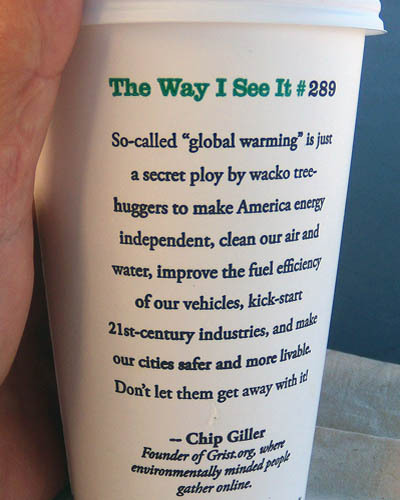
Found this on my coffee cup today (links added here):

The Way I See It #289

So-called “global warming” is just

a secret ploy by wacko tree-

huggers to make America energy

independent, clean our air and

water, improve the fuel efficiency

of our vehicles, kick-start

21st-century industries, and make

our cities safer and more livable.

Don’t let them get away with it!

Chip Giller
Founder of Grist.org, where
environmentally-minded people
gather online.

Starbucks Coffee Cup, The Way I See It #289 (global warming)

Look! Someone found the same cup I found!

I miss those old Starbucks cups — but then, they killed the Starbucks in our town.  I don’t buy the 100 cups of Starbucks coffee I used to get in a year.

More:

Save


Querying the Rachel Carson Critics (who turned out the light?)

June 19, 2013

Another question of mine that will probably never see the light of day.  This group has no answer, so why would they allow the question?

I stumbled across a blog-looking page from the American Council on Science and Health, an industry apologist propaganda site, on World Malaria Day, which was April 25.  You may recognize the name of the group as one of the industry-funded sites that constantly attacks Rachel Carson, and often the World Health Organization, with the unscientific and false claims that environmentalists bannned DDT and thereby condemned millions of Africans to die from malaria — which, ASCH claims, could have easily been eradicated with more DDT poisoning of Africa.

On World Malaria Day, ASCH took note, flirted with the facts (that DDT doesn’t work as it once was thought to work), but then backed away from the facts — that the ban on DDT in the U.S. came years AFTER WHO suspended the malaria eradication campaign in Africa when it was discovered DDT couldn’t kill DDT-adapted mosquitoes, already subject to years of abuse of DDT by agriculture and other industries.  ASCH said:

DDT kills mosquitoes, although not as well as it did 60 years ago. But it also irritates them and repels them, so the small amount sprayed inside homes effectively reduces the transmission of the malarial microbe substantially. The banning of DDT, based upon political anti-chemical bureaucrats and “environmentalists” inspired by Carson’s “Silent Spring” who ran our EPA in 1972, helped to impede the malaria control program led by the UN’s WHO.

Impede?  Impossible for a 1972 ban to have been responsible for the earlier suspension of the WHO campaign, not to mention EPA’s ban ended at the U.S. borders.  So I asked:

Screen capture of query to ACSH on how EPA's ban "impeded" WHO's campaign against malaria, ended years earlier.

Screen capture of query to ACSH on how EPA’s ban “impeded” WHO’s campaign against malaria, ended years earlier.

Ed Darrell Reply

June 19, 2013 at 5:16 am

Your comment is awaiting moderation.

I would be very interested in just how the 1972 ban on DDT in the U.S. “impeded” the UN’s antimalaria campaign, which stopped using DDT heavily seven years earlier, and was suspended in 1969.

After the ban on U.S. use of DDT, all of U.S. manufacture was dedicated to export to Africa and Asia, which greatly increased DDT supplies available there.

How did this impede?

Want to wager a guess as to whether they’ll ever allow the comment to see the light of day at their site, let alone answer it?

More:

Wall of Shame – Sites that continue to spread the pro-DDT hoax as fact:

DDT is good for me advertisement

“DDT is good for me advertisement” from circa 1955.  Photo image from the Crossett Library Bennington College.  This ad today is thought to be emblematic of the propaganda overkill that led to environmental disasters in much of the U.S. and the world.  DDT cleanups through the Superfund continue to cost American taxpayers millions of dollars annually.


Quote of the moment: Rachel Carson, on why her nature writing sounds so much like poetry

June 14, 2013

Rachel Carson said:

“If there is poetry in my book about the sea, it is not because I deliberately put it there, but because no one could write truthfully about the sea and leave out the poetry.”

Cover of The Gentle Subversive, by Mark Hamilton Lytle, for Oxford University Press.

Cover of The Gentle Subversive, by Mark Hamilton Lytle, for Oxford University Press.

Bug Girl wrote a fine review last year of an often over-looked book on Carson, The Gentle Subversive: Rachel Carson, Silent Spring, and the Rise of the Environmental Movement  (Mark Hamilton Lytle, 2007. Oxford Univ. Press.)  It’s worth your click over there to read a nice piece on Carson, on women in science, and on nature writing.

Bug Girl spends the necessary time and space answering critics of Carson, of Silent Spring, and those few odd but incredibly active and loud advocates who claim we can conquer disease if we can only spread enough DDT poison around the Earth.  Go see.

I find it impossible to stand in a place like Yosemite and not hear John Muir‘s voice — and it’s probably that John Muir found that, too.  Or stand on the shores of Waldon Pond and not hear Henry David Thoreau, or stand on sandy soil in Wisconsin and not hear Aldo Leopold, or sit on a redrock outcropping in southern Utah and not hear Ed Abbey.  They probably heard similar voices.  But they had the presence of mind to write down what they heard.

Writing wonderful prose, or poetry, must be easier when the subject sings of itself in your ears, and paints itself in glory for your eyes.

If Carson’s prose borders on poetry, does that add to, or subtract from its science value?

More:

U.S. President Theodore Roosevelt (left) and n...

U.S. President Theodore Roosevelt (left) and nature preservationist John Muir, founder of the Sierra Club , on Glacier Point in Yosemite National Park. In the background: Upper and lower Yosemite Falls. Wikipedia image


Sky that makes people repent

June 7, 2013

May 28, 2013, in Buffalo, Oklahoma.

May 28, 2013, in Buffalo, Oklahoma. Photo by Chris Sanner, Tornado Titans

Tornado Titans comment at Facebook:

“Main Street Buffalo” – Looking down Main Street of Buffalo, Oklahoma as a severe thunderstorm dumping large hail sits nearly stationary just north of town. I’ve been wanting to get a scene like this for a long time. This was still in the late afternoon and it looked like evening outside, the locals were wondering why I’d keep running out in the middle of the road in between traffic with my camera one guy stopped to ask us if we were broke down. Great people!

You see a few of these skies in a week, you’re not so anxious to stand outside and deny global warming caused by humans.  With luck, enough people will be driven to repent of their denialism, and we can get some serious action to restore the atmosphere.


Why it’s important to have accurate history and science on the internet: Don’t lie to kids about DDT

June 6, 2013

Great accomplishment by this kid from Hudson, Massachusetts — but troubling, too.  He’s winning a persuasive speech competition, persuading people against history, law and science, calling for a return of DDT.

Andrew Brandt of Hudson MA, persuasive speaking champion

Andrew Brandt of Hudson holds his winning certificate at the regional speech and debate tournament in New Hampshire in April. He was one of seven to advance to the national competition. (Photo/submitted)

Hudson – Andrew Barndt, 13, from Hudson will be traveling to Tulsa, Okla., in June to join more than 500 students competing in a National Speech and Debate Tournament.

Andrew has qualified to compete in the Persuasive Speech category with the National Christian Forensics and Communications Association (NCFCA). Home-schooled students aged 12 to 18 compete at local and regional tournaments around the country in the winter and spring, culminating in the national tournament in June.

In April, at the regional tournament in Concord, N.H., 27 students competed in the Persuasive Speech category. Andrew’s speech, “DDT: What You Think You Know May Not Be So,” was one of seven chosen to move on the national competition.

According to the NCFCA, “a persuasive speech is an original platform speech that attempts to persuade the audience to adopt a particular point of view or course of action.”

A competitor will give a speech three times in front of different three-judge panels. Judges can be other parents, members of the community or former competitors. The judges rank them on 17 criteria, including: using outside evidence, relating a clear thesis, demonstrating a logical flow of ideas, incorporating proper vocal technique, having good energy level and making eye contact. The top candidates advance to a final round and the winners are decided. Winners receive a trophy and recognition on the NCFCA website.

Andrew will present his winning speech at the national competition held at Oral Roberts University June 18-22. His speech has three parts: debunking the myth of birds’ eggs being harmed due to DDT, disproving the claim that DDT causes cancer in humans, and pointing out that DDT has saved hundred of millions of lives by reducing mosquitoes that carry malaria. He concludes by urging his listeners to repeal the ban on DDT.

“I’m an avid birdwatcher,” Andrew said. “which is how I became familiar with DDT in the first place.”

According to his mother, Ann Barndt, Andrew also competes in debate. “This year he and his brother, Jonathan, 16, partnered together as a team,” she said. “However, their record was not high enough to advance.”

She said the brothers did enjoy preparing for the tournaments, researching various aspects of the this year’s topic, the United Nations. They plan to partner together again next year.

“As for my future, I’m still thinking about how to merge [bird watching] with a sustainable livelihood,” Andrew said.

For more information about the tournament, visit www.ncfca.org.

At the site of the Hudson Community Advocate, I offered what I hope is gentle but persuasive advice to the kid, from one old debater to another:

I commend the young man on his speaking prowess — but he needs a lot of help with his research chops.

1. Birds eggs are harmed by DDT; worse, that’s just one of four ways DDT kills birds. It also poisons chicks outright, in the eggs, poisons the adults (especially migratory birds), and it disrupts the nervous systems of chicks so that, even when they do hatch, they don’t survive.

2. Although it’s a weaker carcinogen, DDT is listed as a “suspected human carcinogen” by the American Cancer Society, CDC and WHO. DDT’s carcinogenic qualities were evidenced long after EPA banned its use because it kills wildlife systems.

3. While DDT played a role in defeating malaria in some countries, it was overused, and it ceased to be so effective as it was. However, malaria rates of infection and total deaths from malaria now are much, much lower than they ever were with DDT. Since malaria deaths are reduced by more than 75%, it’s incorrect math to claim millions died without DDT, wholly apart from the history.

3.1 DDT has never been banned for use against malaria, anywhere. The U.S. ban on DDT, in fact, allowed manufacturing to continue in the U.S., with all DDT dedicated to export. So the U.S. ban, which saved the bald eagle, osprey, peregrine falcon and brown pelican, among others, also multiplied the amount of DDT available to fight malaria in Africa and Asia.

Andrew must be very, very persuasive, to persuade people that DDT, a deadly and mostly useless pollutant, should be revived. Good luck to him in his tournament, and good luck finding better sources next year.

Mr. Brandt must be excused, partly, for his error.  There remains a dedicated and well-funded disinformation assault on the reputation of Rachel Carson, author of Silent Spring, on the World Health Organization, on malaria fighters, on scientists and “environmentalists,” and this assault largely succeeds in ruthlessly elbowing aside the facts in internet searches, and elsewhere.  Fox News still employs serial-prevaricator Steven Milloy whose assault hoaxes on Carson and science of DDT should be more legendary than they are.  So-called Christian organizations join the political fray, while Christians like the Methodists actually fight malaria with the Nothing But Nets campaign — the workers are too busy to crow, the crowers are too busy to fight malaria.  (One may wonder about this Christian debate group — it caters to the small band of home schoolers.  Their evidence standards aside — standards which would disqualify most of the claims against Rachel Carson and for DDT — one wonders how a speaker would fare in this competition,  who praised Rachel Carson and the EPA for banning DDT, and for keeping the ban.  Accuracy of information is not among the criteria to be used in judging.)

The problem with lying to kids is they often believe the lies.  This isn’t a case of scientific disputes, or conflicting studies or information.  Not a jot nor tittle of Rachel Carson’s research citations has ever been questioned.  What she wrote about DDT in 1962 remains valid today, supported by more than a thousand follow-up studies and contradicted by none.  The destructive nature of DDT on bird populations is not questioned by scientists nor experienced bird watchers.  Where did this well-intentioned kid get led so far astray?

Science communicators?  What’s the solution to this problem?

More:


May 25, 1961, 52 years ago: John Kennedy challenged America to go to the Moon

May 26, 2013

President Kennedy at Congress, May 25, 1961

President John F. Kennedy speaking to a special joint session of Congress, on May 25, 1961; in this speech, Kennedy made his famous statement asking the nation to pledge to put a man on the Moon and bring him back safely, in the next ten years.

It was an era when Congress would respond when the President challenged America to be great, and Congress would respond positively.

On May 25, 1961, President Kennedy delivered a special message to Congress, on the challenges facing the U.S. around the world, in continuing to build free market economies, and continuing to advance in science, as means of promoting America’s future.  He closed with the words that have become so famous.  From the Apollo 11 Channel, excerpts from the speech, via Fox Movietone news:

History from the Apollo 11 Channel:

In an address to a Joint session of the United States Congress, Kennedy announces full presidential support for the goal to “commit…before this decade is out, to landing a man on the Moon and returning him safely to the Earth” and urges Congress to appropriate the necessary funds, eventually consuming the largest financial expenditure of any nation in peacetime.

Though Kennedy had initially been convinced that NASA should attempt a manned mission to Mars, NASA Associate Administrator Robert Seamans spent three days and nights working, ultimately successfully, to convince him otherwise.

The complete speech is 46 minutes long.  The JFK Library has a longer excerpt in good video I haven’t figured out how to embed here, but it’s worth your look.  The Library also features the entire speech in audio format.

The complete copy of the written text that President Kennedy spoke from, is also available at the JFK Library.

NASA has a good site with solid history in very short form, and links to a half-dozen great sites.

Can you imagine a president making such a challenge today?

More:


Poster for World Turtle Day (May 23)

May 23, 2013

World Turtle Day, Share the Roads!

Nice reminder, featuring an Eastern Box Tortoise (I think). Image from Conscious Companion.


More: