War between frogs and dragonflies: Frog fail!

April 2, 2013

Which do you think eats more destructive insects, a frog or a dragonfly?

In the war between frogs and dragonflies, for which do we cheer?

Browbeat said:

You should read Natalie Angier’s entire piece about dragonflies from yesterday’s New York Times, of course. But first, you should watch the video above, by Andrew Mountcastle, which accompanies the piece. You should watch it again and again and again.

More:


Fireworks for James Madison’s birthday! Aurora borealis in Alaska, March 16, 2013

March 22, 2013

Fireworks for James Madison’s birthday?

Loren Holmes photo of Aurora borealis over Eureka, Alaska, March 16, 2013

Loren Holmes photograph straight up of Aurora borealis over Eureka, Alaska, on March 13, 2013. AlaskaDispatch.com

I love fireworks.  Kathryn and I have been known to drive a couple hundred miles to see a good show.  Fireworks in honor of the guy who gave us the Constitution and the First Amendment (and much more), seems a great idea to me.

But no one did it . . .

Sometimes the Sun, Moon, stars and planets conspire.

Here’s one of the best, most inspiring five minutes you’ll spend this week. Look what the Sun sent us, filmed in time-lapse glory above Eureka, Alaska, on March 16, 2013, the anniversary of James Madison’s birthday; from AlaskaDispatch.com:

A timelapse of the Aurora Borealis, Northern Lights, over Eureka, Alaska on March 16, 2013. Taken with a Canon 5D Mark III and 24mm f/1.4 and 70-200 f/2.8 lenses. Compiled from 3800 images, with exposures between 2 seconds and 30 seconds.

Loren Holmes, the photographer, provides a more poetic description of the lights he filmed, and more scientific, too, at AlaskaDispatch.com.

AlaskaDispatch.com provided a slide show of Holmes’s better photos, too.

Tip of the old scrub brush to Dr. M. P. Bumsted.

More:


Annals of global warming: No, polar bears are not “fine” — suffer from loss of sea ice

March 20, 2013

Press release from The Journal of Animal Ecology (links added here):

For polar bears, it’s survival of the fattest

One of the most southerly populations of polar bears in the world – and the best studied – is struggling to cope with climate-induced changes to sea ice, new research reveals. Based on over 10 years’ data the study, published in the British Ecological Society‘s Journal of Animal Ecology, sheds new light on how sea ice conditions drive polar bears’ annual migration on and off the ice.

Led by Dr. Seth Cherry of the University of Alberta, the team studied polar bears in western Hudson Bay, where sea ice melts completely each summer and typically re-freezes from late November to early December. “This poses an interesting challenge for a species that has evolved as a highly efficient predator of ice-associated seals,” he explains. “Because although polar bears are excellent swimmers compared with other bear species, they use the sea ice to travel, hunt, mate and rest.”

Polar bear and two cubs wait for ice to reform

Caption from EurekAlert: An adult female polar bear wearing a GPS-satellite linked collar with her two 10-month-old cubs waits for the sea ice to re-form onshore in western Hudson Bay, Manitoba, Canada. Photo Copyright Andrew Derocher, Univeristy of Alberta.

Polar bears have adapted to the annual loss of sea ice by migrating onto land each summer. While there, they cannot hunt seals and must rely on fat reserves to see them through until the ice returns.

Dr. Cherry and colleagues wanted to discover how earlier thawing and later freezing of sea ice affects the bears’ migration. “At first glance, sea ice may look like a barren, uniform environment, but in reality, it’s remarkably complex and polar bears manage to cope, and even thrive, in a habitat that moves beneath their feet and even disappears for part of the year. This is an extraordinary biological feat and biologist still don’t fully understand it,” he says.

From 1991-97 and 2004-09, they monitored movements of 109 female polar bears fitted with satellite tracking collars. They tagged only females because males’ necks are wider than their heads, so they cannot wear a collar. During the same period, the team also monitored the position and concentration of sea ice using satellite images.

“Defining precisely what aspects of sea ice break-up and freeze-up affect polar bear migration, and when these conditions occur, is a vital part of monitoring how potential climate-induced changes to sea ice freeze-thaw cycles may affect the bears,” he says.

The results reveal the timing of polar bears’ migration can be predicted by how fast the sea ice melts and freezes, and by when specific sea ice concentrations occur within a given area of Hudson Bay.

According to Dr. Cherry: “The data suggest that in recent years, polar bears are arriving on shore earlier in the summer and leaving later in the autumn. These are precisely the kind of changes one would expect to see as a result of a warming climate and may help explain some other studies that are showing declines in body condition and cub production.”

Recent estimates put the western Hudson Bay polar bear population at around 900 individuals. The population has declined since the 1990s, as has the bears’ body condition and the number of cubs surviving to adulthood.

Young polar bear challenged by lack of sea ice, Andrew Derocher photo

Caption from EurekAlert: This is a subadult polar bear on a lake on the shores of Hudson Bay in Manitoba, Canada in November waiting for the sea ice to re-form. Copyright Andrew Derocher, Univeristy of Alberta.

Because polar bears’ main food source is seals, and these are hunted almost exclusively on sea ice, the longer bears spend on land, the longer they must go without energy-rich seals. “Climate-induced changes that cause sea ice to melt earlier, form later, or both, likely affect the overall health of polar bears in the area. Ultimately, for polar bears, it’s survival of the fattest,” says Dr. Cherry.

He hopes the results will enable other scientists and wildlife managers to predict how potential climate-induced changes to sea ice freeze-thaw cycles will affect the ecology, particularly the migration patterns, of this iconic species.

###

Seth Cherry et al (2013). ‘Migration phenology and seasonal fidelity of an Arctic marine predator in relation to sea ice dynamics’, doi: 10.1111/1365-2656.12050, is published in the Journal of Animal Ecology on Wednesday 20 March 2013.

More:


Quote of the moment: Richard Feynman, “nature cannot be fooled”

March 18, 2013

Feynman speaking from the grave? You decide:

Feynman uses a glass of ice water to show the Challenger's O-ring problem, 1986

Richard Feynman, at a hearing of the Rogers Commission, demonstrates with a glass of ice water and a piece of O-ring material, how cold makes the O-rings inflexible; photo credit unknown

For a successful technology, reality must take precedence over public relations, for nature cannot be fooled.

Richard Feynman, in the Rogers Commission Report on the Space Shuttle Challenger Accident, appendix (1986)

More:


March 14: π Day! A π roundup, mostly pie

March 14, 2013

Of course you remembered that today is pi Day, right?

Pi Day Pie from Slashfood.com

Happy π Day! Pi Day Pie – Slashfood.com

Oh, or maybe better, π Day.

We’ll start with the brief post from a few months ago, and then build on it with some activities and posts from around the WordPress-o-sphere.

The good people at PiDay.org suggest a few ways you can celebrate:

Make (and Eat) a Pie – These pie recipes for Pi Day from NPR’s McCallister look incredibly tasty. But, there’s no shame in putting a frozen store-bought pie in the oven, or picking up a pie from your local bakery. Any kind of pie is great on Pi Day! If you’re making your own, get inspired by these beautifully designed Pi Day Pies. Tell us on Facebook: What’s your favorite kind of pie for Pi Day?

Hope your π Day is complete as a circle, and well-rounded!

How are others celebrating?  A look around WordPress:

At SocialMediaPhobe, a musical interpretation of pifeaturing the music of Michael Blake:

So Long Freedom:

pidaypieToday is March 14th, also known as “Pi Day” for us math geeks out there because March 14th (3/14) is the first 3 digits of π (3.14159…).  To celebrate “Pi Day” I highly recommend doing something mathematical while having some pie at 1:59 pm.  I recommend Yumology‘s S’mores Pie as it has 3 main ingredients (chocolate, marshmallow, and graham cracker) and about 0.14159 other ingredients like sugar, butter, and stuff.  If you are not a math geek, its okay…you can still eat pie and count things like how many stop signs you pass on your way back to work from lunch.  Or you could go to the library and take out a book on something fun like binary code.  As we like to say, “There are only 10 types of people in the world:  Those that understand binary and those that don’t.”  Seriously, binary is as easy as 01000001, 01000010, 01000011.

Miles Free at PMPA Speaking of Precision:

Today 3-14 at 1:59  I will be celebrqting Pi Day. 3.14159 is the value of pi to 5 decimals...

So besides being  the cause of much techie “irrational” exuberance, Pi Day  is a great way to get some engagement with students.

Marymount High School has several activities, last year they had a design competition incorporating pi; the students then made and sold buttons of each design, proceeds going to the Red Cross.

Hmm- math subject matter, design, production, sales, accounting.

Sounds like what we do in manufacturing.
Maybe celebrating Pi Day is not so irrational as first thought.

Free said his pie is peach.

Steve Doyle at CraveDFW:

On March 12, 2009 your lawmakers  passed a non-binding resolution (HRES 224) recognizing March 14, 2009 as National Pi Day. It is one of the more legit holidays we discuss here, and it is actually an homage to geeks everywhere who see the date as a reason to celebrate due to its mathematical implications. We say any reason to celebrate anything is just fine by us.

Since we are predominately about food we will suggest a few places to actually enjoy a pie.

DSC06367

If you followed us at all this week you may have seen the pie at Bowl and Barrel pop up on our pages. This is the uber delicious Butterscotch Pie served as the solo dessert at the bowling alley and restaurant.  Go eat one of these.

He’s got more pi pie, if you click over there.

Gareth Branwyn at MakeZine offers more pie and a mnemonic:

How to Remember Pi to 15 Digits

Pi-Pie--69299

By way of sci-fi author and mathenaut Rudy Rucker’s Facebook wall comes this:

One way to remember the first few digits of pi is to count the letters in the words of this phrase:

“How I need a drink, alcoholic of course, after the heavy lectures involving quantum mechanics.”

[Image via FreakingNews]

Another song, on YouTube, at Awsomesauce:

b.love offers this clock image (is this clock for sale somewhere?):

A clock for pi day

TED Blog offers two videos:

Chirag Singh explains his “passion for pi.”

Daniel Tammet, “Different Ways of Knowing:

Geeks are really out in force today, flaunting pi for all they’ve got.

More:


Happy birthday, Albert Einstein!

March 14, 2013

How many ways can we say happy birthday to a great scientist born on Pi Day?  So, an encore post.

E=mcc - logo from AIP

E=energy; m=mass; c=speed of light

Happy Einstein Day! to us.  Albert’s been dead since 1955 — sadly for us.  Our celebrations now are more for our own satisfaction and curiosity, and to honor the great man — he’s beyond caring.

Almost fitting that he was born on π Day, no? I mean, is there an E=mc² Day?

Albert Einstein was born on March 14, 1879, in Ulm, Germany, to Hermann and Pauline Einstein. 26 years later, three days after his birthday, he sent off the paper on the photo-electric effect; that paper would win him the Nobel Prize in Physics in another five years, in 1921. In that same year of 1905, he published three other papers, solving the mystery of Brownian motion, describing what became known as the Special Theory of Relativity and solving the mystery of why measurements of the light did not show any effects of motion as Maxwell had predicted, and a final paper that noted a particle emitting light energy loses mass. This final paper amused Einstein because it seemed so ludicrous in its logical extension that energy and matter are really the same stuff at some fundamental point, as expressed in the equation demonstrating an enormous amount of energy stored in atoms, E=mc².

Albert Einstein as a younger man - Nobel Foundation image

Albert Einstein as a younger man – Nobel Foundation image

Any one of the papers would have been a career-capper for any physicist. Einstein dashed them off in just a few months, forever changing the fields of physics. And, you noticed: Einstein did not win a Nobel for the Special Theory of Relativity, nor for E=mc². He won it for the photo electric effect. Irony in history.

106 years later Einstein’s work affects us every day. Relativity theory at some level I don’t understand makes possible the use Global Positioning Systems (GPS), which revolutionized navigation and mundane things like land surveying and microwave dish placement. Development of nuclear power both gives us hope for an energy-rich future, and gives us fear of nuclear war. Sometimes, even the hope of the energy rich future gives us fear, as we watch and hope nuclear engineers can control the piles in nuclear power plants damaged by earthquakes and tsunami in Japan.

English: Albert Einstein on a 1966 US stamp

Albert Einstein on a 1966 US stamp (Photo credit: Wikipedia)

If Albert Einstein was a genius at physics, he was more dedicated to pacifism. He resigned his German citizenship to avoid military conscription. His pacifism made the German Nazis nervous; Einstein fled Germany in the 1930s, eventually settling in the United States. In the U.S., he was persuaded by Leo Szilard to write to President Franklin Roosevelt to suggest the U.S. start a program to develop an atomic weapon, because Germany most certainly was doing exactly that. But while urging FDR to keep up with the Germans, Einstein refused to participate in the program himself, sticking to his pacifist views. Others could, and would, design and build atomic bombs. (Maybe it’s a virus among nuclear physicists — several of those working on the Manhattan Project were pacifists, and had great difficulty reconciling the idea that the weapon they worked on to beat Germany, was deployed on Japan, which did not have a nuclear weapons program.)

English: USSR stamp dedicated to Albert Einste...

Everybody wanted to claim, and honor Einstein; USSR issued this stamp dedicated to Albert Einstein Русский: Почтовая марка СССР, посвящённая Альберту Эйнштейну (Photo credit: Wikipedia)

Einstein was a not-great father, and probably not a terribly faithful husband at first — though he did think to give his first wife, in the divorce settlement, a share of a Nobel Prize should he win it. Einstein was a good violinist, a competent sailor, an incompetent dresser, and a great character. His sister suffered a paralyzing stroke. For many months Albert spent hours a day reading to her the newspapers and books of the day, convinced that though mute and appearing unconscious, she would benefit from hearing the words. He said he did not hold to orthodox religions, but could there be a greater show of faith in human spirit?

Einstein in 1950, five years before his death

Einstein in 1950, five years before his death

When people hear clever sayings, but forget to whom the bon mots should be attributed, Einstein is one of about five candidates to whom all sorts of things are attributed, though he never said them. (Others include Lincoln, Jefferson, Mark Twain and Will Rogers). Einstein is the only scientist in that group. So, for example, we can be quite sure Einstein never claimed that compound interest was the best idea of the 20th century. This phenomenon is symbolic of the high regard people have for the man, even though so few understand what his work was, or meant.

A most interesting man. A most important body of work. He deserves more study and regard than he gets.

More, Resources:


Waiting for Comet Godot

March 14, 2013

Comet Pan-STARRS?

I just can’t see it.

The past two evenings, when it was supposed to be visible, we couldn’t find it.  Maddeningly, others have great photos of the thing.

Here’s a photo of where it was supposed to be the evening of March 12.  Nice sliver of a Moon.

A view to the west over south Grand Prairie, Texas, showing the sliver of the new Moon, but a no-show Comet Pan-STARRS, March 12, 2013.  Photo by Ed, Kathryn and Peanut.

A view to the west over south Grand Prairie, Texas, showing the sliver of the new Moon, but a no-show Comet Pan-STARRS, March 12, 2013. Photo by Ed, Kathryn and Peanut.

We watched for over an hour, from just after the Sun’s winking out in a blaze of orange (Texas dust and DFW smog).  We were shooting without a tripod, and so it was difficult to capture just how thin was the line of the Moon for a long time.  It was not a clear crescent, with mountains of the Moon providing jagged lines that glistened like a crystal glass necklace.  Longer exposures revealed the comet to other observers in other places, but not to us.  Perched as we were right on the edge of the Austin Chalk Escarpment, we were joined by a dozen or so others who hoped to see the comet, or who were just putting their BMX bikes away.

A more detailed, and grainy, shot of the Moon (with no comet):

New Moon over Grand Prairie Texas, looking for Comet Pan-STARRS, photo by Ed Darrell

Eventually the Moon stated its presence, but still no Comet Pan-STARRS, on March 12, 2013. Looking west over Grand Prairie, Texas.  (Yeah, probably would have been a much better photo if not handheld.)

Here’s a photo of where it was supposed to be last night, the evening of March 13.

Moon over Grand Prairie, no comet, 3-13-2013

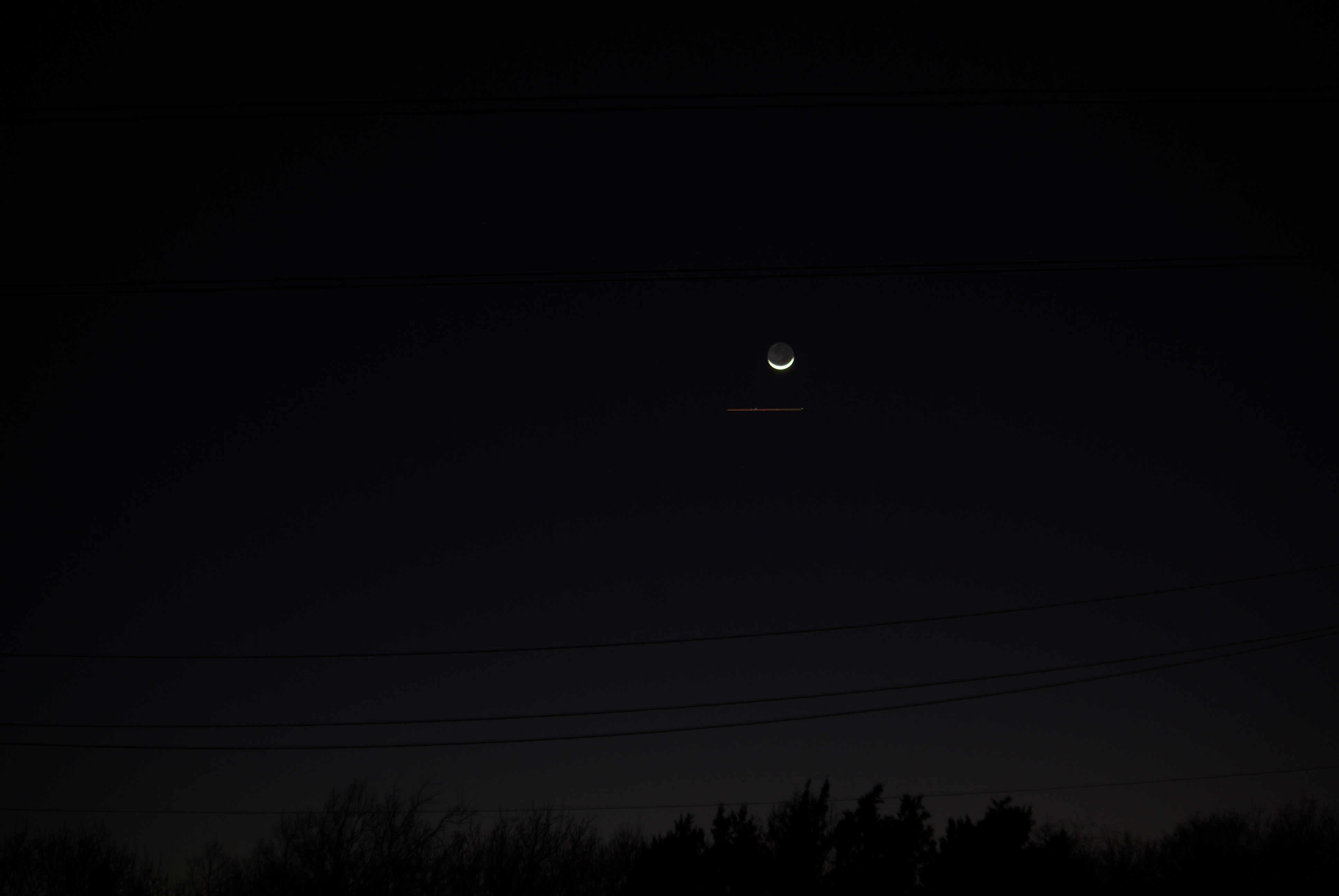
On March 13, Comet Pan -STARRS rode directly underneath the Moon; it’s invisible in this longer exposure, though you can see the streaking lights of a jetliner flying out of DFW International Airport under the Moon.

It’s like waiting for Godot.  Waiting for Comet Godot.

Quoting from SamuellBeckett.net:
ESTRAGON: 
People are bloody ignorant apes.  He rises painfully, goes limping to extreme left, halts, gazes into distance off with his hand screening his eyes, turns, goes to extreme right, gazes into distance. Vladimir watches him, then goes and picks up the boot, peers into it, drops it hastily.
VLADIMIR:  Pah!He spits. Estragon moves to center, halts with his back to auditorium.
ESTRAGON:  Charming spot. (He turns, advances to front, halts facing auditorium.)
Inspiring prospects. (He turns to Vladimir.)
Let’s go.
VLADIMIR:  We can’t.
ESTRAGON:  Why not?
VLADIMIR:  We’re waiting for Godot.
ESTRAGON:  (despairingly). Ah! (Pause.) You’re sure it was here?
VLADIMIR:  What?
ESTRAGON:  That we were to wait.
VLADIMIR:  He said by the tree. (They look at the tree.) Do you see any others?
ESTRAGON:  What is it?
VLADIMIR:  I don’t know. A willow.
ESTRAGON:  Where are the leaves?
VLADIMIR:

It must be dead.


More:

Brian Klimowski's photo of Comet Pan-STARRS, March 12, 2013

Other photographers found Comet Pan-STARRS. This photo comes via SpaceWeather.com. ” Brian Klimowski sends this picture from the countryside near Flagstaff, Arizona . . . ‘Beautiful show this evening!’ says Klimowski. ‘I took the photo from an altitude of about 9500 feet in the San Francisco Peaks near Flagstaff. A 1-second exposure with my Canon digital camera easily revealed the comet.'” Photo details: Canon 7D, 125 mm, 1s @ F/5.6. ISO 1250


Brilliant film: A Forest Year, from Motionkicker

March 14, 2013

Cousin Amanda Holland called my attention to this on Facebook.  Time lapse photography and a forest — heavenly to me.

More details from Motionkicker,  Samuel Orr:

help support my new time-lapse project at kickstarter!
kickstarter.com/projects/motionkicker/new-york-year

A Forest Year was made from 40,000 still images taken from my front window over 15 months, and were blended into the film.

Find out more about how it was made at motionkicker.com

Special thanks to Johnny_RIpper for letting me use his music.
soundcloud.com/johnny_ripper

Tip of the old scrub brush to Amanda Holland and the National Forest Foundation.

More:


Annals of global warming: NASA finds amplified greenhouse effects shift northern growing seasons

March 11, 2013

Global warming affects plants in northern hemisphere, NASA chart

From NASA: Of the 10 million square miles (26 million square kilometers) of northern vegetated lands, 34 to 41 percent showed increases in plant growth (green and blue), 3 to 5 percent showed decreases in plant growth (orange and red), and 51 to 62 percent showed no changes (yellow) over the past 30 years. Satellite data in this visualization are from the AVHRR and MODIS instruments, which contribute to a vegetation index that allows researchers to track changes in plant growth over large areas. Credit: NASA’s Goddard Space Flight Center Scientific Visualization Studio; click image for original view; click here for greater detail

Press release from NASA, March 10, 2013 (links in text added here):

RELEASE : 13-069


Amplified Greenhouse Effect Shifts North’s Growing Seasons

WASHINGTON — Vegetation growth at Earth’s northern latitudes increasingly resembles lusher latitudes to the south, according to a NASA-funded study based on a 30-year record of land surface and newly improved satellite data sets.

An international team of university and NASA scientists examined the relationship between changes in surface temperature and vegetation growth from 45 degrees north latitude to the Arctic Ocean. Results show temperature and vegetation growth at northern latitudes now resemble those found 4 degrees to 6 degrees of latitude farther south as recently as 1982.

“Higher northern latitudes are getting warmer, Arctic sea ice and the duration of snow cover are diminishing, the growing season is getting longer and plants are growing more,” said Ranga Myneni of Boston University’s Department of Earth and Environment. “In the north’s Arctic and boreal areas, the characteristics of the seasons are changing, leading to great disruptions for plants and related ecosystems.”

The study was published Sunday in the journal Nature Climate Change.

Myneni and colleagues used satellite data to quantify vegetation changes at different latitudes from 1982 to 2011. Data used in this study came from NOAA’s Advanced Very High Resolution Radiometers (AVHRR) onboard a series of polar-orbiting satellites and NASA’s Moderate Resolution Imaging Spectroradiometer (MODIS) instruments on the Terra and Aqua satellites.

As a result of enhanced warming and a longer growing season, large patches of vigorously productive vegetation now span a third of the northern landscape, or more than 3.5 million square miles (9 million square kilometers). That is an area about equal to the contiguous United States. This landscape resembles what was found 250 to 430 miles (400 to 700 kilometers) to the south in 1982.

“It’s like Winnipeg, Manitoba, moving to Minneapolis-Saint Paul in only 30 years,” said co-author Compton Tucker of NASA’s Goddard Space Flight Center in Greenbelt, Md.

The Arctic’s greenness is visible on the ground as an increasing abundance of tall shrubs and trees in locations all over the circumpolar Arctic. Greening in the adjacent boreal areas is more pronounced in Eurasia than in North America.

An amplified greenhouse effect is driving the changes, according to Myneni. Increased concentrations of heat-trapping gasses, such as water vapor, carbon dioxide and methane, cause Earth’s surface, ocean and lower atmosphere to warm. Warming reduces the extent of polar sea ice and snow cover, and, in turn, the darker ocean and land surfaces absorb more solar energy, thus further heating the air above them.

“This sets in motion a cycle of positive reinforcement between warming and loss of sea ice and snow cover, which we call the amplified greenhouse effect,” Myneni said. “The greenhouse effect could be further amplified in the future as soils in the north thaw, releasing potentially significant amounts of carbon dioxide and methane.”

To find out what is in store for future decades, the team analyzed 17 climate models. These models show that increased temperatures in Arctic and boreal regions would be the equivalent of a 20-degree latitude shift by the end of this century relative to a period of comparison from 1951-1980.

However, researchers say plant growth in the north may not continue on its current trajectory. The ramifications of an amplified greenhouse effect, such as frequent forest fires, outbreak of pest infestations and summertime droughts, may slow plant growth.

Also, warmer temperatures alone in the boreal zone do not guarantee more plant growth, which also depends on the availability of water and sunlight.

“Satellite data identify areas in the boreal zone that are warmer and dryer and ¬¬other areas that are warmer and wetter,” said co-author Ramakrishna Nemani of NASA’s Ames Research Center in Moffett Field, Calif. “Only the warmer and wetter areas support more growth.”

Researchers did find found more plant growth in the boreal zone from 1982 to 1992 than from 1992 to 2011, because water limitations were encountered in the latter two decades.

Data, results and computer codes from this study will be made available on NASA Earth Exchange (NEX), a collaborative supercomputing facility at Ames. NEX is designed to bring scientists together with data, models and computing resources to accelerate research and innovation and provide transparency.

For more information and images associated with this release, visit:

http://go.nasa.gov/12Amv2s

– end –


text-only version of this release

More:


Neil Tyson, still at it: We need to spend more in government research, in space, in science, in education

March 7, 2013

Here’s a guy who Paul Ryan, Eric Cantor and other “deficit hawks” refuse to debate.  Grover Norquist blanches when you mention his name, and hopes and prays you won’t listen to him:  Neil de Grasse Tyson.

The film was put together from several statements by Tyson, by Evan Schurr.

WRITE TO CONGRESS:
http://www.penny4nasa.org/take-action/

The intention of this project is to stress the importance of advancing the space frontier and is focused on igniting scientific curiosity in the general public.
Facebook cover: (not sure who made this but thank you!)
http://i.imgur.com/yqAGm.png

*FOR THOSE SAYING THE MUSIC IS TOO LOUD* This is the adjusted one http://youtu.be/Fl07UfRkPas

I give immense credit to The Sagan Series for providing the inspiration for this video.
http://www.youtube.com/user/damewse?f…

Copyright Disclaimer Under Section 107 of the Copyright Act 1976, allowance is made for “fair use” for purposes such as criticism, comment, news reporting, teaching, scholarship, and research. Fair use is a use permitted by copyright statute that might otherwise be infringing. Non-profit, educational or personal use tips the balance in favor of fair use. All copyrighted materials contained herein belong to their respective copyright holders, I do not claim ownership over any of these materials. In no way do I benefit either financially or otherwise from this video.

MUSIC:
Arrival of the Birds and Transformation by The Cinematic Orchestra http://www.amazon.com/The-Crimson-Win…

Credits
When We Left Earth http://dsc.discovery.com/tv/nasa/nasa…
The Daily Show with Jon Stewart http://www.thedailyshow.com/
HUBBLE 3D http://www.imax.com/hubble/
NASA TV http://www.nasa.gov/multimedia/nasatv…
The Amazing Meeting http://www.amazingmeeting.com/TAM2011/
“US Mint” http://www.youtube.com/watch?v=-ZzKDL…
“New $100 Note” http://www.youtube.com/watch?v=zgaytK…
Real Time with Bill Maher http://www.hbo.com/real-time-with-bil…
Pale Blue Dot – http://en.wikipedia.org/wiki/Pale_Blu…
STS-135 Ascent Imagery Highlights http://www.youtube.com/watch?v=ikzxtw…
CSPAN State of the Union Address http://www.c-span.org/
The Sagan Series http://www.facebook.com/thesaganseries
The Asteroid that Flattened Mars http://www.youtube.com/watch?v=JgMXPX…
University of Buffalo Communications http://www.communication.buffalo.edu/
Mars Curiosity Rover http://www.youtube.com/watch?v=hnlvvu…
Red Aurora Australis http://www.youtube.com/watch?v=hC7Qro…

Thank you to user florentgermain for the French subtitles

Hey, this is a year old.  Why are you sitting on your hands?  Our future, our children’s future, our great-great-grandchildren’s futures, are on the line.

Tip of the old scrub brush to Robert Krulwich at NPR, who pulled this out and started discussing it again.

More:


Punchline too brutal for work: Why it is that environmentalists are the real humanitarians (a necessary encore)

March 1, 2013

I wish it weren’t true.  I wish people didn’t appear to be getting stupider, less scientifically literate, and less knowledgeable of history (see Santayana‘s thoughts in the upper right-hand corner of the blog . . .).  My e-mail box is filling today with notes from people claiming environmentalists want to rid the Earth of humans, urging that we should oppose them and let poisoning of our air and water continue . . . oblivious to the irony of the claim coupled with their supposed opposition to the idea.  Here’s the truth, in large part, an encore post from several months ago (I apologize in advance for the necessary profanity):

The fictional but very popular memes that environmentalists hate humans, humanity and capitalism wouldn’t bother me so much if they didn’t blind their believers to larger truths and sensible policies on environmental protection.

One may argue the history of the environmental movement, how most of the originators were great capitalists and humanitarians — think Andrew Carnegie, Laurance Rockefeller, Theodore Roosevelt, Gifford Pinchot, and all the early medical doctors who warned of the dangers of pollution-caused diseases — but it falls on deaf ears on the other sides.

Here’s the 30-second response, from Humon, in cartoon form (or here, at Humon Comics):

First panel of cartoon by Humon at Deviant Art

Mother Gaia explains why environmental protection is important, from Humon at Deviant Art

Facts of life and environmental protection – from Humon at Deviant Art

Tip of the old scrub brush to P. Z. Myers, and Mia, whoever she is.  Myers noted, “Environmentalism is actually an act of self defense.”

More:

Wall of Shame; sites that don’t get it, or intentionally tell the error:

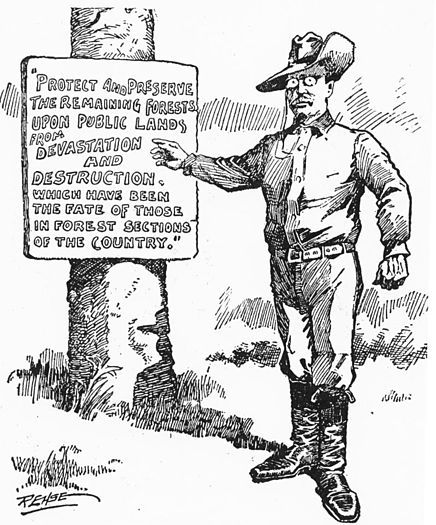
1908 editorial cartoon of President Theodore Roosevelt as “A Practical Forester.”  Source: St. Paul Minnesota “Pioneer Press”. Via GPO's Government Book Talk blog.

1908 Rense editorial cartoon of President Theodore Roosevelt as “A Practical Forester.” Source: St. Paul Minnesota “Pioneer Press”. Via GPO’s Government Book Talk blog.


Hog wild in Texas: Ranchers, guns, and science working against environmental disaster

February 25, 2013

Unusual?  No, this is really a typical marriage of agriculture, government agencies, science and hunters, working on problems of wildlife management, feral hogs in this case.

Notes from Texas Parks & Wildlife:

Feral hogs are running wild across Texas, at great cost to farmers, ranchers, and native wildlife. Hunters are helping, but science may prove critical to controlling the invasion on a broader scale. For more information on feral hogs and feral hog control, visit: http://www.tpwd.state.tx.us/huntwild/…

When it comes to feral hogs, every Texan turns environmentalist.

More:    

English: Sign for Texas Parks and Wildlife Dep...

Sign for Texas Parks and Wildlife Department headquarters – Wikipedia image


Sounds of the Yellowstone in winter will haunt you, lovingly

February 14, 2013

This is a heckuva research project: What is the sound ecosystem of the Yellowstone?

Film from Yellowstone National Park:

The film was produced by Emily Narrow for NPS, with financial assistance from the Yellowstone Association.

From NPS:

Published on Jul 13, 2012

Many people come to Yellowstone to see the fantastic landscapes. Wise visitors also come to experience the amazing soundscapes. This video provides some insight into the value of natural sounds in wild places and how the park is monitoring those sounds as well as the sounds created by humans.

Nothing matches the sound of a western river, to my mind.  I love the sound of the tumbling waters, and it was on one of those roaring creeks that we scattered the ashes of my Yellowstone-loving oldest brother Jerry Jones.

Poster for Yellowstone National Park, Wyoming/...

Classic, vintage poster for Yellowstone National Park, Wyoming/Montana, USA (Photo credit: Wikipedia)

Other sounds will captivate you.  The rush and gush of the geysers, and the gurgle and plop of heated pools rivets you for a while.  Once you hear the chuff of an interested grizzly bear, you don’t forget it.  And while it can be scary if you’re relatively alone on the trail, the howl of the wolf tells you about the wilderness in a way no other sound ever can.  The honks of the geese, the trumpets of the swans, the grunts of the bison, the scolding of the many different squirrels and chipmunks, the slap of a trout jumping out of the river — these are all worth making the trip.

After you go, these sounds will lovingly haunt your life.  You’ll smile when you remember them.

I hope you can go soon.  (I hope I can go, soon.)

Sad note:  Only 1,553 people have watched this video since last July.  Can you spread the word a bit?

More:


Darwin Day, around the cyber world

February 12, 2013

Phantasmagorical art at Pharyngula:

Darwin and life

Colorful Darwin rendering, from Pharyngula

P.Z. mentions that James Randi joins the celebration of Darwin Day at Broward College.

Digital Cuttlefish wrote a poem about Darwin — the usual brilliant Cuttlefish rhymes.

Panda’s Thumb reports on the special Darwin Day issue of Cell Reports.  Read down, you’ll find another post on a series of posts explaining evolution for average people, at BioLogos.  A great idea for Darwin Day, or any day.

Phil Plait at Bad Astronomy reported on the progress of the resolution in Congress to declare Darwin Day, and other matters.

Talk Nerdy To Me at Huffington Post carries a light little post of Darwin trivia.

Evolve, will ya?


Happy Darwin Day 2013! How to celebrate?

February 12, 2013

Charles Darwin

Darwin on Shakespeare: “I have tried lately to read Shakespeare, and found it so intolerably dull that it nauseated me.” (The Quote Blog) In the photo, Utah Valley University Prof. Daniel Fairbanks shows off a bust of Darwin he has sculpted while lecturing about evolution (Fairbanks is the son of sculptor Avard Fairbanks, and an accomplished sculptor himself.)

What to do for Darwin Day, and Evolution Sunday, and Darwin Week?

Wasatch Brewery's Evolution Amber Ale

Wasatch Brewery’s Evolution Amber Ale. Is this still being brewed in Salt Lake City?

Darwinian student's dream, Harper's Weekly, December 23, 1871

The Darwinian student’s after dinner dream. Harper’s Weekly, December 23, 1871; artist not identified; copyright Harper’s Weekly and HarpWeek

More: