Wherever it can, life blossoms

July 5, 2019

Oops. Misattributed, misidentified photo. Turns out this is really from the Atacama Desert in South America. Point still stands, but I got hoaxed on the identification of the photo.

Even just in cracks in the desert clay.

Near Hanksville, Utah. Alt National Park and Forest Service photo. Atacama Desert, South America.

Desert Bloom near the MDRS (Mars Desert Research Station), Hanksville, Utah. Alt National Park and Forest Service photo, by Emily (@ienjoyhiking)

Hmmm. Too far south, too dry an area for me to recognize the species right off the bat. Anyone got suggestions?

See: www.facebook.com/AltNPFS/photos/a.827680717399205/1281923281974944


Dunning Kruger becomes melody, in the “Incompetence Opera”

February 15, 2019

This should be worthy of watching, and of future commentary

"The Incompetence Opera" appears to have been a production of the 2017 IgNobel Prize ceremony in 2017. "‘They don’t know that they don’t know!’ Ray Bauwens sings about the Dunning-Kruger effect at the 2017 Ignobel Prizes ceremony in Harvard 2017 (AIR)"
“The Incompetence Opera” appears to have been a production of the 2017 IgNobel Prize ceremony in 2017. “‘They don’t know that they don’t know!’ Ray Bauwens sings about the Dunning-Kruger effect at the 2017 Ignobel Prizes ceremony in Harvard 2017 (AIR)”

Bookmark this video. Sadly, you’ll have much use for it over the next two years.

Tip of the old scrub brush to The Weekly Sift.

More:


December 31 is Bright Idea Day 2018, anniversary of the Day the Lights Went On

December 31, 2018

Between Christmas and New Year’s Day, here at Millard Fillmore’s Bathtub we celebrate a variety of historically holy days. December 31, by tradition, is Bright Idea Day, the anniversary of the day Thomas Edison demonstrated for the public a working light bulb, in 1879.

100,000 people gather in Times Square, New York City (surely not the 2 million predicted by NBC!) tonight, and millions more around the world, in festivities for the new year made possible by the work of Thomas Alva Edison.

Here it is, the invention that stole sleep from our grasp, made clubbing possible, and launched 50,000 cartoons about ideas:

The light bulb Thomas Edison demonstrated on December 31, 1879, at Menlo Park, New Jersey - Wikimedia image

The light bulb Thomas Edison demonstrated on December 31, 1879, at Menlo Park, New Jersey – Wikimedia image (GFDL)

The light bulb. It’s an incandescent bulb.

It wasn’t the first bulb. Edison a few months earlier devised a bulb that worked with a platinum filament. Platinum was too expensive for mass production, though — and Edison wanted mass production. So, with the cadre of great assistants at his Menlo Park laboratories, he struggled to find a good, inexpensive filament that would provide adequate life for the bulb. By late December 1879 they had settled on carbon filament.

Edison invited investors and the public to see the bulb demonstrated, on December 31, 1879.

Thomas Edison in 1878, the year before he demonstrated a workable electric light bulb. Library of Congress image

Thomas Edison in 1878, the year before he demonstrated a workable electric light bulb. CREDIT: Thomas Edison, head-and-shoulders portrait, facing left, 1880. Prints and Photographs Division, Library of Congress. Reproduction number LC-USZ62-98067

Edison’s successful bulb indicated changes in science, technology, invention, intellectual property and finance well beyond its use of electricity. For example:

  • Edison’s Menlo Park, New Jersey, offices and laboratory were financed with earlier successful inventions. It was a hive of inventive activity aimed to make practical inventions from advances in science. Edison was all about selling inventions and rights to manufacture devices. He always had an eye on the profit potential. His improvements on the telegraph would found his laboratory he thought, and he expected to sell the device to Western Union for $5,000 to $7,000. Instead of offering it to them at a price, however, he asked Western Union to bid on it. They bid $10,000, which Edison gratefully accepted, along with the lesson that he might do better letting the marketplace establish the price for his inventions. Other inventive labs followed Edison’s example, such as the famous Bell Labs, but few equalled his success, or had as much fun doing it.  (Economics teachers:  Need an example of the marketplace in action?)
  • While Edison had some financial weight to invest in the quest for a workable electric light, he also got financial support, $30,000 worth, from some of the finance giants of the day, including J. P. Morgan and the Vanderbilts who established the Edison Light Company.
  • Edison didn’t invent the light bulb — but his improvements on it made it commercial. “In addressing the question ‘Who invented the incandescent lamp?’ historians Robert Friedel and Paul Israel list 22 inventors of incandescent lamps prior to Joseph Wilson Swan and Thomas Edison. They conclude that Edison’s version was able to outstrip the others because of a combination of three factors: an effective incandescent material, a higher vacuum than others were able to achieve (by use of the Sprengel pump) and a high resistance lamp that made power distribution from a centralized source economically viable.”
  • Edison’s financial and business leadership acumen is partly attested to by the continuance of his organizations, today — General Electric, one of the world’s most successful companies over the past 40 years, traces its origins to Edison.

Look around yourself this evening, and you can find a score of ways that Edison’s invention and its descendants affect your life. One of the more amusing effects is in cartooning, however. Today a glowing lightbulb is universally accepted as a nonverbal symbol for ideas and inventions. (See Mark Parisi’s series of lightbulb cartoons, “Off the Mark.”)

Even with modern, electricity-saving bulbs, the cartoon shorthand hangs on, as in this Mitra Farmand cartoon.

Fusilli has an idea, Mitra Farmand, Fuffernutter

Brilliant cartoon from Mitra Farmand, Fluffernutter (regrettably, we note this site is no longer there; but with some hope, we find a new site here)

Or see this wonderful animation, a video advertisement for United Airlines, by Joanna Quinn for Fallon — almost every frame has the symbolic lightbulb in it.

Electrification of America, and the consequent spread of electric lighting and electrical machines to make domestic and industrial life more productive, and the spread of great public works to enable these and other inventions to spread, were made possible by a people roughly united in advancing progress, what historians now call “the progressive agenda” and the great advances of the Progressive Era.

Could we get such agreement among workers, corporate bosses and many levels of government today? When we celebrate anniversaries, like the demonstration of the light bulb, we celebrate the united polity that made such things possible, too.

Gee, I wonder who were the dignitaries to whom Edison demonstrated the electric light on that New Years Eve, in 1879. Anyone know? We can safely wager that there were representatives of the Vanderbilts and Morgans there, families who invested in Edison as an inventor.

Other resources:

Patent drawing for Thomas Edison's successful electric lamp. Library of Congress

Thomas Edison’s electric lamp patent drawing and claim for the incandescent light bulb CREDIT: “New Jersey–The Wizard of Electricity–Thomas A. Edison’s System of Electric Illumination,” 1880. Prints and Photographs Division, Library of Congress. Reproduction Number LC-USZ62-97960.

Even More:

This is an encore post.

Yes, this is an encore post. Defeating ignorance takes patience and perseverance.


World Malaria Report 2018: Quick blueprint for action, no standing still

December 27, 2018

No standing still with malaria, fighting the disease must continue or progress can be quickly lost. Still from WHO film on World Malaria Report 2018 call to action.

No standing still with malaria, fighting the disease must continue or progress can be quickly lost. Still from WHO film on World Malaria Report 2018 call to action.

World Health Organization’s (WHO) World Malaria Report 2018 dropped on November 19, a month earlier than usual (but about the same time as 2017). With an additional few weeks to plug it, it still sank without big ripples in world media.

WHO adds a shorter version, an “executive version” — that still doesn’t get the attention it should.

This is prelude to a tragedy if industrialized and wealthy nations of the world pay no heed, and continue to cut budgets to fight malaria for whatever bad reason some crabby, brown Earth policy maker invents.

Ever optimistic, WHO gives a plan for action to continue to reduce malaria deaths and infections, even with reduced funding. None of the proposed actions involves more DDT to poison poor people in poor countries, however, so it is unlikely to find favor with the crabby policy people now in charge of fixing world problems in the increasingly isolationist West (including the U.S.).

Please watch the video. What is your country doing to eradicate malaria? How can you prod politicians to do more?
2,616

More:


World Malaria Report 2018: World looks away as malaria bounces back

December 7, 2018

Covers of the last four World Malaria Reports. World Health Organization (WHO)

Covers of the last four World Malaria Reports. World Health Organization (WHO)

It’s a common tale but true: In any period when nations collaborate to defeat or eradicate malaria, funders of the programs get board and cut funding.

Malaria roars back.

This cycle has nothing to do with pesticides or medicines, mostly. Especially it’s not a problem that can be fixed with more DDT.

When a nation focuses on beating malaria, progress occurs. When nations lose their focus, malaria strikes back.

After great progress reducing malaria infections and malaria deaths between 1999 and 2017, nations including the U.S. lost focus. International donors failed to contribute enough money to keep the fight going.

World Malaria Report 2018 notes the striking back by malaria.

One other thing we can be quite sure of: Almost all mass media will ignore this report.

What will you do to change things?

You can help by donating $10 to a charity that delivers bednets to people who need them in Asia and Africa. You can help by writing letters to your local newspapers, to your Congressional representatives, and to the President. Every little bit helps.

Here’s the press release on World Malaria Report 2018, which was released by the World Health Organization (WHO) on November 19, 2018.

WHO and partners launch new country-led response to put stalled malaria control efforts back on track

19 November 2018
News Release

Maputo/Geneva

Reductions in malaria cases have stalled after several years of decline globally, according to the new World malaria report 2018. To get the reduction in malaria deaths and disease back on track, WHO and partners are joining a new country-led response, launched today, to scale up prevention and treatment, and increased investment, to protect vulnerable people from the deadly disease.

For the second consecutive year, the annual report produced by WHO reveals a plateauing in numbers of people affected by malaria: in 2017, there were an estimated 219 million cases of malaria, compared to 217 million the year before. But in the years prior, the number of people contracting malaria globally had been steadily falling, from 239 million in 2010 to 214 million in 2015.

“Nobody should die from malaria. But the world faces a new reality: as progress stagnates, we are at risk of squandering years of toil, investment and success in reducing the number of people suffering from the disease,” says Dr Tedros Adhanom Ghebreyesus, WHO Director-General. “We recognise we have to do something different – now. So today we are launching a country-focused and -led plan to take comprehensive action against malaria by making our work more effective where it counts most – at local level.”

Where malaria is hitting hardest

In 2017, approximately 70% of all malaria cases (151 million) and deaths (274 000) were concentrated in 11 countries: 10 in Africa (Burkina Faso, Cameroon, Democratic Republic of the Congo, Ghana, Mali, Mozambique, Niger, Nigeria, Uganda and United Republic of Tanzania) and India. There were 3.5 million more malaria cases reported in these 10 African countries in 2017 compared to the previous year, while India, however, showed progress in reducing its disease burden.

Despite marginal increases in recent years in the distribution and use of insecticide-treated bed nets in sub-Saharan Africa – the primary tool for preventing malaria – the report highlights major coverage gaps. In 2017, an estimated half of at-risk people in Africa did not sleep under a treated net. Also, fewer homes are being protected by indoor residual spraying than before, and access to preventive therapies that protect pregnant women and children from malaria remains too low.

High impact response needed

In line with WHO’s strategic vision to scale up activities to protect people’s health, the new country-driven “High burden to high impact” response plan has been launched to support nations with most malaria cases and deaths. The response follows a call made by Dr Tedros at the World Health Assembly in May 2018 for an aggressive new approach to jump-start progress against malaria. It is based on four pillars:

  • Galvanizing national and global political attention to reduce malaria deaths;
  • Driving impact through the strategic use of information;
  • Establishing best global guidance, policies and strategies suitable for all malaria endemic countries; and
  • Implementing a coordinated country response.

Catalyzed by WHO and the RBM Partnership to End Malaria, “High burden to high impact” builds on the principle that no one should die from a disease that can be easily prevented and diagnosed, and that is entirely curable with available treatments.

“There is no standing still with malaria. The latest World malaria report shows that further progress is not inevitable and that business as usual is no longer an option,” said Dr Kesete Admasu, CEO of the RBM Partnership. “The new country-led response will jumpstart aggressive new malaria control efforts in the highest burden countries and will be crucial to get back on track with fighting one of the most pressing health challenges we face.”

Targets set by the WHO Global technical strategy for malaria 2016–2030 to reduce malaria case incidence and death rates by at least 40% by 2020 are not on track to being met.

Pockets of progress

The report highlights some positive progress. The number of countries nearing elimination continues to grow (46 in 2017 compared to 37 in 2010). Meanwhile in China and El Salvador, where malaria had long been endemic, no local transmission of malaria was reported in 2017, proof that intensive, country-led control efforts can succeed in reducing the risk people face from the disease.

In 2018, WHO certified Paraguay as malaria free, the first country in the Americas to receive this status in 45 years. Three other countries – Algeria, Argentina and Uzbekistan – have requested official malaria-free certification from WHO.

India – a country that represents 4% of the global malaria burden – recorded a 24% reduction in cases in 2017 compared to 2016. Also in Rwanda, 436 000 fewer cases were recorded in 2017 compared to 2016. Ethiopia and Pakistan both had estimated decreases of more than  240 000 in the same period.

“When countries prioritize action on malaria, we see the results in lives saved and cases reduced,” says Dr Matshidiso Moeti, WHO Regional Director for Africa. “WHO and global malaria control partners will continue striving to help governments, especially those with the highest burden, scale up the response to malaria.”

Domestic financing is key

As reductions in malaria cases and deaths slow, funding for the global response has also shown a levelling off, with US$ 3.1 billion made available for control and elimination programmes in 2017 including US$ 900 million (28%) from governments of malaria endemic countries.  The United States of America remains the largest single international donor, contributing US$ 1.2 billion (39%) in 2017.

To meet the 2030 targets of the global malaria strategy, malaria investments should reach at least US$6.6 billion annually by 2020 – more than double the amount available today.

Editors note

Download the WHO World malaria report 2018 app for an interactive experience with the report’s country data: App Store (iOS devices) | Google Play (Android devices).


Lenticular clouds to drive chemtrails fans nuts – beautiful!

November 16, 2018

Recently found Nuno Serrão via some Twitter posts. He’s an astrophotographer — meaning, a photographer who spends time looking at the skies and works to capture on film or magnetic or digital media the beauty and oddities that hover over our heads every day, and especially at night.

Oh, just look at this time lapse:

Astrophotography timelapse shot in Madeira Island on February 21st [2015]. Captured a lenticular cloud, Moon, Mars and Venus. [33,329 views as of November 16, 2018]

It’s only 7 seconds of video, covering perhaps 15 minutes of time, showing the action of the wind in forming the odd lenticular cloud stunningly painted by a setting sun.

Lenticular clouds don’t resemble the fluffy cumulus clouds of cartoons, and so are held suspect by hoax lovers, especially those enthralled by “chemtrails” hoaxes, who argue that clouds are sinister creations of mad scientists and government cabals. Because this short piece shows some of the actions of winds, I love it more.

True legend has it that an artist friend of physicist Richard Feynman told Feynman that scientists can’t be artists, because they know too much behind the scenes. Feynman answered that scientists have even more appreciation of beauty, the image of the flower and its aroma, and an understanding of the lengthy process by which a plant creates a blossom of beauty and sweet smell, to attract insects or humans to propagate new offspring for the plant.

Is this video science, or art?

More:

Tip of the old scrub brush to Antonio Paris, on Twitter.


Ban of DDT did not cause a rise in malaria, or malaria deaths

October 23, 2018

Time to put that old canard to bed.

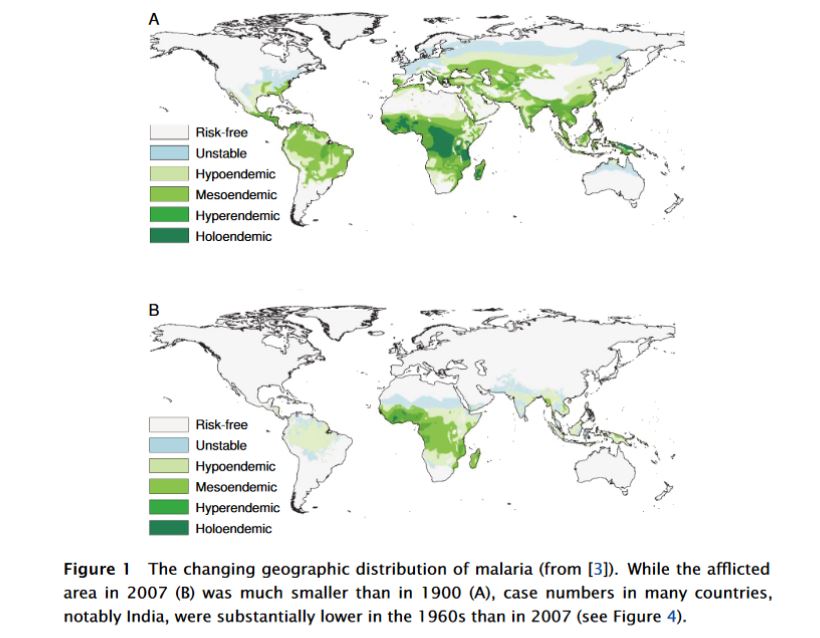
Malaria distribution was greatly reduced in the 20th century, reversing centuries of spreading. But malaria persisted into the 21st century. DDT helped reduce malaria, but the U.S. ban on DDT did not cause a rise in malaria infections or deaths. From a paper by Michael Palmer, M.D,. at Waterloo University.

Malaria distribution was greatly reduced in the 20th century, reversing centuries of spreading. But malaria persisted into the 21st century. DDT helped reduce malaria, but the U.S. ban on DDT did not cause a rise in malaria infections or deaths. From a paper by Michael Palmer, M.D,. at Waterloo University. Palmer’s source, Peter Gething in Nature.

The U.S. ban on DDT in 1972 did not cause millions of unnecessary deaths to malaria. In fact, the worldwide death toll to malaria dropped for at least 18 years after the ban, plateaued for most of a decade, and dropped from 1999 to 2017. Malaria deaths fell dramatically, after the U.S. banned DDT from U.S. farms.

Not sure why Dr. Palmer wrote his essay in 2013, but he got most of the major sources and got most of the history accurately, His title, “The ban of DDT did not cause millions to die from malaria.”

It’s a good paper to bookmark, because it doesn’t always show up in Google searches in the U.S. — Waterloo being a university in Canada, in Waterloo, Ontario

www.science.uwaterloo.ca/~mpalmer/stuff/DDT-myth.pdf

[Update, January 2023: If that link does not work, try the trusty old Wayback Machine: https://web.archive.org/web/20200625073336/http://www.science.uwaterloo.ca/~mpalmer/stuff/DDT-myth.pdf]

[And if that link doesn’t work well, Michael Palmer DDT-myth. Where did Palmer land after Waterloo? It appears he ran off his rails, began complaining about the COVID-19 policies of Waterloo University, and was fired (or had his contract not renewed). Sometime in 2021? Not sure if he’s still active; regret his papers were deleted from Waterloo U’s site. Palmer’s paper on DDT is easily verifiable with sources he cites well.]


Encore: Powers of Ten – Charles and Ray Eames’ brilliant, before-its-time film

October 10, 2018

Images from

Images from “Powers of Ten,” 1977 edition. From IconEye

Back on October 10, 2010, we celebrated “Powers of Ten Day: 10/10/10.”

We’ve only got two tens in the date today, but the work of Charles and Ray Eames deserves remembering at least every October 10.

It’s a classic film, wonderful in its earliest versions in the 1970s, long before CGI. In 2018, I think it stands up very well.

Earlier I wrote:

AMNH’s “The Known Universe” is a cool film. Putting up that last post on the film, I looked back and noted that when I had previously written about the brilliant predecessor films from Charles and Ray Eames, “Powers of Ten,” the Eames films were not freely available on line.

That’s been fixed.

I like to use films like this as warmups to a year of history, and as a reminder once we get into studying the history of space exploration, of just how far we’ve come in understanding the universe, and how big this place is.

Of course, that means wer are just small parts.

The Eames’s genius showed the scale of things, from a couple picnicking in a park, to the outer reaches of the universe, and then back, zooming into the innermost reaches of a human down to the sub-atomic level.

There’s a series of these films; this one, published on YouTube by the Eames Office, was done in 1977, one of the later versions.

How can you use this in class, teachers? (I recommend buying it on DVD, as I did; better sound and pictures, generally.)

Film information:

Uploaded on Aug 26, 2010

Powers of Ten takes us on an adventure in magnitudes. Starting at a picnic by the lakeside in Chicago, this famous film transports us to the outer edges of the universe. Every ten seconds we view the starting point from ten times farther out until our own galaxy is visible only a s a speck of light among many others. Returning to Earth with breathtaking speed, we move inward- into the hand of the sleeping picnicker- with ten times more magnification every ten seconds. Our journey ends inside a proton of a carbon atom within a DNA molecule in a white blood cell. POWERS OF TEN © 1977 EAMES OFFICE LLC (Available at http://www.eamesoffice.com)

At the Eames Office Youtube site, you may find the film in with Mandarin Chinese, German, and Japanese translations (no Spanish?).  If you’re unfamiliar with the work of this couple — you would recognize much of the stuff they designed, I’m sure — check out a short film on an exhibit on Ray Eames (which has concluded, sadly):

More:

The very recognizable, famous Eames Chair, from Herman Miller. Ideally, you can sit in your Eames Chair while watching

The very recognizable, famous Eames Chair and Ottoman, from Herman Miller. Ideally, you can sit in your Eames Chair while watching “Powers of Ten.” Herman Miller image.

This is an encore post.

Yes, this is an encore post. Defeating ignorance takes patience and perseverance.


Annals of Global Warming: IPCC Special Report of Global Warming of 1.5°C

October 8, 2018

Are we doomed? This report is not optimistic — instead it quite starkly spells out the challenge that faces humans, as a total planetary population, if we are to have our species survive for another 100 years.

Cover of IPCC-CH report, Special Report of Global Warming of 1.5°C

Cover of IPCC-CH report, Special Report of Global Warming of 1.5°C

The language of the report is quite dry, as we expect from scientists. But the report, from the International Panel on Climate Change (IPCC), is really quite urgent. If the planet — meaning you and me — does not make dramatic progress in controlling carbon air pollution now, any child born now will face dramatic problems from climate warming.

From the executive summary of the report:

A. Understanding Global Warming of 1.5°C

A1. Human activities are estimated to have caused approximately 1.0°C of global warming above pre-industrial levels, with a likely
range of 0.8° C to 1.2°C. Global warming is likely to reach 1.5°C between 2030 and 2052 if it continues to increase at the current rate. (high confidence) {1.2, Figure SPM.1}

A1.1.
Reflecting the long-term warming trend since pre-industrial times, observed global meansurface temperature (GMST) for the decade 2006–2015 was 0.87°C (likely between 0.75°C and 0.99°C) higher than the average over the 1850–1900 period (very high confidence). Estimated anthropogenic global warming matches the level of observed warming to within ±20% (likely range). Estimated anthropogenic global warming is currently increasing at 0.2°C (likely between 0.1°C and 0.3°C) per decade due to past and ongoing emissions (high confidence). {1.2.1, Table 1.1, 1.2.4}

A1.2.
Warming greater than the global annual average is being experienced in many land regions and seasons, including two to three times higher in the Arctic. Warming is generally higher over land than over the ocean. (high confidence) {1.2.1, 1.2.2, Figure 1.1, Figure 1.3, 3.3.1, 3.3.2}

A1.3.
Trends in intensity and frequency of some climate and weather extremes have been detected over time spans during which about 0.5° C of global warming occurred (medium confidence). This assessment is based on several lines of evidence, including attribution studies for changes in extremes since 1950. {3.3.1, 3.3.2, 3.3.3}

Who will respond to the call to arms? Who will read this report?

I’m providing links to the report here, and the complete press release. Read it here (or at the UN site linked) to get the facts, and to see just how much distortion gets introduced by anti-Earth, anti-science propagandists.

Here is the unedited press release from IPCC on this report:

2018/24/PR
8 October 2018
Summary for Policymakers of IPCC Special Report on Global Warming of 1.5°C approved by governments

Incheon, Republic of Korea, October 8– Limiting global warming to 1.5°C would require rapid, far-reaching and unprecedented changes in all aspects of society, the IPCC said in a new assessment. With clear benefits to people and natural ecosystems, limiting global warming to 1.5°C compared to 2°C could go hand in hand with ensuring a more sustainable and equitable society, the Intergovernmental Panel on Climate Change (IPCC) said on Monday.

The Special Report on Global Warming of 1.5°C was approved by the IPCC on Saturday in Incheon, Republic of Korea. It will be a key scientific input into the Katowice Climate Change Conference in Poland in December, when governments review the Paris Agreement to tackle climate change.

“With more than 6,000 scientific references cited and the dedicated contribution of thousands of expert and government reviewers worldwide, this important report testifies to the breadth and policy relevance of the IPCC,” said Hoesung Lee, Chair of the IPCC.

Ninety-one authors and review editors from 40 countries prepared the IPCC report in response to an invitation from the United Nations Framework Convention on Climate Change (UNFCCC) when it adopted the Paris Agreement in 2015.

The report’s full name is Global Warming of 1.5°C, an IPCC special report on the impacts of global warming of 1.5°C above pre-industrial levels and related global greenhouse gas emission pathways, in the context of strengthening the global response to the threat of climate change, sustainable development, and efforts to eradicate poverty.

“One of the key messages that comes out very strongly from this report is that we are already seeing the consequences of 1°C of global warming through more extreme weather, rising sea levels and diminishing Arctic sea ice, among other changes,” said Panmao Zhai, Co-Chair of IPCC Working Group I.

The report highlights a number of climate change impacts that could be avoided by limiting global warming to 1.5°C compared to 2°C, or more. For instance, by 2100, global sea level rise would be 10 cm lower with global warming of 1.5°C compared with 2°C. The likelihood of an Arctic Ocean free of sea ice in summer would be once per century with global warming of 1.5°C, compared with at least once per decade with 2°C. Coral reefs would decline by 70-90 percent with global warming of 1.5°C, whereas virtually all (> 99 percent) would be lost with 2°C.

“Every extra bit of warming matters, especially since warming of 1.5°C or higher increases the risk associated with long-lasting or irreversible changes, such as the loss of some ecosystems,” said Hans-Otto Pörtner, Co-Chair of IPCC Working Group II.

Limiting global warming would also give people and ecosystems more room to adapt and remain below relevant risk thresholds, added Pörtner. The report also examines pathways available to limit warming to 1.5°C, what it would take to achieve them and what the consequences could be. “The good news is that some of the kinds of actions that would be needed to limit global warming to 1.5°C are already underway around the world, but they would need to accelerate,” said Valerie Masson-Delmotte, Co-Chair of Working Group I.

The report finds that limiting global warming to 1.5°C would require “rapid and far-reaching” transitions in land, energy, industry, buildings, transport, and cities. Global net human-caused emissions of carbon dioxide (CO2) would need to fall by about 45 percent from 2010 levels by 2030, reaching ‘net zero’ around 2050. This means that any remaining emissions would need to be balanced by removing CO2 from the air.

“Limiting warming to 1.5°C is possible within the laws of chemistry and physics but doing so would require unprecedented changes,” said Jim Skea, Co-Chair of IPCC Working Group III.

Allowing the global temperature to temporarily exceed or ‘overshoot’ 1.5°C would mean a greater reliance on techniques that remove CO2 from the air to return global temperature to below 1.5°C by 2100. The effectiveness of such techniques are unproven at large scale and some may carry significant risks for sustainable development, the report notes.

“Limiting global warming to 1.5°C compared with 2°C would reduce challenging impacts on ecosystems, human health and well-being, making it easier to achieve the United Nations Sustainable Development Goals,” said Priyardarshi Shukla, Co-Chair of IPCC Working Group III.

The decisions we make today are critical in ensuring a safe and sustainable world for everyone, both now and in the future, said Debra Roberts, Co-Chair of IPCC Working Group II.

“This report gives policymakers and practitioners the information they need to make decisions that tackle climate change while considering local context and people’s needs. The next few years are probably the most important in our history,” she said.

The IPCC is the leading world body for assessing the science related to climate change, its impacts and potential future risks, and possible response options.

The report was prepared under the scientific leadership of all three IPCC working groups. Working Group I assesses the physical science basis of climate change; Working Group II addresses impacts, adaptation and vulnerability; and Working Group III deals with the mitigation of climate change.

The Paris Agreement adopted by 195 nations at the 21st Conference of the Parties to the UNFCCC in December 2015 included the aim of strengthening the global response to the threat of climate change by “holding the increase in the global average temperature to well below 2°C above pre-industrial levels and pursuing efforts to limit the temperature increase to 1.5°C above pre-industrial levels.”

As part of the decision to adopt the Paris Agreement, the IPCC was invited to produce, in 2018, a Special Report on global warming of 1.5°C above pre-industrial levels and related global greenhouse gas emission pathways. The IPCC accepted the invitation, adding that the Special Report would look at these issues in the context of strengthening the global response to the threat of climate change, sustainable development, and efforts to eradicate poverty.

Global Warming of 1.5°C is the first in a series of Special Reports to be produced in the IPCC’s Sixth Assessment Cycle. Next year the IPCC will release the Special Report on the Ocean and Cryosphere in a Changing Climate, and Climate Change and Land, which looks at how climate change affects land use.

The Summary for Policymakers (SPM) presents the key findings of the Special Report, based on the assessment of the available scientific, technical and socio-economic literature relevant to global warming of 1.5°C.

The Summary for Policymakers of the Special Report on Global Warming of 1.5°C (SR15) is available at https://www.ipcc.ch/report/sr15 or www.ipcc.ch.

Key statistics of the Special Report on Global Warming of 1.5°C

91 authors from 44 citizenships and 40 countries of residence
– 14 Coordinating Lead Authors (CLAs)
– 60 Lead authors (LAs)
– 17 Review Editors (REs)

133 Contributing authors (CAs)
Over 6,000 cited references
A total of 42,001 expert and government review comments
(First Order Draft 12,895; Second Order Draft 25,476; Final Government Draft: 3,630)

For more information, contact:
IPCC Press Office, Email: ipcc-media@wmo.int
Werani Zabula +41 79 108 3157 or Nina Peeva +41 79 516 7068

Notes for editors The Special Report on Global Warming of 1.5 °C, known as SR15, is being prepared in response to an invitation from the 21st Conference of the Parties (COP21) to the United Nations Framework Convention on Climate Change in December 2015, when they reached the Paris Agreement, and will inform the Talanoa Dialogue at the 24th Conference of the Parties (COP24). The Talanoa Dialogue will take stock of the collective efforts of Parties in relation to progress towards the long-term goal of the Paris Agreement, and to inform the preparation of nationally determined contributions. Details of the report, including the approved outline, can be found on the report page. The report was prepared under the joint scientific leadership of all three IPCC Working Groups, with support from the Working Group I Technical Support Unit.

What is the IPCC?
The Intergovernmental Panel on Climate Change (IPCC) is the UN body for assessing the science related to climate change. It was established by the United Nations Environment Programme (UN Environment) and the World Meteorological Organization (WMO) in 1988 to provide policymakers with regular scientific assessments concerning climate change, its implications and potential future risks, as well as to put forward adaptation and mitigation strategies. It has 195 member states.

IPCC assessments provide governments, at all levels, with scientific information that they can use to develop climate policies. IPCC assessments are a key input into the international negotiations to tackle climate change. IPCC reports are drafted and reviewed in several stages, thus guaranteeing objectivity and transparency.

The IPCC assesses the thousands of scientific papers published each year to tell policymakers what we know and don’t know about the risks related to climate change. The IPCC identifies where there is agreement in the scientific community, where there are differences of opinion, and where further research is needed. It does not conduct its own research.

To produce its reports, the IPCC mobilizes hundreds of scientists. These scientists and officials are drawn from diverse backgrounds. Only a dozen permanent staff work in the IPCC’s Secretariat.

The IPCC has three working groups: Working Group I, dealing with the physical science basis of climate change; Working Group II, dealing with impacts, adaptation and vulnerability; and Working Group III, dealing with the mitigation of climate change. It also has a Task Force on National Greenhouse Gas Inventories that develops methodologies for measuring emissions and removals.

IPCC Assessment Reports consist of contributions from each of the three working groups and a Synthesis Report. Special Reports undertake an assessment of cross-disciplinary issues that span more than one working group and are shorter and more focused than the main assessments.

Sixth Assessment Cycle
At its 41st Session in February 2015, the IPCC decided to produce a Sixth Assessment Report (AR6). At its 42nd Session in October 2015 it elected a new Bureau that would oversee the work on this report and Special Reports to be produced in the assessment cycle. At its 43rd Session in April 2016, it decided to produce three Special Reports, a Methodology Report and AR6.

The Methodology Report to refine the 2006 IPCC Guidelines for National Greenhouse Gas Inventories will be delivered in 2019. Besides Global Warming of 1.5°C, the IPCC will finalize two further special reports in 2019: the Special Report on the Ocean and Cryosphere in a Chanhttps://twitter.com/IPCC_CH/status/1049127236564082689ging Climate and Climate Change and Land: an IPCC special report on climate change, desertification, land degradation, sustainable land management, food security, and greenhouse gas fluxes in terrestrial ecosystems. The AR6 Synthesis Report will be finalized in the first half of 2022, following the three working group contributions to AR6 in 2021.

For more information, including links to the IPCC reports, go to: www.ipcc.ch

Discuss away, comments are open.
More:

  • See the Tweet from IPCC, below


Annals of DDT: When they sprayed DDT from airplanes to stop polio

August 10, 2018

March of Dimes Foundation photo:

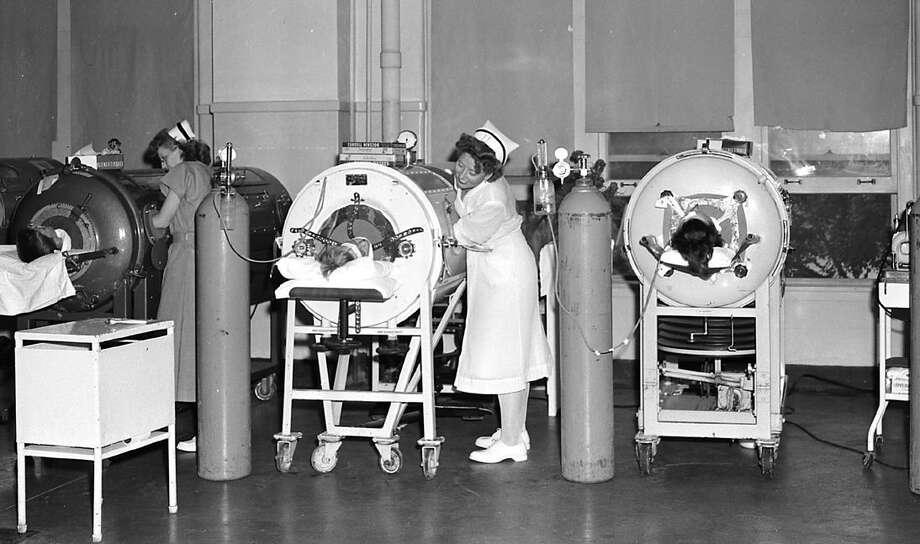
March of Dimes Foundation photo: “Nurses tended to polio patients in iron lung respirators at the Robert B. Green Memorial Hospital polio ward in San Antonio in 1950. It was a common scene throughout the polio crisis that swept Texas.” From the San Antonio Express-News article on the history of polio in the city.

It didn’t work.

In a desperate move to stop polio epidemics, after World War II but before the Salk polio vaccine was available, some American towns authorized aerial spraying of DDT over their cities.

Of course, DDT doesn’t stop viruses, and polio is a virus. Polio virus is not spread by a vector, an insect or other creature which might have been stopped by DDT, as mosquitoes spread malaria parasites and West Nile virus.

Aerial spraying of DDT against polio did not one thing.

A podcast from the Science History Institute discussed these misdirected events recently, and someone there did a sharp, short video to explain the issue.

YouTube explanation:

An animation drawn from episode 207 of Distillations podcast, DDT: The Britney Spears of Chemicals.

The podcast is a short 15 minutes, and fun, “Distillations.”

Americans have had a long, complicated relationship with the pesticide DDT, or dichloro-diphenyl-trichloroethane, if you want to get fancy. First we loved it, then we hated it, then we realized it might not be as bad as we thought. But we’ll never restore it to its former glory. And couldn’t you say the same about America’s once-favorite pop star?

We had a hunch that the usual narrative about DDT’s rise and fall left a few things out, so we talked to historian and CHF fellow Elena Conis. She has been discovering little-known pieces of this story one dusty letter at a time.

But first our associate producer Rigoberto Hernandez checks out some of CHF’s own DDT cans—that’s right, we have a DDT collection—and talks to the retired exterminator who donated them.

I bring it up here because in recent weeks there’s been a little surge on Twitter, and probably on Facebook and other places, in people claiming DDT causes polio, or causes symptoms so close to polio that physicians could never tell the difference. A lot of anti-vaccine advocates pile on, claiming that this would prove that the polio vaccine doesn’t work.

That’s all quite hooey-licious, off course. Polio’s paralysis of muscles in almost no way resembles acute DDT poisoning, which causes muscle misfiring instead of paralysis. As with almost every other disease, acute DDT poisoning can cause nausea; but DDT poisoning either kills its victim rather quickly, or goes away after a couple of weeks.

Polio doesn’t do that.

In the podcast, you’ll hear the common story of kids running behind DDT fogging trucks, because people thought DDT was harmless. In the concentrations in the DDT fogs, it would be almost impossible to ingest the 4 ounces or so of DDT required to get acute poisoning.

In any case, it’s one more odd facet of a long story of human relations to DDT and diseases. It’s worth a listen for history’s sake. But in this case, it’s entertaining, too. You’ll hear stories of people who opposed government actions to spray DDT, and who thought the government was too lax in its regulation and use of DDT.

More:

San Antonio Express-News file photo.

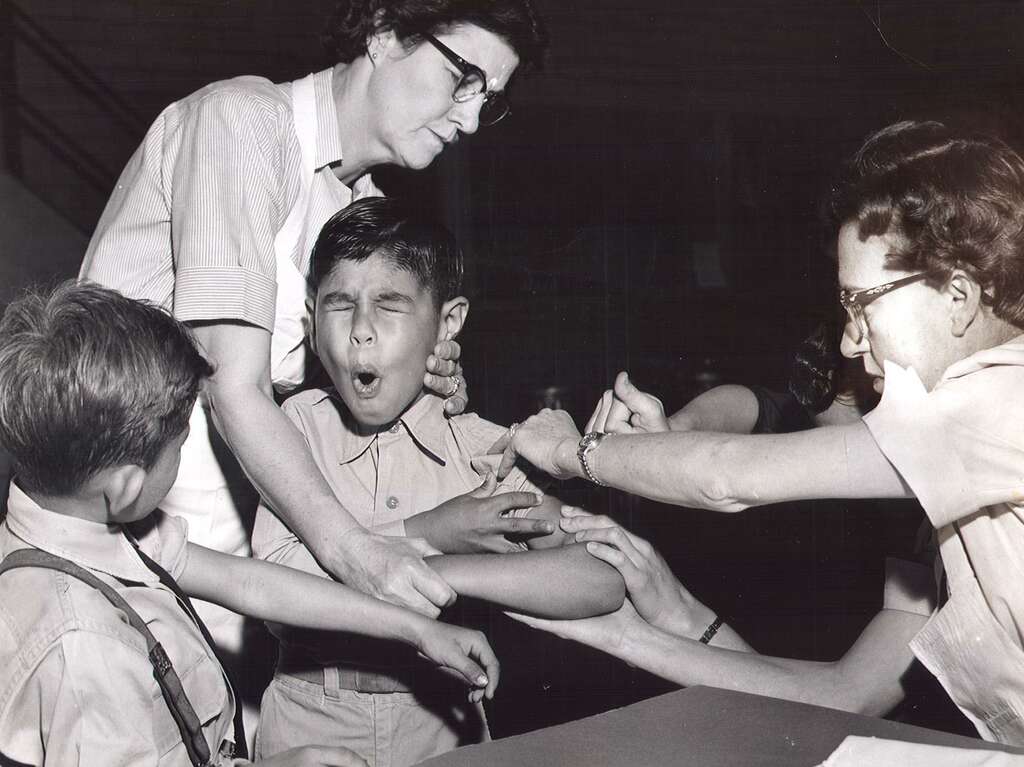
San Antonio Express-News file photo. “A young boy gets polio vaccine in this undated photo.”

Tip of the old scrub brush to Science History Institute (@SciHistoryOrg on Twitter).


Your tax dollars at work, NASA incredible Moon division: Full rotation

July 19, 2018

NASA posted this back in 2013 — but a lot of people missed it. It’s an animation of the Moon’s full rotation, showing all sides of the Moon lighted by the Sun. Film images come from the Lunar Reconnaissance Orbiter (LRO).

Watching this video we can think of all sorts of oddities about the Moon that maybe we didn’t get answers to in our high school astronomy class, or Astronomy 101 at State U: Why do we see only one side of the Moon from Earth? Doesn’t that mean the Moon doesn’t rotate? And shouldn’t Pink Floyd have called the album, “Far Side of the Moon?”

When NASA ran the 24-second version of the video at the Astronomy Picture of the Day (APOD) site on September 16, 2013, NASA thoughtfully provided more information that you ever wanted:

Explanation: No one, presently, sees the Moon rotate like this. That’s because the Earth’s moon is tidally locked to the Earth, showing us only one side. Given modern digital technology, however, combined with many detailed images returned by the Lunar Reconnaissance Orbiter (LRO), a high resolution virtual Moon rotation movie has now been composed. The above time-lapse video starts with the standard Earth view of the Moon. Quickly, though, Mare Orientale, a large crater with a dark center that is difficult to see from the Earth, rotates into view just below the equator. From an entire lunar month condensed into 24 seconds, the video clearly shows that the Earth side of the Moon contains an abundance of dark lunar maria, while the lunar far side is dominated by bright lunar highlands. Two new missions are scheduled to begin exploring the Moon within the year, the first of which is NASA’s Lunar Atmosphere and Dust Environment Explorer (LADEE). LADEE, which launched just over a week ago, is scheduled to begin orbiting the Moon in October and will explore the thin and unusual atmosphere of the Moon. In a few months, the Chinese Chang’e 3 is scheduled to launch, a mission that includes a soft lander that will dispatch a robotic rover.

Tip of the old scrub brush to World and Science on Twitter (@WorldandScience).

https://twitter.com/WorldAndScience/status/1008846859836841985

A detailed still of the Moon, again from NASA:

Details of the Moon, from NASA's fact sheet comparing the Moon and Earth.

Details of the Moon, from NASA’s fact sheet comparing the Moon and Earth.


Trump is most like Millard Fillmore? Perhaps in his failures . . .

July 5, 2018

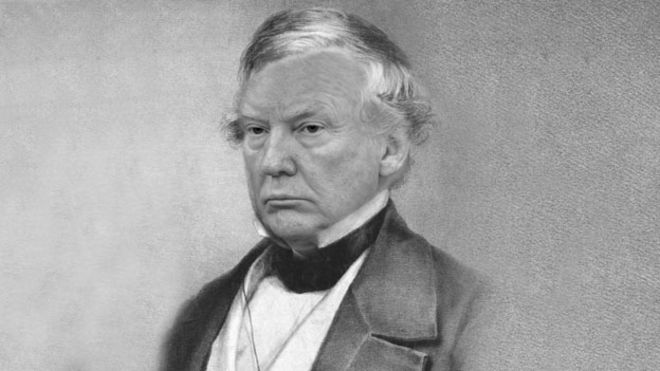
One story says Queen Victoria commented that Millard Fillmore was the handsomest man she'd ever met; true or not, imposing Trump's face on Fillmore doesn't improve anything. Illustration from BBC

One story says Queen Victoria commented that Millard Fillmore was the handsomest man she’d ever met; true or not, imposing Trump’s face on Fillmore doesn’t improve anything. Illustration from BBC

Millard Fillmore was a self-educated man, an ardent reader, the founder of the White House library.

Millard Fillmore understood the strategic geography of Japan, an opened Japan up to the world.

Has Trump done anything beneficial? Logical? Based on good, accurate information?

We may have a bone to pick with BBC.

BBC’s article, by Jude Sheerin from the Washington bureau, actually is quite well done. The article compares the nativism in Fillmore’s time, to which Fillmore fell victim, with Trump’s nativism — and the comparison is troubling.

In the end, the Whigs refused to nominate Fillmore to run for his own term in 1852 (he had succeeded President Zachary Taylor on Taylor’s death, remember); Fillmore was courted by the American Party, better known to school kids as the Know-Nothings. Fillmore led the Know-Nothings to a crushing defeat in 1852 (they did get Maryland), but the Whigs never recovered either. In 1856, partly in the ashes of the Whigs, rose the Republican Party to run John C. Fremont for President.

And in 1860, the new Republican Party managed to knock a homerun, getting Abraham Lincoln elected to the presidency on the party’s second try.

“What is past is prologue,” the wall of the National Archives tells us, and Santayana warns that those who do not remember history will repeat it. What lessons can we learn from comparing Donald Trump to Millard Fillmore?

Other than the fact that Fillmore was actually quite a bit better looking, that is.


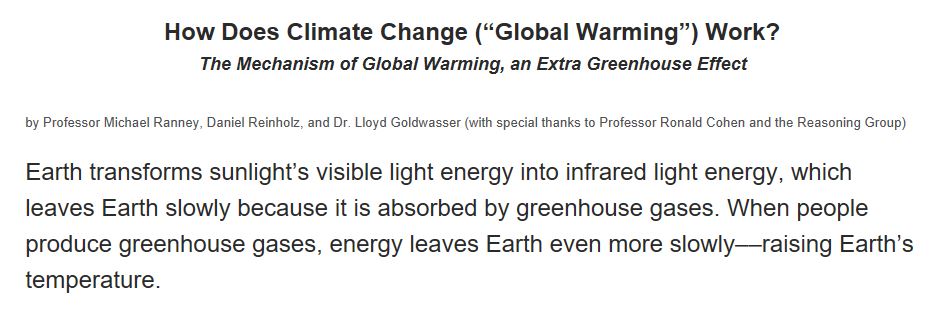
The 1-minute “How Global Warming Works” video

June 8, 2018

Global warming in 35 words, from HowGlobalWarmingWorks.com

Global warming in 35 words, from HowGlobalWarmingWorks.com

From a project at the University of California at Berkeley, http://www.howglobalwarmingworks.org.

Is that simple enough to remember? Is it simple enough to explain to kids? Simple enough to sway a climate change dismissive?


Celebrating 100th anniversary of Feynman’s birth

May 10, 2018


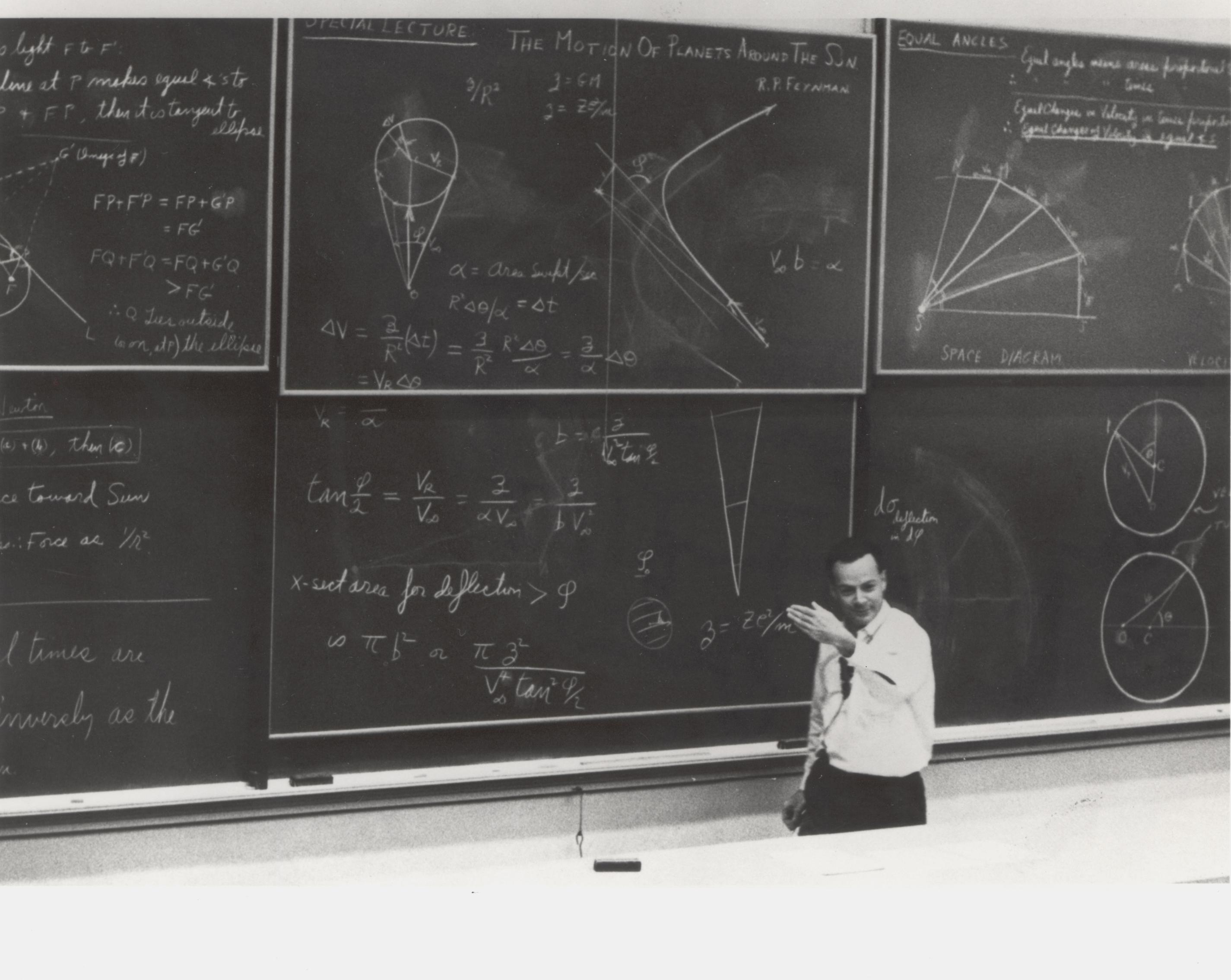
Feynman lecturing, with six chalkboards full of equations, diagrams and notes. CalTech? Feynman would have been 100 years old on May 11, 2018. This became the "lost lecture," now found.

Feynman lecturing, with six chalkboards full of equations, diagrams and notes. CalTech? Feynman would have been 100 years old on May 11, 2018. This became the “lost lecture,” now found; photo may be March 13, 1964.

How to celebrate the 100th anniversary of the birth of Richard Feynman?

Here’s what others say and do.

Paul Halpern wrote a recent book on Feynma


There are those who look critically at Feynman’s life, and recognize his flaws — as Feynman did, too. This is an interesting thread.


https://twitter.com/Caltech/status/994351351806218240


More: 


May 11 is Feynman Day! How to celebrate? (It’s his centenary!)

May 8, 2018

May 11, 2018, is the 100th anniversary of the birth of Richard Feynman (born 1918, died 1988).

Most Feynman fans are celebrating through the entire year — appropriately, for a man so much larger than life and unable to be constrained after death.

We should mark the actual day, I think. It would be a good thing to celebrate science on May 11 in his honor, I think. And, there are lots of other good ways to commemorate a great guy.

Richard Feynman

Richard Feynman. Borrowed from Luciano’s Tumblr, LikeaPhysicist

Feynman’s birthday falls on Statehood Day for Minnesota.  You can fly your flag for both causes, if you wish, Minnesota’s statehood AND Feynman’s birthday.  No proclamation will issue from the White House, but you can fly your flag any day.

Why Feynman Day?  To celebrate invention, physics, interesting characters, and that essential, American quality of je ne sais quoi.

In addition to his winning the Nobel Prize for Quantum Electrodynamics (QED), Feynman popularized the critique of science and other enterprises with what we now call Cargo Cult science, or education, or whatever, where people follow the dance steps, but without the rhythm and music.

Those two things alone would make him a remarkable man.  But, like a product offered for $19.95 as a good buy in a 2:00 a.m. infomercial, with Feynman, there’s more.  With Feynman, there is always more.

I got alerted to Feynman in the first days of the old Quality Paperback Book Club, when they featured his new memoir, Surely You’re Joking, Mr. Feynman!  QPBC was hot on the book, and with a title like that, how could I resist?  When I got the book a week or so later, I read it within two days, while attending law school and working full time.  I remember Feynman.

Norton published the book — and their description, alone, should make you want to read it:

A New York Times bestseller—the outrageous exploits of one of this century’s greatest scientific minds and a legendary American original.

In this phenomenal national bestseller, the Nobel Prize­-winning physicist Richard P. Feynman recounts in his inimitable voice his adventures trading ideas on atomic physics with Einstein and Bohr and ideas on gambling with Nick the Greek, painting a naked female toreador, accompanying a ballet on his bongo drums and much else of an eyebrow-raising and hilarious nature.

All true, and that’s not even the half of the outrageousness, all done with great good humor, about a life lived in great good humor through what should have been a memorable age, but often was just terrifying.

I think sometimes that Feynman’s calm alone, borne of that great good humor and insatiable curiosity, may have gotten us through the birth of the Atomic Age and the Cold War.

Feynman was a giant, and we don’t revere him enough.  Consider:

  • Feynman’s high school sweetheart, Arlene, came down with tuberculosis.  He married her, and took her with him to New Mexico to make atom bombs.  The stories of her confinement to a hospital, and the laborious trekking he had to make between Los Alamos and her bedside in Santa Fe, are touching, and heartbreaking.  It is one of the great love stories of the 20th century, certainly, and perhaps for all time.  It also provided the title for his second memoir, What Do You Care What Other People Think?
  • Every single, college-age man should read Feynman’s stories of how to date, and how to seduce women. Women should read it, too, to know what’s happening. Consent is necessary. His approach was unique, and endeared him to women — in legend, to many women.  Feynman’s dating must have been part of the inspiration for the comedy series, “Big Bang Theory.”  Feynman’s stories are better.  (Heck, it’s even the subject of a popular, classic XKCD comic — probably only Feynman and Einstein among Nobel-winning physicists have made so much money for so many cartoonists.)

US postage stamp featuring Richard Feynman

US postage stamp featuring Richard Feynman

  • Yeah, he’s already been featured on a postage stamp, see at right.  That’s not good enough for Feynman, though — the U.S. Postal Service created a special cancellation stamp for Feynman, featuring a version of his Feynman Diagrams.

    USPS authorized a special postal cancel (United States Postal Service) to honor the 80th birthday of Richard Feynman. This cancel was used in Lake Worth, Florida. For this special day the post office was renamed “Feynman Station.”
    Feynman Commemorative Cancel Feynman Diagram

    The Feynman Diagram used for the postal cancel on this envelope depicts what is known as a “bubble process.” It shows a high energy particle, for example, a cosmic ray (a) from a distant supernova, which emits a high energy photon, for example, a gamma ray (b). The photon, in turn, creates a particle (c) and an anti-particle (d) that exists for a brief moment and then recombines.

    As Feynman liked to point out, an anti-particle is the same thing as a particle with negative energy traveling backward in time (which is why the arrow at (d) points backwards, i.e. to the left). So you could say the photon created only one particle that, at first, traveled forward in time (the bottom semi-circle) and then reversed and went back in time (the top semi-circle) and annihilated itself! By inventing diagrams like this, Richard Feynman made it much easier to understand what is going on in the interactions between sub-atomic particles without getting lost in tremendous amounts of tedious math

  • Working at Los Alamos on the Manhattan Project, Feynman developed a keen appreciation for bureaucracy and all its follies.  His vexations for the security managers are also legendary.  Here’s a quick version of one story — he asked friends and family to write to him in code, but to not include a key to the code, so he’d have to crack the code to read the letter.  Feynman could do it, but the security people couldn’t.  Hilarity ensued.
  • Feynman developed a love for the still-relatively unknown, landlocked Asian nation of Tannu Tuva.  It’s just the sort of place to appeal to a character like Feynman — so obscure most atlases didn’t, and don’t, show it at all — seemingly consumed by the Soviet Union, but held in a special status.  Home of throat singing — and almost impossible to get to.  During the Cold War, Feynman struck up correspondence with people in Tuva, to the concern of Soviet and American intelligence agencies, who seemed not to understand someone might do such thing out of curiosity.  Feynman hoped to travel there to visit new friends, but his final bouts of cancer took him before it was possible.  Tuva, famous among philatelists only, perhaps, honored Feynman with postage stamps and postcards.
  • Just try to find a photo of Feynman not smiling. The man was a joy to be around, for most people, most of the time.
  • Quantum electrodynamics?  No, I can’t explain it, either — but his work had a lot to do with how particles wobble.  I remember that because, according to Feynman, he got the inspiration for the work for which he won the Nobel while spinning plates, like a Chinese acrobat on the Ed Sullivan Show, to the delight of students in the Cornell University cafeteria, and the shock and horror of the food service people.  Who else has yet confessed to such an inspiration for a Nobel?

There’s more — a lot more.  Feynman outlined our current generation of computer memory devices — in 1959.  No, he didn’t patent the idea.  He did patent an idea for a nuclear-powered spacecraft.  Another delightful story.

Feynman in an Apple ad

Feynman was featured in print and broadcast ads for Apple — not one, but two (did anyone else get that honor from Apple?). “Think Different.” This is one of Apple Computer’s most successful advertising campaigns. The theme of the campaign is one that celebrates figures in history who changed the world by thinking differently. Richard Feynman was among the chosen figures. Image from the Feynman Group.

Feynman served on the board that approved science books for the California school system –– his stories of that work will shock some, but it will make others shake their heads as they recognize the current crop of cargo-cultists and political bullies who dominate textbook approval processes, knowing nothing at all about what they are doing, or why.

No, I didn’t forget his brilliant work on the commission that studied the Challenger disaster, for NASA. There’s so much stuff to glorify!

In history, Feynman should be remembered much as we remember Thomas Jefferson, as a renaissance man in his time, a man who put great intellect to great work for his nation and all humanity.

Feynman's second Apple ad

The second Apple ad featuring Richard Feynman. An excerpt from Apple Computer’s campaign commercial: “Here’s to the crazy ones, the misfits, the rebels, the troublemakers, the round pegs in the square holes, the ones who see things differently. They’re not fond of rules and they have no respect for the status quo. You can quote them, disagree with them, glorify or vilify them… about the only thing you can’t do is ignore them, because they change things, they push the human race forward; and while some may see them as the crazy ones, we see genius, because the people who are crazy enough to think they can change the world are the ones who do.”

The sages say we shouldn’t have regrets, but I do have one. When the Challenger Commission was meeting in Washington, D.C., I was working on another commission up the street. I knew Feynman was ill, but our work was important, and we’d heard his disease was in remission. I didn’t goof off a day and go to any of the hearings to see him, to get an autograph, to meet the man. I thought I’d have other opportunities to do that. Now I regret not having met him in person.

In print, and in film, I know him well. In our family, reading Feynman is something everybody does. Feynman’s memoir was one of the last books I read to our son, Kenny, as he was growing up, and growing into reading on his own. Even reading about Feynman, together, was an adventure. Our son, James, took us into the real physics of Feynman, and though I struggle with it more than James, we still read Feynman, for humor, and physics.

What would be appropriate ways to mark Feynman’s birth? At some future date, I hope we’ll have public readings of his books, showings of the documentaries about him, recreations of his lectures, perhaps. And then everyone can get in a circle, beating drums and singing about getting some orange juice, before sending postcards to our friends in Tuva.

Richard Feynman, we still need you, and miss you dearly.

Tannu Tuva

Tuva’s capital is the delightfully-named Kyzyl. From this map, can you figure out where Tuva is, or how to get there — without Google, or Bing?

Tuva postcard honoring Richard Feynman

Tuva postcard, in honor of Richard Feynman — who loved to drum.

There will always be “More” about Richard Feynman, if we’re lucky:

Richard Feynman, unlikely leader, from Open University

Have a great Feynman Day, May 11!

This is an encore post.

Yes, this is an encore post. Defeating ignorance takes patience and perseverance.