Carbon-cutting schemes work, in Great Britain

August 11, 2010

Another press release that will have the climate change critics pulling their hair, from Great Britain’s Department of Energy and Climate Change about the Carbon Reduction Commitment plan (CRC):

50 days for businesses to register for carbon cutting scheme (Press Release)

With just 50 days to go until the end of registration for the Carbon Reduction Commitment Energy Efficiency Scheme (CRC), Greg Barker is calling on the remaining organisations to register now.

Currently 1229 of the organisations required to register have done so.

Launched in April 2010 the CRC requires large public and private sector organisations to register with the Environment Agency by 30th September 2010.

Greg Barker, Energy and Climate Change Minister, said;

“This new Coalition Government wants to boost energy efficiency in business because we know that saving energy saves money. The CRC will encourage significant savings through greater energy efficiency and importantly will make carbon a boardroom issue for many large organisations.

My message to businesses today is to register now. I understand the original complexity of the scheme may have deterred some organisations and I want to hear suggestions as to how we can make the scheme simpler in the future.”

GB Energy Minister Greg Barker and Westminster Fire Station

With just 50 days to go until the end of registration for the Carbon Reduction Commitment Energy Efficiency Scheme (CRC), Greg Barker is calling on the remaining organisations to register now. The Minister visited Westminster Fire Station this month to meet fire fighters and see some of the measures recently installed to improve the station’s energy efficiency.

The London Fire Brigade is one organisation that has registered for the CRC. Energy efficiency projects put in place by the Brigade have led to savings of £260,000 in 2009/10 and over £1 million since the Brigade started focusing on the need to be greener. Despite the organisation growing overall carbon emissions on their buildings are down by over 18% on 1990s levels.

Greg Barker visited Westminster Fire Station this month to meet fire fighters and see some of the measures recently installed to improve the station’s energy efficiency. Chairman and Leader of London Fire and Emergency Planning Authority Councillor Brian Coleman AM, FRSA, said:

“This isn’t just about protecting the environment, it makes excellent business sense. Last year we saved the taxpayer over a quarter of a million pounds by making our fire stations greener and reducing our energy bills.”

The CRC will help to ensure that organisations play their full role in contributing to the UK’s emissions reductions of at least 34% on 1990 levels by 2020 through improved energy efficiency.

  • Find out more about CRC on the DECC website
  • Imagine that: Saving energy both reduces carbon emissions and saves money.

    Add to FacebookAdd to NewsvineAdd to DiggAdd to Del.icio.usAdd to StumbleuponAdd to RedditAdd to BlinklistAdd to TwitterAdd to TechnoratiAdd to Furl


    Monk parakeets in the locusts Chinese pistache

    August 10, 2010

    Terri Potts Smith showed up bright and early for work — was it in the spring? — and we talked in our first floor Dirksen Senate Office Building office about the grind we faced ahead with the hearing schedule for the Senate Labor Committee and subcommittees.  Suddenly she was transfixed by something out the window.

    Having just recently learned that terrorists favored that particular corner for planting bombs under cars, I started a bit.  Terri explained, astonished, that a red bird flew into the tree out the window.

    It was a cardinal (Cardinalis cardinalis), a common bird, but not one common to Utah, where both of us had grown up.

    I think of that often these days, and am still constantly startled, to see green birds flit across the streets of Duncanville, Texas.

    Monk parakeetsMyiopsitta monachus. Also known as the Quaker parrot.

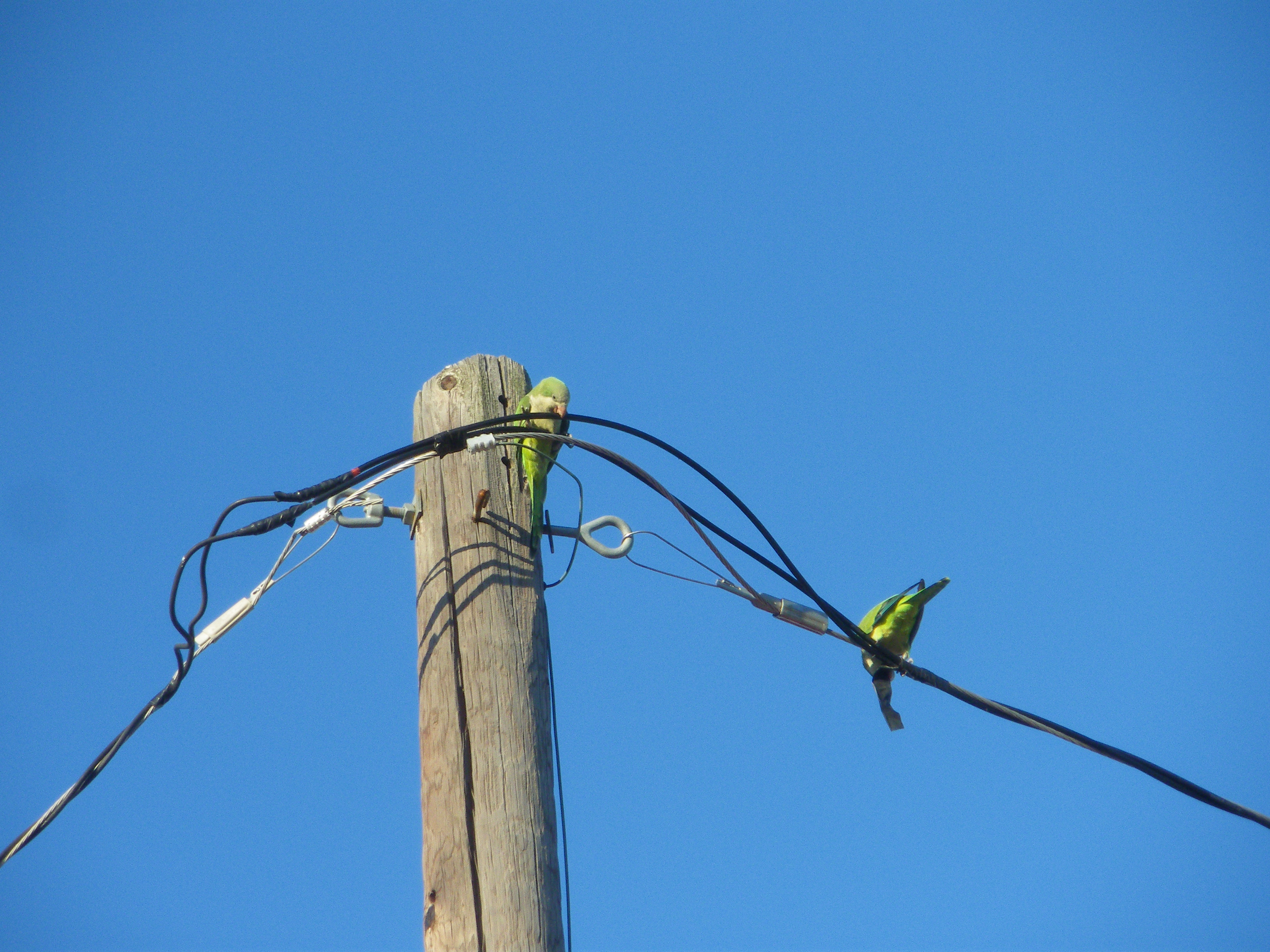
    Monk parakeets in the locusts, Duncanville, Texas, August 10, 2010 - photo by Ed Darrell, use with attribution encouraged

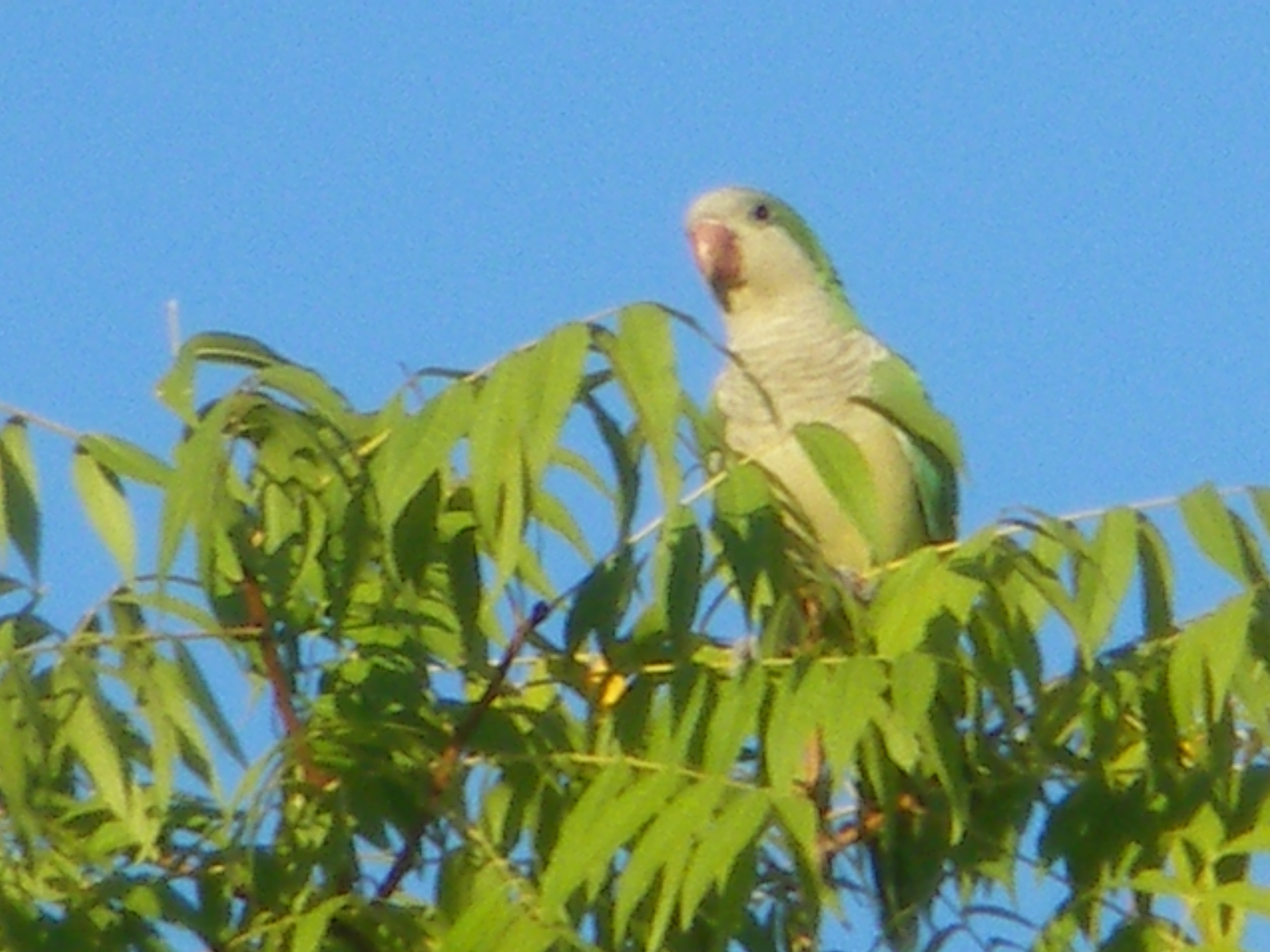
    Monk parakeets profiled in the Chinese pistache, Duncanville, Texas, August 10, 2010 - photo by Ed Darrell; more than a dozen birds are hidden deeper in the tree.

    Monk parakeets are invasive in Texas — it is thought the wild flocks developed from a few dozen escapees in the past three decades.  They favor nesting on tall electrical poles — the stadium lights of the high school and college football stadia host a lot, as do electrical transmission lines.  At Verizon Wireless we had at least one occasion when one of our cell tower climbers was attacked by one of the birds, apparently a mother just after the chicks had hatched.  Cell towers provide excellent habitat for the birds.

    At the best sitings I’ve had, previously I lacked a camera.  Today I happened to have the small Pentax Optio V20.  20 to 30 of the birds roosted along an electrical wire.  They were happy to see me until I pulled out the camera.  (Pure conjecture:  They’re smart.  They’ve seen people with cameras before — and frequently, shortly after that some crew appears with a cherry-picker to destroy their nests.  Camera-shyness is a survival function for the birds.)

    Cute little beggars.

    Monk parakeets flocking -- collecting nesting materials?  Photo by Ed Darrell

    Monk parakeets flocking -- collecting nesting materials?

    All I observed was social activity and some preening, except for the one bird flitting around with a stick in its bill.

    And the two who were trying to pull tape off of electrical transmission wires.

    Monk parakeets assaulting an electrical transmission line.  Photo by Ed Darrell

    Monk parakeets working to get a charge out of life, picking at insulation on an electrical wire.

    Troublemakers.

    Truth be told, I’ll take the monk parakeets in greater profusion, if we can reduce the populations of starlings, grackles and cowbirds.

    Is there any evidence of the parakeets preying on songbirds?

    Monk parakeet in the <del>locust</del> Chinese pistache tree - photo by Ed Darrell - IMGP2237

    Monk parakeet in the Chinese pistache tree. All photos by Ed Darrell, use with attribution encouraged.

    [Update: Oops.  Looked like a locust tree on a quick look.  A longer look, I wasn’t so sure.  Kathryn confirmed that it’s really a Chinese pistache, Pistacia chinensis.]

    Add to FacebookAdd to NewsvineAdd to DiggAdd to Del.icio.usAdd to StumbleuponAdd to RedditAdd to BlinklistAdd to TwitterAdd to TechnoratiAdd to Furl


    Another blog, shocked — shocked! — at cold in Argentina in July

    August 10, 2010

    Unlike the blog discussed in an earlier post at first, this blog seems to understand that it’s winter in South America.  Still, the author can’t understand why record cold in one small spot doesn’t completely negate warming in the rest of the world:  Minnesotans for Global Warming.

    One almost expects to find it has sister sites:  Minnesotans Love Cancer, Minnesotans for Child Abuse, and Self-Lobotomies R Us.

    Maybe it’s not the concept of climate that confuses these people, but the entire notion of “average global temperature.”  People who spend their entire lives below average, probably expect that’s the way it is in temperatures, too.  (Is that nasty enough for today?  I’m feeling crabby about idiocy.)


    Gulf fritillary on blue porterweed

    August 9, 2010

    Gulf fritillary on blue porterweed - photo by Ed Darrell - copy free with attribution IMGP4824

    Gulf fritillary butterfly on blue porterweed, Dallas, Texas — photo by Ed Darrell — use free with attribution

    A gulf fritillary (Agraulis vanillae (Linnaeus, 1758)) on blue porterweed, Stachytarpheta urticifolia, also known as blue rats tail, or nettleleaf velvetberry.  Dallas, Texas, August 9, 2010.

    Gulf fritillary on blue porterweed - photo by Ed Darrell, use permitted with attribution IMGP4820

    This fritillary hung around for a few minutes.

    Kathryn plants butterfly-attracting plants — a concept that was new to me when she introduced it at our home in Cheverly, Maryland, with several plants that acted like butterfly magnets, to my astonished delight.  We first ran into the brilliant orange gulf fritillaries in 1988 or 1989 here in Dallas.  For the past few summers, fritillaries have not been frequent visitors in our yard.

    Kathryn stepped up the butterfly plantings this spring, including passion vine (Passiflora incarnata).  The passion vine twines toward one of the bird feeders, but in the past week or so has been losing leaves — to caterpillars of the gulf fritillary, it turns out.  Blue porterweed attracts all sorts of butterflies, but the fritillaries have been rather common, no doubt hoping to give their progeny a little boost with the passion vine, their favored food.

    Butterfly afficianadoes in Dallas are urged to plant milkweed and butterfly bush to help the monarchs, whose populations are stressed by the recent cold winter, dramatic reductions in habitat, and destruction of their sanctuary trees in Mexico where they migrate each winter.  But all butterflies could use some habitat help, I think.  The rewards are great.

    Gulf fritillary on blue porterweed - photo by Ed Darrell, use permitted with attribution - IMGP4822

    Gulf fritillary on blue porterweed, catching the morning sun

    Gulf fritillary butterfly on blue porterweed - photo by Ed Darrell, use permitted with attribution - IMGP4823

    Butterfly plantings will attract butterflies, guaranteed. Gulf fritillary enjoys some blue porterweed nectar.


    Moral math of climate change, on Speaking of Faith

    August 5, 2010

    Speaking of Faith is carried on many public radio stations nationally, perhaps on one in your area.  If, as I do, you live in an area where the program is not carried, you can pick up a podcast or .mp3 at the program’s website.  (Here’s a list of stations that carry the broadcast.)

    Host Krista Tippett posts a weekly message on the scheduled program — this week, an interview with Bill McKibben, whose book, The End of Nature, was a popular introduction to climate change, when it was published in 1989 (!).

    Yes, this program is about woo and how we deal with it in our daily lives.  This particular program looks at how even woo followers may find it to their advantage to pay attention to the science, and act to protect their families and communities as a result.  This is a moral side of climate change that too many people simply deny.

    Ms. Tippett wrote:

    This week on public radio’s conversation about religion, meaning, ethics, and ideas:

    The Moral Math of Climate Change

    Bill McKibben’s first book, The End of Nature, was the first popular book on climate change, and he is one of the most insightful figures of our time on ecology and life. We’ll explore his hopeful sense that what is good for the environment also nourishes human relationship. And we’ll seek his perspective on knowledge we can trust as we orient our minds and lives to changing realities of the natural world.

    Krista Tippett, host of Speaking of Faith

    History Tends to Surprise Us
    It’s been striking how, across the past few years, the environment has found its way inside my guests’ reflections on every subject, as they say, under the sun. And we do need fresh vocabulary and expansive modes of reflection on this subject that, we’ve come to realize, is not just about ecology but the whole picture of human life and lifestyle.

    Here are some pieces of vocabulary and perspective I’ve loved and used in recent years.

    Starting with the basics, Cal DeWitt — a scientist, conservationist, and Evangelical Christian living in Wisconsin — pointed out to me that “environment” was coined after Geoffrey Chaucer used the term “environing.” This was a turning point in the modern Western imagination — the first time we linguistically defined ourselves as separate from the natural world, known up until then as the Creation. This helps explain why the language of “creation care” is so animating for many conservative Christians — as a return to a sacred insight that was lost. But from quantum physics to economics, too, we are discovering new existential meaning in terms like interconnectedness and interdependence.

    Many people, but most recently the wonderful geophysicist Xavier le Pichon, have made the simple yet striking observation that climate change is the first truly global crisis in human history. In other words, just as we make newfound discoveries about old realities, they are put to the ultimate test. It is easy to be overwhelmed by the signs that we are not up to this test as a species. So it was helpful for me to have Matthieu Ricard, a biologist turned Buddhist monk, remind me that evolutionary change, which is what we need now in our behavior, always comes precisely at the moment where survival — not just betterment — is at stake.

    Such ideas can make the task of integrating, or reintegrating, environmental and human realities sound far away and abstract. But it’s not.

    The most redemptive and encouraging commonality of all the people I’ve encountered who have made a truly evolutionary leap is that they have come to love the very local, very particular places they inhabit. They were drawn into environmentalism by suddenly seeing beauty they had taken for granted; by practical concern for illness and health in neighborhood children; by imagining possibilities for the survival of indigenous flora and fauna, the creation of jobs, the sustainability of regional farms. The catchword of many of our most ingenious solutions to this most planetary of crises is “local” — local food, local economies. Ellen Davis and Wendell Berry illuminate this with poetic, biblical wisdom, each in their way reminding us that the health of our larger ecosystem is linked to knowing ourselves as creatures — “placed creatures.”

    There is so much in my most recent conversation about all of this with Bill McKibben that will frame and deepen my sense of the nature and meaning of climate change moving forward. Among them is an exceedingly helpful four minutes, a brief history of climate change that we’re making available as a separate podcast. But what has stayed with me most of all, I think, is a stunning equation he is ready to make after two decades of immersion in the scientific, cultural, and economic meaning of our ecological present. He points out that cheap fossil fuels have allowed us to become more privatized, less in need of our neighbor, than ever in human history. And he says that in almost every instance, what is good for the environment is good for human community. The appeal of the farmers market is not just its environmental and economic value but the drama, the organic nature, of human contact.

    I also gained a certain bracing historical perspective from my conversation with Bill McKibben. He and I were both born in 1960. He was waking up to the environment in years in which I was in divided Berlin, on the front lines of what felt like the great strategic and moral battle of that age. He published The End of Nature in 1989, the year the Berlin Wall fell. And as I learned from that book, the science of climate change had already begun to emerge at the height of the Cold War. In 1957, two scientists at the Scripps Institution described their findings that humanity initiated an unprecedented “geophysical experiment” that it might not survive.

    So I’ve been chewing on this thought lately: If humanity is around to write history in a century or two, what was happening with the climate in 1989 may dwarf what we perceived as the great geopolitical dramas of that time. Living through the fall of the wall and the reunification of Europe emboldened my sense that there is always more to reality than we can see and more change possible than we can begin to imagine. I draw caution as well as hope from the fact that history tends to surprise us. And I draw caution as well as hope from the knowledge that humanity often surprises itself on the edge of survival.

    The End of Nature by Bill McKibben I Recommend Reading:
    The End of Nature
    by Bill McKibben

    This was the first book to introduce the notion and science of climate change to a non-scientific audience. It is passionately and beautifully written. And while Bill McKibben’s updated introduction in recent printings adds relevant new knowledge, it also highlights just how prescient and powerful the original book remains.

    Add to FacebookAdd to NewsvineAdd to DiggAdd to Del.icio.usAdd to StumbleuponAdd to RedditAdd to BlinklistAdd to TwitterAdd to TechnoratiAdd to Furl


    Return of the Aurora Borealis

    August 4, 2010

    Aurora Borealis, by Wiciwato (Yahoo Flickr compilation) - July-August 2010

    Aurora Borealis, by Wiciwato (Yahoo Flickr compilation) - July-August 2010 - notice the Big Dipper in the photo?

    A storm on the Sun last Sunday launched a wave of cosmic particles toward the Earth — the particles whose striking of the upper atmosphere causes ions to glow, creating the Northern Lights.

    And so the Northern Lights, the Aurora Borealis, returned to the planet in spectacular fashion this week, after more than a year of relative solar dormancy.  According to the Christian Science Monitor, outstanding displays of the lights may continue through this week.

    Yahoo’s Flicker editors put together a collection of photos from Flickr, from which the photo above is taken — there are a lot more spectacular shots there.

    Resources, more:

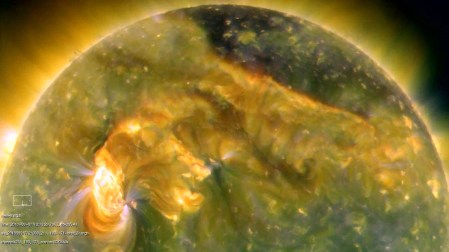
    Pictures of the coronal mass ejection from the Sun dazzle, too:

    Caption from NASA: On August 1st, almost the entire Earth-facing side of the sun erupted in a tumult of activity. There was a C3-class solar flare, a solar tsunami, multiple filaments of magnetism lifting off the stellar surface, large-scale shaking of the solar corona, radio bursts, a coronal mass ejection and more. This extreme ultraviolet snapshot from the Solar Dynamics Observatory (SDO) shows the sun's northern hemisphere in mid-eruption. Different colors in the image represent different gas temperatures ranging from ~1 to 2 million degrees K. Credit: NASA/SDO

    Help someone else find the sky:

    Add to FacebookAdd to NewsvineAdd to DiggAdd to Del.icio.usAdd to StumbleuponAdd to RedditAdd to BlinklistAdd to TwitterAdd to TechnoratiAdd to Furl


    Warming deniers surprised by winter

    July 27, 2010

    Were you writing fiction, you couldn’t make this stuff up.

    Another bastion of people misled by the lack of a Hemingway-brand Solid Gold Sh*t Detector™.

    Another person proud as heck of her denial of global warming, points to cattle freezing in South America in July as proof that the Earth’s atmosphere is not warming.

    At a blog called Frugal Café Blog Zone, “Where it’s chic to be cheap… Conservative social & political commentary, with frugality mixed in,” blogger Vicki McClure Davidson headlined the piece:

    “Remember Al Gore’s “Global Warming” Hoax? People & Cattle in South America Are Dying from Extreme Cold in July”

    Gee, how to break this news to her?

    Vickie, sit down.  This is something you should have learned in geography in junior high:  In the Southern Hemisphere, winter starts on June 21It’s cold in South America in July, because it’s winter in South America in July.

    Cold in winter.  They don’t expect it.  These warming denialists provide the evidence those crabs need, who wonder whether there shouldn’t be some sort of “common sense test” required to pass before allowing people to vote, or drive, or have children.

    Oh, it gets worse:

    Another site picked up the post.  No, seriously.  (Has Anthony Watts seen this yet?)

    • Voting Female [I am convinced that is a sock puppet site designed to insult women; no woman could be that stupid, could she?]
    Earth at northern solstice

    Earth at northern solstice - Wikimedia image


    DDT and birth defects: South African television asks questions

    July 23, 2010

    Steven Milloy, Roger Bate, and Richard Tren hope you never see this television production — they hope you never even hear about it.  It’s one more indication that Rachel Carson was right.

    They hope you never even hear about it.  It’s set for telecast in South Africa next Tuesday:

    Special Assignment to broadcast episode on ‘Collateral Damage’

    Published: 22 July 2010

    This week, Special Assignment looks at those affected by the dangerous DDT chemical and also those who say it is a necessary evil to prevent many South Africans from dying.

    “I have problems with my balls,” says ‘George’. “I was born without testicles,” adds ‘Joseph’, yet another man born in the Limpopo area. These two and many other young men in Venda share a common story.

    Each year, South Africa sprays more than 90 tonnes of the toxic DDT chemical in homesteads in KwaZulu-Natal and Limpopo areas. Though DDT, a persistent organic chemical which can remain in the environment for as much as 40 years is banned across the world, South Africa still uses it to control malaria in the country. Recent studies have however showed that DDT is harmful to humans with hundreds of kids born in the Venda area showing signs of genital deformities. The chemical has also been associated with breast cancer; diabetes; and spontaneous abortion. Yet it remains South Africa’s best option for the prevention of malaria which kills millions of people each year across Africa. This week, Special Assignment looks at those affected by this chemical and also those who say it is a necessary evil to prevent many other South Africans from dying.

    ‘Collateral Damage’ will be broadcast on Special Assignment on Tuesday, 27 July, at 20:31 on SABC3.


    News from the strike at Science Blogs, and Pharyngula

    July 21, 2010

    Management noticed the picket line, has agreed to discuss.   Let us hope it’s a short-lived* strike.

    _____________

    That’s pronounced with a long “i” if you care to say it correctly.


    Vegetarian fireworks: Fruit and vegetable MRIs

    July 19, 2010

    Fireworks!

    Broccoli, in an MRI

    Broccoli, as seen by MRI

    Looks like fireworks to me.

    From Inside Insides, a site dedicated to MRIs of food.

    Oddly beautiful.  Interesting.  Nerdy.

    Tip of the old scrub brush to P. Z. Myers at Pharyngula.


    First cicada killer sighting of 2010

    July 19, 2010

    Cicada killer wasps appeared as early as July 7, in our yard.  This year we had a cold winter, with snows that appear to have stymied even the nasty, invasive Argentine fire ant.  But June was dry and hot.  July came with rains, and cicada killers don’t like wet soil to dig in.

    For that matter, we don’t have many cicadas, either.

    Plus, we had to tear down a planter box attached to the dining room window, since it hid termites too well.  No doubt that planter had young from the cicada killers in it.

    Early yesterday evening, as we finished dinner, we watched the house finches (Carpodacus mexicanus) escorting their young to the bird feeders, the cardinal “babies” (Cardinalis cardinalis) breaking out of their baby feathering, we looked for the family of red-bellied woodpeckers (Melanerpes carolinus) — and there it was:  One lone cicada hawk zooming across the patio, yellow-and-black striped abdomen standing out among the other paper wasps (almost certainly Sphecius speciosa).

    They’re back!

    Earlier at Millard Fillmore’s Bathtub:

    More:


    University of Arizona’s “malaria-proof” mosquito

    July 15, 2010

    This could be good news:  A genetically-altered mosquito that doesn’t harbor the malaria parasite, and so cannot pass it along to humans it bites in its later life.

    One more way to end the use and production of DDT.

    Press release from the University of Arizona (one of my alma mater schools):

    The first malaria-proof mosquito

    Scientists at the University of Arizona have achieved a breakthrough in the fight against malaria: a mosquito that can no longer give the disease to humans

    IMAGE: Michael Riehle, holding genetically altered mosquitoes, and his team work in a highly secure lab environment to prevent genetically altered mosquitoes from escaping.

    Click here for more information.

    For years, researchers worldwide have attempted to create genetically altered mosquitoes that cannot infect humans with malaria. Those efforts fell short because the mosquitoes still were capable of transmitting the disease-causing pathogen, only in lower numbers.

    Now for the first time, University of Arizona entomologists have succeeded in genetically altering mosquitoes in a way that renders them completely immune to the parasite, a single-celled organism called Plasmodium. Someday researchers hope to replace wild mosquitoes with lab-bred populations unable to act as vectors, i.e. transmit the malaria-causing parasite.

    “If you want to effectively stop the spreading of the malaria parasite, you need mosquitoes that are no less than 100 percent resistant to it. If a single parasite slips through and infects a human, the whole approach will be doomed to fail,” said Michael Riehle, who led the research effort, the results of which will be published July 15 in the journal Public Library of Science Pathogens. Riehle is a professor of entomology in the UA’s College of Agriculture and Life Sciences and is a member of the BIO5 Institute.

    Riehle’s team used molecular biology techniques to design a piece of genetic information capable of inserting itself into a mosquito’s genome. This construct was then injected into the eggs of the mosquitoes. The emerging generation carries the altered genetic information and passes it on to future generations. For their experiments, the scientists used Anopheles stephensi, a mosquito species that is an important malaria vector throughout the Indian subcontinent.

    The researchers targeted one of the many biochemical pathways inside the mosquito’s cells. Specifically, they engineered a piece of genetic code acting as a molecular switch in the complex control of metabolic functions inside the cell. The genetic construct acts like a switch that is always set to “on,” leading to the permanent activity of a signaling enzyme called Akt. Akt functions as a messenger molecule in several metabolic functions, including larval development, immune response and lifespan.

    When Riehle and his co-workers studied the genetically modified mosquitoes after feeding them malaria-infested blood, they noticed that the Plasmodium parasites did not infect a single study animal.

    IMAGE: Under UV light, this mosquito larva reveals a red fluorescent marker in its nervous system, causing eyes and nerves to glow. The marker’s presence tells the researchers in Riehle’s…

    Click here for more information.

    “We were surprised how well this works,” said Riehle. “We were just hoping to see some effect on the mosquitoes’ growth rate, lifespan or their susceptibility to the parasite, but it was great to see that our construct blocked the infection process completely.”

    Of the estimated 250 million people who contract malaria each year, 1 million – mostly children – do not survive. Ninety percent of the number of fatalities, which Riehle suspects to be underreported, occur in Sub-Saharan Africa.

    Each new malaria case starts with a bite from a vector – a mosquito belonging to the genus Anopheles. About 25 species of Anopheles are significant vectors of the disease.

    Only the female Anopheles mosquitoes feed on blood, which they need to produce eggs. When they bite an infected human or animal, they ingest the malaria parasite.

    Once the Plasmodium cells find themselves in the insect’s midgut, they spring into action. They leave the insect’s digestive tract by squeezing through the midgut lining. The vast majority of Plasmodium cells do not survive this journey and are eliminated by the mosquito’s immune cells. A tiny fraction of parasite cells, usually not more than a handful, make it and attach themselves on the outside of the midgut wall where they develop into brooding cells called oocysts.

    Within 10-12 days, thousands of new Plasmodium cells, so-called sporozoites, sprout inside the oocyst. After hatching from the oocyst, the sporozoites make their way into the insect’s salivary glands where they lie in wait until the mosquito finds a victim for a blood meal. When the mosquito bites, some sporozoites are flushed into the victim’s bloodstream.

    “The average mosquito transmits about 40 sporozoites when it bites,” said Riehle, “but it takes only one to infect a human and make a new malaria victim.”

    Several species of Plasmodium exist in different parts of the world, all of which are microscopically small single-celled organisms that live in their hosts’ red blood cells. Each time the parasites undergo a round of multiplication, their host cells burst and release the progeny into the bloodstream, causing the painful bouts of fever that malaria is known and feared for.

    Malaria killed more soldiers in the Civil War than the fighting, according to Riehle. In fact, malaria was prevalent in most parts of the U.S. until the late 1940s and early 1950, when DDT spraying campaigns wiped the vectors off the map. Today, a new case of malaria occurs in the U.S. only on rare occasions.

    The severity of the disease depends very largely on the species of the Plasmodium parasite the patient happens to contract.

    “Only two species of Plasmodium cause the dreaded relapses of the disease,” said Riehle. “One of them, Plasmodium vivax, can lie dormant in the liver for 10 to 15 years, but now drugs have become available that target the parasites in the liver as well as those in the blood cells.”

    That said, there are no effective or approved malaria vaccines. A few vaccine candidates have gone to clinical trials but they were shown to either be ineffective or provide only short-term protection. If an effective vaccine were to be developed, distribution would be a major problem, Riehle said.

    Researchers and health officials put higher hopes into eradication programs, which aim at the disease-transmitting mosquitoes rather than the pathogens that cause it.

    “The question is ‘What can we do to turn a good vector into a bad vector?'” Riehle said.

    “The eradication scenario requires three things: A gene that disrupts the development of the parasite inside the mosquito, a genetic technique to bring that gene into the mosquito genome and a mechanism that gives the modified mosquito an edge over the natural populations so they can displace them over time.”

    “The third requirement is going to be the most difficult of the three to realize,” he added, which is why his team decided to tackle the other two first.

    “It was known that the Akt enzyme is involved in the mosquito’s growth rate and immune response, among other things,” Riehle said. “So we went ahead with this genetic construct to see if we can ramp up Akt function and help the insects’ immune system fight off the malaria parasite.”

    The second rationale behind this approach was to use Akt signaling to stunt the mosquitoes’ growth and cut down on its lifespan.

    “In the wild, a mosquito lives for an average of two weeks,” Riehle explained. “Only the oldest mosquitoes are able to transmit the parasite. If we can reduce the lifespan of the mosquitoes, we can reduce the number of infections.”

    His research team discovered that mosquitoes carrying two copies of the altered gene had lost their ability to act as malaria vectors altogether.

    “In that group of mosquitoes, not a single Plasmodium oocyst managed to form.”

    At this point, the modified mosquitoes exist in a highly secured lab environment with no chance of escape. Once researchers find a way to replace wild mosquito populations with lab-bred ones, breakthroughs like the one achieved by Riehle’s group could pave the way toward a world in which malaria is all but history.

    ###

    This study was funded by the National Institutes of Health.

    Reference: Corby-Harris et al. Activation of Akt Signaling Reduces the Prevalence and Intensity of Malaria Parasite Infection and Lifespan in Anopheles stephensi Mosquitoes. Public Library of Science (PLoS) Pathogens, July 2010 issue: www.plospathogens.org

    How do you like them genetic engineering guys now?


    Tea Party symbols: Forgetting history and science

    July 13, 2010

    From the Los Angeles Times blogs, Opinion, from February 2010:

    Tea Party footnotes

    February 7, 2010 |  7:39 am

    A couple of musings about the Tea Party convention in Tennessee:

    I’m puzzled by the disgruntled reaction among Tea Partiers to the fact that the convention charged money to attend — about $550, it’s been reported — and that the convention organizer was a for-profit company. Yeah, it’s expensive, all right, but isn’t profit-making quintessentially American?

    And I’ve seen photos of conventioneers wearing T-shirts with the image of a bald eagle on the back, the national bird, symbol of the nation. When the Founding Fathers were drawing up the blueprints for the United States, there were hundreds of thousands of bald eagles, coast to coast, clime to clime.

    But then humans began crowding them out and shooting them down in such numbers that a law protecting them was put into place in 1940. But that was just about the time that DDT began to be used in vast quantities, and there went the bald eagle population again. DDT in the food chain rendered bald eagle shells too thin to incubate or hatch and perhaps rendered some adult birds infertile.

    Rachel Carson’s seminal book ”Silent Spring” raised the public’s awareness of the risks of DDT. In 1967, bald eagles were ruled an endangered species in much of the U.S. — a status that was made national on the nation’s bicentennial, in 1976 — and they weren’t declared to be a thriving species once again until 2007.

    Which means that, if it hadn’t been for all those tree-hugging pinko environmentalists, the bird of prey on all those T-shirts, the proud bald eagle, might very well have been a dead duck.

    — Patt Morrison

    Audubon watercolor of bald eagle - Library of Congress image

    Audubon watercolor of bald eagle – Library of Congress image

    Help save the bald eagle from Tea Party sniping:

    Add to FacebookAdd to NewsvineAdd to DiggAdd to Del.icio.usAdd to StumbleuponAdd to RedditAdd to BlinklistAdd to TwitterAdd to TechnoratiAdd to Furl


    I get e-mail: Media Matters calls bluffs of climate change “skeptics”

    July 10, 2010

    Media Matters may be a site worth tracking more closely, not only on climate issues:

    Media Matters: The greatest science “scandal” “in the history of man” predictably falls apart

    In their never-ending quest to prove that they understand the intricacies of climate science better than actual climate scientists, conservative media figures routinely promote any ridiculous “evidence” they think undermines the scientific consensus about climate change.

    This is a group that repeatedly points to snowstorms in February as proof that global warming is not real; claims that CO2 can’t be a pollutant because “we breathe” it; and ignores actual temperature data to baselessly claim that the Earth is really “cooling.”

    Last year, conservative climate change skeptics, in the words of Wall Street Journal’s Kimberly Strassel, thought they had found a “gold mine.” Conservative media figures seized on emails stolen from climate scientists and proceeded to completely distort their contents. As we pointed out repeatedly at the time, this “scandal” relied on outrageous misrepresentations of the stolen emails and did not in any way undermine the scientific consensus about climate change.

    Nevertheless, conservative media figures incessantly hyped the non-scandal with their usual overblown rhetoric:

    • Glenn Beck — who says he is not a conspiracy theorist, remember — suggested in the wake of “Climategate” that climate change is a “scam.” He also said that if the United Nations’ Intergovernmental Panel on Climate Change report “had been done by Japanese scientists, there is not enough knives on planet Earth for hara-kiri.”
    • Noted climatologist Rush Limbaugh, who frequently decries the supposed global warming “hoax,” proposed that all of the scientists involved in “Climategate” should be “named and fired, drawn and quartered, or whatever it is.”
    • Andrew Breitbart called for “capital punishment” for NASA scientist James Hansen, because “Climategate” was supposedly “high treason.”
    • The Washington Times, Michelle Malkin, Ann Coulter, Investor’s Business Daily, The American Spectator’s Robert Stacy McCain, Rich Lowry, Newsmax’s James Hirsen, and Michael Ledeen all joined forces to smear the scientific consensus on climate change as a “cult.”
    • Fox News’ Mike Huckabee explained that “Jesus would be a truthseeker” while discussing the “revelation” that scientists had “cooked” climate change data.

    The crew at Fox & Friends spent this year’s Earth Day promoting an important cause. No, not encouraging environmental consciousness — they devoted the show to pushing “Climategate” falsehoods in order to falsely claim that “scientists held back data that discredits theories on global warming.” They were joined by Brent Bozell of the Media Research Center, who was there to complain about non-Fox networks “dismiss[ing]” and “ignor[ing]” the story.

    Last December, Bozell told Lou Dobbs that “Climategate” is the “biggest scandal in terms of science, finance, and politics … in the history of man.” After Bozell compared the climate science “cover-up” to “the craziness” of Dan Brown’s fiction, he actually managed to draw laughter from Dobbs. Unfortunately, contrary to Bozell’s suggestion that media outlets ignored the story, numerous non-Fox “Climategate” stories adopted conservatives’ dishonest framing of the non-story.

    And now for the inevitable conclusion of this manufactured controversy.

    As reported by The New York Times’ Andrew Revkin — who, by the way, Rush Limbaugh thinks should “just go kill” himself — the Independent Climate Change Email Review “cleared climate scientists and administrators” involved in “Climategate” of “malfeasance.” This follows several other exonerations of the scientists involved in the phony scandal. In response, Media Matters, joined by numerous progressive and clean energy groups, called on all outlets that reported on the original “Climategate” controversy to set the record straight.

    So this leaves us where we were before the “Climategate” freakout: There is still overwhelming scientific evidence supporting the theory of global warming.

    And once again conservative media proved that they don’t hesitate to rely on blatant distortions, outright falsehoods, and a complete disregard for reality to advance their political causes.

    Mainstream media outlets would be doing everyone a service if they remembered that the next time they decide to report on whatever Rush Limbaugh, Glenn Beck, Fox News, and the perpetual conservative outrage machine are yelling about.

    Conservatives’ phony scandal of the week: The Obama Justice Department and the New Black Panther Party

    While we’re on the subject of manufactured scandals that respectable media outlets shouldn’t take seriously, Fox News and its friends in the conservative echo chamber spent much of the week promoting phony, trumped-up allegations against the Justice Department.

    In short, conservative media outlets have been aggressively promoting the charge by GOP activist J. Christian Adams that President Obama’s Justice Department engaged in racially charged “corruption” when it partially dismissed a case against members of the New Black Panther Party for allegedly engaging in voter intimidation outside of a Philadelphia polling center on Election Day in 2008.

    As we have documented extensively, Adams should not be trusted. He is a long-time right-wing activist with extensive ties to the Bush-era politicization of the Justice Department. Adams himself has admitted that he lacks first-hand knowledge to support his accusations. Additionally, Adams’ charge that the DOJ’s action in the New Black Panther case shows unprecedented, racially motivated corruption is undermined by the fact that the Obama DOJ obtained judgment against one of the defendants, and that the Bush DOJ declined to pursue similar allegations against a group of Minutemen — one of whom was carrying a gun — in 2006.

    Even the Republican vice chairwoman of the U.S. Commission on Civil Rights called the New Black Panthers case “very small potatoes” and said an investigation into the DOJ’s decision is full of “overheated rhetoric filled with insinuations and unsubstantiated charges.”

    And yet again, the fact that this is a completely manufactured scandal didn’t stop conservative media figures from engaging in one of their time-honored traditions: attempting to obscure their own problems with race by accusing others of racism.

    Radio host Jim Quinn — who once told “race-baiting” African-American “ingrates” to “get on your knees” and “kiss the American dirt” because slavery brought them to the U.S. — hyped the New Black Panther story by calling the civil rights community “race-baiting poverty pimps.”

    Rush Limbaugh — who earlier this week announced that if Obama wasn’t black he’d be a “tour guide in Honolulu” and claimed Obama is using the office of the presidency to seek “payback” for the country’s history of racism — forwarded Adams’ charge that the case was dropped because of racially charged corruption.

    Beck, who infamously called President Obama a “racist” with a “deep seated hatred for white people or the white culture,” declared that the Obama administration is “full” of “people that will excuse” the “hatred” of the New Black Panthers. He also relied on falsehoods to try to connect Obama to the New Black Panthers, and claimed today that the New Black Panthers are part of Obama’s “army of thugs.”

    Of course, the New Black Panthers are a fringe hate group, and only a cynical race-baiter like Glenn Beck would claim they are somehow part of Barack Obama’s imaginary “army of thugs.”

    But I’m sure they appreciate all of the publicity, courtesy of Glenn Beck and Fox News.

    Bek Younuhvercity

    This week also marked the launch of Beck’s latest attempt to grab money from “educate” his audience: Beck University.

    As Beck described it, the online Beck University is an “academic program” that would be a “unique experience bringing together experts in the fields of religion, American history, and economics.” At the outset of the first “course” — Faith 101, with frequent Beck guest/promoter of historical misinformation David Barton — Beck announced that viewers “will learn more in the next hour than you’ve probably learned in your entire life about American history.”

    Laughable hyperbole aside, as we pointed out this week, Glenn Beck is uniquely unqualified to found a university, considering he regularly traffics in bizarre conspiracy theories, distortions, and downright falsehoods on a wide variety of subjects.

    The day after the first “course” at Beck University, Beck stood in front of his blackboard and labeled various historical figures “heros” or “villians.”

    And lastly, by my count, between his TV show last night and his radio program today, Beck launched no fewer than four baseless charges that, by his standards, should get him fired.

    This weekly wrap-up was compiled by Media Matters’ Ben Dimiero.

    Whom the gods destroy, they first make mad, Euripides said (paraphrased).  With that ancient wisdom in hand, one might be well advised not to stand next to Glenn Beck or Fox News.

    If Glenn Beck wishes to know the evils of Woodrow Wilson or Theodore Roosevelt, I can point him to sources.  In spite of those evils, however, they remain heroes of American history for the good things they did.  Beck criticizes them for those good things, however, and not for their failures (including Wilson’s patent racism, and Roosevelt’s failure to push for integration at opportune times — to Beck, those would be virtues, I fear).

    Visit Media Matters here, sign up for Media Matters’ e-mail newsletter here.


    The scientist’s work desk

    July 8, 2010

    This should be close to the top of “Best Places to Work.”

    Condor flight pen observation booth - Amanda Holland photo, all rights reserved

    Condor flight pen observation booth – Amanda Holland photo, all rights reserved

    From my desk at the Senate Democratic Policy Committee I could look up to a crystal chandelier 10 feet across.  Out the west window was a view over the National Museum of Art, down the mall to the Washington Monument and Lincoln Memorial.  25 yards away, over specially-ordered Italian tile, was the gallery to the World’s Greatest Deliberative Body.  From my desk at the Senate Labor Committee I looked out on that grand Calder sculpture in the Hart Senate Office Building atrium.  A couple of my memorable offices.

    The work spaces I miss?  That water tank in Shiprock, New Mexico, with the million-dollar view of the Shiprock; that trailer laboratory we parked in Huntington Canyon, Utah.   That old dock on the Sawkill in the Hudson Valley of New York, by the old snag where the pileated woodpeckers nested and raised their brood.

    Cousin-in-law Amanda Holland took this photo of her work station, above.  This is a place where real science gets done.  Amanda wrote:

    I get to sit here for hours at a time, recording condor behavior. It does not get old. These birds are AMAZING. You can see a couple condors perched on a snag in the back of the flight pen.

    Real work, for real good.  That’s always the best place to work.