Highest powered LASER in the world – in Texas, naturally

August 15, 2008

Longhorns must be proud. This is really cool science.

The University of Texas is hosting an open house for the Petawatt Laser. The Petawatt Laser is the most powerful laser in the world, creating “power output of more than 2,000 times the output of all power plants in the United States. (A petawatt is one quadrillion watts.)” The open house is August 28. (No, I didn’t get an invitation; Meg Gardiner’s husband got one.)

The laser is brighter than sunlight on the surface of the sun, but it only lasts for an instant, a 10th of a trillionth of a second (0.0000000000001 second).

Not me teach - I didnt shine that laser on your whiteboard.  (Seriously - Dr. Todd Whitmire, University of Texas, operator of the Petawatt Laser)

'Not me teach - I didn't shine that laser on your whiteboard.' (Seriously - Dr. Todd Ditmire, University of Texas, operator of the Petawatt Laser)

The laser reached greater than one petawatt of output in a test run March 31, 2008, at the University of Texas’s Texas Center for High Intensity Laser Science. The instrument will be used to create and study in extreme conditions, “including gases at temperatures greater than those in the sun and solids at pressures of many billions of atmospheres.”

This will allow them to explore many astronomical phenomena in miniature. They will create mini-supernovas, tabletop stars and very high-density plasmas that mimic exotic stellar objects known as brown dwarfs.

“We can learn about these large astronomical objects from tiny reactions in the lab because of the similarity of the mathematical equations that describe the events,” said Ditmire, director of the center.

Such a powerful laser will also allow them to study advanced ideas for creating energy by controlled fusion.

The Texas Petawatt was built with funding provided by the National Nuclear Security Administration, an agency within the U. S. Department of Energy.

Millard Fillmore’s Bathtub could use a petawatt laser, to keep the water in the tub warm, don’t you think?

Tip of the old scrub brush to Lying for a Living.

Resources (just for the sake of listing “ultrafast science”):

Bonus: Flag etiquette violation, below the fold.

Read the rest of this entry »


Will Rogers and Wiley Post crash in Alaska, 1935

August 15, 2008

Will Rogers, images from Will Rogers Museums, Oklahoma

Will Rogers, images from Will Rogers Museums, Oklahoma

After Mark Twain died, America found another great humorist, raconteur, story-teller, who tickled the nation’s funny-bone and pricked the collective social conscience at the same time. Will Rogers is most famous today for his sentiment that he never met a man he didn’t like. In 1935, he was at the height of his popularity, still performing as a lariat-twirling, Vaudeville comedian who communed with presidents, and kept his common sense. He wrote a daily newspaper column that was carried in 500 newspapers across America.  Rogers was so popular that Texas and Oklahoma have dueled over who gets the bragging rights in claiming him as a native son.

Will Rogers ready to perform.  Photo taken prior to 1900 - Wikimedia

Will Rogers ready to perform. Photo taken prior to 1900 - Wikimedia

Wiley Post was known as one of the best pilots in America. He gained fame by being the first pilot to fly solo around the world. Post was famous for his work developing new ways to fly at high altitudes. Post was born in Texas and moved to Oklahoma. He lost an eye in an oil-field accident in 1924, then used the settlement money to buy his first airplane. He befriended Will Rogers when flying Rogers to an appearance at a Rodeo, and the two kept up their friendship literally to death.

Post asked Rogers to come along on a tour of the great unknown land of Alaska, where Post was trying to map routes for mail planes to Russia. Ever adventurous, Rogers agreed — he could file his newspaper columns from Alaska by radio and telephone. On August 15, 1935, their airplane crashed near Point Barrow, Alaska, killing them both.

Wiley Post, first to fly solo around the world, in an early pressure suit for high-altitude flying - Wikimedia photo

Wiley Post, first to fly solo around the world, in an early pressure suit for high-altitude flying - Wikimedia photo

On August 15, 2008, a ceremony in Claremore, Oklahoma, will honor the two men on the 73rd anniversary of their deaths. About 50 pilots from Oklahoma, Missouri, Kansas and Arkansas will fly in to the Claremore Airport for the Will Rogers-Wiley Post Fly-In Weekend. Oklahoma Lt. Gov. Jari Askins will offer a tribute.

Rogers was 56, leaving behind his wife, Betty, and four children. Post, 36, left a widow.

Rogers’ life is really quite legendary. Historian Joseph H. Carter summed it up:

Will Rogers was first an Indian, a cowboy then a national figure. He now is a legend.
Born in 1879 on a large ranch in the Cherokee Nation near what later would become Oologah, Oklahoma, Will Rogers was taught by a freed slave how to use a lasso as a tool to work Texas Longhorn cattle on the family ranch.
As he grew older, Will Rogers’ roping skills developed so special that he was listed in the Guinness Book of Records for throwing three lassos at once: One rope caught the running horse’s neck, the other would hoop around the rider and the third swooped up under the horse to loop all four legs.
Will Rogers’ unsurpassed lariat feats were recorded in the classic movie, “The Ropin’ Fool.”
His hard-earned skills won him jobs trick roping in wild west shows and on the vaudeville stages where, soon, he started telling small jokes.
Quickly, his wise cracks and folksy observations became more prized by audiences than his expert roping. He became recognized as being a very informed and smart philosopher–telling the truth in very simple words so that everyone could understand.
After the 10th grade, Will Rogers dropped out of school to become a cowboy in a cattle drive. He always regretted that he didn’t finish school, but he made sure that he never stopped learning–reading, thinking and talking to smart people. His hard work paid off.
Will Rogers was the star of Broadway and 71 movies of the 1920s and 1930s; a popular broadcaster; besides writing more than 4,000 syndicated newspaper columns and befriending Presidents, Senators and Kings.
During his lifetime, he traveled around the globe three times– meeting people, covering wars, talking about peace and learning everything possible.
He wrote six books. In fact he published more than two million words. He was the first big time radio commentator, was a guest at the White House and his opinions were sought by the leaders of the world.
Inside himself, Will Rogers remained a simple Oklahoma cowboy. “I never met a man I didn’t like,” was his credo of genuine love and respect for humanity and all people everywhere. He gave his own money to disaster victims and raised thousands for the Red Cross and Salvation Army.

Post’s legacy is significant, too. His employer, Oklahoma oil man F. C. Hall, encouraged Post to push for aviation records using Hall’s Lockheed Vega, and Post was happy to comply. Before his history-making trip around the world, he had won races and navigation contests. NASA traces the development of the space-walking suits worn by astronauts to Post’s early attempts for flight records:

For Wiley Post to achieve the altitude records he sought, he needed protection. (Pressurized aircraft cabins had not yet been developed.) Post’s solution was a suit that could be pressurized by his airplane engine’s supercharger.

First attempts at building a pressure suit failed since the suit became rigid and immobile when pressurized. Post discovered he couldn’t move inside the inflated suit, much less work airplane controls. A later version succeeded with the suit constructed already in a sitting position. This allowed Post to place his hands on the airplane controls and his feet on the rudder bars. Moving his arms and legs was difficult, but not impossible. To provide visibility, a viewing port was part of the rigid helmet placed over Post’s head. The port was small, but a larger one was unnecessary because Post had only one good eye!

Last photo of Will Rogers (in the hat) and Wiley Post, in Alaska in 1935 (from Century of Flight)

Last photo of Will Rogers (in the hat) and Wiley Post, in Alaska in 1935 (from Century of Flight)

Tip of the old scrub brush to Alaska bush advocate Pamela Bumsted.

Resources:


Institute for Creation Research: Still fraudulent after all these years

August 13, 2008

Sometime in the spring I let a long-running discussion with pastor Joe Leavell taper off. I thought I’d be back to it more quickly. It’s that sort of summer.

In one of his last posts, Joe said he’d been to a lecture by some folks from the Institute for Creation Research, the same bunch that tried to hornswoggle Texas into letting them grant graduate degrees in science education and biology for teaching creationism to their students instead, as a way of injecting creationism into the schools stealthily but still illegally. Texas refused to give them the authorityICR promises to appeal and sue for the privilege.

Joe said:

The response was rather lengthy, but they talked about the research that they have been doing over the past 7-8 years or so and the difference accredited scientists that are working for them. They also claimed that creationists get criticized for not writing peer reviewed articles in journals, but they claimed that they had submitted countless articles over the years and they all get rejected. They simply can’t get printed, was the claim, so they print their own stuff. They also pointed me to the RATE project, which honestly, without knowing a ton about science (though I do know some), is very convincing to me.

Here’s the link:
https://www.icr.org/rate/

The main argument that I found convincing was the presence of helium in the rocks which wouldn’t be there if the rocks were millions of years old. They said they’ve been working on this project about 8 years and have spent $1.5 million on it. They also submitted all of their research to top labs in the country to make sure they weren’t accused of “fudging” the evidence. Check it out (if you have time) and let me know what you come up with.

I’ll be brief in my response here, at least to start: Same old fraud, not even new wineskins.

Dr. Russell Humphreys, a famous creationism crank (to serious geologists and other scientists), claims that the amount of helium he detected in some zircon crystals was so high that the crystals could not be more than a few thousands of years old, rather than the millions of years old all other dating methods by all other scientists produce. Humphreys’ findings have never been submitted to any science journal for publication, but were instead distributed to donors to a creationist ministry.

Oh, Joe: These guys depend on a lack of normal skepticism and a lack of knowledge to perpetrate these frauds on honest Christians. I do wish more Christians would hold their feet to the fire.

A few observations:

First, this project exhibits most of Bob Parks’ seven warning signs of bogus science. Those signs are:

  1. The discoverer pitches the claim directly to the media. In this case, to media and donors.
  2. The discoverer says that a powerful establishment is trying to suppress his or her work. This thread runs through all ICR work. Humphreys’ later attempts at character assassination against his critics specifically for their critiques of the RATE project are exactly the warning sign of bogus science that we should expect, from bogus science. (See the final three paragraphs here.)
  3. The scientific effect involved is always at the very limit of detection. This sign, not so much.
  4. Evidence for a discovery is anecdotal. In place of the usual description of methodologies used so other scientists can replicate the measurement, we get a story about samples for other purposes, purloined for this measurement. Most of the critical references to the conclusion were unpublished, or revealed only in crank science publications.
  5. The discoverer says a belief is credible because it has endured for centuries. See the paper: “Many creationists believed . . .”
  6. The discoverer has worked in isolation. In this case, it’s difficult to know for certain; there is no methodology, no statement of where the work was carried, by whom, and no peer review. No other labs appear to be working on these issues. Dollars to doughnuts this work at government laboratories in Oak Ridge and Los Alamos is not catalogued in the labs’ work records, nor is it reported to Congress. Not only working in isolation, but completely on the sly.
  7. The discoverer must propose new laws of nature to explain an observation. Humphreys had earlier proposed diffusion rates far in excess of anything measured, and in this case, he assumes similar, completely uncorroborated conclusions.

Second, the conclusions have been challenged (“debunked” might be a better description) by scientists who know the subject matter. There’s a thorough discussion on Talk.Origins, by Kevin Henke (at the University of Kentucky); to summarize, there is no reason to think that helium could get out of those zircon crystals at depth, especially under the pressures at the depths the samples were recovered from; plus there are other problems:

Throughout Humphreys (2005), Dr. Humphreys stresses that his YEC conclusions must be correct because his Figure 2 shows a supposedly strong correlation between his “creation model” and vacuum helium diffusion measurements from Humphreys (2003a, 2004). However, Dr. Humphreys’ diagram has little scientific merit. First of all, his helium diffusion experiments were performed under a vacuum rather than at realistic pressures that model the subsurface conditions at Fenton Hill (about 200 to 1,200 bars; Winkler, 1979, p. 5). McDougall and Harrison (1999), Dalrymple and Lanphere (1969) and many other researchers have already shown that the diffusion of noble gases in silicate minerals may decrease by at least 3-6 orders of magnitude at a given temperature if the studies are performed under pressure rather than in a vacuum. Secondly, because substantial extraneous helium currently exists in the subsurface of the Valles Caldera, which is only a few kilometers away from the Fenton Hill site, Dr. Humphreys needs to analyze his zircons for 3He, and quartz and other low-uranium minerals in the Fenton Hill cores for extraneous 4He. Thirdly, chemical data in Gentry et al. (1982b) and Zartman (1979) indicate that Humphreys et al. and Gentry et al. (1982a) may have significantly underestimated the amount of uranium in the Fenton Hill zircons, which could reduce many of their Q/Q0 values by at least an order of magnitude and substantially increase Humphreys et al.‘s “creation dates.” Dr. Humphreys needs to perform spot analyses for 3He, 4He, lead, and uranium on numerous zircons from all of his and R. Gentry’s samples so that realistic Q/Q0 values may be obtained.

The “dating” equations in Humphreys et al. (2003a) are based on many false assumptions (isotropic diffusion, constant temperatures over time, etc.) and the vast majority of Humphreys et al.‘s critical a, b, and Q/Q0 values that are used in these “dating” equations are either missing, poorly defined, improperly measured or inaccurate. Using the best available chemical data on the Fenton Hill zircons from Gentry et al. (1982b) and Zartman (1979), the equations in Humphreys et al. (2003a) provide ridiculous “dates” that range from hundreds to millions of “years” old (average: 60,000 ± 400,000 “years” old [one significant digit and two standard deviations] and not 6,000 ± 2,000 years as claim by Humphreys et al., 2004). Contrary to Humphreys (2005), his mistakes are not petty or peripheral, but completely discredit the reliability of his work.

I think ICR is affect loaded. For years they argued that because there is so little helium in the atmosphere, the Earth cannot be very old. Helium gas floats to the top of the atmosphere and drifts off into space, so there can never be a large accumulation of the stuff in the air. ICR is making a similar argument here: That helium must migrate out of rocks and drift away. Alas, there isn’t much support for the claim that helium cannot be contained in a rock matrix, especially under significantly greater pressures achieved in large rock masses, deep underground. There are a lot of examples of gases being trapped in rocks; that helium in the air drifts away does not mean helium in rock will drift away.

Third, the RATE project tends to rely on disproven or highly questionable claims, rather than solid science. The claims of polonium haloes once were published in a reputable journal, but retracted by the journal after scientists trying to replicate the results discovered that the author had sampled much newer magma intrusions in granite*, and not the base granite at all (* that is, lava that squeezed into cracks in the granite). ICR continues on as if the paper had not been found faulty, as if the results had never been retracted. In any other context, this would be considered academic fraud at best. Were it done as research under a federal grant, it would be a felony.

Fourth, there is the issue of whether RATE can do anything other than fog up the area. One of the original goals of RATE was to date the rocks from Noah’s flood. As you know, claims that such a flood ever occurred are regarded as crank science among geologists. After several years of discussion and meetings, RATE participants announced they had been unable to distinguish which rocks on Earth are pre-flood, and which are post flood. Consequently, dating the rocks of the flood was precluded because they could not be found, reliably (or at all!).

This is long-term scam stuff, Joe. How many little old ladies and upstanding men in how many congregations have given how many millions of dollars to this quackery? Imagine what good could have been done had those dollars gone to honest enterprise among Christians.

Joe, does this stuff make you angry? It should. ICR confesses to have spent $1.5 million in this project over eight years — ostensibly a science project, and yet not one single publishable science paper out of it.

This is academic fraud of the most foul kind, to me. It angers me that ICR carries on these frauds with money contributed by trusting Christians. One has a right to expect better ethics from people who claim to be engaged in ministry for Jesus, I believe.


That shudder was Texas thinking about really teaching the Bible in public schools

August 8, 2008

Among other issues I’ve not followed closely on the blog due to a way too-busy summer is the issue of teaching the Bible in Texas public schools. The Texas Lege, failing to get a contract with Comedy Central, passed a law that says every public school district in Texas “may” teach a course in the Bible if kids petition for it.

The bill had fancier, slightly more legal language, but was just about that ambiguous (having drafted my first federal law <cough>34</cough> years ago, and having written many amendments to state, federal and local laws, and having survived the rigorous legislative drafting course at George Washington, I feel qualified to complain about the problems in the law’s language).

Left hanging were answers to these questions:

  • Who or what determines the curriculum for such a course?
  • Does the law require the district to offer the class, when a request is made? For one student? For ten?
  • Will the state provide money to offer the class, since every district in the state is under-funded?
  • Will the State School Board authorize texts for the class, so individual districts don’t have to spring to buy the texts, even though the state fund is grossly underfunded and text purchases in core areas like mathematics, science and English go begging?

The question about whether the law requires a course to be offered was bucked over to the Texas Attorney General’s office, but so far they have ducked the issue (if Greg Abbott were alive today, I’m sure they would have given a quicker answer so schools could prepare).

The question on whether the SBOE would offer guidance on curriculum was also answered in July. No.

About three dozen school districts in Texas’s 254 counties already offer courses in the Bible. Some have been sued for offering more of a Sunday school class, and they lost, or settled, by requiring real academic rigor.

What are the stakes?

Well, consider that Texas also has among the highest teen-age, school-girl pregnancy rates in the nation, which contributes mightily to a staggering drop out rate. Shouldn’t Texans be happy that kids can get instruction on Biblical history and its use as literature?

Well, have you read the Bible?

Christian Beyer, who blogs at Sharp Iron, noted in comments at John Shore’s blog, Suddenly Christian, in a thread about whether God cares if one is married or unmarried:

You know, I think you just might be right.

Anita over on her blog [Grace Unfolding] wrote an interesting article related to what you are saying, and she surprised the heck out of me with a new Biblical revelation (for me, anyway). The dude and the chick in Song of Songs (Song of Solomon?), even though they ended up in the sack, were NOT MARRIED! [bolding and link added]

http://www.sisterfriends-together.org/gay-okay-sex-no-way/

I never really cared for the Song of Songs before – too many Christian guys quoting it to me when they bragged about how ‘Godly’ their marriage was and how the Holy Spirit was giving their sex life a boost. Puh-leese! Breasts like fawns? What’s next – thigh’s like calves? (Wait a minute… )

How will this play in Crawford, Beaumont, Pleasant Grove, Crockett or Paris? Oh, my.

So far the SBOE has gone with a “teach the controversy” philosophy in science. Turnabout is fair play, no?

Additional resources:


Fred Flintstone waded here: Hoaxsters ready to teach creationism to Texas kids

August 5, 2008

Creationists in Texas claim to have found a stone with footprints of a human and a dinosaur.

No, I’m not kidding.

Hoax

Hoax “dinosaur and human footprints” claimed to be found in the Paluxy River near Glen Rose, Texas.

Could you make this stuff up? Well, yeah, I guess some people think you could. Somebody did make this stuff up.

According to a report in the too-gullible Mineral Wells Index, long-time hoaxster and faux doctorate Carl Baugh’s Creation Evidence Museum announced the rock was found just outside Dinosaur Valley State Park. The area has been the site of more than one creationist hoax since 1960, and was an area rife with hoax dinosaur prints dating back to the 1930s. (See these notes on the warning signs of science hoaxes and history hoaxes.)

The estimated 140-pound stone was recovered in July 2000 from the bank of a creek that feeds the Paluxy River near Glen Rose, Texas, located about 53 miles south of Fort Worth. The find was made just outside Dinosaur Valley State Park, a popular destination for tourists known for its well-preserved dinosaur tracks and other fossils.

The limestone contains two distinct prints – one of a human footprint and one belonging to a dinosaur. The significance of the cement-hard fossil is that it shows the dinosaur print partially over and intersecting the human print.

In other words, the stone’s impressions indicate that the human stepped first, the dinosaur second. If proven genuine, the artifact would provide evidence that man and dinosaur roamed the Earth at the same time, according to those associated with the find and with its safekeeping. It could potentially toss out the window many commonly held scientific theories on evolution and the history of the world.

Except, as you can see, Dear Reader and Viewer, it’s a hoax. No dinosaur has a footprint exactly resembling the print of Fred Flintstone’s pet Dino, as the rock shows; nor do human footprints left in mud look like the print shown.

Dear God, save us from such tom-foolery, please.

To the newspaper’s credit, they consulted with an expert who knows better. The expert gave a conservative, scientific answer, however, when the rock deserved a chorus of derisive hoots:

However, Dr. Phillip Murry, a vertebrate paleontology instructor in the Geoscience department of Tarleton State University at Stephenville, Texas, stated in his response to an interview request: “There has never been a proven association of dinosaur (prints) with human footprints.”

The longtime amateur archeologist who found the fossil thinks that statement is now proven untrue.

“It is unbelievable, that’s what it is,” Alvis Delk, 72, said of what could be not only the find of a lifetime, but of mankind.

Delk is a current Stephenville and former Mineral Wells resident (1950-69) who said he found the rock eight years ago while on a hunt with a friend, James Bishop, also of Stephenville, and friend and current fiancee Elizabeth Harris.

Yes, it’s unbelievable.

For comparison, real hominid footprints look much different — the print below was left in a thin-layer of volcanic ash about 4 million years ago, 61 million years after dinosaurs went extinct, according to timelines corroborated by geologists, paleontologists, astronomers, nuclear physicists and biologists:

Print of a hominid, found at Laetoli, Africa; image from Stanford University

Print of a hominid, found at Laetoli, Tanzania, Africa; image from Stanford University. Photo: J. Reader/SPL

With luck, serious scientists will get a chance to analyze the prints soon, and note that they are hoaxes. If history is any guide, however, Baugh and his comrades will keep the rock from scientific analysis, claiming that scientists refuse to analyze it.

The rock is approximately 30 inches by 24 inches. The human footprint, with a deep big toe impression, measures 11 inches in length. Baugh said the theropod track was made by an Acrocanthosaurus. Baugh said this particular track was likely made by a juvenile Acrocanthosaurus, one he said was probably about 20 feet long, stood about 8 feet tall and walked stooped over, weighing a few tons.

Its tracks common in the Glen Rose area, the Acrocanthosaurus is a dinosaur that many experts believe existed primarily in North America during the mid-Cretaceous Period, approximately 125 million to 100 million years ago.

Baugh said Delk’s discovery casts doubts on that theory. Baugh said he believes both sets of prints were made “within minutes, or no more than hours of each other” about 4,500 years ago, around the time of Noah’s Flood. He said the clay-like material that the human and dinosaur stepped in soon hardened, becoming thick, dense limestone common in North Texas.

He said the human print matches seven others found in the same area, stating the museum has performed excavations since 1982 in the area Baugh has dubbed the “Alvis Delk Cretaceous Footprint” discovery.

This “find” comes as the State Board of Education begins rewriting science standards for Texas schools. The chairman of the SBOE is a committed creationist who publicly says he hopes to get creationism into the standards and textbooks in Texas, miseducating Texas students that creationism has a scientific basis.

Delk’s own daughter, Kristi Delk, is a geology major at Tarleton State University in Stephenville and holds different beliefs from her dad about the creation of Earth and the origins of man.

She said she wants to see data from more tests before jumping to any conclusions.

“I haven’t come to terms with it,” she said. “I am skeptical, actually.”

Listen to your daughter, Mr. Delk.

In a story Texas educators hope to keep completely unrelated to the foot prints hoax, Mineral Wells area schools showed gains in academic achievement on the Texas state test program.

Additional resources:

________________________

Gary Hurd at Stones and Bones, who Is a bit of an expert in this stuff, calls “fake.

Here is how to fake a patina that will look like this fake fossil: Brush the surface with vinegar, and then sprinkle with baking powder followed by baking soda, and let dry. Repeat until you are happy with the results. This is not the only way, or even the best way. But it is simple, and will fool the average fool. Especially easy if they want to be fooled.

So, having spent a little bit more time on the photo of this fake, I feel that I understand a bit more about how it was produced. A legitimate dinosaur track was found and removed. Incompetent, unprofessional “Cleaning” damaged it. An parital overprint, or simple erosion depression was “improved” by adding “toes.” The faked surfaces were smothed over with a simple kitchen concoction to make a “patina.” Artifact fabricators next bury the fake for a year or two, or they smear it with fertilizer and leave it exposed. This helps weather the object and obscure tool marks.

Did you find this post useful, or entertaining? Vote to share it with others — click the “Digg” button above; list it on Reddit or other services, if you have memberships there. Link to this post from your own blog. Help spread the word this hoax is coming.

Help stamp out hoaxes; run with the word:

Add to FacebookAdd to NewsvineAdd to DiggAdd to Del.icio.usAdd to StumbleuponAdd to RedditAdd to BlinklistAdd to TwitterAdd to TechnoratiAdd to Furl

Save

Save


Thank God, and the Courts, for Charles Darwin

July 6, 2008

Rev. Michael Dowd has a book out, ThankGod for Evolution, and he wrote an op-ed in the Dallas Morning News on July 1 (as I understand it — wasn’t in Dallas that day).

I don’t vouch for the book — yet, at least. I’ve not read it. I find the study of science, and especially of evolution, offers no barrier to my faith, nor does my faith offer any barrier to my study of science. My faith, which requires an ethical life, offers barriers to creationism — a subject of other posts. But thank God for Charles Darwin? Sure. 

“Thank God for Charles Darwin.” T-shirt design from Redbubble


We also need to thank the federal courts, where the First Amendment is enforced, keeping unreasonable fables from diluting science education in public schools.

Which gets us to this: Chris Comer, the former science curriculum expert for the Texas Education Agency (TEA) who was fired for sending out an e-mail seen as supportive of evolution, is suing TEA, to get her job back (it’s illegal to fire public employees for bad religious reasons).

Watch that suit.

Rev. Dowd’s essay, courtesy of Sam Hodges and the Dallas Morning News Religion Blog, below the fold.

Read the rest of this entry »


What Lucy will see, leaving Houston . . .

June 22, 2008

What Lucy saw will see, leaving Houston . . .

[The exhibit on Lucy, our Australopithecus afarensis ancestor, has been extended at the Houston Museum of Natural Science, through September 1, 2008. Go. Go see the exhibit. Don’t put it off.]

Coming out of the display on Lucy at the Houston Museum of Natural Science, coming back down the staircase, this is the painting on the wall. In my imagination, this is what Lucy saw will see as they carried carry her, crated up, out of the building. In reality they probably took will carry her down a freight elevator.

This one’s for you, P.Z. — drop into the Houston museum next time you’re down there:

Whale and Squid mural at Houston MNH


Historic images: Quanah Parker, Last Chief of the Comanches

June 19, 2008

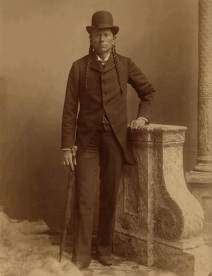
Quanah Parker, photo by Lanney

Quanah Parker, a Kwahadi Comanche chief; full-length, standing in front of tent.
Photographed by Lanney. Public Domain photo.
National Archives, “Pictures of Indians in the United States”

Photographs of Native Americans reside among the publicly and internet available materials of the National Archives. Images can be ordered in sets of slides, or as individual prints, though many are available in quality high enough for PowerPoint works and use on classroom materials. Many of the photos are 19th century.

Quanah Parker stands as one of the larger Native Americans in Texas history. This photo puts a face to a reputation in Texas history textbooks. Texas teachers may want to be certain to get a copy of the photo. His life story includes so many episodes that seem to come out of a Native American version of Idylls of the King that a fiction writer could not include them all, were they not real.

  • Quanah’s mother was part of the famous Parker family that helped settle West Texas in the 1830s. Cynthia Ann Parker was captured in 1836 when Comanches attacked Fort Parker, near present-day Groesbeck, Texas, in Limestone County. (See Fort Parker State Park.) Given a new name, Nadua (found one), she assimilated completely with the Nocona band of Comanches, and eventually married the Comanche warrior Noconie (also known as Peta Nocona). Quanah was their first child, born in 1852.
  • Nadua was captured by a Texas party led by Lawrence Sullivan “Sul” Ross in 1860, in the Battle of Pease River. Noconie, Quanah, and most of the Nocona men were off hunting at the time, and the fact of Nadua’s capture was not realized for some time. Nadua asked to return to the Comanches and her husband, but she was not allowed to do so. When her youngest daughter, who had been captured with her, died of an infection, Nadua stopped eating, and died a few weeks later.
  • Sul Ross was a character in his own right. At the time he participated in the raid that recaptured Cynthia Parker, he was a student at Baylor University (“What do I do on summer breaks? I fight Indians.”) At the outbreak of the Civil War, Ross enlisted in the Confederate Army as a private. Over 135 battles and skirmishes he rose to the rank of Brigadier General, the ninth youngest in the Confederate Army. A successful rancher and businessman back in Texas after the war, he won election as governor in 1887, served two very successful terms (he resolved the Jaybird-Woodpecker War in Fort Bend County, and had to call a special session of the legislature to deal with a budget surplus), refused to run for a third term, and was named president of Texas Agricultural and Mechanical College (Texas A&M) within a few days of stepping down as governor. Ross’s leadership of the college is legendary — students put pennies near a statue of Ross in a traditional plea to pass final exams, among many other traditions. After his death, Texas created Sul Ross State University, in Alpine, Texas, in his honor.
  • Quanah Parker’s father, Noconie, died a short time after his mother’s capture. He left the Nocona band, joined the Destanyuka band under Chief Wild Horse, but eventually founded his own band with warriors from other groups, the Quahadi (“antelope eaters”) (also known as Kwahadi). The Quahadi band grew to be one of the largest and most notorious, always with Quanah leading them. The Quahadis refused to sign the 1867 Medicine Lodge Treaties, and so avoided immediate internment to a reservation. However, dwindling food supplies and increasing opposition forced Quanah to retire to a reservation in 1875, in what is now southwestern Oklahoma. This was the last Comanche band to come to the reservation.
  • Quanah was appointed Chief of all the Comanches.
  • Through investments, Quanah became rich — probably the richest Native American of his time.
  • Quanah hunted with President Theodore Roosevelt.

    Quanah Parker in later life, as a successful businessman. Wikipedia image, public domain

    Quanah Parker in later life, as a successful businessman. Wikipedia image, public domain

  • Rejecting monogamy and Christianity, Quanah founded the Native American Church movement, which regards the use of peyote as a sacrament. Quanah had been given peyote by a Ute medicine man while recovering from wounds he’d suffered in battle with U.S. troops. Among his famous teachings: The White Man goes into his church and talks about Jesus. The Indian goes into his Tipi and talks with Jesus.
  • Photo at right: Quanah Parker in his later life, in his business attire. Photo thought to be in public domain.
  • Bill Neeley wrote of Quanah Parker: “Not only did Quanah pass within the span of a single lifetime from a Stone Age warrior to a statesman in the age of the Industrial Revolution, but he never lost a battle to the white man and he also accepted the challenge and responsibility of leading the whole Comanche tribe on the difficult road toward their new existence.”
  • Quanah Parker died on February 23, 1911. He is buried at Fort Sill Cemetery, Oklahoma, next to his mother and sister.

Quanah Parker’s epitaph reads:

Resting Here Until Day Breaks
And Shadows Fall and Darkness Disappears is
Quanah Parker Last Chief of the Comanches
Born 1852
Died Feb. 23, 1911

Other Resources:

Spread Quanah’s story:

Add to FacebookAdd to NewsvineAdd to DiggAdd to Del.icio.usAdd to StumbleuponAdd to RedditAdd to BlinklistAdd to TwitterAdd to TechnoratiAdd to Furl


McLeroy declares war on science in Texas classrooms?

June 15, 2008

Considering recent history and the Texas State Board of Education, how can any reasonable voter or parent read this, except as a declaration of war on science? According to the blogs at the Dallas Morning News:

State Board of Education chairman David Bradley of Beaumont told GOP delegates [at the Texas State Republican Convention] that the board was about to take up the science curriculum for public schools. He forecasted a fight over evolution vs. creationism.
Bradley said there are some on the board (he’s among them) that believe God created Man.
“There are others who think their ancestors were apes. That’s okay. But I’m going to vote the right way,” Bradley said.

Is there anything there that suggests Bradley wants good science in Texas textbooks and Texas classrooms?

Remember the Excellence in Education Commission Report in 1983? The Commission warned that the nation was facing “a rising tide of mediocrity” in schools, in such things as lax science standards.

“Our nation is at risk. The educational foundations of our society are presently being eroded by a rising tide of mediocrity. If an unfriendly foreign power had attempted to impose on America the mediocre educational performance that exists today, we might well have viewed it as an act of war. We have, in effect, been committing an act of unthinking, unilateral educational disarmament. History is not kind to idlers.”

25 years later, Commissar Don McLeroy is leading the tide of mediocrity, doing crippling things to our education system that the likes of Nikita Khruschev and Mao Ze Dong could only dream about.


Dallas Fed sessions for teachers June 30 and July 1

June 11, 2008

Federal Reserve Branch banks take seriously the Fed’s pledge to education Americans, and to support educators in understanding economics and the work of the Federal Reserve Banking System.

The educator support team at the Dallas Fed recently secured approval to provide continuing education credits for a two-day session on globalization planned for San Antonio, on June 30 and July 1. These sessions are easy, generally loaded with details, and tailored for educations. Plus they are usually well catered.

$35.00 gets all materials, two lunches, one continental breakfast, and 12 hours of credit.

All details from the Fed’s press release, below the fold.

Read the rest of this entry »


Texas creationist eruptions

June 4, 2008

Not only is ICR appealing their case on granting creationism degrees for science teachers (see preceding post), the State Board of Education is gearing up for another battle in Commissar Don McLeroy’s War on Education and War on Science (two wars for the price of one!  He’ll campaign as a budget cutter next time . . .).

See the New York Times today, “Opponents of Evolution Adopting a New Strategy.

Oy.


Creationist group appeals decision on granting degrees

June 4, 2008

Texas’s Institute for Creation Research (ICR) is appealing the decision of the Texas Higher Education Coordinating Board that denied ICR the power to grant graduate science degrees.   According to the story in the Houston Chronicle, ICR plans to take the issue to court if THECB does not reverse itself.

Institute spokesman Lawrence Ford said the voluminous appeal — it is 755 pages long, including supporting documents — is based upon a claim of “viewpoint discrimination.”

The appeal described the board’s decision as “academic (and religious) bigotry masquerading as Texas Education Code ‘enforcement.’ ”

Board members and staff are accused of denying the request in April because the institute and its leaders believe the biblical version of the Earth’s creation is literally true.

Institute CEO Henry Morris III said last spring his school’s program includes information about evolution, although he and others affiliated with the school don’t accept the proof of evolution offered by mainstream scientists.

Board members and Higher Education Commissioner Raymund Paredes said they were concerned the degree would not equip graduates to teach science in Texas’ public schools.

The real issue, Stafford said Monday, is whether the institute’s course work — offered online and still available, although not accredited — fits the label of the proposed degree.

The disputed degree is a Master of Science in science education. “Either the curriculum or the label has to change,” Stafford said.

“That label has a particular meaning of preparing somebody as a science teacher.”

Paredes reiterated that in a May 21 letter to Morris. “It was determined that the designation of the degree and the content of the degree were not adequately aligned,” he wrote. “Approval would require either a change in the designation of the degree or a change in the content covered.”

The institute is not inclined to do either, Ford said.

More information at these websites:


Texans want McLeroy gone, too

May 26, 2008

Texans who ought to know want Education Commissar Don McLeroy out, too — P. Z. Myers (“Fire Don McLeroy”) is not the only one.

In a letter reported in only one newspaper I’ve found, The Houston Chronicle, State Board of Education member Mary Helen Baranga of Corpus Christi asked Gov. Rick Perry to fire McLeroy.

Don McLeroy “has created havoc” as chairman of the State Board of Education and should be replaced, the senior member of the board said in a letter to Gov. Rick Perry.

“It is such a shame that after all these years of trying to improve public education in Texas, we are taking steps backwards because of Don McElroy,” Mary Helen Berlanga of Corpus Christi said in her letter to Perry, misspelling McLeroy’s name.

Berlanga, who has been on the 15-member board since 1984, said McLeroy’s leadership has been a disaster and asked Perry to replace him with “a moderate conservative who can work with all members of the State Board of Education and the citizens of this state.”

Gov. Perry said the SBOE should deal with the issues.

Has Perry forgotten what office he holds?   Nuts.


More on McLeroy’s war on Texas English students

May 25, 2008

The Houston Chronicle’s coverage of the Texas State Board of Education meetings this week is not well indexed on the web. Following a couple of odd links I found Gary Sharrar’s article (he’s the Chronicle’s education reporter), though the Associated Press Story shows up for the paper’s main article on most indices I found.

Sharrar adds a few details of Kommissar McLeroy’s war on English education, but the significant thing about the story is in the comments, I think. One poster appears to have details that are unavailable even from TEA. Partisans in the fight have details that Texas law requires to be made public in advance of the meetings, while the state officials who need to advise on the regulations and carry them out, do not.

TEA has an expensive website with full capabilities of publishing these documents within moments of their passage. As of Sunday morning, TEA’s website still shows the documents from last March. Surely Texas is not getting its value from TEA on this stuff.

Sharrar wrote:

Two different outside groups offered opposite reactions. The Texas Public Policy Foundation, a free-market think tank, favored the board’s action.

“It is obvious that too many Texas public school students aren’t learning the basics with our current curriculum,” said Foundation education policy analyst Brooke Terry. “We are glad the new curriculum will emphasize grammar and writing skills.”

Texas public schools fail to adequately prepare many students for college or the workplace, she said, citing a 2006 survey by the Conference Board found that 81 percent of employers viewed recent high school graduates as “deficient in written communications” needed for letters, memos, formal reports and technical reports.

But the Texas Freedom Network, which promotes public education, religious freedom and individual liberties, called the board divisive and dysfunctional.

“College ready” generally means reading well, and reading broadly in literature. From a pedagogical standpoint, emphasizing “grammar and writing skills” over the reading that is proven to improve grammar and writing skills will be a losing battle. I hope the details of the plan will show something different when TEA ever makes them available to the taxpaying/education consuming public and English teachers. NCLB asks that such changes be backed by solid research — it will be fascinating to see whether there is any research to support the Texas plan (not that it matters; this section of NCLB has been ignored by the right wing from the moment NCLB was signed).

Prior to this week’s series of meetings, Commissar McLeroy expressed what sounds like disdain for reading in the English curriculum to the El Paso Times:

But chairman McLeroy said he would fight against some of the measures the educators want, especially the comprehension and fluency portion.

Their suggestions, he said, would have students waste time on repetitive comprehension strategies instead of actually practicing reading by taking in a rich variety of literature.

“I think that time is going to be lost because they’ll be reading some story, and they’ll just overanalyze,” he said.

By the way, calling the Texas Public Policy Foundation a “free market think tank” is misleading. The group is quite hostile to public education, and features on its board several people who have led fights to gut funding for public schools and impose bleed-the-schools voucher programs. The Foundation appears to endorse preaching in public schools and gutting science standards, among other problems.

If it’s good work, why is it done in secret? Remember that I spent years in right wing spin work in Washington. Here’s what I see: Either McLeroy’s administration at the state board is incredibly incompetent and can’t even get the good news right, and out on time, or there is another, darker and probably illegal agenda at work.

Below the fold, the full text of the comment from “WG1” at the Chronicle’s website.

Other resources:

Read the rest of this entry »


Texas education board turns authoritarian

May 24, 2008

Nobody can recall the ceremony, but Don McLeroy made it clear yesterday that he thinks he’s been designated Kommissar of Education, ramming through a proposal altering English standards for the next decade — without debate, without even a chance to read the proposal.

It’s probably not so bad a pig in a poke as it might be — of course, no one had the chance to review it, so no one knows, really — but the processes used, worthy of Napoleon or Kruschev on a bad day, should give cause for concern.

Gotta think about this one for a while.