Wendy Davis’s first ad: A positive vision for Texas (but too long for most TV)

October 8, 2013

In stark contrast to Greg Abbott‘s “Texas is for white people with guns” advertisement (addressed here yesterday), Wendy Davis‘s get-to-know-me ad paints a vision of a better Texas to be had, even if in a too-long four-and-a-half minutes:

The ad was released yesterday at Davis’s campaign website, “Are you with Wendy?”

I imagine the GOP will jump on the ad, complaining that it doesn’t show enough guns (are there any?).  But it does several things the next Texas governor needs to do:

  1. It paints a picture of a Texas government that works to help people succeed in Texas.
  2. Davis’s ad shows Texas’s diversity, and suggests both that the diversity is a virtue for Texas’s future, and that Texas government shouldn’t be barring the door (or voting booth) to any Texan (especially white Texas women, many of whom may get a shock when they try to vote this November).
  3. Davis urges policies to help Texas cattlemen, who have been hammered hard under GOP rule (50% of Texas beef ranches closed in the past two years).
  4. Davis urges policies to help Texas farmers (cotton is still big in about a hundred counties).
  5. Aerospace and aviation get specific attention — you saw the American Airlines jet? Davis was City Councilwoman in Fort Worth, American’s hometown and headquarters. Already Davis turned around Greg Abbott on that issue when she called for a Texas government that supported American Airlines and its few tens of thousands of jobs in Texas.  Abbott announced last week that he has dropped his suit to prevent American’s merger with USAir, a suit that threatened Texas jobs directly.
  6. The ad ties Davis’s success in business, and life, to public institutions that help all Texans, institutions Davis used to climb the success ladder.
  7. Pro-business. Business in Davis’s ad is aerospace, ranching, farming, oil, and main street retail, among others.  Abbott’s ad shows only one ramshackle BBQ shack.
  8. It demonstrates an area where Greg Abbott should have been active in fighting crime, processing rape backlogged rape kits from Texas assaults — but where it too Davis in the legislature to get action to solve the crimes.
  9. Oh, yeah:  Education is in there.  It’s solidly in there.
  10. Overall, it’s a positive, “once more into the breach” sort of story.  At the end of Abbott’s ad, one can say he seems a physically capable guy; at the end of Davis’s ad, one may want to get up and go start a business, or run for office.

Davis’s ad does a lot of things a pitch for Texas’s next governor needs to do, on issues that we hope the next governor is way ahead of the rest of us on — but which are wholly missing from Abbott’s first non-negative ad effort.

What do you think?

More:

Davis at a rally following her most recent history-making filibuster.  KUT photo by Jorge Sanhueza-Lyon

Davis at a rally following her most recent history-making filibuster. KUT photo by Jorge Sanhueza-Lyon


Greg Abbott’s campaign stumbles — except for white people with guns

October 7, 2013

For three days after Fort Worth State Sen. Wendy Davis announced her candidacy for the Democratic Party’s nomination for governor, the Republican front-runner, Greg Abbott, seemed off-balance, first going to negative campaigning about Davis.

Some Texans wondered whether Abbott had a good idea about what the role of governor is, which could form a basis for his candidacy.  Why does Abbott want to be governor, and what would he do?

Today Abbott released an almost-90-second advertisement.  The ad reveals Abbott doesn’t have a vision for Texas in the future, and the ad suggests Abbott will rely heavily on trying to scare white Texans to outvote everybody else.

Here are my observations about Abbott’s ad as it came to me on Facebook, and the ad, below.

Greg Abbott first went negative when State Sen. Wendy Davis announced her campaign for governor last week.

He’s having difficulty finding a reason to run for governor, demonstrated by his video, below.

The video is impressive:

  1. Not a single Hispanic shown out of several dozen people. In fact, there appears to be only one, lonely woman of color in the entire thing. Texas is for white people, Abbott appears to be saying.
  2. Those white people in Texas need guns. It’s not like Texas has any shortage of guns, nor has the Obama administration done anything to restrict gun ownership or use, nor is it even an issue in Texas — but watch the video, you understand that the Texas white people shown in it, need guns. (Why? you may ask?)
  3. Abbott is all for low-wage, service industry jobs. When he talks about jobs in Texas, the ad shows a rickety, ramshackle BBQ joint. You may like BBQ more than Greg Abbott, but if you’re an aerospace worker, or you work for American Airlines, you would do well to question why Abbott worked so hard to kill American Airlines before Sen. Davis made it a campaign issue. (Abbott belatedly dropped his suit challenging the American/USAir merger, last week. Less than a week in the campaign and Wendy Davis is already improving Texas government . . .)
    Faced with a pro-business Democrat with a proven record of making things work for business and Texas, Abbott is adrift. These appear to be issues he hasn’t pondered much, other than to reduce regulations on businesses that injure people.
  4. Not a word about education. Where will all those gun-wielding white people send their kids to school?
  5. When he mentions water policy, something that comes far behind guns, BBQ, and the Tea Party in Greg Abbott’s Texas, he shows footage of Interstate 35 in Austin. One of Texas’s greatest problems (on the ballot in November with a Constitutional Amendment), but to Abbot it’s an afterthought. Maybe he thinks he can shotgun a few clouds to resolve the issues?
  6. Not a word about farming, nor ranching. Texas’s lack of a water policy, and inadequate work to mitigate global warming, pushed about 50% of Texas’s cattle and beef operations out of business on the GOP watch, just in the last four years. In Greg Abbott’s Texas, land is for shooting quail for rich folk, all you hamburger eaters can take a hike.
  7. Not a word about oil or gas, nor fracking, nor the abuse of eminent domain to ram a pipeline through Texas ranches and farms, killing the ranches and farms.
    You’d think after two decades in state office, Mr. Abbott would have a better idea about Texas and Texas problems, and would run a campaign on how to improve things for Texans, not just out of state pipeline companies.
  8. Abbott is running against Barack Obama, and he hates California. No good reason, but those are probably the only applause lines in his bereft-of-Texas stump speech.

You’d think some of those Million-Dollar-A-Year consultants would have worried a bit about Texas in setting up these ads. They must think their only chance is to scare their supporters out to the polls. They may be right.

Abbott’s campaign said:

Preserve Texas as the land of liberty. Watch my video below, and donate here: http://bit.ly/18UKBnr

What do you think, America?  See any reason for anyone other than a paranoid white guy to vote for Abbott?

Conflict of interest note:  Abbott is a Duncanville boy, a favorite of most residents of Duncanville we know. 

More: 

Texas Attorney General Greg Abbott appears bef...

Texas Attorney General Greg Abbott appears before a controversial tablet displaying the Ten Commandments on the grounds of the Texas State Capitol (behind the capitol building) in Austin, Texas, USA. (Photo credit: Wikipedia)


The Wendy Davis story — stay tuned

October 3, 2013

Two years ago this ad helped push Texas State Sen. Wendy Davis to victory in a district stacked against her.  I think it’s one of the more powerful political advertisements done in the last decade at least, considering the target audience.

Today Sen. Davis will announce she’s running for Governor of Texas.  Regardless the outcome of the race, it’s still a remarkable life story.

Polls show Davis only 8 points behind Republican Attorney General Greg Abbott, who usually enjoys an 80%-20% advantage in elections.  Davis is good enough to essentially wipe out the name identification, party identification and money advantage Abbott has, before she announces.

It could be a very exciting political year in Texas.  Stay tuned.

More:

Details: The entire conversation between Texas Senator Wendy Davis and James Henson, Director of the Texas Politics Project at UT Austin. Senator Davis discussed a range of topics including education, budget priorities in the 82nd Legislature, her filibuster in the final hours of the 82nd lege, and the future of the Democratic Party in Texas.

Recorded Dec 1, 2011 at The University of Texas at Austin.

Master of the Capitol:  Picture from Vogue Magazine; caption: Wendy Davis in a Carolina Herrera dress and Reed Krakoff pumps. Photographed by Eric Boman, Vogue, September 2013

Master of the Capitol, “I do hate losing”: Picture from Vogue Magazine; caption: Wendy Davis in a Carolina Herrera dress and Reed Krakoff pumps. Quote from the article: “I’m a very competitive person,” she says as the sun sets behind her and she packs up for the movie. “You won’t change things unless you are prepared to fight, even if you don’t win.” She pauses. “But I do hate losing.” Photographed by Eric Boman, Vogue, September 2013


Jeff Danziger knows Texans, and DeLay, and Cruz . . .

September 27, 2013

Cartoon by Jeff Danziger, in the National, and other New York Times Syndicate clients.

Cartoon by Jeff Danziger, in the NationalMemo, and other New York Times Syndicate clients.

Jeff Danziger drew cartoons for the Christian Science Monitor when I discovered him.  He’s moved from there (as has a lot of the good stuff that used to show up in the print editions, especially since it’s gone to electronic daily publication).  But his style is cool, to me, and he’s spot on here.

I don’t think he’s a Texan.  Here he captures small-town Texas well, with an especially nice flourish in the Shiner ad on the pool table light.

Is this right?  He’s been nominated for a Pulitzer, but never got the award?

More: 


Texas, the eyes of Darwin are upon you

September 20, 2013

Graphic from Colin Purrington, in commemoration of the kickoff of hearings at the Texas State Board of Education on science textbooks, September 18, 2013

Graphic from Colin Purrington, in commemoration of the kickoff of hearings at the Texas State Board of Education on science textbooks, September 18, 2013

Colin Purrington Tweeted, “Thanks, @ncse for helping keep Darwin in Texas science textbooks. #Whac-A-Mole #creationism #StandUp4Science pic.twitter.com/8dNYbqFELV.”

More:


Orchestra of New Spain, performance calendar for 2013-2014

September 11, 2013

Some e-mail is more worthy of sharing than others.

You’re in the Dallas area, and you’re not familiar with the Orchestra of New Spain?  We do have several very good musical organizations around town bending towards the classical, apart from the big professional companies — including the Dallas Wind Symphony, the Arlington Master Chorale, the Turtle Creek Chorale, the Dallas Bach Society — so that finding a place to listen should NOT be a problem.

But I keep running into people who don’t know about these groups.

I got the schedule for the coming year from the Orchestra of New Spain — you really should go see them, and listen.  They’re good, and these events are fun.


Dear friends and subscribers,
The 2013-14 Season of the Orchestra of New Spain begins on October 10 in the City Performance Hall, Dallas Arts District. The season brochure is on its way and will arrive in your mailbox in a few days. While awaiting it’s arrival please peruse our offerings below, or in more detail at:
Thanks to all of you who are already subscribers. If you haven’t made your move you may consider this prime time to subscribe, and enjoy premium seating, even assured seating for some of our intimate events.
To subscribe, or renew your subscription, please visit us online, mail a check, or call the office.
And NOW, the
 
25th Season of the Orchestra of New Spain
Thur, Oct 10, 8 pm, City Performance Hall
Latino-Barroco Fusion Ensemble
 
Fri, Nov 8, 6:30 pm, North Dallas Home of Margo & Jim Keyes
Home and Garden concert
Fri, Nov 22, 7 pm, Christ the King Catholic Church, Preston & Colgate
Requiem for a lost leader
 
Sun, Dec15, 5 pm, Christ the King Catholic Church, Preston & Colgate
Christmas at Christ the King
 
          Sun, Jan 19, 6 pm, The Annual Courcelle Dinner
          TBA (not included in subscription)
 
Sat, Feb 8, 6:30 pm, Meadows museum
Sorolla, Falla, Lorca and Flamenco: preview
 
Fri, Feb 14 & Sat, Feb 15, 7:30 pm, City Performance Hall
The Rise of Flamenco: Lorca, Falla, Sorolla
 
Sat, Mar 29, 7pm, Zion Lutheran Church, Lovers Lane
Villa y Corte – Town and Court
 
Thur, May 15, 6:30, place TBA
Home and Garden concert
 
(If you have not received our brochure in the past or suspect you are not on our snail mail list, please request you brochure by mail the moment you read this, and before they are mailed next week!)
Orchestra of New Spain
214-750-1492
info@orchestraofnewspain.org
www.orchestraofnewspain.org
One can learn a lot about the great, lesser-known performance spaces around Dallas just following this bunch.  Who knows when that will come in handy?

60 Minutes piece on Gulen, leader of the Gulen schools group

September 7, 2013

This is a follow up on my earlier post on the Gulen schools, Cosmos Foundation, Harmony Schools.

A pro-education religious movement could be a good thing.  Is it?


Burqas forced on Texas students?

August 23, 2013

Come the CSCOPE critics from the wilds of Texas:

Of course, if you ask DanaSomething, or any other CSCOPE critic, when and where that burqa event took place, she produces no evidence.

For three weeks now I’ve made a practice of asking CSCOPE critics for evidence of the evils of Texas teachers and curriculum planners they claim occur.

Not a single example has checked out.

If you’re familiar with the “burqa” controversy in Lumberton, Texas, you know the facts don’t square with the CSCOPE critics’ shorthand version.

Monday, February 25th, 2013

Lumberton ISD Response to CSCOPE and Promotion of Islam

Recently a picture had surfaced showing five students dressed in burqas (Islamic attire) in a World Geography classroom at Lumberton High School. The lesson that was offered was not a written CSCOPE lesson; however it informed students to the customary culture of the people in the Middle East. The lesson that occurred was presented on February 1, 2013. As part of the curriculum from the World Geography TEKS (as prescribed by the state of Texas), the students are to study the culture (TEKS number 17):

“Culture. The student understands the distribution, patterns, and characteristics of different cultures.” The student is expected to:

(A)  describe and compare patterns of culture such as language, religion, land use, education, and customs that make specific regions of the world distinctive;

(B)  describe major world religions, including animism, Buddhism, Christianity, Hinduism, Islam, Judaism, and Sikhism, and their spatial distribution;

(C)  compare economic, political, or social opportunities in different cultures for women, ethnic and religious minorities, and other underrepresented populations; and

(D)  evaluate the experiences and contributions of diverse groups to multicultural societies.”

The lesson that was offered focused on exposing students to world cultures, religions, customs, and belief systems. A description on the whiteboard behind the students show the splits in religions: Islam (Sunni and Shia), Judaism (Reform, Conservatives, and Orthodox), and Christianity (Catholic, Orthodox, and Protestant). Clothing expresses the individual culture. The lesson is not teaching a specific religion, and the students volunteered to wear the clothing.

The portrait focused only on Middle Eastern attire and the students are wearing variations of this customary attire found in the Middle Eastern culture. This portrait does not reflect the entire aspect of the lesson. The lesson encompassed diversity education so students receive a firm understanding of our world and why people are motivated differently.

Lumberton ISD has purchased the CSCOPE curriculum however; the teachers are not required to teach the lessons that are provided. The school district follows the Year at a Glance, a scope and sequence of the adopted Texas Essential Knowledge and Skills, as well as the Instructional Focus Document which explains the Rationale, Common Misconceptions for students, TEKS, and the Key Academic Vocabulary that supports conceptual development. The district has great teachers and supports the teachers and their individuality in methods of instructional delivery.

Lumberton is a small  town of about 12,000 people (2010 Census) a few miles north of Beaumont.  Lumberton Independent School District (ISD) schools are “recognized” under the old, just-outdated school and district rating system Texas used, suggesting that student achievement was above average.  State test scores tend to show the same. If this is their example, we should note that in addition to characterizing the lesson wrong, getting wrong the facts of students trying on clothes of other cultures, and the fact that this exercise is not at all related to CSCOPE, the students seem to be learning well.

Kudos to Lumberton, and to CSCOPE, right? Not for the Right Wing Crazies.

Remember, when Glenn Back went on national unwatched television to complain about the “Marxist” lesson in economics, when we finally got the slide, it showed clearly that it favored free marketry.

On this burqa thing?  I’m willing to say no kid has ever been “forced” to wear a burqa for any school purpose — though some may have put on a costume for a report (is that bad?).

In short, I find the critics of CSCOPE to be at odds with the facts, making stuff up to yell about.  Almost every single one of the criticisms for how the Texas standards on Islam are taught, involves the fact that Islam is taught about at all.  CSCOPE critics claim “indoctrination” when it’s clear from lesson plans, support materials, texts, state standards, and test results, that students are simply learning about history, geography and culture.

Shame on any politician who acts on such unhinged, false rants.

There’s a “debate” between Texas State Sen. Dan Patrick, R-Bedlam, and the most sane member of the Texas State Board of Education, Thomas Ratliff, set for this Saturday, in Tyler. One wonders how absurd it can get. Will Patrick tell us which Texas school forced kids to wear burqas?  Don’t bet on it.  Will Patrick provide any other evidence of rampant socialism or Marxism in Texas schools?  No, don’t bet on that, either.

More (good and bad information here; caveat emptor:

The world is still safe for fairness.

The world is still safe for fairness.  Joseph McCarthy remains in his grave on the banks of the Fox River in Appleton, Wisconsin; Texas critics of schools and teachers should leave McCarthy’s scurrilous methods and false claims buried, too.


Forgotten Texas history: Bicentennial of the Battle of Medina, August 18, 1813

August 19, 2013

1813?

Back in 2006, reporter Art Chapman in the Fort Worth Star-Telegram makes a plea to remember the deadliest battle for Texas independence, fought years before the Texas Revolution.

In 2013 the Battle of Medina lies buried under seven more years of newspapers and historic events.  We need to fight to remember history.  This is another punch in that fight.

Billy Calzada photo, 2011 Reenactment of the Battle of Medina (in Texas)

Caption from Tropas de Ulramar: Re-enactors dressed as participants in the Battle of Medina fire a musket volley during a ceremony on Saturday, Aug. 20, 2011, commemorating the 198th anniversary of the Battle of Medina. The event was sponsored by the Texas Society – Sons of the American Revolution. The Battle of Medina was fought on Aug. 18, 1813, when a Spanish army, attempting to win Texas from the Republican Army of the North, which was supported by the United States and included veterans of the American Revolution, won a battle fought south of San Antonio near Espey. It is thought that about 800 Republicans died in the battle. [Other estimates put the death toll on the Texas side at 1,500]
Photo: BILLY CALZADA


The long drive for Texas independence from Mexico may be more clearly seen in the light of the continents-long struggles for independence that included not only the American Revolution, but also revolutions in the nations of Haiti, Mexico, Chiapas, and others across Central America and South America. The Battle of Medina was a part of that earlier history. Fought on August 18, 1813, it was more deadly than any other battle in the wars for Texas independence, it is linked to Mexico’s long history of struggle. It occurred in the same year that Haiti got independence, and in the middle of the War of 1812, which helps to obscure the history of the battle.

Chapman’s report said:

“Contrary to popular belief, the struggle for democracy in Texas did not begin with the Anglo-led revolution of 1835-36,” author and historian James Haley wrote in a recent Austin American-Statesman article. “In fact, the yearning for liberty had its own ongoing legacy in Latin America.

“As early as 1810, movements for independence began simultaneously in Venezuela and Argentina. It was also in 1810, on Sept. 16, that the Mexican priest Father Miguel Hidalgo y Costilla raised his famous grito, the cry for social justice that opened the Mexican campaign for independence, a date now celebrated as Diez y Seis.”

America was drawn into that campaign when it funded a small force under the control of Bernardo Gutierrez de Lara, one of Father Hidalgo’s emissaries. A former Army officer, Augustus Magee, went along with the expedition to offer military advice. The Gutierrez-Magee Expedition, also called the Green Flag Rebellion because of its banner, soon captured Nacogdoches. All went well for the expedition — too well — and Texas independence was quickly claimed. Spain took immediate measures to quell the insurrection.

It ended at the Battle of Medina, “the biggest, bloodiest battle ever fought on Texas soil,” a South Texas historian says.

Spanish forces slaughtered more than 1,000 of the rebels, perhaps as many as 1,500. The battle methods, and total extirpation of the losing forces, would recur in the Texas Revolution.

Fewer than 100 republic troops survived the battle, Thonhoff said. Those not killed in the battle were later chased down and executed. Retaliation went on for days. Royalist forces swept into San Antonio and took revenge on anyone they suspected of aiding the rebel forces. One of the royalist officers was a young Lt. Antonio Lopez de Santa Anna.

The bodies of soldiers killed in battle were left where they fell. It would be nine years before their bones were gathered and buried in a communal grave.

This story should translate well to the Texas-required 7th-grade history course. Here is a cause — the archaeological excavation and historical marking of the battlefield itself — which lends itself well to getting students to write letters to state legislators and state education authorities. Here is news of an archaeological site that could provide work for a generation of diggers, and experience for countless school kids taken on tour. And the story of the battle is one of those relatively unknown gems that excite students who realize, after they discover it, that they know something that most others do not know.

English: Medina Battle -State Marker- Near Lem...

Medina Battle -State of Texas historic marker Near Leming, Texas. Wikipedia image

As well, this should be supplement to world history courses, which in my experience too often overlook the independence wars and successes in Central and South America. The article mentions independence movements in Argentina and Venezuela. The United States fought Britain in the War of 1812, which was the western fallout of England’s simultaneous war with Napoleon (who was on the road to getting his comeuppance in Russia). Haiti’s drive for independence from France racked that Caribbean nation. A mapping exercise showing the various independence movements occurring between 1800 and 1826 provides links to parts of the narrative of American nations’ independence that often gets overlooked.

The battle also ties together several otherwise loose threads in the Texas history curriculum.

  • The Gutierrez-McGee Expedition falls into that time period and that type of movement to steal Texas known as the filibusters.
  • The treachery of the Green Flag Rebels in executing the Spanish officers in San Antonio after the Spanish had surrendered raises issues of ethics in battle that are rich for discussion.
  • Incompetence with which the Texian forces were led into the battle, missing completely the feint the Spanish troops made until they were already into a classic battle trap, is another place to emphasize the importance of having good leaders especially in rebellion (this will become clear to students, perhaps, when they study the events of 1775 and 1776 and Washington’s leadership, in the 8th grade curriculum in Texas).
  • Santa Anna’s presence as a young officer at the Battle of Medina suggests that he got the idea of “no quarter” early in his career; see how the tactic plays out 23 years later at the Battle of the Alamo, the Battle of Coleto, Goliad, and the Battle of San Jacinto, with an older Santa Anna in command.
  • In the context of Texas’ becoming a “majority-minority” state with a very large population with historical ties to Mexico, the Battle of Medina deserves greater consideration in Texas history curricula.

Partly due to the brutality of the Spanish victors to the survivors, wounded and dead, the battlefield itself was not cleaned up for years — bodies lay across a wide area.  Medina was a touchy point, a point of embarrassment perhaps to local Mexicans and Texians, a loyalty test for the Spanish rulers.  So the battle site was ignored and hushed up.  200 years later, we don’t know the exact site of the battle.  A lot of work remains to be done, exploration of archives in Spain, Mexico and Texas, exploration of map collections, archaeological and paleontological work on the suspected sites of the battle.  But every year this work remains undone, the story becomes that much more difficult to find.  It is unlikely we’ll ever know all that we probably should about the Battle of Medina.

Other sources you may find useful:


Will Rogers and Wiley Post crashed in Alaska, August 15, 1935

August 15, 2013

Will Rogers, images from Will Rogers Museums, Oklahoma

Will Rogers, images from Will Rogers Museums, Oklahoma

August 15, the Ides of August, hosted several significant events through the years.  In 1935, it was a tragic day in Alaska, as an airplane crash took lives of Will Rogers and Wiley Post.  To refresh your memory, an encore post, with a few edits and additions.

After Mark Twain died, America found another great humorist, raconteur, story-teller, who tickled the nation’s funny-bone and pricked the collective social conscience at the same time. Will Rogers is most famous today for his sentiment that he never met a man he didn’t like. In 1935, he was at the height of his popularity, still performing as a lariat-twirling, Vaudeville comedian who communed with presidents, and kept his common sense. He wrote a daily newspaper column that was carried in 500 newspapers across America.  Rogers was so popular that Texas and Oklahoma have dueled over who gets the bragging rights in claiming him as a native son.

Will Rogers ready to perform.  Photo taken prior to 1900 - Wikimedia

Will Rogers ready to perform. Photo taken prior to 1900 – Wikimedia

Wiley Post was known as one of the best pilots in America. He gained fame by being the first pilot to fly solo around the world. Post was famous for his work developing new ways to fly at high altitudes. Post was born in Texas and moved to Oklahoma. He lost an eye in an oil-field accident in 1924, then used the settlement money to buy his first airplane. He befriended Will Rogers when flying Rogers to an appearance at a Rodeo, and the two kept up their friendship literally to death.

Post asked Rogers to come along on a tour of the great unknown land of Alaska, where Post was trying to map routes for mail planes to Russia. Ever adventurous, Rogers agreed — he could file his newspaper columns from Alaska by radio and telephone. On August 15, 1935, their airplane crashed near Point Barrow, Alaska, killing them both.

Wiley Post, first to fly solo around the world, in an early pressure suit for high-altitude flying - Wikimedia photo

Wiley Post, first to fly solo around the world, in an early pressure suit for high-altitude flying – Wikimedia photo

On August 15, 2008, a ceremony in Claremore, Oklahoma, honored the two men on the 73rd anniversary of their deaths. About 50 pilots from Oklahoma, Missouri, Kansas and Arkansas will fly in to the Claremore Airport for the Will Rogers-Wiley Post Fly-In Weekend. Oklahoma Lt. Gov. Jari Askins will offer a tribute.

Rogers was 56, leaving behind his wife, Betty, and four children. Post, 36, left a widow.

Rogers’ life is really quite legendary. Historian Joseph H. Carter summed it up:

Will Rogers was first an Indian, a cowboy then a national figure. He now is a legend.

Born in 1879 on a large ranch in the Cherokee Nation near what later would become Oologah, Oklahoma, Will Rogers was taught by a freed slave how to use a lasso as a tool to work Texas Longhorn cattle on the family ranch.
As he grew older, Will Rogers’ roping skills developed so special that he was listed in the Guinness Book of Records for throwing three lassos at once: One rope caught the running horse’s neck, the other would hoop around the rider and the third swooped up under the horse to loop all four legs.

Will Rogers’ unsurpassed lariat feats were recorded in the classic movie, “The Ropin’ Fool.”

His hard-earned skills won him jobs trick roping in wild west shows and on the vaudeville stages where, soon, he started telling small jokes.

Quickly, his wise cracks and folksy observations became more prized by audiences than his expert roping. He became recognized as being a very informed and smart philosopher–telling the truth in very simple words so that everyone could understand.

After the 10th grade, Will Rogers dropped out of school to become a cowboy in a cattle drive. He always regretted that he didn’t finish school, but he made sure that he never stopped learning–reading, thinking and talking to smart people. His hard work paid off.

Will Rogers was the star of Broadway and 71 movies of the 1920s and 1930s; a popular broadcaster; besides writing more than 4,000 syndicated newspaper columns and befriending Presidents, Senators and Kings.

During his lifetime, he traveled around the globe three times– meeting people, covering wars, talking about peace and learning everything possible.

He wrote six books. In fact he published more than two million words. He was the first big time radio commentator, was a guest at the White House and his opinions were sought by the leaders of the world.

Inside himself, Will Rogers remained a simple Oklahoma cowboy. “I never met a man I didn’t like,” was his credo of genuine love and respect for humanity and all people everywhere. He gave his own money to disaster victims and raised thousands for the Red Cross and Salvation Army.

Post’s legacy is significant, too. His employer, Oklahoma oil man F. C. Hall, encouraged Post to push for aviation records using Hall’s Lockheed Vega, and Post was happy to comply. Before his history-making trip around the world, he had won races and navigation contests. NASA traces the development of the space-walking suits worn by astronauts to Post’s early attempts for flight records:

For Wiley Post to achieve the altitude records he sought, he needed protection. (Pressurized aircraft cabins had not yet been developed.) Post’s solution was a suit that could be pressurized by his airplane engine’s supercharger.

First attempts at building a pressure suit failed since the suit became rigid and immobile when pressurized. Post discovered he couldn’t move inside the inflated suit, much less work airplane controls. A later version succeeded with the suit constructed already in a sitting position. This allowed Post to place his hands on the airplane controls and his feet on the rudder bars. Moving his arms and legs was difficult, but not impossible. To provide visibility, a viewing port was part of the rigid helmet placed over Post’s head. The port was small, but a larger one was unnecessary because Post had only one good eye!

Last photo of Will Rogers (in the hat) and Wiley Post, in Alaska in 1935 (from Century of Flight)

Last photo of Will Rogers (in the hat) and Wiley Post, in Alaska in 1935 (from Century of Flight)

Tip of the old scrub brush to Alaska bush advocate Pamela Bumsted.

Resources:


Just point your cameras to the skies and shoot: Lubbock on August 14

August 14, 2013

With all the cameras around, if everybody just points their own camera to the skies and starts shooting, we’ll get some good shots.

Tonight the Texas Storm Chasers sent this one out:

Storm over Lubbock, Texas, August 14, 2013 - photo by Texas Storm Chasers

Texas Storm Chasers ‏@TxStormChasers 27m RT @TaylorKLynn: @TxStormChasers Took these from my phone of the storm heading into northern Lubbock! pic.twitter.com/5LQX1qBWsN #txwx

Looks like “Night on Storm Prairie” to me. (Where’s Disney when you need em?)

Shot with a camera phone, I’m guessing from inside a hotel (are those reflections in the window?).  Not sure who shot it, so I’ve just credited “Texas Storm Chasers.”

Weather is cool.  Photos of weather are cool, too.

More:

Read the rest of this entry »


Mark Twain in Fort Worth

July 29, 2013

Mark Twain statue, Trinity Park, Fort Worth, Texas Photo by Barbara Schmidt © 2010

Mark Twain statue, Trinity Park, Fort Worth, Texas Photo by Barbara Schmidt © 2010

I’m falling down in my Mark Twain fandom, obviously.  Barbara Schmidt, who keeps the fine site, TwainQuotes (www.twainquotes.com), features this photo of Mark Twain holding an open copy of The Adventures of Huckleberry Finn, on one of the main pages at her site.

I did not know such a statue of Twain existed in Texas, let alone within an hour’s travel from my home.  I’ll have to track it down.

Why is it there?  Twain never set foot in Fort Worth, that I know.

What other great statues hide around Dallas and Fort Worth?

More:

Mark Twain in Fort Worth's Trinity Park, by Amy Moore, at Everything Everywhere

Mark Twain in Fort Worth’s Trinity Park, by Amy Moore, at Everything Everywhere.  The statue was created by Gary Lee Price.


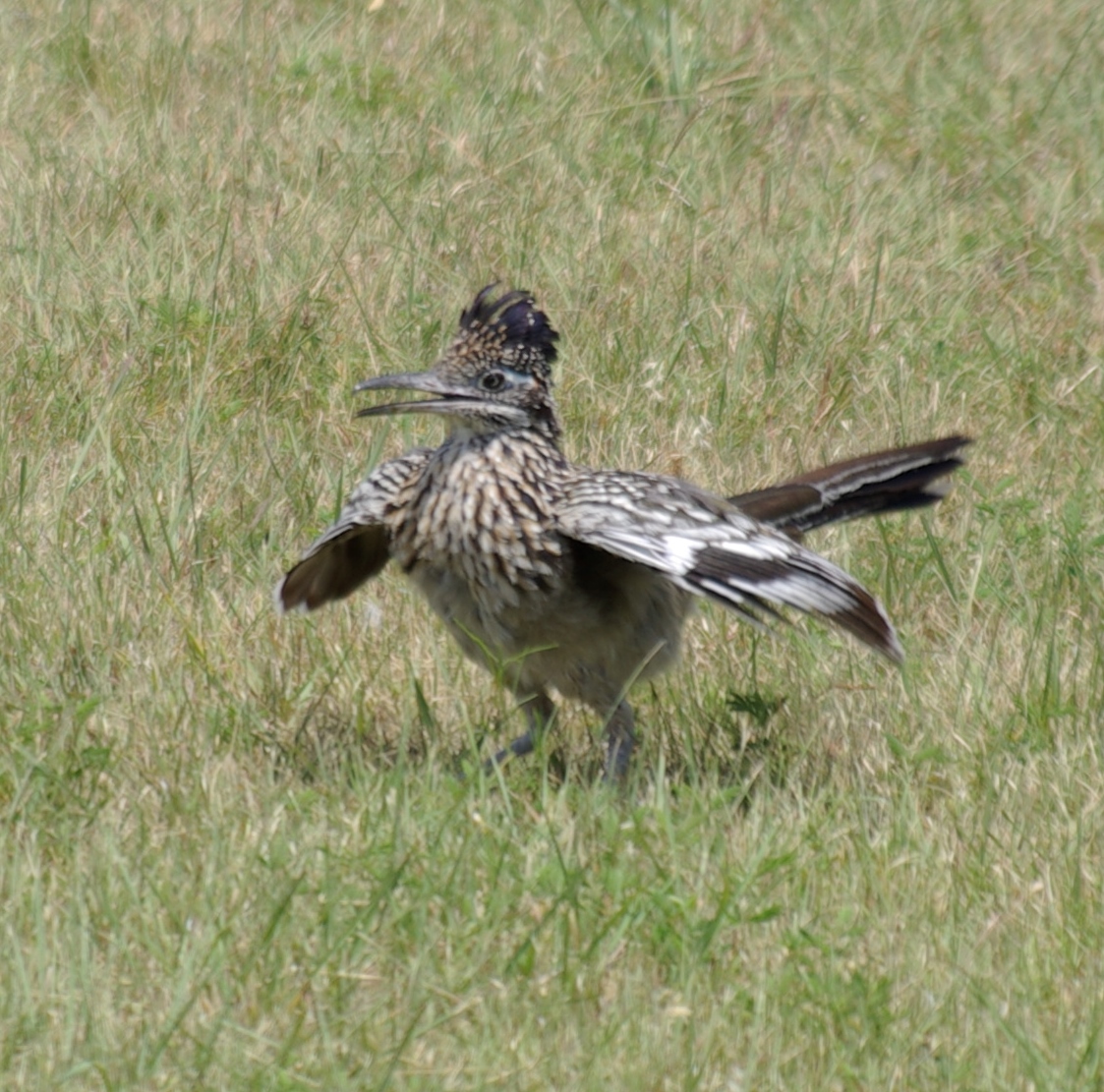
Return of the roadrunners

July 13, 2013

Our move to Texas in 1987 offered as one amenity, local roadrunners.

Camp Wisdom road was mostly two lanes then — it’s six, now.  Clark Road was two lanes.  It’s expanded to six, with a direct link to the freeway Spur 408.  Wheatland Road was two lanes.  You guessed it: Six now.

Not sure about baseball fields any more, but with roads, if you build ’em, people will come.  The empty prairie and cedar forests favored by golden-cheeked warblers, and favorable to lizard-eating roadrunners, gave way to bulldozers putting up apartment complexes, strip shopping centers (still mostly vacant), self-storage businesses, and more roads.  Roads bring automobiles, and autos provide collision courses for roadrunners.

In the summer, I used to see a roadrunner at least weekly at the intersection of Camp Wisdom and Clark; once watched one hunt down a very large Texas fence lizard and dash off with the lizard dangling from either side of its beak.  In the era before electronic cameras.

All that development takes the habitat of roadrunners, and that is the slow death of much wildlife.  Roadrunners dwindled down.  About 2009 we discussed how rare they were.  In 2011 Kathryn and I saw one lone roadrunner along Old Clark Road in Cedar Hill, precariously living in a 50-yard swath between two roads (which are slated to be widened), sharing a railroad track.  Nothing since.

Mama and chick roadrunners

Mama roadrunner gives me the eyeball from the safety of the cedar tree, while the chick grooms. Is it safe to go out into the sun?

Until two weeks ago.  Kathryn called me, excited that she’d seen a roadrunner crossing Mountain Creek Parkway, where Wheatland Road dead-ends into it.  It’s good roadrunner weather.  We were happy to know at least one survived.

Then, last Thursday I was driving along Old Clark Road.  I brought along the Pentax K10D because I was hopeful of catching the hawk family living a block off of Wheatland and Cedar Ridge Roads.  A roadrunner dashed across the road from a small ranchette into a “vacant” field of wild prairie grasses dotted with Ashe cedars.  My experience is they are reclusive, and don’t like to be watched.  I grabbed the camera and got a couple of shots of the bird, running under a tree and meeting up with another, smaller one — a chick!

I doubled back and u-turned, hoping they might at least dash.  The larger one danced on the edge of the shadow of the tree for a minute, then uncharacteristically strutted out, hunting something to eat.  She got something that looked like a lizard, or a fantastically large grasshopper, and a few other tidbits from the grass.  She strutted around, and headed back to the shade, and to the younger one.

Mama Roadrunner flaps happily after ingesting a large something.

Mama Roadrunner flaps happily after ingesting a large something.

Roadrunners, the greater roadrunner, Geococcyx californianus (which means “Californian Earth-cuckoo,” a description of many politicians in the Golden State, perhaps).

I shot stills, with a 50-200 mm telephoto zoom, and I got a bunch of shots.  I strung them together in Windows Moviemaker.

Are the roadrunners doing okay?  Not really.  They’re not gone, but much of their old habitat disappeared from this hill, the highest point in Texas between the Louisiana border and the Rockies — swallowed by human development, homes, suburban shopping, and the roads that go with that development.

How are roadrunners doing in your area?  Got pictures?  (Cindy Knoke has a longer telephoto than I’ve got, and photos to prove it; go see.)

Greater Roadrunner running

Greater Roadrunner doing what roadrunners to, back to the shade of a cedar tree and her chick. It was 102 degrees F, after all.

More:


Dallas hearing on Texas redistricting tomorrow, June 6, 2013

June 5, 2013

I get e-mail from Sen. Wendy Davis:

Texas State Sen. Wendy Davis, D-Fort Worth. Dallas Observer image

Texas State Sen. Wendy Davis, D-Fort Worth. Dallas Observer image

I wrote to you last week about the Special Session that Governor Perry has called to address redistricting. As you know, state leaders have dropped their challenges to the Senate district map, meaning that the current makeup of Senate District 10 should remain unchanged for the remainder of the decade. This is wonderful news for our community. We’ve faced this redistricting battle for the past two years and have finally earned an important victory that continues to hold us together.

Unfortunately, Governor Perry is also insisting that the Legislature adopt the interim congressional and State House maps, which include features that a federal court ruled are in violation of the U.S. Voting Rights Act. The people of our district certainly know how important it is to have fairly drawn maps that allow voters to elect the leaders of their choice. All Texans deserve that.

You have a chance to speak out against the unfair congressional and State House maps.

I hope you will join us tomorrow for a public hearing with the House Select Committee on Redistricting. It’s vital that we make our voices heard. Let’s tell our state leaders to keep Senate District 10 intact and then to draw fair congressional and State House districts.

PUBLIC HEARING – House Select Committee on Redistricting
Thursday, June 6 – 2:00 PM – 1401 Pacific Avenue, Dallas
 

The Committee will hear testimony from any member of the public until 7:00 PM.
Once again, I understand that this is extremely short notice. I wish that there were more opportunities for the people of North Texas to have their say on this critical issue, but this may be the only chance that we get. If you are able, please come stand with us in the fight for fair maps.

Your friend, and proudly, your state senator,

Wendy
Wendy Davis

Will you be there?

English: Seal of State Senate of Texas. Españo...

Seal of State Senate of Texas. Wikipedia image. (Are those dots the Illuminati dots Gov. Perry insisted on?)

It’s a lousy place for inexpensive parking, so you may want to take the train — it runs within a couple of blocks of the hearing site.  But it’s a vital topic.

One wearies of the Texas GOP ramming their views down the gullet of citizens as if voters were just geese to be fattened for foie gras.

More:


Holding teachers accountable, in reality

June 5, 2013

Scott McLeod at Dangerously!Irrelevant put together a video, with computer voices to protect the innocent naive genuinely ignorant and proudly stupid.

Teachers who watch this may cry as they watch America’s future slip away into the Tide of Mediocrity™ we were warned about, which NCLB mistook for high water.  Turn it up so you can hear the full sound effects.  That’s the level of mediocrity rising as the “official” fiddles.

W. Edwards Deming researched and wrote a lot about organization managers who don’t really have a clue what is going on in their organizations, and who lack tools to measure employee work, because they lack an understanding of just what products are, what the resources are that are required to make the desirable product, and how to processes that make those products work, or could work better.

That’s education, today.

Should teachers be “held accountable?”  Depends.  Effective organizations understand that accountability is the flip-side of the coin of authority.  Anyone accountable must have the authority to change the things that affect product, for which that person is “held accountable.”  Texas schools lose up to 45 days a year to testing — that may drop as the TAKS test is phased out, but it won’t drop enough.  45 days is, effectively 25% of the school year.  If time-on-task is important to education as Checker Finn used to badger us at the Department of Education, then testing is sucking valuable resources from education, way above and beyond any benefits testing may offer.

Today, Texas Governor Rick Perry has proposed laws sitting on his desk that would greatly pare back unnecessary testing.  A coalition of businessmen (no women I can discern) with a deceptively-named organization urges Perry to veto the bills, because, they claim, rigor in education can only be demonstrated by a tsunami of tests.

What’s that, you ask?  Where is the person concerned about the student?  She’s the woman with the leaky classroom, who is being shown the door.

Why is it those with authority to change things for the better in Texas schools, and many other school systems throughout the U.S., are not being held accountable? If they won’t use their authority to make things better, why not give that authority to the teachers?

Check out McLeod’s blog — good comments on his video there.

More:

Fitzsimmons in the Arizona Daily Star

Fitzsimmons in the Arizona Daily Star