President Obama issued a directive ordering all federal facilities to fly the national flag at half-staff from now until Veterans Day (November 11), to honor the soldiers and civilians felled at Fort Hood, Texas.
“It is an act of violence that would have been heartbreaking had it occurred anyplace in America,” Obama said. “It is a crime that would have horrified us had its victims been Americans of any background. But it’s all the more heartbreaking and all the more despicable because of the place where it occurred and the patriots who were its victims.”
The president said he met Friday with FBI Director Robert Mueller, Defense Secretary Robert Gates and others to discuss their continuing investigation into the attack, which also injured at least 30.
Obama also expressed his condolences to the victims’ families and recognized those who helped the wounded after the shooting at the base’s Soldier Readiness Processing Center. The center is where soldiers go to have their teeth checked and medical records updated before deploying overseas.
“These are the men and women we honor today. These are the men and women we’ll honor on Veterans Day,” Obama said. “And these are the men and women we shall honor every day, in times of war and times of peace, so long as our nation endures.” (from the Virginian-Pilot, in Norfolk, Virginia)
So far I’ve been able to learn that Joe Bruni is a firefighter. Beyond that, I don’t know much other than his YouTube series on flag etiquette is very good — not perfect, but very, very good.
In this episode he talks about carrying a flag. I wish he’d discussed it in terms of a flag ceremony, but he gets the basics right.
Younger Scouts, Cub Scouts, Brownies and Bluebirds will have difficulty holding a large flag and pole vertical — get a flag harness to help them out (usually less than $25.00 at Scout supply shops).
He’s got a bunch of these. I’ll pass them along as I get a chance to view them.
(Joe Bruni — who are you?)
Spread the word; friends don't allow friends to repeat history.
Star-spangled Banner and the War of 1812 – The original Star-Spangled Banner, the flag that inspired Francis Scott Key to write the song that would become our national anthem, is among the most treasured artifacts in the collections of the Smithsonian’s National Museum of American History in Washington, D.C.
Every school kid learns the story of the “Star-Spangled Banner,” or should.
During the War of 1812, Georgetown lawyer Francis Scott Key, stood aboard a British ship in Baltimore Harbor to negotiate the release of his friend, Dr. William Beanes, who had been taken prisoner while the British stormed through Bladensburg, Maryland, after burning Washington, D.C. Key witnessed the British shelling of Fort McHenry, the guardian of Baltimore’s harbor. Inspired when he saw the U.S. flag still waving at dawn after a night of constant shelling, Key wrote a poem.
Key published the poem, suggested it might be put to the tune of “Anachreon in Heaven” (a tavern tune popular at the time) — and the popularity of the song grew until Congress designated it the national anthem in 1931. In telling the story of the latest restoration of that garrison flag now housed at the Smithsonian Museum of American History,Smithsonian Magazine repeated the story in the July 2000 issue: “Our Flag Was Still There.”
It’s a wonderful history with lots of splendid, interesting details (Dolley Madison fleeing the Executive Mansion clutching the Gilbert Stuart portrait of George Washington, the guy who had introduced Dolley to James Madison and then snubbed them after they were married; the British troops eating the White House dinner the Madisons left in their haste; the gigantic, 42 by 30 foot flag sewn by Mary Pickersgill, a Baltimore widow trying to support her family; the rag-tag Baltimore militia stopping cold “Wellington’s Invicibles;” the British massing of 50 boats and gunships; and much more).
It’s a grand and glorious history that stirs the patriotic embers of the most cynical Americans.
And it’s all true.
So it doesn’t deserve the voodoo history version, the bogus history created by some person preaching in a church (I gather from the “amens”) that is making the rounds of the internet, stripped of attribution so we cannot hunt down the fool who is at fault.
We got this in an e-mail yesterday; patriots save us, there must be a hundred repetitions that turn up on Google, not one correcting this horrible distortion of American history.
Horrible distortion of American history
(The full version is a mind-numbing 11 minutes plus. Some people have put it on other sites.)
Why do I complain?
It was the War of 1812, not the Revolutionary War — there were 15 states, not 13 colonies.
There was no ultimatum to to Baltimore, nor to the U.S., as this fellow describes it.
Key negotiated for the release of one man, Dr. Beanes. There was no brig full of U.S. prisoners.
It’s Fort McHenry, not “Henry.” The fort was named after James McHenry, a physician who was one of the foreign-born signers of the Constitution, who had assisted Generals Washington and Lafayette during the American Revolution, and who had served as Secretary of War to Presidents Washington and Adams.
Fort McHenry was a military institution, a fort defending Baltimore Harbor. It was not a refuge for women and children.
The nation would not have reverted to British rule had Fort McHenry fallen.
There were 50 ships, not hundreds. Most of them were rafts with guns on them. Baltimore Harbor is an arm of Chesapeake Bay; Fort McHenry is not on the ocean.
The battle started in daylight.
Bogus quote: George Washington never said “What sets the American Christian apart from all other people in this world is he will die on his feet before he will live on his knees.” Tough words. Spanish Civil War. Not George Washington. I particularly hate it when people make up stuff to put in the mouths of great men. Washington left his diaries and considerably more — we don’t have to make up inspiring stuff, and when we do, we get it wrong.
The battle was not over the flag; the British were trying to take Baltimore, one of America’s great ports. At this point, they rather needed to since the Baltimore militia had stunned and stopped the ground troops east of the city. There’s enough American bravery and pluck in this part of the story to merit no exaggerations.
To the best of our knowledge, the British did not specifically target the flag.
There were about 25 American casualties. Bodies of the dead were not used to hold up the flag pole — a 42 by 30 foot flag has to be on a well-anchored pole, not held up by a few dead bodies stacked around it.
You can probably find even more inaccuracies (please note them in comments if you do).
The entire enterprise is voodoo history. The name of Key is right; the flag is right; almost everything else is wrong.
Please help: Can you find who wrote this piece of crap? Can you learn who the narrator is, and where it was recorded?
I keep finding troubling notes with this on the internet: ‘My school kids are going to see this to get the real story.’ ‘Why are the libs suppressing the truth?’ ‘I didn’t know this true story before, and now I wonder why my teachers wouldn’t tell it.’
If Peter Marshall and David Barton gave a gosh darn about American history, they would muster their mighty “ministries” to correct the inaccuracies in this piece. But they are silent.
Hoisting the flag at Guantanamo, Cuba, June 12, 1898. Edward H. Hart, photographer. Image from the American Memory Collection at the Library of Congress
Oh, it’s important in retrospect, no?
On June 10, 1898, U.S. Marines landed at Guantánamo Bay. For the next month, American troops fought a land war in Cuba that resulted in the end of Spanish colonial rule in the Western Hemisphere. Cuban rebels had gained the sympathy of the American public while the explosion and sinking of the U.S.S. Maine, widely blamed on the Spanish despite the absence of conclusive evidence, further boosted American nationalistic fervor.
On June 12, the area was secured and the flag posted.
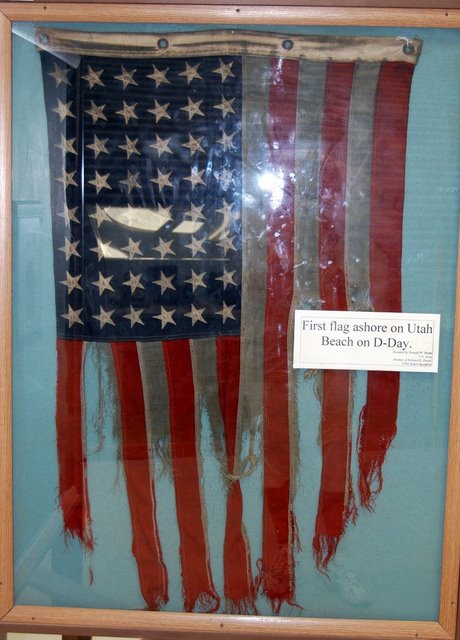
First U.S. flag on Utah Beach, Normandy, D-Day, June 6, 1944; Pima Air Museum, Tucson, Arizona
This mostly an encore post. A reader sent an e-mail with a question: Does U.S. law suggest the flying of the U.S. flag on the anniversary of D-Day?
Today is the 65th anniversary of the Invasion of Normandy in World War II, a date generally called D-Day. No, you don’t have to fly your flag. This is not one of the days designated by Congress for flag-flying.
But you may, and probably, you should fly your flag. If you have any D-Day veterans in your town, they will be grateful, as will their spouses, children, widows and survivors. A 22-year-old soldier on the beach in 1944 would be 87 today, if alive. These men and their memories of history fade increasingly fast. Put your flag up. You may be surprised at the reaction.
If you do run into a D-Day veteran, ask him about it. Keep a record of what he says.
"First Wave at Omaha: The Ordeal of the Blue and the Gray" by Ken Riley: Behind them was a great invasion armada and the powerful sinews of war. But in the first wave of assault troops of the 29th (Blue and Gray) Infantry Division, it was four rifle companies landing on a hostile shore at H-hour, D-Day -- 6:30 a.m., on June 6, 1944. The long-awaited liberation of France was underway. After long months in England, National Guardsmen from Virginia, Maryland and the District of Columbia found themselves in the vanguard of the Allied attack. In those early hours on the fire-swept beach the 116th Infantry Combat Team, the old Stonewall Brigade of Virginia, clawed its way through Les Moulins draw toward its objective, Vierville-sur-Mer. It was during the movement from Les Moulins that the battered but gallant 2d Battalion broke loose from the beach, clambered over the embankment, and a small party, led by the battalion commander, fought its way to a farmhouse which became its first Command post in France. The 116th suffered more than 800 casualties this day -- a day which will long be remembered as the beginning of the Allies' "Great Crusade" to rekindle the lamp of liberty and freedom on the continent of Europe. Image from National Guard Heritage series, from which the caption was borrowed.
Spread the word; friends don't allow friends to repeat history.
Every kid should learn this stuff by third grade, but it’s clear from what we see that they don’t.
So here’s a quick review of dos and don’ts for display and behavior toward the U.S. flag on this most flag-worthy of days, the 4th of July. With a few comments.
1. Fly your flag, from sunup to sundown. If you’re lucky enough to have a flagpole, run the flag up quickly. Retire it slowly at sunset. Then go see fireworks.
2. Display flags appropriately, if not flown from a staff. If suspended from a building or a wall, remember the blue field of stars should always be on the right — the “northwest corner” as you look at it. Do not display a flag flat.
3. Salute the flag as it opens the 4th of July parade. In a better world, there would be just one U.S. flag at the opening of the parade, and the entire crowd would rise as it passes them in a great patriotic, emotional wave — civilians with their hands over their hearts, hats off; people in uniform saluting appropriately with hats on. It’s likely that your local parade will not be so crisp. Other entries in the parade will have flags, and many will be displayed inappropriately. A true patriot might rise and salute each one — but that would look silly, perhaps even sillier than those sunshine patriots who display the flag inappropriately. Send them a nice letter this year, correcting their behavior. But don’t be obnoxious about it.
4. Do not display the flag from a car antenna, attached to a window of a car, or attached in the back of a truck. That’s against the Flag Code, which says a flag can only be displayed attached to the right front fender of a car, usually with a special attachment. This means that a lot of the National Guard entries in local parades will be wrongly done, according to the flag code. They defend the flag, and we should not make pests of ourselves about it. Write them a letter commending their patriotism. Enclose the Flag Code, and ask them to stick to it next time. Innocent children are watching.
5. Do not dishonor the flag by abusing it or throwing it on the ground. It’s become popular for a local merchant to buy a lot of little plastic flags and pass them out to parade goers. If there is an advertisement on the flag, that is another violation of the Flag Code. The flag should not be used for such commercial purposes. I have, several times, found piles of these flags on the ground, dumped by tired people who were passing them out, or dumped by parade goers who didn’t want to carry the things home. It doesn’t matter if it’s printed on cheap plastic, and made in China — it is our nation’s flag anyway. Honor it. If it is worn, dispose of it soberly, solemnly, and properly.
That’s probably enough for today. When the Flag Desecration Amendment passes — if it ever does — those parade float makers, National Guard soldiers, and merchants, can all be jailed, perhaps. Or punished in other ways.
Until that time, our best hope is to review the rules, obey them, and set examples for others.
Have a wonderful 4th of July! Fly the flag. Read the Declaration of Independence out loud. Love your family, hug them, and feed them well. That’s part of the Pursuit of Happiness that this day honors. It is your right, your unalienable right. Use it wisely, often and well.
Image: Flag flying in front of the U.S. Capitol. If from a photo, this flag is probably one on one of the buildings of the Library of Congress. It is a Library of Congress photo.
Spread the word; friends don't allow friends to repeat history.
Interest in proper etiquette for flag display increased recently — not enough by my calculation, but any increase is welcomed. Where is good information available?
This Congressionally-sponsored guide is basic and accurate. As a classroom resource or a piece of a Scout troop library, it’s a useful reference guide. It can be downloaded (it’s a .pdf), and printed out in color (56 pages).
The book includes many illustrations showing proper flag display. It also covers the history of the U.S. flag in good enough detail to get through most high school reports, and it features illustrations of flags of each of the states.
Congress in the past provided many publications on such topics for general public consumption and use in classrooms, but has cut back on free distribution of printed information since the early 1980s. One might be able to get a printed copy with a request to one’s local Member of the House of Representatives, or U.S. Senator.
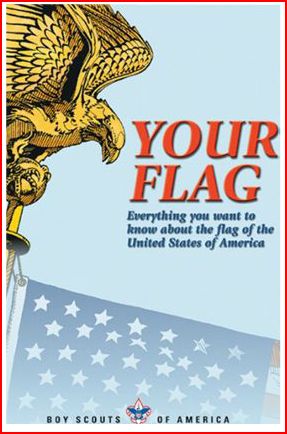
Boy Scouts of America version of the flag etiquette guide, Your Flag
Another book I’ve found very useful is an official Boys Scouts of America publication of the almost the same name, Your Flag. It’s a graphic-novel type of publication — cartoons for every point to be made. It features deeper information on proper flag display. The book can be purchased at any local Boy Scout Council supply shop, or any other shop that stocks Scout literature. It can also be ordered from BSA’s national catalog, or online at Scoutstuff.org, for $7.9910.99plus shipping. Every Scout troop should have one of these, and it is also very useful for classroom libraries, for history and civics.
In either publication, one learns that there are not many ways to display a flag properly from a vehicle — improper displays include decals on windows, bumper stickers, flying them from the radio antenna, or attaching them to a window pole to be battered in freeway-speed winds.
One might hope these books get much broader circulation.
Spread the word; friends don't allow friends to repeat history.
Yes, the flag amendment is dead, again. Yes, the Fourth of July is past. False history continues to plague the U.S. flag, however. When my wife forwarded to me the post below, it was the fourth time I had gotten it, recently. Bad history travels fast and far. Let’s see if we can steer people in a better direction with real facts.
A flag folding at a funeral for a military person carries great weight, without any script at all. Wikimedia image from DOD release: Members of the U.S. Navy Ceremonial Guard fold the American flag over the casket bearing the remains of sailors killed in the Vietnam War during a graveside interment ceremony at Arlington National Cemetery on May 2, 2013. Lt. Dennis Peterson, from Huntington Park, Calif.; Ensign Donald Frye, from Los Angeles; and Petty Officers 2nd Class William Jackson, from Stockdale, Texas, and Donald McGrane, from Waverly, Iowa, were killed when their SH-3A Sea King helicopter was shot down on July 19, 1967, over Ha Nam Province, North Vietnam. All four crewmembers were assigned to Helicopter Squadron 2.
Here is the post as it came to me each time — I’ve stripped it of the sappy photos that are occasionally added; note that this is mostly whole cloth invention:
Did You Know This About Our Flag
Meaning of Flag Draped Coffin.
All Americans should be given this lesson. Those who think that America is an arrogant nation should really reconsider that thought. Our founding fathers used God’s word and teachings to establish our Great Nation and I think it’s high time Americans get re-educated about this Nation’s history. Pass it along and be proud of the country we live in and even more proud of those who serve to protect our “GOD GIVEN” rights and freedoms.
To understand what the flag draped coffin really means……
Or, until that account is unsuspended by the forces supporting Donald Trump: Follow @FillmoreWhite, the account of the Millard Fillmore White House Library
We've been soaking in the Bathtub for several months, long enough that some of the links we've used have gone to the Great Internet in the Sky.
If you find a dead link, please leave a comment to that post, and tell us what link has expired.
Thanks!
Retired teacher of law, economics, history, AP government, psychology and science. Former speechwriter, press guy and legislative aide in U.S. Senate. Former Department of Education. Former airline real estate, telecom towers, Big 6 (that old!) consultant. Lab and field research in air pollution control.
My blog, Millard Fillmore's Bathtub, is a continuing experiment to test how to use blogs to improve and speed up learning processes for students, perhaps by making some of the courses actually interesting. It is a blog for teachers, to see if we can use blogs. It is for people interested in social studies and social studies education, to see if we can learn to get it right. It's a blog for science fans, to promote good science and good science policy. It's a blog for people interested in good government and how to achieve it.
BS in Mass Communication, University of Utah
Graduate study in Rhetoric and Speech Communication, University of Arizona
JD from the National Law Center, George Washington University


 Posted by Ed Darrell









 Millard Fillmore's Bathtub