September 17, 2008
John Stossel’s new book makes a detour to rail against the regulation of DDT and against Rachel Carson and her book, Silent Spring.
I’ve not read the book, but from what I’ve read about it, he’s got it dead wrong. If the example offered by Grokmedia is their own, and not Stossel’s, shame on them. (Stossel’s complained about DDT before, though, and gotten the facts as wrong as Grokmedia has them.) The claims are unbelievable:
Consider the chemical DDT. I’m sure, if you’ve heard anything at all about DDT, it’s that it’s a horrible, deadly chemical, that must be banned to preserve the public’s safety. The truth is, the only thing DDT affects are mosquitos. Not humans. In fact, I’m old enough to remember trucks pulling through our neighborhood and spraying the stuff into the air, like gigantic clouds, bringing death – to the mosquito population. These clouds of DDT harmed no one. There were no great increases in any kind of cancer or other fatal diseases – and certainly none that could be associated with DDT. Enter the book, Silent Spring.
A woman by the name of Rachel Carson wrote a book that vilified DDT, and blamed our love of chemical solutions for her own cancer. (She died of breast cancer two years after the publication of her book.) Silent Spring is almost single-handedly credited with triggering a worldwide ban on DDT. The result of this ban has been, paradoxically enough, millions of deaths in countries like Ethiopia, where malaria kills due to mosquito infestations. U.S. aid policy bans sending money to any country that chooses to spray with DDT.
How did Silent Spring cause this wave of destruction? Marketing. The book was marketed by it’s publishers. The marketing efforts attracted the attention of a mainstream media hungry for stories that scare the populace to death. The unwashed masses Demanded That Something Be Done. Politicians, eager to grandstand (and free of conciences that might give them pause to think about the Law of Unintended Consequences) passed laws, and that was that.
Here’s what I wrote in comments to the post at Grokmedia, which appears to have gone into their own hell for any post that disagrees with their views:
Stossel said that about DDT? Once again, he’s gone off the rails.
Do you seriously think that a book publisher with its meager PR budget could derail a multi-billion-dollar pesticide manufacturing industry that was led by several of America’s top 100 corporations? Do you think corporations are really that incompetent at the public relations game?
The truth is that DDT was banned because of its harm to the environment, not due to its dangers to human health (though, to be perfectly accurate we should note that every cancer-fighting agency on Earth says DDT is a probably human carcinogen, and recent research has strengthened the links between cancer in people exposed to DDT in their mother’s breast milk and in utero, and that DDT is now known to be a rather nasty endocrine disruptor in all animals). More than a thousand studies confirmed the dangers of DDT to birds and other predators higher up in food chains, especially in estuarine waters.
No one passed a law banning DDT. If the action was popular, that was beside the point. In 1962, in response to the half-million-dollar slander campaign against Carson by the pesticide manufacturers (don’t take my word for it — look it up), President Kennedy asked his Science Advisory Council to scrutinize the book. In May 1963 they reported back that Carson was correct on all counts but one — they said Carson went too easy on the dangers of DDT, and that action needed to be taken right away to stop its use. Kennedy dallied, however, and did little before he died.
The “ban” on DDT came nearly a decade later, in 1972. It was not due to any “junk science” law (an interesting claim since it is based on junk science itself). Two federal courts had ordered EPA to speed up its analysis of the registration of the pesticide, in lieu of simply ordering the stuff off the market after two entirely different lawsuits. Pesticide manufacturers had been defendants in both lawsuits, and they put up a more than vigorous fight — but they lost on the science.
EPA dragged its feet, but finally acted against DDT in 1972, effectively banning the broadcast spraying of DDT on crops, but leaving it available for things like malaria control. Of course the ruling was challenged in court, since under U.S. law, had the ruling been only popular, and not based on considerable evidence, the courts would have been obligated to nullify the ruling. In two separate challenges, the courts ruled that EPA’s action was solidly based on the scientific evidence, and therefore would stand.
That’s quite a bit different from the picture Stossel paints, I gather. Is this, perhaps, his first foray into fiction?
And, did you catch the contradictions? The author claims mosquito abatement in Ethiopia is hampered by a lack of U.S. aid, as a result of Rachel Carson’s book in 1962. Do they know that George Bush is president? Do they really think Bush and Cheney are tools of Rachel Carson? Do they know that bed nets have cut malaria rates by half where they were used in Ethiopia?
Looks like another example of DDT poisoning to me.
Spread the word; friends don't allow friends to repeat history.
 4 Comments |
  Africa, DDT, Junk science, Malaria, Politics, Rachel Carson, Science, Voodoo history, Voodoo science | Tagged: Africa, DDT, Ethiopia, Junk science, Malaria, Rachel Carson, Voodoo history, Voodoo science |
  Permalink
 Posted by Ed Darrell
August 24, 2008
Page A1 of the New York Times on Sunday, August 24, 2008: “A Teacher on the Front Line as Faith and Science Clash.”
Read it, and consider these questions:
- Would your local paper have the guts to report on this issue, for your local schools? (The Times went to Florida; heaven knows few Florida papers could cover the issue in Florida so well.)
- What is your local school board doing to support science education, especially for evolution, in your town? Or is your local school board making it harder for teachers to do their jobs?
- What is your state education authority doing to support science education, especially in evolution, in your state? Or is your state school board working to make it harder for teachers to do their jobs, and working to dumb down America’s kids?
- Do your school authorities know that they bet against your students when they short evolution, because knowledge about evolution is required for 25% of the AP biology test, and is useful for boosting scores on the SAT and ACT?
- Does your state science test test evolution?
- Do your school authorities understand they are throwing away taxpayer dollars when they encourage the teaching of voodoo science, like intelligent design?
It takes a good paper like the Times to lay it on the line:
The Dover decision in December of that year [2005] dealt a blow to “intelligent design,” which posits that life is too complex to be explained by evolution alone, and has been widely promoted by religious advocates since the Supreme Court’s 1987 ban on creationism in public schools. The federal judge in the case called the doctrine “creationism re-labeled,” and found the Dover school board had violated the constitutional separation of church and state by requiring teachers to mention it. The school district paid $1 million in legal costs.
That hasn’t slowed the Texas State Board of Education’s rush to get the state entangled in litigation over putting religious dogma in place of science. The Texas Education Agency (TEA) is already embroiled in one suit, brought by the science-promoting science curriculum expert they fired for noting in an e-mail that science historian Barbara Forrest was speaking in a public event in Austin. TEA may well lose this case, and their side is not helped when State Board Chairman Don McLeroy cavorts with creationists in a session teaching illegal classroom tactics to teachers. Clearly Texas education officials are not reading the newspapers, the court decisions, or the science books.
Here’s one of the charts accompanied the article. While you read it, consider these items: The top 10% of science students in China outnumber all the science students in the U.S.; the U.S. last year graduated more engineers from foreign countries than from the U.S.; the largest portion were from China. China graduated several times the number of engineers the U.S. did, and almost all of them were from China.
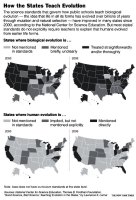
Copyright 2008 by the New York Times
Can we afford to dumb down any part of our science curriculum, for any reason? Is it unfair to consider creationism advocates, including intelligent design advocates, as “surrender monkeys in the trade and education wars with China?”
Update: 10:00 p.m. Central, this story is the most e-mailed from the New York Times site today; list below the fold.
Read the rest of this entry »
Spread the word; friends don't allow friends to repeat history.
5 Comments | Biology, Charles Darwin, Creationism, Darwin, Education, Education quality, Evolution, Intelligent Design, Politics, Public education, Religion, Science, Separation of church and state, State school boards, Teaching, Texas, Texas Citizens for Science, Texas Education Agency (TEA), Texas Freedom Network, Voodoo science, War on Education, War on Science | Tagged: Creationism, Don McLeroy, Education, Evolution, Politics, Religion, Science, Texas, Voodoo science | Permalink
Posted by Ed Darrell
August 21, 2008
Here’s the post from über creationist Ken Ham’s site, in its entirety:
Last week, AiG speaker Mike Riddle did a series of talks in Brenham, Texas. On the first day, Mike did four different sessions for 1st–6th graders. He usually speaks to young people on topics like “The Riddle of the Dinosaurs,” AiG’s well-known “7C’s of History,” and fossils.

On the next day, Mike did four special sessions for teachers. Each presentation was geared to help instructors be better prepared to teach origins in the public schools. In addition to speaking on what creationists believe, he spoke on understanding presuppositions and assumptions in the origins debate–and using critical thinking skills. Mike also had the opportunity to meet with the Chairman of the Texas State School Board, Don McLeroy (a biblical creationist), and gave presentations to an open audience at the Brenham High School auditorium.

Mike and Don McLeroy (Chairman, Texas State School Board)
“Special sessions for teachers?” Oy vey.
1. I’ll wager, if those were real, public school teachers, they were given continuing education credits for attending. That would be illegal, especially if Riddle did not preface his presentations with a legal disclaimer that what he urges is contrary to Texas science standards and contrary to the Constitution. Want to wager whether he did?
2. What’s McLeroy doing there? Doesn’t he know he’s supposed to maintain antiseptic separation from such controversial stuff? They fire people from the TEA for attending sessions that are legal and support the Texas standards. What sort of Quisling action is this on McLeroy’s part?
3. Is Rick Perry watching? The state’s legal fees will rise dramatically as a result of this kind of bad judgment at the SBOE. Can Texas taxpayers afford this?
4. Why does Don McLeroy hate Texas’s smarter, college-bound children so?
It takes a particular form of chutzpah to stand idly by while qualified science teachers are fired from the state’s education agency for promoting science, and then go cavort with creationists. It may not be cowardice exactly, but courage is its antonym.
Spread the word; friends don't allow friends to repeat history.
4 Comments | Education, Ethics, History, Politics, Religion, Science, State school boards, Teaching, Texas, Texas Citizens for Science, Texas Education Agency (TEA), Voodoo science | Tagged: Bad Judgment, Creationism, education standards, Evolution, Ken Ham, Politics, Religion, Science, Texas, Voodoo science | Permalink
Posted by Ed Darrell
August 18, 2008
Louisiana’s state legislature — the legislature that the Supreme Court slapped down in 1987 for trying to introduce religion into science classes in Edwards v. Aguillard — rushed through a bill drafted by the deaf-to-the-law Discovery Institute which purports on its face to make it legal for Louisiana science teachers to teach creationism, intelligent design, tarot card reading, UFO-ism, or any other crank science that the teacher feels compelled to offer.

A Louisiana alligator used by c design proponetsist Denyse O'Leary to illustrate a blog post about Louisiana's litigation bait law on creationism in schools. Without any appreciation of th irony, or as a subtle warning, we can't say. (photo from The Advocate?)
Louisiana’s Gov. Bobby Jindal, R-Mars, rushed to sign the brain-sucker into law, in his ambitious quest to get John McCain to name him as the nominee for vice president. It appears on the surface that Jindal’s national political aspirations will have to wait, but the law he signed requires Louisiana’s school districts to be ready when the students come back in the next few weeks, to do whatever it is they are going to do about creationism and other crank science.
Discovery Institute minions have been hawking creationism wares, and other creationists have offered to put Genesis into the science curriculum — but the law does not authorize those actions or wares itself. Instead, it passes the judgment to local school boards, sort of.
“Sort of.” Words that make a litigator’s heart flutter when talking about to-be-implemented laws! You’d think that, with all the money the Discovery Institute spends to entice legislators and school board members to poke their noses into matters they do not know, DI could spend a few thousands of dollars to get a competent legislative law drafter to draft a workable law. The cheapskates always pay more, Click and Clack say, and here’s another case to prove the point. It would have been difficult to intentionally write a law better intended to get local school boards sued.
A few of us noted the law does not indemnify local school districts against lawsuits if they goof and put religion into science classes. This is important, because the law requires local school districts to step up to the line and have a policy in place by the start of this school year. Which means, if the district doesn’t have the policy written out now, they’re late.
Tony Whitson at Curricublog spent time this summer pondering exactly how the law works, what it requires, and who it requires to act. His analysis — that the law is litigation bait just waiting to snare a local school board, a real “Dover Trap” — is cool, hard, and chilling. Go read it at his blog.
Whitson recommends that the Louisiana Board of Elementary and Secondary Education get an opinion from the state’s attorney general. This will not comply with the impossible and punishing deadline the legislature established, but it’s a much wiser stewardship of local monies, to try to avoid litigation. Tony wrote:
Taking stock of the situation: To summarize where things now stand, in light of everything above:
The law is by no means so benign as its promoters pretend. It will unleash all manner of chaotic mischief. On the other hand, there is a method to this madness, making it predictable that the perpetrators’ strategy will be to insinuate Exploring Evolution into the state’s (and then other states’) public schools.
BESE and the school districts cannot comply with the statute, which commands that
The State Board of Elementary and Secondary Education and each city, parish, or other local public school board shall adopt and promulgate the rules and regulations necessary to implement the provisions of this Section prior to the beginning of the 2008-2009 school year.
There are legal requirements (public notice, etc.) for adopting administrative rules for implementing legislation that make it impossible for that to be done by every state and district school board before the new school year begins.
So what can BESE do?
My suggestion is that BESE, at it’s meeting Tuesday, should move to request an opinion from the State Attorney General. They should ask him for an opion advising them, the district Boards of Education, and individual school principals, as to who will be responsible for the costs of defending against litigation for unconstitutional state promotion of religion in the use of supplemental materials. Presumably, if there’s a suit brought directly against BESE itself because of the substance of a text they have approved, then they would be defended by the AG’s office, on behalf of the state (like when the AG hired Wendell Bird as as special assistant for defending the state’s “Balanced Treatment” law). But will the AG commit his office to defending every district, every school, and every teacher whose use of “supplemental materials” is challenged for violation of the First Amendment?
Louisiana’s legislature set a trap for Louisiana science teachers and local school boards — whether intentionally or not is immaterial. Rather than authorize specific material for the curriculum, the new creationism law requires school boards to analyze materials to supplement the science curriculum. The law passes the buck to the local school boards.
So, Louisiana school board members now must become expert on science, and Constitutional law.
Rule of thumb: It costs a school board about $1 million every time they goof and put religion into science classrooms, in litigation costs alone. Louisiana’s legislature didn’t appropriate any money to compensate the school boards.
This law promises to entangle science educators and curriculum, and ensnare local school boards – all of which helps dumb down science achievement and prevent U.S. kids from getting the education they need to compete in a global economy. Alas.
Spread the word; friends don't allow friends to repeat history.
3 Comments | Creationism, Education, Education success, Evolution, First day, History, Intelligent Design, Politics, Rampant stupidity, Science, Teaching, Voodoo science | Tagged: Creationism, Education, Evolution, History, Intelligent Design, Louisiana, Politics, Science, Voodoo science | Permalink
Posted by Ed Darrell
August 17, 2008
It’s gotta be a virus, and pray to God it isn’t contagious.
Jennifer Marohasy made jaws drop with a stunningly under-informed claim about energy equilibrium and light bulbs, confusing watts as a measure of heat, getting thermodynamics wrong, and generally acting as if her wits temporarily headed to the beach.
And then she came right back with this one [moved to here]:
I have become curious about something. The core of the Earth is alleged to be molten. It’s also a fact that the deeper you dig into the Earth, the warmer it gets. Where is that heat coming from… surely not from the Sun. What’s the possibility that the Earth generates some of it’s own heat from geothermal processes?
The possibility is 100%. Ernest Rutherford had the goods on the issue just after the turn of the 19th to the 20th centuries. He won the Nobel Prize for Chemistry in 1908 for his work on radioactivity, which included calculations on how the planet Earth is heated from within. Some sources say Rutherford identified planetary heating as early as 1896.

Ernest Rutherford, Nobel Foundation photo
Marohasy lives in Australia — is Google disabled for that continent or something?
These are the people who lead the charge for climate change skeptics? Anthony Watts, where are you?
This is a preview of the sort of ignorance that will elbow its way into Texas science if the State Board of Education succeeds in dumbing down Texas science classes, pulling down the intelligence quotient with creationism.
“Alleged to be molten.”
And water is alleged to be wet.
Spread the word; friends don't allow friends to repeat history.
7 Comments | Climate change, geology, Global warming, Rampant stupidity, Science, Voodoo science | Tagged: Climate change, geology, Physics, Science, Voodoo science | Permalink
Posted by Ed Darrell
August 17, 2008
Every once in a while we get a glimpse of what the future would be like if the creationists ruled education and could teach some of the fantastic things they believe to be true as fact.
For example, creationists have for years complained that the basic chemistry of life somehow violates what chemists and physicists know as the “laws” of thermodynamics. Patient explanations of what we know about how photosynthesis works, and how animals use energy, and what the laws of thermodynamics actually are, all fall on deafened ears.
Comes Jennifer Marohasy, an Australian blogger at The Politics and Environment Blog, with this fantastic explanation about how the well-established notion of radiative equilibrium, simply doesn’t work.
“For the Earth to neither warm or cool, the incoming radiation must balance the outgoing.”
Not really.
No, really. Go read the post. And see these critiques, at Tugboat Potemkin, where problems with the rules of the principle of Conservation of Energy are noted, and Deltoid, where LOLCats makes a debut in explaining physics to the warming denialists.
Then go back and read the comments at Marohasy’s blog.
It’s not just the confusion of terms, like treating watts as units of heat. There’s an astonishing lack of regard for cause and effect in history, too:
Conservation of energy: it’s not just a phrase. The theory of radiative equilibrium arose early in the 19th century, before the laws of thermodynamics were understood.
Probably didn’t mention it here before, but Marohasy is also one of those bloggers who suffers from DDT poisoning. Among other things, she and Aynsley Kellow (whose book she recommends) use an astounding confabulation of history to claim DDT wasn’t harming birds at all, completely ignoring more than 1,000 research studies to the contrary (and not one in support of their claim).
Suggestion for research: Is the denialism virus that affects creationists, DDT advocates, and climate denialists, the same one, or are there slight variations? A virus seems the most charitable explanation, unless one wishes to blame prions.
Creationist physics, denialism in meteorology, physics, chemistry, and history. It makes a trifecta winner look like he’s not trying.
See also:
Spread the word; friends don't allow friends to repeat history.
1 Comment | Accuracy, Climate change, Creationism, denialism, Education, Global warming, History, Physics, Science, Voodoo history, Voodoo science | Tagged: chemistry, Climate change, Creationism, DDT, denialism, History, Physics, Thermodynamics, Voodoo history, Voodoo science | Permalink
Posted by Ed Darrell
August 12, 2008
This will be a short post, and so will confuse the long-winded but short-thought intelligent design advocates, especially those who claim to be philosophers, and especially those who claim to be philosophers of science who can see a role for intelligent design.
A short visit to Telic Thoughts last week produced a revelation that they have a new philosopher who wants to argue that intelligent design “philosophically” could be science, if. I answered that argument at some length, in lay terms, here: “Intelligent Design, a pig that does not fly.”
Dr. Francis Beckwith, at Baylor, appears to have dropped his campaign to teach philosophy in science classes since he rediscovered that God visits the Pope, and since he moved on to more serious philosophical pursuits and away from his practice of confusing people about the law of separation of church and state in America (especially confusing the Texas State Board of Education). We hope Beckwith sticks with philosophy and stays out of Texas textbooks.
So there was a vacancy in the phalanx of defenders of intelligent design, in the slot reserved for company store philosohers. Dr. Brad Monton volunteered for the job. Monton has a blog, here. Monton philosophizes at the University of Colorado.
What should be the role of theism in science? Exactly this: Theism should encourage scientists to be diligent, to be honest, to ask tough questions, and be kind. Theism should encourage scientists to be wise stewards of their lab resources and time, and to share the fruits of their work with humanity, for the benefit of all creation (no, not “creationism”).
That’s it. Honest and thorough, not mean. Work quickly and true.
If scientists stick to the noble purposes of their work, using these noble methods, we will see a quick death to creationism and intelligent design, which clamor and riot to be included in the science texts though they have not a lick of evidence to support them that is honest, true and nobly gained.
Philosophical debates do not belong in high school science classes, nor middle school or elementary school science classes. The fun of science, the honest ethics of science, the value of science, and the stuff of science are appropriate topics for those science classes. Especially school kids should not be encouraged to offer unevidenced, petulent denials of the facts as we know them. That will only encourage them to become larcenists, disturbed individuals, and Republican state legislators. Heaven knows we don’t need those.
Wes Elsberry agrees at his blog, The Austringer, but with more felicity:
The issue is not whether science could make progress in spite of re-adoption of 17th century theistic science, but whether theistic science could provide any benefit to the methods of science today. Monton, Plantinga, and the neo-Luddites have not convincingly made that case. Mostly, they haven’t even badly made that case. They seem to assume that science would be better off reverting to 17th century theistic science and become perplexed when scientists disagree with them. We had that debate, we call it “the 19th century”. Nobody has shown that the mostly-theistic body of scientists who decided to eschew supernatural conjectures as part of science were wrong to do so. Mostly, I think, because they were right to do so, and their reasoning still applies today.
Monton seeks a publisher. I wish he’d seek a course in botany, another in zoology, another in genetics, and one in evolution. He might find something worth publishing, then.
Philosophically, anything fits in science, if there is evidence to support it, and especially if there is theory that supports it and offers solid explanations that can be relied upon. But we don’t teach philosophy to kids. We teach the kids the evidence. Philosophically, any voodoo science could be considered science, if there were evidence to support it. Philosophically, the FAA should regulate flying pigs that pose a threat to commercial and general aviation. Pragmatically, however, pigs don’t fly. In regulation of our air space, and in our science classes, we rely on theory backed by hard evidence. I wish theists would all agree on that point, and shut up about intelligent design until some institute of discovery actually provides research results that provide evidence that ID is science, rather than philosophy.
See? I said it would be short.
Spread the word; friends don't allow friends to repeat history.
10 Comments | Accuracy, Creationism, Education, Evolution, Intelligent Design, Politics, Religion, Science, State school boards, Teaching, Voodoo science | Tagged: Creationism, Education, Evidence, Evolution, Intelligent Design, Philosophy, Religion, Science, State Boards of Education, Voodoo science | Permalink
Posted by Ed Darrell
August 10, 2008
Y’all with a smattering of understanding about evolution: Go to this blog and help straighten out the creationists, will you?
“Creationist medical dilemma” at Unreasonable Faith
This is one of the hottest posts in the WordPress blogging continent at the moment. Unreasonable Faith posted the old Doonesbury cartoon about the guy whose doctor diagnoses tuberculosis, and then asks the guy whether he’s a creationist before prescribing treatment (if you don’t know the cartoon, go see!). I don’t think it was intended to attract so much traffic.
In the past three days creationists have moved into the comments section with all manner of creationist misinformation. Few of the creationists are the hard-shelled, obnoxious type, but they could use some good information on genetics, mutations and evolution rates from someone familiar with the topics.
Spread the word; friends don't allow friends to repeat history.
Leave a Comment » | Creationism, Evolution, Health care, Religion, Science, Voodoo science | Tagged: Creationism, Evolution, Health care, Medical Care, Religion, Science, Voodoo science | Permalink
Posted by Ed Darrell
August 5, 2008
Creationists in Texas claim to have found a stone with footprints of a human and a dinosaur.
No, I’m not kidding.

Hoax “dinosaur and human footprints” claimed to be found in the Paluxy River near Glen Rose, Texas.
Could you make this stuff up? Well, yeah, I guess some people think you could. Somebody did make this stuff up.
According to a report in the too-gullible Mineral Wells Index, long-time hoaxster and faux doctorate Carl Baugh’s Creation Evidence Museum announced the rock was found just outside Dinosaur Valley State Park. The area has been the site of more than one creationist hoax since 1960, and was an area rife with hoax dinosaur prints dating back to the 1930s. (See these notes on the warning signs of science hoaxes and history hoaxes.)
The estimated 140-pound stone was recovered in July 2000 from the bank of a creek that feeds the Paluxy River near Glen Rose, Texas, located about 53 miles south of Fort Worth. The find was made just outside Dinosaur Valley State Park, a popular destination for tourists known for its well-preserved dinosaur tracks and other fossils.
The limestone contains two distinct prints – one of a human footprint and one belonging to a dinosaur. The significance of the cement-hard fossil is that it shows the dinosaur print partially over and intersecting the human print.
In other words, the stone’s impressions indicate that the human stepped first, the dinosaur second. If proven genuine, the artifact would provide evidence that man and dinosaur roamed the Earth at the same time, according to those associated with the find and with its safekeeping. It could potentially toss out the window many commonly held scientific theories on evolution and the history of the world.
Except, as you can see, Dear Reader and Viewer, it’s a hoax. No dinosaur has a footprint exactly resembling the print of Fred Flintstone’s pet Dino, as the rock shows; nor do human footprints left in mud look like the print shown.
Dear God, save us from such tom-foolery, please.
To the newspaper’s credit, they consulted with an expert who knows better. The expert gave a conservative, scientific answer, however, when the rock deserved a chorus of derisive hoots:
However, Dr. Phillip Murry, a vertebrate paleontology instructor in the Geoscience department of Tarleton State University at Stephenville, Texas, stated in his response to an interview request: “There has never been a proven association of dinosaur (prints) with human footprints.”
The longtime amateur archeologist who found the fossil thinks that statement is now proven untrue.
“It is unbelievable, that’s what it is,” Alvis Delk, 72, said of what could be not only the find of a lifetime, but of mankind.
Delk is a current Stephenville and former Mineral Wells resident (1950-69) who said he found the rock eight years ago while on a hunt with a friend, James Bishop, also of Stephenville, and friend and current fiancee Elizabeth Harris.
Yes, it’s unbelievable.
For comparison, real hominid footprints look much different — the print below was left in a thin-layer of volcanic ash about 4 million years ago, 61 million years after dinosaurs went extinct, according to timelines corroborated by geologists, paleontologists, astronomers, nuclear physicists and biologists:

Print of a hominid, found at Laetoli, Tanzania, Africa; image from Stanford University. Photo: J. Reader/SPL
With luck, serious scientists will get a chance to analyze the prints soon, and note that they are hoaxes. If history is any guide, however, Baugh and his comrades will keep the rock from scientific analysis, claiming that scientists refuse to analyze it.
The rock is approximately 30 inches by 24 inches. The human footprint, with a deep big toe impression, measures 11 inches in length. Baugh said the theropod track was made by an Acrocanthosaurus. Baugh said this particular track was likely made by a juvenile Acrocanthosaurus, one he said was probably about 20 feet long, stood about 8 feet tall and walked stooped over, weighing a few tons.
Its tracks common in the Glen Rose area, the Acrocanthosaurus is a dinosaur that many experts believe existed primarily in North America during the mid-Cretaceous Period, approximately 125 million to 100 million years ago.
Baugh said Delk’s discovery casts doubts on that theory. Baugh said he believes both sets of prints were made “within minutes, or no more than hours of each other” about 4,500 years ago, around the time of Noah’s Flood. He said the clay-like material that the human and dinosaur stepped in soon hardened, becoming thick, dense limestone common in North Texas.
He said the human print matches seven others found in the same area, stating the museum has performed excavations since 1982 in the area Baugh has dubbed the “Alvis Delk Cretaceous Footprint” discovery.
This “find” comes as the State Board of Education begins rewriting science standards for Texas schools. The chairman of the SBOE is a committed creationist who publicly says he hopes to get creationism into the standards and textbooks in Texas, miseducating Texas students that creationism has a scientific basis.
Delk’s own daughter, Kristi Delk, is a geology major at Tarleton State University in Stephenville and holds different beliefs from her dad about the creation of Earth and the origins of man.
She said she wants to see data from more tests before jumping to any conclusions.
“I haven’t come to terms with it,” she said. “I am skeptical, actually.”
Listen to your daughter, Mr. Delk.
In a story Texas educators hope to keep completely unrelated to the foot prints hoax, Mineral Wells area schools showed gains in academic achievement on the Texas state test program.
Additional resources:
- Glen Kuban’s description of earlier “man track” hoaxes around the Paluxy River in the area of Glen Rose, Texas, near Dinosaur Valley State Park
- Overview of dinosaur tracking, again by Glen Kuban (pay attention to Kuban; he’s good)
- Dinosaur Valley State Park website. Dinosaur Valley is not the “best” park in Texas’s outstanding system of more than 100 outstanding parks, but it’s a jewel. It operates on a shoestring, but it operates with some of the most dedicated government employees anywhere, in one of the most dedicated government agencies anywhere. You should go see the park. Camp there. Spend a lot of time in the river and elsewhere looking at tracks. Talk to the rangers. This is the real stuff, folks, in the wild. You can touch prehistory. God left it there for you, and to irritate creationists to the brink of screaming insanity. Go see it.
- Texas Citizens for Science
- Carl Baugh’s Creation Evidences Museum in Glen Rose, Texas – note the hoax footprints are already shown in the masthead of this site
- Baugh’s “scientific publication” of the description of the prints
- For comparison, Leakey’s and Hay’s 1979 paper in Nature on the Laetoli footprints; “When a volcanic eruption sent a rain of ash over what is now Tanzania, an adult and child, probably both Australopithecus afarensis, set out to watch the show — leaving, as a poignant souvenir, perfect and very modern-looking footprints, preserved in the ashfall.”
________________________
Gary Hurd at Stones and Bones, who Is a bit of an expert in this stuff, calls “fake.“
Here is how to fake a patina that will look like this fake fossil: Brush the surface with vinegar, and then sprinkle with baking powder followed by baking soda, and let dry. Repeat until you are happy with the results. This is not the only way, or even the best way. But it is simple, and will fool the average fool. Especially easy if they want to be fooled.
So, having spent a little bit more time on the photo of this fake, I feel that I understand a bit more about how it was produced. A legitimate dinosaur track was found and removed. Incompetent, unprofessional “Cleaning” damaged it. An parital overprint, or simple erosion depression was “improved” by adding “toes.” The faked surfaces were smothed over with a simple kitchen concoction to make a “patina.” Artifact fabricators next bury the fake for a year or two, or they smear it with fertilizer and leave it exposed. This helps weather the object and obscure tool marks.
Did you find this post useful, or entertaining? Vote to share it with others — click the “Digg” button above; list it on Reddit or other services, if you have memberships there. Link to this post from your own blog. Help spread the word this hoax is coming.
Help stamp out hoaxes; run with the word:


Save
Save
Spread the word; friends don't allow friends to repeat history.
37 Comments | Accuracy, Bogus history, Creationism, Education, History, Hoaxes, Public education, Religion, Science, Texas, Texas Citizens for Science | Tagged: bogus science, Creationism, Dinosaur Valley State Park, Dinosaurs, Glen Rose, History, Hoaxes, human evolution, Paleontology, Paluxy River, Religion, Science, Texas, Voodoo science | Permalink
Posted by Ed Darrell
August 4, 2008
No, I’m not talking about actual poisoning by the chemical, an organochloride insecticide. I’m talking again about people driven to madness by false claims that DDT will cure malaria, that DDT is banned for use against malaria, and that some few super powerful people, all of them evil environmentalists, are forcing governments, all health workers, and the world’s tobacco companies to stop the use of DDT — ergo, they say, everyone who has died from malaria since [some point in the past that is surely the fault of environmentalists] died due to lack of DDT.
Which makes those people worse murderers than Stalin at least, so the crazies claim.
Here’s the latest fuse that set me off. I’ll analyze it below the fold, after the lecture.
Is it a virus that spreads in late summer? I’ve noted here earlier the tendency of the pro-DDT wackoes to surge out of the woodwork in summer to claim, against the facts, that West Nile virus would be no problem if there were DDT. Mosquitoes that carry West Nile are best killed in as larva, living in water; DDT is not as efficient as other larvacides, particularly when weighed against DDT’s tendency to kill everything that comes in contact with the water and the plants and animals living in and around it.
But watch: Any mention of malaria in the news, and they drop letters to the editors of every weekly newspaper in America, blaming unnamed environmentalists for killing millions in Africa, or Asia, or both. In the Bizarro™ World of DDT advocates, all insect-borne diseases were on the run until Rachel Carson personally padlocked every DDT manufacturer in the world. I have news browsers set to pick up mentions of DDT, and except for the recent surge in news about the band DDT from Russia, every day brings another internet mention of how DDT could have saved the world, if only.
Dear Reader, Dear God, there are several inaccuracies there. It’s curious that some people can get ideas so exactly contrary to the facts, contrary to reality, so often.

Arnold Kling, economist blogging at the Freedom Fund’s Library of Economics and Liberty — in this case, misblogging against science and medicine.
Wait. What’s this? There’s a trail of misinformation and disinformation we can follow. This livejournal poster links to this Wikipedia article on “seasteading,” and from there to this blog on the value of seasteading, which bases the pie-in-the-sea philosophy on the common, occasionally-but-randomly correct rant against government, based on Arnold Kling’s rant at EconLog.
Have we seen this before? Yes, Dear Reader, we have — and if you look in the comments to Kling’s rant, you’ll see Tim Lambert fiercely shoveling facts to try to put out the fires of ignorance. I even posted there — back in April. The facts, the links, the arguments, are all there, for anyone with half a brain and half a desire to do the right thing and get the facts right.
April to August (misdated September). The nutty DDT advocates are working on a four month cycle. Repeat the falsehoods every four months, three times a year (intentionally or not; some viral marketing works better if it’s not intentional, like the innocent carriers of typhoid who are unaffected by it, don’t mean to spread it around, but breath the pathogen out with every breath).
Blather, don’t bother to rinse, repeat.
It’s time someone wrote a new book on propaganda, warning of its evils.
Read the rest of this entry »
Spread the word; friends don't allow friends to repeat history.
2 Comments | Accuracy, DDT, Politics, Science, Voodoo history, Voodoo science | Tagged: Accuracy, DDT, Economics, Politics, Propaganda, Science, Voodoo science | Permalink
Posted by Ed Darrell
June 27, 2008
According to the Associated Press, Louisiana Gov. Bobby Jindal signed the latest creationism bill to come out of the Louisiana legislature “in the last few days.”
Discovery Institute operatives claimed credit for authoring the bill and provided close support to advocates of the bill in Louisiana. Oddly, now that the bill has become law and is likely to be a litigation magnet, DI has backed off of supporting the bill.
That is an object lesson, which may be lost on Louisiana school boards. The bill is a bit of a stealth creationism bill. It doesn’t directly advocate creationism by name. It adopts the creationist tactics of claiming that criticism of evolution is critical thinking, a confused statement of what critical thinking is if ever there was one. Critical thinking should involve real information, real knowledge, and serious criticism of a topic. The bill is designed to frustrate the teaching of evolution. The part Louisiana school boards need to watch is this: The bill passes the buck on litigation to the school boards.
In other words, the Louisiana legislature, Louisiana Family Forum, and Discovery Institute will not support any school district that allows a teacher to teach the religious dogma that commonly passes as creationism and intelligent design.
As part of the War on Education and the War on Science, this is effective tactics in action. If any teacher in Louisiana seeks approval for anti-evolution materials as the law encourages, school boards are put on the spot. If the school board approves the anti-evolution material, it is the school board’s action that will be the subject of the suit; if the board disapproves the material, but the teacher teaches it, the teacher can be fired and would be personally liable for any lawsuit.
But if a science teacher teaches evolution as the textbook has it, the Louisiana Family Forum will complain to the school board that “alternative materials” were not offered.
So to avoid trouble, evolution will be left out of the curriculum. The kids are failing the tests anyway — who will notice, or care? Not the Louisiana lege, not the Louisiana governor.
As America slips farther behind the rest of the industrialized world on education achievement in science, Louisiana’s legislature has sided with those who promote the “rising tide of mediocrity.” If a foreign government had done this to us, we’d regard it as an act of war, the Excellence in Education Commission said in 1983.
So what is it when the Louisiana legislature and Gov. Jindal do it to us? Treason? Maybe Bill Dembski will ask Homeland Security to investigate this attack on America by Louisiana’s elected officials.
Spread the word; friends don't allow friends to repeat history.
6 Comments | Creationism, Education, Politics, Public education, Religion, Science, Voodoo science, War on Education, War on Science | Tagged: Creationism, Politics, Religion, Science, Voodoo science, War on Education, War on Science | Permalink
Posted by Ed Darrell
May 26, 2008
Much as we’d like to deny it, the evidence to verify Barnum’s Law just keeps piling up.
Here’s a blogger astounded by the black stuff on the pad on her feet, convinced that it’s toxic stuff magically drained out of her body, through her feet.
Who is going to tell her the facts?
Uh, you haven’t been suckered by that scam, have you?
Update: The blogger in question seems to have gotten the message: The post has been yanked. Smart people change things when their errors are pointed out.
Spread the word; friends don't allow friends to repeat history.
Leave a Comment » | Health care, Hoaxes, Scams, Science, Voodoo science, Woo | Tagged: Health care, Scams, Science, Toxic feet, Voodoo science | Permalink
Posted by Ed Darrell
May 16, 2008
Steve Milloy and an entire host of DDT denialists hope you never read any newspaper from Africa. Your ignorance is their best argument.
If you don’t read African newspapers, they can continue to blame environmentalists for any case of malaria that occurs in Africa. They’ll claim, though it’s not true, that environmentalists urged a complete ban on the use of DDT. They’ll argue, falsely, that African governments were bullied into not using DDT by environmentalists, ignoring the fact that some African nations have just never been able to get their kit together to conduct an anti-malaria campaign, while other nations discovered DDT was ineffective — and most of the nations have no love for environmentalists anyway (Idi Amin? Jomo Kenyatta? Who does Milloy think he’s kidding?).
If you don’t read African newspapers, you’ll miss stories like this one, from the Daily Times in Malawi, that say it’s Milloy’s old friends in the tobacco business who stand in the way of modest use of DDT.
If you don’t read African newspapers, you’ll miss stories like this one, from New Vision in Kampala, Uganda, that say it’s the cotton farmers who stand in the way of modest use of DDT.
If Steven Milloy wanted to get DDT used against malaria in Africa, in indoor residual spraying (IRS) campaigns, all he has to do is pick up the phone and ask his friends to allow it to be done.
Someone who will lie to you about their friends’ misdeeds, and try to pin it on a nice old lady like Rachel Carson, will go Charles Colson one better: They’ll walk over your grandmother to do what they want to do. In fact, they’ll go out of their way to walk over your grandmother.
The New Republic seems to have come around to get the story straight. Truth wins in a fair fight — it’s a fight to make sure the fight is fair, though.
John Stossel? Your company doesn’t get tobacco money any more. What’s your excuse? Do you really believe the Bush administration is beholden to environmentalists on this one issue? How long have you been covering politics?
(Texts of news stories below the fold.)
Read the rest of this entry »
Spread the word; friends don't allow friends to repeat history.
Leave a Comment » | Africa, Business Ethics, Conservation, DDT, Environmental protection, Ethics, Health care, Hoaxes, Junk science, Malaria, Newspapers, Public health, Rachel Carson, Science, Voodoo history, Voodoo science | Tagged: Africa, DDT, Ethics, health, Junk science, Malaria, Rachel Carson, Science, Voodoo history, Voodoo science | Permalink
Posted by Ed Darrell
May 16, 2008
DDT denialists like Steven Milloy like to paint Rachel Carson as a lone, cranky and crackpot voice in the wilderness against DDT (never mind how that makes the DDT industry look, unable to use facts and the $500,000 public relations campaign to get their message out).
It’s not so. As Carson noted, concerns about DDT were raised early, and often.
The Dallas Public Library makes available much of the news from the Dallas Morning News of the last century. On my way to find something else, I plugged in “DDT” as a search term. Among other articles that popped up was a May 9, 1951 story of Texas scientists warning a Congressional committee of the harms of DDT.
“Hazard to health,” was the flying head, “Renner Scientist Cites DDT Harm.” The story, by the News’ Washington Bureau reporter Ruth Schumm, covered a hearing before an unnamed committee of the House, “investigating the use of chemicals in foods.” (Where was the copy editor on that one?)
John M. Dendy of the Texas Research Foundation delivered the testimony. Dendy worked out of the Foundation’s laboratory in Renner. Renner was an independent community then, located south of Renner, west of Coit, and north of Campbell Roads (no, it’s not there today).
Studies in the foundation’s laboratories at Renner, Dallas County, have proved that DDT and other chemicals are now causing mass contamination of milk, meat and other foods, Dendy said.
Dendy said that crops absorb the DDT sprayed on them — still true, and more problematic since it’s been discovered that DDT is also damaging to some plants — and animals that graze the crops get that dosage. Dairy cows, beef cattle and sheep were the chief animals mentioned.
Even though the Texas State Health Department has ruled that no DDT should be present in milk comsumed by human beings, DDT is showing up in the Dallas milk supply even in December, long past the usual season for spraying with insecticides. About half of the Dallas milk supply is imported from Oklahoma, Missouri and Wisconsin, he said.
* * * * *
In the Texas Research Foundation tests, the degree of contamination ranged from 3.10 parts per million in lean meat to 68.55 parts per million in fat meat, Dendy testified.
In milk, the DDT conamination ranged from less than .5 parts per million to 13.83 parts per million.
Dendy testified that so far as he knew, the exact effects of such poisoning on human beings has not yet been established.
Dendy warned in his testimony that DDT builds up over time in “human and animal fat tissue,” so the dangers to human health become greater as the exposure grows over time.
The worried Congressmen wanted to know if there is a substitute for DDT.
Dendy said he was not working on that problem, but he knew others were.
Notably absent from the hearing was the committee chairman, Rep. James J. Delaney, D-NY, according to the list offered by the DMN. That’s right: Delaney was the one who, in 1957, got his amendment passed to the Safe Food and Drug Act, the organic act for the U.S. Food and Drug Administration (FDA) making it illegal to use anything known to be carcinogenic as a food additive (DDT doesn’t count, because it’s not a food additive, but a food contaminant, which is regulated not by the FDA, but by the Department of Agriculture).
So, in 1951, before Rachel Carson had left the U.S. Fish and Wildlife Service, 11 years prior to the publication of her book Silent Spring, 21 years before the EPA banned use of DDT on crops, conservative scientists from Texas were alerting Congress to the dangers of DDT.
It’s in the history books. You can look it up.
Read the rest of this entry »
Spread the word; friends don't allow friends to repeat history.
2 Comments | DDT, Health care, History, Junk science, Rachel Carson, Science, Voodoo history, Voodoo science | Tagged: DDT, health, History, Junk science, Rachel Carson, Science, Voodoo science | Permalink
Posted by Ed Darrell
May 16, 2008
Well developed thoughts from an atheist on morality, especially the morality of creationism, in a review of Ken Ham’s book, The Lie: Evolution, from a blogger, In Case You’re Interested. Ham is the guy who raised nearly $30 million for the Creation Museum, a monument to denial of reality.
Coincidence? Ham’s book repeats all of the shoddy arguments that show up in Ben Stein’s mockumentary film.
Spread the word; friends don't allow friends to repeat history.
2 Comments | Books, Charles Darwin, Creationism, Darwin, Education, Evolution, Rampant stupidity, Religion, Science, Voodoo history, Voodoo science | Tagged: Books, Creationism, Religion, Voodoo science | Permalink
Posted by Ed Darrell





 Millard Fillmore's Bathtub