D-Day: 65 years ago today

June 6, 2009

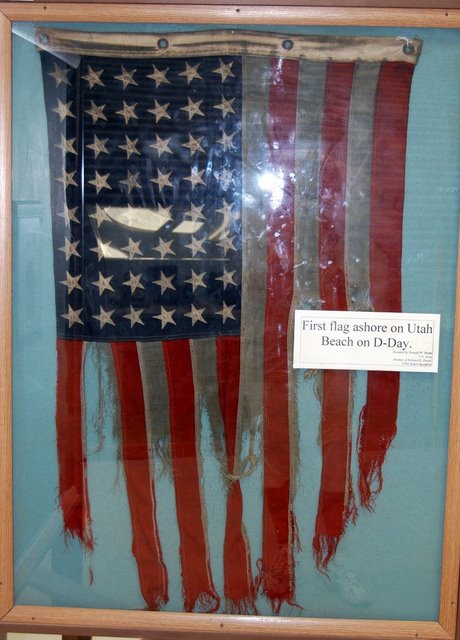
First Flag on Utah Beach, June 6, 1944

First U.S. flag on Utah Beach, Normandy, D-Day, June 6, 1944; Pima Air Museum, Tucson, Arizona

This mostly an encore post.  A reader sent an e-mail with a question:  Does U.S. law suggest the flying of the U.S. flag on the anniversary of D-Day?

Today is the 65th anniversary of the Invasion of Normandy in World War II, a date generally called D-DayNo, you don’t have to fly your flag. This is not one of the days designated by Congress for flag-flying.

But you may, and probably, you should fly your flag.  If you have any D-Day veterans in your town, they will be grateful, as will their spouses, children, widows and survivors. A 22-year-old soldier on the beach in 1944 would be 87 today, if alive.  These men and their memories of history fade increasingly fast.  Put your flag up.  You may be surprised at the reaction.

If you do run into a D-Day veteran, ask him about it.  Keep a record of what he says.

First Wave at Omaha:  The Ordeal of the Blue and the Gray by Ken Riley:  Behind them was a great invasion armada and the powerful sinews of war. But in the first wave of assault troops of the 29th (Blue and Gray) Infantry Division, it was four rifle companies landing on a hostile shore at H-hour, D-Day -- 6:30 a.m., on June 6, 1944. The long-awaited liberation of France was underway. After long months in England, National Guardsmen from Virginia, Maryland and the District of Columbia found themselves in the vanguard of the Allied attack. In those early hours on the fire-swept beach the 116th Infantry Combat Team, the old Stonewall Brigade of Virginia, clawed its way through Les Moulins draw toward its objective, Vierville-sur-Mer. It was during the movement from Les Moulins that the battered but gallant 2d Battalion broke loose from the beach, clambered over the embankment, and a small party, led by the battalion commander, fought its way to a farmhouse which became its first Command post in France. The 116th suffered more than 800 casualties this day -- a day which will long be remembered as the beginning of the Allies Great Crusade to rekindle the lamp of liberty and freedom on the continent of Europe.  Image from National Guard Heritage series, from which the caption was borrowed.

"First Wave at Omaha: The Ordeal of the Blue and the Gray" by Ken Riley: Behind them was a great invasion armada and the powerful sinews of war. But in the first wave of assault troops of the 29th (Blue and Gray) Infantry Division, it was four rifle companies landing on a hostile shore at H-hour, D-Day -- 6:30 a.m., on June 6, 1944. The long-awaited liberation of France was underway. After long months in England, National Guardsmen from Virginia, Maryland and the District of Columbia found themselves in the vanguard of the Allied attack. In those early hours on the fire-swept beach the 116th Infantry Combat Team, the old Stonewall Brigade of Virginia, clawed its way through Les Moulins draw toward its objective, Vierville-sur-Mer. It was during the movement from Les Moulins that the battered but gallant 2d Battalion broke loose from the beach, clambered over the embankment, and a small party, led by the battalion commander, fought its way to a farmhouse which became its first Command post in France. The 116th suffered more than 800 casualties this day -- a day which will long be remembered as the beginning of the Allies' "Great Crusade" to rekindle the lamp of liberty and freedom on the continent of Europe. Image from National Guard Heritage series, from which the caption was borrowed.


Is Texas the state most vulnerable to global climate change?

June 6, 2009

John Mashey occasionally graces these pages with his comments — a cool, reasoned head on hot issues like global warming/global climate change, despite his history in computers or maybe because of it (which would put the lie to the idea that computer programming explains why so many computer programmers are wacky intelligent design advocates).

Mashey offered a comment over at RealClimate on a post about hoaxer and science parodist Christopher Monckton — a comment you ought to read if  you think about Texas ever, and especially if you like the place.  It’s comment #413 on that Gigantor blog.

Monckton wrote a letter to the New York Times and attached to it a graph.  The graph, it turns out, probably would need to be classified in the fiction section of a library or book store, were it a book.  Much discussion occurs, absent any appearance by Monckton himself who does not defend his graphs by pointing to sources that might back what his graphs say, usually.

In short, the post and the extensive comments shed light on the problems of veracity which plague so many who deny either that warming is occurring, or that air pollution from humans might have anything to do with it, or that humans might actually be able to do anything to mitigate the changes or the damage, or that humans ought to act on the topic at all.

So I’ve stolen Mashey’s comment lock, stock and barrel, to give it a little more needed highlight.

If you follow environmental issues much, you probably know Count Christopher Monckton as a man full of braggadocio and bad information on climate.  He is known to have worked hard to hoodwink the U.S. Congress with his claims of expertise and policy legitimacy, claiming to be a member of the House of Lords though he is not (some climate change deniers in Congress appear to have fallen for the tale).  He pops up at denialist conferences, accuses scientists of peddling false information, and he is a shameless self-promoter.

After much discussion, Mashey turned his attention to claims that Texans don’t know better than Monckton, and other things; Mashey notes that denialists cite Monckton’s performance at a conservative political show in Texas, instead having paid attention to real climate scientists who were meeting just up the road, for free:

AGW’s impact depends on where you live
OR
Texas is Not Scotland, even when a Scottish peer visits

1) SCOTLAND
Viscount Monckton lives in the highlands of Scotland (Carie, Rannoch, 57degN, about the same as Juneau, AK, but warmer from Gulf Stream.)

a) SEA LEVEL, STORMS
Most of Scotland (esp the highlands) is well above sea level, and in any case, from Post-Glacial Rebound, it’s going up. [Not true of Southern England.]

b) PRECIPITATION
Scotland gets lots of regular precipitation. From that, he likely gets ~1690mm or more rainfall/year, noticeably more than Seattle or Vancouver.

Scotland has complex, variable weather systems, with more rain in West than in East, but has frequent precipitation all year.

c) TEMPERATURE
Scotland’s climate would likely be better with substantial warming. See UK Met Office on Scotland, which one might compare with NASA GISS Global Annual Mean Surface Air Temperature Change. Scotland average maximum temperatures are 18-19C in the summer, i.e., in most places it might occasionally get up to 70F, although of course it varies by geography. +3C is no big deal. The record maximum was 32.9C (91F), set in 2003. Maybe there is yet a good future for air-conditioning/cooling vendors.

If one does a simple linear regression on both sets of annual data, one finds that SLOPE(Scotland) = .0071C/year, SLOPE(world) = .0057C/year, i.e., Scotland is warming slightly faster than the world as a whole.

d) AGRICULTURE
The combination of b) and c) is, most likely *good* for agriculture in Scotland. There is plenty of rain, and higher temperatures mean less snow and a longer growing season. Great!

In addition, the British geoscientist/vineyard archaeologist Richard Selley thinks that while it may be too hot for good vineyards in Southern England by 2080, it will be fine for some areas of Scotland.
Future Loch Ness Vineyard: great!

e) OIL+GAS, ENERGY
Fossil fuel production (North Sea oil&gas) is very important to the Scotland economy. Wikipedia claims oil-related employment is 100,000 (out of total population of about 5M).

Scotland has not always been ecstatic to be part of the UK.

2) TEXAS
The Viscount Monckton spoke for Young Conservatives of Texas, April 28 @ Texas A&M, which of course has a credible Atmospheric Sciences Department. Of course, many of them were unable to hear the Viscount because they were in Austin at CLIMATE CHANGE Impacts on TEXAS WATER, whose proceedings are online. See especially Gerald North on Global Warming and TX Water.

Monckton delivered his message: “no worries, no problems” which might well fit Scotland just fine, at least through his normal life expectancy.

The message was delivered to Texans typically in their 20s, many of whom would expect to see 2060 or 2070, and whose future children, and certainly grandchildren, might well see 2100.

Texas is rather different from Scotland, although with one similarity (oil+gas).

a) SEA LEVEL, STORMS

Texas has a long, low coastline in major hurricane territory.
Brownsville, TX to Port Arthur is a 450-mile drive, with coastal towns like Corpus Christi, Galveston, and Port Arthur listed at 7 feet elevations. The center of Houston is higher, but some the TX coast has subsidence issues, not PGR helping it rise. The Houston Ship Canal and massive amounts of infrastructure are very near sea level. More people live in the Houston metropolitan area + rest of the TX coast than in all of Scotland.

Of course, while North Sea storms can be serious, they are not hurricanes. IF it turns out that the intensity distribution of hurricanes shifts higher, it’s not good, since in the short term (but likely not the long term), storm surge is worse than sea level rise.

Hurricane Rita (2005) and Hurricane Ike (2008) both did serious damage, but in some sense, both “missed” Houston. (Rita turned North, and hit as a Category 3; Ike was down to Category 2 before hitting Galveston).

Scotland: no problem
TX: problems already

b) RAINFALL
Texas is very complex meteorologically, and of course, it’s big, but as seen in the conference mentioned above (start with North’s presentation), one might say:

– The Western and Southern parts may well share in the Hadley-Expansion-induced loss of rain, i.e., longer and stronger droughts, in common with NM, AZ, and Southern CA. Many towns are dependent on water in rivers that come from the center of the state, like the Brazos.

– The NorthEast part will likely get more rain. [North’s comment about I35 versus I45 indicates uncertainty in the models.]

– Rain is likely to be more intense when it happens, but droughts will be more difficult.

Extreme weather in TX already causes high insurance costs, here, or here.

Scotland: no problem
Texas: problems.

c) TEMPERATURE

Texas A&M is ~31degN, rather nearer the Equator than 57degN.
Wikipedia has a temperature chart. It is rather warmer in TX, but is also more given to extremes.

Scotland: +3C would be dandy,
Texas: +3C not so dandy.

d) AGRICULTURE
Between b) and c), less water in dry places, more water in wet places, more variations in water, and higher temperatures (hence worse evaporation/precipitation difference) are not good news for TX agriculture, or so says Bruce McCarl, Professor of Agricultural Economics at TAMU.

For audiences unfamiliar with Texas A&M, the “A” originally stood for Agriculture, and people are called Aggies. One might assume that agricultural research is valued.
Politically, “Aggie-land” would not be considered a hotspot of hyper-liberal folks prone to becoming climate “alarmists”.

Scotland: warmer, great! Wine!
Texas: serious stress.

d) OIL+GAS, ENERGY
Here, there is more similarity: fossil fuels are economically important.

On the other hand, Scotland was settled long before the use of petroleum, and while places like the highlands are very sparse, cities like Edinburgh and Glasgow are relatively dense, and many villages are quite walkable. Warmer temperatures mean *lower* heating costs.

Texas has naturally developed in a very different style, and with forthcoming Peak Oil, this may be relevant. In 2006, according to EIA, Texas was #1 in energy consumption, 5th per-capita (after AK, WY, LA, ND) and uses 2X/capita of states like NY or CA. Some of that is inherent in different climate and industry.

Sprawling development in a state with water problems, subject to dangerous weather extremes, and already seriously-dependent on air-conditioning, may end being expensive for the residents.

Scotland: makes money from fossil energy, but it was mostly built without it. Warmer temperatures reduce energy use.
Texas: already uses ~2.5-3X higher energy/capita, compared to Scotland. Warmer temperatures likely raise energy use.

3. SUMMARY

Gerald North’s talk ended by asking:
“Is Texas the most vulnerable state?”

That sounds like an expert on trains, hearing one coming in the distance, standing on the tracks amidst a bunch of kids, trying to get them off the tracks before there’s blood everywhere.

On the other side, someone safely away from tracks keeps telling the kids that experts are wrong, there is no danger, so they can play there as long as they like.

You will be well informed if you also read Mashey’s comments at #120 and #132.


Quote of the moment: Eisenhower on D-Day (encore post)

June 5, 2009

Eisenhower talks to troops of invasion force, June 5 -- before D-Day[Encore post from 2007.]

Soldiers, Sailors, and Airmen of the Allied Expeditionary Force: You are about to embark upon the Great Crusade, toward which we have striven these many months. The eyes of the world are upon you.

Order of the Day, 6 June, 1944 (some sources list this as issued 2 June)


4 Stone Hearth 68 + remote central = good convergence

June 5, 2009

4 Stone Hearth’s 68th incarnation rises at remote central, among my favorite archaeology/anthropology/ancient history blogs.

Tim has done an outstanding job of shaking good stuff out of the internet tree:  Did cooking make humans smartKris Hirst on the human transition to agriculture (every history teacher needs this one);  The new discovery of a Miocene era ape, in Europe; and returning to a topic I spend so many years listening to at the Senate Labor Comittee, is tobacco worse than cocaine?

That’s just scratching the surface.  Go see.


Domestic terrorism in the U.S.

June 4, 2009

This is terrorism, isn’t it?  What definition of terrorism would leave this out?


Reagan years: A contrarian’s view

June 4, 2009

California abandoned the memory of the guy who worked tirelessly to keep California in the Union during the Civil War, Unitarian Universalist preacher Starr King, replacing his statue in the U.S. Capitol’s pantheon of state heroes (two to a state) with a statue of Ronald Reagan.  June 4 marks the fifth anniversary of Reagan’s passing.

Statute of Thomas Starr King of California, then in National Statuary Hall (U.S. Capitol)

Statute of Thomas Starr King of California, then in National Statuary Hall (U.S. Capitol)

Older son Kenny sent a note today, saying he now understands why I was so troubled by the Reagan years.  Some guy at The Free Speech Zone added it up — it has what AP history classes call a “point of view,” but calculate the serious factual error to fact ratio:

1) Treason: As a private citizen, and BEFORE the election, in contravention of both law and tradition, Reagan’s minions and handlers illegally negotiated with the Iranians to induce them hold the American Embassy hostages until after the elections,to embarrass President Carer and to prevent his successful negotiation of an “October Surprise.” Sent future VP George Bush, Sr., and future CIA chief William Casey to Paris to negotiate the deal.

2) Sent arms, including chemical weapons, to both Iraq and Iran during the decade-long Iran-Iraq war, making those two countries the two biggest US arms trading partners at precisely the time when it was illegal to trade with either due to both US and UN laws.

3) Iran/Contra: Used drug traffickers to transport illegal arms to Nicaragua, ignoring the contraband which was brought back on the return trip, creating  a massive and immediate increase in cocaine trade in urban California. Illegally used the CIA to mine harbors and ferry Contra troops in Nicaragua. Eventually, several administration staffers were convicted of crimes ranging from lying to Congress to conspiracy  to defraud the U.S. The scandal involved the administration selling arms  to  Iran and using proceeds from the sales to fund a guerrilla insurgent group in Nicaragua

4) Created alQaeda in Afghanistan to oppose the Soviet puppet/occupation there

5) Sponsored right-wing, State terrorism in El Salvador,  Honduras, Haiti, and Guatemala against indigenous insurgents who were fighting the dictatorial, hereditary regimes there. Illegally invaded  and occupied Grenada, overthrowing the democratically elected President

6) Lied about ALL of this activity before Congress, and suborned his Secretary of Defense to perjury, as well.

7) Rescinded Carter policy that all US international financial support be based upon valid human rights records.

8) Took the world to the brink of nuclear war, putting nuclear weapons into Europe, violating the very provision that was the settlement to the Cuban missile crisis.

9) Instituted the so-called “Mexico City” doctrine, effectively barring recipients of U.S. foreign aid from promoting abortion as a  method of family planning.

10) Instigated trickle-down/voodoo economics, which was the beginning of what has recently culminated in the crash of the bubbles. Here is a subset of his regime’s economic sins:

a) Within the first year of the policy, we were in a depression caused in large measure by the policy. The “historic” 27% tax-cut was skewed two to one in favor of those making over $200,000 per year, in percentages, and far more in real dollars. By the end of the second year, increases in state and local taxes more than replaced the cuts for the middle class. b) Wages throughout Reagan/Bush remained stagnant in real dollars for the next 12 years, the longest and worst growth performance in middle class wages in US history. Average national growth was the lowest since the early 30s.

c) Conspired with corpoRat and congressional allies to sustain spending by loosening credit, to replace the wages they were  not going to increase.

d) Named Ayn Rand acolyte and free-market apostle Alan Greenspan as Chief of the Federal Reserve.

11) The HUD/DoI Scandals: Samuel Pierce and his associates were found to have rewarded wealthy  contributors to the administration’s campaign with funding for low  income housing development without the customary background checks, and lobbyists, such as former Secretary of the Interior James G. Watt, were rewarded with huge lobbying  fees for assisting campaign contributors with receiving government loans and  guarantees. Sixteen  convictions were eventually handed down, including several members of the Reagan  administration.

12) Appointed some of the “worst” Federalist Society/strict constructionists to the federal bench, including Scalia, Kennedy, and O’Connor, ALL of whose votes were crucial in (illegally) installing GW Bush in the presidency in 2000, and named Rehnquist Chief Justice.

13) Ordered the revocation of the FCC regulation called “the Fairness Doctrine,” and opened up the Press to the rash of consolidations which has led, now, to a compromised, toothless, stenographic, lap-dog “Fourth Estate.”

14) Initiated the attack on labor unions by attacking PATCO, the Air Traffic Controllers union, creating a crisis in airport control towers nation-wide, and importantly, started the slow erosion of US worker wages and benefits.

15) Through the appointment of James Watt, who claimed that the environment was “expendable” since the “second coming of Christ was at hand,”, Reagan reduced clean water and air standards, reduced labor, mine, and industrial safety standards,and cut funding to supervisory and regulatory agencies charged with monitoring those industries.

16) Increased the defense budget to 240% previous levels.

17)  Systematically ignored the beginning of the AIDS/HIV epidemic, blaming the victims publically.

18)The S&L collapse: Reagan’s “elimination of loopholes” in the tax code included the elimination of  the “passive loss” provisions that subsidized rental housing. Because this was  removed retroactively, it bankrupted many real estate developments made with  this tax break as a premise. This with some other “deregulation” policies  ultimately led to the largest political and financial scandal in U.S. history:  The  Savings and Loan crisis. The ultimate cost of the crisis is estimated to have totaled around USD $150 billion, about $125 billion of which was consequently and directly subsidized by the U.S.  government, which contributed to the large  budget deficits of the  early 1990s.

19) Called ketchup a vegetable for the purposes of school-lunch funding and reduced early education and head-start funding.

20) Symbolically ripped the solar panels, installed by Pres. Carter, from the White House,and blamed trees for causing air pollution.

I had thought the savings and loan crisis more the result of Senate Banking Committee Chairman Jake Garn’s doing, but the dates are right.  Nobel Economics Memorial Prize winner Paul Krugman offered some insight there, don’t miss Krugman’s column on our current economic woes.

He didn’t mention the killing of the program to wipe out measles, in the 1981 Budget Reconciliation.  Paltry program cost $3 million a year, should have been done by 1985.  Savings of about $12 million.  Without the program, measles roared back.  I could come up with a half dozen similar stories.

History teachers, got enough for a POV question on Reagan?

Scared yet?


Can anyone stop the spam from 94.102.49.76?

June 3, 2009

WordPress’s spam filters are doing a great job keeping it out of the blogs, but I’ve been hit with about 5,000 spam comments in the last week.  Just keeping the filters clear is a problem (which I try to do because good posts frequently get caught in the spam filters).

The posts consist of nothing but phrases linked to a site that obviously is not what it purports to be in the links.

Almost all of it comes from this computer:  94.102.49.76

Can anyone stop the spam?


Alberta: Academic freedom, or shackles?

June 3, 2009

Alberta, Canada’s legislature passed a bill that allows parents to pull kids out of the classroom if evolution is taught, or almost anything else that the parents deem counter to their own religion.  It’s a passive-aggressive response to laws that require non-discrimination against sexual orientation.

Or does it really allow an opt-out for evolutionMaybe.  Who can tell?

Even Albertans agree they don’t want to be Arkansas:

‘All they’ve done is make Alberta look like Northumberland and sound like Arkansas.’— Brian Mason, Alberta NDP leader

Oy.  Canada has its own version of the Texas Lege.

Bill 44 represents a deep-seated resentment of education in the hearts of conservatives.  It strikes at the purpose of education, to make students aware of society and other people.  It suggests that some ideas are so dangerous they cannot be discussed, even to rebut.

Fears of parents and conservatives are real.  Often what they fear is not real, or not a problem, or maybe even part of the solution.  Can they come to understand that if they can’t even discuss the issues?

Resources:


Molina High School jumps

June 2, 2009

We’re closing out the year at Molina High School, and it’s busier than a blogger wants it to be.  I’m way behind on blogging.  Among notable things I’ve not written about:

  • Students at Molina made dramatic gains in scores on the Texas Assessment of Knowledge and Skills (TAKS).  In fact, our kids jumped, from “academically unacceptable” to “recognized,” according to preliminary indications (Texas Education Agency (TEA) will post official results later in the summer).  In any case the gains should be enough to get the school off of Texas Academic Death Row.  Way to go, students.
  • We graduated the seniors last Saturday.  Nice bunch of kids, really.  Now we just have a couple of days of finals for the non-graduates left.
  • Dallas ISD is working to cut the funding for magnet schools and learning centers.  Remember this kid? They want to cut his school. Why?  Some wag thinks that the Elementary and Secondary Education Act requires that no school spend more per pupil than any other school.  These magnets and learning centers were created originally to aid in desegregating Dallas schools.  Nasty board meeting last week.
  • Dallas ISD is working to get rid of teachers with a rating system no one can explain.  My 90%+ passing rate for students on the TAKS doesn’t count for squat.  What does count?  I have to keep my door unlocked, among other things.  No kidding.
  • Dallas ISD needs money.  So the district officials propose to charge PTAs for use of school buildings.

Perhaps fortunately, the State Lege died yesterday, at least in regular session.  Alas, they didn’t get all the state programs funded.  Special session is likely.  No man’s life, liberty or property, etc.

You couldn’t make this up if you were trying to write a humor column.

More soon, I hope.


Life is like the Brooklyn Bridge: David McCullough at the University of Utah

June 1, 2009

Because there have been public libraries everywhere for so long, free to all, does not mean they will therefore go on without our appreciation and support. There are, it may surprise you to know, more public libraries in America than there are McDonalds. But their infinite value should never be underestimated just because they are so familiar.

Nor does the fact that we have so long believed in education for all mean that quality public education will quite naturally continue without our constant attention, or that good teachers will just come along, because they always have. There is no more important work than that of our teachers, or more important people in our society. In Utah alone there are presently some 23,000 teachers, true builders.

Because we believe we must be, as John Adams insisted, a government of laws and not of men, does not mean we should ever take it for granted that everyone understands that bedrock premise and will thus make certain there’s no straying off in less acceptable directions.

David McCullough, author of great histories like Mornings on Horseback and 1776, delivered the key commencement address to graduates of the University of Utah this spring.

His comments from which the excerpt above was taken, ripped off completely from news center at Utah, below.

Historian David McCullough, photo by William B. McCullough

Historian David McCullough, photo by William B. McCullough

“President Young, members of the Board of Trustees, distinguished faculty, fellow honorees, friends of the University, proud parents, and you who graduate today, May 8, 2009.

I deeply appreciate the high tribute of an honorary degree and the singular privilege of addressing this spectacular gathering. What an important, joyous occasion it is with so many assembled of all ages, all walks of life, from all parts of the country and of the world, all here to celebrate hard-earned, worthy accomplishment in so many fields of learning. I thank you and congratulate you one and all.

* * *

In the long ago year of 1869, with the opening of the Suez Canal and the completion of the transcontinental railroad, just to the north from here at Promontory, Utah, the world became appreciably smaller — in theory. It was the theory that led the celebrated French author, Jules Verne, to postulate that as of 1869 one could go “Around the World in 80 Days.”

The population of the United States stood at what seemed an unimaginable high of 39,000,000. Salt Lake City, which 25 years before was not to be found on any map, had grown to a thriving community of 12,000.

And that same year, 1869, at New York, the eastern-most terminus of the transcontinental railroad, work began on what was to be the greatest bridge in America, indeed one of the most famous American achievements in history.

If it seems odd that I begin my remarks at that distant time and distant place, it is because I see the Brooklyn Bridge as emblematic of the call I wish to make to you of the graduating Class of 2009 to give serious thought to what you wish to accomplish in your turn in your time, and how you wish to be remembered by history.

And because the Brooklyn Bridge, a surpassing symbol of affirmation, rose up out of an era as infamous for wretched corruption and absurd extravagance as, alas, our own has become.

The Gilded Age, as Mark Twain called it, seemed the ultimate show of just how rotten things could get, the very antithesis of what the founding generation of Washington, Franklin, Adams, and Jefferson had in mind.

And yet — and yet — out of that time, let us be aware, came a truly noble work that still stands today more than a century later.

It was the moon shot of its time — a brilliant, unprecedented technical achievement — and more, a great work of art intended, yes, to fill a utilitarian need, but also to enhance and enlarge the way of life of the communities it served, and to give justifiable pride to those who did the work.

For millions of immigrants arriving at New York by sea, including a great many who were bound for Utah, it was the first man-made wonder they beheld in America, the New World, where anything was possible.

With its enormous towers of granite, then the tallest structures on the continent, and its use of steel cables, the Brooklyn Bridge combined the architecture of past and future. It was the start of the high rise city in America, but also in its way very like the ancient cathedrals of Europe, in that, rising above all else within sight, it was intended, as said, to stand as a testament to the aspirations of the civilization that built it.

So what will we build in the years ahead? What will you build, you of the new generation upon whom so many high hopes are riding?

How will history regard you in years to come – you who are part of this over-ripe, shadowed, uncertain time which has understandably given rise to so many grave forebodings about the future?

Will you help navigate the troubled waters? Will you rise above avarice and indifference and self-pity? Will you be a generation of builders, not more mere spectators who leave creativity and performance and responsibility to others?

Will you take what you have learned here as inspiration to still greater learning?

Will you make your lives count?

The easy answer is time will tell. The better answer, I think, is it’s up to you.

We are a diverse lot, we Americans, and we have a lot of work to do, and thus it has been from the beginning and therein is our great advantage.

There is wondrous strength in our variety and a clear, powerful sense of direction in the fact that the American ideal in which we believe has still to be reached.

We have always been a people of many peoples and the high ideals professed by the Founders, though never fully attainable, have remained our stars to steer by. We strive on to reach those ideals — full equality, as one glowing example — and the desire to strive, the combined faith in what we stand for as a self-governing people, is what has helped us in the right course most, if not all, of the time.

Had the American dream been handed to us all in tidy order, all done up with everything set to operate perfectly in perpetuity, we would hardly be the people we are.

And this same, very American story is mirrored in the story of the Brooklyn Bridge. The great work was conceived in the mind of the brilliant engineer John A. Roebling, its Founding Father. But numerous flaws and problems in his design had still to be resolved when he met an untimely death at the very start of the work. Thus it was left to his son to address those problems and build the great work of his father’s dream, just as it was left to still others in succeeding generations to solve still further problems unforeseen at the start — the advent of automobile traffic, for example — and maintain proper upkeep and repairs.

So it has been with our American way of life and so it will continue. There must be no deferred maintenance, no dispensing with the old verities of individual conduct, no dodging responsibilities, no leaving national policy entirely to those in power — not that is if the structure is to endure.

Just because certain basic, familiar elements have been part of our way of life for so long does not mean they can be taken for granted. They must never be taken for granted.

Because there have been public libraries everywhere for so long, free to all, does not mean they will therefore go on without our appreciation and support. There are, it may surprise you to know, more public libraries in America than there are McDonalds. But their infinite value should never be underestimated just because they are so familiar.

Nor does the fact that we have so long believed in education for all mean that quality public education will quite naturally continue without our constant attention, or that good teachers will just come along, because they always have. There is no more important work than that of our teachers, or more important people in our society. In Utah alone there are presently some 23,000 teachers, true builders.

Because we believe we must be, as John Adams insisted, a government of laws and not of men, does not mean we should ever take it for granted that everyone understands that bedrock premise and will thus make certain there’s no straying off in less acceptable directions.

Remember please, you who are to carry the torch in your turn, that indifference to the plain duties of citizenship can prove perilous. Remember that common sense is by no means common.

Harry Truman, a man of very great common sense, whose birthday is today, once observed wisely that the only new thing in the world is the history you don’t know.

Many of the new American citizens I have spoken to have expressed puzzlement that so many native-born Americans know so little of their own history. How interesting — and disconcerting — that the American history exam required for citizenship now is one many Americans born and raised here could not pass.

How appropriate that John A. Roebling, an immigrant, named his son Washington, and at the onset of the Civil War insisted that that son answer Lincoln’s call to serve.

In the fourteen years it took to build the Brooklyn Bridge, there were terrible setbacks — fires in the caissons below the river, failure of equipment, the discovery of gross political corruption — again as in the larger American story. Men suffered dreadfully from caisson disease, or the bends. Twenty or more were killed in accidents.

Washington Roebling, a gifted leader who never asked anyone to do what he himself would not do, suffered such agonies from the bends that he spent years directing operations from the window of his sickroom overlooking the work, while his courageous wife, Emily Warren Roebling, became his all-important second-in-command in a day when women were not supposed ever to assume such responsibility.

Such was the determination and character of so many who took part that the work went heroically forward. Thousands were involved in the effort before it was finished, including many hundreds of immigrant laborers, and yes, every race and nationality took part.

President Young has said that this university was built upon “the principles of hard work, dedication, and a stubborn will to succeed,” no matter the obstacles. That, too, is exactly the story of the Brooklyn Bridge.

The grand opening, and the greatest public celebration ever seen in New York until then, took place just this time of year, in May, 1883.

* * *

I am here today due in part to a set of circumstances that led to a friendship with the remarkable Larry Miller. Larry was a builder who loved his family, his church, his hometown, his work, and his country. He believed fervently in the transforming miracle of education, and in the last years of his life took a leading role in helping to improve the teaching of teachers. I thank my lucky stars that our paths crossed and we had the chance to work together. It is one of my great regrets that I never had the chance to take him on a walk over the Brooklyn Bridge. He loved history.

History can be a great source of inspiration. History, as a wise teacher said, is an inexhaustible storehouse of ideas.

History encourages sympathies and a sense of humor and serves as a ready antidote to the hubris of the present.

So read more history, you who are about to commence to the next part of the journey. Read all you can in all fields. Never stop reading and especially books that have stood the test of time.

And make it your practice to ask people about themselves and what they’ve learned from experience. Don’t ever forget that there isn’t a man or woman, no matter their appearance or station in life, who doesn’t know something, or how to do something, that you don’t.

Try not to make the mistake of equating ease or possessions with happiness. Find that in your work if possible. Bear in mind that hard work and joy are not mutually exclusive.

By all means set your sights high.

I believe that as difficult and unsettling as so many of our large problems are today, that we will, by working together and using our heads, succeed in resolving most if not all of them. I have long been and remain an optimist at heart.

Still, a great civilization must have more in mind than solving problems. A great civilization must be one that thinks and works creatively, that is inspired to express itself in creative accomplishment of enduring value.

“The shapes arise!” wrote Brooklyn’s own immortal poet Walt Whitman, celebrating the era of the Brooklyn Bridge. What will be the shapes you cause to rise?

Whatever you build — figuratively or literally — build it to last.

By almost any measure ours is a vastly changed time from that of 1869. The record setting trip around the world made by jet plane a few years ago was not 80 days but 67 hours, 1 minute, and 10 seconds. But the old human urge, the need to express the best that is in us goes on as always it has, thank heaven.

In closing I urge each and all of you to make it a point some time to walk over the Brooklyn Bridge. You will never forget it. Go with a friend, a fellow spirit, and on a beautiful day like this one. The view is spectacular, the breezes blow free, the bridge itself is a masterpiece.

And wherever you go in your travels to come, and I’m sure you will go far, before checking out of a hotel or motel, be sure to tip the maid.”