I was traveling, learning about past presidents, and I missed did not see or hear the “debate” last week among Republican hopefuls for the presidency.
Old friend and commentator Pat Carrithers asked on Facebook:
What did we learn from the Republican debate last night?
We learned they all hate Obama.
We learned they have no new thoughts or ideas for economic recovery.
We learned that they still think “No” is a policy and a program.
So, I repeat, What did we learn from the Republican debate last night.
I look at the Republican field, and I worry. I may have explained before that my experience is that we should hope for, and work to obtain, the best possible candidate from each party, because circumstances well may conspire to elect the lesser of those two candidates. I cannot in good conscience hope for a clown like Bachmann or Palin to win the Republican nomination.
The Salt Lake Tribunes great, sharp-penned Pat Bagley's view of the June 2011 Republican Presidential Debates. (When is Bagley going to win a Pulitzer?)
It seems odd to me that the two candidates who rate highest on my Qualified to Lead (QTL) criteria are both Mormons, both of whom have employed people I worked with. (This contrasts sharply with Texas’s Rick Perry who is not in the campaign officially yet, but who, to my mind, has abandoned most standards of propriety in his false claims about his shepherding of Texas — remember he claimed we had a budget surplus a year ago, but this year announced deficits of nearly $30 billion, which led him to propose cutting essential functions of government; Perry would be at least a third clown in the Republican race, to me.)
Five days on the road and we hoped to make it home Friday night.
"I've got the Presidential Seal / I'm up on the Presidential Podium. / My Mama loves me, she loves me . . ."* Playing around with the podium and teleprompter at the George H. W. Bush Presidential Library and Museum in College Station, Texas.
Air conditioning on the bus failed, and then the vacuum system failed and we lost the ability to close the door, and we started to lose brakes. Fortunately, we were within sight of Dallas when things really came to smash.
So our Teachers Tour of Presidential Libraries came to an interesting end last night. More good fortune — the bus stalled out in the parking lot of a gas station with a Dickey’s Barbecue attached. Ross Perot is right, at least about this: Dickey’s food is worth the stop.
Other stops along the way provided nutrition for our minds, and for our classroom preparation. Education experts at the 13 National Archives-related Presidential Libraries work together, and work separately, to create classroom friendly and classroom ready materials. Beyond the museums, we were looking for history to use in our classes. We got a lot of pointers to documents our students can use in class to learn history and how to write it.
This is the second year of this particular Teaching American History grant, from the U.S. Department of Education to the Dallas Independent School District. It’s important that you know that, because Republicans in Congress propose to cut this program out. This is one of the few programs I think has value way beyond the dollars spent on it. TAH may become just one more victim of the conservatives’ War on Education.
It was a rowdy group of teachers, of course, and we closed down every bookstore we found along the way. The bus driver hopes never again to hear a single verse of “99 Student Essays to Grade on the Desk.”
Barely two months after the Battle of Lexington and the Battle of Concord (April 19, 1775), British regulars attacked American colonists holding high ground near Boston, at Bunker and Breed’s Hills. The Library of Congress carries a suitable-for-the-classroom description of the events, with links to resources:
On June 17, 1775, American troops displayed their mettle in the Battle of Bunker Hill during the siege of Boston, inflicting casualties on nearly half of the British troops dispatched to secure Breed’s Hill (where most of the fighting occurred).
Approximately 2,100 British troops under the command of General Thomas Gage stormed Breed’s Hill, where colonial soldiers were encamped. In their fourth charge up the hillside, the British took the hill from the rebels, who had run out of ammunition. After suffering more than 1,000 casualties during their attacks on Breed’s Hill, the British halted their assaults on rebel strongholds in Boston. The last rebels left on the hill evaded capture by the British thanks to the heroic efforts of Peter Salem, an African-American soldier who mortally wounded the British commanding officer who led the last charge.
When George Washington assumed command of colonial forces two weeks later, he garnered ammunition for Boston troops and secured Dorchester Heights and Bunker Hill.
Mr. Everett has described Peter Salem, a black man, and once a slave, as having been among the most prominent and meritorious characters at the battle of Bunker’s Hill. Indeed, the historical painting of that scene, by Col. Trumbull, an eyewitness, done in 1785, gives Peter Salem , with other black patriots, a conspicuous place. One of the latter is thus commemorated:
“To the Honorable General Court of the Massachusetts Bay: The subscribers beg leave to report to your Honorable House (which we do in justice to the character of so brave a man), that, under our own observation, we declare that a negro man, called Salem Poor, of Col. Frye’s regiment, Capt. Ames’ company, in the late battle at Charlestown, behaved like an experienced officer, as well as an excellent soldier. To set forth particulars of his conduct would be tedious. We would beg leave to say, in the person of this said negro, centres a brave and gallant soldier. The reward due to so great and distinguished a character, we submit to the Congress.”
Cambridge, Dec. 5, 1755.
See the Today in History feature on artist John Trumbull whose paintings depicting the Battle of Bunker Hill and other events of the Revolutionary period have become American icons. Search the Today in History Archive on revolution to find other features on the Revolutionary War.
See the 1905 film Spirit of ’76 from the American Mutoscope and Biograph Company. The film is a dramatic recreation of Archibald Willard’s famous painting by the same title and was made to illustrate the well-known song “Bunker Hill.”
So, why don’t the Republicans do what the people of Wisconsin want, instead? Why are Wisconsin Republicans acting as a special elite, ignoring voters’ wishes?
A Rasmussen poll out today reveals that almost 60% of likely Wisconsin voters now disapprove of their aggressive governor’s performance, with 48% strongly disapproving.
While these numbers are clearly indicators of a strategy gone horribly wrong, there are some additional findings in the poll that I suspect deserve even greater attention.
It turns out that the state’s public school teachers are very popular with their fellow Badgers. With 77% of those polled holding a high opinion of their educators, it is not particularly surprising that only 32% among households with children in the public school system approve of the governor’s performance. Sixty-seven percent (67%) disapprove, including 54% who strongly disapprove.
Can anyone imagine a politician succeeding with numbers like this among people who have kids?
These numbers should be of great concern not only to Governor Walker but to governors everywhere who were planning to follow down the path of war with state employee unions. You can’t take on the state worker unions without taking on the teachers – and the teachers are more popular than Gov. Walker and his cohorts appear to realize.
Tip of the old scrub brush to Wisconsinite Jean Detjen.
Spread the word; friends don't allow friends to repeat history.
What event critical to western history and the development of the democratic republic in the U.S. happened here in 1215?
A teacher might use some of these photos explaining the steps to the Constitution, in English law and the heritage of U.S. laws. Other than the Magna Carta, all the events of Runnymede get overlooked in American studies of history. Antony McCallum, working under the name Wyrdlight, took these stunning shots of this historic meadow. (He photographs stuff for studies of history, it appears.)
Maybe it’s a geography story.
View of Runnymede Meadow from Engham Village — Wyrdlight photo through Wikimedia
Several monuments to different events of the past millennium populate the site. The American Bar Association dedicated a memorial to the Magna Carta there — a small thing open to the air, but with a beautiful ceiling that is probably worth the trip to see it once you get to England.
Wikipedia explains briefly, with a note that the ABA plans to meet there again in 2015, the 800th anniversary of the Great Charter:
Magna Carta Memorial
The Magna Carta Memorial & view towards the ‘medes’
Engraved stone recalling the 1985 ABA visit
Situated in a grassed enclosure on the lower slopes of Cooper’s Hill, this memorial is of a domed classical style, containing a pillar of English granite on which is inscribed “To commemorate Magna Carta, symbol of Freedom Under Law”. The memorial was created by the American Bar Association to a design by Sir Edward Maufe R.A., and was unveiled on 18 July 1957 at a ceremony attended by American and English lawyers.[5]
Since 1957 representatives of the ABA have visited and rededicated the Memorial renewing pledges to the Great Charter. In 1971 and 1985 commemorative stones were placed on the Memorial plinth. In July 2000 the ABA came:
to celebrate Magna Carta, foundation of the rule of law for ages past and for the new millennium.
In 2007 on its 50th anniversary the ABA again visited Runnymede and during the convention installed as President Charles Rhyne who devised Law Day which seeks in the USA an annual reaffirmation of faith in the forces of law for peace.
The ABA will be meeting at Runnymede in 2015 on the 800th anniversary of the sealing of the original charter.
The Magna Carta Memorial is administered by the Magna Carta Trust, which is chaired by the Master of the Rolls.[10]
In 2008, flood lights were installed to light the memorial at night, but due to vandalism they now lie smashed.
I’ll wager the lights get fixed before 2015.
Detail of the Magna Carta monument at Runnymede. I took this photo some time in the early Eighties. (Photo credit: Wikipedia)
Detail of ceiling of the Magna Carta Memorial detailing play of light, and star pattern, Runnymede – Wikimedia image
It’s not really that big — but what do you think of when you see this photo of the unindexed files at the George H. W. Bush Library and Museum (at Texas A&M at College Station, Texas)?
Hello? Which row has the Arks of the Convenants?
Yeah, we all thought the same.
The big difference: In College Station, archivists are working through these documents, indexing them for use.
They use Freedom of Information Act requests to set their agenda, which strikes me as bass ackwards, but they’re working on getting it done.
Spread the word; friends don't allow friends to repeat history.
With a group of history teachers from Dallas Independent School District, I’m off on a trip that will take us to three Presidential Libraries in the system operated by the National Archives. This study is underwritten in part by a grant from the Teaching American History program at the U.S. Department of Education, one of those good programs that is on the chopping block.
Yesterday we toured and talked at the George H. W. Bush Presidential Library and Museum in College Station, Texas. Today it’s the LBJ in Austin.
I hope your summer is as productive.
Spread the word; friends don't allow friends to repeat history.
One hundred and fifty National Geographic Society employees march in the Preparedness Parade on Flag Day, June 14, in 1916. With WWI underway in Europe and increasing tensions along the Mexican border, President Woodrow Wilson marched alongside 60,000 participants in the parade, just one event of many around the country intended to rededicate the American people to the ideals of the nation.
Not only the anniversary of the day the flag was adopted by Congress, Flag Day is also the anniversary of President Dwight Eisenhower’s controversial addition of the words “under God” to the Pledge of Allegiance in 1954.
(Text adapted from “:Culture: Allegiance to the Pledge?” June 2006, National Geographic magazine)
The first presidential declaration of Flag Day was 1916, by President Woodrow Wilson. Wilson won re-election the following November with his pledge to keep America out of World War I, but by April of 1917 he would ask for a declaration of war after Germany resumed torpedoing of U.S. ships. The photo shows an America dedicated to peace but closer to war than anyone imagined. Because the suffragettes supported Wilson so strongly, he returned the favor, supporting an amendment to the Constitution to grant women a Constitutional right to vote. The amendment passed Congress with Wilson’s support and was ratified by the states.
The flags of 1916 should have carried 48 stars. New Mexico and Arizona were the 47th and 48th states, Arizona joining the union in 1913. No new states would be added until Alaska and Hawaii in 1959. That 46-year period marked the longest time the U.S. had gone without adding states, until today. No new states have been added since Hawaii, more than 49 years ago. (U.S. history students: Have ever heard of an essay, “Manifest destiny fulfilled?”)
150 employees of the National Geographic Society marched, and as the proud CEO of any organization, Society founder Gilbert H. Grosvenor wanted a photo of his organization’s contribution to the parade. Notice that Grosvenor himself is the photographer.
I wonder if Woodrow Wilson took any photos that day, and where they might be hidden.
Since 1916, when President Woodrow Wilson issued a presidential proclamation establishing a national Flag Day on June 14, Americans have commemorated the adoption of the Stars and Stripes by celebrating June 14 as Flag Day. Prior to 1916, many localities and a few states had been celebrating the day for years. Congressional legislation designating that date as the national Flag Day was signed into law by President Harry Truman in 1949; the legislation also called upon the president to issue a flag day proclamation every year.
According to legend, in 1776, George Washington commissioned Philadelphia seamstress Betsy Ross to create a flag for the new nation. Scholars debate this legend, but agree that Mrs. Ross most likely knew Washington and sewed flags. To date, there have been twenty-seven official versions of the flag, but the arrangement of the stars varied according to the flag-makers’ preferences until 1912 when President Taft standardized the then-new flag’s forty-eight stars into six rows of eight. The forty-nine-star flag (1959-60), as well as the fifty-star flag, also have standardized star patterns. The current version of the flag dates to July 4, 1960, after Hawaii became the fiftieth state on August 21, 1959.
Fly your flag with pride today.
Elmhurst Flag Day 1939, DuPage County Centennial - Posters From the WPA
GOPUSA, a radically right-wing blog claiming affiliation with the Republican Party, can’t stand the heat, and so works to keep serious comments out of their blog kitchen.
Context: I called bluff on the claim that George Bush gave up golf to honor vets (turns out he did in fact give up golf after his physician told him he should to avoid further injury to his knee, but that’s almost beside the point). I also questioned the attempted smear, that Obama went golfing on Memorial Day instead of honoring fallen soldiers (he spent the entire morning and a good chunk of the afternoon honoring fallen soldiers).
In any case, I offered a photo of Bush off to . . . not golf, it appears now, but hardly giving up recreation to support soldiers. Also note that Bush is wearing socks emblazoned with the Presidential Seal. Good heavens, is there no institution Bush wouldn’t disparage, even his own?
No one could offer any evidence Bush gave up golf, but the photo must be suspect because it is found at a “liberal” blog. My response still suffers in moderation over there:
Comment by edarrell
June 6, 2011 @ 10:52 am Your comment is awaiting moderation.
onewildman, the author of that site is a former Reagan administration official, one of the original leaders of the neo-conservative movement.
Or, if you claim it’s incorrect, show us Bush’s schedule, show us the Bush announcement. You’ve been suckered by a made up tale.
GOPUSA is run by a guy named Bobby Eberle, probably a scion of the radical right-wingers who thought Ronald Reagan too liberal back in the 1980s.
Bottom line: Making up petty charges, like criticizing Obama for golfing on Memorial Day, reveals the paucity of policy and patriotism both in Republican political circles. On Memorial Day Obama continued his administration’s formal dedicated work to help veterans, inviting Gold Star families to breakfast in the State Room of the White House (Gold Star families are those who have lost a member of the family in war). Then he visited the Tomb of the Unknowns at Arlington National Cemetery, laying a wreath to honor them and their colleagues who served and died in service; then he participated in the formal ceremony honoring fallen heroes. From at least 8:00 a.m. to 2:00 p.m., Obama spent his time honoring our fallen soldiers.
Mrs. Obama motored to Walter Reed Hospital in the afternoon, to spend a couple of hours visiting wounded soldiers.
We’re supposed to feel that a golf game then dishonors soldiers? How many hours did Bobby Eberle spend with soldiers and the families of fallen soldiers on Memorial Day?
Any normal, well-balanced person must wonder: Is there anyone with horse sense left in Republican circles? Is there anyone there with the sense God gave chickens?
Here’s the logo of GOPUSA:
Logo of GOPUSA. What is it?
What is it? To me, it looks like a hand creeping towards you to steal your wallet. I wonder what they think it’s supposed to be?
Spread the word; friends don't allow friends to repeat history.
According to the catalogue from Heritage Auctions, this piece of glass was formed in what is now the Libyan Sahara 29 million years ago when a meteoroid struck the sand, creating massive heat that fused sand into glass. This light lemonade colored glass comes from only a small part of the Libyan sands. Tektite is collectible by itself. Some craftsman (unidentified and unplaced in time by Heritage Auctions) carved this piece into a cephalopod.
Taking an uncommonly large and clear specimen, the master lapidarist has carved the form of a malevolent-looking octopus, with superb rugose skin texture and a mass of curling tentacles. With a gorgeous translucence and lovely delicate green/yellow color, this exceptional sculpture measures 2¾ x 2 x 1¾ inches. Estimate: $2,800 – $3,200.
Compared to the giant articulated dinosaurs about 50 feet away from the display, one could easily overlook this little gem. Still, bidding online looked to be pretty active. Is P.Z. still in the British Isles? Is he bidding by internet? Is his Trophy Wife™ planning a Father’s Day surprise?
Tektites should pique your interest, Dear Reader. Glass formed only when interplanetary objects smash into the planet, providing clues to the makeup of our solar system and universe, dating back well before recorded time, found in only a few fields around the Earth. They are the perfect marriage-merger of geology, astronomy, geography, natural history, history and, in this case, art. They are popular among collectors. Who walks away with this one this afternoon?
Spread the word; friends don't allow friends to repeat history.
From my earlier post on the Texas Tribune interview with Michael Marder, in which he questioned the assumptions that monkeying with teacher discipline, accountability, pay, training, vacations, or anything else, can produce better results in educating students, especially students from impoverished backgrounds.
Marder is the director of the University of Texas’s program to encourage much better prepared teachers, UTeach.
Michael Marder’s numbers show that it’s not the teachers’ fault that so many students are not ready for college, and not learning the stuff we think they should know.
Texas Tribune said:
In the popular 2010 documentary Waiting for Superman, former DC schools chancellor Michelle Rhee said, “But even in the toughest of neighborhoods and circumstances, children excel when the right adults are doing the right things for them.”
After looking at the data, Marder has yet to be convinced that any teaching solution has been found that can overcome the detrimental effects of poverty on a large scale — and that we may be looking for solutions in the wrong place.
[Reeve] Hamilton’s interview of Marder takes up three YouTube segments — you should watch all three.
For the record, Michelle Rhee is probably right: In the toughest neighborhoods, children excel when the right adults do the right things for them. But the right adults usually are parents, and the right things include reading to the children from about 12 months on, and pushing them to love learning and love books. Teachers get the kids too late, generally, to bend those no-longer-twigs back to a proper inclination. The government interventions required to boost school performance must come outside the classroom. Michelle Rhee’s great failure — still — is in her tendency not to recognize that classroom performance of a student has its foundations and live roots in the homes and neighborhoods who send the children to school every day.
Spread the word; friends don't allow friends to repeat history.
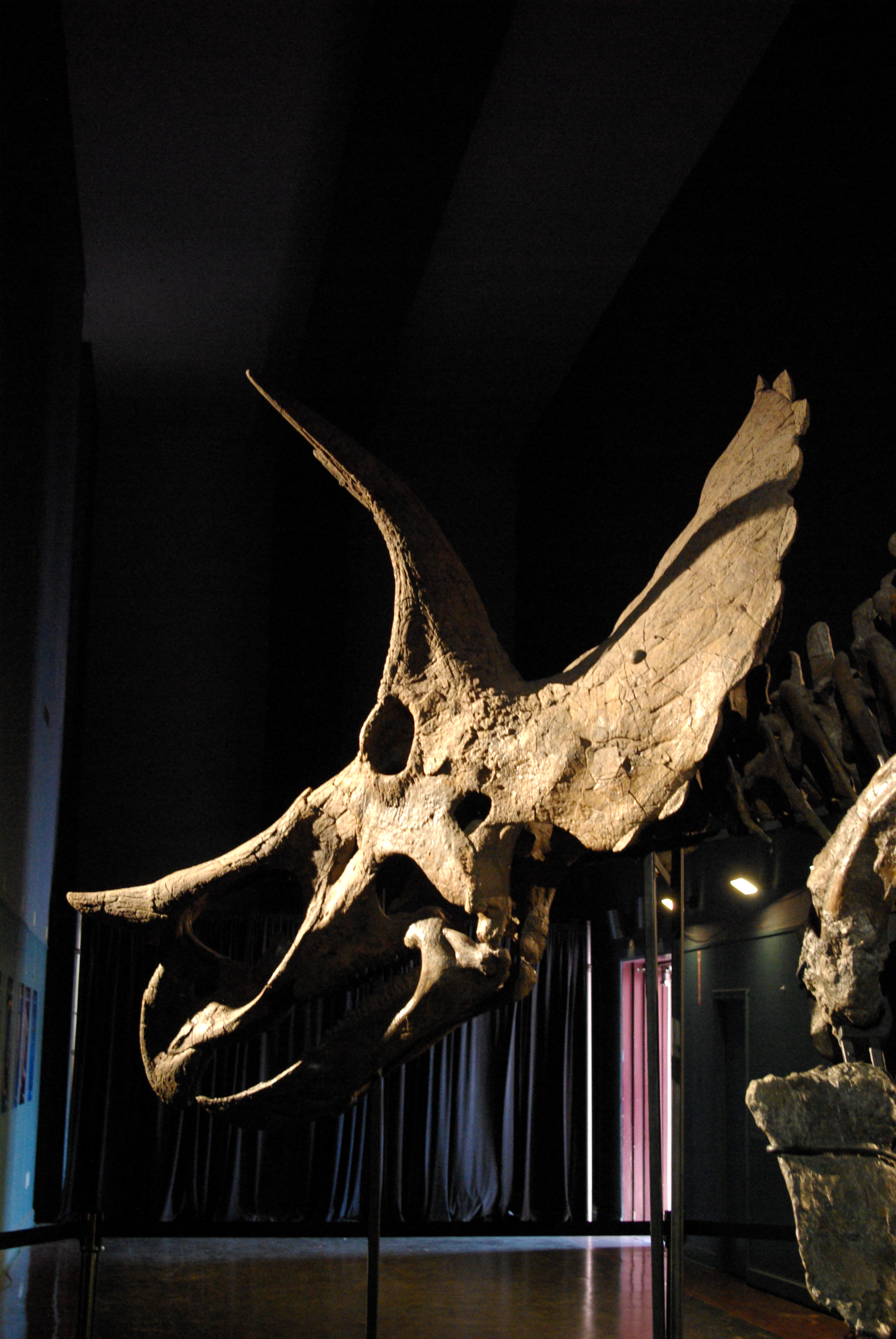
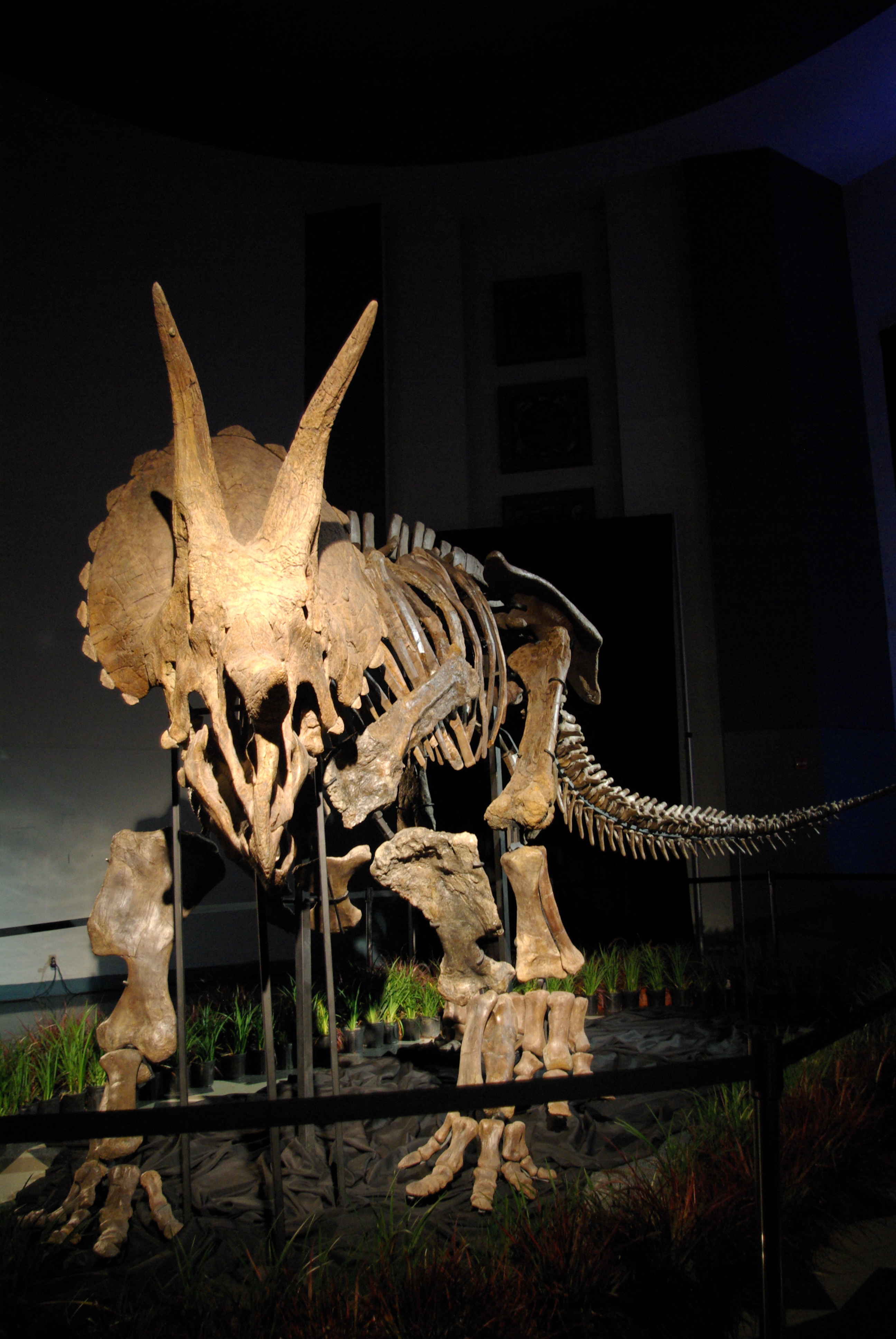
Triceratops welcomes bidders and gawkers to the Heritage Auction sale of fossils, gems, meteorites, and other national history ephemera. HA estimates this nearly-complete triceratops, mounted, to be worth about $700,000; less than 24 hours before the live auction, it has an online bid of $500,000 already.
Heritage Auctions set up a bug bunch of fossils, gems, meteorites, taxidermy, and art work from natural materials, for an auction on Sunday, June 12, 2011.
I can’t afford to bid, but they let me in to get photos. Nice people.
Heritage Auctions' June special, a triceratops - photo by Ed Darrell; use permitted with attribution
The triceratops greets visitors and bidders at the display site, the Tower Building at Dallas’s art deco gem, Fair Park. (If you look at the ceiling above the triceratops, you can see where restorers have stripped away several layers of paint to reveal the original ceiling paintings — original artwork, including murals, was painted over in the years following the dramatic debut of the buildings; restoration work proceeds slowly because of lack of funding.)
Triceratops horridus Cretaceous Hell Creek formation, Harding County, South Dakota
Triceratops has enjoyed much cultural publicity ever since its discovery. It is an iconic dinosaur that has appeared in movies ranging from black and white cinema to modern movies like “Jurassic Park.” It has also been in cartoons, such as the children’s classic “The Land before Time.” Triceratops is also the official state fossil of South Dakota and the official state dinosaur of Wyoming.
The present specimen was discovered in 2004 in two parts: First, the fossil hunters came upon pieces of dinosaur bone eroding down a gully. Following these bone fragments, they eventually came upon large bones that would indicate the presence of a large Ceratopsian dinosaur. While this large mass of bones was being excavated, other members of the team followed another bone trail which led them to an amazingly well preserved skull 750 feet away from the original discovery. Over the course of months, the specimens were carefully excavated in large blocks; each specimen was covered in plaster jackets and removed from the field to the lab. It was only during preparation that they discovered the dinosaur was a Triceratops, and it happened to be a Triceratops with an incredibly complete skull. The bones and skull were carefully removed from their field jackets and prepared using hand tools. Broken bones were professionally repaired and restored while a few missing elements were cast from other Triceratops skeletons. A custom made mount was created to support the bones and the skull; innovative bracket mounts were crafted for each bone so that no bones had to be damaged in order to mount them. The bones were mounted in osteologically correct position; making it comparable to and possibly surpassing the accuracy of older mounts in museum displays. Though it is impossible to say whether or not the skull is original to the specimen, being discovered 750 feet apart, it is certainly possible that the two elements are associated for a number of reasons: first, the size of the skull is consistent with the proportional size dimensions of the skeleton, and second, the surrounding matrix (host rock) was identical in composition.
The completed skeleton is enormous; measuring 19 feet long from head to tail, 11 feet across, and towering 12 feet tall. The skull itself measures 7 feet long with 3 ½ foot long horns; placing it near the top of the size range for Triceratops skulls. The leg bones stand 10 feet tall from toes to the top of the scapula; dwarfing many other Triceratops skeletons. Given that the skull represents about 30% of a dinosaur’s entire skeleton, the present specimen is about 75% original bone, with the right leg, pelvic region, several cervical vertebrae and a few tail vertebrae being cast reproductions.
Who owns the thing? Who put it together? Who is losing the specimen, should it go to a private collection (you got a living room that big?), and which museum really wants it?
But that’s just one of the specimens up for sale at this auction, and not necessarily the best. Also up for bid: A stegosaurus, and an allosaurus, posed as a “fighting pair.”
The "fighting pair," an allosaurus (left) and stegosaurus (right) posed in combat positions. Photo by Ed Darrell, use permitted with attribution.
Am I jaded? On the one hand you can’t look at these specimens without thinking they deserve to be seen by kids, and adults, and studied by paleontologists and biologist of all stripes — and so who has the right to sell these off? On the other hand, this is a Second Gilded Age, and the search for prize fossil specimens is often financed by the proceeds from these auctions. I enjoyed an hour’s browsing and photographing — a slide presentation on the wonders of America for some sleepy class next fall.
How many of these specimens will I get a chance to see again in the future?
Or, Dear Reader, how many of these will you ever get a chance to see?
HA will sell a lot more than just a few dinosaur fossils. This same sale includes the largest shark jawbone ever found, stuffed Kodiak and polar bears (from the same hunter), gems, art from petrified wood and fossilized fish, and a large selection of meteorites, including the only meteoroid ever confirmed to have struck and killed a living creature (a cow in Argentine; you can’t toss a stone without hitting a cow in Argentina, I hear).
Requires a large wall and high ceilings to display
I don’t plan to go bid; there’s about an hour remaining for online bidding tonight, but if you’re interested and you’ve got your income tax refund burning a hole in your pocket, you can also bid by telephone and hotlink on the internet (go to the Heritage Auction site for details). Frankly, I don’t think the sale will get the attention it deserves. I hope these spectacular specimens will land where they can get a great, admiring and studious audience.
Spread the word; friends don't allow friends to repeat history.
Boy Scout Junior Cruz, with Cpl. Adam Galvez's parents Tony and Amy Galvez, at Adam Galvez Street in Salt Lake City
Marines honor their fallen comrade Cpl. Adam Galvez, at the ceremony naming a street after Galvez.7
Once upon a time I might have wondered about the utility of such a project, not because naming a street after a veterans isn’t a great idea, but because the actions required for naming streets might not measure up to the usual expectations for great service in an Eagle project. This project and the stories about it quickly dispel such worries — for example, notice that the city required Cruz to raise the $2,000 required to change the street signs, such fundraising itself a major accomplishment. Our son James’s project at the DFW National Cemetery required similar fundraising, and got at least as much in in-kind contributions — but it was major work.
Marines salute at the ceremony for the naming of Adam Galvez Street, 2007
Reading the news story, I thought back to a question that has plagued me for years: Why didn’t we have the good sense to welcome back Vietnam vets with parades, and other welcome home activities? That was one great lesson of Vietnam I think we, as a nation, learned well. Today national news programs, like the PBS Newshour, honor each fallen soldier in our nation’s wars. Here in Dallas, and at other cities I suspect, there is a formal volunteer program to make sure soldiers returning from Iraq and Afghanistan deployments get a flag-waving cheer when they get off the airplane. Churches, schools, Girl Scouts and Boy Scouts volunteer to go wave the flags and cheer the soldiers. The volunteers may get more out of it than the soldiers, but the message is clear all the way around: These soldier men and women served their nation, and they deserve thanks and a cheer.
Ceremony naming Adam Galvez Street, February 2007
Is it too late to do that for Vietnam veterans? A chief complaint over the years, especially from the war-hungry right wing, is that the Vietnam peace movement dishonored those veterans, chiefly by not honoring them more when they came home.
My brother, Wes, served four tours in Southeast Asia in that war, returning each time to no great celebration other than his family’s great gratitude at his return. He’s too great a patriot to complain — as are most of the other Vietnam vets. Our periodic patriotic celebrations now do better: Vietnam vets get honored at July 4 and Veterans’ Day celebrations, and the fallen get special honors on Memorial Day, in most towns in America.
Junior Cruz hit on a great idea, though: Name a street in honor of the fallen.
Why not do that for more Vietnam vets? My hometown of Pleasant Grove, Utah, had a population of fewer than 10,000 people during the Vietnam conflict, but well I remember in my high school years when the list of fallen passed 11, including a recently-graduated studentbody president and basketball star and the brother of a woman in my French class. Neither of them has a memorial other than their gravestone, that I’m aware.
Adam Galvez Street, Salt Lake City, Utah
Street names can tell us a lot about a town or city. In the great booming times of 1950s through 1990s, a lot of streets in America were named after developers’ kids, wives and ex-wives. More recently developers have taken to cutesy names on a theme designed to sell homes: “Whispering Waters Way,” “Mountain View,” etc. Those cities where history gets some note in street names do well, I think. Ogden, Utah, named a bunch of streets after presidents, in order of their service, from Washington through the second Harrison (and as a consequence, a lot of people who grew up in Ogden can name the presidents in order from Washington through almost to Teddy Roosevelt). New York has not suffered from renaming a stretch of road The Avenue of the Americas, Washington, D.C. has done well with both Independence Avenue and Constitution Avenue.
Why not rename some streets in American after Vietnam veterans? While we’re at it, how about Korean War veterans? We can’t recapture the time and do what we should have done about 58 years ago for Korea or about 45 years ago for Vietnam. We can do noble things from now, forward. Why not create memorials that remind us of the great service these people did for their nation, and name and rename streets in their honor?
Or, until that account is unsuspended by the forces supporting Donald Trump: Follow @FillmoreWhite, the account of the Millard Fillmore White House Library
We've been soaking in the Bathtub for several months, long enough that some of the links we've used have gone to the Great Internet in the Sky.
If you find a dead link, please leave a comment to that post, and tell us what link has expired.
Thanks!
Retired teacher of law, economics, history, AP government, psychology and science. Former speechwriter, press guy and legislative aide in U.S. Senate. Former Department of Education. Former airline real estate, telecom towers, Big 6 (that old!) consultant. Lab and field research in air pollution control.
My blog, Millard Fillmore's Bathtub, is a continuing experiment to test how to use blogs to improve and speed up learning processes for students, perhaps by making some of the courses actually interesting. It is a blog for teachers, to see if we can use blogs. It is for people interested in social studies and social studies education, to see if we can learn to get it right. It's a blog for science fans, to promote good science and good science policy. It's a blog for people interested in good government and how to achieve it.
BS in Mass Communication, University of Utah
Graduate study in Rhetoric and Speech Communication, University of Arizona
JD from the National Law Center, George Washington University


 Posted by Ed Darrell











 Millard Fillmore's Bathtub