It’s the annual competition EPA sponsors for younger people and older people, the Rachel Carson Sense of Water Contest. Contest officials want you to participate and vote on the photos, to help select the winners:
Wade In And Cast Your Vote For The 2012 Winners Of The Rachel Carson Sense Of Water Contest
“To stand at the edge of the sea, to sense the ebb and flow of the tides, to feel the breath of a mist moving over a great salt marsh, to watch the flight of shore birds that have swept up and down the surf lines of the continents for untold thousands of year, to see the running of the old eels and the young shad to the sea, is to have knowledge of things that are as nearly eternal as any earthly life can be.” Rachel Carson from “The Sea Around Us”
For the past six years, I have had the privilege of overseeing the Rachel Carson Sense of Wonder contest. The purpose is to create artistic expressions through photography, poetry, essays and dance that capture the sense and appreciation of the environment. This year’s contest focused on water in recognition of the 40th Anniversary of the Clean Water Act. Teams of young persons and older have expressed appreciation for water through extraordinary and precious expressions of art. From raindrops on a blade of grass, to a gentle rain in a forest, to waves in the ocean as far as the eye can see, we see, taste and feel water.
I have been heartened to receive messages from grandparents and grandchildren, parents and children, teachers and students, and nature lovers of all ages, who appreciate the teaching of Rachel Carson.
Andre Gide, a French Nobel laureate for literature wrote, “Man cannot discover new oceans unless he has the courage to lose sight of the shore.” Many of our teams did just that, discovering and exploring water and nature with a new sense of wonder. And just as the pleasing as Handel’s water music was for King George, I too have been thrilled by the notes from participants:
“thanks for giving this opportunity to kids to rethink about environment and nature”
“we had a great time completing this contest.”
“such a wonderful project!!!”
“when will EPA announce the 2013 contest and what will the theme be?”
Our judges were also impressed by the imaginative entries from teams that worked across generations to discover and enjoy the beauty of water. It was a quite a challenge for them to select finalists from so many lovely works. Now it is your chance to help us select the 2012 winners of the Rachel Carson Sense of Water Contest here.
About the Author: Kathy Sykes is a Senior Advisor for Aging and Sustainability in the Office or Research and Development at the U.S. EPA. She grew up in Madison, WI and has been working at the U.S. EPA since 1998. She believes the arts can serve as an environmental educational tool and foster appreciation and protection for the natural world.
Editor’s Note: The opinions expressed in Greenversations are those of the author. They do not reflect EPA policy, endorsement, or action, and EPA does not verify the accuracy or science of the contents of the blog.
It’s worthy and fun enterprise — and some of the photographs will make you gasp, and some may bring tears to your eyes. Go see, and vote for the winners.
You’ve seen the news, about the discovery of a complete set of baseball cards in an attic in Defiance, Ohio. The collection should make its owners very, very rich. It includes rare cards of Honus Wagner, and Ty Cobb, The Georgia Peach.
On July 18, 1927, Ty Cobb recorded his 4,000th career hit. Cobb finished out his Major League Baseball career in 1928 with a grand total of 4,191 hits. Cobb stood as the all-time hit leader until his total was surpassed by Pete Rose in 1985.
Cobb began his professional career at the age of eighteen with the Detroit Tigers with which he played twenty-two of his twenty-four seasons. Like the careers of baseball greats Pete Rose and “Shoeless” Joe Jackson, Cobb’s was marred by scandal. He was allowed to resign in 1926 in lieu of being banned for alleged gambling violations. However, Cobb was subsequently exonerated and reinstated by baseball’s first commissioner, Judge Kenesaw Mountain Landis.
Cobb, born on December 18, 1886, in Narrows, Georgia, and nicknamed “The Georgia Peach,” was known for his temper as well as for his outstanding athletic ability. He stole home fifty-four times—fifty times with the Detroit Tigers and four times with the Philadelphia Athletics, won twelve batting average titles, and managed the Detroit Tigers for six seasons while also playing center field. His lifetime batting average was .367. Cobb made use of his reputation as an aggressive (often dirty) base runner to intimidate infielders, stealing 892 bases during his professional career. Ty Cobb was one of the first five players elected to the in Cooperstown, New York, in 1936, along with Walter Johnson, Christy Mathewson, Babe Ruth, and Honus Wagner.
Chas. O’Leary and Tyrus Cobb,
1912. Baseball Cards, 1887-1914
This baseball card featuring Chas O’Leary and Tyrus Cobb, produced by the American Tobacco Company in 1912, shows Cobb sliding into third base. Click on the back of the card to read a description of Cobb’s base running statistics.
For more about baseball and its legendary players, search the following American Memory collections:
John Paul Jones, naval hero of the American Revolution, died in Paris on July 18, 1792. Born John Paul in Scotland on July 6, 1747, he apprenticed at age thirteen to a shipowner and sailed to Barbados. Owing to problems on another voyage to the West Indies (in 1773 he killed a sailor during a mutiny in Tobago, claiming self-defense), he fled to Virginia and changed his name—first to John Jones, and later to John Paul Jones.
Jones was commissioned a first lieutenant in the Continental Navy in December 1775 and the following year was commissioned a captain. His achievements at sea during the war were spectacular. Jones distinguished himself in action in the Atlantic Ocean during 1776 and 1777 in command of the naval ships the Alfred, the Providence, and the Ranger, taking many British ships as prizes.
On September 23, 1779, Jones achieved his most famous victory off the coast of England. With his flagship the Bonhomme Richard, which he had renamed in honor of his patron Benjamin Franklin, and accompanied by four other vessels, Jones engaged the British merchant fleet led by the Serapis in heavy combat for over three-and-one-half hours. During the battle, Jones answered the enemy’s demand that he surrender with the immortal words, “I have not yet begun to fight!”
After heavy losses of life on both sides, the British surrendered. Jones and his crew left their sinking ship and transferred to the captured Serapis. Congress passed a resolution thanking Jones and he received a sword and the Order of the Military Merit from King Louis XVI of France.
John Paul Jones held no further appointments in the United States Navy, but he served as rear admiral in the Russian Navy under Empress Catherine II of Russia from 1788-90. After his discharge, he resided in Paris in obscurity until his death and was buried in an unmarked grave. More than a hundred years later, the remains of the Navy’s first hero—lionized for his brilliant naval career, were identified and brought back to the United States with a full naval escort. His body is interred in a marble crypt, modeled on Napoleon’s tomb, in the chapel of the U.S. Naval Academy in Annapolis, Maryland.
All that bellyaching about Obama’s out of control spending? Bunk.
All that ballyhoo about how the U.S. spends way too much on foreign aid? Dangerous anti-American propaganda; we don’t spend enough.
For evidence, look at the Congressional Budget Office‘s non-partisan analysis of the State Department reauthorization act for the coming year, Fiscal 2013. And please, get the facts before you start to complain.
H.R. 6018 would authorize appropriations for the Department of State and related agencies, the Peace Corps, and international broadcasting activities. CBO estimates that implementing the bill would cost $15.8 billion over the 2013-2017 period, assuming appropriation of the specified and estimated amounts.
We’re talking actual outlays for the State Department, for all of our diplomatic efforts to prevent war, secure and strengthen peace, represent U.S. interests in trade and defense and culture, and manage the provision of about $37 billion in aid to other nations, of a total around $9.3 billion for FY 2013. (See page 2)
That’s a pittance.
Even if we include the $37 billion in foreign aid payouts, that’s less than $50 billion a year to manage and maintain our vital relationships in the world.
Less than 1% of our national budget goes to foreign aid.
Less than 1 penny of every dollar you pay in taxes, goes to foreign aid.
How much would be enough? We could double foreign aid without any significant effect to the deficits, but with huge effects in good will and actual production of peace overseas.
Most people think a “fair” percentage of the budget to dedicate to foreign aid would be about 10%.
This is no time for austerity in federal spending.
I miss his broadcasts, still, and they were gone a good 20 years earlier.
Here’s an earlier post on Cronkite:
Walter Cronkite at his office typewriter:
Walter Cronkite at his typewriter, in his office – from The Typewriter blog
Pipe rack to his left, on the shelf above; full set of the Encyclopedia Britannica to his right (probably a 1960s set); A lot of books, some dealing with space exploration, among his favorite topics; models of the X-15 and early versions of the Space Shuttle; award from the Boy Scouts to his right, where he can see it easily.
When was this photo taken? 1970s? Earlier? Maybe someone who follows Dixie Cups could date the cup to Cronkite’s left.
This is probably the same office, redecorated, and stripped down to move – and with a different typewriter (a Smith-Corona electric?):
Caption from the San Francisco Chronicle website: “In this March 6, 1981 file photo, Walter Cronkite talks on the phone at his office, prior to his final newscast as CBS anchorman in New York City. Behind him is a framed Mickey Mouse cartoon and his Emmy award. Famed CBS News anchor Walter Cronkite, known as the ‘most trusted man in America’ has died, Friday, July 17, 2009. He was 92.”
Then there are those happy masses who know him for his historical work, recovering the works of Johann Sebastian Bach’s final and most wayward child, P. D. Q. Bach.
Tip of the old bathtub-hardened conductor’s baton to Eric Koenig.
This is mostly an encore post. It was scheduled to run on time, not sure why it didn’t — problems of being on the road, you know.
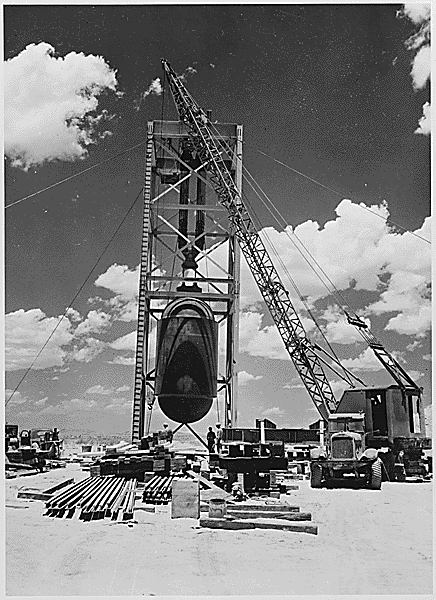
Rare color photograph of the first nuclear test at Trinity site, July 16, 1945. Blurriness is in the original photograph (done when color photography was still fairly new). (Photo credit: Wikipedia)
Spread the word; friends don't allow friends to repeat history.
Little towns in Kansas look like neutron bomb test sites. Especially on a Saturday afternoon, there are no people. Many of the buildings look as though they haven’t been occupied since Dwight Eisenhower was president.
But there’s a cafe in Scott, Kansas, about the intersection of U.S 40 and U.S. 83, that looks like a new business in an old building, the Road Kill Grill. It’s motto:
“Road Kill Grill: For diners with discerning tastes.”
Woody Guthrie singing, Smithsonian Folkways image – The sticker on Woody’s guitar reads, “This Machine Kills Fascists.” Woody regarded music as a great tool of democracy and freedom.
July 14, 2012, marks the 100th anniversary of the birth of Woody Guthrie, folksinger, union organizer, chronicler of American values, troubles and change.
We’re already more than halfway through Woody’s centennial year — and what celebration took place at Millard Fillmore’s Bathtub? History slips by so fast.
Much celebration remains. Get out your calendar and figure out which events you can join in.
Poster for the 2012 Woody Guthrie Folk Festival in Okemah, Oklahoma
How is Pete Seeger doing? He just turned — what? — 93; will he be able to make many of these events? (Book signing in New York, July 18 . . .) (Let’s start the Pete Seeger Centennial a few years early, maybe — like now . . .)
As the astrophysicist Neil deGrasse Tyson put it on the Hayden Planetarium website, “Manhattanhenge may just be a unique urban phenomenon in the world, if not the universe.”
Surely there is a phenomenon almost as cool, somewhere in the American Midwest or Mountain West, perhaps, where the good Presbyterian, Lutheran and Mormon pioneers laid out their cities and entire states with clean Cartesian grids . . . anyone got information to correct Dr. Tyson?
Maybe the question to ask, perhaps from Tyson, is how to calculate when an east-west street in your town might get a “henge” moment.
Sunrise at Delicate Arch, Arches National Park, by Alex Savage
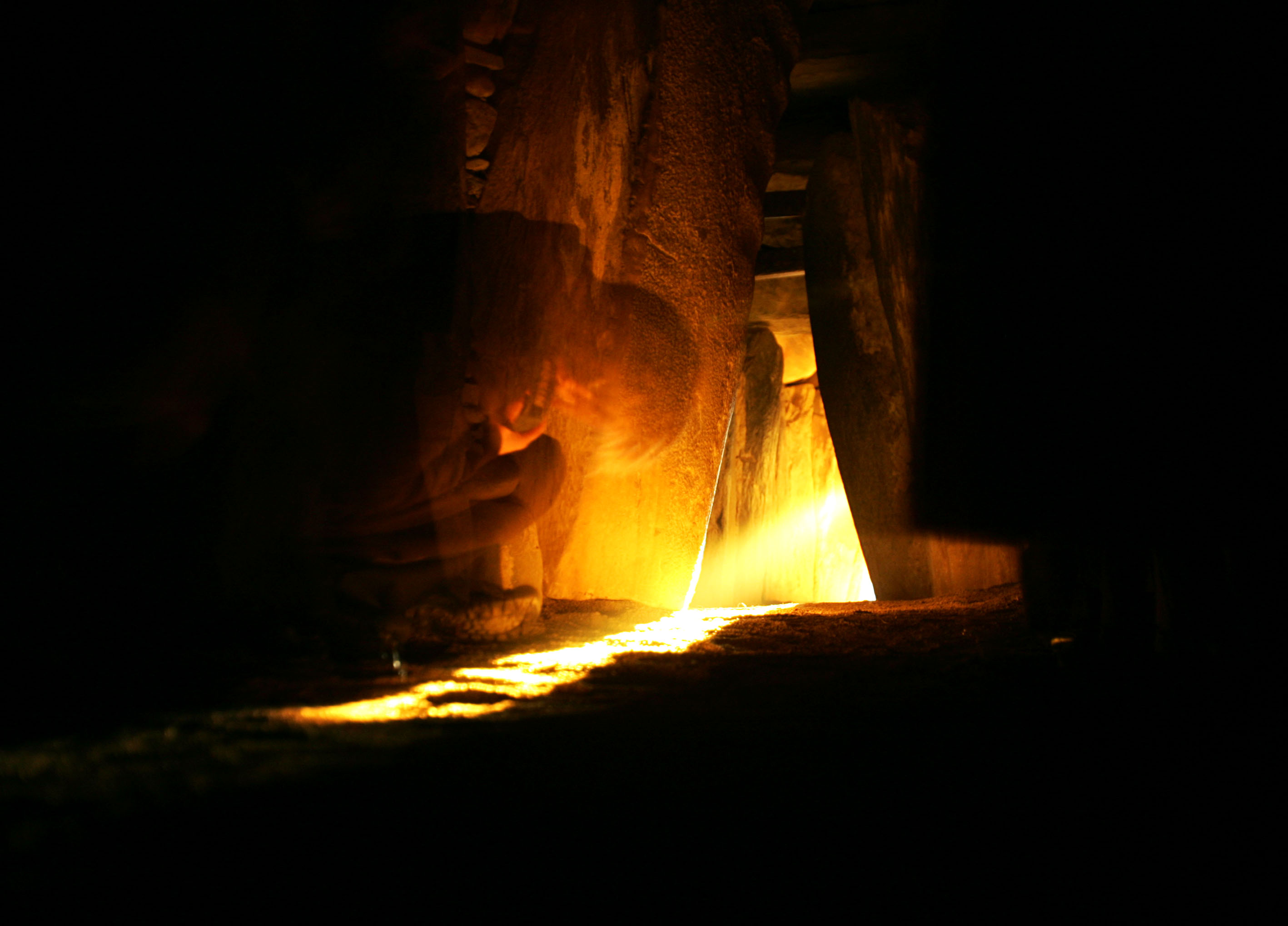
December 20, 2009, solstice sunrise at Newgrange, Ireland – Photograph by Cyril Byrne – courtesy of The Irish Times (Astronomy Picture of the Day, NASA)
Statue of Freedom (Liberty) which appears atop the U.S. Capitol (Photo credit: Wikipedia)
On this date, Architect of the Capitol, Montgomery C. Meigs received the conceptual drawings from Thomas Crawford, an American neoclassical artist, for the Statue of Freedom. The statue was to be the crown jewel of the dome atop the Capitol Rotunda. The first sketch of the statue featured a woman with a liberty cap. When Secretary of War Jefferson Davis objected to the allegorical allusion to a freed Roman slave, the artist revised the drawing to feature a statue with a helmet. Although construction on the dome began in 1856, the dome and its final accouterments were not in place until December 2, 1863. Freedom’s story contains an ironic twist; a slave named Philip Reid played an integral part in placing Freedom atop the dome. A contract dispute threatened to halt the project’s progress until Reid determined how to complete the complicated casting of the statue. As a result, he oversaw the remainder of the its construction. To commemorate the completion of the statue and its crowning of the dome, officials organized a dramatic ceremony with a 35-gun military salute echoed by salutes from the 12 forts ringing the federal city.
The dome of the US Capitol building. (Photo credit: Wikipedia)
Spread the word; friends don't allow friends to repeat history.
This summer, the greatest sports event on Earth comes to London. And our best sportsmen and women have a once in a lifetime opportunity, to compete at the highest level with the whole country behind them. That’s why we’re asking the nation to join together, to give our athletes the greatest home advantage we can give them. It could be the difference in seconds and millimetres, turning silver into gold. This summer, there’s nowhere else in the world to be.
After the death of his daughter Mary, Fillmore went abroad. While touring Europe in 1855, Fillmore was offered an honoraryDoctor of Civil Law (D.C.L.) degree by the University of Oxford. Fillmore turned down the honor, explaining that he had neither the “literary nor scientific attainment” to justify the degree.[22] He is also quoted as having explained that he “lacked the benefit of a classical education” and could not, therefore, understand the Latin text of the diploma, adding that he believed “no man should accept a degree he cannot read.”[9]
Tip of the small, folding travel scrub brush to Gil Brassard, believe it or not.
Sunrise over Stonehenge on the summer solstice, June 21, 2005 — the analogy of Manhattan’s skyscrapers to the rocks of Stonehenge is obvious (Photo credit: Wikipedia)
Dr. Tyson at the November 29, 2005 meeting of the NASA Advisory Council, in Washington, D.C. (Photo credit: Wikipedia)
Some time ago astronomy phenom Neil de Grasse Tyson mentioned the twice-a-year happenstance of the sun’s setting perfectly in line with New York City’s east-west gridded streets. On many streets, on most streets, you can watch the sun all the way down to the horizon, between the massive “rocks” of Manhattan skyscrapers, almost like watching the solstices at Stonehenge.
On May 30 at 8:16 p.m. and again on July 11 at 8:24 p.m., Manhattanhenge reaches its point of perfection as the full setting sun aligns with the city’s grid of East-West streets, according to the American Museum of Natural History’s Hayden Planetarium. The best places to view the fiery canyon of skyscrapers are at 14th, 23rd, 34th, 42nd, 57th Streets. The Empire State Building and the Chrysler Building offer especially good views.
Manhattanhenge on 34th Street, by Chaitanya Kapadia / UGC – Here’s what Chaitanya Kapadia says about this picture: “I had set up on a nice spot right in the middle of 34th Street, between the double yellow lines with a few photographers wanting to get the Empire State Building in my shot. However, I should have anticipated photographers to just swarm the streets when the sun lined up with the grid. Minutes later, the police drove down the middle of the road, getting everyone out, which only meant stepping to the side until they passed you, and then right back. Took this using three exposures hand-held.”
Or, until that account is unsuspended by the forces supporting Donald Trump: Follow @FillmoreWhite, the account of the Millard Fillmore White House Library
We've been soaking in the Bathtub for several months, long enough that some of the links we've used have gone to the Great Internet in the Sky.
If you find a dead link, please leave a comment to that post, and tell us what link has expired.
Thanks!
Retired teacher of law, economics, history, AP government, psychology and science. Former speechwriter, press guy and legislative aide in U.S. Senate. Former Department of Education. Former airline real estate, telecom towers, Big 6 (that old!) consultant. Lab and field research in air pollution control.
My blog, Millard Fillmore's Bathtub, is a continuing experiment to test how to use blogs to improve and speed up learning processes for students, perhaps by making some of the courses actually interesting. It is a blog for teachers, to see if we can use blogs. It is for people interested in social studies and social studies education, to see if we can learn to get it right. It's a blog for science fans, to promote good science and good science policy. It's a blog for people interested in good government and how to achieve it.
BS in Mass Communication, University of Utah
Graduate study in Rhetoric and Speech Communication, University of Arizona
JD from the National Law Center, George Washington University
By Kathy Sykes
to lose sight of the shore.” Many of our teams did just that, discovering and exploring water and nature with a new sense of wonder. And just as the pleasing as Handel’s water music was for King George, I too have been thrilled by the notes from participants:


 Posted by Ed Darrell









 Millard Fillmore's Bathtub
