Forgotten disasters in U.S. schools: The New London, Texas, gas explosion

March 18, 2013

Most high school history students don’t know about it.  Most high school history students in Texas don’t know about it.

New London School, New London, Texas, before the 1937 disaster.  Photo from the New London Museum

New London School, New London, Texas, before the 1937 disaster. Photo from the New London Museum

I wonder, sometimes, how many Texans remember at all.

I wonder, too, if there are lessons to be learned from the New London tragedy, while the nation debates what to do to prevent recurrences of school shootings.

The deadliest disaster ever to hit a public school in the U.S. struck on March 18, 1937, when a natural gas explosion destroyed the new school building at New London, Texas, killing about 300 people — 76 years ago today.

The remains of the London School after the exp...

The remains of the London School after the explosion of March 18, 1937. Wikipedia photo

Noise from the blast alerted the town, and many people in the oilfields for many miles.  Telephone and telegraph communication got word out.  Oil companies dismissed their employees, with their tools, to assist with rescue and recovery efforts.  Notably, 20-year-old Walter Cronkite came town to report the news for a wire service.

Investigation determined that a leak in a newly-installed tap into the waste gas pipe coming from nearby oil fields probably allowed natural gas to accumulate under the building.  A spark from a sander started a fire in gas-filled air, and that in turn exploded the cavern under the school.  School officials approved the tap to the waste gas line to save money.  Natural gas is odorless.  One result of the disaster was a Texas law requiring all utility natural gas to be odorized with ethyl mercaptan.

Though the Great Depression still gripped the nation, wealth flowed in New London from oil extraction from the nearby oil fields.  The  school district completed construction on a new building in 1939, just two years later — with a pink granite memorial cenotaph in front.

Today, disasters produce a wealth of litigation, tort suits trying to get money to make the injured whole, and to sting those at fault to change to prevent later disasters.  In 1937 official work cut off such lawsuits.

Three days after the explosion, inquiries were held to determine the cause of the disaster. The state of Texas and the Bureau of Mines sent experts to the scene. Hearings were conducted. From these investigations, researchers learned that until January 18, 1937, the school had received its gas from the United Gas Company. To save gas expenses of $300 a month, plumbers, with the knowledge and approval of the school board and superintendent, had tapped a residue gas line of Parade Gasoline Company. School officials saw nothing wrong because the use of “green” or “wet” gas was a frequent money-saving practice for homes, schools, and churches in the oilfield. The researchers concluded that gas had escaped from a faulty connection and accumulated beneath the building. Green gas has no smell; no one knew it was accumulating beneath the building, although on other days there had been evidence of leaking gas. No school officials were found liable.

These findings brought a hostile reaction from many parents. More than seventy lawsuits were filed for damages. Few cases came to trial, however, and those that did were dismissed by district judge Robert T. Brown for lack of evidence. Public pressure forced the resignation of the superintendent, who had lost a son in the explosion. The most important result of the disaster was the passage of a state odorization law, which required that distinctive malodorants be mixed in all gas for commercial and industrial use so that people could be warned by the smell. The thirty surviving seniors at New London finished their year in temporary buildings while a new school was built on nearly the same site. The builders focused primarily on safety and secondarily on their desire to inspire students to a higher education. A cenotaph of Texas pink granite, designed by Donald S. Nelson, architect, and Herring Coe, sculptor, was erected in front of the new school in 1939.  (Texas Handbook of History, Online, from the Texas State Historical Association)

Of about 500 students, more than 50% of them died.  Once the new school and memorial were built, and the law passed requiring utilities to odorize natural gas so leaks could be detected earlier, survivors and rescuers rather shut down telling the history.  A 1977 reunion of survivors was the first in 40 years.

New London School shortly after the March 18, 1937, explosion.  Photo from the New London Museum.

New London School shortly after the March 18, 1937, explosion. Photo from the New London Museum.

Because of that healing silence, the story slipped from the pages of most history books.

Trinity Mother Frances Hospital treated the victims; a 2012 film from the hospital offers one of the best short histories of the events available today.

New London, and the New London Museum, work to remember the dead and honor them.  Work continues on a film about the disaster, perhaps for release in 2013:

Now, more than 75 years later, the London Museum, across the highway from where the original school was destroyed, keeps alive the memory of much of a generation who died on that terrible day.

This video was produced by Michael Brown Productions of Arlington, TX as a prelude to a feature documentary on the explosion and its aftermath which is planned for
the spring of 2013.  . . .

www.newlondonschool.org/museum

What are the lessons of the New London Disaster?  We learned to remember safety, when dealing with natural gas.  A solution was found to alert people to the presence of otherwise-odorless, explosive gases, a solution now required by law throughout the U.S.  Natural gas explosions decreased in number, and in damages and deaths.  Wealthy schools districts, cutting corners, can create unintended, even disastrous and deadly consequences.  Quick rebuilding covers the wounds, but does not heal them.

Remembering history takes work; history not remembered through the work of witnesses, victims and survivors, is quickly forgotten — to the detriment of history, and to the pain of the witnesses, victims and survivors.

New, New London School and granite cenotaph memorial to the victims of the 1937 explosion

New, New London School and granite cenotaph memorial to the victims of the 1937 explosion. Photo from Texas Bob Travels.

More:

Houston’s KHOU-TV produced a short feature on the explosion in 2007:


Powerful argument for limiting bullets in a clip: Colorado Sen. Mike Johnston pleads to give victims a chance to escape

March 17, 2013

Here’s one of my nominees for the next editions of Great Speeches of the 21st Century, and Great Speeches in American History.  Sen. Mike Johnston, on March 11, in the Colorado State Senate, spoke against coward, “hollow men,” who commit mass shootings, and how to protect from them:

Notes from YouTube posting:

Published on Mar 12, 2013

March 11, 2013: Sen. Mike Johnston (D-Denver) describes how gun safety legislation, particularly HB 13-1224, can make a difference.

What do you think?

Senator Michael Johnston

Colorado State Senator Michael Johnston – Wikipedia Photo

‘Eleven kids saved in eleven seconds’ seems like a powerful argument, to me.

And this:  “And so the bad news is that at that moment will be outgunned.  The good news is that in America that never means we will be outfought.”

And this:  “The task of taking lives, and the task of saving lives, are fundamentally different endeavors, and they require different tools.”

At about 6:04 into this, listen to Sen. Johnston talk about the “cost of living and loving is that it takes up so much space in our lives.”

Wow.

More:


Quote of the moment: Mike Mansfield (b. March 16, 1903)

March 16, 2013

Senate Majority Leader Mike Mansfield, D-Montana

Senate Majority Leader Mike Mansfield, D-Montana; oil on canvas by Aaron Shikler, 1978 – Wikimedia image

Mike Mansfield was born on March 16, 1903.  Best boss I ever had.

Robert A. Nowlan’s Born This Day attributed this quote to Mansfield:

After all, even a politician is human.

Laconic as he was, Mansfield didn’t say anything more meaty than that?

Read about Mansfield at the Bathtub, here.  Mansfield died on October 5, 2001.

At a sad time when the political agenda of activist republic destroyers includes bitterly working hard to wipe out the history of great men like Mansfield, it’s important we remember him on his birthday.

English: Senate desk X, used by Democratic lea...

This is a photo of one of the rarest views of history one can see, visible only to those few people who get onto the floor of the U.S. Senate, and only if someone opens a desk for them.  One of the more interesting, odd, and sentimental traditions developed in the U.S. Senate is the signing of the desks.  Sometime in the 19th century senators began signing the inside of the desks they were assigned to on the Senate floor.  Sometimes a desk gets associated with a particular state and a senator from that class; sometimes a desk get associated with family (Sens. John, Ted and Robert Kennedy, for example).  Here is Senate desk X, used by Democratic leaders (Joseph T. Robinson, Alben W. Barkley, Scott W. Lucas, Ernest McFarland, Lyndon B. Johnson, Mike Mansfield, Robert Byrd, George J. Mitchell, Tom Daschle and Harry Reid) (Photo credit: Wikipedia)

More:


March 16, Freedoms Day – How to celebrate James Madison?

March 16, 2013

March 16 falls on Saturday this year, so celebrations of James Madison, who was born on March 16, 1751, will get lumped into the “something else to do” during Saturday errands, category.

March 16 is not a holiday.  It’s not even a Flag Flying Day (though, if you left your flag up for March 15th’s anniversary of Maine’s statehood . . . no one would notice).

Secretary of State James Madison, who won Marb...

Secretary of State James Madison, who won Marbury v. Madison, but lost Judicial review. Photo: Wikipedia

Should we leave James Madison out of our celebrations of history with such vengeance?

Madison left a great legacy.  The question is, how to honor it, and him?

  • Madison is known popularly, especially for elementary school history studies (the few that are done anymore), as the Father of the Constitution.  It’s fitting:  Madison engaged in a great, good conspiracy with George Washington and Alexander Hamilton to get the convention to “amend” the Articles of Confederation and create a better, probably stronger, national government.  But Washington stayed behind the scenes, and pulled very few strings Madison didn’t tell him to pull. Hamilton’s support from New York was weak; while Hamilton played a hugely important role in getting the convention called, and in getting New York to ratify the Constitution with the creation of the Federalist Papers project, the day-to-day operation of the convention and direction of the political forces to make it work, fell to Madison.
  • Madison’s notes on the Philadelphia convention give us the best record of the then-secret proceedings. 

    English: James Madison, fourth president of th...

    Notice the error in this caption:  “James Madison, fourth president of the United States wrote the Constitution at his estate near Orange Virginia, called Montpelier. Pictured here after an extensive renovation.” Photo from Wikipedia.  (James Madison didn’t write the Constitution; it was hammered out in Philadelphia, not Montpelier; the patriot and rake Gouverneur Morris wrote out the final draft.)

  • Madison devised the scheme of getting conventions to ratify the Constitution, instead of colonial/state legislatures.  He had Patrick Henry in mind.  Henry opposed any centralized government for the colonies, to the point that he refused to attend the Philadelphia convention when he was appointed a delegate; by the end of the convention, Henry was off to another term as governor where he hoped to orchestrate the defeat of ratification of the constitution in the Virginia legislature.  Madison circumvented that path, but Henry still threw up every hurdle he could.  (Henry organized the anti-federalist forces in the Virginia Convention, and hoping to kill the Constitution, called it fatally flawed for having no bill of rights; when Madison’s organizing outflanked him, especially with a promised to get a bill of rights in the First Congress, Henry blocked Madison’s election to the U.S. Senate, and organized forces to stop his popular election to the U.S. House.  That failed, ultimately, and Madison pushed the legislative package that became the Bill of Rights).
  • Andrew Hamilton started writing a series of newspaper columns, with John Jay, to urge New York to ratify of the Constitution; but after Jay was beaten nearly to death by an anti-federalist mob, Hamilton invited Madison to step in and help.  Madison ended up writing more than Hamilton and Jay put together, in that collection now known as The Federalist Papers.
  • Madison backed down George Mason, and got the great defender of citizens’ rights to add religious freedom to the Virginia Bill of Rights, in 1776.  Religious freedom and freedom of conscience became a life-long crusade for Madison, perhaps moreso than for Thomas Jefferson.
  • A sort of protege of Thomas Jefferson, Madison pushed much of Jefferson’s democratic and bureaucratic reforms through the Virginia legislature, into law.  Especially, it was Madison who stoppped Patrick Henry’s plan to have Virginia put preachers on the payroll, and instead pass Jefferson’s Statute for Religious Freedom into law in 1786.
  • Madison wrote the best defense of American religious freedom in the Memorial and Remonstrance, a petition to the Virginia legislature to get Jefferson’s bill passed.
  • Madison sponsored and passed more Constitutional Amendments than anyone else in history.  We have 27 amendments to our Constitution.  Madison pushed through the first 10, now known as the Bill of Rights.  In the original package proposed out of Congress were a dozen amendments.  One of those became salient again in the late 20th century, and was finally ratified in 1992 — the 27th Amendment.  Madison is the author of 11 of the 27 amendments, including the first ten and the last one.
  • Yeah, James Madison was the defendant in Marbury v. Madison; he made history even when he didn’t do anything
  • Madison is the only president to face enemy gunfire while president, commanding troops on the frontlines during the British invasion of Washington in 1814.
  • Madison took over the creation of the University of Virginia when Jefferson’s death prevented his following through.
  • Madison’s record as an effective, law-passing legislator is rivaled only by Lyndon Johnson among the 43 people we’ve had as president.  Both were masters at get stuff done.
  • Madison is the ultimate go-to-guy for a partner.  In his lifetime, to the great benefit of his partners, he collaborated with George Washington to get the convention in Philadelphia; he collaborated with Ben Franklin to get Washington to be president of the Philadelphia convention, without which it could not have succeeded; he collaborated with Hamilton on the Constitution and again on the Federalist papers; he collaborated with Jefferson to secure religious freedom in 1776, 1786, and 1789; Madison collaborated with Jefferson to establish our party political system (perhaps somewhat unintentionally), and to get Jefferson elected president; Madison collaborated with Jefferson and Jay to make the Louisiana Purchase; Madison took James Monroe out of the Patrick Henry camp, and brought Monroe along to be a great federalist democrat, appointing Monroe Secretary of State in Madison’s administration, and then pushing Monroe to succeed him as president.  Also, Madison was a prize student of the great John Witherspoon at what is now Princeton; Witherspoon took Madison, studying for the clergy, and convinced him God had a greater calling for him than merely to a pulpit.

As the ultimate Second Man — when he wasn’t the First Man — Madison’s role in history should not be downplayed, not forgotten.

March 16 is Madison’s birthday (“new style”).

What would be fitting ways to celebrate Madison’s life and accomplishments, on his birthday?  Nothing done so far in the history of the Republic adequately honors this man and his accomplishments, nor begins to acknowledge the great debt every free person owes to his work.

(Dolley Madison?  There are two topics for other, lengthy discussions — one on their marriage, and how they worked together; one on Dolley, a power in her own right.)

Previously, at Millard Fillmore’s Bathtub:

More:


New York in time-lapse — a teaser

March 14, 2013

Another time-lapse film by Samuel Orr, this one on a city, “New York Day.”

I said it is a teaser.  Orr wants to do a longer film, but needs some financial backing to get it done.

Details here:

Please go to the Kickstarter project page and help support a longer version of this short film

kickstarter.com/projects/motionkicker/new-york-year

I shot this film over 4 trips to NYC 2011-2012. The time-lapse sequences you see here were made (mostly) from hundreds of thousands of still images. A Canon 7D and T3i were the main cameras, with backup from a couple of older Nikon Coolpix 5000 point and shooters. A few clips are sped-up video.

Many thanks to the generosity of the musician/composer who allowed his great celtic track “Sawjig” to be used;
Ben Rusch aka Jasmine Brunch
benrusch.com
jasminebrunch.com

For more info on this and other projects;
motionkicker.com
twitter.com/motionkicker

i


March 14: π Day! A π roundup, mostly pie

March 14, 2013

Of course you remembered that today is pi Day, right?

Pi Day Pie from Slashfood.com

Happy π Day! Pi Day Pie – Slashfood.com

Oh, or maybe better, π Day.

We’ll start with the brief post from a few months ago, and then build on it with some activities and posts from around the WordPress-o-sphere.

The good people at PiDay.org suggest a few ways you can celebrate:

Make (and Eat) a Pie – These pie recipes for Pi Day from NPR’s McCallister look incredibly tasty. But, there’s no shame in putting a frozen store-bought pie in the oven, or picking up a pie from your local bakery. Any kind of pie is great on Pi Day! If you’re making your own, get inspired by these beautifully designed Pi Day Pies. Tell us on Facebook: What’s your favorite kind of pie for Pi Day?

Hope your π Day is complete as a circle, and well-rounded!

How are others celebrating?  A look around WordPress:

At SocialMediaPhobe, a musical interpretation of pifeaturing the music of Michael Blake:

So Long Freedom:

pidaypieToday is March 14th, also known as “Pi Day” for us math geeks out there because March 14th (3/14) is the first 3 digits of π (3.14159…).  To celebrate “Pi Day” I highly recommend doing something mathematical while having some pie at 1:59 pm.  I recommend Yumology‘s S’mores Pie as it has 3 main ingredients (chocolate, marshmallow, and graham cracker) and about 0.14159 other ingredients like sugar, butter, and stuff.  If you are not a math geek, its okay…you can still eat pie and count things like how many stop signs you pass on your way back to work from lunch.  Or you could go to the library and take out a book on something fun like binary code.  As we like to say, “There are only 10 types of people in the world:  Those that understand binary and those that don’t.”  Seriously, binary is as easy as 01000001, 01000010, 01000011.

Miles Free at PMPA Speaking of Precision:

Today 3-14 at 1:59  I will be celebrqting Pi Day. 3.14159 is the value of pi to 5 decimals...

So besides being  the cause of much techie “irrational” exuberance, Pi Day  is a great way to get some engagement with students.

Marymount High School has several activities, last year they had a design competition incorporating pi; the students then made and sold buttons of each design, proceeds going to the Red Cross.

Hmm- math subject matter, design, production, sales, accounting.

Sounds like what we do in manufacturing.
Maybe celebrating Pi Day is not so irrational as first thought.

Free said his pie is peach.

Steve Doyle at CraveDFW:

On March 12, 2009 your lawmakers  passed a non-binding resolution (HRES 224) recognizing March 14, 2009 as National Pi Day. It is one of the more legit holidays we discuss here, and it is actually an homage to geeks everywhere who see the date as a reason to celebrate due to its mathematical implications. We say any reason to celebrate anything is just fine by us.

Since we are predominately about food we will suggest a few places to actually enjoy a pie.

DSC06367

If you followed us at all this week you may have seen the pie at Bowl and Barrel pop up on our pages. This is the uber delicious Butterscotch Pie served as the solo dessert at the bowling alley and restaurant.  Go eat one of these.

He’s got more pi pie, if you click over there.

Gareth Branwyn at MakeZine offers more pie and a mnemonic:

How to Remember Pi to 15 Digits

Pi-Pie--69299

By way of sci-fi author and mathenaut Rudy Rucker’s Facebook wall comes this:

One way to remember the first few digits of pi is to count the letters in the words of this phrase:

“How I need a drink, alcoholic of course, after the heavy lectures involving quantum mechanics.”

[Image via FreakingNews]

Another song, on YouTube, at Awsomesauce:

b.love offers this clock image (is this clock for sale somewhere?):

A clock for pi day

TED Blog offers two videos:

Chirag Singh explains his “passion for pi.”

Daniel Tammet, “Different Ways of Knowing:

Geeks are really out in force today, flaunting pi for all they’ve got.

More:


Happy birthday, Albert Einstein!

March 14, 2013

How many ways can we say happy birthday to a great scientist born on Pi Day?  So, an encore post.

E=mcc - logo from AIP

E=energy; m=mass; c=speed of light

Happy Einstein Day! to us.  Albert’s been dead since 1955 — sadly for us.  Our celebrations now are more for our own satisfaction and curiosity, and to honor the great man — he’s beyond caring.

Almost fitting that he was born on π Day, no? I mean, is there an E=mc² Day?

Albert Einstein was born on March 14, 1879, in Ulm, Germany, to Hermann and Pauline Einstein. 26 years later, three days after his birthday, he sent off the paper on the photo-electric effect; that paper would win him the Nobel Prize in Physics in another five years, in 1921. In that same year of 1905, he published three other papers, solving the mystery of Brownian motion, describing what became known as the Special Theory of Relativity and solving the mystery of why measurements of the light did not show any effects of motion as Maxwell had predicted, and a final paper that noted a particle emitting light energy loses mass. This final paper amused Einstein because it seemed so ludicrous in its logical extension that energy and matter are really the same stuff at some fundamental point, as expressed in the equation demonstrating an enormous amount of energy stored in atoms, E=mc².

Albert Einstein as a younger man - Nobel Foundation image

Albert Einstein as a younger man – Nobel Foundation image

Any one of the papers would have been a career-capper for any physicist. Einstein dashed them off in just a few months, forever changing the fields of physics. And, you noticed: Einstein did not win a Nobel for the Special Theory of Relativity, nor for E=mc². He won it for the photo electric effect. Irony in history.

106 years later Einstein’s work affects us every day. Relativity theory at some level I don’t understand makes possible the use Global Positioning Systems (GPS), which revolutionized navigation and mundane things like land surveying and microwave dish placement. Development of nuclear power both gives us hope for an energy-rich future, and gives us fear of nuclear war. Sometimes, even the hope of the energy rich future gives us fear, as we watch and hope nuclear engineers can control the piles in nuclear power plants damaged by earthquakes and tsunami in Japan.

English: Albert Einstein on a 1966 US stamp

Albert Einstein on a 1966 US stamp (Photo credit: Wikipedia)

If Albert Einstein was a genius at physics, he was more dedicated to pacifism. He resigned his German citizenship to avoid military conscription. His pacifism made the German Nazis nervous; Einstein fled Germany in the 1930s, eventually settling in the United States. In the U.S., he was persuaded by Leo Szilard to write to President Franklin Roosevelt to suggest the U.S. start a program to develop an atomic weapon, because Germany most certainly was doing exactly that. But while urging FDR to keep up with the Germans, Einstein refused to participate in the program himself, sticking to his pacifist views. Others could, and would, design and build atomic bombs. (Maybe it’s a virus among nuclear physicists — several of those working on the Manhattan Project were pacifists, and had great difficulty reconciling the idea that the weapon they worked on to beat Germany, was deployed on Japan, which did not have a nuclear weapons program.)

English: USSR stamp dedicated to Albert Einste...

Everybody wanted to claim, and honor Einstein; USSR issued this stamp dedicated to Albert Einstein Русский: Почтовая марка СССР, посвящённая Альберту Эйнштейну (Photo credit: Wikipedia)

Einstein was a not-great father, and probably not a terribly faithful husband at first — though he did think to give his first wife, in the divorce settlement, a share of a Nobel Prize should he win it. Einstein was a good violinist, a competent sailor, an incompetent dresser, and a great character. His sister suffered a paralyzing stroke. For many months Albert spent hours a day reading to her the newspapers and books of the day, convinced that though mute and appearing unconscious, she would benefit from hearing the words. He said he did not hold to orthodox religions, but could there be a greater show of faith in human spirit?

Einstein in 1950, five years before his death

Einstein in 1950, five years before his death

When people hear clever sayings, but forget to whom the bon mots should be attributed, Einstein is one of about five candidates to whom all sorts of things are attributed, though he never said them. (Others include Lincoln, Jefferson, Mark Twain and Will Rogers). Einstein is the only scientist in that group. So, for example, we can be quite sure Einstein never claimed that compound interest was the best idea of the 20th century. This phenomenon is symbolic of the high regard people have for the man, even though so few understand what his work was, or meant.

A most interesting man. A most important body of work. He deserves more study and regard than he gets.

More, Resources:


Waiting for Comet Godot

March 14, 2013

Comet Pan-STARRS?

I just can’t see it.

The past two evenings, when it was supposed to be visible, we couldn’t find it.  Maddeningly, others have great photos of the thing.

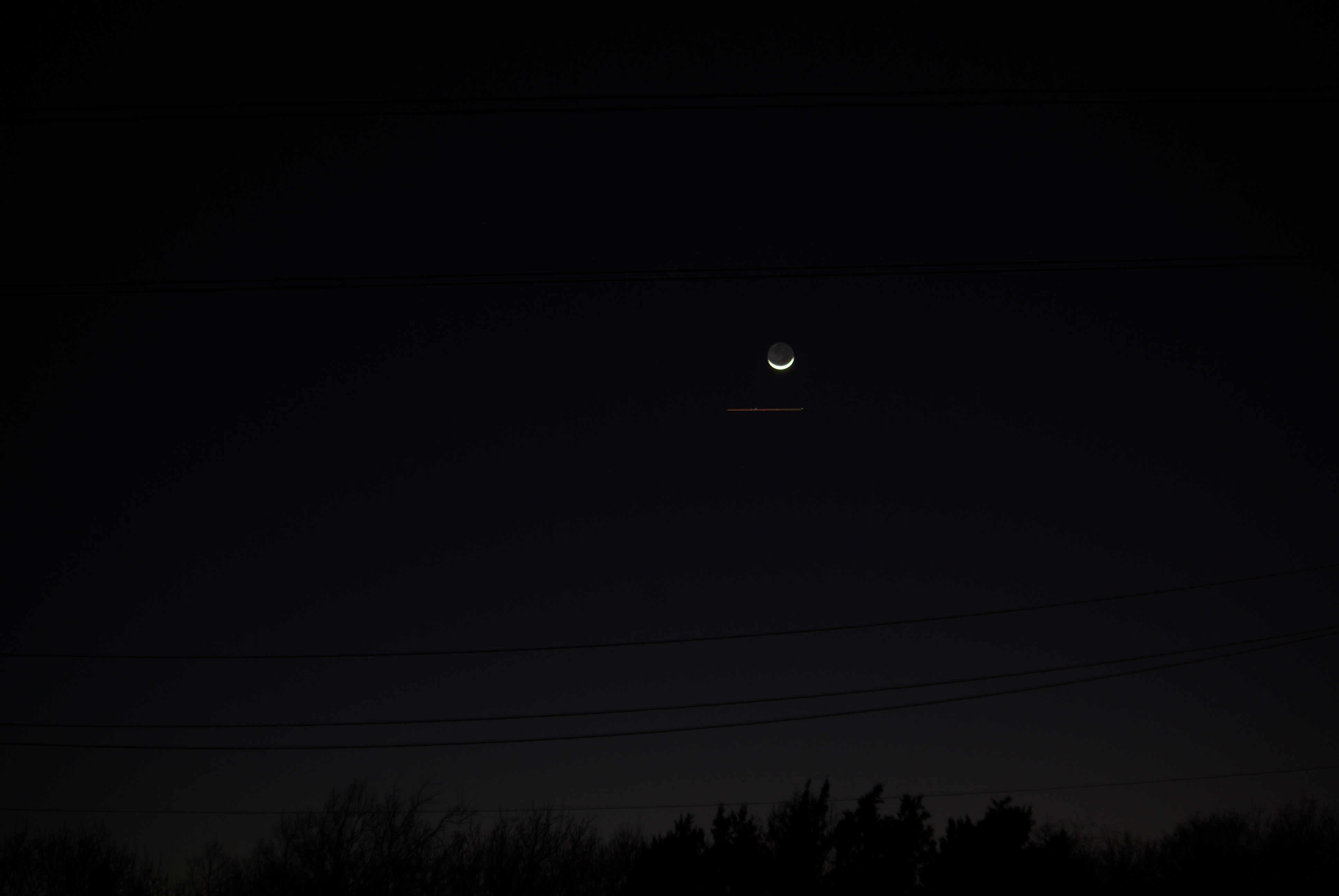
Here’s a photo of where it was supposed to be the evening of March 12.  Nice sliver of a Moon.

A view to the west over south Grand Prairie, Texas, showing the sliver of the new Moon, but a no-show Comet Pan-STARRS, March 12, 2013.  Photo by Ed, Kathryn and Peanut.

A view to the west over south Grand Prairie, Texas, showing the sliver of the new Moon, but a no-show Comet Pan-STARRS, March 12, 2013. Photo by Ed, Kathryn and Peanut.

We watched for over an hour, from just after the Sun’s winking out in a blaze of orange (Texas dust and DFW smog).  We were shooting without a tripod, and so it was difficult to capture just how thin was the line of the Moon for a long time.  It was not a clear crescent, with mountains of the Moon providing jagged lines that glistened like a crystal glass necklace.  Longer exposures revealed the comet to other observers in other places, but not to us.  Perched as we were right on the edge of the Austin Chalk Escarpment, we were joined by a dozen or so others who hoped to see the comet, or who were just putting their BMX bikes away.

A more detailed, and grainy, shot of the Moon (with no comet):

New Moon over Grand Prairie Texas, looking for Comet Pan-STARRS, photo by Ed Darrell

Eventually the Moon stated its presence, but still no Comet Pan-STARRS, on March 12, 2013. Looking west over Grand Prairie, Texas.  (Yeah, probably would have been a much better photo if not handheld.)

Here’s a photo of where it was supposed to be last night, the evening of March 13.

Moon over Grand Prairie, no comet, 3-13-2013

On March 13, Comet Pan -STARRS rode directly underneath the Moon; it’s invisible in this longer exposure, though you can see the streaking lights of a jetliner flying out of DFW International Airport under the Moon.

It’s like waiting for Godot.  Waiting for Comet Godot.

Quoting from SamuellBeckett.net:
ESTRAGON: 
People are bloody ignorant apes.  He rises painfully, goes limping to extreme left, halts, gazes into distance off with his hand screening his eyes, turns, goes to extreme right, gazes into distance. Vladimir watches him, then goes and picks up the boot, peers into it, drops it hastily.
VLADIMIR:  Pah!He spits. Estragon moves to center, halts with his back to auditorium.
ESTRAGON:  Charming spot. (He turns, advances to front, halts facing auditorium.)
Inspiring prospects. (He turns to Vladimir.)
Let’s go.
VLADIMIR:  We can’t.
ESTRAGON:  Why not?
VLADIMIR:  We’re waiting for Godot.
ESTRAGON:  (despairingly). Ah! (Pause.) You’re sure it was here?
VLADIMIR:  What?
ESTRAGON:  That we were to wait.
VLADIMIR:  He said by the tree. (They look at the tree.) Do you see any others?
ESTRAGON:  What is it?
VLADIMIR:  I don’t know. A willow.
ESTRAGON:  Where are the leaves?
VLADIMIR:

It must be dead.


More:

Brian Klimowski's photo of Comet Pan-STARRS, March 12, 2013

Other photographers found Comet Pan-STARRS. This photo comes via SpaceWeather.com. ” Brian Klimowski sends this picture from the countryside near Flagstaff, Arizona . . . ‘Beautiful show this evening!’ says Klimowski. ‘I took the photo from an altitude of about 9500 feet in the San Francisco Peaks near Flagstaff. A 1-second exposure with my Canon digital camera easily revealed the comet.'” Photo details: Canon 7D, 125 mm, 1s @ F/5.6. ISO 1250


Brilliant film: A Forest Year, from Motionkicker

March 14, 2013

Cousin Amanda Holland called my attention to this on Facebook.  Time lapse photography and a forest — heavenly to me.

More details from Motionkicker,  Samuel Orr:

help support my new time-lapse project at kickstarter!
kickstarter.com/projects/motionkicker/new-york-year

A Forest Year was made from 40,000 still images taken from my front window over 15 months, and were blended into the film.

Find out more about how it was made at motionkicker.com

Special thanks to Johnny_RIpper for letting me use his music.
soundcloud.com/johnny_ripper

Tip of the old scrub brush to Amanda Holland and the National Forest Foundation.

More:


Great obits, tribute: The Scoop on obit author Amanda Lewis

March 13, 2013

The Scoop, a blog of the Dallas Morning News, followed up on that great obit of Harry Stamps.  Reporter Eric Aasen tracked down Amanda Lewis, Stamps’s daughter, and the author of his obituary, which the Biloxi Sun-Herald judge “best ever.”

Harry Stamps and his daughter, Amanda Lewis

Harry Stamps with his daughter, Amanda Lewis, at her wedding in Dallas. Lewis wrote the great obituary for her father published last week in the Biloxi Sun-Herald. Photo from Amanda Lewis, via The Scoop

“He had a life-long love affair with deviled eggs, Lane cakes, boiled peanuts, Vienna [Vi-e-na] sausages on saltines, his homemade canned fig preserves, pork chops, turnip greens, and buttermilk served in martini glasses garnished with cornbread.”

Lewis tells The News she started writing the obituary Thursday morning, when she began the long drive from Dallas to Mississippi. She says her mother had given her some highlights, some bullet points in order to write the standard small-print farewell. But that’s not the kind of obituary she wanted to write.

“I don’t understand why people do a résumé for an obituary,” says Lewis. “It never captures the spirit of the person. My dad had such a big spirit. He had such a big personality. And I didn’t think listing where he went to college and his résumé would do him justice. I liked the idea of setting it up as kind of a contrast where at first you think it’ll be a pretentious obituary — everyone’s great when they die in an obituary — and then I tried to use what would have been his sense of humor to describe my dad. And clearly it worked. I was pleased with it.”

So was everyone else.

Aasen had a couple of great photos to add  (and it ran in this morning’s edition of the newspaper, too).

My father told the story of attending the funeral for a woman who had a bit of a checkered past, as he would euphemistically tell us, and who did not get along with everyone.  He said the pastor, delivering a eulogy, talked of fine Italian tapestries, famous for brilliant colors and even silver and gold used as thread.  “In every fine Italian tapestry, there are black threads woven in, to contrast with the silver and gold,” the pastor said.  “And so it was with the life of this woman.”

Some tributes to the departed capture their spirit — think of Teddy Kennedy quoting  a paraphrase of Bernard  Shaw at the funeral of his brother Robert.  Tributes provide deep, lasting memories, or change events on their own, sometimes.

Harry Stamps’s obit was a great oneI’ve posted two others that I think produced more smiles than tears, and I know there are other obituaries out there that are worthy of reading, spreading the news about, and perhaps, emulation.   Know of any?

More:


Backyard birds: Goldfinch at the feeder

March 12, 2013

No, he’s not particularly gold — but this is winter, and if he’s going to get his breeding plumage, it will come in a couple of weeks.

We’ve had Niger thistle seed feeders out for years; this year one goldfinch (Spinus tristis) finally started to visit.  We’ve had as many as four at a time — but they’re probably headed north soon.

Here’s a shot of our first guest, from a couple of weeks ago.

Goldfinch at the feeder

A goldfinch male, checking out the feeder before bringing in his buddies — we hope.

If you’re north of Dallas, and you see this guy at your feeder this summer, tell him “hello” from us.

The non-breeding plumage isn’t so flashy as the bright yellow of the breeding males.  Some of the finches settle in to a beautiful, smooth olive-drab livery for much of the winter.  Close up, they look like good pen-ink-drawings by a master artist.

More:


Great obits: Val Patterson, Salt Lake City

March 12, 2013

A nice guy by all reports – but not a Ph.D.

Not that he cheated to get it.

It’s a great story, and it unfolded only in the obituary he wrote for himself.  The obituary ran in The Salt Lake Tribune, from July 15 to July 22, 2012.

Val Patterson

Obituary

1953 – 2012

Val Patterson

Val Patterson, 1953-2012

I was Born in Salt Lake City, March 27th 1953. I died of Throat Cancer on July 10th 2012. I went to six different grade schools, then to Churchill, Skyline and the U of U. I loved school, Salt Lake City, the mountains, Utah. I was a true Scientist. Electronics, chemistry, physics, auto mechanic, wood worker, artist, inventor, business man, ribald comedian, husband, brother, son, cat lover, cynic. I had a lot of fun. It was an honor for me to be friends with some truly great people. I thank you. I’ve had great joy living and playing with my dog, my cats and my parrot. But, the one special thing that made my spirit whole, is my long love and friendship with my remarkable wife, my beloved Mary Jane. I loved her more than I have words to express. Every moment spent with my Mary Jane was time spent wisely. Over time, I became one with her, inseparable, happy, fulfilled. I enjoyed one good life. Traveled to every place on earth that I ever wanted to go. Had every job that I wanted to have. Learned all that I wanted to learn. Fixed everything I wanted to fix. Eaten everything I wanted to eat. My life motto was: “Anything for a Laugh”. Other mottos were “If you can break it, I can fix it”, “Don’t apply for a job, create one”. I had three requirements for seeking a great job; 1 – All glory, 2 – Top pay, 3 – No work.

Val Patterson

Val Patterson, 1953-2012

Now that I have gone to my reward, I have confessions and things I should now say. As it turns out, I AM the guy who stole the safe from the Motor View Drive Inn back in June, 1971. I could have left that unsaid, but I wanted to get it off my chest.  Also, I really am NOT a PhD. What happened was that the day I went to pay off my college student loan at the U of U, the girl working there put my receipt into the wrong stack, and two weeks later, a PhD diploma came in the mail. I didn’t even graduate, I only had about 3 years of college credit. In fact, I never did even learn what the letters “PhD” even stood for. For all of the Electronic Engineers I have worked with, I’m sorry, but you have to admit my designs always worked very well, and were well engineered, and I always made you laugh at work. Now to that really mean Park Ranger; after all, it was me that rolled those rocks into your geyser and ruined it. I did notice a few years later that you did get Old Faithful working again. To Disneyland – you can now throw away that “Banned for Life” file you have on me, I’m not a problem anymore – and SeaWorld San Diego, too, if you read this.

To the gang: We grew up in the very best time to grow up in the history of America. The best music, muscle cars, cheap gas, fun kegs, buying a car for “a buck a year” – before Salt Lake got ruined by over population and Lake Powell was brand new. TV was boring back then, so we went outside and actually had lives. We always tried to have as much fun as possible without doing harm to anybody – we did a good job at that.

If you are trying to decide if you knew me, this might help… My father was RD “Dale” Patterson, older brother “Stan” Patterson, and sister “Bunny” who died in a terrible car wreck when she was a Junior at Skyline. My mom “Ona” and brother “Don” are still alive and well. In college I worked at Vaughns Conoco on 45th South and 29th East. Mary and I are the ones who worked in Saudi Arabia for 8 years when we were young. Mary Jane is now a Fitness Instructor at Golds on Van Winkle – you might be one of her students – see what a lucky guy I am? Yeah, no kidding.

My regret is that I felt invincible when young and smoked cigarettes when I knew they were bad for me. Now, to make it worse, I have robbed my beloved Mary Jane of a decade or more of the two of us growing old together and laughing at all the thousands of simple things that we have come to enjoy and fill our lives with such happy words and moments. My pain is enormous, but it pales in comparison to watching my wife feel my pain as she lovingly cares for and comforts me. I feel such the “thief” now – for stealing so much from her – there is no pill I can take to erase that pain.

If you knew me or not, dear reader, I am happy you got this far into my letter. I speak as a person who had a great life to look back on. My family is following my wishes that I not have a funeral or burial. If you knew me, remember me in your own way. If you want to live forever, then don’t stop breathing, like I did.

A celebration of life will be held on Sunday, July 22nd from 4:00 to 6:00 pm at Starks Funeral Parlor, 3651 South 900 East, Salt Lake City, casual dress is encouraged.

Online condolences may be offered and memorial video may be viewed at www.starksfuneral.com.

These little snippets of history delight historians, though many of them are so fantastic they make newspaper obit writers frazzled trying to track down the facts.


Great Obits: Amos Schuchman, New York City

March 12, 2013

Amos Schuchman

Amos Schuchman, photo from the New York Daily News, via BizPac Review

Another great obituary.

It was a paid notice (most obituaries are paid notices, by the way), published February 2, 2013 — and it offered Amos Schuchman one last dig at The New York Times:

Amos Schuchman's obit, loved everything about NYC except the NY Times

“[Amos Schuchman] Loved his family, his birth and adopted countries, finance, skiing, opera, ballet and biking in Central Park. Loved everything about NYC, except the New York Times.”

“Loved everything about NYC, except the New York Times.”

Amos Schuchman’s children wrote, “His fearless heart still beats within all of us.  Shalom, Saba.”

Sometimes obituaries really capture the deceased person’s spirit.  Schuchman’s smiling now.

(No, I don’t share his view of the newspaper.)

More:


Great obits: Harry Weathersby Stamps, Long Beach

March 12, 2013

Alerted by a Tweet from Matt Soniak:

Several blogs and other sites, and the Biloxi Sun-Herald, say this is the best obit ever.  It’s a very good one, in any case.

Harry Stamps and wife Ann, in Long Beach, Mississippi

Photo from the SunHerald: PHOTO COURTESY AMANDA LEWIS Harry Stamps stands with wife Ann at their Katrina-damaged home in Long Beach. Stamps wears his famous grass-stained Mississippi State University baseball cap Read more here: http://www.sunherald.com/2013/03/11/4521106/best-obit-ever-harry-stamps-obituary.html#storylink=cpy

At the Biloxi SunHerald.com:

Harry Weathersby Stamps

December 19, 1932 — March 9, 2013

Long Beach

Harry Weathersby Stamps, ladies’ man, foodie, natty dresser, and accomplished traveler, died on Saturday, March 9, 2013.

Harry was locally sourcing his food years before chefs in California starting using cilantro and arugula (both of which he hated). For his signature bacon and tomato sandwich, he procured 100% all white Bunny Bread from Georgia, Blue Plate mayonnaise from New Orleans, Sauer’s black pepper from Virginia, home grown tomatoes from outside Oxford, and Tennessee’s Benton bacon from his bacon-of-the-month subscription. As a point of pride, he purported to remember every meal he had eaten in his 80 years of life.

The women in his life were numerous. He particularly fancied smart women. He loved his mom Wilma Hartzog (deceased), who with the help of her sisters and cousins in New Hebron reared Harry after his father Walter’s death when Harry was 12. He worshipped his older sister Lynn Stamps Garner (deceased), a character in her own right, and her daughter Lynda Lightsey of Hattiesburg. He married his main squeeze Ann Moore, a home economics teacher, almost 50 years ago, with whom they had two girls Amanda Lewis of Dallas, and Alison of Starkville. He taught them to fish, to select a quality hammer, to love nature, and to just be thankful. He took great pride in stocking their tool boxes. One of his regrets was not seeing his girl, Hillary Clinton, elected President.

He had a life-long love affair with deviled eggs, Lane cakes, boiled peanuts, Vienna [Vi-e-na] sausages on saltines, his homemade canned fig preserves, pork chops, turnip greens, and buttermilk served in martini glasses garnished with cornbread.

He excelled at growing camellias, rebuilding houses after hurricanes, rocking, eradicating mole crickets from his front yard, composting pine needles, living within his means, outsmarting squirrels, never losing a game of competitive sickness, and reading any history book he could get his hands on. He loved to use his oversized “old man” remote control, which thankfully survived Hurricane Katrina, to flip between watching The Barefoot Contessa and anything on The History Channel. He took extreme pride in his two grandchildren Harper Lewis (8) and William Stamps Lewis (6) of Dallas for whom he would crow like a rooster on their phone calls. As a former government and sociology professor for Gulf Coast Community College, Harry was thoroughly interested in politics and religion and enjoyed watching politicians act like preachers and preachers act like politicians. He was fond of saying a phrase he coined “I am not running for political office or trying to get married” when he was “speaking the truth.” He also took pride in his service during the Korean conflict, serving the rank of corporal–just like Napolean, as he would say.

Harry took fashion cues from no one. His signature every day look was all his: a plain pocketed T-shirt designed by the fashion house Fruit of the Loom, his black-label elastic waist shorts worn above the navel and sold exclusively at the Sam’s on Highway 49, and a pair of old school Wallabees (who can even remember where he got those?) that were always paired with a grass-stained MSU baseball cap.

Harry traveled extensively. He only stayed in the finest quality AAA-rated campgrounds, his favorite being Indian Creek outside Cherokee, North Carolina. He always spent the extra money to upgrade to a creek view for his tent. Many years later he purchased a used pop-up camper for his family to travel in style, which spoiled his daughters for life.

He despised phonies, his 1969 Volvo (which he also loved), know-it-all Yankees, Southerners who used the words “veranda” and “porte cochere” to put on airs, eating grape leaves, Law and Order (all franchises), cats, and Martha Stewart. In reverse order. He particularly hated Day Light Saving Time, which he referred to as The Devil’s Time. It is not lost on his family that he died the very day that he would have had to spring his clock forward. This can only be viewed as his final protest.

Because of his irrational fear that his family would throw him a golf-themed funeral despite his hatred for the sport, his family will hold a private, family only service free of any type of “theme.” Visitation will be held at Bradford-O’Keefe Funeral Home, 15th Street, Gulfport on Monday, March 11, 2013 from 6-8 p.m.

In lieu of flowers, the family asks that you make a donation to Mississippi Gulf Coast Community College (Jeff Davis Campus) for their library. Harry retired as Dean there and was very proud of his friends and the faculty. He taught thousands and thousands of Mississippians during his life. The family would also like to thank the Gulfport Railroad Center dialysis staff who took great care of him and his caretaker Jameka Stribling.

Finally, the family asks that in honor of Harry that you write your Congressman and ask for the repeal of Day Light Saving Time. Harry wanted everyone to get back on the Lord’s Time.

View & sign register book @ www.bradfordokeefe.com
Read more here: http://www.legacy.com/obituaries/sunherald/obituary.aspx?n=harry-stamps&pid=163538353&fhid=4025#fbLoggedOut#storylink=cpy

Yeah, but wouldn’t it have been funny to have held the funeral at the local links?  Just give the address, say nothing about golf, and don’t let anyone mention the venue.  They’d have talked about it for years.


How to tell Scouts are coming for dinner

March 11, 2013

Scout Dutch ovens at Camp Wisdom

Scouts coming for dinner – Dutch ovens ready for duty at Wisdom Trail District Outdoor Leader training, Camp Wisdom, Circle 10 Council BSA, March 9, 2013.

Dutch ovens lined up for duty is a tell that Scouts and Scouters are expected for dinner, aren’t they?

More: