Fly your flag today? Remembering D-Day, 1944 – 69 years ago

June 6, 2013

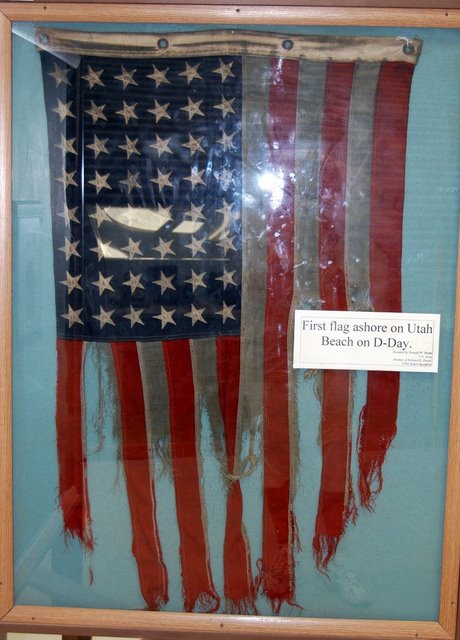
First Flag on Utah Beach, June 6, 1944

First Flag on Utah Beach, June 6, 1944 – Photo by Mark Wainwright

Today is the 69th anniversary of the Invasion of Normandy in World War II, a date generally called D-Day.  I usually get at least one e-mail request:  No, you don’t have to fly your flag.  This is not one of the days designated by Congress for flag-flying.

But you may fly your flag, and probably, you should.  If there are any D-Day veterans in your town, they’ll appreciate it.

This is mostly an encore post.


Why it’s important to have accurate history and science on the internet: Don’t lie to kids about DDT

June 6, 2013

Great accomplishment by this kid from Hudson, Massachusetts — but troubling, too.  He’s winning a persuasive speech competition, persuading people against history, law and science, calling for a return of DDT.
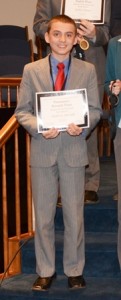
Andrew Brandt of Hudson MA, persuasive speaking champion

Andrew Brandt of Hudson holds his winning certificate at the regional speech and debate tournament in New Hampshire in April. He was one of seven to advance to the national competition. (Photo/submitted)

Hudson – Andrew Barndt, 13, from Hudson will be traveling to Tulsa, Okla., in June to join more than 500 students competing in a National Speech and Debate Tournament.

Andrew has qualified to compete in the Persuasive Speech category with the National Christian Forensics and Communications Association (NCFCA). Home-schooled students aged 12 to 18 compete at local and regional tournaments around the country in the winter and spring, culminating in the national tournament in June.

In April, at the regional tournament in Concord, N.H., 27 students competed in the Persuasive Speech category. Andrew’s speech, “DDT: What You Think You Know May Not Be So,” was one of seven chosen to move on the national competition.

According to the NCFCA, “a persuasive speech is an original platform speech that attempts to persuade the audience to adopt a particular point of view or course of action.”

A competitor will give a speech three times in front of different three-judge panels. Judges can be other parents, members of the community or former competitors. The judges rank them on 17 criteria, including: using outside evidence, relating a clear thesis, demonstrating a logical flow of ideas, incorporating proper vocal technique, having good energy level and making eye contact. The top candidates advance to a final round and the winners are decided. Winners receive a trophy and recognition on the NCFCA website.

Andrew will present his winning speech at the national competition held at Oral Roberts University June 18-22. His speech has three parts: debunking the myth of birds’ eggs being harmed due to DDT, disproving the claim that DDT causes cancer in humans, and pointing out that DDT has saved hundred of millions of lives by reducing mosquitoes that carry malaria. He concludes by urging his listeners to repeal the ban on DDT.

“I’m an avid birdwatcher,” Andrew said. “which is how I became familiar with DDT in the first place.”

According to his mother, Ann Barndt, Andrew also competes in debate. “This year he and his brother, Jonathan, 16, partnered together as a team,” she said. “However, their record was not high enough to advance.”

She said the brothers did enjoy preparing for the tournaments, researching various aspects of the this year’s topic, the United Nations. They plan to partner together again next year.

“As for my future, I’m still thinking about how to merge [bird watching] with a sustainable livelihood,” Andrew said.

For more information about the tournament, visit www.ncfca.org.

At the site of the Hudson Community Advocate, I offered what I hope is gentle but persuasive advice to the kid, from one old debater to another:

I commend the young man on his speaking prowess — but he needs a lot of help with his research chops.

1. Birds eggs are harmed by DDT; worse, that’s just one of four ways DDT kills birds. It also poisons chicks outright, in the eggs, poisons the adults (especially migratory birds), and it disrupts the nervous systems of chicks so that, even when they do hatch, they don’t survive.

2. Although it’s a weaker carcinogen, DDT is listed as a “suspected human carcinogen” by the American Cancer Society, CDC and WHO. DDT’s carcinogenic qualities were evidenced long after EPA banned its use because it kills wildlife systems.

3. While DDT played a role in defeating malaria in some countries, it was overused, and it ceased to be so effective as it was. However, malaria rates of infection and total deaths from malaria now are much, much lower than they ever were with DDT. Since malaria deaths are reduced by more than 75%, it’s incorrect math to claim millions died without DDT, wholly apart from the history.

3.1 DDT has never been banned for use against malaria, anywhere. The U.S. ban on DDT, in fact, allowed manufacturing to continue in the U.S., with all DDT dedicated to export. So the U.S. ban, which saved the bald eagle, osprey, peregrine falcon and brown pelican, among others, also multiplied the amount of DDT available to fight malaria in Africa and Asia.

Andrew must be very, very persuasive, to persuade people that DDT, a deadly and mostly useless pollutant, should be revived. Good luck to him in his tournament, and good luck finding better sources next year.

Mr. Brandt must be excused, partly, for his error.  There remains a dedicated and well-funded disinformation assault on the reputation of Rachel Carson, author of Silent Spring, on the World Health Organization, on malaria fighters, on scientists and “environmentalists,” and this assault largely succeeds in ruthlessly elbowing aside the facts in internet searches, and elsewhere.  Fox News still employs serial-prevaricator Steven Milloy whose assault hoaxes on Carson and science of DDT should be more legendary than they are.  So-called Christian organizations join the political fray, while Christians like the Methodists actually fight malaria with the Nothing But Nets campaign — the workers are too busy to crow, the crowers are too busy to fight malaria.  (One may wonder about this Christian debate group — it caters to the small band of home schoolers.  Their evidence standards aside — standards which would disqualify most of the claims against Rachel Carson and for DDT — one wonders how a speaker would fare in this competition,  who praised Rachel Carson and the EPA for banning DDT, and for keeping the ban.  Accuracy of information is not among the criteria to be used in judging.)

The problem with lying to kids is they often believe the lies.  This isn’t a case of scientific disputes, or conflicting studies or information.  Not a jot nor tittle of Rachel Carson’s research citations has ever been questioned.  What she wrote about DDT in 1962 remains valid today, supported by more than a thousand follow-up studies and contradicted by none.  The destructive nature of DDT on bird populations is not questioned by scientists nor experienced bird watchers.  Where did this well-intentioned kid get led so far astray?

Science communicators?  What’s the solution to this problem?

More:


Words most abused by the right

June 5, 2013

Morgan Freeberg had a great idea, but mislabled it.  I’ve started a corrected list here, below.  More corrections will need to be made, and a few additions will be in order.  I already added a tiny handful.  To start out all the links go to Morgan’s site, so I can’t vouch for any of his definitions.  Feel free to suggest explanatory links for any work or phrase, in comments.

First draft,”Words Most Abused by the Right”:

  1. Tolerance

    Tolerance t-shirt design from Northern Sun

    Tolerance t-shirt design from Northern Sun; t-shirt will certainly tick off members of the Right Wing.

  2. Fairness
  3. Equality
  4. Vote
  5. Democracy
  6. Capitalism
  7. Free market
  8. Economics
  9. Jobs
  10. Family
  11. Marriage
  12. Contraception, and Family Planning
  13. Inclusion
  14. Science
  15. Open-minded
  16. Egalitarian
  17. Stereotype
  18. Oppressive
  19. Non-threatening
  20. Diversity
  21. Everyone
  22. Skeptic
  23. Nuance
  24. Progressive
  25. Constitution
  26. History
  27. Science
  28. Religion
  29. Environment
  30. News
  31. Journalism
  32. Hate speech
  33. Tea Party
  34. Abuse
  35. Torture
  36. Greed
  37. Assault (weapon/rifle/gun)
  38. Wealthy
  39. Any tangible noun that ends with “ist,” or intangible noun that ends with “ism.”
  40. Undocumented
  41. Working (family)
  42. Worker
  43. Labor
  44. Right(s)
  45. Ethical
  46. Transparent(cy)
  47. Landmark
  48. Theocracy
  49. Common sense
  50. Safety
  51. Fascist/ism
  52. Communist/ism
  53. Socialist/ism
  54. Mainstream
  55. Forward

Morgan also “cross-posted” his list at House of Eratosthenes and Right Wing News.  Hilarity ensues, I’m sure.


Dallas hearing on Texas redistricting tomorrow, June 6, 2013

June 5, 2013

I get e-mail from Sen. Wendy Davis:

Texas State Sen. Wendy Davis, D-Fort Worth. Dallas Observer image

Texas State Sen. Wendy Davis, D-Fort Worth. Dallas Observer image

I wrote to you last week about the Special Session that Governor Perry has called to address redistricting. As you know, state leaders have dropped their challenges to the Senate district map, meaning that the current makeup of Senate District 10 should remain unchanged for the remainder of the decade. This is wonderful news for our community. We’ve faced this redistricting battle for the past two years and have finally earned an important victory that continues to hold us together.

Unfortunately, Governor Perry is also insisting that the Legislature adopt the interim congressional and State House maps, which include features that a federal court ruled are in violation of the U.S. Voting Rights Act. The people of our district certainly know how important it is to have fairly drawn maps that allow voters to elect the leaders of their choice. All Texans deserve that.

You have a chance to speak out against the unfair congressional and State House maps.

I hope you will join us tomorrow for a public hearing with the House Select Committee on Redistricting. It’s vital that we make our voices heard. Let’s tell our state leaders to keep Senate District 10 intact and then to draw fair congressional and State House districts.

PUBLIC HEARING – House Select Committee on Redistricting
Thursday, June 6 – 2:00 PM – 1401 Pacific Avenue, Dallas
 

The Committee will hear testimony from any member of the public until 7:00 PM.
Once again, I understand that this is extremely short notice. I wish that there were more opportunities for the people of North Texas to have their say on this critical issue, but this may be the only chance that we get. If you are able, please come stand with us in the fight for fair maps.

Your friend, and proudly, your state senator,

Wendy
Wendy Davis

Will you be there?

English: Seal of State Senate of Texas. Españo...

Seal of State Senate of Texas. Wikipedia image. (Are those dots the Illuminati dots Gov. Perry insisted on?)

It’s a lousy place for inexpensive parking, so you may want to take the train — it runs within a couple of blocks of the hearing site.  But it’s a vital topic.

One wearies of the Texas GOP ramming their views down the gullet of citizens as if voters were just geese to be fattened for foie gras.

More:


Holding teachers accountable, in reality

June 5, 2013

Scott McLeod at Dangerously!Irrelevant put together a video, with computer voices to protect the innocent naive genuinely ignorant and proudly stupid.

Teachers who watch this may cry as they watch America’s future slip away into the Tide of Mediocrity™ we were warned about, which NCLB mistook for high water.  Turn it up so you can hear the full sound effects.  That’s the level of mediocrity rising as the “official” fiddles.

W. Edwards Deming researched and wrote a lot about organization managers who don’t really have a clue what is going on in their organizations, and who lack tools to measure employee work, because they lack an understanding of just what products are, what the resources are that are required to make the desirable product, and how to processes that make those products work, or could work better.

That’s education, today.

Should teachers be “held accountable?”  Depends.  Effective organizations understand that accountability is the flip-side of the coin of authority.  Anyone accountable must have the authority to change the things that affect product, for which that person is “held accountable.”  Texas schools lose up to 45 days a year to testing — that may drop as the TAKS test is phased out, but it won’t drop enough.  45 days is, effectively 25% of the school year.  If time-on-task is important to education as Checker Finn used to badger us at the Department of Education, then testing is sucking valuable resources from education, way above and beyond any benefits testing may offer.

Today, Texas Governor Rick Perry has proposed laws sitting on his desk that would greatly pare back unnecessary testing.  A coalition of businessmen (no women I can discern) with a deceptively-named organization urges Perry to veto the bills, because, they claim, rigor in education can only be demonstrated by a tsunami of tests.

What’s that, you ask?  Where is the person concerned about the student?  She’s the woman with the leaky classroom, who is being shown the door.

Why is it those with authority to change things for the better in Texas schools, and many other school systems throughout the U.S., are not being held accountable? If they won’t use their authority to make things better, why not give that authority to the teachers?

Check out McLeod’s blog — good comments on his video there.

More:

Fitzsimmons in the Arizona Daily Star

Fitzsimmons in the Arizona Daily Star


George Washington in the cherry blossoms

June 4, 2013

Interesting to me that a guy who didn’t go to college, made a fortune, left money to establish a college (and other schools), and has a great university named after him, today.

George Washington (by Avard Fairbanks) among the cherry blossoms at George Washington University

Bust of George Washington by Avard Fairbanks, at George Washington University, among the cherry blossoms. GWU photo

Full disclosure:  My law degree comes from George Washington University, which was for many years Utah’s second law school, after the University of Utah.

More:


Beauty happens without warning

June 3, 2013

Brad Goldpaint (Goldpaint Photography) planned to shoot pictures of the Milky Way, something I’ve tried to do without much success, at Crater Lake National Park, one of the more spectacular backdrops for such a photograph.

Those plans were interrupted — without warning.  Thank goodness.

More information:

I drove to Crater Lake National Park on the night of May 31, 2013 to photograph the Milky Way rising above the rim. I’ve waited months for the roads to open and spring storms to pass, so I could spend a solitude night with the stars. Near 11pm, I was staring upward towards a clear night sky when suddenly, without warning, an unmistakable faint glow of the aurora borealis began erupting in front of me. I quickly packed up my gear, hiked down to my truck, and sped to a north facing location. With adrenaline pumping, I raced to the edge of the caldera, set up a time-lapse sequence, and watched the northern lights dance until sunrise. The moon rose around 2am and blanketed the surrounding landscape with a faint glow, adding depth and texture to the shot. The last image in the sequence above shows the route of the International Space Station (ISS) which flew over at 2:35am.

Please feel free to share #withoutwarning

See more images at goldpaintphotography.com/2013/06/02/without-warning/

Music composed by Ben Beiny entitled, “The Right Moment”

Limited edition, fine-art prints are available at goldpaintphotography.com/purchase

Follow me:
Facebook: facebook.com/goldpaintphotography
Twitter: twitter.com/goldpaintphoto
Google+: plus.google.com/117178975214870026107/
Newsletter: goo.gl/XLPgV

No motion control systems were used during the production of this time-lapse. We are actively seeking various marketing partnerships to strategically promote and develop, specialized photography equipment used in the field. If you are interested in soliciting your product with Goldpaint Photography, please contact us at info@goldpaintphotography.com.

Poetic understatement:  ” . . . without warning, an unmistakable faint glow of the aurora borealis began erupting in front of me.”

More:

Still from Brad Goldpaint's

Still from Brad Goldpaint’s “Without Warning,” image from Goldpaint via MSNBC


“Hit the trail!” June 1 is National Trails Day

June 1, 2013

National Trails Day logo

National Trails Day is the first Saturday in June, each year.

June 1 is National Trails Day, celebrated the first Saturday of June each year.  It’s a day designated by hikers and users of trails, the people who use trails for health, fun and adventure.

This should be a particularly American, and broadly celebrated event.  We are a nation of trails throughout our history — including in no particular order the Natchez Trace, the Chisholm Trail, various Trails of Tears, the Cumberland Trail, the Oregon Trail, the Overland Trail, the Goodnight Trail, the Santa Fe Trail, the Mission Trails, and countless others.  We fly across the continent in five hours today; when European explorers came, they explored the place on foot, first.  When humans migrated across the Bering Land Bridge, they came on foot, and populated the Americas from the Arctic Circle to Tierra del Fuego.

Hiking is much of who we are.

When is National Trails Day®?

This year National Trails Day® will occur on June 1, 2013. National Trails Day is always the first Saturday in June.

What is National Trails Day®?

American Hiking Society‘s National Trails Day® (NTD) is a celebration of America’s magnificent Trail System, occuring annually on the first Saturday in June. NTD features a series of outdoor activities, designed to promote and celebrate the importance of trails in the United States. Individuals, clubs and organizations from around the country host National Trails Day® events to share their love of trails with friends, family, and their communities. NTD introduces thousands of Americans to a wide array of trail activities: hiking, biking, paddling, horseback riding, trail running, and bird watching and more. For public and private land managers alike, National Trails Day® is a great time to showcase beautiful landscapes and special or threatened locales as thousands of people will be outside looking to participate in NTD events.

National Trails Day® evolved during the late ‘80s and ‘90s from a popular ethos among trail advocates, outdoor industry leaders and political bodies who wanted to unlock the vast potential in America’s National Trails System, transforming it from a collection of local paths into a true network of interconnected trails and vested trail organizations. This collective mindset hatched the idea of a singular day where the greater trail community could band together behind the NTD moniker to show their pride and dedication to the National Trails System.

View the National Trails Day® historical timeline.

Why Celebrate Trails?

America’s 200,000 miles of trails allow us access to the natural world for recreation, education, exploration, solitude, inspiration, and much more. Trails give us a means to support good physical and mental health; they provide us with a chance to breathe fresh air, get our hearts pumping, and escape from our stresses. All it takes is a willingness to use them!

National Trails Day® also aims to highlight the important work thousands of volunteers do each year to take care of America’s trails. Trails do not just magically appear for our enjoyment; their construction and maintenance takes hours of dedicated planning and labor. So give thanks to your local volunteers and consider taking a day to give back to your favorite trail.

Who Can Host a National Trails Day® event?

Anyone can host a National Trails Day® event. If you need help with programming ideas or would like more information, take some time to read through the materials on the host information page. There you will find all the information you need to host a successful event. Once you’ve planned the event, remember to register it!

Who Can Attend a National Trails Day® event?

Anyone is allowed to attend public NTD events, unless otherwise noted. All public events are listed under the event search page. Events registered as “private” will not appear on the event search page.

What Kinds of Events are Included?

National Trails Day® events involve a broad array of activities, including hiking, bike riding, trail maintenance, birding, wildlife photography, geocaching, paddle trips, trail running, trail dedications, health-focused programs, and children’s activities. Whatever you like to do outdoors, there is bound to be an event to fit your interests. If you don’t find the type of event you want, then plan it yourself — and be sure to register it.

How do Trails Make You Healthy?

Trails give you the opportunity to get your heart pumping, lungs expanding, and muscles working at various levels of difficulty, thereby improving your physical as well as mental well-being. With obesity rates skyrocketing, exercise is increasingly important, and trails provide a wide variety of opportunities for being physically active.

Does National Trails Day® have to be the first Saturday in June?

If your organization has a conflict with the first Saturday in June, plan your National Trails Day® event for a day or weekend that works best for you. No matter what day you choose, be sure to register your event with American Hiking Society; the national attention will draw more participants and media, and American Hiking Society will help you throughout the entire planning process.

Looking for ways to get involved year round?

Become a member of American Hiking Society or join the Alliance of Hiking Organizations.

Got a picture of your favorite trail?  Send it in, or link to it in comments.

Menunkatuck Blue-Blazed (CFPA) Trail. Particip...

Menunkatuck Blue-Blazed (CFPA) Trail. Participants in the National Trails Day 2010 inaugural Menunkatuck Trail hike sponsored by the Connecticut Forest and Park Association (CFPA), Guilford Conservation Land Trust (GCLT) and the New Haven Hiking Club (NHHC). Wikipedia photo

More:


June 1: Fly your flags today in Kentucky and Tennessee to celebrate their statehood

June 1, 2013

Law on flag flying encourages citizens to fly their U.S. flags on specific dates, and on the date of statehood of the state in which a citizen lives.

Kentucky joined the union on June 1, 1792, the 15th state.  Tennessee joined four years later, on June 1, 1796, becoming the 16th state.

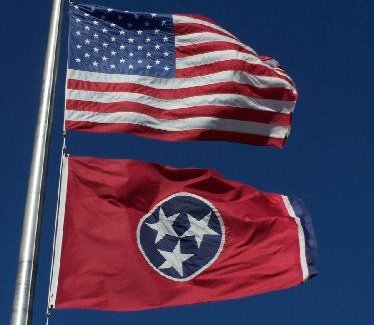
U.S. and Tennessee flags flying together on one staff.  Photo by J. Stephen Conn

U.S. and Tennessee flags flying together on one staff. Photo by J. Stephen Conn

Kentucky's state flag, by Gage Skidmore

Kentucky’s state flag features a Native American and European colonist standing together, and the state motto, “United We Stand, Divided We Fall.” Photo by Gage Skidmore

Kentucky’s admission to the union pushed the U.S. flag to 15 stars and 15 stripes.   President George Washington signed the law that authorized the U.S. flag be expanded to 15 stripes in early 1794.  I’ve not pinned down the history of what happened next.  So far as I know there was no law expanding the flag to 16 stripes, and in 1818, Congress said the flag would be 13 stripes, and stars equal to the number of states.

A 15-striped Star-spangled Banner that flew over Fort McHenry in Baltimore Harbor in 1814 and inspired Francis Scott Key to write the poem that is now the lyric to our national anthem.  President James Monroe signed the 13-stripe law in 1818.

What happened in between?  I suspect there are a lot of 15-stripe flags, but it wouldn’t surprise me to find a 16-stripe flag somewhere.  A variety of stars-and-stripes flags cropped up, which the 1818 law was intended to squelch.

Residents of the Bluegrass State and the Volunteer State should fly their flags today, in honor of their state’s having joined the union on June 1.