
U.S. flag flies at half-staff at the Madison Building of the Library of Congress, September 17, 2013. Photo from @GayleOsterberg
U.S. flag flies at half-staff at the Madison Building of the Library of Congress, September 17, 2013. Photo from @GayleOsterberg
 Leave a Comment » |
  Flag etiquette, Library of Congress, U.S. Flag | Tagged: Flag at half-staff, Flag etiquette, Library of Congress, U.S. Flag |
  Permalink
 Posted by Ed Darrell
Wholly apart from the two guys in Michigan who shot each other to death yesterday.
ABC News ran some tests. People with concealed carry permits — how would they help in mass shooting situations?
Part 1:
Part 2:
Liberals Unite commented on these videos:
The controlled study documented in these videos show that concealed carry permit holders are fooling themselves if they think they will be able to react effectively to armed aggressors. Most CCW holders won’t even be able to un-holster their gun. They will more likely be killed themselves or kill innocent bystanders than stop the aggressor.
For more details, see “Unintended Consequences: Pro-Handgun Experts Prove That Handguns Are a Dangerous Choice for Self-Defense.” http://www.vpc.org/studies/unincont.htm.
CCW permit holders don’t protect innocent people. They kill them.
Perhaps we should discuss preventing these cases altogether. Discuss politely.
More:

It’s a cotton t-shirt, not Kevlar.
30 Comments | Guns, Politics, Second Amendment | Tagged: ABC News, Concealed Carry Permit, Guns, Politics, Public Safety, Second Amendment | Permalink
Posted by Ed Darrell
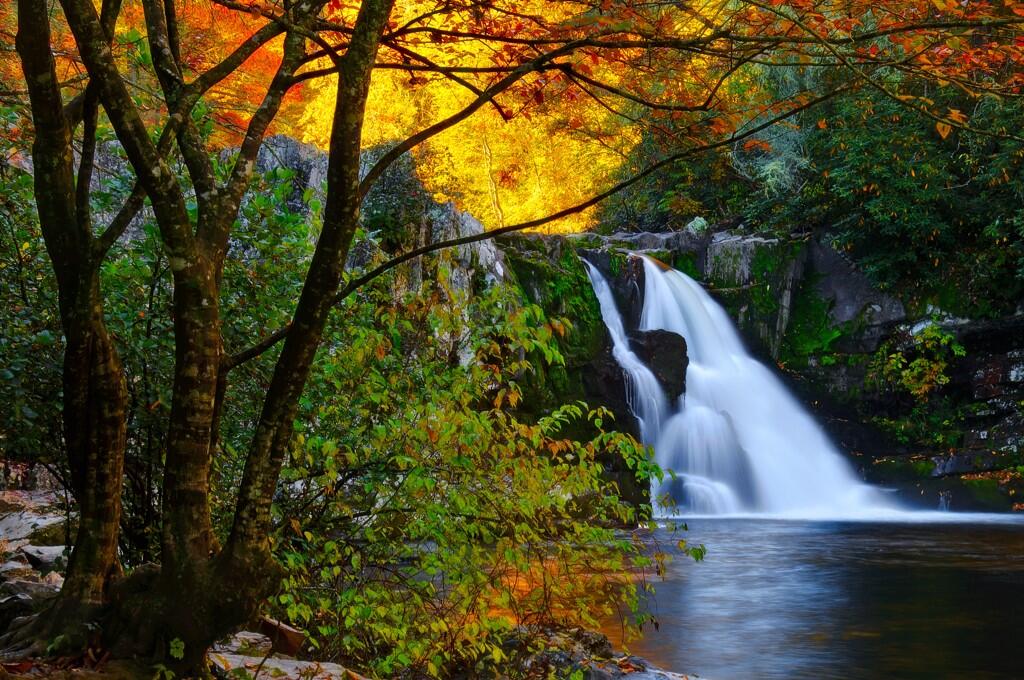
US Dept of Interior @Interior 16 Sep Department of Interior Tweet: It doesn’t get much prettier than this. Abrams Falls in Great Smoky Mountains National Park. #Tennessee pic.twitter.com/S5dQgcffEZ
There’s great beauty in many of the units of the U.S. National Park Service. The Great Smoky Mountains National Park, one of the “crown jewels” of the Park System, has a few spots of beauty of its own.
Great Smoky Mountains National Park, Abrams Falls,
More:
2 Comments | National Parks, photography | Tagged: Great Smoky Mountains NP, National Parks, photography | Permalink
Posted by Ed Darrell

USDA/Flickr photo via Mother Jones: A National Park Service fire crew builds a sprinkler system around a grove of sequoias. USDA/Flickr
It’s a rolling tragedy, in time-lapse. Fire always offers a chance at beauty, if we don’t think about the destruction the fire wreaks.
A lot of cameras around Yosemite, and some were set to do time-lapse photos of the recent Rim Fire. One hopes there is some academic value to these films, perhaps in demonstrating how the diurnal rhythms of the atmosphere changes the behavior of fire (notice how smoke often changes directions at sunset, and then at sunrise, and back again).
All that smoke. Much of it was living plant material just a few weeks ago, and we watch it turned to tiny particles and gases, and spread by the winds.
More information from the filmmakers and posters:
Published on Aug 28, 2013
Time-lapse photography shows various perspectives of the 2013 Rim Fire, as viewed from Yosemite National Park. The first part of this video is from the Crane Flat Helibase. The fire [was] . . .burning in wilderness and . . . not immediately threatening visitors or employees. The second half of the video is from Glacier Point, showing Yosemite Valley, and how little the smoke from the fire has impacted the Valley.
In this next piece, you’ll see footage of fire fighting operations, including a back-burn, and helicoptering of supplies to firefighters on the front lines. It’s the non-time-lapse version, with wildtrack sound.
Published on Sep 7, 2013
Fire crews in Yosemite conducted firing operations along the Tioga Road this week to provide a buffer of protection from the Rim Fire. As you can see in this video, the fire mostly burns debris on the forest floor rather than the trees. It’s only when the forest floor accumulates too much debris or too many young trees that a small fire like this gets hot enough to torch mature trees and spread from treetop to treetop.
Later in the video, we give you a behind-the-scenes peek at Yosemite’s Helicopter 551 ferrying supplies from the Crane Flat helibase.
The timelapse, from August, has over a million-and-a-half views on YouTube; the non-timelapse, a few weeks later, has fewer than 6,000 views, as I write this. Time-lapse is very popular.
More:
1 Comment | Forestry, National Parks, Wildfires, Wildlife, Yosemite | Tagged: Forest Fires, Glacier Point, Natural history, Science, Time-lapse photography, Yosemite National Park | Permalink
Posted by Ed Darrell
Got a stack of banned books ready?
Banned Books Week is September 22-28 for 2013.

So THAT’s what Lady Liberty holds in her left hand. (Reading the Declaration of Indpendence can still get you into trouble in a few places — mostly not in the U.S., but even in the U.S.)
We still have banned books? Is that bad?
Consider, first, that on September 17, 2013, the Texas State Board of Education opened hearings on science textbooks to be “adopted” for Texas schools. Radical elements of the SBOE furiously organized to stack rating panels with people who want to censor science, to stop the teaching of Darwin’s work on evolution. (No, I’m not kidding.)
This comes in the middle of a rancorous fight in Texas over CSCOPE, a cooperative lesson-plan exchange set up by 800 Texas school districts to help teachers meet new Texas education standards adopted years ago (without new books!). Critics labeled reading lists and any reading on religions other than Christianity “socialist” or “Marxist,” and complained that Texas social studies books do not slander Islam.
Then there is the flap over Persepolis, in Chicago. With all the other trouble Chicago’s schools have several bluenoses worked to get this graphic “novel” banned (it’s not really a novel; it’s a memoir). They complained about graphic violence in what is a comic book. Persepolis tells the story of a young woman growing up in Iran during the Iranian Revolution.
The autobiographical graphic memoir Persepolis by Marjane Satrapi was pulled from Chicago classrooms this past May by Chicago Public Schools CEO Barbara Byrd-Bennett due to “inappropriate” graphic language and images, specifically, scenes of torture and rebellion. Parents, teachers, and First Amendment advocates protested the ban, and as a result — while still pulled from 7th grade — Persepolis is currently under review for use in grades 8-10. (For details, see CBLDF Rises to Defense of Persepolis.)
Persepolis is an important classroom tool for a number of reasons. First, it is a primary source detailing life in Iran during the Revolution and the Iran-Iraq War . Readers of all ages get a glimpse of what life is like under repressive regimes and relive this period in history from a different perspective. It also begs detailed discussion of the separation of church and state. Furthermore, this is a poignant coming-of-age story that all teens will be able to relate to and serves as a testament to the power of family, education, and sacrifice.
In America, textbooks get attacked for telling the truth about Islam and not claiming it is a violence-based faith; and supplemental reading gets attacked when it presents the violence the critics complain was left out of the texts.
We need to think this through.
What banned books have you read lately?
More:

Persepolis has been made into a movie.
Leave a Comment » | Banned Books, Books, Censorship, Education, First Amendment, History, Literature, State school boards, Texas, Textbooks | Tagged: Banned Book Week, Banned Books Week, Books, Censorship, Chicago Public Schools, Education, First Amendment, History, Literature, Persepolis, Texas State Board of Educaiton, Textbooks | Permalink
Posted by Ed Darrell
One of the anti-environmental, anti-green false myths kicking around is that DDT is not harmful to humans, and therefore it probably shouldn’t have been banned, “and Rachel Carson was wrong.”

This poster from the U.S. Fish and Wildlife Service illustrates bioaccumulation, the process by which larger animals can be killed by acute DDT poisoning.
Reality is that DDT is a poison, but acute poisoning of large animals tends to take a lot. Insectivorous animals or their predators can get those fatal amounts, but humans generally don’t. DDT as a toxin kills mammals and birds and amphibians and reptiles and fish with equal alacrity, slowed only by the size of the organism and whether the organism’s diet consists of other things that consume and accumulate DDT.
Often that misperception is coupled with a claim that DDT does not cause cancer, and so should have its ban lifted.
But, the facts:
That last point isn’t easy to document in the U.S. During the go-go DDT years there was one case of a young girl who drank from a prepared DDT solution, and died a short time later. The incident was a tragedy, but not unique for the 1950s and 1960s. It was written off to lax safety standards, and because it occurred long before the origin of on-line databases, essentially it has fallen out of history. Just try to find a reference to the death today.
Partly, this lack of information on human toxicity is due to the fact that DDT use was slowing dramatically by the late 1960s (it was becoming ineffective), and after the ban in 1972, there were few cases in the U.S. where humans were exposed to the stuff, except in emissions from DDT manufacturing plants. EPA’s order banning DDT in the U.S. applied only to agricultural use, and the chief agricultural use remaining was on cotton. Manufacturing was not banned, however, which meant U.S. DDT makers could continue to pump the stuff out and sell it overseas, in Africa, and Asia. This continued right up to that day in 1984 that U.S. companies became subject to damage for the poisons they make under the Superfund law — almost every DDT maker declared bankruptcy to escape liability in the weeks before the Superfund became effective, saddling taxpayers with a few dozen Superfund sites to be cleaned up on the taxpayer’s dime.
DDT has never been banned in Africa or Asia, however. And there we find a badly-documented history of people poisoning themselves with DDT, usually in suicides.
Whatever other pathologies these cases may exhibit, they reveal that DDT does, indeed, kill humans.
Like this recent case, from Ghana; yes, that’s the illustration used in the newspaper; from the Ghana Broadcasting Corporation:
Sep 11, 2013 at 11:52amMan commits suicide over wife’s confessionBenjamin Kwaku Owusu, a 40-year-old former Manager of Unity Oil Filling Station in Suhum, has committed suicide by drinking DDT Gamullio 20 insecticide.
A family spokesperson who spoke to the Ghana News Agency on condition of anonymity said Owusu and his wife lived at Suhum and had been married for five years but never had a child.
He said the situation often developed into misunderstanding between them but later the wife got pregnant and left for her home town.
According to the spokesperson, whiles Owusu was preparing for the wife to deliver, he had a shocking message from the wife that the pregnancy belonged to another man and not him.
He said Owusu, who had a shock, rushed into his room and drunk the DDT Insecticide and fell unconscious.
“Owusu was rushed to the hospital but died soon after he was admitted,” he said.
When the police at Suhum was contacted, they confirmed the story and said the body of the deceased had since been buried after post mortem examination at the Suhum Government Hospital.
GNA
Not sure what “Gamullio 20” means, but it seems to be the brand name of the poison used.
More:
21 Comments | Accuracy, DDT, History, Rachel Carson, Science | Tagged: Accuracy, DDT, Ghana, History, Rachel Carson, Science, Superfund | Permalink
Posted by Ed Darrell
Contrary to the claims of President Obama’s critics, his administration is proceeding to develop energy resources in new areas.
Just a couple of weeks ago experimental wind energy sites off the coast of Virginia were auctioned off.

Wind power farm at sea; Clemson University image, of unidentified ocean-based wind farm.
Can these tracts be developed responsibly? I have not followed the issue, and I have not read the Environmental Impact Statement on this sale (surely there was one, since this is a “significant federal act” with great impact on these waters and the coast of Virginia). Surely this is safer and cleaner than oil leases; enough cleaner? Far enough away to avoid destructive effects on wildlife and other resources?
What do you think?
Here’s the press release from the Department of Interior:
Interior Holds Second Competitive Lease Sale for Renewable Energy in Federal Waters
Historic Sale for Wind Energy Development Offshore Virginia Advances President’s Climate Action Plan
09/04/2013
WASHINGTON, D.C. – As part of President Obama’s Climate Action Plan to create American jobs, develop domestic clean energy sources and cut carbon pollution, the Interior Department today completed the nation’s second competitive lease sale for renewable energy in federal waters, garnering $1,600,000 in high bids for 112,799 acres on the Outer Continental Shelf offshore Virginia.
Virginia Electric and Power Company is the provisional winner of the sale, which auctioned a Wind Energy Area approximately 23.5 nautical miles off Virginia Beach that has the potential to support 2,000 megawatts of wind generation – enough energy to power more than 700,000 homes.
The sale follows a July 31 auction of 164,750 acres offshore Rhode Island and Massachusetts for wind energy development that was provisionally won by Deepwater Wind New England, LLC, generating $3.8 million in high bids.
“This year’s second offshore wind lease sale is another major milestone in the President’s all-of-the-above energy strategy and demonstrates continued momentum behind a robust renewable energy portfolio that will help to keep our nation competitive and expand domestic energy production while cutting carbon pollution,” said Secretary of the Interior Sally Jewell. “Today’s sale is the result of a great deal of collaboration and planning with the Commonwealth of Virginia, which has been a leader in advancing offshore renewable energy for the Atlantic coast and an enthusiastic partner in this effort.”
“Today’s renewable energy lease sale offshore Virginia is another significant step forward in the President’s call for action to address climate change and the Administration’s all-of-the-above energy strategy,” said Bureau of Ocean Energy Management (BOEM) Director Tommy Beaudreau. “I congratulate Virginia Electric and Power Company and we look forward to overseeing their development of the Virginia wind energy area, which will create jobs, increase our energy security and provide abundant sources of clean renewable power.”
Efforts to spur responsible development of offshore wind energy are part of a series of Obama Administration actions to increase renewable energy both offshore and onshore by improving coordination with state, local and federal partners. The Virginia Renewable Energy Task Force has been a leading agent in intergovernmental collaboration for wind energy development offshore Virginia.
Since 2009, Interior has approved 47 wind, solar and geothermal utility-scale projects on public lands, including associated transmission corridors and infrastructure to connect to established power grids. When built, these projects could provide more than 13,300 megawatts – enough energy to power more than 4.6 million homes and support more than 19,000 construction and operations jobs.
As part of the President’s comprehensive Climate Action Plan, he has challenged Interior to re-double efforts on its renewable energy program by approving an additional 10,000 megawatts of renewable energy production on public lands and waters by 2020.
At the same time, under the Administration’s all-of-the-above energy strategy, domestic oil and gas production has grown each year President Obama has been in office, with domestic oil production currently higher than at any time in two decades; natural gas production at its highest level ever; and renewable electricity generation from wind, solar, and geothermal sources having doubled. Combined with recent declines in oil consumption, net oil imports in 2012 fell to the lowest level in 20 years.”
BOEM auctioned the Wind Energy Area offshore Virginia as a single lease, containing 19 whole Outer Continental Shelf blocks and 13 sub-blocks. For a map of the Wind Energy Area, click here.
The auction lasted 1 day, consisting of 6 rounds before determining the provisional winner. In addition to Virginia Electric and Power Company the following company participated in the auction: Apex Virginia Offshore Wind, LLC. Following the auction, the Attorney General, in consultation with the Federal Trade Commission, will have 30 days in which to complete an antitrust review of the auction.
The lease will have a preliminary term of six months in which to submit a Site Assessment Plan to BOEM for approval. A Site Assessment Plan describes the activities (e.g., installation of meteorological towers and buoys) the lessee plans to perform for the assessment of the wind resources and ocean conditions of its commercial lease.
After a Site Assessment Plan is approved, the lessee will have up to four and a half years in which to submit a Construction and Operations Plan (COP) for approval, which provides a detailed outline for the construction and operation of a wind energy project on the lease. If the COP is approved, the lessee will have an operations term of 33 years.
BOEM is expected to announce additional auctions for Wind Energy Areas offshore Maryland, New Jersey, and Massachusetts later this year and in 2014.
For more information on what’s going on offshore Virginia, visit BOEM’s website.
23 miles puts it far enough out that it’s generally out of sight from shore. Out of sight, out of mind? Out of danger? Out of disaster potential?
Does a coal-power company’s winning these leases suggest a scheme to keep wind power from being developed, to improve the case for coal?
More:
Leave a Comment » | Economics, Electricity, Energy, Environmental protection | Tagged: Bureau of Ocean Energy Management, Economics, Energy, environment, Virginia, Wind farm | Permalink
Posted by Ed Darrell
It’s almost painful how much residents of the U.S. don’t know about our neighbor to the south, Mexico.
No, Cinco de Mayo is not Mexican Independence Day.
That would be September 16.

Dolores Hidalgo Church at night. Wikipedia image
But just to confuse things more, Mexico did not get independence on September 16.
September 16 is the usual date given for the most famous speech in Mexico’s history — a speech for which no transcript survives, and so, a speech which no one can really describe accurately. A Catholic priest who was involved in schemes to create an armed revolution to throw out Spanish rule (then under Napoleon), thought his plot had been discovered, and moved up the call for the peasants to revolt. At midnight, September 15, 1810, Father Miguel Hidalgo y Costilla declaimed the need for Mexicans to rise in revolution, from his church in the town of Dolores, near Guanajuato. The cry for freedom is known in Spanish as the Grito de Dolores.
Hidalgo himself was hunted down, captured and executed. Mexico didn’t achieve independence from Spain for another 11 years, on September 28, 1821.
To commemorate, usually the President of Mexico repeats the speech at midnight, in Mexico City, or in Dolores. If the President does not journey to Dolores, some other official gives the speech there. Despite no one’s knowing what was said, there is a script from tradition used by the President:
Political history of Mexico is not easy to explain at all.
Hidalgo’s life was short after the speech, but the Spanish still feared the power of his ideas and names. In his honor, a town in the Texas territory of Mexico was named after him, but to avoid provoking authorities, the name was turned into an anagram: Goliad.
In one of those twists that can only occur in real history, and not in fiction, Goliad was the site of a Mexican slaughter of a surrendered Tejian army during the fight for Texas independence. This slaughter so enraged Texans that when they got the drop on Mexican President and Gen. Santa Ana’s army a few days later at San Jacinto, they offered little quarter to the Mexican soldiers, though Santa Ana’s life was spared.
Have a great Grito de Dolores Day, remembering North American history that we all ought to know.

Father Hidalgo: Antonio Fabres, Miguel Hidalgo, oil on canvas, image taken from: Eduardo Baez, military painting in the nineteenth century Mexico, Mexico, National Defense Secretariat, 1992, p.23. Wikipedia image
More:
10 Comments | Freedom - Political, Grito de Dolores, History, Mexico, Revolution | Tagged: freedom, Grito de Dolores, History, Mexican War of Independence, Mexico, Miguel Hidalgo y Costilla, Revolution | Permalink
Posted by Ed Darrell

“By Dawn’s Early Light”: Francis Scott Key beholding the still-flying Star-spangled Banner, after the Battle of Baltimore, 1814. 1912 painting by Edgar Percy Moran, Wikipedia image.
Short videos often pack a heckuva punch for history classes. Here’s one from today’s CBS “Sunday Morning,” with Charles Osgood reporting on the creation and flying at Fort McHenry of a replica of a flag that flew there 199 years ago on September 14 — the inspiration to Francis Scott Key for his poem, “The Star-spangled Banner.”
<iframe frameborder=”0″ width=”480″ height=”270″ src=”//www.dailymotion.com/embed/video/x15schq” allowfullscreen>
Star-Spangled Banner flies again at Fort McHenry by cbsnews
Star-Spangled Banner flies again at Fort McHenry by cbsnews
http://www.cbsnews.com/news/the-star-spangled-banner-yet-waves-anew/
Published on Sep 15, 2013
CBS News video: Star-Spangled Banner flies again at Fort McHenry – Applying the same techniques used nearly two hundred years ago, a team of quilters created an exact replica of the flag that flew over Baltimore Harbor during the War of 1812, the same flag that inspired Francis Scott Key to pen our national anthem. Charles Osgood reports.
This is history that most of my juniors didn’t know. It’s not history we’re supposed to teach, but it’s history they are accountable for on Texas tests. A short video like this one at a key spot can boost scores on the state tests — and, though I’ve not been victimized by them yet, the new end-of-course tests probably assume juniors know this stuff, too.
I hope CBS keeps this piece available for history teachers, especially through 2014 and the 200th anniversary of the battle, and Key’s writing of the poem.
[Text of CBS news story here, in case video stops working.]
More:
Fort McHenry today:

Aerial view of Fort McHenry, at the mouth of Baltimore Harbor, clearly show the star design that made it more defensible from ground attack. During the Battle of Baltimore, British troops were not able to land and get close to the fort. Image from the office of the Governor of Maryland, via the National Park Service
7 Comments | History, Music, Star-spangled Banner, War of 1812 | Tagged: CBS News, Francis Scott Key, History, Music, National Anthem, Star-spangled Banner, War of 1812 | Permalink
Posted by Ed Darrell
Anybody send this to you on Facebook (100 times, maybe?)

Hoax claims about the Pledge of Allegiance, found on Facebook and innumerable e-mails
Clever, eh? It repeats the McCarthy-era editing of the Pledge of Allegiance, and then comes up with this whopper:
. . . My generation grew up reciting this every morning in school, with my hand on my heart. They no longer do that for fear of offending someone!
Let’s see how many Americans will re-post and not care about offending someone!
Not quite so long-lived as the Millard Fillmore Bathtub Hoax — which started in 1917 — but a lot more common these days.
Just as false. Maybe more perniciously so.
Consider:
The creator of that poster is probably well under the age of 50, and may have grown up with the hand-over-heart salute used after World War II. That was not the original salute, and I’d imagine the author is wholly ignorant of the original and why it was changed.

Wikipedia image and caption: Students pledging to the flag, 1899, 8th Division, Washington, D.C. Part of the Frances Benjamin Johnston 1890 – 1900 Washington, D.C., school survey.
Wikipedia gives a concise history of the salute:
Swearing of the Pledge is accompanied by a salute. An early version of the salute, adopted in 1892, was known as the Bellamy salute. It started with the hand outstretched toward the flag, palm down, and ended with the palm up. Because of the similarity between the Bellamy salute and the Nazi salute, developed later, the United States Congress instituted the hand-over-the-heart gesture as the salute to be rendered by civilians during the Pledge of Allegiance and the national anthem in the United States, instead of the Bellamy salute. Removal of the Bellamy salute occurred on December 22, 1942, when Congress amended the Flag Code language first passed into law on June 22, 1942.

Students in an unnamed school in 1941, offering the Bellamy Salute for the Pledge of Allegiance. Wikipedia image.
One might understand why the Bellamy Salute was changed, during war with Nazi Germany.
Arrogance and ignorance combine to form many different kinds of prejudices, all of them ugly. The arrogant assumption that only “our generation” learned patriotism and that whatever goes on in schools today is not as good as it was “in our day,” regardless how many decades it’s been since the speaker was in a public school, compounds the ignorance of the fact that since 1980, forced patriotic exercises in schools have increased, not decreased.
Like much about our nation’s troubles, assumptions based on ignorance often are incorrect assumptions. Consequently, they give rise to what is today clinically known as the Dunning Kruger Effect (or syndrome), so elegantly summed by by Bertrand Russell in the 1930s:
The trouble with the world is that the stupid are cocksure and the intelligent are full of doubt.
Humorously summed up by “Kin” Hubbard:
It isn’t what we don’t know that gives us trouble, it’s what we know that ain’t so.
Ignorance is a terrible disease, but one easily cured, by reading. We can hope.
More:
42 Comments | Accuracy, Dunning-Kruger Effect, Education, First Amendment, Flag etiquette, History, Hoaxes, Law, Patriotism, Pledge to the flag, Public education, U.S. Flag | Tagged: Accuracy, Dunning-Kruger Effect, Education, First Amendment, Flag etiquette, History, Hoaxes, Law, Patriotism, Pledge of Allegiance, public schools, U.S. Flag | Permalink
Posted by Ed Darrell
Can you recall what you were doing on September 5, 1977?

The Voyager 1 aboard the Titan III/Centaur lifted off on September 5, 1977, joining its sister spacecraft, the Voyager 2, on a mission to the outer planets. Wikipedia image, from NASA
That’s the day NASA launched Voyager I, on a trip to photograph planets in our solar system more close up than we can get with Earth-bound telescopes. The Hubble Space Telescope was not even on the drawing board then.
After completing its mission, Voyager I continued on its path. Scientists thought it would survive to leave the solar systems, and a few forward-looking thinkers hoped to learn more about just how far the influence of our Sun really extends. At some point, Voyager I would leave space where the chief gravitational and wind influence is the Sun, and move into truly inter-stellar (“between the stars”) space, where gravity and particle emissions are dominated by other objects in our galaxy.
Last week NASA announced that time came in August of 2012, confirmed by data transmitted back to earth by Voyager’s primitive capabilities, over the last year.
Space.com explains it well:
Interesting to think of the investment in thought, money, effort and patience by scientists and policy-makers to wait more than 35 years for such a research result.
More:

Voyager I, artist’s interpretation. NASA image
Leave a Comment » | Astronomy, History, NASA, Research, Science | Tagged: Astronomy, Exploration, History, NASA, Research, Science, Solar System, Voyager 1 | Permalink
Posted by Ed Darrell
You’ve heard the news by now: Voyager I has left the system.
What are we to think of that?
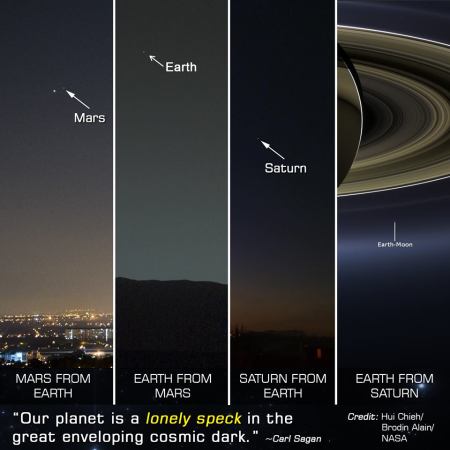
Earth, Moon, Mars, Jupiter – What you see depends on where you are, in reality as well as metaphorically. Images from NASA
” . . . astronomy is a humbling and character-building experience.”
– Carl Sagan on how images of Earth from space change our perspective
Sagan’s words in the full passage impart a larger message, about caring for our planet and our neighbors on it.
From this distant vantage point, the Earth might not seem of any particular interest. But for us, it’s different. Consider again that dot. That’s here. That’s home. That’s us. On it everyone you love, everyone you know, everyone you ever heard of, every human being who ever was, lived out their lives. The aggregate of our joy and suffering, thousands of confident religions, ideologies, and economic doctrines, every hunter and forager, every hero and coward, every creator and destroyer of civilization, every king and peasant, every young couple in love, every mother and father, hopeful child, inventor and explorer, every teacher of morals, every corrupt politician, every “superstar,” every “supreme leader,” every saint and sinner in the history of our species lived there – on a mote of dust suspended in a sunbeam.
The Earth is a very small stage in a vast cosmic arena. Think of the rivers of blood spilled by all those generals and emperors so that in glory and triumph they could become the momentary masters of a fraction of a dot. Think of the endless cruelties visited by the inhabitants of one corner of this pixel on the scarcely distinguishable inhabitants of some other corner. How frequent their misunderstandings, how eager they are to kill one another, how fervent their hatreds. Our posturings, our imagined self-importance, the delusion that we have some privileged position in the universe, are challenged by this point of pale light. Our planet is a lonely speck in the great enveloping cosmic dark. In our obscurity – in all this vastness – there is no hint that help will come from elsewhere to save us from ourselves.
The Earth is the only world known, so far, to harbor life. There is nowhere else, at least in the near future, to which our species could migrate. Visit, yes. Settle, not yet. Like it or not, for the moment, the Earth is where we make our stand. It has been said that astronomy is a humbling and character-building experience. There is perhaps no better demonstration of the folly of human conceits than this distant image of our tiny world. To me, it underscores our responsibility to deal more kindly with one another and to preserve and cherish the pale blue dot, the only home we’ve ever known.
— Carl Sagan, Pale Blue Dot: A Vision of the Human Future in Space, 1997 reprint, pp. xv–xvi
In other words, we’re on our own. What are we going to do about that?
Tip of the old scrub brush to Hashem Al-ghaili for making this image! https://www.facebook.com/ScienceNaturePage, and to All Science, All the Time.
It would be good to have better photo credits, including the genius who put together the montage.
More:

This is the photo that inspired Sagan’s reflection, as opposed to the photos in the poster mashup above. Via Wikipedia, with captions. ¶Seen from about 6 billion kilometers (3.7 billion miles), Earth appears as a tiny dot (the blueish-white speck approximately halfway down the brown band to the right) within the darkness of deep space. ¶This narrow-angle color image of the Earth, dubbed ‘Pale Blue Dot’, is a part of the first ever ‘portrait’ of the solar system taken by Voyager 1. The spacecraft acquired a total of 60 frames for a mosaic of the solar system from a distance of more than 4 billion miles from Earth and about 32 degrees above the ecliptic. From Voyager’s great distance Earth is a mere point of light, less than the size of a picture element even in the narrow-angle camera. Earth was a crescent only 0.12 pixel in size. Coincidentally, Earth lies right in the center of one of the scattered light rays resulting from taking the image so close to the sun. This blown-up image of the Earth was taken through three color filters – violet, blue and green – and recombined to produce the color image. The background features in the image are artifacts resulting from the magnification.

1 Comment | Astronomy, Famous quotes, NASA, Quotes, Science | Tagged: Astronomy, Carl Sagan, Famous quotes, History, NASA, Pale Blue Dot, Quotes, Science | Permalink
Posted by Ed Darrell

Painting of the Sand Creek Massacre, Colorado Historical Society
Sometimes the e-mail I get brings wind of real history discussions, and this one sounds interesting even if the Texas State Board of Education is trying to run away from U.S. history on the issues of war on Native Americans.
Teachers, you can get an hour of CE credit, if you phone and let them know in advance.
And it’s free.
These sessions are good, and if you think you don’t know enough to ask good questions, you should understand that SMU faculty will be there to grill the author if you don’t.
A Misplaced Massacre:
Struggling over the Memory of Sand Creek
Ari Kelman, University of California-DavisThursday, September 19, 2013
6 pm reception followed by 6:30 lecture and book-signing
The DeGolyer Library
6404 Hilltop Lane at McFarlin Boulevard, on the campus of SMUIn this lecture, Kelman will examine the ways in which generations of Americans have struggled to come to terms with the meaning the Sand Creek Massacre and its aftermath, most publicly at the 2007 opening of the Sand Creek Massacre National Historic Site in Kiowa County, Colorado.
Books will be available for purchase and for signing.
Although this event is free and open to the public, seating is limited. Please register on the link below. If you have questions or need special accommodations, please call 214-768-3684 or email swcenter@smu.edu
More:
Leave a Comment » | History, Native Americans | Tagged: Colorado, History, Indian Wars, Native American, Sand Creek Massacre, Southern Methodist University | Permalink
Posted by Ed Darrell

President John F. Kennedy speaking to an audience in the football stadium at Rice University in Houston, September 12, 1962. Kennedy made the public case for why the U.S. should try a Moon shot. NASA photo.
Kennedy’s speech at Rice University, “We Choose to Go to the Moon,” was delivered in the football stadium (not nearly full), on September 12, 1962.
Obviously, that was back before global warming held such a tight death grip on Texas (it’s so bad here, even Rick Perry is trying to move north, out of the state).
Day in and day out, Kennedy’s speech, the text, the audio, and sources of commentary on it, are among the most popular of the nearly 5,000 posts at Millard Fillmore’s Bathtub. Go see why:
September 12, 1962, was also the ninth anniversary of JFK’s marriage to Jacqueline Bouvier. She let him go out of town to talk rockets?
Anything for the nation, I suppose.
More:

Moonwalking astronaut salutes the U.S. flag on the Moon. Twelve people went to the Moon, all of them in the U.S. space program run by NASA. (My photo source does not identify this astronaut.)
Leave a Comment » | History, John F. Kennedy, Moon, Motivation, NASA, Science, Space Race | Tagged: History, John F. Kennedy, Moon Race, Motivation, Science, September 12 1962, Space Race | Permalink
Posted by Ed Darrell
Some e-mail is more worthy of sharing than others.
You’re in the Dallas area, and you’re not familiar with the Orchestra of New Spain? We do have several very good musical organizations around town bending towards the classical, apart from the big professional companies — including the Dallas Wind Symphony, the Arlington Master Chorale, the Turtle Creek Chorale, the Dallas Bach Society — so that finding a place to listen should NOT be a problem.
But I keep running into people who don’t know about these groups.
I got the schedule for the coming year from the Orchestra of New Spain — you really should go see them, and listen. They’re good, and these events are fun.

Dear friends and subscribers,The 2013-14 Season of the Orchestra of New Spain begins on October 10 in the City Performance Hall, Dallas Arts District. The season brochure is on its way and will arrive in your mailbox in a few days. While awaiting it’s arrival please peruse our offerings below, or in more detail at:Thanks to all of you who are already subscribers. If you haven’t made your move you may consider this prime time to subscribe, and enjoy premium seating, even assured seating for some of our intimate events.To subscribe, or renew your subscription, please visit us online, mail a check, or call the office.And NOW, the25th Season of the Orchestra of New SpainThur, Oct 10, 8 pm, City Performance HallLatino-Barroco Fusion EnsembleFri, Nov 8, 6:30 pm, North Dallas Home of Margo & Jim KeyesHome and Garden concertFri, Nov 22, 7 pm, Christ the King Catholic Church, Preston & ColgateRequiem for a lost leaderSun, Dec15, 5 pm, Christ the King Catholic Church, Preston & ColgateChristmas at Christ the KingSun, Jan 19, 6 pm, The Annual Courcelle DinnerTBA (not included in subscription)Sat, Feb 8, 6:30 pm, Meadows museumSorolla, Falla, Lorca and Flamenco: previewFri, Feb 14 & Sat, Feb 15, 7:30 pm, City Performance HallThe Rise of Flamenco: Lorca, Falla, SorollaSat, Mar 29, 7pm, Zion Lutheran Church, Lovers LaneVilla y Corte – Town and CourtThur, May 15, 6:30, place TBAHome and Garden concert(If you have not received our brochure in the past or suspect you are not on our snail mail list, please request you brochure by mail the moment you read this, and before they are mailed next week!)
Leave a Comment » | Dallas, Music, Texas, Texas Music | Tagged: Dallas, dallas wind symphony, Music, Orchestra of New Spain, Texas, Turtle Creek Chorale | Permalink
Posted by Ed Darrell
You are currently browsing the Millard Fillmore's Bathtub blog archives for September, 2013.


Ed Darrell on Texas's Colorado River


Come on in, the water's fine. Come often: Cleanliness is next to godliness.


 Millard Fillmore's Bathtub