Robert Johnson’s centennial, May 8: Memorial to the blues

May 8, 2011

May 8, 2011, is the 100th anniversary of the birth of bluesman Robert Johnson.
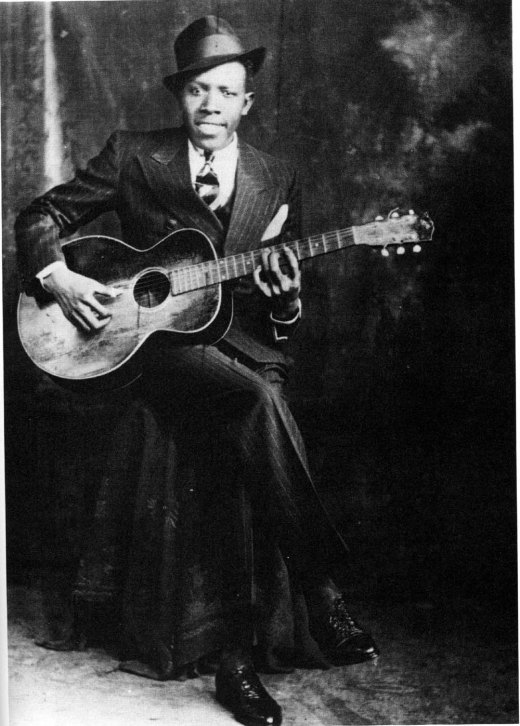
Robert Johnson, hat and guitar
Robert Johnson — one of two known photographs of the Delta blues legend

In a fitting tribute to Johnson and an important coming-of-age coming-to-senses moment, First Presbyterian Church in downtown Dallas announced plans to save the old Brunswick Records Building at 508 Park Avenue, a site where Johnson recorded songs in 1937 that changed the blues, changed recording, and left us a legacy of Johnson to study from his short life.

(On at least one day of those 1937 recordings, Johnson could have brushed shoulders with the Light Crust Doughboys, the Texas Swing legends, who were recording in the same building.  The Doughboys set their own pace and gave birth to Bob Wills and the Texas Playboys.  Two of Texas’s greatest music legends, in the same building on the same day, both just stepping on the platform of the train to immortality.)

Saving 508 Park Avenue vexed Dallas for a couple of decades.  First, blues is not the music of Dallas cognescenti, though the world class musicians in town including Dallas Symphony Orchestra’s Jaap van Zweden tend to support the eclectic music scence and honoring musicians of all genres (and Texas is loaded with different music genres).  Second, while Park Avenue may have been a bustling business district adjunct once, Dallas’s city center suffered 50 years of decline after school desegregation.  Parts of downtown and Uptown begin to look prosperous again, but the southern peninsula of the city, away from the now-packed-with-performance venues Arts District, a freeway and ten blocks away from Uptown, with its back up against another freeway, part of Interstate 30 and the famous Dallas Mixmaster.

508 Park Avenue, Dallas, Robert Johnson's early recording site, photo by Justin Terveen for the Dallas Observer in 2011
508 Park Avenue, Dallas, Robert Johnson’s early recording site, photo by Justin Terveen for the Dallas Observer, 2011

Plus, the building is directly across the street from the Stewpot, a kitchen operated by First Presbyterian Church to serve Dallas large and unfortunately thriving homeless population.

Who wants to renovate an abandoned building that has homeless people as scenery for the better part of the day?

Big news this week:  508 Park Avenue was sold to First Presbyterian, who have plans to save the building (and recording studio!), add a performance amphitheatre at one end of the block, and a park at the other.  This is people-friendly development well ahead of its time — there is not a resident population in that part of the city to support such a venue — yet.

Last summer, it was the neighbors, First Presbyterian Church of Dallas, who made an offer to buy 508 Park Avenue and the adjacent building and empty lot. But the deal was contingent on the city allowing the church, which also operates the Stewpot, to tear down an unrelated building next door, at 1900 Young, and replace it with an outdoor amphitheater for church socials and concerts. The Landmark Commission went into last Monday’s meeting with angels on one shoulder and devils on the other: The commission’s task force suggested approval; city staff, denial. The latter would have sent 508 Park Avenue back into purgatory.

But Landmark OK’d the plan, and the church says it will restore 508 Park Avenue to its former glory, inside and out—including the construction of a real recording studio where Johnson once sat and played “Hell Hound on My Trail.”

The church promises: It has musicians lined up to participate, but it can’t yet reveal who. The church promises: 508 Park Avenue will be resurrected.

One hell of a birthday gift for a man who supposedly sold his soul to the Devil.

The second authenticated photo of blues legend Robert Johnson

So, on Robert Johnson’s 100th birthday (assuming he wasn’t really born in 1912 . . . another mystery for another time, perhaps), the news is that the legendary bluesman who burned out like a shooting star helped save one of the few examples of art deco building decoration in Dallas, when a group of Christians who help the homeless, decided to step in an update their downtown Dallas campus.

Every step of the way, it’s an unlikely story.  Truth is, in this case, much, much stranger than fiction.

Ovation Music released to YouTube the video of Eric Clapton playing and singing “Me and the Devil,” at 508 Park Avenue, in the same room where Robert Johnson sang for a record early on.  Johnson recorded the song at that same location on Sunday, June 20, 1937.

508 Park Avenue, Dallas, is already a memorial to Robert Johnson, to the blues, and to the city where these early blues hits were made.  The struggle remains to make the memorial accessible, and not threatened with destruction.

More, resources: 


April is National Poetry Month, 2011

April 10, 2011

You did remember, right?  I got another reminder in e-mail:

National Poetry Month continues, and so does your support! We’re getting closer to our goal of $30,000 in 30 days, and we thank you for your donation. If you haven’t donated yet, please do. You’ll be helping us share your love of poetry with children and adults all across America.

Here’s another way to support National Poetry Month: celebrate Poem In Your Pocket Day on Thursday, April 14. It’s simple: tuck a poem you love in your pocket and share it with co-workers, family, and friends. Or go a step further and create your own Poem In Your Pocket Day event using the ideas at www.poets.org/pockets.

And please, please, show your support for poetry with a donation to the Academy of American Poets. As an added incentive, we’ll thank you for your generosity with these free gifts:
• Donate $25 and receive a free download of W.S. Merwin recordings.
• Donate $50 and receive a free download of W.S. Merwin recordings and a Walt Whitman ruled notebook for your own poems.
• Donate $100 and receive a free download of W.S. Merwin recordings, a Walt Whitman ruled notebook for your own poems, and a copy of the innovative anthology Poem in Your Pocket for Young Poets.

Please click here to support National Poetry Month. And if you haven’t downloaded the Poem Flow app for your iPhone, find it on iTunes and take poetry with you wherever you are.


Thanks for being a part of the Poets.org community. Please sign in to subscribe to other Poets.org newsletters, change your email address or unsubscribe from this list at any time.

Academy of American Poets
75 Maiden Lane, Suite 901
New York, NY 10038
212-274-0343
academy@poets.org


Quote of the moment: Edward Albee on democracies, and hope for the future

March 14, 2011

Playwright Edward Albee - Albee Foundation photo

Playwright Edward Albee - Albee Foundation photo

[On the slashing of arts education funding:] It’s especially discouraging when you live in a democracy where anything good is possible, if only we have the courage to deal with it.

— Edward Albee, playwright, Diane Rehm Show (WAMU-FM/NPR), March 14, 2011 (49:50 in)


American Icons: Half Dome in Yosemite National Park

February 2, 2011

One of what should be an occasional series of posts on American iconic places, natural features, sights to see, etc.  For studies of U.S. history and U.S. geography, each of these posts covers subjects an educated American should know.  What is the value of these icons?  Individually and collectively, our preservation of them may do nothing at all for the defense of our nation.  But individually and collectively, they help make our nation worth defending.

This is a less-than-10-minute video you can insert into class as a bell ringer, or at the end of a class, or as part of a study of geologic formations, or in any of a number of other ways.  Yosemite Nature Notes provides glorious pictures and good information about Yosemite National Park — this video explains the modern incarnation of Half Dome, an enormous chunk of granite that captures the imagination of every living, breathing soul who ever sees it.

Potential questions for class discussion:

  • Have you put climbing Half Dome on your bucket list yet?  Why not?
  • Is it really wilderness when so many people go there?
  • How should the National Park Service, and the Forest Service and Bureau of Land Management, manage these spectacular, completely unique features, both to preserve their wild nature, and allow people to visit them?
  • What are the federalism issues involved in protecting Half Dome, or any grand feature, like the Great Smokey Mountains, Great Dismal Swamp, Big Bend, Yellowstone Falls, or Lincoln Memorial?
  • Does this feature make you wonder about how glaciers carve mountains and valleys?  (Maybe you should watch this video about glaciers in Yosemite.)
  • What is the history of the preservation of the Yosemite Valley?
  • Planning your trip to Yosemite:  Which large city airports might be convenient to fly to?  (What part of which state is this in?)
  • What other grand sights are there to see on your trip to Yosemite?
  • What does this image make you think?  Can you identify the people in it?

    John Muir and Teddy Roosevelt in Yosemite Valley

    Who are those guys? Why might it matter? (Answer below the fold)

  • How about this image? Who made this, and so what?

    Albert Bierstadt, Sunrise, Yosemite Valley, ca. 1870 - Amon Carter Museum, Fort Worth, Texas

    Photo or painting? Where could you see this work?

Read the rest of this entry »


Not over Up and Over It!

January 30, 2011

Nearly six million people have watched this — surely you’re among them:

Up and Over It!  Odd name for a dance company (would it be suitable for a synth pop band?).  Suzanne Cleary and Peter Harding, veterans of Irish step-dancing megaproductions.

But, did you click over to see their Facebook site, or their regular website?  This dance team takes dance in Ireland well beyond the range of “Riverdance,” and makes it really entertaining.

Acclaimed Irish Dancers Suzanne Cleary & Peter Harding blow the brains out of the Irish Dance show genre in a multi-media extravaganza. This brand new show liberates Irish Dance from its velvet-clad, tin-whistle-blowing, diddly-idleness and drags it kicking and screaming into the 21st Century. Inspired by hip-hop theatre, contemporary dance and electro-pop, Cleary and Harding present their alternative take on the Irish dance show format, asking what’s next for the 90s phenomenon we all loved or loathed?

Have you looked?  A sampler of their work:

Story telling by artists, but in media underused and underappreciated, probably because of the difficulties to work in them:

Most of the time, it’s just good fun to watch.  Isn’t that meaning enough these days?

(Sheesh!  Riverdance was ’90s?  High school kids today won’t remember it.)


Portrait of Lord Robert Baden Powell, the founder of Scouting

December 11, 2010

HERKOMER Hubert von | Sir Robert Baden-Powell (1857-1941). | 1903

Hubert von Herkomer's 1903 portrait of the founder of Scouting, Sir Robert Baden-Powell - California State University's World Images Kiosk

Before Boy Scouting, Sir Robert Baden-Powell was the hero of the Siege of Mafeking, during the Boer War.  This image of the founder of Scouting does not appear often, but deserves some audience, here in the Centennial of Scouting in the U.S.


Fort Worth area teachers: Amon Carter Museum workshop on art from the Gilded Age

November 29, 2010

From the Amon Carter Museum education department (in Fort Worth):

During the Gilded Age, the U.S. economy boomed, the population soared, and Americans flourished. Well, not all Americans; for some this time was not prosperous. During an educator workshop on December 9, [2010] explore both sides of this period using paintings and sculpture from the Amon Carter’s collection.  [Send a note of interest to: education@cartermuseum.org.]

Eastman Johnson, Bo-Peep (Amon Carter Museum)

Eastman Johnson (1824–1906), Bo-Peep, 1872, oil on canvas, Amon Carter Museum of American Art, Fort Worth, Texas, 1980.

Or just sign up:

Thursday, December 9, 2010 – 5:00pm – 7:00pm

The Gilded (or Not-So-Gilded) Age

Educator Workshop: $12 for museum members and $15 for nonmembers

During the Gilded Age (late 1800s to the early 1900s), the U.S. economy boomed, the population soared, and Americans prospered. Well, not all Americans; for some this time in American history was not prosperous. Explore both sides of this period using paintings and sculpture from the Amon Carter’s collection. This workshop is most appropriate for educators of all grade levels teaching English, language arts, social studies, U.S. history, and visual art, although others may benefit. Refreshments are provided from 4:30 to 5 p.m.

Download registration form


It’s a movement! Hallelujah!

November 22, 2010

Holy frijole, Batman!  It’s a virus, and it’s spreading!

Ellie was listening.  She’s gotta be behind this:

Details at YouTube:

On Nov.13 2010 unsuspecting shoppers got a big surprise while enjoying their lunch. Over 100 participants in this awesome Christmas Flash Mob. This is a must see!

This flash mob was organized by http://www.AlphabetPhotography.com to wish everyone a very Merry Christmas!

Special thanks to Robert Cooper and Chorus Niagara, The Welland Seaway Mall, and Fagan Media Group.

More:


Hams squared: Presidents left holding the ham

November 13, 2010

You could call it art.

Millard Fillmore, holding a ham - by Bijijoo

Millard Fillmore, holding a ham - by the artist known as Bijijoo

Perhaps it is related to the rain and the clouds:  An Oregon artist painted portraits of the U.S. presidents, each holding a pink ham.  A big ham.

No kidding.  Salon explained:

As it turns out, “The Presidential Ham” is both real and utterly hilarious. Since 2006, Oregon artist bijijoo (real name: M.T. Horne) has painted pictures of each president holding a giant, pink piece of pork. Some, like Abraham Lincoln, are fiercely protective of their meat; others, like Richard Nixon, look proud and dismissive. But each image has a very clear and important message: I am a president, and I am holding this ham.

Some people may be suspected of having too much time on their hands.  Or too much ham.

No, Millard Fillmore was not the first president to put ham into the White House.

Tip of the old scrub brush to Dr. Bumsted.


Academy Award winner: “Logorama”

August 16, 2010

Delightfully creative.  Surely there is at least a bell ringer in here, just in identifying the different logos.  For economics and sociology classes, this is a study in branding, done in very interesting fashion.

Can you use it in class, even at 16 minutes?  The language may be too edgy for freshman and sophomores, yes?

A short description from the Vimeo post, by Marc Altshuler, who owns the company who created and recorded the music for the film:

This is a short film that was directed by the French animation collective H5, François Alaux, Hervé de Crécy + Ludovic Houplain. It was presented at the Cannes Film Festival 2009. It opened the 2010 Sundance Film Festival and won a 2010 academy award under the category of animated short.

In this film there are two pieces of licensed music, in the beginning and in the end. All the other music and sound design are original. The opening track (Dean Martin “Good Morning Life”) and closing track (The Ink Spots “I don’t want to send the world on fire”) songs are licensed pre-existing tracks. All original music and sound design is by, human (www.humanworldwide.com)

Brilliant little work even if you can’t use it in class.


Dan Valentine – My Sister/My Brother, part 1

August 11, 2010

By Dan Valentine

MY SISTER / MY BROTHER – Part 1

One magical, fairy-tale of an evening, back in 1998, my baby sister Valerie—she is eight-years younger than myself—was knighted by Her Majesty Queen Beatrix of the Netherlands.

And I was there!

She is one of the few ballerinas and/or Americans ever to be so honored.

Funny, just a few short years before in Manhattan, after my sister had performed onstage with the great Russian dancer Rudolf Nureyev—yes, that one!—my mom had doused out a cigarette in the Queen’s half-empty cocktail.  At a reception for members of the Dutch community in town (Walter Cronkite was there), my mom, looking around for an ashtray and not finding one nearby, spotted a half-filled drink and plopped her cig in it.  A moment later, the Queen came back, after a brief newspaper interview, to finish her toddy, only to find a, well, you-know-what in it.

But back to little sister’s knighthood.

Earlier that morning, I had attended a ballet class with my sister.  Ballerinas and their male counterparts take class every day of the week to brush up on their technique and such.  They stretch, move to the Barre, and do sequences in the center of the floor for an hour or so.  This is followed by grueling hours of rehearsals for upcoming and/or present performances.  So, anyway, I was standing by the wayside watching a Russian ballerina from the Bolshoi twirl around and around and around.  We made eye contact and she fainted, dead away.  In my dreams, I caught her in my arms.  In reality, she slumped to the floor.  I like to think it was caused by my George Clooney good looks, but it was probably caused by exhaustion.

That day, for a short time, I was the talk of the company.

Her lifemate, Roeland Kerbosch, an award-winning Dutch film director, had informed me a short time beforehand what was to take place that evening.  I remember smoking—of course! as they say in the Netherlands—by the stage door of the Muziektheater in Amsterdam when my sister showed to suit up.  She told me that she was worried about that night’s performance.  Can’t remember why.  All I was thinking was:  Val, this is going to be one of, if not thee greatest night of your life.

Utah-born ballerina Valerie Valentine, Dutch National Ballet

Valerie Valentine, Dutch National Ballet

Later that evening, Valerie—I call her Val, sometimes Vali—was dancing onstage when suddenly everyone but herself stopped in their tracks.  The conductor put down his baton.  The music stopped.  The performance came to a halt.  My sister, in the middle of a pas de deux or whatever, looked around perplexed.  What the heck is going on?

After a moment, the Mayor of Amsterdam walked on stage and bestowed upon her the Order of the Dutch Lion—the highest honor a non-military person can receive in the Netherlands—in recognition for her 25 years of “significant contribution to the art of dance.”

He read from a scroll:  “Admired for her energy and dedication to her work, Valerie Valentine’s beautiful sense of line, strong technique and expressive, magical stage presence have inspired not only choreographers, but photographers and filmmakers as well . . .”

Needless to say, there was a party afterward.  Cocktails, hors d’œuvres, a band, dancing, etc.  I was very happy for my sister, ecstatically so.  But I left the celebration shortly after it began.

I can’t remember feeling sadder.

Sitting at an outside cafe, just a few a blocks away, was my artist brother Jimmy, uninvited (and rightly so; he was literally crazy as hell), doing his best to drink himself to death, an endeavor he would shortly accomplish.

He died four years later, age 48, in Torremolinos, Malaga, Spain . . . on Valentine’s Day.

Add to FacebookAdd to NewsvineAdd to DiggAdd to Del.icio.usAdd to StumbleuponAdd to RedditAdd to BlinklistAdd to TwitterAdd to TechnoratiAdd to Furl


Some teachers had great summer experiences

August 6, 2010

One of our more adventurous teachers spent the summer on a Fulbright-Hays program in Senegal, in West Africa.

Lunch in Senegal, William Adkins photo

No, that's not William Adkins. That's his lunch one day in Senegal.

William Adkins’ African adventure blog is here.  Mine it for stuff you can use in economics, art, world history, world geography, or anything else.  He’ll probably give you free reign to use the photos for classroom presentations.

What did you do on your summer vacation?

Add to FacebookAdd to NewsvineAdd to DiggAdd to Del.icio.usAdd to StumbleuponAdd to RedditAdd to BlinklistAdd to TwitterAdd to TechnoratiAdd to Furl


Chess games of the rich and famous: Duchamp vs. Man Ray

July 9, 2010

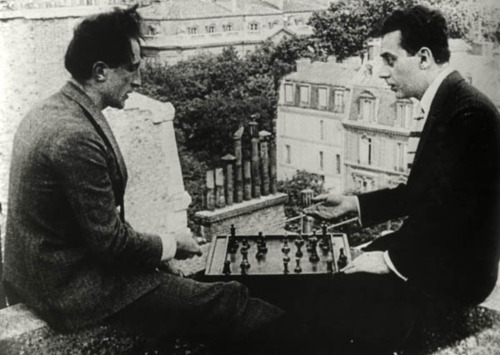
Marcel Duchamp and Man Ray play chess on a rooftop in Paris.

Duchamp again, this time on a rooftop in Paris, playing chess against Man Ray.

The photograph is later than 1915, when Duchamp moved to the U.S. to avoid World War I, and met Ray; it is probably after 1918.

The two even played chess in a movie:

Man Ray directed a number of influential avant-garde short films, known as Cinéma Pur, such as Le Retour à la Raison (2 mins, 1923); Emak-Bakia (16 mins, 1926); L’Étoile de Mer (15 mins, 1928); and Les Mystères du Château de Dé (20 mins, 1929). Man Ray also assisted Marcel Duchamp with his film Anemic Cinema (1926) and Fernand Léger with his film Ballet Mécanique (1924). Man Ray also appeared in René Clair‘s film Entr’acte (1924), in a brief scene playing chess with Duchamp.

The photo above is a still from that 1924 René Clair movie — it comes about 4:30 into the movie (the version shown here is half of the 20-minute movie, with a very modern, surrealist music score added; you can see the entire movie from Pathé, with a more contemporary score, here).

https://vimeo.com/488844088

Update, March 14, 2011:  See also this story from 2008 about Duchamp’s need to play chess, featuring of photo of Duchamp, Teeny Duchamp and the composer John Cage deeply engrossed in a game.  A good read about chess, and Duchamp.

Tip of the old scrub brush to ArtLex.com.


Chess games of the rich and famous: Marcel Duchamp

July 6, 2010

Duchamp playing chess

Sculptor and conceptual artist Marcel Duchamp playing chess. Unknown photographer, via Concepts into Virtualities

Marcel Duchamp, according to Andrew Stafford:

Marcel Duchamp (1887-1968), the painter and mixed media artist, was associated with Cubism, Dadaism and Surrealism, though he avoided any alliances. Duchamp’s work is characterized by its humor, the variety and unconventionality of its media, and its incessant probing of the boundaries of art. His legacy includes the insight that art can be about ideas instead of worldly things, a revolutionary notion that would resonate with later generations of artists.

Also, he liked to play chess.

Marcel Duchamp with chess set designed by his friend, Max Ernst

Marcel Duchamp with chess set designed by his friend, Max Ernst

The photograph at left comes from ChessMate.com:

. . . Marcel Duchamp, enjoying a chess set designed and presented to him by fellow artist, Max Ernst.

To say that Duchamp was an avid chess player would be an understatement. He played at approximately expert to master strength, and it is well known that he had — during the later part of his formidable career as a visual artist — given up the pursuit of art in favor of chess.

Here is an interesting quote about art and chess that is attributed to Marcel Duchamp:

“I am still a victim of chess. It has all the beauty of art — and much more. It cannot be commercialized. Chess is much purer than art in its social position.”

You will also want to see:

  • “Half-naked Thursday:  Eve Babitz with Marcel Duchamp,” at You Can Hire An Artist.   Is it safe for work or school?  The photo shows Duchamp in a gallery filled with his works at in 1963, playing chess with Eve Babitz, who is nude.   (The museum is identified as the “Pasadena Art Museum,” which would be the Pasadena Museum of Art of California See the explanation from Kathleen Benton in comments; I think it more likely that the museum is the Norton Simon Museum, also in Pasadena, but showing much more modern art and European art. (The Pasadena Art Museum is wonderful, by the way — an outstanding place to spend an afternoon; the Norton Simon is one you must see in your lifetime.)
  • “Not Wanting to Say Anything About Marcel,” by John Cage, at the Norton Simon Museum in Pasadena.

Chess games of the rich and famous: Bob Dylan, by Daniel Kramer

July 3, 2010

Bob Dylan at the chessboard, Woodstock, New York, 1964 - photo copyright Daniel Kramer

Bob Dylan at the chessboard, Woodstock, New York, 1964 – low resolution version of the original photo, copyright by Daniel Kramer – Barbara Archer Galleries

A good decade before I got to Woodstock.

Daniel Kramer began photographing Bob Dylan early in Dylan’s career, making many of the best shots available.

This 1964 photo of Dylan playing chess in Woodstock, New York, featured in an exhibition of Kramer’s photographs put on by Barbara Archer Galleries in 2005.

From the exhibit’s biography of Kramer:

Daniel Kramer is a New York-based photographer and film director who is long recognized for his portraits and picture stories in national and international magazines and books. Shortly after opening his first studio in New York City, Daniel Kramer saw Bob Dylan perform The Lonesome Death of Hattie Carroll on television in 1964. Even after the show ended, Kramer couldn’t shake the image of Dylan from his mind. “I was completely taken by what this man had done and how he had done it. His performance was perfect. With simple, basic tools – his voice, a guitar, and a harmonica, he drove his message deep into my mind. I was aware that I was seeing a very important talent.”

In August 1964, after months of phone calls and letters to Dylan’s manager, Albert Grossman, Kramer was given the opportunity to arrange a portrait sitting in Woodstock, New York with the twenty-three-year old performer who was by then in the process of becoming an international star. The two men quickly developed a warm and trusting professional relationship that allowed for many extraordinary photographic sessions. “Photography has brought me into contact with many notable people, including Presidents of the United States, and I have happily had the opportunity to meet and talk with prominent people in all walks of life,” comments Kramer. “Although many of these encounters were memorable, my association with Dylan has a special meaning.”

Many of these photographs were first published in Kramer’s 1967 book bob dylan, the first major work about the performer-songwriter (reprinted as Bob Dylan: A Portrait of the Artist’s Early Years, 2001). They were also used on the album covers for Highway 61 Revisited (1965), Biograph (1985) and Bringing It All Back Home (1965), which was nominated for a Grammy and selected by Rolling Stone as one of the “100 Greatest Album Covers of All Time.” A number of rare and previously unpublished pictures by Kramer also appear in the 52-page booklet and packaging that accompanies Bob Dylan’s two-CD set, Live 1964: Concert at Philharmonic Hall – The Bootleg Series, Volume 6 (2004) and on the cover of a three-CD boxed set BOB DYLAN the collection (2004).

Daniel Kramer’s photographs have also been exhibited or collected by such museums as the Whitney Museum of American Art, The International Center of Photography in New York, The Smithsonian’s National Portrait Gallery in Washington, D.C., The Experience Music Project in Seattle, The Rock and Roll Hall of Fame and Museum in Cleveland, and in numerous national and international galleries.

An interesting three-way marriage of the young Bob Dylan, a great photographer in Daniel Kramer, and one of the world’s oldest and most respected games of skill, chess. Go see all the photos.

More: