Why so few streets named after Vietnam veterans?

June 11, 2011

Junior Cruz of Salt Lake City was 15 when his Eagle Scout Project honored a fallen soldier from our war in Iraq, Adam Galvez.  You can read a stirring story from The Deseret News at Adam Galvez.com.

Junior Cruz, with Cpl. Adam Galvez's parents Tony and Amy Galvez, at Adam Galvez Street in Salt Lake City

Boy Scout Junior Cruz, with Cpl. Adam Galvez's parents Tony and Amy Galvez, at Adam Galvez Street in Salt Lake City

Marines honor fallen comrade Cpl. Adam Galvez, Salt Lake City, 2007

Marines honor their fallen comrade Cpl. Adam Galvez, at the ceremony naming a street after Galvez.7

Once upon a time I might have wondered about the utility of such a project, not because naming a street after a veterans isn’t a great idea, but because the actions required for naming streets might not measure up to the usual expectations for great service in an Eagle project.  This project and the stories about it quickly dispel such worries — for example, notice that the city required Cruz to raise the $2,000 required to change the street signs, such fundraising itself a major accomplishment.  Our son James’s project at the DFW National Cemetery required similar fundraising, and got at least as much in in-kind contributions — but it was major work.

Marines at the naming of Adam Galvez Street, 2007

Marines salute at the ceremony for the naming of Adam Galvez Street, 2007

Reading the news story, I thought back to a question that has plagued me for years:  Why didn’t we have the good sense to welcome back Vietnam vets with parades, and other welcome home activities?  That was one great lesson of Vietnam I think we, as a nation, learned well.  Today national news programs, like the PBS Newshour, honor each fallen soldier in our nation’s wars.  Here in Dallas, and at other cities I suspect, there is a formal volunteer program to make sure soldiers returning from Iraq and Afghanistan deployments get a flag-waving cheer when they get off the airplane.  Churches, schools, Girl Scouts and Boy Scouts volunteer to go wave the flags and cheer the soldiers.  The volunteers may get more out of it than the soldiers, but the message is clear all the way around:  These soldier men and women served their nation, and they deserve thanks and a cheer.

Ceremony naming Adam Galvez Street, February 2007

Ceremony naming Adam Galvez Street, February 2007

Is it too late to do that for Vietnam veterans?  A chief complaint over the years, especially from the war-hungry right wing, is that the Vietnam peace movement dishonored those veterans, chiefly by not honoring them more when they came home.

My brother, Wes, served four tours in Southeast Asia in that war, returning each time to no great celebration other than his family’s great gratitude at his return.  He’s too great a patriot to complain — as are most of the other Vietnam vets.  Our periodic patriotic celebrations now do better:  Vietnam vets get honored at July 4 and Veterans’ Day celebrations, and the fallen get special honors on Memorial Day, in most towns in America.

Junior Cruz hit on a great idea, though:  Name a street in honor of the fallen.

Why not do that for more Vietnam vets?  My hometown of Pleasant Grove, Utah, had a population of fewer than 10,000 people during the Vietnam conflict, but well I remember in my high school years when the list of fallen passed 11, including a recently-graduated studentbody president and basketball star and the brother of a woman in my French class.   Neither of them has a memorial other than their gravestone, that I’m aware.

Adam Galvez Street, Salt Lake City, Utah

Adam Galvez Street, Salt Lake City, Utah

Street names can tell us a lot about a town or city.  In the great booming times of 1950s through 1990s, a lot of streets in America were named after developers’ kids, wives and ex-wives.  More recently developers have taken to cutesy names on a theme designed to sell homes:  “Whispering Waters Way,” “Mountain View,” etc.   Those cities where history gets some note in street names do well, I think.  Ogden, Utah, named a bunch of streets after presidents, in order of their service, from Washington through the second Harrison (and as a consequence, a lot of people who grew up in Ogden can name the presidents in order from Washington through almost to Teddy Roosevelt).  New York has not suffered from renaming a stretch of road The Avenue of the Americas, Washington, D.C. has done well with both Independence Avenue and Constitution Avenue.

Why not rename some streets in American after Vietnam veterans?  While we’re at it, how about Korean War veterans?  We can’t recapture the time and do what we should have done about 58 years ago for Korea or about 45 years ago for Vietnam.  We can do noble things from now, forward.  Why not create memorials that remind us of the great service these people did for their nation, and name and rename streets in their honor?

Resources:


Scouts Shooting for the Moon: The story of twelve Moon walkers, and Scouting

April 30, 2011

1cernan_jump_salutes_flag_-_gpn-2000-001273_0

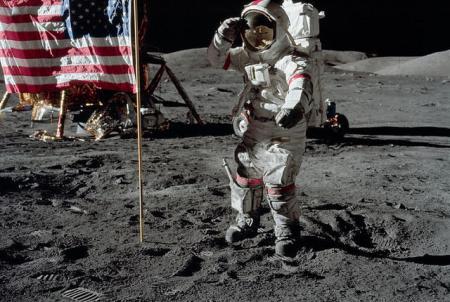
Astronaut and 2nd Class Boy Scout Eugene Cernan saluted the U.S. flag on the Moon, on the last Apollo mission, Apollo 17. Photography by Astronaut and Tenderfoot Scout Harrison Schmitt. NASA image.

A short piece I presented this morning to the Tom Harbin Scout Museum Symposium on Scout History, a great morning organized by Bob Reitz, the curator of the Tom Harbin Scout Museum at Camp Wisdom, in Dallas, Texas. Of course the material is copyrighted, but by all means you have permission to use the material at Courts of Honor or in recounting the better history of Boy Scouting.

Scouts Shooting for the Moon:  The story of twelve Moon walkers, and Scouting

This is a recreation with modern numbers of a presentation first used a decade ago. Searching for material for a speech to honor Eagles at our District Dinner, several people suggested in a short period of time, ‘Why not talk about the astronauts who landed on the Moon. I hear they were all Eagle Scouts.’  Was that accurate?  It would have been a good story if so. Research revealed something quite different. The true story can carry just as much inspiration, however. Scouting is shown to be a program that can lead to a lifetime of adventure and accomplishment. Also, Eagles may take some inspiration in knowing they have accomplished something most of the men who walked on the Moon did not.

Speakers constantly need good material for Eagle Scout Courts of Honor and other events honoring Scouts and Scouters. For one event honoring a group of new Eagle Scouts, several people urged that I research the facts behind the story they had heard, that most, or all of the men who walked on the Moon were Eagle Scouts. New Eagles would find comfort in knowing they had soared into the midst of such company, they reasoned.

So it came to pass that, before the advent of Wikipedia and Google, I spent hours on the telephone until a press person at NASA pointed out to me a collection of information on astronauts that NASA had thoughtfully put on-line. At some high cost I printed out the few pages that dealt with the Scouting experience of astronauts, and worked to correlate it with information about which of them had gone to the moon, and which had not.

Anyone can find that book online with ease, today. The NASA Astronaut Fact Book provides information on almost every detail about NASA’s crew of astronauts, past and present. It includes one-and-a-half pages on the Scouting background of people working as astronauts and payload specialists for NASA, and others NASA has launched into manned missions. Cross-indexing that information with lists of Apollo Mission astronauts, I created four short tables showing the Apollo astronauts who went to the Moon, their missions, and the Scout rank they achieved, if any.

Lunar Astronauts and Scouting Experience

Twelve Moon Walkers

Name Mission Dates on the Moon Scout Rank
1 Neil Armstrong Apollo 11 July 21, 1969 Eagle Scout
2 Buzz Aldrin Apollo 11 July 21, 1969 Tenderfoot Scout
3 Pete Conrad Apollo 12 November 19-20, 1969 Cub Scout
4 Alan Bean Apollo 12 November 19-20, 1969 1st Class
5 Alan Shepard Apollo 14 February 5-6, 1971 1st Class
6 Edgar Mitchell Apollo 14 February 5-6, 1971 Life Scout
7 David Scott Apollo 15 July 31-August 2, 1971 Life Scout
8 James Irwin Apollo 15 July 31-August 2, 1971 None
9 John Young Apollo 16 April 21-23, 1972 2nd Class
10 Charles Duke Apollo 16 April 21-23, 1972 Eagle Scout
11 Eugene Cernan Apollo 17 December 11-14, 1972 2nd Class
12 Harrison Schmitt Apollo 17 December 11-14, 1972 Tenderfoot Scout

Apollo 13

Name Mission Dates on the Moon Scout Rank
1 Jim Lovell Apollo 13 Lunar Swingby Eagle Scout
2 Jack Swigert Apollo 13 Lunar Swingby 2nd Class
3 Fred Haise Apollo 13 Lunar Swingby Star

Lunar Missions That Did Not Land

Name Mission Dates on the Moon Scout Rank
1 Frank Borman Apollo 8 Orbited only None
2 Jim Lovell Apollo 8 (&13) Orbited only Eagle Scout
3 William Anders Apollo 8 Orbited only Life Scout
4 Tom Stafford Apollo 10 Orbited only Star Scout
5 John Young Apollo 10 (& 16) Orbited only 2nd Class
6 Eugene Cernan Apollo 10 (& 17) Orbited only 2nd Class

Others Who Did Not Land

Name Mission Dates on the Moon Scout Rank
1 Michael Collins Apollo 11 Capsule pilot None
2 Dick Gordon Apollo 12 Capsule pilot Star Scout
3 Stewart Roosa Apollo 14 Capsule pilot None
4 Al Worden Apollo 15 Capsule pilot 1st Class
5 Ken Mattingly Apollo 16 Capsule pilot Life Scout
6 Ronald Evans Apollo 17 Capsule pilot Life Scout

In all, 24 men flew to the Moon. Twelve set foot on the lunar surface. Of the twelve, eleven were Scouts, two were Eagles. Of the 24, 20 were Scouts, three were Eagles.

At the time I originally researched, about 70% of all astronauts were alumni of Scouting, men and women. Officially, BSA lists 181 NASA astronauts as being alumni, 57.4%

NASA lists the colleges and universities astronauts attended. NASA lists military service, hometowns, and states of birth. But with the possible exception of a generic category of “public schools,” no category of astronauts is larger than the category of Scouting experience. If we were advising a young person on how to get to become an astronaut, we would be remiss if we did not advise him or her to join Scouting.

What can we conclude?

Three things became apparent to me in tracking these figures down. One, I learned once again that the true stories most often carry great value, more value than the stories people make up, or assume.

Two, I learned that Scouting by itself carries great value, without a Scout’s having earned Eagle. We know that not all the Moon walkers earned the Eagle rank. But we also notice that no flight ever went to the Moon without at least two Scouts aboard. Three of the 24 lunar voyagers are Eagles, 12.5%. Two of the dozen who actually set foot on the Moon are Eagles, 16.7%. Eleven of the twelve Moon walkers were Scouts, 91.7%. 21 of 24 lunar voyagers were Scouts, 87.5%.

So, while it was not necessary to be an Eagle, it certainly seemed to help. But simply having Scouting experience seemed to be the biggest help. There may be some magic in a boy’s having taken that oath that carries through his entire life, and spurs him to do daring and great things. That is important. A trend begins to emerge. Scouting by itself, without earning the highest rank, provides great value. When a boy signs up, he signs on for the adventure of a lifetime, and often that leads to a lifetime of adventure. That venturesome spirit carries on well past his Scouting years.

The story of Jim Lovell might carry some great weight with Scouts. Lovell is the only person to have gone to the Moon twice, but never set foot on it. He was the commander of Apollo 13, whose near-disaster was chronicled in the movie of the same name. Among other lessons that might be pulled out of the story:  When your Moon-bound spaceship explodes and loses power on the way to the Moon, it is often good to have an Eagle Scout handy to help get through the experience and return safely.

Is there inspiration here?

When I first presented these figures at a Scout meeting, a parent asked me whether these numbers would discourage boys from working for any rank advancement, since just being a Scout seems to carry such weight. This should not discourage Eagles, nor discourage any Scout from working to get the Eagle rank. We should look at it this way:  Every Scout who earns an Eagle has done what ten of the twelve who walked on the Moon did not do, perhaps could not do. Nine more Moon walkers started on that path to Eagle, but did not finish, or could not finish.

Not every Eagle can go to the Moon, but every Eagle has already won an award that most of those who did go to the Moon wish they had.

Especially in the circles of corporate and government leadership, character, what it is and how to get it, concerns people. What sort of character does it take to go to the Moon? Every Scout has a glimpse of what is required, and every Eagle can say, “I know what it takes to get such character.”

Bibliography

Human Spaceflight, “The Apollo Program,” NASA, July 2, 2009; accessed April 28, 2011; http://spaceflight.nasa.gov/history/apollo/

Astronaut Fact Book, NASA,  NP-2005-01-001JSC, January 2005; accessed April 27, 2011; spaceflight.nasa.gov/spacenews/factsheets/pdfs/astro.pdf

BSA, “Facts About Scouting,” 2009; accessed April 28, 2011; http://www.scouting.org/about/factsheets/scoutingfacts.aspx

“Astronauts With Scouting Experience,” Eagle Scout Information, U.S. Scouting Service Project, April 6, 2011; accessed April 29, 2011; http://www.usscouts.org/eagle/eagleastronauts.asp

About the author:

Ed Darrell teaches U.S. History at Moises E. Molina High School in Dallas. He has taught economics, government, world history and street law in high schools; he also taught at the University of Utah, University of Arizona, and DeVry University. He is a former speech writer for politicians. His degree in Mass Communication came from the University of Utah, and his law degree from George Washington University. This was presented to the Jack Harbin Museum Symposium of Scout History, April 30, 2011.

World Scout badge carried to the Moon by Astronaut Neil Armstrong.

World Scout badge carried to the Moon by Astronaut Neil Armstrong.


Save


One Boy Scout’s story: Kazimierz Piechowski, “I escaped from Auschwitz”

April 14, 2011

Good reading:  An article by Homa Kahleeli in The Guardian from Tuesday, April 12, 2011:

I escaped from Auschwitz

Kazimierz Piechowski is one of just 144 prisoners to have broken out of the notorious Nazi camp and survive. Today aged 91, he tells his extraordinary story

Kazimierz Piechowski, Boy Scout who escaped Auschwitz - Guardian photo

Guardian caption: "Kazimierz Piechowski in 2011. 'We just planned that I would play the role of an SS officer so well that the guards would believe me.' Photograph: Christian Sinibaldi for the Guardian"


Portrait of Lord Robert Baden Powell, the founder of Scouting

December 11, 2010

HERKOMER Hubert von | Sir Robert Baden-Powell (1857-1941). | 1903

Hubert von Herkomer's 1903 portrait of the founder of Scouting, Sir Robert Baden-Powell - California State University's World Images Kiosk

Before Boy Scouting, Sir Robert Baden-Powell was the hero of the Siege of Mafeking, during the Boer War.  This image of the founder of Scouting does not appear often, but deserves some audience, here in the Centennial of Scouting in the U.S.


BSA awards Bill Gates the Silver Buffalo

September 15, 2010

News came out during the Jamboree, but yesterday in Seattle the Boy Scouts of America made it tangibly official.

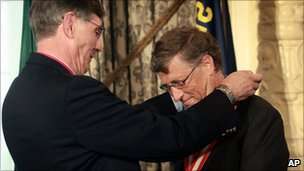
Microsoft founder and philanthropist Bill Gates, Jr. received the Silver Buffalo Award, the highest honor BSA gives to any Scouter.

Gates was a Life Scout; his father, William Gates, Sr.,  is an Eagle Scout.  The awards ceremony was scheduled to include members of Gates’s Cub Scout Pack 144 and Boy Scout Troop 186.

Microsoft founder Bill Gates receiving the Silver Buffalo award from Boy Scouts of America. BBC image

Microsoft founder Bill Gates receiving the Silver Buffalo award from Boy Scouts of America. BBC image

More:


High rates of drowning: Why is there a racial disparity in drowning deaths?

August 16, 2010

Congress granted a national charter to the American Red Cross to perform emergency services, and to teach people to swim, to prevent drowning, as part of the disaster-readiness services of the organization originally founded in 1881.  Many of us got our first swim lessons under the direction of a Water Safety Instructor trained and certified by the Red Cross; some of us went on to get WSI certification to teach swimming and lifesaving.

But for some reasons, these drowning prevention measures are not working to save the lives of African Americans as well as for everybody else.

NPR’s Talk of the Nation carried a story about the problem in today’s edition (available on-line here, a 30-minute story):

Swimming Disparity
The drowning deaths of six black teens in Louisiana renewed questions about the long-standing disparity between those Americans who can swim and those who can’t. Neither the teens who drowned nor their families who watched from shore could swim.  According to the CDC the rate of fatal drowning is highest among African-American children ages 5-14 (three times that of white children in the same age range) due to a combination of social, economic and cultural issues. Neal Conan talks about what causes the dangerous disparity in swimming, and how to recognize and assist someone who’s drowning.

Drowning rates run even higher for Native Americans.

Race disparities in drownings in the U.S.; AP chart via NPR

Race disparities in drownings in the U.S.; AP chart via NPR

More than 30 people have died in drowning accidents already this year in Texas alone — victims of all races — after a terrible 2009 record.  About 3,500 people die in the U.S. from drowning every year.  Most of these accidental deaths could have been prevented with the use of personal flotation devices, and may have been preventable had the people involved had basic drownproofing, or swimming, or lifesaving instruction.

(Remember this mantra:  Reach; throw; row; go.  Only after attempts to reach for the victim, perhaps with a pole, or throw a flotation device, or row a boat, should anyone including a well-trained lifesaver, go into the water to retrieve someone drowning.)

Where can people get instruction on how to prevent drownings?  Red Cross courses are offered at countless community pools — those pools are, alas, generally the first services cut back when cities and counties trim budgets, as they have been trimming since the start of our nation’s financial woes in 2008.    Other good sources of anti-drowning instruction are the YMCA, Girl Scouts, and Boy Scouts.

I received lifesaving instruction at community pools, and in Red Cross sanctioned programs at Brigham Young University and the University of Utah.  I earned the Swimming, Lifesaving, Rowing and Canoeing merit badges in Scouting, and I taught rowing and canoeing at a Scout camp and another camp, and I taught Red Cross Lifesaving for several years as a WSI.

Even in Dick Schwendiman’s astounding Advanced First Aid course at the University of Utah, I didn’t learn the following stuff about drowning, however (another Red Cross certified course).  Regardless whether you can get a lifesaving course, or if you’ve had one, you need to go read Mario Vittone’s stuff on drowning, and how to recognize when someone in the water needs help:

Button, Drowning doesn't look like drowning

The new captain jumped from the cockpit, fully dressed, and sprinted through the water. A former lifeguard, he kept his eyes on his victim as he headed straight for the owners who were swimming between their anchored sportfisher and the beach. “I think he thinks you’re drowning,” the husband said to his wife. They had been splashing each other and she had screamed but now they were just standing, neck-deep on the sand bar. “We’re fine, what is he doing?” she asked, a little annoyed. “We’re fine!” the husband yelled, waving him off, but his captain kept swimming hard. ”Move!” he barked as he sprinted between the stunned owners. Directly behind them, not ten feet away, their nine-year-old daughter was drowning. Safely above the surface in the arms of the captain, she burst into tears, “Daddy!”

How did this captain know – from fifty feet away – what the father couldn’t recognize from just ten? Drowning is not the violent, splashing, call for help that most people expect. The captain was trained to recognize drowning by experts and years of experience. The father, on the other hand, had learned what drowning looks like by watching television. If you spend time on or near the water (hint: that’s all of us) then you should make sure that you and your crew knows what to look for whenever people enter the water. Until she cried a tearful, “Daddy,” she hadn’t made a sound.

You’ll find that life-saving article at Mario Vittone’s blog on boater safety. If you are a teen ager, a parent, a grandparent, or you ever swim, you need to read that article.  (Thanks to P. Z. Myers at Pharyngula for pointing the way to that post.)

Will you help save a life, please?

Resources:


Photog (and Eagle Scout) Luke Sharrett leaving NY Times . . .

August 13, 2010

Go see the photos.  Seriously.  “The Capital was his classroom”, by David Dunlap.

Doubtless, there are other accomplished photojournalists in Washington who have won an Eagle Scout medal with bronze palm. Luke Sharrett of The Times may be the only one who earned his just six years ago.

And he is almost certainly the only photographer who’ll be leaving the D.C. press corps on Friday to start his junior year in college.

“Why are you doing that?” President Obama asked him as Air Force One was taking off the other day.

Dunlap does not say whether Sharrett earned the Photography Merit Badge.  Anyone know?


Boy Scouts and learning respect

August 11, 2010

From the daily Chattanoogan website, a letter to the editor:

The Boy Scouts Are Supposed To Teach Respect
posted August 9, 2010

I just watched one of the most disturbing videos I have seen in a long time. A friend posted a video on “Facebook” of the Boy Scout’s of America, jeering, and booing, the President of the United States. I absolutely couldn’t believe what I was watching.

Like most guys my in my age group, which is older than dirt, I was a Boy Scout. I never rose much above the “Tenderfoot” level, but I really have fond memories of my experiences with the “Troop.” I was taught a lot of “life’s lessons” from some of the finest men in Chattanooga, one of those lessons was respect.

The President of the United States of America is the “Commander in Chief” of our military. He also serves as the President of the “Boy Scout’s of America.” That appointment is automatic upon his, or her, swearing into office. I was taught to respect the office of the President, whether you agreed with the “office holder” or not. Whether the President is Bush, Roosevelt, Eisenhower, or Obama, he deserves the respect that title carries.

I served as both a Boy Scout and Explorer Scout Counselor several years ago. I enjoyed the time I spent with the kids I was entrusted with, and I am proud of the adults they grew to become. At the time, we didn’t have to compete with the internet, cable television, and “Twitter”, to capture the boys attention. Those days will forever stand as another Norman Rockwell painting of better, more innocent days.

Now the BSA has attempted to become another breeding ground for the religious zealots, where homophobes abound. They have even been compared to the quasi-right wing military groups. Somewhere along the way, the purpose, and usefulness, of scouting has been diminished, or in some cases, erased completely. The kids are obviously not taught respect, nor civility.

I remember, “On my honor, I promise to do my duty to God, and to my Country.” That promise didn’t say anything about respecting only Republicans or Democrat’s. In fact, politics wasn’t even brought into the equation. A Scout is “trustworthy, loyal, friendly, courteous”, and that is the oath they take. Where is the courtesy in booing?

If we can’t even try to teach our youth civility, to disagree without being disagreeable, what hope do we have for our future? From what I saw today, things look pretty bleak.

Rod Dagnan
Chattanooga

From the Op-Ed News Network:

August 10, 2010 at 09:34:27     Permalink
Time to Add ‘Respect’ to the Scout Law

The Boy Scouts owe President Obama an apology for their disrespectful conduct at this year’s National Jamboree.

::::::::

I just read that 45,000 Boy Scouts booed the President of the United States for failing to address them in person at this year’s National Jamboree at Fort A. P. Hill, Virginia. Instead of addressing the Scouts, President Obama appeared on “The View” television show.

I was a Scout myself for 10 years and received the Eagle Rank in March 1962. Later I was an adult leader. When my own son was old enough, he joined the Scouts and I was a den leader, assistant scoutmaster, and District Committee member. I think I have a pretty good idea of what Scouting is and ought to be.

The Scouts’ shameful display of disrespect at the Jamboree is not it.

Here’s a memo to the Scouts: sometimes in this life – and may yours be long and happy – things don’t go your way. You don’t always get everything you want. Life has its disappointments and setbacks. As incredible as it may now seem, there are some people and things in this world that are actually more important, or at least more immediate, than you are.

When that happens, you can boo and complain. Or you can suck it up, man up, and move on. Which do you think good Scouts should do?

Understand this: the President of the United States is an elected official. In today’s partisan political climate, he has to gauge almost all of his actions partly in terms of their electoral impact. He can’t do the job at all if his team doesn’t get elected or re-elected. And the mid-term elections are only three months away.

You may not like it but that’s the way it is.

No offense to you, but the President will gain a lot more electoral advantage from appearing on “The View” than he would by addressing 45,000 people who are too young to vote anyway. That’s just a fact of political life. Sorry, but it’s true; that’s the way our system works. It’s not a perfect system.

I am not a religious man; in fact, for more than 50 years the Scout Law has been my religion. I believe that when I come to the end of all my days, I will have very little explaining to do if I can say to the Almighty that I lived my life according to the Scout Law: “A Scout is trustworthy, loyal, helpful, friendly, courteous, kind, obedient, cheerful, thrifty, brave, clean, reverent.”

But because I am not a religious man, I have substituted for “Reverent’ in my own personal credo another “R’ word: Respectful. A Scout is Respectful. A Scout is respectful of himself and others, whether he agrees with them or not.

Maybe it is now time to add Respectful to the Scout Law.

The shameful lack of respect these Scouts showed to the President at this year’s Jamboree reflects poorly on the organization, its proud legacy, and on the Scouts themselves. They have disgraced the uniform and its heritage.

The Scouts owe the President an apology.

Rick Wise is an industrial psychologist and retired management consultant. For 15 years, he was managing director of ValueNet International, Inc.

Before starting ValueNet, Rick was director, corporate training and, later, director, corporate strategy for Travelers Corp., an international insurance and financial services firm. He lost six friends in the World Trade Center on 9/11. Rick was a Vietnam-era Navy Hospital Corpsman.

Rick holds PhD and M.Ed. degrees from Penn State. His BS is from West Chester University. He completed post-doctoral work at Rensselaer, Northwestern, Colorado, and Harvard. A native of Pennsylvania, Rick now lives in New England.

Letter of the Day at the website of the Mineapolis Star-Tribune, for August 11 (added here late on that day):

Letter of the day: Eagle Scout: Booing Obama broke the Boy Scout Law

Last update: August 11, 2010 – 6:42 PM

As an Eagle Scout, I was appalled that some Boy Scouts reportedly booed President Obama when he appeared in a taped message at the recent National Scout Jamboree in Virginia. While I can understand their disappointment at not being addressed in person, the Boy Scouts involved in this incident broke about half of the tenets of Boy Scout Law: They were not loyal, friendly, courteous, kind or obedient in the least. Their leaders should help them understand what the Boy Scout Law means and how to follow it.
TOM KELSEY, SHOREWOOD

A different view from the National Guard’s video of Day 4 of the Jamboree:

BSA’s version (go check out the comments):

You don’t need to know Morse code to send the message along:

Add to FacebookAdd to NewsvineAdd to DiggAdd to Del.icio.usAdd to StumbleuponAdd to RedditAdd to BlinklistAdd to TwitterAdd to TechnoratiAdd to Furl


Something to toot your horn about: Scouts save Bugling merit badge

August 10, 2010

Boy Scouts of America reviews merit badge offerings from time to time, adding new badges, modifying requirements, retiring badges that are unpopular or outdated.

Recently Bugling was dropped as a separate badge, and made an adjunct of the Music merit badge.  Bugling was a great tradition in Scouts — a music-oriented badge that required only that one be able to memorize and blow recognizable versions of several bugle calls.

Perhaps ironically, Bugling also drew the spotlight as the last merit badge earned by several of those super Scouts who earned every possible merit badge.  For some reason, learning to blow the horn was just the last or toughest thing they could master.

Good news:  Bugling has been reinstated.

Bugling reinstated as separate merit badge

Bugling Have your guys start practicing “Taps,” because Bugling is here to stay.

In early June, we reported that the Bugling merit badge was to be discontinued and its requirements merged into Music merit badge.

That’s no longer the case. Responding to concerns from hundreds of Scouters, the BSA’s Youth Development team has decided to reinstate Bugling as a separate merit badge.

Oddly enough, this means that Bugling will never have officially been part of Music merit badge, because the changes were never reflected in a Boy Scout Requirements book.

Bugling and Music will continue to share a merit badge pamphlet. Requirements and information for both of the badges will be contained within that single booklet.

More:

To the Colors, from USSSP Bugling Merit Badge page

"To the Colors," one of the bugle calls required for the Bugling merit badge. Image from U.S. Scouting Service Project


Obama Blows Off the Boy Scouts? – ColbertNation report

August 6, 2010

Vodpod videos no longer available.

Obama Blows Off the Boy Scouts | July 28, 2010 …, posted with vodpod

How was your time at the Jamboree? Did you have time to miss Obama?

If you had time to miss him, you weren’t there.

Here’s Obama’s video address to the Scouts:

Earlier at Millard Fillmore’s Bathtub:

Add to FacebookAdd to NewsvineAdd to DiggAdd to Del.icio.usAdd to StumbleuponAdd to RedditAdd to BlinklistAdd to TwitterAdd to TechnoratiAdd to Furl


Live webcast, Boy Scout Centennial Celebration – NOW

July 31, 2010

By the way, you can pick up a live webcast of the Boy Scouts of America Centennial Celebration, here.

The broadcast is already an hour old; Scouts are taking their seats, show due to start in less than an hour.

On Saturday, July 31, 2010, at 8 p.m. EST, the Scouting family — past, present and future — will be able to take part, in a special nationwide broadcast. A Shining Light Across America will bring the Centennial Celebration Show from the 100th Anniversary National Scout Jamboree in Fort AP Hill, Va. to communities across the country via Webcast and satellite transmission.

Go see.

Here’s action in Times Square, earlier today:

Times Square, BSA Centennial, July 31, 2010

Times Square, BSA Centennial, July 31, 2010 - BSA caption: "It isn’t every day that visitors to New York’s Times Square can canoe down Broadway, climb a rock wall, or practice virtual archery … but it isn’t every year that we celebrate our 100th Anniversary! Here’s a look at the excitement and adventure happening in Times Square today before the “Shining Light Across America” broadcast of the jamboree’s Centennial Celebration Show this evening."


They’re all our kids

July 29, 2010

Which kid is yours?

Scouts at the Arena Show, Day 3, 2010 National Jamboree

Scouts at the Arena Show, Day 3, 2010 National Jamboree - "Scouts carry in American flags to start the opening arena show in Ft. A.P. Hill, Va., Tuesday July 27, 2010. Photo by Daniel Giles" (from Flickr stream)

All of them.


Mike Rowe proposes an amendment to the Scout Law

July 27, 2010


New stamp honoring Scouting — buy some today.

July 27, 2010

Show your support of Scouting — get the commemorative Scout stamp for your important letters.

USPS stamp honoring Scouting Centennial

USPS stamp honoring Scouting Centennial

The stamp is available for sale at your post office, starting today.  Press release from USPS below.

WASHINGTON — The U.S. Postal Service today awarded scouting its ‘stamp of approval’ to celebrate 100 years of the U.S. scouting movement. The 44-cent first-class Scouting stamp, available nationwide today, was dedicated at the National Scout Jamboree at Fort A.P. Hill, VA, where more than 30,000 scouts from around the nation set up camp for 10 days of premier scouting fun during the organization’s centennial anniversary.

“Scouting showed me the importance of protecting the environment,” said former Boy Scout Sam Pulcrano, who, as the vice president of Sustainability, oversees the Postal Service’s green initiatives. “That is why I am proud of the work we are doing at the Postal Service. We have a long history of environmental leadership and innovation. We were testing electric mail delivery vehicles during the horse and buggy days, and we were recycling long before there was a universal symbol for it. Just as the scouts are famous for serving others and helping their communities, our sustainability efforts are benefiting our families, friends and neighbors in the communities where we live and work.”

Joining Pulcrano in dedicating the stamp were Robert Mazzuca, Chief Scout Executive of the Boy Scouts of America; Terry Dunn, 2010 Jamboree chairman; and Lt. Colonel John Haefner, U.S. Army Ft. A.P. Hill Garrison commander. Emceeing the event was 15-year-old Eagle Scout and Bloomington, MN, native Jeremy Biedny, who earned his stamp collecting merit badge shortly after becoming a scout and discovered a personal passion for stamps.

“We are appreciative that scouting’s centennial will have a place in history with the many great people and events that are commemorated on U.S. stamps.” said Mazzuca. “It is truly an honor to receive the distinction of a commemorative stamp, and we hope that it provides the entire country the opportunity to share in the milestone of our 100th anniversary.”

The design, created by illustrator Craig Frazier of Mill Valley, CA, depicts the spirit and outdoor adventure of scouting through a backpacking scout and a large silhouette of a scout surveying the landscape.

The Boy Scouts of America celebrated its 100th anniversary Feb. 8, 2010. To mark this milestone, the organization has undertaken celebration efforts nationwide that reintroduce the organization to today’s young people and families, reinforcing the value of scouting and reconnecting with the millions the organization has affected. For more information visit www.scouting.org. The Scouting stamp recognizes the contributions to society made by all U.S. scouting organizations.

The Postal Service receives no tax dollars for operating expenses, and relies on the sale of postage, products and services to fund its operations.

Ordering First-Day-of-Issue Postmarks
Customers have 60 days to obtain the first-day-of-issue postmark by mail. They may purchase new stamps at their local Post Office, at The Postal Store website at www.usps.com/shop, or by calling 800-STAMP-24. They should affix the stamps to envelopes of their choice, address the envelopes to themselves or others, and place them in a larger envelope addressed to:

Scouting Stamp
Postmaster
117 Milford Street
Bowling Green, VA 22427-9998

After applying the first-day-of-issue postmark, the Postal Service will return the envelopes through the mail. There is no charge for the postmark. All orders must be postmarked by Sept. 27, 2010.

Ordering First-Day Covers
Stamp Fulfillment Services also offers first-day covers for new stamp issues and Postal Service stationery items postmarked with the official first-day-of-issue cancellation. Each item has an individual catalog number and is offered in the quarterly USA Philatelic catalog. Customers may request a free catalog by calling 800-STAMP-24 or writing to:

Information Fulfillment
Dept. 6270
U.S. Postal Service
PO Box 219014
Kansas City, MO 64121-9014

Philatelic Products
Four philatelic products are available for this stamp issue:

  • 465461, First-Day Cover, 82 cents.
  • 465465, Digital Color Postmark, $1.50.
  • 465491, Ceremony Program, $6.95.
  • 465499, Digital Color Postmark Keepsake, $10.95.

# # #


Making Boy Scouting a political football — shame on those outlets

July 27, 2010

When President Barack Obama met with a group of outstanding Boy Scouts in the Oval Office a few weeks ago to discuss policies affecting Scouting, and especially policies affecting children, teen agers and young adults in the U.S., very few conservative sites thought it important to cover.  Let’s be more precise:  No conservative Obama critics, nor much of anyone else, bothered to cover it.  I’d love to see links even of local media in the Scouts’ hometowns that printed a story or photo.

To the credit of the White House, neither did the press promote the meeting as a political point.  Scouting prefers not to be a political football, and Scouting policy asks that Scouts avoid even looking like politicking while in uniform. (Scouts are encouraged to participate in the political process, including through the three citizenship merit badges, which encourage Scouts to communicate their concerns about policy to elected representatives, while working for the merit badge and in the future as participating citizens.)

2010 is a grand year for Scouting.  It’s the centennial of Scouting’s coming to the United States.  There’s a special Scout Jamboree, being held at Fort A. P. Hill in Virginia (the last time the Jamboree will be held on federal property — that’s another story for another time).   It’s always fun when presidents come to the Jamboree and speak, but it’s not always possible.

But today, news comes that President Obama will send a video speech to the Scouts at the Jamboree, as has been done sometimes in the past.  Many of us are disappointed that President Obama will not appear in person; but some of us who have experience scheduling such things know that elected officials cannot make every appearance they would like to.  Presidential schedules in the modern world are particularly difficult; for an appearance at Fort A. P. Hill security must be imposed (even on a Scouting event), aircraft landing sites need to be arranged and secured . . . dealing with more than 30,000 Scouts becomes an onerous task.

Still, we’re disappointed.

Adding to that disappointment, comes now a group of harpy Obama critics, no friends of Scouting that I can determine, but anxious to claim this scheduling decision as some sort of snub to Scouting, and to the American flag.

Media Matters has the facts, and puts the scheduling stuff into perspective, “Overhyped conservative nonsense of the Day:  Obama hates the Boy Scouts.”  UpdateBlue Wave News has it in perspectiveWonkette’s satire, unfortunately, goes awry, but her heart and brain are in the right places.

The snub is by those critics who attempt to turn Scouting into a political football.  The insults are all from them.

Shame on them, collectively and individually:

Update: We’re going to have to add on a wing to accommodate the Wall of Shame:

Hmmmm.

I’ll wager none of those authors bothers to volunteer for Scouting.  I’d be surprised (and disappointed) to discover any were Scouts.  Scouting wouldn’t revoke their citizenship merit badges, but they’ve forgotten them, if they ever earned them.

Scouting faces severe hurdles these days, some of them I would say were placed by poobahs at the top of Scouting; these guys listed above are not helping.

Here are some tests to see which of these blogs and pundit outlets is friendly to Scouting:  Which of them covered the award, this morning of the Distinguished Eagle Scout Award to Tuskegee Airman Charles McGee?  Which of them covered the dedication of the U.S. Postal Service’s stamp honoring the Scouting Centennial, today?  As of this moment, I can find no media coverage of these things at all, even by local media.

Why do these pundits cover Scouting only when it gives them a chance to make an unfair shot at a politician they don’t like?  Seriously, who is doing disservice to Scouting, and the nation?

Good news about Scouting’s 100th Year, and the Jamboree: