20 years ago, the Berlin Wall fell – reverse domino effect

November 9, 2009

High school sophomores in Texas study world history, and juniors study U.S. history. At 16 and 17 years old, they have difficulty figuring out the fuss over the Berlin Wall. It’s just pictures in their textbook.

The Wall was already three or four years gone when they were born. They don’t remember living with the Soviet Union at all — it’s been Russia to them for their entire lives.

I have some hopes that the celebrations set for this week will aid their understanding, on the 20th anniversary of the breaching and destruction of the wall.

Dominoes set for celebration of the Berlin Wall's destruction.  AP photo by Herbert Knosowski, via Canadian Broadcast System

Caption from CBC: "Dominoes are placed where the Berlin Wall once stood in front of the Brandenburg Gate in the German capital. (Herbert Knosowski/Associated Press)"

An enormous line of giant dominoes is set up along the line where the old wall stood — to be toppled on November 9, the anniversary of the official breaching of the wall.

It’s the “domino theory” in reverse.

About 1,000 plastic foam dominoes will fall to the ground Monday along the route where the Berlin Wall once stood to mark the 20th anniversary of the crumbling of the Cold War barrier.

The 2.3-metre-high blocks, painted by schoolchildren, stretch for 1.5 kilometres in a path near the Brandenburg Gate and the German parliament.

Former Polish leader Lech Walesa, whose pro-democracy movement Solidarity played a key role in ending communism in Eastern Europe, will tip the first domino at 8 p.m. local time.

I made one visit to the wall, late on a night in 1988.  American Airlines explored the possibility of taking over the service authorized from Munich to Berlin.  Soviet and East German rules required passenger flights to stay at a very uncomfortable 10,000 feet.  Pan Am had the route, but Pan Am was in trouble.  We spent a day with Berlin airport authorities and real estate agents trying to figure out how to set up a reservations office and other ground facilities.  European airports tended to force foreign carriers to share gate facilities, which was a problem, and we devoted a lot of time to gathering data for computer lines.

But then, after a smashing dinner of sausage and German-style potatoes in a great, small Berlin pub, we talked our taxi driver into giving us a tour of the wall.  He drove a spot near the Brandenburg gate, and there on a chain link fence keeping westerners from the wall were eight fresh wreaths.  Eight people had died trying to cross from East Berlin to West Berlin in the previous six months.  One wreath for each death.

Just over a year later, the Berlin Wall itself would be gone.

West Berlin acted much like a normal, western European city.  But the wall was there as a constant reminder of the oppression on the other side, a dull fog to constantly dim even the sunniest day.

Old posts on the Berlin Wall here at the bathtub are suddenly popular — usually they get a lot of hits after March when U.S. schools get to the post-World War II era, the Cold War and the Berlin airlift.  I imagine the current popularity has something to do with the anniversary.

I hope somebody has some great video of the dominoes toppling.

Dominoes acerbicly note the irony:  While the U.S. feared nations would fall under communism in a “domino effect,” especially in Southeast Asia (Indochina), communism broke up in a domino effect, as one communist-dominated country after another found freedom near the end of the Cold War.  Why has no one done a serious essay on the domino effect of freedom?

More news and resources:

Famous sign warning visitors leaving West Berlin

A sign of old times, now unneeded

Viral dominoes: Help spread the news:

Add to FacebookAdd to NewsvineAdd to DiggAdd to Del.icio.usAdd to StumbleuponAdd to RedditAdd to BlinklistAdd to TwitterAdd to TechnoratiAdd to Furl


Al Gore shows how green investing works

November 3, 2009

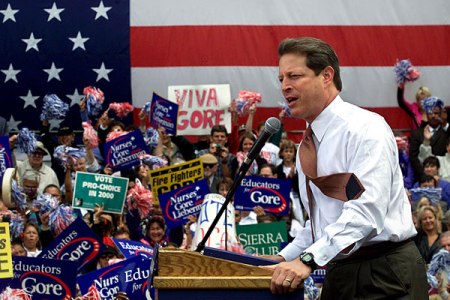
Then Vice President Al Gore campaigning in Des Moines, Iowa, November 25, 1999.

Then Vice President Al Gore campaigning in Des Moines, Iowa, November 25, 1999.

Among the more amusing about-faces in conservative knee-jerk politics is conservative criticism of Al Gore for being a successful investor.

No, I’m not kidding.

Back in April, Gore testified to a House Energy and Commerce Committee in April — one of the committees where Gore was a shining star when he was a Member — and he ran into a challenge from Tennessee Rep. Marsha Blakburn who tried to play bad cop in grilling Gore about his investment work.  Since leaving politics Gore has worked to put his money where his advocacy is, backing green industries and energy efficiency projects. Blackburn is a Republican representing Tennessee’s 7th District. Blackburn appears not to understand how cross-examination works.

In most discussions I’ve had on warming issues over the past two months, advocates for doing nothing almost always bring up Gore as as “profiteer” for investing in green businesses.

It’s as if conservatives and Republicans have forgotten how business works in a free-enterprise system, and they think that free enterprise is tantamount to communism.

T. Boone Pickens used to be a favorite witness for Republicans to call at Congressional hearings.  Pickens was, and still is, a staunch advocate of free enterprise, and he advocates a lot less regulation than most Democrats want.  Then Pickens’s investments, especially his vulture investments in dying companies where he’d sell off the assets and put the company out of existence, were touted by Republicans as indication that Pickens is a genius.

A hard look at Gore’s investments shows him to be nothing more than a free-enterprise advocate who leads the way in green investments.  He has made huge gambles in businesses that warming skeptics claim won’t work — and his investments have tended to pay off, to the great consternation of warming do-nothings who understand markets.

This story in the New York Times suggests just how well Gore has done, and how much his leadership in investing might benefit us.  It’s worth bookmarking for your next discussion on what we should do about global warming — because you know somebody will try to make it about Al Gore.  It just galls the heck out of conservatives and anti-science folks that Gore is right so often, and that he is such a practitioner of the Scout Law.

Anti-pollution is good business.  Reducing the dumping of poisons into the air and water makes sense, and it makes a better economy in the long run.  Sometimes it makes a better economy in the short run, too.  Gore stepped into the marketplace, a very capitalist act.  His investments paid off, demonstrating that markets do work, and demonstrating that green business is smart business.  What are Republicans and conservatives thinking in taking after Gore’s business success?

Oh — Boone Pickens? He used to have an office in Trammell Crow Tower when our offices at Ernst & Young LLP were a floor or so away.  We shared elevator rides many times, and he is in person as gracious and smart as he appeared in those Congressional hearings years ago.

His money today?  He’s investing in wind power, because he thinks we need to act now to reduce dependency on oil imports.

Maybe Republican anti-green politics is coming home to roost.

Add to FacebookAdd to NewsvineAdd to DiggAdd to Del.icio.usAdd to StumbleuponAdd to RedditAdd to BlinklistAdd to TwitterAdd to TechnoratiAdd to Furl


80/20 Day: July 15, 1848, birth of Vilfredo Pareto

July 15, 2009

Happy 80/20 Day!

Italian economist, engineer and political activist Vilfredo Pareto was born on July 15, 1848, in Paris, where his father had fled due to political difficulties.

Pareto should be more famous, for his explanation of the 80/20 rule, and for his contribution to making better things, the Pareto chart.  Many economic texts ignore his work almost completely.

Vilifred Pareto, Wikipedia image

Vilfredo Pareto, Wikipedia image

His contributions, as accounted at Wikipedia:

A few economic rules are based on his work:

Resources:


Insurance experts: Get ready for climate change now

July 12, 2009

Climate change denialism is an astounding ball of contradictions and conundrums.

For example, while most denialists claim to be free-market devotees, they pointedly ignore market indications that climate change is real, aggravated by human actions (and inaction), and that humans can do anything about it.

Look at the insurance industry.  I’ve noted often that, here in Texas, we pay higher premiums on home insurance because climate change has produced worse weather, which costs insurance companies a lot.  Insurance company actuaries are paid to predict the future, reliably.  If they fail, insurance companies die quickly.

Weather-related catastrophes, such as wildfires, are posing a serious threat to the insurance industry worldwide. (Photograph source: John McColgan, Bureau of Land Management, Alaska Fire Service.) Caption from Berkeley Lab Research News

Weather-related catastrophes, such as wildfires, are posing a serious threat to the insurance industry worldwide. (Photograph source: John McColgan, Bureau of Land Management, Alaska Fire Service.) Caption from Berkeley Lab Research News

The “market” girds itself to fight climate change that governments are not going to move fast enough to prevent.  This will cost you a lot of money.

A good place to go for information about climate change and how it affects is the Lawrence Berkeley Laboratories, a group that studies the future and is no longer limited (if it ever was) to nuclear future issues.

Insurance in a Climate of Change, The Greening of Insurance in a Warming World, is loaded with information about insurance industry calculations of what the future is, and how insurance companies might and should react to the changes.

How relevant are weather-related natural disasters for insurers, and is there any evidence that the situation is worsening?

Globally, we are seeing about $80 billion/year in weather-related economic losses, of which $20 billion (about a quarter) are insured. This is like a “9/11” every year. Weather-related losses represent about 90% of all natural disaster losses, and the data I just cited do not include an enormous amount of aggregate losses from small-scale or gradual, non-catastrophic events (e.g., lightning, soil subsidence, gradual sea-level rise).

Inflation-adjusted economic losses from catastrophic events rose by 8-fold between the 1960s and 1990s and insured losses by 17-fold. Losses are increasing faster than insurance premiums. The insured share of total losses has increased dramatically in recent decades, and variability is increasing (a key trouble sign for risk-wary insurers). Weather-related catastrophes have clearly visible adverse effects on insurance prices, and availability. Of particular concern are the so-called “emerging markets” (developing countries and economies in transition”, which already have $375 billion per year in insurance premiums (about 12% of the global market at present, but rising). They are significantly more vulnerable to climate change than are industrialized countries. Emerging markets are the center of growth for the industry, yet they are also the center of vulnerability.

Increased exposures are surely influenced—and no doubt heavily in some areas—by rising demographic and socioeconomic exposures. Yet, the rise in losses has outpaced population, economic growth, and insurance penetration. The science of “attribution analysis” is still in primitive stages, and thus we cannot yet quantify the relative roles of global climate change and terrestrial human activities. Some have prematurely jumped to the conclusion [PDF] that demographic trends explain the entire rise in observed losses. In the year 2005, three independent refereed <!– –>scientific articles drew linkages between hurricane trends and climate change.

Denialists claim weather stations are badly-placed, and so we need not worry about climate change since warming can’t accurately be measured — never mind the worldwide rise in temperatures of atmosphere and oceans.   Denialists claim that the greenhouse effect cannot be blamed on carbon dioxide emissions since carbon dioxide is such a small proportion of the gases in the atmosphere, apparently wholly unaware of the greenhouse effect in atmospheric gases, or unaware that only a thin pane of glass makes a greenhouse work.  Denialists claim that polar bears do not decline precipitously, yet, so all wildlife will be unaffected – nevermind the dramatic shifts in migration patterns of birds and migrating mammals, and the dramatic shift in the arrival of spring.  Denialists claim that Boston Harbor has survived 300 years of human development, so all harbors can survive any increase in ocean levels, nevermind the pending disasters of islands sinking out of site and destroying entire nations in the South Pacific, and never mind the drownings in Bengla Desh at every cyclone.

Most denialists rent apaartments or own homes.  Denying the insurance increases will be more difficult, though I fully expect Anthony Watts and Co. will deny that the insurance company actions and studies of global warming are warranted or accurate.

Is there any good news in all of this?

By all means. Insurers need to look no farther than their roots as founders of the original fire departments, early advocates for building codes and fire safety, etc. That is to say that insurers’ history is all about risk management and loss prevention. The same thinking can apply in the case of climate change. Just as insurers fought fire risks through encouraging fire safety, better modeling, and fire suppression, so too can they be part of the climate change solution. This can take many forms, ranging from providing new insurance products (e.g., for carbon trading or energy savings insurance [PDF]), to promoting energy-efficient and renewable technologies [PDF] that also help prevent everyday losses, to engaging in the broader policy discussion on climate change. Insurers can also be part of improving the underlying science of climate change, modeling, and impacts assessment. We maintain an extensive compilation of examples of how leading insurers are stepping into the arena in a constructive manner.

Alas, there is no insurance against the dithering of climate change denialists.

Go, with all thy internet getting, get thee wisdom.


David Barton: Mediocre scientists who are Christian, good; great scientists, bad

July 9, 2009

I’m reviewing the reviews of Texas social studies curricula offered by the six people appointed by the Texas State Board of Education.  David Barton, a harsh partisan politician, religious bigot, pseudo-historian and questionable pedagogue, offers up this whopper, about fifth grade standards.:

In Grade 5 (b)(24)(A), there are certainly many more notable scientists than Carl Sagan – such as Wernher von Braun, Matthew Maury, Joseph Henry, Maria Mitchell, David Rittenhouse, etc.

Say what?  “More notable scientists than Carl Sagan . . . ?”  What is this about?

It’s about David Barton’s unholy bias against science, and in particular, good and great scientists like Carl Sagan who professed atheism, or any faith other than David Barton’s anti-science brand of fundamentalism.

David Barton doesn’t want any Texas child to grow up to be a great astronomer like Carl Sagan, if there is any chance that child will also be atheist, like Carl Sagan.  Given a choice between great science from an atheist, or mediocre science from a fundamentalist Christian, Barton chooses mediocrity.

Currently the fifth grade standards for social studies require students to appreciate the contributions of scientists.  Here is the standard Barton complains about:

(24) Science, technology, and society. The student understands the impact of science and technology on life in the United States. The student is expected to:

(A) describe the contributions of famous inventors and scientists such as Neil Armstrong, John J. Audubon, Benjamin Banneker, Clarence Birdseye, George Washington Carver, Thomas Edison, and Carl Sagan;
(B) identify how scientific discoveries and technological innovations such as the transcontinental railroad, the discovery of oil, and the rapid growth of technology industries have advanced the economic development of the United States;
(C) explain how scientific discoveries and technological innovations in the fields of medicine, communication, and transportation have benefited individuals and society in the United States;
(D) analyze environmental changes brought about by scientific discoveries and technological innovations such as air conditioning and fertilizers; and
(E) predict how future scientific discoveries and technological innovations could affect life in the United States.

Why doesn’t Barton like Carl Sagan?  In addition to Sagan’s being a great astronomer, he was a grand populizer of science, especially with his series for PBS, Cosmos.

But offensive to Barton was Sagain’s atheism.  Sagan wasn’t militant about it, but he did honestly answer people who asked that he found no evidence for the efficacy or truth of religion, nor for the existence of supernatural gods.

More than that, Sagan defended evolution theory.  Plus, he was Jewish.

Any one of those items might earn the David Barton Stamp of Snooty-nosed Disapproval, but together, they are about fatal.

Do the scientists Barton suggests in Sagan’s stead measure up? Barton named four:

Wernher von Braun, Matthew Maury, Joseph Henry, Maria Mitchell, David Rittenhouse

In the category of “Sagan Caliber,” only von Braun might stake a claim.  Wernher von Braun, you may recall, was the guy who ran the Nazi’s rocketry program.  After the war, it was considered a coup that the U.S. snagged him to work, first for the Air Force, and then for NASA.  Excuse me for worrying, but I wonder whether Barton likes von Braun for his rocketry, for his accommodation of anti-evolution views, or for his Nazi-supporting roots.  (No, I don’t trust Barton as far as I can hurl the Texas Republican Party Platform, which bore Barton’s fould stamp while he was vice chair of the group.)

So, apart from the fact that von Braun was largely an engineer, and Sagan was a brilliant astronomer with major contributions to our understanding of the cosmos, what about the chops of the other four people?  Why would Barton suggest lesser knowns and unknowns?

Matthew Maury once headed the U.S. Naval Observatory, in the 19th century.  He was famous for studying ocean currents, piggy-backing on the work of Ben Franklin and others.  Do a Google search, though, and you’ll begin to undrstand:  Maury is a favorite of creationists, a scientist who claimed to subjugate his science to the Bible.  Maury claimed his work on ocean currents was inspired at least in part by a verse in Psalms 8 which referred to “paths in the sea.”  Maury is not of the stature or achievement of Sagan, but Maury is politically correct to Barton.

Joseph Henry is too ignored, the first head of the Smithsonian Institution. Henry made his mark in research on magnetism and electricity.  But it’s not Henry’s science Barton recognizes.  Henry, as a largely unknown scientist today, is a mainstay of creationists’ list of scientists who made contributions to science despite their being creationists.  What?  Oh, this is inside baseball in the war to keep evolution in science texts.  In response to the (accurate) claim that creationists have not contributed anything of scientific value to biology since about William Paley in 1802, Barton and his fellow creationists will trot out a lengthy list of scientists who were at least nominally Christian, and claim that they were creationists, and that they made contributions to science.  The list misses the point that Henry, to pick one example, didn’t work in biology nor make a contribution to biology, nor is there much evidence that Henry was a creationist in the modern sense of denying science.  Henry is obscure enough that Barton can claim he was politically correct, to Barton’s taste, to be studied by school children without challenging Barton’s creationist ideas.

Maria Mitchell was an American astronomer, the second woman to discover a comet. While she was a Unitarian and a campaigner for women’s rights, or more accurately, because of that, I can’t figure how she passes muster as politically correct to David Barton.  Surely she deserves to be studied more in American history than she is — perhaps with field trips to the Maria Mitchell House National Historic LandmarkIt may be that Barton has mistaken Mitchell for another creationist scientist. While Mitchell’s life deseves more attention — her name would be an excellent addition to the list of woman scientists Texas children should study — she is not of the stature of Sagan.

David Rittenhouse, a surveyor and astronomer, and the first head of the U.S. Mint, is similarly confusing as part of Barton’s list.  Rittenhouse deserves more study, for his role in extending the Mason-Dixon line, if nothing else, but it is difficult to make a case that his contributions to science approach those of Carl Sagan.  Why is Rittenhouse listed by Barton?  If nothing else, it shows the level of contempt Barton holds for Sagan as “just another scientist.”  Barton urges the study of other scientists, any other scientists, rather than study of Sagan.

Barton just doesn’t like Sagan.  Why?  Other religionists give us the common dominionist or radical religionist view of Sagan:

Just what is the Secular Humanist worldview? First and foremost Secular Humanists are naturalists. A naturalist believes that nature is all that exists. “The Cosmos is all there is, or was, or ever will be.” This was the late Carl Sagan’s opening line on the television series “Cosmos.” Sagan was a noted astronomer and a proud secular humanist. Sagan maintained that the God of the Bible was nonexistent. (Imagine Sagan’s astonishment when he came face to face with his Maker.)

Sagan’s science, in Barton’s view, doesn’t leave enough room for Barton’s religion.  Sagan was outspoken about his opposition to superstition.  Sagan urged reason and the active use of his “Baloney-Detection Kit.” One of Sagan’s later popular books was titled Demon-haunted World:  Science as a candle in the dark.  Sagan argued for the use of reason and science to learn about our world, to use to build a framework for solving the world’s problems.

Barton prefers the dark to any light shed by Sagan, it appears.

More resources on the State Board of Education review of social studies curricula


Obama fans, Democrats: Political stuff clearance sale!

May 31, 2009

Great idea.  Really.  There’s a lot of campaign stuff left over.  Rather than dump it, they’re selling it cheap.

Image from the Obama campaign site, June 2009

Image from the Obama campaign site, June 2009

Government and politics teachers can stock up on the stuff to decorate the room.  AP Government teacher Mrs. Richie, at Duncanville High School had a collection of bumperstickers that went back 30 years before she retired (where did that collection go?)

Or, maybe you just need tote bags to replace the plastic and paper choices the grocery store gives you.  Green up, cheap, at the Obama site!

Over at Republican National Headquarters, they’re having a sale on politicians, I hear. Entire Congressional committee minorities, cheap.  Izzat so?  Not really.  Really?


Economics: Tracking layoffs

January 28, 2009

Economics students doing reports or projects on employment or unemployment rates?

Need something depressing?

Check out Layoff Daily.

Let’s hope they run out of news, very, very soon.

Tip of the old scrub brush to Californian in Texas.


Public Lands insanity

November 16, 2008

Remember when Strange Maps “discovered” that so much of the 13 western states is owned by the Federal Government?  On the one hand, it was nice to see people paying attention to public lands in the west.

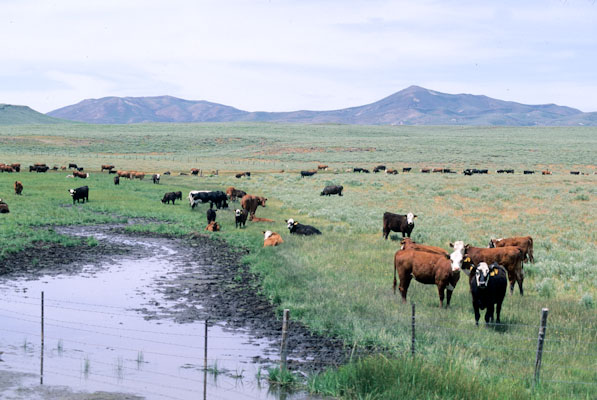
Public lands in a western state, with grazing cattle. Wild Earth Guardians image.

Public lands in a western state, with grazing cattle. Wild Earth Guardians image.

Public lands.  Photo from the Montana Wildlife Federation

Public lands. Photo from the Montana Wildlife Federation

At the Bathtub, we remarked on the history of the issue with a map that showed where the publicly-owned lands really are (the Strange Maps version only showed a dot in the middle of each state proportionate to the federal land held in the state.)  On the other hand, it was an open invitation for know-nothings and know-littles to jump in with silly ideas.  Remarkably, the post remained free of such folderol — until just recently.

None of these sites gives any serious thought to the idea.  None provides a scintilla of an iota of analysis to indicate it would be a good idea.

As one of the the principal spokesmen for the Sagebrush Rebellion in the early days, I want it known that I’ve thought these issues through, and argued them through, and followed the documentation for 30 years (Holy frijole!  I’m old!).  Issues with public lands revolve around stewardship.  Bad stewardship is not improved by a change in ownership.  Ownership change has all too often only led to worse stewardship.  Selling off the public lands is a generally stupid idea.

Certain local circumstances change the nature of a tiny handful of such deals — but not often, not in many places, and not enough to make a significant contribution to retiring any debt the federal government owns.

On the other hand, incomes from these lands typically runs a few multiples of the costs of managing them.  The Reagan administration discovered the lands were a great source of money to offset losses in other places, and for that reason (I suspect) never really got on the Sagebrush Rebellion band wagon — or, maybe Reagan’s higher officials just didn’t get it.

It’s troubling that such a flurry of stupidity strikes now, during a transition of presidents. This is how stupid ideas get traction, like kudzu on a cotton farm, while no one is paying deep attention.  Let’s put this idea back into its coffin with a sagebrush stake in its heart.

Bottom line:  Keep public lands in federal trust.  The Sagebrush Rebellion is over.  The sagebrush won.

_____________

Speaking of presidential transitions, who should be Secretary of Interior?  Stay tuned.

More:

Update 2014: The original GSA map showing percentages of federal holdings in each state (including Indian Reservations as federal holdings), as published in Strange Maps when it was still active.

Update 2014: The original GSA map showing percentages of federal holdings in each state (including Indian Reservations as federal holdings), as published in Strange Maps when it was still active.


Can I turn this in late? More economics carnivals

May 31, 2008

Struck in Traffic works to lay claim to the title of King of the Economics Carnival with his bi-weekly American Economics Blog Carnival. Two editions since I last posted on it (though I confess, I visited a couple of other occasions thinking I would post).

For those correspondents who argue with me that the U.S. faces a crisis of turning to socialism, I invite you to find either posts advocating socialist policies (5-years plans, anyone?), or from obviously Marxist or socialist economists. Tell us what you find in comments, please, I dare you.

And I wonder: Do students learn the meaning of the word “sepulchre” anymore? Would they get the reference to a “white sepulchre?”


Trafficking workers’ bodies for profit

May 27, 2008

If a guy beats someone to death, it’s murder, right?  And so the nation’s labor laws hold an employer liable for the death of a worker when unsafe working conditions caused the death.

But what if the worker doesn’t die?  What if the worker only loses his arms, or legs, or arms and legs?

No death, no crime, U.S. law says. 

What if the employer poisons the worker with cyanide that eats away the worker’s brain

No death, no crime, U.S. law says.

My colleagues and I were shocked to learn that an employer who breaks the nation’s worker-safety laws can be charged with a crime only if a worker dies. Even then, the crime is a lowly Class B misdemeanor, with a maximum sentence of six months in prison. (About 6,000 workers are killed on the job each year, many in cases where the deaths could have been prevented if their employers followed the law.) Employers who maim their workers face, at worst, a maximum civil penalty of $70,000 for each violation.

Read a plea to change the law, in the New York Times, from David H. Uhlmann, a law professor at the University of Michigan.


Censorship in the oddest of places

May 12, 2008

I think it was Euripides who said, “Whom the gods destroy, they first make mad.” Evidence of the madness sometimes is small compensation for bearing the burden of having to deal with the madness of others.

Iaian Murray’s book is getting accolades from some of the odd sources you’d expect to rave over the book without ever having seen it or giving it a moment’s analysis as to accuracy, relevancy, or morality. I stumbled into a bunch of such sites looking to see why Murray took after me, and what I had said that he quoted, to earn me a place in his index.

One would not expect to run into a censorship buzzsaw at a site that proclaims itself to be free enterprise. But Bloodhoundblog has frustrated all my attempts to correct their errors on DDT, in a post “Cleaned by Capitalism: Our professed love of nature is an artifact of our enormous prosperity.” Perhaps I shouldn’t complain — the offending language on DDT was removed eventually. The extolling of Murray’s book remains, however, in an odd screed against public roads and compact fluorescent lightbulbs (go read the site — can you tell what the guy thinks about CFLs?)

Can the irony get much deeper?

Humorously, there is an ill-informed discussion of fascism vs. socialism as communism in the thread — the discussants blithely unaware that totalitarian censorship is a sin under any fair government scheme.

Was it just that they don’t want to discuss the science of DDT? I’ve corrected a minor error in history, too, in a later comment; will that comment hold up? You might want to check out the comments. Do you think the existence of public lands encourages their abuse? It seemed to me the discussants didn’t understand at all that much of our environmental trouble has occurred on private land, often problems of toxic pollution created by the owners of the land.

Ardent and loud “capitalists” often are the first to sell out. They fall for censorship, they fall for hucksterism — just so long as they still get to wave their flag, insult the academy, and a promise they can make some money doing it. Businesses didn’t stand up to fascism in the early 20th century — nor much of any other time business was promised a license to continue operations.

The issues are not simple. If we insist FedEx not do business in China, do we miss a great opportunity to insinuate a capitalist enterprise as a wedge into a crumbling structure of oppressive politics? If we allow China to host Olympic games, do we strengthen their oppressive structure, or weaken it?

Should we stand idly by while the Chinese government censors the internet (and this blog) to its own people? Should I not kick a little when Bloodhoundblog censors my comments?


Two million minute challenge

May 9, 2008

Just over two weeks to graduation, son James is concerned about global competitiveness.  He’s off to study physics at Lawrence University in the fall; he is insistent I note the news in the paper this week.  I still have an active  stake in public schools, after all — good call, James.  Here’s his concern, below.

Each child has two million minutes of life over the four years of high school. Whether the U.S. can remain competitive in the global economy depends more than ever on how each child allocates those two million minutes.

A new film raises concerns that U.S. children are losing out against students from India and China.

Dallas Morning News business reporter Jim Landers wrote about the movie, “Two Million Minutes,” in an article May 6. It’s an indication of something that this is front page in the business section — an indication of genuine concern, one may hope.

Science and mathematics education gets the major attention in the film. One wishes this film could compete with the anti-science film “Expelled!” which still lingers malodrously in a few theatres across the nation.

Landers wrote:

2 Million Minutes argues that “the battle for America’s economic future isn’t being fought by our government. It’s being fought by our kids.”

And in a series of international comparisons, the U.S. kids are not doing so well. The one area where they score better than the rest is self-confidence.

Once they leave the eighth grade, students have a little more than 2 million minutes to get ready for work or college and the transition to being an adult. This documentary, made by high-tech entrepreneur Robert Compton, follows two high school seniors in Carmel, Ind., two in Bangalore, India, and two in Shanghai, China, to see how they use their time.

All six are bright, accomplished, college-bound individuals.

Our students spend a lot of time watching TV, working part-time jobs, playing sports and video games, but not so much on homework. The Chinese kids spend an extra month in school each year, more hours at school each day and more hours doing homework. By the time they graduate, Chinese students have spent more than twice as much time studying as their U.S. counterparts.

While one may hope kids will pay attention, one may be unhappy to recall the topic, and many of the same or similar numbers, were published nationally in the 1980s by the Office of Educational Research and Improvement (OERI) at the U.S. Department of Education. I remember it well, since I was publisher for some of the work.

The website for the movie offers more details, including a calendar of screenings. DVDs are available, but at very high prices — $25 for home use, $100 for school or non-profit use. I’d love to show it to students; I can get a couple of much-needed PBS videos for that same price. I hope producers will work to arrange distribution competitive with opposition movies like Stein’s. I’ll wager “Expelled!” will hit the DVD market at about $10.00, with thousands of DVDs available for free to churches and anti-science organizations.

Landers chalks up some of the stakes, and we should all pay attention:

Nearly 60 percent of the patents filed with the U.S. Patent and Trademark Office in the field of information technology now originate in Asia.

The United States ranks 17th among nations in high-school graduation rate and 14th in college graduation rate.

In China, virtually all high school students study calculus; in the United States, 13 percent study calculus.

For every American elementary and secondary school student studying Chinese, there are 10,000 students in China studying English.

The average American youth now spends 66 percent more time watching television than in school.

SOURCE: “Is America Falling off the Flat Earth?” by Norman R. Augustine, chairman, National Academy of Sciences “Rising Above the Gathering Storm” committee


Why eugenics doesn’t work

January 25, 2008

Dog and cat breeders, pigeon fanciers, racehorse breeders, and others whose livelihoods depend on their trying to do better than nature at the Darwinian game often offer anecdotes about breeding failures. They thought they might get a faster horse, but they got a skittish one instead; they thought they were getting a good bird dog, but the dog would panic at the shot of a gun.

Breeders know genetics carry a lot of traits, and trying to select for one is difficult. One may amplify a bad trait in addition to the desired trait.

In short, as the actors told us in the old Chiffon Margarine advertisements, it’s not nice to fool Mother Nature, and not always easy.

Enron tilted E sign, Associated Press photo

In one classic paper that more critics of Darwin should read, researchers discovered that instead of getting better egg production, they got mean chickens that damaged production of the entire flock.

Adam Lerymenko at Greythumb.blog notes the paper, and notes how the phenomenon was demonstrated among humans at the now-failed and discredited Enron Corp. (While informative, the piece may not be wholly safe for profanity filters in schools; the comments may be a problem, too.)

One of my favorite papers in evolutionary biology, which I have mentioned here before, is this:

Muir, W.M., and D.L. Liggett, 1995a. Group selection for adaptation to multiple-hen cages: selection program and responses. Poultry Sci. 74: s1:101

It outlines the group selection effects observed when trying to breed chickens for increased egg production in multiple-hen cage environments. In short, selecting individual chickens for increased productivity in a group environment didn’t select for increased productivity. Instead, it selected for mean chickens. The result was an overall reduction in productivity. Only by selecting at the group level was productivity increased.

The topic is a worthy one for discussion in economics courses, especially with regard to incentives for certain behaviors.

There is this caution: Adam notes that Enron annually fired the “bottom 10%” as a matter of policy, trying to encourage everyone else to work harder, trying to reward productive people, trying to prune deadwood from the corporate vine. At one point, some divisions of GE Corp. would purge the bottom 25%. That’s even more intensive selective pressures, for evil as well as good.

W. Edwards Deming was right, in his 14-point program for getting quality production from corporations and other organizations. He said no corporation ever appears to get it right when they select individuals to blame for problems with annual performance reviews, rather than working to improve processes to improve quality of their products. (See Point 12)

And when legislators try to purge education of bad teachers? Can they possibly hope to get anything but mean chickens? Economists indict our reliance on standardized tests of students.

So much to learn, so many a–holes.

Resources:

Photo: Enron tilted E sign from the Houston headquarters; Associated Press photo via ABC News, January 22, 2008.


The Story of Stuff

December 15, 2007

How many different lesson plans can you get from this video? How about from this video with the add-ons?

Vodpod videos no longer available. from www.willbrehm.com

posted with vodpod
You can see a higher quality version at Will Brehm’s “Story of Stuff” website.

The site offers a lot. E-mail updates on issues, cheap DVDs of the movie ($10.00 each for the first 10, $9.00 each for the next 10 . . . you may want to get a copy for each social studies classroom), background stories to the movie, story of Annie Leonard, background sheets, lists of organizations working on the issues and reading lists and more. I found no lesson plans, but you can surely cobble one together for an hour class, with 20 minutes taken up by the film. Plus you can download the movie, for free.

Go noodle around the site: There are lots of possibilities for student projects, student discussions, in-class exercises, homework, and fun.

This movie details, quickly and with good humor, the economics of recycling, the economics of waste disposal, and the economics of production. This provides a great gateway to talk about civics and government, and how to make things happen like garbage collection and recycling; a gateway to talk about economics, especially the various flows of money and goods; a gateway to talk about geography and how we have used our land and rivers to bury and carry waste; and how we use natural resources generally.

This would also be a good video for Boy Scout merit badge classes for the Citizenship in the Community and Citizenship in the Nation badges.

Contrasted with most of the industrial grade video I’ve seen for economics classes, this is fantastic. It’s better than any of the sometimes ambitious, but ultimately dull productions from the Federal Reserve Banks (are you listening, Richard Fisher? Hire Will Brehm’s group). (No offense, Osgood — yours is the best of that lot.)

Sen. Tom Coburn, R-Okla., probably has political objections to the movie, claiming it leans left, which indicates it’s in the mainstream. If you’re using any other supplemental material in your classes, this just balances it out.

Screen capture from the film, “Story of Stuff”

Vox Day: Trapped in a quote mine cave-in

August 31, 2007

Vox Day, who claims to know more than most mortals can even think about, has fallen into a quote mine. (Quote mine defined.) Worse, the mine appears to have caved in.

Vox Day wishes to make the claim that Darwin is responsible for the evils of the Soviet Union. Apart from the prima facie absurdity of the claim, Vox has a dozen highly tenuous links he wishes to torture into supporting his claim, despite their refusal to do so.

This just in: Since I started out on this particular Fisking, Vox has popped up with this gem:

Unsurprisingly, evolutionists are reacting strongly to my column today. They swear up and down that there is no connection whatsoever between evolution and Communism, despite the fact that every single major Communist not only subscribed to Darwinist evolution but considered Darwin to be second only to Hegel as a pre-Marxist socialist figure.

There is no evidence Stalin or Lenin ever subscribed to evolution theory, and at any rate, Stalin expressly rejected Darwin and evolution, eviscerating the Soviets’ lead in genetics in 1920 by banning the teaching of evolution, banning research in evolution or research that had Darwinian overtones, stripping Darwin-theory subscribing biologists of their jobs, exiling a few to Siberia and death in several cases, and executing a few just for good measure. In place of evolution, Stalin backed Trofim Lysenko who advocated, apart from his creationist-like hatred of Darwin, an odd, almost-Lamarckian idea that stress in utero would change characteristics.

So, for example, Lysenko ordered that seed wheat be frozen, and then planted in winter. The freezing, the Stalin-Lysenko idea held, would make the wheat able to grow in cold weather. The crop failures were so spectacular that at least 4 million people died of starvation in the Soviet Union. By 1954 the crop failures were so massive the Soviet Union had to purchase wheat from the U.S., with loans from the U.S. These loans crippled any hope of the Soviet economy ever breaking out of its doldrums, and started the long slide to the collapse of the Soviet Union. You’d think Vox Day, who professes to be a libertarian and a Christian, would approve of the collapse of the Soviet Union by any cause — but he does not approve of the collapse if it came by a lack of evolution theory.

Vox Day never lets the facts get in the way of a rant. (As evidence that Marx was so deeply influenced by evolution theory, Vox notes that a fellow who knew Darwin, Edward Aveling attended Marx’s funeral. If that doesn’t convince, you, Vox says, Aveling later wrote an article saying it’s true, Marxism was based on evolution theory. So take THAT all you people who think Marxism emphasizes collectivism and the state: Darwin’s individual competition for survival is the REAL root of socialism. No, I’m not making this up — go read it for yourself. Then get some facts — read this account, which includes the guest list of Marx’s funeral. There were only nine people at Marx’s funeral, and Vox got the guest list wrong: Aveling wasn’t there. One more Vox claim refuted.)

Back to the regularly scheduled Vox Day quote mine cave-in, below the fold.

Read the rest of this entry »