You be the judge, at Daryl Cagle’s Political Cartoonist Index.
Then come back here and tell us your opinion.
You be the judge, at Daryl Cagle’s Political Cartoonist Index.
Then come back here and tell us your opinion.
 4 Comments |
  Cartoons, Political cartoons | Tagged: Political cartoons, Politics, Rush Limbaugh |
  Permalink
 Posted by Ed Darrell
Thomas Nast invented Santa Claus? Clement C. Moore didn’t write the famous poem that starts out, “‘Twas the night before Christmas, and all through the house . . . ?”
The murky waters of history from Millard Fillmore’s Bathtub soak even our most cherished ideas and traditions.
But isn’t that part of the fun of history?

Thomas Nast’s first published drawing featuring Santa Claus; for Harper’s Weekly, “A Journal of Civilization,” January 3, 1863 Nast portrayed the elf distributing packages to Union troops: “Santa Claus in camp.” Nast (1840-1904) was 23 when he drew this image.
Yes, Virginia (and California, too)! Thomas Nast created the image of Santa Claus most of us in the U.S. know today. Perhaps even more significant than his campaign against the graft of Boss Tweed, Nast’s popularization of a fat, jolly elf who delivers good things to people for Christmas makes one of the great stories in commercial illustration. Nast’s cartoons, mostly for the popular news publication Harper’s Weekly, created many of the conventions of modern political cartooning and modeled the way in which an illustrator could campaign for good, with his campaign against the graft of Tammany Hall and Tweed. But Nast’s popular vision of Santa Claus can be said to be the foundation for the modern mercantile flurry around Christmas.
Nast is probably ensconced in a cartoonists’ hall of fame. Perhaps he should be in a business or sales hall of fame, too. [See also Bill Casselman’s page, “The Man Who Designed Santa Claus.]
Nast’s drawings probably drew some inspiration from the poem, “Account of a Visit from St. Nicholas,” traditionally attributed to Clement C. Moore, a New York City lawyer, published in 1822. The poem is among the earliest to describe the elf dressed in fur, and magically coming down a chimney to leave toys for children; the poem invented the reindeer-pulled sleigh.
Modern analysis suggests the poem was not the work of Moore, and many critics and historians now attribute it to Major Henry Livingston, Jr. (1748-1828) following sleuthing by Vassar College Prof. Don Foster in 2000. Fortunately for us, we do not need to be partisans in such a query to enjoy the poem (a complete copy of which is below the fold).
The Library of Congress still gives Moore the credit. When disputes arise over who wrote about the night before Christmas, is it any wonder more controversial topics produce bigger and louder disputes among historians?
Moore was not known for being a poet. The popular story is that he wrote it on the spur of the moment:
Moore is thought to have composed the tale, now popularly known as “The Night Before Christmas,” on December 24, 1822, while traveling home from Greenwich Village, where he had bought a turkey for his family’s Christmas dinner.
Inspired by the plump, bearded Dutchman who took him by sleigh on his errand through the snow-covered streets of New York City, Moore penned A Visit from St. Nicholas for the amusement of his six children, with whom he shared the poem that evening. His vision of St. Nicholas draws upon Dutch-American and Norwegian traditions of a magical, gift-giving figure who appears at Christmas time, as well as the German legend of a visitor who enters homes through chimneys.
Again from the Library of Congress, we get information that suggests that Moore was a minor celebrity from a well-known family with historical ties that would make a good “connections” exercise in a high school history class, perhaps (”the link from Aaron Burr’s treason to Santa Claus?”): (read more, below the fold)
Clement Moore was born in 1779 into a prominent New York family. His father, Benjamin Moore, president of Columbia University, in his role as Episcopal Bishop of New York participated in the inauguration of George Washington as the nation’s first president. The elder Moore also administered last rites to Alexander Hamilton after he was mortally wounded in a tragic duel with Aaron Burr.
A graduate of Columbia, Clement Moore was a scholar of Hebrew and a professor of Oriental and Greek literature at the General Theological Seminary in Manhattan. [See comment from Pam Bumsted below for more on Moore.] He is said to have been embarrassed by the light-hearted verse, which was made public without his knowledge in December 1823. Moore did not publish it under his name until 1844.
Tonight, American children will be tucked in under their blankets and quilts and read this beloved poem as a last “sugarplum” before slipping into dreamland. Before they drift off, treat them to a message from Santa, recorded by the Thomas Edison Company in 1922.
“Santa Claus Hides in Your Phonograph“
By Arthur A. Penn, Performed by Harry E. Humphrey.
Edison, 1922.
Coupling date: 6/20/1922. Cutout date: 10/31/1929.
Inventing Entertainment: The Motion Pictures and Sound Recordings of the Edison Companies
Listen to this recording (RealAudio Format)
Listen to this recording (wav Format, 8,471 Kb)
But Henry Livingston was no less noble or historic. He hailed from the Livingtons of the Hudson Valley (one of whose farms is now occupied by Camp Rising Sun of the Louis August Jonas Foundation, a place where I spent four amazing summers teaching swimming and lifesaving). Livingston’s biography at the University of Toronto site offers another path for a connections exercise (”What connects the Declaration of Independence, the American invasion of Canada, the famous poem about a visit from St. Nick, and George W. Bush?”):
Henry Livingston Jr. was born in Poughkeepsie, New York, on Oct. 13, 1748. The Livingston family was one of the important colonial and revolutionary families of New York. The Poughkeepsie branch, descended from Gilbert, the youngest son of Robert Livingston, 1st Lord of Livingston Manor, was not as well off as the more well-known branches, descended from sons Robert and Philip. Two other descendants of Gilbert Livingston, President George Walker Herbert Bush and his son, President-Elect George W. Bush, though, have done their share to bring attention to this line. Henry’s brother, Rev. John Henry Livingston, entered Yale at the age of 12, and was able to unite the Dutch and American branches of the Dutch Reformed Church. At the time of his death, Rev. Livingston was president of Rutgers University. Henry’s father and brother Gilbert were involved in New York politics, and Henry’s granduncle was New York’s first Lt. Governor. But the law was the natural home for many of Henry’s family. His brother-in-law, Judge Jonas Platt, was an unsuccessful candidate for governor, as was his daughter Elizabeth’s husband, U.S. Supreme Court Justice Smith Thompson. Henry’s grandson, Sidney Breese, was Chief Justice of the Illinois Supreme Court.
Known for his encyclopedic knowledge and his love of literature, Henry Livingston was a farmer, surveyor and Justice of the Peace, a judicial position dealing with financially limited criminal and civil cases. One of the first New Yorkers to enlist in the Revolutionary Army in 1775, Major Henry Livingston accompanied his cousin’s husband, General Montgomery, in his campaign up the Hudson River to invade Canada, leaving behind his new wife, Sarah Welles, and their week-old baby, on his Poughkeepsie property, Locust Grove. Baby Catherine was the subject of the first poem currently known by Major Livingston. Following this campaign, Livingston was involved in the War as a Commissioner of Sequestration, appropriating lands owned by British loyalists and selling them for the revolutionary cause. It was in the period following Sarah’s early death in 1783, that Major Livingston published most of his poems and prose, anonymously or under the pseudonym of R. Ten years after the death of Sarah, Henry married Jane Patterson, the daughter of a Dutchess County politician and sister of his next-door neighbor. Between both wives, Henry fathered twelve children. He published his good-natured, often occasional verse from 1787 in many journals, including Political Barometer, Poughkeepsie Journal, and New-York Magazine. His most famous poem, “Account of a Visit from St. Nicholas,” was until 2000 thought to have been the work of Clement Clarke Moore (1779-1863), who published it with his collected poems in 1844. Livingston died Feb. 29, 1828.
More on Henry Livingston and his authorship of the Christmas poem here.

Our views of Santa Claus owe a great deal also to the Coca-Cola advertising campaign. Coca-Cola first noted Santa’s use of the drink in a 1922 campaign to suggest Coke was a year-round drink (100 years after the publication of Livingston’s poem). The company’s on-line archives gives details:
In 1930, artist Fred Mizen painted a department store Santa in a crowd drinking a bottle of Coke. The ad featured the world’s largest soda fountain, which was located in the department store of Famous Barr Co. in St. Louis, Mo. Mizen’s painting was used in print ads that Christmas season, appearing in The Saturday Evening Post in December 1930.
- 1936 Coca-Cola Santa cardboard store display
Archie Lee, the D’Arcy Advertising Agency executive working with The Coca-Cola Company, wanted the next campaign to show a wholesome Santa as both realistic and symbolic. In 1931, The Coca-Cola Company commissioned Michigan-born illustrator Haddon Sundblom to develop advertising images using Santa Claus — showing Santa himself, not a man dressed as Santa, as Mizen’s work had portrayed him.
- 1942 original oil painting – ‘They Remembered Me’
For inspiration, Sundblom turned to Clement Clark Moore’s 1822 poem “A Visit From St. Nicholas” (commonly called “‘Twas the Night Before Christmas”). Moore’s description of St. Nick led to an image of Santa that was warm, friendly, pleasantly plump and human. For the next 33 years, Sundblom painted portraits of Santa that helped to create the modern image of Santa — an interpretation that today lives on in the minds of people of all ages, all over the world.
Santa Claus is a controversial figure. Debates still rage among parents about the wisdom of allowing the elf into the family’s home, and under what conditions. Theologians worry that the celebration of Christmas is diluted by the imagery. Other faiths worry that the secular, cultural impact of Santa Claus damages their own faiths (few other faiths have such a popular figure, and even atheists generally give gifts and participate in Christmas rituals such as putting up a decorated tree).
For over 100 years, Santa Claus has been a popular part of commercial, cultural and religious life in America. Has any other icon endured so long, or so well?


________________________
Below:
From the University of Toronto Library’s Representative Poetry Online
Major Henry Livingston, Jr. (1748-1828)
Account of a Visit from St. Nicholas
1 ‘Twas the night before Christmas, when all thro’ the house,2 Not a creature was stirring, not even a mouse;3 The stockings were hung by the chimney with care,4 In hopes that St. Nicholas soon would be there;5 The children were nestled all snug in their beds,6 While visions of sugar plums danc’d in their heads,7 And Mama in her ‘kerchief, and I in my cap,8 Had just settled our brains for a long winter’s nap –9 When out on the lawn there arose such a clatter,10 I sprang from the bed to see what was the matter.11 Away to the window I flew like a flash,12 Tore open the shutters, and threw up the sash.13 The moon on the breast of the new fallen snow,14 Gave the lustre of mid-day to objects below;15 When, what to my wondering eyes should appear,16 But a miniature sleigh, and eight tiny rein-deer,17 With a little old driver, so lively and quick,18 I knew in a moment it must be St. Nick.19 More rapid than eagles his coursers they came,20 And he whistled, and shouted, and call’d them by name:21 “Now! Dasher, now! Dancer, now! Prancer, and Vixen,22 “On! Comet, on! Cupid, on! Dunder and Blixem;23 “To the top of the porch! to the top of the wall!24 “Now dash away! dash away! dash away all!”25 As dry leaves before the wild hurricane fly,26 When they meet with an obstacle, mount to the sky;27 So up to the house-top the coursers they flew,28 With the sleigh full of Toys — and St. Nicholas too:29 And then in a twinkling, I heard on the roof30 The prancing and pawing of each little hoof.31 As I drew in my head, and was turning around,32 Down the chimney St. Nicholas came with a bound:33 He was dress’d all in fur, from his head to his foot,34 And his clothes were all tarnish’d with ashes and soot;35 A bundle of toys was flung on his back,36 And he look’d like a peddler just opening his pack:37 His eyes — how they twinkled! his dimples how merry,38 His cheeks were like roses, his nose like a cherry;39 His droll little mouth was drawn up like a bow.40 And the beard of his chin was as white as the snow;41 The stump of a pipe he held tight in his teeth,42 And the smoke it encircled his head like a wreath.43 He had a broad face, and a little round belly44 That shook when he laugh’d, like a bowl full of jelly:45 He was chubby and plump, a right jolly old elf,46 And I laugh’d when I saw him in spite of myself;47 A wink of his eye and a twist of his head48 Soon gave me to know I had nothing to dread.49 He spoke not a word, but went straight to his work,50 And fill’d all the stockings; then turn’d with a jerk,51 And laying his finger aside of his nose52 And giving a nod, up the chimney he rose.53 He sprung to his sleigh, to his team gave a whistle,54 And away they all flew, like the down of a thistle:55 But I heard him exclaim, ere he drove out of sight –56 Happy Christmas to all, and to all a good night.
Leave a Comment » | Art, Cartoons, Civil War, Family, History, History and art, History images, Holidays, Newspapers, Poetry, Religion, Thomas Nast | Tagged: Art, Cartoons, Christmas, Civil War, Coca-Cola, Family, History, History and art, History images, Holidays, Newspapers, Poetry, Religion, Thomas Nast | Permalink
Posted by Ed Darrell
Judges returned their ballots — the winners of the 2008 Ranan Lurie Political Cartoon Awards have been announced at the United Nations.
First place to a Greek cartoonist, Michael Kountouris of Eleftheros Typos:

Michael Kountoris, Eleftheros Typos, 1st place in the Lurie/UN Cartoon Awards, 2008
Of the 13 cartoons, 1st, 2nd, 3rd and honorable mentions, at least six touch on environmental topics. Is this a representation of a the cartoons published in the past year?
All the cartoons honored deserve your viewing — go see them here.
The award is offered annually by the UN Correspondents Association in honor of Ranan Lurie, who probably still is the most widely syndicated cartoonist in history. A sample of Lurie’s work, below the fold.
2 Comments | Cartoons, History, History images, Political cartoons, Politics, United Nations | Tagged: Cartoons, History, Political cartoons, Politics, Ranan Lurie, UN Correspondents Association, United Nations | Permalink
Posted by Ed Darrell
| 1805 | The Lewis and Clark Expedition arrived at the Pacific Ocean. |
| 1874 | The first cartoon depicting the elephant as the symbol of the Republican Party was printed in Harper’s Weekly. [Thomas Nast was the artist.] |
| 1916 | Republican Jeannette Rankin of Montana became the first woman elected to the U.S. House of Representatives. |
| 1917 | The Bolsheviks overthrew the Russian government in St. Petersburg. |
| 1940 | Only four months after its completion, the Tacoma Narrows Bridge in Washington state, the third longest suspension bridge in the world at the time, collapsed. No one was injured. |
Video of the Tacoma Narrows Bridge disaster:
_______________
Update: Blue Ollie has more information on the bridge collapse — and is generally worth a visit.
1 Comment | Cartoons, Disasters, History, Political cartoons, Russian Revolution, Technology, World War I | Tagged: Bolshevik Revolution, Disasters, History, Lewis and Clark, Republican Party, Russian Revolution | Permalink
Posted by Ed Darrell
Did the cartoonist specifically have Texas and State Board of Education Chairman Don McLeroy in mind?

Cartoon from Thomas Kondenkandeth; was he thinking specifically of Texas?
Found it at the German language version of the Seed Magazine science blogs, Hintern Mond gleich links, “Bissige Wissenschafts-Cartoons.”
Leave a Comment » | Cartoons, Political cartoons, Politics, Science, Texas | Tagged: Cartoons, Political cartoons, Politics, Science, Texas | Permalink
Posted by Ed Darrell
George Santayana is best known as a historian. He’s famous for his observation on the importance of studying history to understand it, and getting it right: “Those who cannot remember the past are condemned to repeat it.” (See citation in right column of the blog.)
Steve Greenberg is a historian cartoonist whose work is published in the Ventura County (California) Star. He offers a Santayana-esque analysis of economics positions of presidential candidates.

Steve Greenberg, published in the Ventura County Star
Click on the thumbnail for a larger version.

Steve Greenberg, Ventura County Star, via Cagle Comics
Greenberg has compressed into 33 words and 5 images a rather complex argument in this year’s presidential campaign.
Is Greenberg right? Do you see why Boss Tweed feared Thomas Nast’s cartoons more than he feared the reporters and editorial writers?
This election campaign we may be able to get the best analysis and commentary from cartoonists. Same as always. Teachers: Are you stockpiling cartoons for use through the year in government, economics, and history?
Other resources:
Note to Cagle cartoons: I think I’m in fair use bounds on this. In any case, I wish you would create an option for bloggers, and an option for teachers who may reuse cartoons year after year. I’ve tried to contact you to secure rights for cartoons in the past, and I don’t get responses. Complain away in comments if you have a complaint, but let us know how we can expose cartoonists to broader audiences and use these materials in our classrooms for less than our entire teacher salary.
33 Comments | Campaigns, Cartoons, Economics, Elections, History, Political cartoons, Presidents | Tagged: Cartoons, Economics, History, John McCain, Political cartoons, presidential campaign, Steve Greenberg | Permalink
Posted by Ed Darrell
Hoax complaints against presidential candidates are old ideas. In 1796, Alexander Hamilton paid newspaper editors to print stories saying Thomas Jefferson was atheist. It was a minor theme in that campaign, but after John Adams’ political fortunes foundered on the Alien and Sedition Acts, among other missteps, Hamilton stepped up the attacks in the election of 1800.
Jefferson’s great biographer, Dumas Malone, estimates that by election day, fully half the American electorate believed Jefferson was atheist. Jefferson made a perfect target for such a charge — staunch advocate of religious freedom, he thought it beneath the dignity of a politician to answer such charges at all, so he did not bother to deny them publicly. Ministers in New England told their congregations they would have to hide their Bibles because, as president, Jefferson would send troops to confiscate them.
In a warning to hoaxers, we might hope, Americans elected Jefferson anyway.
Such nefariousness plagues campaigns today, still. Boone Pickens, who helped fund the Swiftboat Veterans’ calumny against war hero John Kerry, has an offer to pay $1 million to anyone who can show the charges false. In a replay of Holocaust denial cases, Pickens refuses to accept any evidence to pay the award, last week turning away the affidavits of the men who were present at the events.
At the Bathtub, we’ve already sampled a crude and steady attempt to brand Hillary Clinton a Marxist with creative editing of a few of her speeches.
The assaults on Barack Obama are already the stuff of legend. The comic strip, “Doonesbury,” is running a story line with a volunteer for the internet rumor stopping part of the campaign, FighttheSmears.com. The smears are real.

Matthew Most of the Washington Post wrote a lengthy piece in yesterday’s paper, “An attack that came out of the ether,” on the research done by a woman at the Institute for Advanced Study in Princeton, New Jersey, on the origins of the internet hoax that Barack Obama is a Muslim — a rumor so potent that Georgetown University Prof. Edward Luttwak repeated it in a New York Times op-ed article, without the fact checkers catching it (the Times consulted five scholars of Islam who all agreed the foundation for the claim is incorrect).
Danielle Allen has tracked the rumor back to its sources, in a failed campaign against Obama in Illinois and a candidate who admittedly was looking for mud, and one constant sniper at FreeRepublic.com. It’s impressive sleuthing, and the article would be a good departure for study of how media affect campaigns in a government or civics class.
The “how to” list is really very short:
According to the Post story: [A] search showed that the first mention of the e-mail on the Internet had come more than a year earlier. A participant on the conservative Web site FreeRepublic.com posted a copy of the e-mail on Jan. 8, 2007, and added this line at the end: “Don’t know who the original author is, but this email should be sent out to family and friends.”
Allen discovered that theories about Obama’s religious background had circulated for many years on the Internet. And that the man who takes credit for posting the first article to assert that the Illinois senator was a Muslim is Andy Martin.
Martin, a former political opponent of Obama’s, is the publisher of an Internet newspaper who sends e-mails to his mailing list almost daily. He said in an interview that he first began questioning Obama’s religious background after hearing his famous keynote speech at the 2004 Democratic National Convention.
The story is well worth reading. It can help educate us to how to avoid being victims of such rumors in the future.
Tip of the old scrub brush to e-mail correspondent MicahBrown.
3 Comments | Accuracy, Barack Obama, Campaigns, Cartoons, Education, Free press, Free speech, History, Hoaxes, Obama 2008, Politics, Technology | Tagged: 2008 campaign, Barack Obama, Campaign Technology, Education, Elections, History, Hoaxes, How to, Media, Politics | Permalink
Posted by Ed Darrell
We had to take a semester of typing in high school. Computers back then were readers of stacks of punch cards, but the idea was that those students bound for college would need to know how to type to do term papers, and the other students would be able to use typing as a job skill. I got up to 90 words per minute for a short period.
One of my majors was mass communication. I wrote a lot of radio news scripts, and I wrote constantly for the Daily Utah Chronicle. Utah’s debate team was quite active, too, and we typed our evidence cards so they’d be easier to share. By my junior year, almost everything handed in was typewritten.
After one lousy year of grad school I took a job as press secretary for a U.S. Senate campaign. It was a shoe-string operation, and I typed all our press releases myself — plus the few prepared speeches. Three years later we had computers to use for press releases and speech texts in the Senate. My office was the first in the Senate to completely automate the process. By the time I moved to the President’s Commission on Americans Outdoors, we had PCs on everybody’s desk (ahead of our time, I know). At the Department of Education a couple of years later, we even had a crude e-mail system.
Moving to American Airlines was a shock. As counsel, I was expected to write everything in long-hand, so the secretary could type up the final copy. Having been wholly keyboard for way over a decade, I couldn’t make the switch. I had to find a surplused, still-barely-working typewriter to give stuff to the secretary. By the time I left four years later, everybody had PCs on their desks (and at least half the secretarial positions were gone, too). That was my last experience with long-hand as the norm, until I got to the Dallas Independent School District.
Our kids didn’t learn cursive long or well. Younger son James doesn’t do much in cursive at all (thank you notes are a problem, of course). Older son Kenny has keyboards on everything, and probably types better than I do. I didn’t worry much about it.
Is that true? Does writing improve literacy and numeracy?
That would explain a lot about my students’ inabilities in both areas, and it would suggest we need to do a lot more writing, and a lot more note-taking. It would suggest that our drive to technology has damaged our skills in an unexpected way.
What do you think? Does anyone know if there is an actual study on the topic? Comments open.
1 Comment | Cartoons, Education, literacy, Numeracy, Technology | Tagged: Cartoons, Cursive, Education, Handwriting, literacy, Numeracy, Technology | Permalink
Posted by Ed Darrell
You’re a good student of history. You know that when someone says, “a house divided,” they’re talking about Lincoln’s famous, troubling speech from June 1858. Right?
Look below the fold.
1 Comment | 1787, Cartoons, DBQ sources, Famous quotes, History, Lesson plans, Quotes, U.S. Constitution | Tagged: 1787, A House Divided, Cartoon, Constitution, History, Lesson plan ideas, Library of Congress | Permalink
Posted by Ed Darrell
I missed the news: Gus Arriola died on February 4, in Carmel, California. He was 90.
Heck, I’ve missed his strip, Gordo, for years. One of a kind — Arriola’s work alone was worth the price of any newspaper that carried it.

It wasn’t until I was in college that I realized the strip was a real ground breaker, a vanguard of Mexican-Americans in daily newspapers.
Really good strips are just really good strips.
So long, Gus.
Tip of the old scrub brush to Baldo’s Tia Carmen, for the news.

Copyright © 2008 Universal Press Syndicate
Leave a Comment » | Cartoons, History, Newspapers | Tagged: Cartoons, Gordo, Gus Arriola, Media, Newspapers | Permalink
Posted by Ed Darrell
A few days ago, via Peoples Geography, I discovered the work of graffiti artist Banksy — rather behind the curve, judging from his history. I posted a particularly provocative work of his in this post within the past week.
Today CBS Evening News and other outlets report some enterprising building owner in London who recognized Banksy’s work, preserved it, and has auctioned it away on eBay. It fetched $407,000 US. (CBS video here)
The work, depicting an artist in old-fashioned clothes putting the finishing touches on the word “BANKSY” spray-painted in red, was scrawled on a wall on the Portobello Road in the west London district of Notting Hill.
It was offered for sale on the e-Bay auction site and went for 208,100 pounds after attracting 69 bids.
The winner of the auction may well get the painting and the wall it is on, but they will have to calculate how to get the whole work delivered and pay to replace the wall.
“I am selling the wall because I can’t really justify owning a piece of art worth as much as it is,” said Luti Fagbenle, the owner of the property on which the graffiti is sprayed.
A political cartoon changed the life of one London building owner.
Leave a Comment » | Art, Cartoons, Dissent, Political cartoons, Travel | Tagged: Art, Banksy, Dissent, eBay, Media | Permalink
Posted by Ed Darrell
Thomas Nast helped bring down the crooks at Tammany Hall with cartoons. Boss Tweed, the chief antagonist of Nast, crook and leader of the Tammany Gang, understood that Nast’s drawings could do him in better than just hard hitting reporting — the pictures were clear to people who couldn’t read.
But a cartoon has to get to an audience to have an effect.
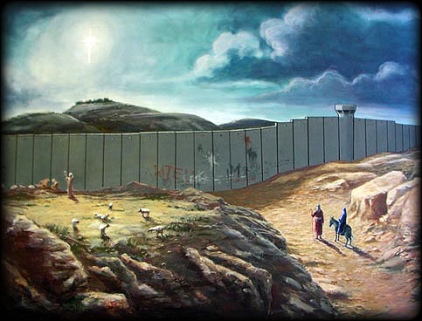
Here’s one below, a comment on the security wall being built in Israel, that got very little circulation in the west at Christmas time. Can you imagine the impact had this drawing run in newspapers in Europe, the U.S., and Canada?
It’s a mashup of a famous oil painting related to the Christian Nativity, from a London-based artist who goes by the name Banksy. (Warning: Banksy pulls no punches; views shown are quite strong, often very funny, always provocative, generally safe for work unless you work for an authoritarian like Dick Cheney who wants no counter opinions.)
Tip of the old scrub brush to Peoples Geography.
3 Comments | Art, Cartoons, Dissent, History, Palestine, Political cartoons | Tagged: Art, Banksy, Cartoons, Dissent, Israel's Wall, Mary and Joseph, Media, Palestine, Political cartoons, Politics | Permalink
Posted by Ed Darrell
Thomas Nast invented Santa Claus? Clement C. Moore didn’t write the famous poem that starts out, “‘Twas the night before Christmas, and all through the house . . . ?”
The murky waters of history from Millard Fillmore’s Bathtub soak even our most cherished ideas and traditions.
But isn’t that part of the fun of history?
Yes, Virginia (and California, too)! Thomas Nast created the image of Santa Claus most of us in the U.S. know today. Perhaps even more significant than his campaign against the graft of Boss Tweed, Nast’s popularization of a fat, jolly elf who delivers good things to people for Christmas makes one of the great stories in commercial illustration. Nast’s cartoons, mostly for the popular news publication Harper’s Weekly, created many of the conventions of modern political cartooning and modeled the way in which an illustrator could campaign for good, with his campaign against the graft of Tammany Hall and Tweed. But Nast’s popular vision of Santa Claus can be said to be the foundation for the modern mercantile flurry around Christmas.
Nast is probably ensconced in a cartoonists’ hall of fame. Perhaps he should be in a business or sales hall of fame, too. [See also Bill Casselman’s page, “The Man Who Designed Santa Claus.]
Nast’s drawings probably drew some inspiration from the poem, “Account of a Visit from St. Nicholas,” traditionally attributed to Clement C. Moore, a New York City lawyer, published in 1822. The poem is among the earliest to describe the elf dressed in fur, and magically coming down a chimney to leave toys for children; the poem invented the reindeer-pulled sleigh.
Modern analysis suggests the poem was not the work of Moore, and many critics and historians now attribute it to Major Henry Livingston, Jr. (1748-1828) following sleuthing by Vassar College Prof. Don Foster in 2000. Fortunately for us, we do not need to be partisans in such a query to enjoy the poem (a complete copy of which is below the fold).
The Library of Congress still gives Moore the credit. When disputes arise over who wrote about the night before Christmas, is it any wonder more controversial topics produce bigger and louder disputes among historians?
Moore was not known for being a poet. The popular story is that he wrote it on the spur of the moment:
Moore is thought to have composed the tale, now popularly known as “The Night Before Christmas,” on December 24, 1822, while traveling home from Greenwich Village, where he had bought a turkey for his family’s Christmas dinner.
Inspired by the plump, bearded Dutchman who took him by sleigh on his errand through the snow-covered streets of New York City, Moore penned A Visit from St. Nicholas for the amusement of his six children, with whom he shared the poem that evening. His vision of St. Nicholas draws upon Dutch-American and Norwegian traditions of a magical, gift-giving figure who appears at Christmas time, as well as the German legend of a visitor who enters homes through chimneys.
Again from the Library of Congress, we get information that suggests that Moore was a minor celebrity from a well-known family with historical ties that would make a good “connections” exercise in a high school history class, perhaps (“the link from Aaron Burr’s treason to Santa Claus?”): (read more, below the fold)
10 Comments | Art, Business, Cartoons, Family, History, History and art, History images, Holidays, Newspapers, Poetry, Political cartoons | Tagged: Art, Business, Cartoon, Christmas, Civil War, Family, History, Media, Newspapers, Poetry, Thomas Nast | Permalink
Posted by Ed Darrell
How many different lesson plans can you get from this video? How about from this video with the add-ons?
Vodpod videos no longer available. from www.willbrehm.com
posted with vodpod
You can see a higher quality version at Will Brehm’s “Story of Stuff” website.
The site offers a lot. E-mail updates on issues, cheap DVDs of the movie ($10.00 each for the first 10, $9.00 each for the next 10 . . . you may want to get a copy for each social studies classroom), background stories to the movie, story of Annie Leonard, background sheets, lists of organizations working on the issues and reading lists and more. I found no lesson plans, but you can surely cobble one together for an hour class, with 20 minutes taken up by the film. Plus you can download the movie, for free.
Go noodle around the site: There are lots of possibilities for student projects, student discussions, in-class exercises, homework, and fun.
This movie details, quickly and with good humor, the economics of recycling, the economics of waste disposal, and the economics of production. This provides a great gateway to talk about civics and government, and how to make things happen like garbage collection and recycling; a gateway to talk about economics, especially the various flows of money and goods; a gateway to talk about geography and how we have used our land and rivers to bury and carry waste; and how we use natural resources generally.
This would also be a good video for Boy Scout merit badge classes for the Citizenship in the Community and Citizenship in the Nation badges.
Contrasted with most of the industrial grade video I’ve seen for economics classes, this is fantastic. It’s better than any of the sometimes ambitious, but ultimately dull productions from the Federal Reserve Banks (are you listening, Richard Fisher? Hire Will Brehm’s group). (No offense, Osgood — yours is the best of that lot.)
Sen. Tom Coburn, R-Okla., probably has political objections to the movie, claiming it leans left, which indicates it’s in the mainstream. If you’re using any other supplemental material in your classes, this just balances it out.
3 Comments | Business, Business Ethics, Capitalism, Cartoons, Classroom technology, Conservation, Economics, Environmental protection, Ethics, Free market economics, Freedom - Political, Geography - Economic, Law, Lesson plans, Natural resources, On-line learning, Public health, Student projects, Technology in the classroom, Video and film | Tagged: Business, Economics, environment, pollution, Technology | Permalink
Posted by Ed Darrell
I love Thomas Nast cartoons, partly for their dated look. They look like they are 100 years old from the style of the art.
For much the same reason, I love Herblock cartoons. They look like the middle of the 20th century. And Pat Oliphant cartoons look like post-Kennedy modern ideas.

Clay Bennett, winner of the 2007 Curie UN Cartoon Award
Clay Bennett cartoons look like 21st century clean to me. There’s a smoothness, a silkiness of color that lends an immediacy to them. They really look good, and they look like they’d project well in a classroom (though I’ve not tried any of Bennett’s, actually).
All four of these cartoonists had or has something to say, too. I’ve enjoyed Bennett’s work in the Christian Science Monitor for some time. His work is clean, but it has a cutting edge that can’t be missed.
So, I was happy to see that he had won a commendation from the Ranan Lurie Cartoon Competition at the UN Correspondents’ Association dinner. Other people see good stuff in his drawings — I’m not alone.
Here’s his UN Lurie award-winning cartoon:
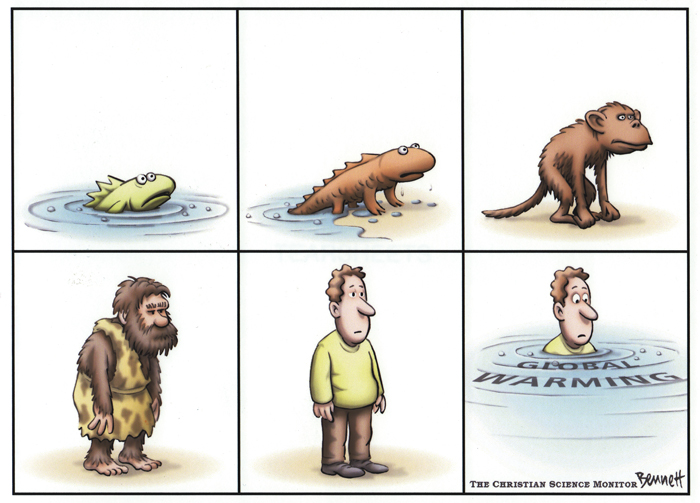
Cartoon winner of the 2007 Curie UN Cartoon Award
More of Bennett’s cartoons can be seen here, at the Clay Bennett Archives.
Bennett’s last cartoon in the Monitor was November 17. The good news: He’s moving to the Chattanooga Times-Free Press. We can hope that means one more opening is available for a cartoonist.
One more, below the fold. Read the rest of this entry »
2 Comments | Cartoons, Climate change, climate_change, Global warming, Political cartoons, Politics | Tagged: Cartoons, Clay Bennett, Climate change, Evolution, Global warming, Intelligent Design, Political cartoons, Politics | Permalink
Posted by Ed Darrell
You are currently browsing the archives for the Cartoons category.


Ed Darrell on Texas's Colorado River


Come on in, the water's fine. Come often: Cleanliness is next to godliness.


 Millard Fillmore's Bathtub
