Additional CO2 and warmer weather will help plants, the climate change denialists say. That’s not what we see, however. Turns out CO2 helps weeds, and warmer weather helps destructive species, more than it helps the stuff we need and want in the wild.
With increasingly warm winters at high elevations in the West, a predator that has stalked forests for decades has gained the upper hand. It is mountain pine blister rust, an invasive fungus. Combined with mountain pine beetles, which kill hundreds of thousands of trees per year in the Greater Yellowstone Area (GYA), the environmental health of the Rocky Mountains and neighboring regions is in danger. To make matters worse, the species most susceptible to these two threats, the whitebark pine, is also the most vital to ecosystem stability, essential to the survival of more than 190 plant and animal species in Yellowstone alone.
First debuted at SXSW Eco, this video tells the story of our endangered western forests and how American Forests and the Greater Yellowstone Coordinating Committee are working toward their restoration and protection for future generations.
(Yes, there is a bias. Several biases exist there simultaneously, actually, so we should say there are biases. The most important for you to know about are the biases for good science and accuracy, especially historical accuracy.)
Let’s see what history shows. EPA started a photographic record of environmental conditions, in 1971. Recently the project gained light again with help of the National Archives. Parts of the record are touring the country, and the display is available in Dallas for a week (photos added):
National “Documerica” Environmental Photo Exhibit Comes to Dallas
(DALLAS – August 7, 2012) The Environmental Protection Agency will open “Documerica” exhibit of photographs depicting environmental conditions of the past and present beginning August 7, 2012. The display arrives in Dallas after a quick stop in Austin at the Texas Environmental Superconference as part of its national tour. The exhibit will be open on the 7th Floor at Fountain Place in downtown Dallas through August 14, 2012.
One of the photos in the Documerica archives, looking to me to be from Texas, along Texas’s Colorado River (I have no idea whether this is one of the photographs displayed) (From the Documerica-1 Exhibition. For Other Images in This Assignment, See Fiche Numbers 27, 28, 31, 32, 33.) (Photo credit: The U.S. National Archives)
From its development in 1971, “Documerica” became the United States’ first serious pictorial examination of the environment. The project collected more than 15,000 images, documenting the environmental and human conditions of this country when EPA was starting its mission. The idea was to visually record the difference in conditions in later years, providing the public with a measurement of progress made to accomplish goals set by Congress.
Forty years later the project was rediscovered with the help of National Archives. “State of the Environment” launched Earth Day 2011 as an opportunity for the public to participate and engage in a modern revitalization of Documerica. There are more than 1,900 new images that have been submitted to EPA through Flickr.
The EPA photo project will continue accepting submissions through the end of 2013. Public entries will be considered for a larger exhibit of both projects set for March-September 2013 at the U.S. National Archives’ Lawrence F. O’Brien Gallery in Washington, D.C.
EPA’s art exhibit is on the 7th floor of Fountain Place, this building, usually listed at 1445 Ross Avenue. It’s between the Woodall Rodgers Freeway and Ross Avenue, between North Field Street and North Akard Street, Metered parking may be available; it should be a not-too-difficult walk from the West End, if done before the temperature rises above 95 degrees (as it is predicted to do each day in the next week).
The building that houses the exhibit is a landmark in Dallas, designed by I. M. Pei; fountains and trees grace the base of the building. If you’re not a denizen of daytime downtown Dallas, it might be worth a trip to see.
Alas, the fleeting nature of the stay in Dallas means it will be long gone before any environmental science classes can be assigned to view it.
Fortunately the photographs are available on Flickr — teachers, will you let us know what devious assignments you make out of this collection of historic photographs?
Naming one of their top five targets per week, the League of Conservation Voters (LCV) will name three more Members of Congress to their “Flat Earth Five,” members who not only vote against LCV positions, but also seem to dwell among flat-Earth believers on science, generally.
First two of the Flat Earth Five:
Rep. Ann Marie Buerkle (N.Y.)
Rep. Dan Benishek (Mich.)
Who will fill the three remaining slots — and will they survive election?
If you’re in Lubbock this weekend, and if you have a corral that needs an equine inhabitant, you can buy an ass — a burro — from the Bureau of Land Management. Or a horse.
According to a news release, animals are periodically removed from the range to “maintain healthy herds” and protect the land. It says more than 225,000 wild horses and burros have been adopted since 1973.
The animals are described as “iconic symbols of America’s western heritage.”
Adoption fees will start at $125, as set by law.
The age requirement to adopt an animal is 18. Buyers must have no animal abuse on their records as well as room for the animal to dwell.
Buyers’ records will be checked at the time of adoption.
At least 400 square feet of corral space is required per animal as well as a 6-foot corral fence for adult horses and a 5-foot fence for yearlings. Animals must also have access to food, water and shelter.
Buyers must load animals in covered stock-type trailers with swing gates and sturdy walls and floors, according to the news release.
People who adopt horses at least 4 years of age will receive a one-time care-and-feeding allowance of $500 from the bureau after one year upon receiving official ownership titles.
The news release states that no younger horses, burros and trained animals are eligible for the allowance.
Adoptions will be from 2-6 p.m. today, 8 a.m.-6 p.m. Friday and 8 a.m.-noon Saturday. Animals are available on a first-come, first-served basis.
Bureau staff will be available at the site to help with loading, questions and applications. The fairgrounds are located at the northeast corner of Broadway and U.S. 87.
Map of Superfund sites in California. Red indicates sites currently on final National Priority List, yellow is proposed for the list, green means a site deleted (usually due to having been cleaned up). Data from United States Environmental Protection Agency CERCLIS database available at http://www.epa.gov/superfund/sites/phonefax/products.htm. Retrieved April 24, 2010 with last update reported as March 31, 2010. (Photo credit: Wikipedia)
It’s near midsummer, so the sputtering of right-wing and anti-science propaganda calls for a “return to DDT” should begin to abate, absent a serious outbreak of West Nile Virus human infections, or some fit of stupidity on the part of DDT advocates.
DDT remains a deadly poison, and you, American Taxpayer, are on the hook for millions of dollars needed to clean up legacy DDT manufacturing sites across the nation. Contrary to bizarre claims, DDT really is a poison.
U.S. Environmental Protection Agency (EPA) works constantly at these cleanups. Comes this press release from EPA talking about a small success, a $14.6 million settlement with past property owners or users of sites in Torrance, California, designated for cleanup under the Superfund. The money will pay for cleanup of groundwater at the sites.
Links to sources other than EPA, and illustrations are added here.
Plant will Treat a Million Gallons per Day, Prevent Spread of Contamination
LOS ANGELES – The U.S. Environmental Protection Agency has reached a $14.6 million settlement with four companies for the construction of a groundwater treatment system at the Montrose and Del Amo Superfund sites in Torrance, Calif. Construction of the treatment system is the first step in the cleanup of groundwater contaminated by chemicals used to manufacture DDT and synthetic rubber over three decades.
Once operational, the system will extract up to 700 gallons of water per minute, or a total of a million gallons each day, removing monochlorobenzene and benzene, and re-injecting the cleaned, treated water back into the aquifer. The treated water will not be served as drinking water, but will instead be re-injected to surround the contamination and prevent it from any further movement into unaffected groundwater areas. Construction of the treatment system is expected to be completed in 18 months. EPA will pursue further settlements with the four companies and other parties to ensure that additional cleanup actions are taken and the groundwater treatment system is operated and maintained until cleanup levels are met.
“One of the toxic legacies of DDT and synthetic rubber manufacturing is polluted groundwater,” said Jared Blumenfeld, EPA’s Regional Administrator for the Pacific Southwest. “The treatment plant will be a milestone for the site, protecting the groundwater resources for the thousands of people who live or work near these former facilities.”
Montrose Chemical Corporation of California manufactured the pesticide DDT from 1947 until 1982. Monochlorobenzene was a raw material used in making DDT. The Montrose site was placed on the EPA’s National Priorities List (NPL) in 1989. The Del Amo Superfund site, located adjacent to the Montrose site, was formerly a synthetic rubber manufacturing facility that used benzene, naphthalene and ethyl benzene. The Del Amo site was placed on the NPL in September of 2002. Groundwater contamination from both sites has co-mingled and will be cleaned up by this single treatment system.
The four responsible parties for this settlement are: Montrose, Bayer CropScience Inc., News Publishing Australia Limited, and Stauffer Management Company LLC. In addition to constructing the treatment system, these parties will also pay oversight costs incurred by EPA and the California Department of Toxic Substances Control.
To date, extensive investigations and cleanup actions have been performed at both sites. EPA’s DDT soil removal actions in the neighborhood near the Montrose site were completed in 2002. In 1999, Shell began cleaning-up the Del Amo Superfund site, constructing a multi-layer impermeable cap over the waste pits and installation of the soil-vapor extraction and treatment system. Additional soil and soil gas cleanups at the Del Amo site are slated to begin in 2013.
The proposed consent decree for the settlement, lodged with the federal district court by the U.S. Department of Justice on July 9, 2012, is subject to a 30-day comment period and final court approval. A copy of the proposed decree is available on the Justice Department website at: http://www.justice.gov/enrd/Consent_Decrees.html
It was billed as a “hike” that might take 2.5 hours, but David Hurt, the grand benefactor of Dogwood Canyon Audubon Center, was the guide — at the two hour mark we had just ambled to the blossoming trees in their still-semi-secret location. Amble, not a hike.
Great day to be outside.
David Hurt spent 14 years working to establish the reserve and education center at Dogwood Canyon, in Cedar Hill, Texas — now he just can’t resist leading tours of the better sites and sights.
The voyage is at least half the fun.
After more than a year of serious drought, some of North Texas experienced high rainfall in the past three months. Spring-fed streams and seeps on Cedar Hill and across the Escarpment flow well for the moment, lending hope to wild bird breeding. On some entangled bank . . .
Mr. Hurt often stopped to explain bird songs and habits, and despite his claim not to like “plant people,” he stopped most often to identify plants, or to compare plants that can be confused. This Audubon facility sits in a transitional zone, between two kinds of prairies. It’s forest nature is an oddity in the zone. Dogwood Canyon features plants more commonly identified with the Texas Hill Country and with East Texas, as well as Blackland Prairie plants considered icons of the area. In this case, Hurt showed the differences between Texas redbud and eastern redbud, both of which occur in this area. Hurt carefully demonstrated how to identify poison ivy, now in abundance off the trails. This was a sharp contrast to two weeks ago when I couldn’t find a single sprig of poison ivy to show Scout leaders.
Poison ivy along the trail. Keep away.
Is it eastern red oak, or something else? How to tell?
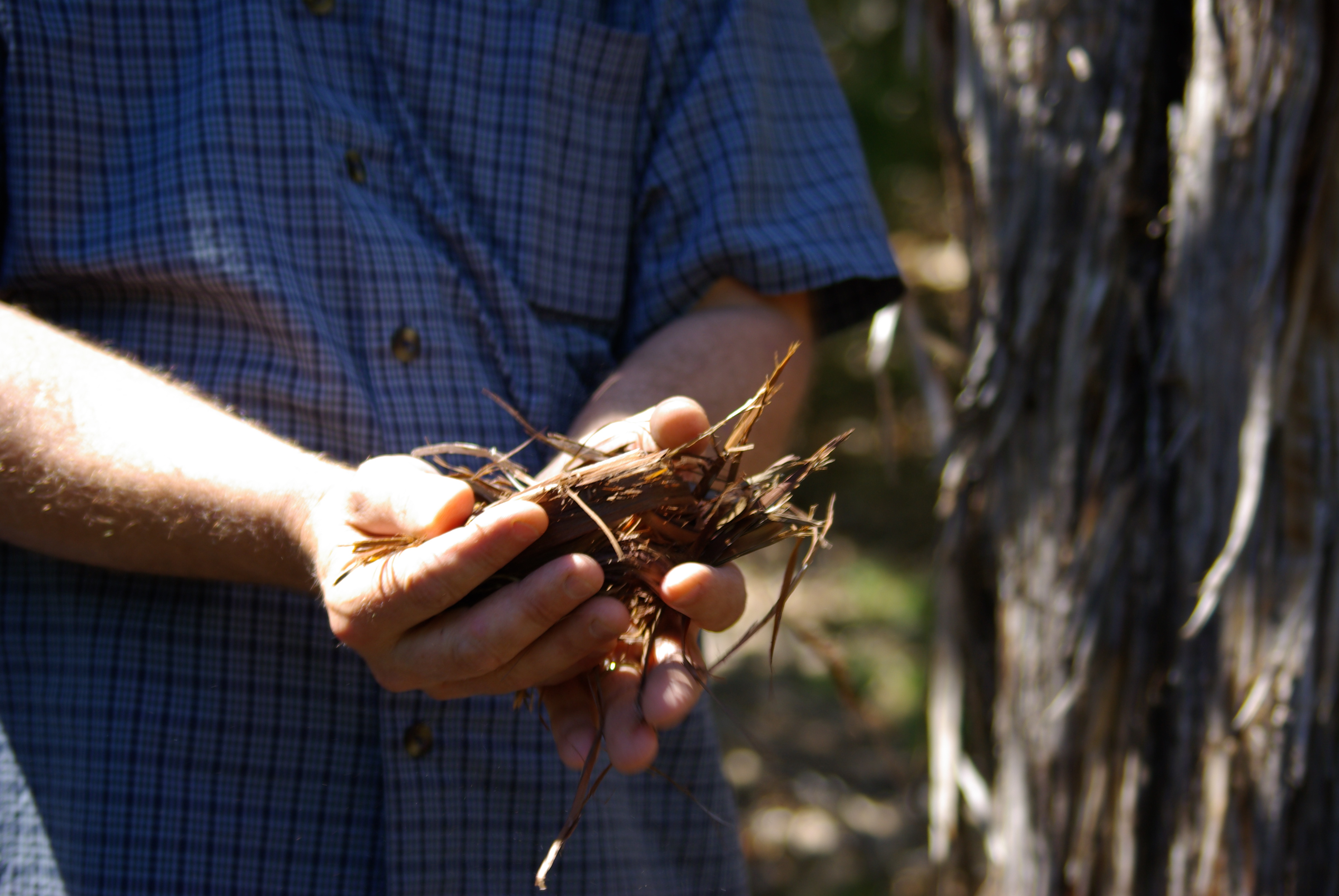
Hurt showed how to make a nest from loose bark strips from Ashe juniper trees. Golden-cheeked warblers, a threatened species, require this bark for nesting, and it can come only from mature Ashe junipers. The birds need this nesting material close to a good stand of deciduous trees, where they catch their food.
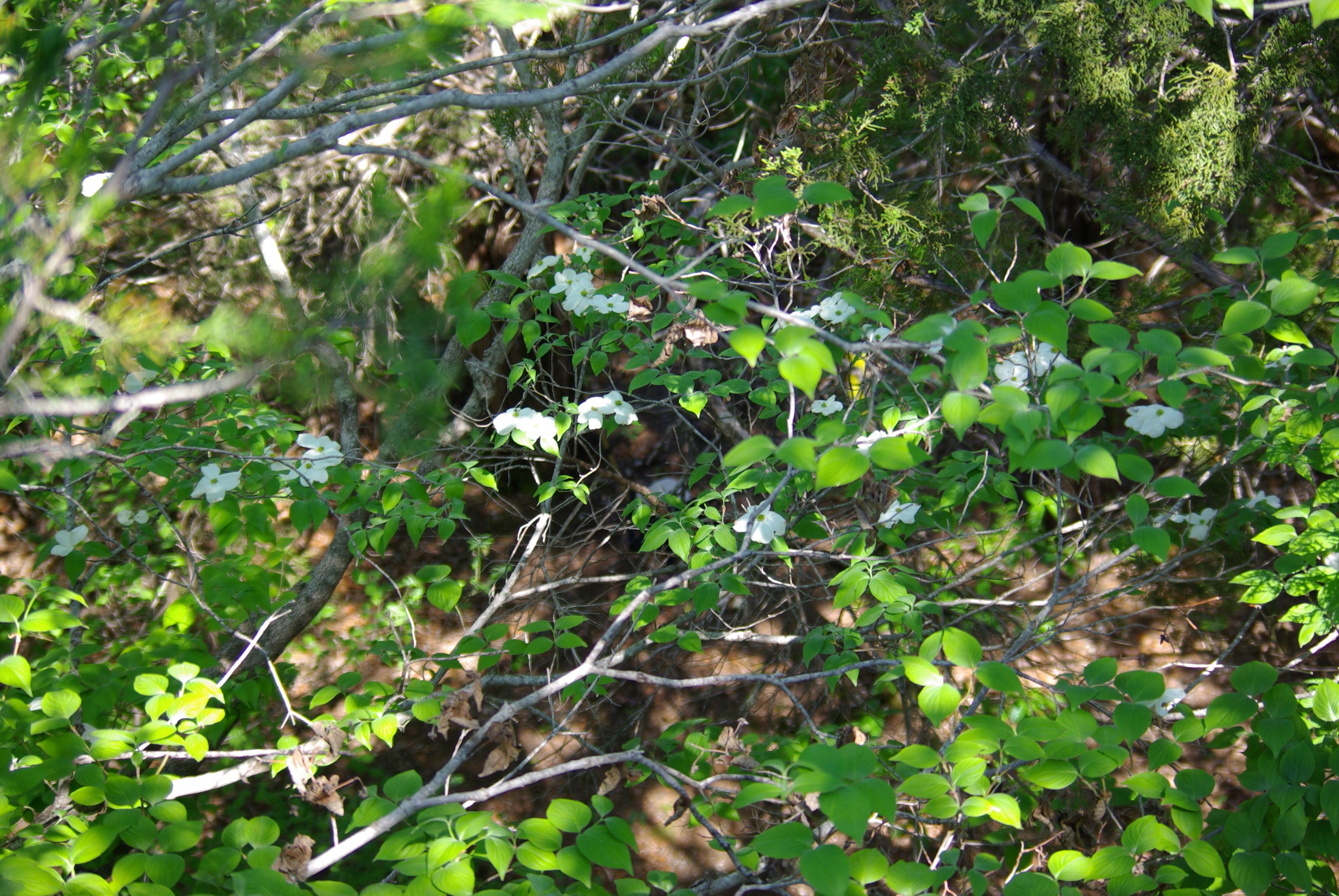
The dogwoods in bloom! An early spring, and lots of water, pushed the trees to leaf out before blossoming started — usually the blossoms come first. The drought last year probably hurts blossoming this year. Blossoms are not yet at their peak.
Exquisite aroma and beauty from the dogwood blossoms – not the carpet of white we saw in a previous year. Still just the shock of finding these little beauties in Dallas County adds to their splendor. Dogwoods do well in East Texas, where it is wetter and the soil is acid. Here on the escarpment it is generally dry, hotter, and the soil is thin and alkaline. That the blossoms show up at all is a stunning oddity, a stroke of fortune emblematic of the unique place that is Dogwood Canyon.
Much angst among Heartlandgate perpetrators over the increasingly obvious fact that Peter Gleick not only shouldn’t be prosecuted, but can’t be prosecuted under federal law, for duping Heartland employees into revealing their true intentions, to lie about global warming so people won’t “believe” it and support solutions.
Peter Gleick, lifetime of informing the public accurately at a researcher's greatly diminished salary; Heartland Institute is spending thousands of dollars to convince people he changed suddenly. Who to believe? Here's Gleick at the World Economic Forum Annual Meeting Davos 2009 (Photo credit: World Economic Forum)
18 U.S.C. 1343:
Whoever, having devised or intending to devise any scheme or artifice to defraud, or for obtaining money or property by means of false or fraudulent pretenses, representations, or promises, transmits or causes to be transmitted by means of wire, radio, or television communication in interstate or foreign commerce, any writings, signs, signals, pictures, or sounds for the purpose of executing such scheme or artifice, shall be fined under this title or imprisoned not more than 20 years, or both….
Did you catch that, Dear Reader? Gleick would be guilty of federal wire fraud had he asked the perpetrators of Heartlandgate to send him money or property.
But all Gleick asked for was a copy of their agenda for a meeting, and the supporting data. No money, no property. Nothing of value. Nor did he intend to use, nor could he use, any of that information to get money or property.
You noted, of course, the site is one promulgated by the Heartland Institute itself.
If you are in any degree confused about who to believe in this issue, or worse, if you are convinced that there is a pattern of skirting of the laws by scientists (contrary to the evidence), you should be concerned that you’re not getting the full story.
Doyle is a good writer and his site is a great idea with wonderful execution, The Pop History Dig.
Short of Linda Lear’s biography of Carson, Doyle’s piece presents the facts squarely, with no axes grinding. (Steve Milloy, Rutledge Taylor, The Competitive Enterprise Institute, Roger Bate, Richard Tren, the astroturf group Africa Fighting Malaria, Anthony Watts, Jay Ambrose and Christopher Monckton, and other purveyors of anti-Carson and anti-science vitriol will not like Doyle’s piece and will claim it to be biased.)
The GOP race seems to have come down to a Mormon and two Catholics.
How can it be that they got the two craziest Catholics in America to run for the GOP nomination? Surely they do not represent the best we could find among Catholics.
EPA Recognizes National Radon Action Month: Test for Radon Gas to Protect Health
21,000 Americans die from radon related lung cancer each year
WASHINGTON – The U.S. Environmental Protection Agency (EPA) is encouraging Americans this January, as part of National Radon Action Month, to take simple and affordable steps to test their homes for harmful levels of radon gas. Radon, a colorless odorless gas, is the leading cause of lung cancer among non-smokers. Radon can seep into a home from underground and if left to accumulate, high levels of radon can cause lung cancer. Improving indoor air quality by increasing awareness of environmental health risks, such as radon gas, supports healthier homes and communities.
“Testing for radon is an easy and important step in protecting the health of your family,” said Gina McCarthy, EPA Assistant Administrator for the Office of Air and Radiation. “Radon can be found in every single state. Nationally, elevated radon levels are in as many as one in 15 homes – a statistic that is even higher in some communities.”
Approximately 21,000 people die from radon related lung cancer each year in the United States, yet elevated levels of this health hazard can be prevented through these simple steps:
Test: EPA and the U.S. Surgeon General recommend that all homes, both with and without basements, be tested for radon. Affordable Do-It-Yourself radon test kits are available at home improvement and hardware stores and online or a qualified radon tester can be hired.
Fix: EPA recommends taking action to fix radon levels above 4 Picocuries per Liter (pCi/L). Addressing high radon levels often costs the same as other minor home repairs.
Save a Life: By testing and fixing for elevated levels of radon in your home, you can help prevent lung cancer while creating a healthier home and community.
Radon is a natural, radioactive gas that comes from the breakdown of uranium in soil, rock and water. It can enter homes through cracks in the foundation or other openings such as holes or pipes. In addition to testing for radon, there now are safer and healthier radon-resistant construction techniques that home buyers can discuss with builders to prevent this health hazard.
In 2011, EPA announced the Federal Radon Action Plan, along with General Services Administration and the Departments of Agriculture; Defense; Energy; Health and Human Services; Housing and Urban Development; Interior; and Veterans Affairs. This action plan will demonstrate the importance of radon risk reduction, address finance and incentive issues to drive testing and mitigation, and build demand for services from industry professionals.
More information on how to Test, Fix, Save a Life, obtain a text kit, or contact your state radon office: http://www.epa.gov/radon or call 1-800-SOS-RADON
Entrepreneurial mycologist Paul Stamets seeks to rescue the study of mushrooms from forest gourmets and psychedelic warlords. The focus of Stamets’ research is the Northwest’s native fungal genome, mycelium, but along the way he has filed 22 patents for mushroom-related technologies, including pesticidal fungi that trick insects into eating them, and mushrooms that can break down the neurotoxins used in nerve gas.
There are cosmic implications as well. Stamets believes we could terraform other worlds in our galaxy by sowing a mix of fungal spores and other seeds to create an ecological footprint on a new planet.
“Once you’ve heard ‘renaissance mycologist’ Paul Stamets talk about mushrooms, you’ll never look at the world — not to mention your backyard — in the same way again.” — Linda Baker, Salon.com
Spread the word; friends don't allow friends to repeat history.
Video – Some fish have levels of mercury so high that it may be harmful, especially for pregnant women and young children. Find out if you may have been exposed to mercury.
Ask yourself: If mercury poisoning is not a problem worthy of EPA’s new standards to prevent mercury pollution, why are health officials warning us to restrict our intake of fish that soak up the mercury emitted by coal-fired power plants?
[No, I can’t figure out why the video doesn’t show here. Look at the VodPod widget in the right column, a bit lower, and look at the video there. Or, click on the link, and go to the site with the video.]
Spread the word; friends don't allow friends to repeat history.
Dr. Douglas Brinkley writes history, and teaches. In the last decade he’s been one of our premiere historians of conservation and wilderness preservation, especially as started by Theodore Roosevelt.
The issue at the hearing was the Arctic National Wildlife Refuge.
One may get a whiff of “skeptic” desperation at the hearing — Brinkley’s written a book on wilderness protection. That’s why he was called to testify.
Tip of the old scrub brush to Eli Rabett. He’s right — it’s tough to improve on the straight dope, the unexpurgated version. So most of this post is borrowed from the Bunny’s Spartan, laconic post of this same material.
Dr. Brinkley's 2011 history of wilderness and preservation of Alaska
From a review of Brinkley’s important 2006 history, The Great Deluge: Hurricane Katrina, New Orleans, and the Mississippi Gulf Coast: “In his preface to ‘The Great Deluge,’ Douglas Brinkley writes, ‘My hope is that this history, fast out of the gates, may serve as an opening effort in Katrina scholarship.’ He needn’t worry. A prolific author, known for publishing at breakneck speed, Brinkley has put his skills to good use by interviewing hundreds of Katrina survivors, disaster responders and public officials, and then weaving their disparate stories into a seamless narrative of the hurricane’s momentous first week. It’s a microhistory, logging in at more than 700 pages, but its thick detail provides a ground-level view of human behavior far richer than the breathless news reports that stunned and shamed the nation in the summer of 2005.
Brinkley’s book that Don Young should have already read, but better read now if he loves Alaska: The Quiet World – Saving Alaska’s Wilderness Kingdom, 1879-1960; a good description of the book from the publisher, HarperCollins: “A riveting history of America’s most beautiful natural resources, The Quiet World documents the heroic fight waged by the U.S. federal government from 1879 to 1960 to save wild Alaska—Mount McKinley, the Tongass and Chugach national forests, Gates of the Arctic, Glacier Bay, Lake Clark, and the Coastal Plain of the Beaufort Sea, among other treasured landscapes—from the extraction industries. Award-winning historian Douglas Brinkley traces the wilderness movement in Alaska, from John Muir to Theodore Roosevelt to Aldo Leopold to Dwight D. Eisenhower, with narrative verve. Basing his research on extensive new archival material, Brinkley shows how a colorful band of determined environmentalists created the Arctic National Wildlife Refuge just before John F. Kennedy became president. “
Or, until that account is unsuspended by the forces supporting Donald Trump: Follow @FillmoreWhite, the account of the Millard Fillmore White House Library
We've been soaking in the Bathtub for several months, long enough that some of the links we've used have gone to the Great Internet in the Sky.
If you find a dead link, please leave a comment to that post, and tell us what link has expired.
Thanks!
Retired teacher of law, economics, history, AP government, psychology and science. Former speechwriter, press guy and legislative aide in U.S. Senate. Former Department of Education. Former airline real estate, telecom towers, Big 6 (that old!) consultant. Lab and field research in air pollution control.
My blog, Millard Fillmore's Bathtub, is a continuing experiment to test how to use blogs to improve and speed up learning processes for students, perhaps by making some of the courses actually interesting. It is a blog for teachers, to see if we can use blogs. It is for people interested in social studies and social studies education, to see if we can learn to get it right. It's a blog for science fans, to promote good science and good science policy. It's a blog for people interested in good government and how to achieve it.
BS in Mass Communication, University of Utah
Graduate study in Rhetoric and Speech Communication, University of Arizona
JD from the National Law Center, George Washington University


 Posted by Ed Darrell








 Millard Fillmore's Bathtub