Typewriter of the moment: Rachel Carson

December 14, 2008

From the library of Life Magazine images available for sale through an agreement with Google:  “Marine biologist and author Rachel Carson, 1952.”  Photo by Hank Walker.  [Photo no longer available at that site; this is the same image, I believe]

Rachel Carson in 1952.  Life Magazine photo by Hank Walker

This photo was taken about the time Carson left the U.S. Fish and Wildlife Service, about the time her best-selling book The Sea Around Us was a hit.  This was a decade before the publication of her most famous work, Silent Spring, and 12 years prior to her death from cancer in 1964.


A rationalist on climate change

December 7, 2008

Interesting voice on climate change, at Greenfyre.  For teachers, there are interesting sources that should work well in presentations.

If Anthony Watts slams the site, we’ll know it’s good.


Remembering Love Canal, 30 years ago

November 26, 2008

Hell-raising site called Red State Rebels remembers that the Love Canal disaster came to a head 30 years ago, with the evacuation of the homes surrounding the toxic dump site.

Your students probably don’t know about it, and the textbooks will do the story no justice, if they mention it at all.  While this article is written from a biased perspective, it’s a solid recounting of the history — and your AP kids need to read stuff with viewpoints, anyway.

Adeline Levine, a sociologist who wrote a book about Love Canal, described to me the scene she had witnessed exactly 30 years earlier, on Aug. 11, 1978. “It was like a Hitchcock movie,” she said, “where everything looks peaceful and pleasant, but something is slumbering under the ground.”

That “something” was more than 21,000 tons of chemical waste. The mixed brew contained more than 200 different chemicals, many of them toxic. They were dumped into the canal — which was really more of a half-mile-long pond — in the 1940s and 1950s by the Hooker Electrochemical Co. In 1953, the canal was covered with soil and sold to the local school board, and an elementary school and playground were built on the site. A working-class neighborhood sprang up around them.

“The neighborhood looked very pleasant,” says Levine, who was a sociology professor at the State University of New York, Buffalo, in 1978. “There were very nice little homes, nicely kept, with gardens and flowers and fences and kids’ toys, and then there were young people who were rushing out of their homes with bundles and packing up their cars and moving vans.”

Love Canal was in the midst of an all-out panic when Levine arrived; just nine days earlier, the state health commissioner had declared an emergency and recommended that pregnant women and children under the age of two evacuate the neighborhood. A week after that, the state and federal governments agreed to buy out homes next to the canal.

See the entire piece.

Resources:


Good Interred With Their Bones Dept.: Michael Crichton

November 24, 2008

https://i.ytimg.com/vi/9qtgQXtrl4Q/hqdefault.jpg

Author Michael Crichton railing against environmental protection and science he politically disagreed with, at the Smithsonian Institution, about the same time as his Commonwealth Club presentation.

One of my news grabbers found an article on environmentalism and religion at a Live Journal site, an answer to a speech by Michael Crichton on environmentalism as religion.  Crichton’s speech was delivered in 2003 to the Commonwealth Club in San Francisco, a venerable old institution for giving a soap box to doers and thinkers. [Note, April 2015: If that link doesn’t work, find Crichton’s speech here.]

Crichton’s speech started out with promise:

I have been asked to talk about what I consider the most important challenge facing mankind, and I have a fundamental answer. The greatest challenge facing mankind is the challenge of distinguishing reality from fantasy, truth from propaganda. Perceiving the truth has always been a challenge to mankind, but in the information age (or as I think of it, the disinformation age) it takes on a special urgency and importance.

We must daily decide whether the threats we face are real, whether the solutions we are offered will do any good, whether the problems we’re told exist are in fact real problems, or non-problems. Every one of us has a sense of the world, and we all know that this sense is in part given to us by what other people and society tell us; in part generated by our emotional state, which we project outward; and in part by our genuine perceptions of reality. In short, our struggle to determine what is true is the struggle to decide which of our perceptions are genuine, and which are false because they are handed down, or sold to us, or generated by our own hopes and fears.

As an example of this challenge, I want to talk today about environmentalism.

The promise was short-lived.

Crichton described his learnings from studying anthropology, including an observation that religions always arise, and cannot be stamped out.  From there he makes an astounding leap, to claim that environmentalism is religion.  From that failed leap, the speech rapidly deteriorates.  He adopts tenets of American Christian and political fundamentalism, rapidly following up with a disavowal of fundamentalism, as if to try to hide what he’s done, or deny it, at least for himself:

So I can tell you some facts. I know you haven’t read any of what I am about to tell you in the newspaper, because newspapers literally don’t report them. I can tell you that DDT is not a carcinogen and did not cause birds to die and should never have been banned. I can tell you that the people who banned it knew that it wasn’t carcinogenic and banned it anyway. I can tell you that the DDT ban has caused the deaths of tens of millions of poor people, mostly children, whose deaths are directly attributable to a callous, technologically advanced western society that promoted the new cause of environmentalism by pushing a fantasy about a pesticide, and thus irrevocably harmed the third world. Banning DDT is one of the most disgraceful episodes in the twentieth century history of America. We knew better, and we did it anyway, and we let people around the world die and didn’t give a damn.

I can tell you that second hand smoke is not a health hazard to anyone and never was, and the EPA has always known it. I can tell you that the evidence for global warming is far weaker than its proponents would ever admit. I can tell you the percentage the US land area that is taken by urbanization, including cities and roads, is 5%. I can tell you that the Sahara desert is shrinking, and the total ice of Antarctica is increasing. I can tell you that a blue-ribbon panel in Science magazine concluded that there is no known technology that will enable us to halt the rise of carbon dioxide in the 21st century. Not wind, not solar, not even nuclear. The panel concluded a totally new technology-like nuclear fusion-was necessary, otherwise nothing could be done and in the meantime all efforts would be a waste of time. They said that when the UN IPCC reports stated alternative technologies existed that could control greenhouse gases, the UN was wrong.

I can, with a lot of time, give you the factual basis for these views, and I can cite the appropriate journal articles not in whacko magazines, but in the most prestigious science journals, such as Science and Nature. But such references probably won’t impact more than a handful of you, because the beliefs of a religion are not dependent on facts, but rather are matters of faith. Unshakeable belief.

From the promising start of claiming we must be skeptical and carefully sort out what is true from what is not true, he rapidly plunges from the stratosphere into the depths of the ocean of misinformation.  Count the errors:

  1. Newspapers have been regular carriers of claims that restrictions on DDT are unnecessary.  You won’t find such claims in science journals, in fact — they appear almost without exception in newspapers.  Crichton is wrong about where you’d learn that DDT is harmless.  You can’t learn it from people who know.
  2. DDT is a “probable human carcinogen” listed by every cancer-fighting agency on Earth.  Fortunately for humans, it appears to be weakly carcinogenic.  Recent studies indicate it’s devious in its carcinogenicity, too — it gives cancers not to the people who were exposed, but to their children.  Research into this path is only about a decade old.  Recent studies confirm carcinogenicity in humans.  Carcinogenicity in almost every other animal exposed has been long known.  It is highly unlikely that a compound known to cause cancer in every mammal tested, would not be carcinogenic in humans.  Again, you can’t learn this stuff in science journals.  You’ll have to learn it as dogma from cranks and crackpots.
  3. DDT’s links to the deaths of young birds is rock solid.  The links were clear by 1962, and no study has been done since 1962 to question those conclusions.  In fact, more than 1,000 studies have been done on the links, and published in peer-review journals.  Each one supports Rachel Carson’s conclusions that DDT is deadly to young birds.  The mechanisms are now known by which DDT causes eggshell-thinning, which increases the chick mortality.  Recovery of the bald eagle, osprey, and brown pelican correlate exactly with the decline of DDT in the tissues of the birds.  No scientist who has studied the matter doubts that DDT kills birds.
  4. DDT was banned because it disrupts eco-systems.  In the wild, it is uncontrollable.  Yes, it kills pests.  But it also kills all the pest predators, too.  The pests use reproduction as a survival tool, and outreproduce predators, and even DDT.  An application of DDT, then, kills off the predators that protect an ecosystem from the pests, and the pests come roaring back, unchecked by nature.  The poison is magnified as it rises through the food chain (trophic levels, if you want the science term).  By the time an eagle or predator fish eats, it gets a crippling dose of the stuff.  By the mid-1960s, insects and arachnid pests around the world had begun to show resistance and even immunity to DDT (bedbugs demonstrated resistance by 1950; some are completely immune to DDT; almost all mosquitoes now carry multiple copies of a gene which allows mosquitoes to digest DDT as a nutrient, doing no harm).  The restrictions on DDT had nothing to do with human cancers, but everything to do with saving crops and forests, and the wildlife that lives there.  Crichton pulls an old bait-and-switch when he claims regulators knew DDT “wasn’t carcinogenic and banned it anyway.”  The regulators knew it might be a weak carcinogen, but they did not know it spreads through the environment and lasts almost forever, contaminating even human breast milk for at least six decades after application.  But this was not their concern.  The dangers of carcinogenicity were on top of the concerns about agriculture and forests and prairies.  Regulators acted to save the world we live in, and noted that such action also produced a minor reduction in cancer risk.
  5. DDT use in Africa never reached the nations where most malaria victims die today, at least not by 1972.  The ban on spraying DDT on cotton has nothing to do with malaria rates today, except that contrary to Crichton’s claim, it was the DDT use that aided malaria, not its cessation.  So for Crichton to claim that stopping the use of DDT on U.S. cotton crops led to a rise in malaria in Africa is a stretch of evidence way, way beyond any logical link.  Chaos theory only jokingly suggests the butterfly’s fluttering in Beijing last month affects weather in New York this month.  Boll weevils in the U.S. don’t carry malaria anyway, let alone fly to Africa to infect children there.
  6. Crichton dogmatically insists smoke is not a health hazard to non-smokers.  You won’t find much research to back his claim.  It’s another claim he makes religiously, on belief, not on evidence.  He can tell us second-hand smoke is not dangerous, but he can’t back the claim with evidence.  (Dangers of second-hand smoke have been well known since the 1970s; when Orrin Hatch got the law passed to switch to four, rotating warnings on cigarette packages, the debate was whether to include a fifth warning of second-hand smoke.)
  7. Urbanization figures cited by Crichton are low, and do not consider the damage done by urbanization to non-urban lands.  Low?  In one study, planners looked at Tippecanoe County, Indiana.  Recently, urban land use there rose from 8% to 12% — starting from a baseline larger than Crichton allows.  Crichton might argue that counties in North Dakota lose people, but the pollution and erosion from the urbanization in West LaFayette, Indiana, cannot be offset by relatively stable rural areas 600 miles away (I’m plucking a figure out of my hat), in a completely different watershed, in a completely different airshed, in a completely different climate, in a different economy.  Any soldier  or farmer can tell you that concentrating activities of people in a smaller area multiplies the impacts.  If you have 40 cows roaming over 6 acres, you don’t need to worry so much about where they leave their pies, or the concentration of ammonia in their urine.  If you put those same 40 cows in one small pen, however, you’ve just created a runoff problem, and health problems for the cows and the people who handle them.  Wholly apart from the numbers games, the facts show that urbanization increases the need for green and wild space for the people who move into the citiesTwo different presidential commissions reporting 25 years apart noted the needs, and the needs are only more fierce now (the link is to an article by Charles Jordan, who was one of the commissioners on the President’s Commission on Americans Outdoors which reported in 1987, the second of the two studies referred to — see Jordan’s article for full details).
  8. If the Sahara is shrinking, that doesn’t help much.  South of the Sahara, in Niger, an area the size of Luxembourg is lost to desertification every year.  Deserts are advancing in Arizona, California, China (both the Gobi and the Taklamakan), and across the rest of Central Asia to Africa.  If the Sahara is shrinking, that’s probably good.  It’s not enough to suggest that desertification is not a problem, even in North Africa.  Ultimately, it’s not how much land is affected, but rather it is the effects themselves, and how they affect humans.  Desertification — which is defined by international agencies as the degradation of land — affects 16.5 million people in Europe alone.  According to the UN, desertification threatens the lives and livlihoods of about out of every six people on Earth — 1.2 billion people total.  How does the Sahara’s shrinking help them?  Is Crichton just pulling another bait-and-switch?
  9. The total ice on Antarctica is increasing because the waters around the icy continent are warming — “lake effect” increases snowfall when increased evaporation from warmer waters is carried by the air over land.  The rather dramatic increases in ice pack on parts of Antarctica are stark testimony to the ill effects of global warming.
  10. If Crichton is right, and no existing technology will allow us to reduce carbon emissions, then we need to hit the panic button, not the snooze button.

Those are just the factual errors in two paragraphs.  Environmentalism as religion?  Maybe that would be a good idea, if the religion honored accuracy and truth telling, rather than fictional accounts of what is going on on Dear Old Planet Earth.

I enjoyed Michael Crichton’s writing, and I hope his stories inspire kids to work at a life in science.  But, as with Caesar, as Antony noted, the bad stuff people do lives on past them.  Let’s change that for Crichton – kill the bad stuff, keep the good stuff.

The evil that men do lives after them;
The good is oft interred with their bones.

William Shakespeare
Julius Caesar, Act III, Scene 2

Update, April 4, 2013:  American Elephants, a blog that isn’t about elephants, isn’t about their conservation, and in my view, isn’t much about America, either, fell victim to Crichton’s errors, all these months later. Plenty of time to get the story right since 2008, but American Elephants couldn’t do it.  American Elephants is too often an example of the Dunning Kruger effect, alas.

Other sites that still get it wrong, five and six years later:


Public Lands insanity

November 16, 2008

Remember when Strange Maps “discovered” that so much of the 13 western states is owned by the Federal Government?  On the one hand, it was nice to see people paying attention to public lands in the west.

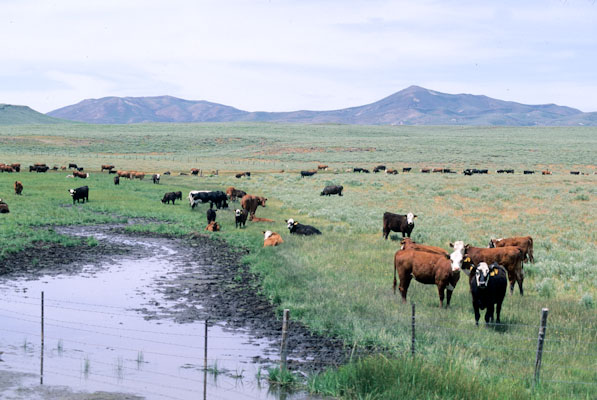
Public lands in a western state, with grazing cattle. Wild Earth Guardians image.

Public lands in a western state, with grazing cattle. Wild Earth Guardians image.

Public lands.  Photo from the Montana Wildlife Federation

Public lands. Photo from the Montana Wildlife Federation

At the Bathtub, we remarked on the history of the issue with a map that showed where the publicly-owned lands really are (the Strange Maps version only showed a dot in the middle of each state proportionate to the federal land held in the state.)  On the other hand, it was an open invitation for know-nothings and know-littles to jump in with silly ideas.  Remarkably, the post remained free of such folderol — until just recently.

None of these sites gives any serious thought to the idea.  None provides a scintilla of an iota of analysis to indicate it would be a good idea.

As one of the the principal spokesmen for the Sagebrush Rebellion in the early days, I want it known that I’ve thought these issues through, and argued them through, and followed the documentation for 30 years (Holy frijole!  I’m old!).  Issues with public lands revolve around stewardship.  Bad stewardship is not improved by a change in ownership.  Ownership change has all too often only led to worse stewardship.  Selling off the public lands is a generally stupid idea.

Certain local circumstances change the nature of a tiny handful of such deals — but not often, not in many places, and not enough to make a significant contribution to retiring any debt the federal government owns.

On the other hand, incomes from these lands typically runs a few multiples of the costs of managing them.  The Reagan administration discovered the lands were a great source of money to offset losses in other places, and for that reason (I suspect) never really got on the Sagebrush Rebellion band wagon — or, maybe Reagan’s higher officials just didn’t get it.

It’s troubling that such a flurry of stupidity strikes now, during a transition of presidents. This is how stupid ideas get traction, like kudzu on a cotton farm, while no one is paying deep attention.  Let’s put this idea back into its coffin with a sagebrush stake in its heart.

Bottom line:  Keep public lands in federal trust.  The Sagebrush Rebellion is over.  The sagebrush won.

_____________

Speaking of presidential transitions, who should be Secretary of Interior?  Stay tuned.

More:

Update 2014: The original GSA map showing percentages of federal holdings in each state (including Indian Reservations as federal holdings), as published in Strange Maps when it was still active.

Update 2014: The original GSA map showing percentages of federal holdings in each state (including Indian Reservations as federal holdings), as published in Strange Maps when it was still active.


Solid research on controlling malaria

October 20, 2008

Looking for other things, I stumbled into two research journal articles on the fight against malaria.  Neither calls for a return to broadcast spraying of DDT; neither claims the ban on agricultural use of DDT had any significant effect on the rise of malaria.

Both are loaded with serious research that exposes DDT advocates as charlatans.

First:  from Clinical Microbiology Reviews, October 2002, p. 564-594, Vol. 15, No. 4
0893-8512/02/$04.00+0; DOI: 10.1128/CMR.15.4.564-594.2002. “Evolutionary and Historical Aspects of the Burden of Malaria,” by Richard Carter and Kamini N. Mendis:

SUMMARY:  Malaria is among the oldest of diseases. In one form or another, it has infected and affected our ancestors since long before the origin of the human line. During our recent evolution, its influence has probably been greater than that of any other infectious agent. Here we attempt to trace the forms and impacts of malaria from a distant past through historical times to the present. In the last sections, we review the current burdens of malaria across the world and discuss present-day approaches to its management. Only by following, or attempting to follow, malaria throughout its evolution and history can we understand its character and so be better prepared for our future management of this ancient ill.

Second, from Joel G. Bremen, Martin S. Alilio, and Anne Mills, “Conquering the Intolerable Burden of Malaria:  What’s New, What’s Needed:  A Summary,” Am. J. Trop. Med. Hyg., 71(2 suppl), 2004, pp. 1-15 (The American Journal of Tropical Medicine and Hygeine).

High school kids, there are the sources you need for your papers on the fight against malaria.


Atomic history, nuclear future

October 19, 2008

We’re going to see more nuclear power plants in the U.S., it’s a safe bet.  Both presidential candidates support developing alternatives to oil and coal.  Nuclear power is one of the alternatives.

John McCain kept repeating his comfort words, that ‘storage of wastes is not a problem.’ There is not a lot of evidence to support his claims.  With turmoil in financial markets, however, the nuclear power issue has gotten very little serious attention or scrutiny.  From the push to get compensation for radiation victims of atomic weapons and development in the U.S., I learned that the issue is not really whether wastes and other materials can be safely used and wastes stored. The issues are entirely issues of will.

Advantage to Obama, I think.  He’s not claiming that the storage problems are all solved.  A clear recognition of reality is good to have in a president.

Son Kenny sent a link to a history site, Damn Interesting, and it tells the story of the Techa River in the old Soviet Union — a place condemned for generations by the nuclear excesses of the past.

To make the story briefer, in their rush to produce nuclear weapons, the Soviets did nothing to protect Russia from radioactive waste products until it was much too late.  Efforts to reduce radioactive emissions, by storing them in huge underwater containers, resulted in massive explosions that released more radiation than Chernobyl (What?  You hadn’t heard of that, either?).

It’s a reminder that safety and security with peaceful uses of nuclear power depend on humans doing their part, and thinking through the problems before they arise.

Can we deal with radioactive wastes?  We probably have the technology.  Do we have the will? Ask yourself:  How many years has the U.S. studied Yuccan Mountain to make a case to convince Nevadans to handle the waste?  How many more decades will it take?

How is our history of dealing with nuclear contamination issues?  Not good.

Last spring SMU’s history department sponsored a colloquium on a power generation in the southwest, specifically with regard to coal and uranium mining on the Navajo Reservation.   We’ve been there before.

One of the photos used in one of the lectures, by Colleen O’Neill of Utah State, showed two Navajo miners outside a uranium mine during a previous uranium boom.  Neither one had a lick of protective equipment.  Underground uranium mining exposes miners to heave concentrations of radon gas, and if a miner is unprotected by breathing filters at least, there is a nearly 100% chance the miner will get fatal lung cancers.

Of the 150 Navajo uranium miners who worked at the uranium mine in Shiprock, New Mexico until 1970, 133 died of lung cancer or various forms of fibrosis by 1980 ([Ali, 2003] ).

Our Senate hearings on radiation compensation, in the 1970s, produced dozens of pages of testimony that Atomic Energy Commission officials understood the dangers, but did nothing to protect Navajo miners (or other miners, either).  It is unlikely that anyone depicted in those photos is alive today.

AP Photo  (borrowed from ehponline.org)

"Mine memory - Navajo miners work the Kerr-McGee uranium mine, 7 May 1953. Today, uranium from unremediated abandoned mines contaminates nearby water supplies. image: AP Photo" (borrowed from ehponline.org) This photo is very close to the one used by Prof. O'Neill. It may have been taken at nearly the same time. If you know of any survivors from this photo, please advise.

At a refining facility on the Navajo Reservation, highly radioactive wastewater was stored behind an inadequate earthen dam.  The dam broke, and the wastes flowed through a town and into local rivers.  Contamination was extensive.

Attempts to collect for the injuries to Navajo miners and their families were thrown out of court in 1980, on the grounds that the injuries were covered under workers compensation rules (where injury compensation was also denied, generally).

Navajos organized to protest the power plant. One wonders whether they can win it.

Sen. McCain seems cock sure that radioactive wastes won’t kill thousands of Americans in the future as they have in the past.  The uranium mining and uranium tailings issues occurred in Arizona, the state McCain represents.  Does he know?

We regard ourselves in the U.S. as generally morally superior to “those godless communists.”  Can we demonstrate moral superiority with regard to development of peacetime nuclear power, taking rational steps to protect citizens and others, and rationally, quickly and fairly compensating anyone who is injured?

That hasn’t happened yet.

When [uranium] mining [on the Navajo Reservation] ceased in the late 1970’s, mining companies walked away from the mines without sealing the tunnel openings, filling the gaping pits, sometimes hundreds of feet deep, or removing the piles of radioactive uranium ore and mine waste. Over 1,000 of these unsealed tunnels, unsealed pits and radioactive waste piles still remain on the Navajo reservation today, with Navajo families living within a hundred feet of the mine sites. The Navajo graze their livestock here, and have used radioactive mine tailings to build their homes. Navajo children play in the mines, and uranium mine tailings have turned up in school playgrounds (103rd Congress, 1994 ).

Think of the story of Techa River as a warning.

Resources:


Malaria/DDT Carnival addendum

October 11, 2008

It’s almost as interesting that these posts show up on the same day, as what they say.

Following on the heels of the impromptu Malaria/DDT carnival earlier in the week, take a look at these posts:


Carnival of Fighting Malaria (and DDT)

October 8, 2008

It’s been about a year since the first, completely impromptu Carnival of DDT.  Last fall, in October and November, there was enough going on about DDT to merit something like a blog carnival, with a second in November.

My news searches today turned up a number of items of interest in DDT and fighting malaria — enough to merit another summary post, IMHO.  Here goes.

First, Tim Lambert at Deltoid sets straight the history of the policy of the World Health Organization (WHO) with regard to DDT use, and whether WHO caved in to pressures from environmentalists to completely ban DDT, as Roger Bate had earlier, erroneously said.  Tim has a number of well-researched, well-reasoned posts on DDT and health; people researching the issue should be sure to visit the archives of his blog.  But for today, make sure you read “Roger Bates’ false history.

Ornithologist Tom Cade holds a gyrfalcon, which is larger than the peregrine falcons he helped to preserve. Now working to aid the revival of the California condors, he will speak Friday at Hawk Mountain Sanctuary.  Allentown (Pennsylvania) Morning-Call

Ornithologist Tom Cade holds a gyrfalcon, which is larger than the peregrine falcons he helped to preserve. Now working to aid the revival of the California condors, he will speak Friday (October 10) at Hawk Mountain Sanctuary. Allentown (Pennsylvania) Morning-Call

(Photo above has gone missing; see photo below)

Ornithologist Tom Cade, with a falcon; photo by Kate Davis, from Cade's biography at Global Raptors

Ornithologist Tom Cade, with a falcon; photo by Kate Davis, from Cade’s biography at Global Raptors

This Friday the Hawk Mountain Sanctuary presents an award to Tom Cade, the Boise, Idaho guy credited with doing much to save the endangered peregrine falcon. You can read about it in the Allentown, Pennsylvania, Morning Call.

Cade played a major role in reviving the nearly extinct peregrine falcon in the 1970s. As a graduate student, he studied how a pesticide contributed to their sharp population decline. He eventually founded a conservation group, The Peregrine Fund, which reintroduced captivity-bred birds to the wild.

. . . The falcon’s revival is widely considered one of the most successful recoveries of an endangered species. The species teetered on the brink of extinction in 1970, when as few as 39 known pairs of nesting falcons existed. A 2003 survey puts the number of nesting pairs at more than 3,100.

On Thursday Cade will receive the Sarkis Acopian Award for Distinguished Achievement in Raptor Conservation.  According to The Morning Call, “The award is given infrequently by Hawk Mountain officials and is named after the Kempton-area bird sanctuary’s primary benefactor, a late philanthropist who studied engineering at Lafayette College.”

Also, see this story about the recovery of peregrines in Canada, from the Sudbury Star.

Bug Girl tells the story of a new documentary on the Michigan State University professor who documented the deaths of songbirds made famous in Rachel Carson’s book, Silent Spring. Dr. George J. Wallace’s work became the subject of an article in Environmental Journalism in 2005.  Students and faculty at MSU’s Knight Center for Environmental Journalism produced the movie, “Dying to Be Heard.”  Be sure to check out the comments at Bug Girl, for more information.

International health care expert César Chelala argues that the “War Against Malaria Can Be Won, Without DDT” at the on-line Epoch Times. Chelala reports on a project in Mexico — where DDT use has never stopped since 1946 — a project now extended to other places in Central America, demonstrating that the tried and true methods of preventing mosquitoes from breeding and avoiding contact work well to fight malaria.  Plus, he says, it’s cheaper than using DDT.  Doubt that it could work?  Chelala points out that the Panama Canal could not be dug without controlling mosquito-borne illnesses, and the Canal was opened in 1914, 25 years before DDT was demonstrated to be deadly to insects, more than 30 years before widespread deployment of DDT.

Early detection and treatment is critical to eliminate the parasite carriers. An important aspect of this project has been the collaboration of voluntary community health workers who are taught to make an early diagnosis in situ and to administer complete courses of treatment not only to those affected but also to the patients’ immediate contacts.

The project was carried out in specific pilot areas called “demonstration areas” which had been selected due to their high levels of malaria transmission. In those areas, the number of malaria cases fell 63% from 2004 to 2007. In several demonstration areas I visited in Honduras and Mexico as a consultant for the Pan American Health Organization malaria had practically been eliminated. Plans are underway to expand the project to other regions where malaria remains a serious threat.

One of the advantages of not using DDT (besides avoiding its toxic effects) is the enormous savings realized from discontinuing its routine use. These savings can now be put to good use with other diseases.

You might also want to view Chelala’s description of solutions for public health crises in Africa, at The Globalist.

Chelala’s cool, clear and accurate reporting sadly contrasts with the hysteric and wrong reporting at Newsbusters and other polemical outlets on the web, seemingly bent on perpetration of the hoax that DDT is harmless and Rachel Carson was wrong.

Liz Rothchild’s one-woman play about Rachel Carson, “Another Kind of Silence,” got good reviews upon opening at the Warehouse Theatre, in Croydon, England.

Meanwhile, from Uganda comes news that DDT spraying failed to reduce malaria in spraying done in that nation. Proponents expected a sharp and steep decline in malaria, but numbers are not greatly reduced.  Even after taking account for the legal difficulties of spraying, after conservative businessmen sought an injunction to stop DDT use, the results do not speak well for DDT’s effectiveness.

Contrary to expectations, data collected by health departments in Apac and Oyam districts, which record the highest malaria incidence in the world, do not reflect significant improvements since DDT spraying ended prematurely. From May to July 2008, which is the period immediately following the spraying, between 400 and 600 clinical malaria cases per 100,000 of the population were reported per week in Oyam; and 600 to 800 such cases in Apac for the same period. These are almost exactly the same as the number of cases reported between January and April 2008.

Getting news out of Africa is not always easy.  Reading reports from Ugandan papers, it becomes clear that reporting standards differ greatly from the U.S. to Uganda.  Still, the saga from Uganda demonstrates that DDT is no panacea.  Uganda is a nation that had not used DDT extensively prior to the mid-1960s.  Resistance to use now comes from tobacco and cotton interests who speciously claim that potential DDT contamination of crops would result in the European Union banning vital Ugandan exports.  The legal issues all alone assume Shakespearean tragedy dimensions.  Or, perhaps more accurately, we could call the story Kafkaesque.

See also:

Happily, we have evidence that younger people show concern about DDT pollution, in a story about the stuff in Teen Ink magazine.

A study in the UK finds DDT present in colostrum, the vital pre-milk substance newly-lactating mothers create for their babies, as well as in later breast milk.

Bed bugs continue their own surge on Americans, and knee-jerk writers editorialize for the return of DDT, completely unaware that bed bugs are among those critters most resistant to DDT, and unaware that there are other, more effective solutions.

James McWilliams writes in The Texas Observer that most of us are ecological illiterates, which makes control of pollution more difficult, in a review of a new book, The Gulf Stream. Canny readers will recognize McWilliams as the author of the recently-published book, American Pests: Our Losing War on Insects from Colonial Times to DDT.

Sandra Steingraber will lecture on November 11 in Philadelphia on “The Many Faces of DDT,” part of a series of lectures sponsored by the Chemical Heritage Foundation, “Molecules That Matter.”  Steingraber is the author of Living Downstream:  An ecologist looks at cancer and the environment.

Canada’s Leader-Post reports that Chinese food processors have been caught using DDT in food to reduce insect infestations.  The cycle starts all over again.

Time for this carnival’s midway to shut down for the night.  Don’t let the bed bugs bite.


Hope is the things with feathers

September 11, 2008

The Singing Cricket noticed that, with DDT use in decline, a lot of birds can be seen that we didn’t see for a long time. She takes hope at that thought.

Nice photos, too.

Apologies to Emily Dickinson, of course.

Read the rest of this entry »


Lost expedition? Where’s the photos of the “new” Peruvian waterfall?

August 28, 2008

You’d think someone like National Geographic Society would hustle down there to find it.

Whatever happened to the expedition that took off on the trek to photograph what was rumored to be a world-class waterfall newly discovered in Peru?  The cataract was rumored to be among the world’s tallest.

Perhaps a reader who reads Spanish might find some news in the South American newspapers.  Has anyone seen any news?


Spectacular waterfall discovered in Peru – adventurers off to document it

August 16, 2008

Gocta was unknown until a few years ago — to the outside world. Local Peruvians knew about it, but said little. Gocta turned out to be the third highest waterfall in the world

Lightning has struck Peru again: A week ago an expedition left paved-road civilization to document another very high waterfall, perhaps higher than Gocta, whose existence was only recently discovered, outside of local residents — who said nothing because they feared the reaction of the outside world, or they just didn’t think that anyone else would be particularly interested. The expedition includes “representatives of the sub-regional direction of Bagua Grande and Utcubamba, from Utcubamba’s National Institute of Culture, a topographer of the provincial municipality and a cameraman.”

Perus Gocta, the third-highest waterfall in the world - Alberto Pintado photo

Peru's Gocta, the third-highest waterfall in the world - Alberto Pintado photo

A local explorer, Obed Cabanillas Silva, who seems to be coordinating local efforts to make the cataract known, said there are “stone structures” on the path to the waterfall. Could there be undiscovered, uncharted ruins of former How does the rest of the world miss a waterfall higher than a 250-story building? Here’s a Google Earth challenge — how many other giant waterfalls are there in Peru, “undiscovered” by the rest of the world? Remember the recent discovery of an impact crater in Australia?

The expedition of “discovery” set off a week ago — can you beat them to the thing, on Google Earth, or with any other LandSat image? (The few pieces of data on the specific location I have are at the bottom of this post.)

Gocta itself came to light in 2005 when a German engineer working on a water project close by, persuaded the Peruvian government to survey the uncharted, unnamed waterfall. When the surveyors came back with a report the thing was 2,532 feet hight, the German, Stefan Ziemandorff, checked his National Geographic Guide, figured it was third largest in the world, and had the good sense to call a press conference to let everyone else know. (Ziemandorff first heard of the cataract in 2002.)

World Waterfall Database is more picky. They rank Gocta at #16 right now — something about free fall, flow amounts, other measures.

The discovery of Gocta produced documentation of other spectacular water features nearby, Catarata Yumbilla (870 m) and Cataratas la Chinata (580 m). One might wonder about what methodical search of the area might find.

Read the rest of this entry »


An account of bioaccumulation of pesticides — dangers of DDT explained

August 14, 2008

Even short-time readers know of the problems of DDT advocates, denialists who seen to think we can poison our way to health — or worse, that we can poison others, in Africa, to health.

Here’s a voice from the other side, an Australian anti-pesticide, go-back-to-nature site, that tells a dramatic story from California:  The Permaculture Institute, “Pesticides, and You.” Clear Lake offered a dramatic example of the dangers of bioaccumulating chemicals, especially pesticides like DDT.

Without endorsing everything this group urges, I will say the clear, simple explanation of the events at Clear Lake is accurate, worth reading, and worth remembering.  It’s what Rachel Carson sounded the alarm to warn us about, and but for the movement spurred partly by her book, Silent Spring, it’s what we would have faced at countless other locations.

Update 2014, California grebes:  Mating grebes engage in the “weed dance,” where they present each other with nest-building materials. Photo: madesonphotography.com, via BayNature.org

Update 2014, California grebes: Mating grebes engage in the “weed dance,” where they present each other with nest-building materials. Photo: madesonphotography.com, via BayNature.org


African nations back off of limited DDT use

August 7, 2008

Anti-DDT business interests appear triumphant, if only temporarily,  in their efforts to stop the use of DDT in the fight against malaria.

ProtectAfrica.com reports use of DDT has been stopped in northern UgandaNine corporations sued to stop the sprayingNew Visions reports a shift to a chemical named ICON for use in Indoor Residual Spraying, designed to protect people against mosquitoes in their homes.

I have links to stories saying Rwanda has abandoned DDT in the past few weeks, but none of the links work.

Meanwhile, from The East African in Nairobi, Kenya, comes the report that Tanzania became the first East African nation in recent years to use DDT for limited, indoor spraying. [But be wary of this source; the article also claims many nations outlawed DDT after 1972; not accurate in Africa, nor most other places.]

There is high irony in businesses opposing the use of DDT when environmental organizations in other nations do not oppose it.


Thought of the moment: Environmental movement most diverse

August 6, 2008

Environmentalism is the most politically diverse movement in history. Here in the Kingsnorth climate camp, I have met anarchists, communists, socialists, liberals, conservatives and, mostly, pragmatists. I remember sitting in a campaign meeting during the Newbury bypass protests and marvelling at the weirdness of our coalition. In the front row sat the local squirearchy: brigadiers in tweeds and enormous moustaches, titled women in twin sets and headscarves. In the middle were local burghers of all shapes and sizes. At the back sat the scuzziest collection of grunge-skunks I have ever laid eyes on. The audience disagreed about every other subject under the sun – if someone had asked us to decide what day of the week it was, the meeting would had descended into fisticuffs – but everyone there recognised that our quality of life depends on the quality of our surroundings.

The environment is inseparable from social justice. Climate change, for example, is primarily about food and water. It threatens the fresh water supplies required to support human life. As continental interiors dry out and the glaciers feeding many of the rivers used for irrigation disappear, climate change presents the greatest of all threats to the future prospects of the poor. The rich will survive for a few decades at least, as they can use their money to insulate themselves from the effects. The poor are being hammered already.

British ecologist, journalist and activist, George Monbiot (Wikimedia image)

British ecologist, journalist and activist, George Monbiot (Wikimedia image)