Young public school artists draw award-winning inspiration from endangered species.

May 1, 2015

Young artists inspired by #endangeredspecies:1st prize D Starovoytov,6th grade http://1.usa.gov/1Koe2RY  @EcoSchoolsUSA  From @USFWSRefuges

Young artists inspired by #endangeredspecies:1st prize D Starovoytov,6th grade http://1.usa.gov/1Koe2RY @EcoSchoolsUSA From @USFWSRefuges

Maybe someone can make that 6th grader’s day, or life, by asking to purchase that piece (watercolor?) for a few thousands of dollars, to go into a college fund.

The USFWS blog, A Talk on the Wildside, announced the winners of the agency’s 2015 Saving Endangered Species Youth Art Contest.

David Starovoytov, a sixth-grader from California, won the Grand Prize with his art of a Kentucky arrow darter, a beautiful fish found only in eastern Kentucky. During the breeding season, the males are blue-green with scarlet spots and scarlet-orange vertical bars on their body.  The Kentucky arrow darter is a candidate for federal listing under the Endangered Species Act (ESA). Federal candidates warrant ESA protection but are sometimes precluded from listing by other higher priority listing actions (other species are more imperiled and take priority).  Each year, the Service publishes a list and summarizes the current status for all candidate species in its Candidate Notice of Review (CNOR). The CNOR helps landowners and natural resource managers plan conservation to address threats to candidate species. The Kentucky Department of Fish and Wildlife Resources has identified the Kentucky arrow darter as a species of greatest conservation need and has been hard at work conserving it through captive breeding and other projects.  A key threat to the Kentucky arrow darter is degradation of habitat through surface coal mining and other human activities.  Changes in water quality have a profound impact on all aquatic species, including the Kentucky arrow darter.

The darter itself has an interesting story. Cool that a California kid heard the story, and made such a nice work of art.

The rest of the press release, and other winners:

AlligatorFourteen-year-old Seungeun Yi, of California, took second place with art of an American alligator, actually one of our greatest ESA successes. As recently as the 1950s, American alligator populations were at all-time lows as market-hunting and habitat loss decimated the species. ESA protection prohibited hunting, and the alligator began to recover, and states throughout the South helped make sure the population increased. We declared the animal fully recovered in 1987, but related species are still in trouble, so the American alligator is listed as “threatened due to similarity of appearance.

San Francisco garter snake

Another Californian, Mark Deaver, 8, won the Grades k-2 Category with his art of an endangered San Francisco garter snake. The San Francisco garter snake with its turquoise body and orange, black and red-orange stripes, is often called the most beautiful snake in the United States. Because they are so beautiful, some people collect them illegally. But the more significant threat comes from habitat loss. We are working with the California Department of Fish and Wildlife, the National Park Service, Golden Gate National Parks Conservancy, the California Department of Parks and Recreation and other partners to provide habitat for the snake.

eagle

Difei Li, 10, of New Jersey, won the Grades 3-5 Category with art of a bald eagle. Perhaps the ESA success story, the bald eagle population bottomed out in 1963 with just 417 nesting pairs in the contiguous United States. Habitat destruction and degradation, illegal shooting and the widespread use of DDT had sent the eagle population plummeting after World War II. Protecting habitat, banning most DDT use and a host of conservation actions by the American public helped bald eagles make a remarkable recovery. Though removed from the endangered species list in 2007 because their populations recovered sufficiently, bald eagles are protected under the Migratory Bird Treaty Act and the Bald and Golden Eagle Act.

Northern aplomado falconClaire Noelle Kiernicki, 12, of  Illinois, won the Grades 6-8 Category with art of an endangered Northern aplomado falcon. Once widespread throughout the American Southwest, the aplomado falcon disappeared in South Texas in the 1940s and 1950s because of widespread loss of habitat.  An aggressive captive breeding and re-introduction effort has improved population numbers and the aplomado falcon is making a comeback in southern Texas.

bat

Adam Pavan, 15, of California, won the Grades 9-12 Category with art of an endangered Hawaiian hoary bat. Also known as the ‘ope‘ape‘a, populations are believed to be threatened by habitat loss, pesticides, predation, and roost disturbance. Its decline may be primarily due to the reduction of tree cover in historic times, and they may be indirectly impacted by the use of pesticides. Conservation plans guide the management and use of forests to reduce negative efforts to known bat populations and, continued support for the ‘ope‘ape‘a research cooperative.

Congratulations to all the entrants and thank you for helping spread the word about the endangered species of  the United States and its waters.


No, Earth Day does not celebrate Lenin, who was anti-environmentalist – 2015 debunking of the annual Earth Day/Lenin hoax

April 20, 2015

This is mostly an encore post, repeated each year on April 22 and Earth Day — sad that it needs repeating; anti-environmentalists don’t appear to learn much, year to year.  (Yes, some of the links may be dated; if you find one not working, please let me know in comments.)

You could write it off to pareidolia, once.

Like faces in clouds, some people claimed to see a link. The first Earth Day, on April 22, 1970, coincided with Lenin’s birthday. There was no link — Earth Day was scheduled for a spring Wednesday, when the greatest number of college students would be on campus.

Link to permanent Earth Day site, at EarthDay.org

Link to permanent Earth Day site, at EarthDay.org

Now, years later, with almost-annual repeats of the claim from the braying right wing, it’s just a cruel hoax.  It’s as much a hoax on the ill-informed of the right, as anyone else. Many of them believe it.

No, there’s no link between Earth Day and the birthday of V. I. Lenin:

One surefire way to tell an Earth Day post is done by an Earth Day denialist: They’ll note that the first Earth Day, on April 22, 1970, was an anniversary of the birth of Lenin.

Coincidentally, yes, Lenin was born on April 22 (new style calendar; it was April 10 on the calendar when he was born — one might accurately note that Lenin’s mother always said he was born on April 10).

It’s a hoax. There is no meaning to the first Earth Day’s falling on Lenin’s birthday — Lenin was not prescient enough to plan his birthday to fall in the middle of Earth Week, a hundred years before Earth Week was even planned.

About.com explains why the idea of a link between Earth Day and Lenin is silly:

Does Earth Day Promote Communism?
Earth Day 1970 was initially conceived as a teach-in, modeled on the teach-ins used successfully by Vietnam War protesters to spread their message and generate support on U.S. college campuses. It is generally believed that April 22 was chosen for Earth Day because it was a Wednesday that fell between spring break and final exams—a day when a majority of college students would be able to participate.

U.S. Sen. Gaylord Nelson, the guy who dreamed up the nationwide teach-in that became Earth Day, once tried to put the whole “Earth Day as communist plot” idea into perspective.

“On any given day, a lot of both good and bad people were born,” Nelson said. “A person many consider the world’s first environmentalist, Saint Francis of Assisi, was born on April 22. So was Queen Isabella. More importantly, so was my Aunt Tillie.”

April 22 is also the birthday of J. Sterling Morton, the Nebraska newspaper editor who founded Arbor Day (a national holiday devoted to planting trees) on April 22, 1872, when Lenin was still in diapers. Maybe April 22 was chosen to honor Morton and nobody knew. Maybe environmentalists were trying to send a subliminal message to the national subconscious that would transform people into tree-planting zombies. One birthday “plot” seems just about as likely as the other. What’s the chance that one person in a thousand could tell you when either of these guys were born.

My guess is that only a few really wacko conservatives know that April 22 is Lenin’s birthday (was it ever celebrated in the Soviet Union?). No one else bothers to think about it, or say anything about it, nor especially, to celebrate it.

Certainly, the Soviet Union never celebrated Earth Day. Nor was Lenin any great friend of the environment.  He stood instead with the oil-drillers-without-clean-up, with the strip-miners-without-reclamation, with the dirty-smokestack guys.  You’d think someone with a bit of logic and a rudimentary knowledge of history could put that together.

Gaylord Nelson, Living Green image

Inventor of Earth Day teach-ins, former Wisconsin Governor and U.S. Senator Gaylord Nelson

The REAL founder of Earth Day, Wisconsin’s U.S. Sen. Gaylord Nelson, usually recognized as the founder and father of Earth Day, told how and why the organizers came to pick April 22:

Senator Nelson chose the date in order to maximize participation on college campuses for what he conceived as an “environmental teach-in.” He determined the week of April 19–25 was the best bet; it did not fall during exams or spring breaks, did not conflict with religious holidays such as Easter or Passover, and was late enough in spring to have decent weather. More students were likely to be in class, and there would be less competition with other mid-week events—so he chose Wednesday, April 22.

In his own words, Nelson spoke of what he was trying to do:

After President Kennedy’s [conservation] tour, I still hoped for some idea that would thrust the environment into the political mainstream. Six years would pass before the idea that became Earth Day occurred to me while on a conservation speaking tour out West in the summer of 1969. At the time, anti-Vietnam War demonstrations, called “teach-ins,” had spread to college campuses all across the nation. Suddenly, the idea occurred to me – why not organize a huge grassroots protest over what was happening to our environment?

I was satisfied that if we could tap into the environmental concerns of the general public and infuse the student anti-war energy into the environmental cause, we could generate a demonstration that would force this issue onto the political agenda. It was a big gamble, but worth a try.

At a conference in Seattle in September 1969, I announced that in the spring of 1970 there would be a nationwide grassroots demonstration on behalf of the environment and invited everyone to participate. The wire services carried the story from coast to coast. The response was electric. It took off like gangbusters. Telegrams, letters, and telephone inquiries poured in from all across the country. The American people finally had a forum to express its concern about what was happening to the land, rivers, lakes, and air – and they did so with spectacular exuberance. For the next four months, two members of my Senate staff, Linda Billings and John Heritage, managed Earth Day affairs out of my Senate office.

Five months before Earth Day, on Sunday, November 30, 1969, The New York Times carried a lengthy article by Gladwin Hill reporting on the astonishing proliferation of environmental events:

“Rising concern about the environmental crisis is sweeping the nation’s campuses with an intensity that may be on its way to eclipsing student discontent over the war in Vietnam…a national day of observance of environmental problems…is being planned for next spring…when a nationwide environmental ‘teach-in’…coordinated from the office of Senator Gaylord Nelson is planned….”

Nelson, a veteran of the U.S. armed services (Okinawa campaign), flag-waving ex-governor of Wisconsin (Sen. Joe McCarthy’s home state, but also the home of Aldo Leopold and birthplace of John Muir), was working to raise America’s consciousness and conscience about environmental issues.

Lenin on the environment? Think of the Aral Sea disaster, the horrible pollution from Soviet mines and mills, and the dreadful record of the Soviet Union on protecting any resource. Lenin believed in exploiting resources and leaving the spoils to rot in the sun, not conservation; in practice there was no environmental protection, but instead a war on nature, in the Soviet Union.

So, why are all these conservative denialists claiming, against history and politics, that Lenin’s birthday has anything to do with Earth Day?

Can you say “propaganda?” Can you say “political smear?”

2015 Resources and Good News:

2014 Resources and Good News:

2013 Resources and Good News:

Good information for 2012:

Good information from 2011:

Good information from 2010:

2014’s Wall of Shame:

2013 Wall of Shame:

Wall of Lenin’s Birthday Propaganda Shame from 2012:

Wall of Lenin’s Birthday Propaganda Shame from 2011:

Wall of Lenin’s Birthday Propaganda Shame from 2010:

Spread the word. Have you found someone spreading the hoax, claiming Earth Day honors Lenin instead? Give us the link in comments.


Oh, look: EPA ordered DDT to be used to fight malaria in 1972!

October 29, 2014

U.S. Environmental Protection Agency did not start a “worldwide ban” on using DDT to fight malaria. EPA instead lifted a court imposed ban on use of the pesticide to fight disease.

At least a couple of times a week I run into someone who claims that environmentalists are evil people, led by Rachel Carson (who, they say, may be as evil as Stalin, Hitler and Mao put together), and that their hysteria-and-n0t-fact-based “worldwide ban” on DDT use led to tens of millions of people dying from malaria.

Each point of the rant is false.

air pollution control activities in the Four Corners area of the U.S., in the 1970s -- soon after the agency completed its hearings and rule making on the pesticide DDT.  EPA photo.

EPA Administrator William Rucklshaus during an airplane tour of air pollution control activities in the Four Corners area of the U.S., in the 1970s — soon after the agency completed its hearings and rule making on the pesticide DDT. EPA photo.

But lack of truth to claims doesn’t stop them from being made.

Serious students of history know better, of course.  Federal agencies, like EPA, cannot issue orders on science-based topics, without enough hard science behind the order to justify it.  That’s the rule given by courts, inscribed in law for all agencies in the Administrative Procedure Act (5 USC Chapter 5), and required of EPA specifically in the various laws delegating authority to EPA for clean air, clean water, toxics clean up, pesticides, etc.   Were an agency to issue a rule based on whim, the courts overturn it on the basis that it is “arbitrary and capricious.”  EPA’s 1972 ban on DDT use on certain crops was challenged in court, in fact — and the courts said the science behind the ban is sufficient.  None of that science has been found faulty, or the DDT manufacturers and users would have been back in court to get the EPA order overturned.

Reading the actual documents, you may discover something else, too:  Not only did the EPA order apply only to certain crop uses, not only was the order restricted to the jurisdiction of the EPA (which is to say, the U.S., and not Africa, Asia, nor any area outside U.S. jurisdiction), but the order in fact specifically overturned a previously-imposed court ruling that stopped DDT use to fight malaria.

That’s right: Bill Ruckelshaus ordered that use of DDT fight malaria is okay, in the U.S., or anywhere else in the world.

Quite the opposite of the claimed “worldwide ban on DDT to fight malaria,” it was, and is, an order to allow DDT to be used in any disease vector tussle.

How did the ranters miss that?

Here are the relevant clauses from the 1972 order, from a short order following a few pages of explanation and justification:

Administrator’s Order Regarding DDT

Order. Before the Environmental Protection Agency. In regard: Stevens Industries, Inc., et al. (Consolidated DDT Hearings). I.F.&R. Docket No. 83 et al.

In accordance with the foregoing opinion, findings and conclusions of law, use of DDT on cotton, beans (snap, lima and dry), peanuts, cabbage, cauliflower, brussel sprouts, tomatoes, fresh market corn, garlic, pimentos, in commercial greenhouses, for moth-proofing and control of bats and rodents are hereby canceled as of December 31, 1972.

Use of DDT for control of weevils on stored sweet potatoes, green peppers in the Del Marva Peninsula and cutworms on onions are canceled unless without 30 days users or registrants move to supplement the record in accordance with Part V of my opinion of today. In such event the order shall be stayed, pending the completion of the record, on terms and conditions set by the Hearing Examiner: Provided, That this stay may be dissolved if interested users or registrants do not present the required evidence in an expeditious fashion. At the conclusion of such proceedings, the issue of cancellation shall be resolved in accordance with my opinion today.

Cancellation for uses of DDT by public health officials in disease control programs and by USDA and the military for health quarantine and use in prescription drugs is lifted. [emphasis added]

In order to implement this decision no DDT shall be shipped in interstate commerce or within the District of Columbia or any American territory after December 31, 1972, unless its label bears in a prominent fashion in bold type and capital letters, in a manner satisfactory to the Pesticides Regulation Division, the following language:

  1. For use by and distribution to only U.S. Public Health Service Officials or for distribution by or on approval by the U.S. Public Health Service to other Health Service Officials for control of vector diseases;
  2. For use by and distribution to the USDA or Military for Health Quarantine Use;
  3. For use in the formulation for prescription drugs for controlling body lice;
  4. Or in drug; for use in controlling body lice – to be dispensed only by physicians. [emphasis added]

Use by or distribution to unauthorized users or use for a purpose not specified hereon or not in accordance with directions is disapproved by the Federal Government; This substance is harmful to the environment.

The Pesticides Regulation Division may require such other language as it considers appropriate.

This label may be adjusted to reflect the terms and conditions for shipment for use on green peppers in Del Marva, cutworms on onions, and weevils on sweet potatoes if a stay is in effect.

Dated: June 2, 1972

William D. Ruckelshaus

[FR Doc.72-10340 Filed 7-6-72; 8:50 am]
Federal Register, Vol. 37, No. 131 – Friday, July 7, 1972 pp. 13375-13376

Here is the entire order, in .pdf format. ddt-ruckelshaus order

More:


Go read, “The Enduring Relevance of Rachel Carson”

September 3, 2014

Seriously, go read this whole essay — especially if you’re looking for some snarky way to complain about the ban on DDT.

It is tough for a single publication or its author to have an impact across nations, cultures, genres, and disciplines. It is tougher still for their appearance on the world stage to spark a social movement, rekindle human values and awareness, and create new mandates for action. And toughest of all is when the author is a woman, a scientist, who must overcome the prejudices of her time−of gender, of notions of progress, of the omnipotence of untrammelled industry−to articulate a clear-eyed, renewed vision of a better world, a cleaner environment, where people do not merely live, but flourish.

If I had to pick one exemplary work from the environmental canon that does this and does it well, it would be the one that burst on the scene on this day, 16 June, all of 52 years ago, in the United States of America and then swiftly encompassed, in its scope and sweep, the rest of the world. The book, Silent Spring, and its author, marine biologist Rachel Carson, are widely credited to be the sparks that lit the fire of the global environmental movement. Carson, whose 107th birth anniversary came and passed quietly on May 27, with little fanfare other than a commemorative Google Doodle, died fifty years ago after a battle with breast cancer. Why should we bother to remember Rachel Carson and Silent Spring? What could a woman, a book, from over five decades ago have to do with the enormously changed world we live in today? Yet, over the last few weeks, during fieldwork and travels in India’s northeast and the Western Ghats mountains, I thought frequently of Rachel Carson and her prescient words in Silent Spring.

Google Doodle on Rachel Carson's birthday, 27 May 2014 (Courtesy: Google)


“Earth’s not warming; it’s dying”

August 8, 2014

From the same designer who brought us INY; would this graphic design symbol get people more properly concerned?

Designer Milton Glaser suggests a logo for discussions on global warming . . .

Designer Milton Glaser suggests a logo for discussions on global warming . . .

Designer Milton Glaser created this logo; he’s serious, according to Salon, today.

Milton Glaser is famous for uniting New Yorkers under the simple, iconic “I Heart New York” logo. (He also designed the label for Brooklyn Brewery and, as I learned on a recent tour, had the good sense to emphasize the beer’s borough of origin back before it was cool.) Now, at age 85, he’s out to rebrand the climate movement. The pitch: a hazy black circle with just a small band of green (read: Earth), which people can purchase and wear as a button. In a poster hung on the exterior of the New York School of Visual Arts‘ East 23rd Street building, the logo is accompanied by the slogan “It’s not warming, it’s dying.”

The obvious problem, right off the bat, is that Earth is warming: It’s done so rapidly over the 20th century, and is expected to continue at an even faster rate over the next 100 years. The world’s governments agreed that we should try to limit warming to below 2 degrees Celsius (3.6 degrees Fahrenheit) above pre-industrial levels to try to avoid the worst consequences of that warming, yet we’re on track to blow right past that limit. While Glaser obviously agrees that this is a problem, the slogan obscures that point. And as someone attuned to the world of climate deniers, I can’t help thinking that getting the hashtag #itsnotwarming to go viral might not have the intended effect.

(Also, as Fast Co.Exist points out, it’s not the planet that’s at risk of dying — it’s us.)

But those are technicalities. Glaser told WNYC’s Brain Lehrer that his problem with the word “warming” is that it “sounds reassuring and comforting.” So if your complaint is that the slogan sounds overly pessimistic, well, that’s kind of the point. “Either Earth is dying or it’s beginning to grow again,” Glaser explained. “My preference would be that it was beginning to grow again, but for the moment I have no evidence of that.”

More at Salon.

What do you think?  A good idea?  Better indicator of a more appropriate message?

(Yes, Fast Co.Exist is right — remember this cartoon?)


Rachel Carson: Pen Against Poison (U.S. State Department bio)

August 4, 2014

Especially for international audiences, often distributed by U.S. Embassies in foreign nations, the U.S. State Department offers a wealth of information about the United States, our businesses and heritage, and our history and national heroes.

For several years State has made available a 20 page booklet on Rachel Carson, one of the great drivers of the modern conservation movement after 1960. It was created in 2007, to celebrate the 100th anniversary of Carson’s birth.

Cover of the 20-page pamphlet, Rachel Carson: Pen Against Poison

Cover of the 20-page pamphlet, Rachel Carson: Pen Against Poison

It keeps moving.  Today I’m unable to find it at the site of the U.S. State Department, except through our Embassy to South Korea.  I fear the document may go away, and I frequently refer people to it.

I’m making it available here, as insurance against its going away from State Department sites.

If you haven’t read it, take a look.  If you’re a teacher of literature, or biology or science, or history, consider this as a resource for your students.

Three extended essays make up the substance of the book.  Phyllis McIntosh wrote, “A Quiet Woman Whose Book Spoke Loudly.”  Michael Jay Friedman discussed the effects of Carson’s work and writings, “A Book That Changed a Nation.”  And distinguished entomologist May Berenbaum contributed an essay on the actual controversies about the hard choices involved in dealing with pesticide safety, “A Persistent Controversy, A Still Valid Warning.”  There is a photo essay covering 50 years, and a series of links and other sources, good for students.

If you find those links no longer work, please comment below — and maybe send me an e-mail.


EPA approves CO2 permit for Texas steel maker; anyone notice?

June 19, 2014

Here’s the press release from EPA’s Region 6 office:

EPA Finalizes Greenhouse Gas Permit for Voestalpine Iron Production Plant
$740M facility in San Patricio Co., TX, will bring 1,400 construction jobs and150 permanent jobs

DALLAS – (June 16, 2014) The U.S. Environmental Protection Agency (EPA) has issued a final greenhouse gas (GHG) Prevention of Significant Deterioration (PSD) construction permit to Voestalpine for an iron production plant in San Patricio County, TX. The facility’s process for producing iron will use minimal natural gas and will be 40 percent more efficient than traditional methods. The permit is another in the series of permits drafted by the Texas Commission on Environmental Quality (TCEQ) and issued by EPA under a program to facilitate timely permitting for applicants in the State of Texas.

“Voestalpine shows energy efficiency is a common-sense strategy for success, not just in business but for the environment as well,” said Regional Administrator Ron Curry. “The joint EPA and TCEQ permitting program is helping Texas business grow while building greener plants.”

The plant will reduce iron ore pellets, which will be used as raw material input at steel mills. The direct reduced iron process will use only clean-burning natural gas instead of solid fossil fuels. The estimated project cost is $740 million and will bring 1,400 construction jobs to the area. Once complete, the facility will create around 150 permanent jobs.

In June 2010, EPA finalized national GHG regulations, which specify that beginning on January 2, 2011, projects that increase GHG emissions substantially will require an air permit.

EPA believes states are best equipped to run GHG air permitting programs. Texas is working to replace a federal implementation plan with its own state program, which will eliminate the need for businesses to seek air permits from EPA. This action will increase efficiency and allow for industry to continue to grow in Texas.

EPA has finalized 43 GHG permits in Texas, proposed an additional six permits, and currently has 21 additional GHG permit applications under review and permit development in Texas.

For all of the latest information on GHG permits in Texas please visit: http://yosemite.epa.gov/r6/Apermit.nsf/AirP

Connect with EPA Region 6:
On Facebook: https://www.facebook.com/eparegion6
On Twitter: https://twitter.com/EPAregion6
Activities in EPA Region 6: http://www.epa.gov/aboutepa/region6.htm

Headquarters of Voestalpine, head-turning building by Dietmar Feichtinger Architectes, located in Linz, Austria.  Architecture News Plus image

Headquarters of Voestalpine, head-turning building by Dietmar Feichtinger Architectes, located in Linz, Austria. Architecture News Plus image. Voestalpine plans to build a $740 million steel plant near Corpus Christi, Texas.

This is big news, really.  Texas constantly complains about regulations on greenhouse gases, and regularly and constantly sues EPA to stop regulation.  Texas and it’s wacky governor Rick Perry constantly complain that EPA regulation harms jobs, and that permits never really get issued.  So this announcement should be front page news in most Texas newspapers.

How was it covered?

That’s it for Texas media.  Where are the Dallas Morning News, the Fort Worth Star-Telegram, the Houston Chronicle, the San Antonio Express, the El Paso Times?  Big market TV and radio?

National coverage was limited to low-circulation newsletters.

Seems to me that these issues of actual action on climate change, are under-reported.

More:

Groundbreaking for Voestalpine facility near Corpus Christi, Texas

Caption from Voestalpine LLC: After about a year of preparation, Wolfgang Eder, CEO of voestalpine, broke ground today for the construction of a direct reduction plant in Texas (USA). This EUR 550 million investment is the largest foreign investment in the history of the Austrian Group. The voestalpine Texas LLC plant is being constructed at the La Quinta Trade Gateway Terminal in close proximity to the City of Corpus Christi. Starting in 2016, the plant will produce two million tons of HBI (Hot Briquetted Iron) and DRI (Direct Reduced Iron) annually and will supply Austrian locations, such as Linz and Donawitz, with “sponge iron” as a premium raw material. With the new facility, voestalpine can significantly reduce production costs in Europe. The highly automated plant will create 150 jobs.


We are poorer because Farley Mowat is dead

May 9, 2014

Farley Mowat died May 7.  He was 92.

The man was such a champion of the environment that he was, at one time in the 1980s, prevented from traveling to the U.S., because he was listed with Immigration as a potential terrorist.  He may be the only person so listed, simply for urging that we stop killing animals.

Mowat was unsurpassed as a pure curmudgeon in favor of the wild, wild animals, wilderness, and environmental protection.  He was a story teller above all, understanding completely the powerful role that stories play in moving government policies — which his books frequently did.  His first works, on indigenous peoples in Canada’s far north, wrought significant changes in Canada’s policies towards those now known as First Nations.  When his signature book, Never Cry Wolf, was translated into Russian, Russia prohibited hunting wolves.

Victim of virus arcticus, Farley Mowat, probably in the 1970s; image from Econet.ca

Victim of virus arcticus, Farley Mowat, probably in the 1970s; image from Econet.ca

From the Washington Post obit notice:

“I keep my optimism alive and revitalized by accepting the fact that we are a bad species, and probably haven’t got much time here,” he told The Washington Post in 1994, “and it’s not going to break my heart when Homo sap wanders offstage.”

Then he added, “Wanna get some more coffee?”

Barry Goldwater might say that extremism in pursuit of noble conservation is no vice.  Mowat wouldn’t care what Goldwater thought.

So long, Farley Mowat.

More:


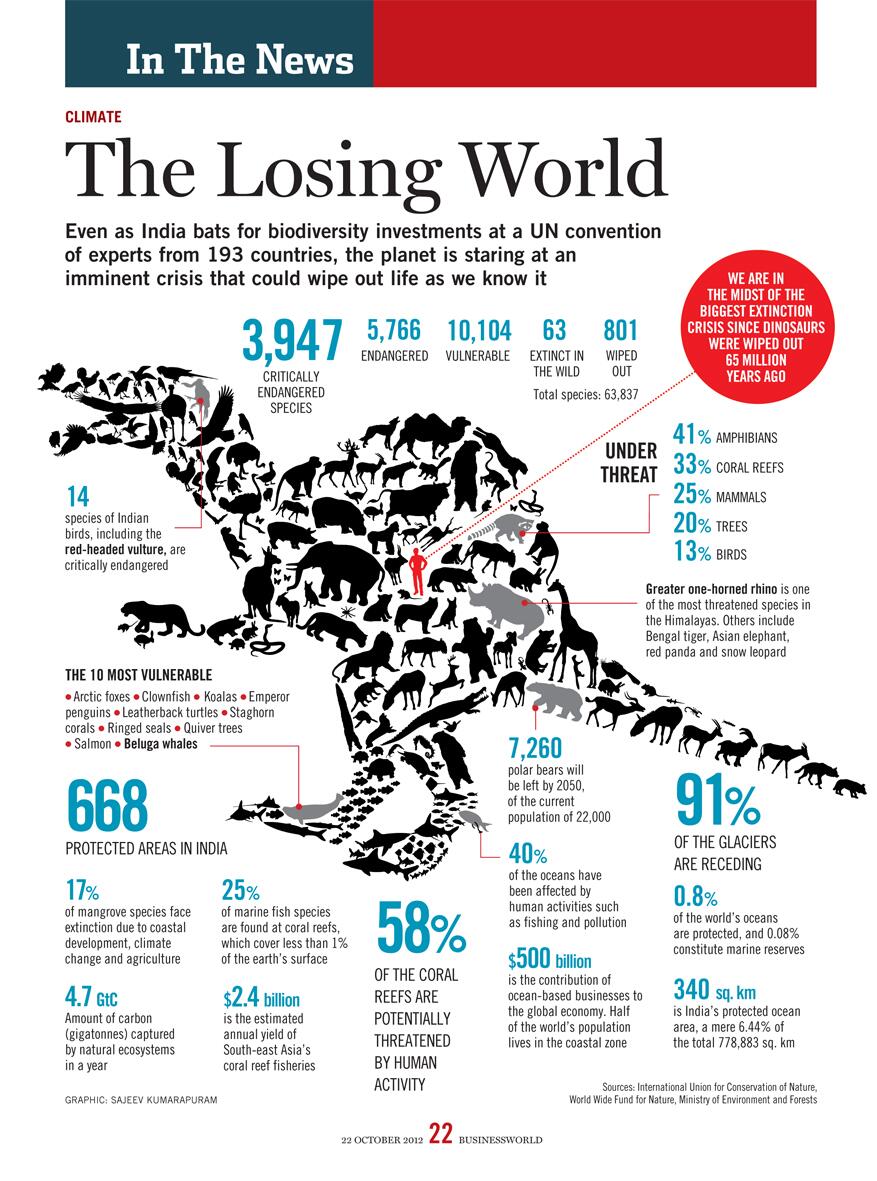
Losing the fight for biodiversity: An infographic

April 28, 2014

BusinessWorld infographic

BusinessWorld infographic

From BusinessWorld, a publication in India:

Even as India bats for biodiversity investments at a UN convention of experts from 193 countries, the planet is staring at an imminent crisis that could wipe out life as we know it.

Compiled by Yashodhara Dasgupta

Click Here To Download Infographic

Sources: International Union for Conservation of Nature,
World Wide Fund for Nature, Ministry of Environment and Forests

Graphic: Sajeev Kumarapuram

(This story was published in Businessworld Issue Dated 22-10-2012)
– See more at: http://www.businessworld.in/news/business/environment/the-losing-world/570570/page-1.html#sthash.mmSk4DDw.dpuf

This would be a good poster for geography, biology, general science and world history courses. Can your drafting class print this out for you in poster format?

When all of the “coal mine canaries” on Earth die out, how much longer have humans left to live on Earth?

What hope have we, with yahoos like this leading us in Congress?

ven as India bats for biodiversity investments at a UN convention of experts from 193 countries, the planet is staring at an imminent crisis that could wipe out life as we know it.Compiled by Yashodhara Dasgupta – See more at: http://www.businessworld.in/news/business/environment/the-losing-world/570570/page-1.html#sthash.mmSk4DDw.dpuf

ven as India bats for biodiversity investments at a UN convention of experts from 193 countries, the planet is staring at an imminent crisis that could wipe out life as we know it.Compiled by Yashodhara Dasgupta

Click Here To Download Infographic


Sources: International Union for Conservation of Nature,

World Wide Fund for Nature, Ministry of Environment and ForestsGraphic: Sajeev Kumarapuram

(This story was published in Businessworld Issue Dated 22-10-2012)

– See more at: http://www.businessworld.in/news/business/environment/the-losing-world/570570/page-1.html#sthash.mmSk4DDw.dpuf

ven as India bats for biodiversity investments at a UN convention of experts from 193 countries, the planet is staring at an imminent crisis that could wipe out life as we know it.Compiled by Yashodhara Dasgupta

Click Here To Download Infographic


Sources: International Union for Conservation of Nature,

World Wide Fund for Nature, Ministry of Environment and ForestsGraphic: Sajeev Kumarapuram

(This story was published in Businessworld Issue Dated 22-10-2012)

– See more at: http://www.businessworld.in/news/business/environment/the-losing-world/570570/page-1.html#sthash.mmSk4DDw.dpuf


2014: STILL, again, Earth Day/Lenin hoax trotted out: Earth Day honors Earth, our majestic home — not Lenin

April 22, 2014

This is mostly an encore post, repeated each year on April 22 — sad that it needs repeating.

You could write it off to pareidolia, once. Like faces in clouds, some people claimed to see a link. The first Earth Day, on April 22, 1970, coincided with Lenin’s birthday. There was no link — Earth Day was scheduled for a spring Wednesday. Now, years later, with almost-annual repeats of the claim from the braying right wing, it’s just a cruel hoax.

No, there’s no link between Earth Day and the birthday of V. I. Lenin:

One surefire way to tell an Earth Day post is done by an Earth Day denialist: They’ll note that the first Earth Day, on April 22, 1970, was an anniversary of the birth of Lenin.

Coincidentally, yes, Lenin was born on April 22 (new style calendar; it was April 10 on the calendar when he was born — one might accurately note that Lenin’s mother always said he was born on April 10).

It’s a hoax. There is no meaning to the first Earth Day’s falling on Lenin’s birthday — Lenin was not prescient enough to plan his birthday to fall in the middle of Earth Week, a hundred years before Earth Week was even planned.

About.com explains why the idea of a link between Earth Day and Lenin is silly:

Does Earth Day Promote Communism?
Earth Day 1970 was initially conceived as a teach-in, modeled on the teach-ins used successfully by Vietnam War protesters to spread their message and generate support on U.S. college campuses. It is generally believed that April 22 was chosen for Earth Day because it was a Wednesday that fell between spring break and final exams—a day when a majority of college students would be able to participate.

U.S. Sen. Gaylord Nelson, the guy who dreamed up the nationwide teach-in that became Earth Day, once tried to put the whole “Earth Day as communist plot” idea into perspective.

“On any given day, a lot of both good and bad people were born,” Nelson said. “A person many consider the world’s first environmentalist, Saint Francis of Assisi, was born on April 22. So was Queen Isabella. More importantly, so was my Aunt Tillie.”

April 22 is also the birthday of J. Sterling Morton, the Nebraska newspaper editor who founded Arbor Day (a national holiday devoted to planting trees) on April 22, 1872, when Lenin was still in diapers. Maybe April 22 was chosen to honor Morton and nobody knew. Maybe environmentalists were trying to send a subliminal message to the national subconscious that would transform people into tree-planting zombies. One birthday “plot” seems just about as likely as the other. What’s the chance that one person in a thousand could tell you when either of these guys were born.

My guess is that only a few really wacko conservatives know that April 22 is Lenin’s birthday (was it ever celebrated in the Soviet Union?). No one else bothers to think about it, or say anything about it, nor especially, to celebrate it.

Gaylord Nelson, Living Green image

Inventor of Earth Day teach-ins, former Wisconsin Governor and U.S. Senator Gaylord Nelson

Wisconsin’s U.S. Sen. Gaylord Nelson, usually recognized as the founder and father of Earth Day, told how and why the organizers came to pick April 22:

Senator Nelson chose the date in order to maximize participation on college campuses for what he conceived as an “environmental teach-in.” He determined the week of April 19–25 was the best bet; it did not fall during exams or spring breaks, did not conflict with religious holidays such as Easter or Passover, and was late enough in spring to have decent weather. More students were likely to be in class, and there would be less competition with other mid-week events—so he chose Wednesday, April 22.

In his own words, Nelson spoke of what he was trying to do:

After President Kennedy’s [conservation] tour, I still hoped for some idea that would thrust the environment into the political mainstream. Six years would pass before the idea that became Earth Day occurred to me while on a conservation speaking tour out West in the summer of 1969. At the time, anti-Vietnam War demonstrations, called “teach-ins,” had spread to college campuses all across the nation. Suddenly, the idea occurred to me – why not organize a huge grassroots protest over what was happening to our environment?

I was satisfied that if we could tap into the environmental concerns of the general public and infuse the student anti-war energy into the environmental cause, we could generate a demonstration that would force this issue onto the political agenda. It was a big gamble, but worth a try.

At a conference in Seattle in September 1969, I announced that in the spring of 1970 there would be a nationwide grassroots demonstration on behalf of the environment and invited everyone to participate. The wire services carried the story from coast to coast. The response was electric. It took off like gangbusters. Telegrams, letters, and telephone inquiries poured in from all across the country. The American people finally had a forum to express its concern about what was happening to the land, rivers, lakes, and air – and they did so with spectacular exuberance. For the next four months, two members of my Senate staff, Linda Billings and John Heritage, managed Earth Day affairs out of my Senate office.

Five months before Earth Day, on Sunday, November 30, 1969, The New York Times carried a lengthy article by Gladwin Hill reporting on the astonishing proliferation of environmental events:

“Rising concern about the environmental crisis is sweeping the nation’s campuses with an intensity that may be on its way to eclipsing student discontent over the war in Vietnam…a national day of observance of environmental problems…is being planned for next spring…when a nationwide environmental ‘teach-in’…coordinated from the office of Senator Gaylord Nelson is planned….”

Nelson, a veteran of the U.S. armed services (Okinawa campaign), flag-waving ex-governor of Wisconsin (Sen. Joe McCarthy’s home state, but also the home of Aldo Leopold and birthplace of John Muir), was working to raise America’s consciousness and conscience about environmental issues.

Lenin on the environment? Think of the Aral Sea disaster, the horrible pollution from Soviet mines and mills, and the dreadful record of the Soviet Union on protecting any resource. Lenin believed in exploiting resources, not conservation.

So, why are all these conservative denialists claiming, against history and politics, that Lenin’s birthday has anything to do with Earth Day?

Can you say “propaganda?”  Can you say “political smear?”

2014 Resources and Good News:

2013 Resources and Good News:

Good information for 2012:

Good information from 2011:

Good information from 2010:

2014’s Wall of Shame:

2013 Wall of Shame:

Wall of Lenin’s Birthday Propaganda Shame from 2012:

Wall of Lenin’s Birthday Propaganda Shame from 2011:

Wall of Lenin’s Birthday Propaganda Shame from 2010:

Spread the word.  Have you found someone spreading the hoax, claiming Earth Day honors Lenin instead?  Give us the link in comments.


“Years of Living Dangerously” – April 13 premiere of climate change information series

April 11, 2014

Will it work this time?  Can it recharge the effort Al Gore started?

Monte Best of Plainview, Texas, explains to Don Cheadle how the Texas drought caused the Cargill Company to close its meat packing plant in the city.

Monte Best of Plainview, Texas, explains to Don Cheadle how the Texas drought caused the Cargill Company to close its meat packing plant in the city. “Act of God,” many local people say.

Here’s the trailer:

The avid promotional explanation:

Published on Mar 14, 2014

Don’t miss the documentary series premiere of Years of Living Dangerously, Sunday, April 13th at 10PM ET/PT.

Subscribe to the Years of Living Dangerously channel for more clips:
http://s.sho.com/YearsYouTube

Official site: http://www.sho.com/yearsoflivingdange…
The Years Project: http://yearsoflivingdangerously.com/
Follow: https://twitter.com/YEARSofLIVING
Like: https://www.facebook.com/YearsOfLiving
Watch on Showtime Anytime: http://s.sho.com/1hoirn4
Don’t Have Showtime? Order Now: http://s.sho.com/P0DCVU

It’s the biggest story of our time. Hollywood’s brightest stars and today’s most respected journalists explore the issues of climate change and bring you intimate accounts of triumph and tragedy. YEARS OF LIVING DANGEROUSLY takes you directly to the heart of the matter in this awe-inspiring and cinematic documentary series event from Executive Producers James Cameron, Jerry Weintraub and Arnold Schwarzenegger.

More: 


Legacy of DDT abuse: Cleaning up old pesticide dumps

February 15, 2014

Contrary to science denialist claims, DDT is not harmless.  Users and abusers of DDT, abandoned stocks of DDT and other pesticides around the world, after the stuff had become essentially useless against insect or other pests originally targeted.

In the U.S., EPA moves in to clean up DDT dumps, under the Comprehensive Environmental Response, Compensation and Liability Act of 1980 (CERCLA), or Superfund.  In much of the world, various UN agencies find the old pesticides, and clean them up as funding allows.

The Food and Agricultural Organization (FAO) documents its cleanup efforts with photos of sessions training technicians to find and catalog dump sites, repackaging of old drums when necessary, extraction, packing and shipping to a disposal site.

Photos tell a story words on paper cannot.

Caption from FAO: TN (Tanzania) before: 40 tonnes of 50 year old DDT were found in Menzel Bourguiba Hospital, TN - : M. Davis

Caption from FAO: TN (Tanzania) before: 40 tonnes of 50 year old DDT were found in Menzel Bourguiba Hospital, TN – : M. Davis

Sometimes the toxic wastes did not stay neatly stacked.

FAO caption:  TN before: 40 tonnes of 50 year old DDT were found in Menzel Bourguiba Hospital, TN

FAO caption: TN before: 40 tonnes of 50 year old DDT were found in Menzel Bourguiba Hospital, TN View real size

DDT use against insect vectors of disease essentially halted in the mid-1960s.  The Rockefeller Foundation’s and UN’s ace mosquito fighter, Fred Soper, ran into mosquitoes in central Africa that were resistant and immune to DDT. Farmers and businesses had seized on DDT as the pesticide of choice against all crop pests, or pests in buildings.  By the time the UN’s malaria-fighting mosquito killers got there, the bugs had evolved to the point DDT didn’t work the malaria eradication campaign.

Also, there were a few DDT accidents that soured many Africans on the stuff.  Around lakes where local populations caught the fish that comprised the key protein in their diet, farmers used DDT, and the runoff killed the fish.

Use of DDT ended rather abruptly in several nations.  Stocks of DDT that had been shipped were abandoned where they were stored.

For decades.

FAO caption:    Obsolete DDT in Luanda, Angola - July 2008 -  : K. Cassam

FAO caption: Obsolete DDT in Luanda, Angola – July 2008 – : K. Cassam

Prevention and disposal of obsolete chemicals remains as a thorny problem throughout much of the world.  Since 2001, under the Persistent Organic Pollutants Treaty, (POPs), the UN’s World Health Organization (WHO) has coordinated work by WHO and a variety of non-governmental organizations (NGOs), as well as governments, to make safe the abandoned pesticides, and detoxify or destroy them to prevent more damage.  FAOs efforts, with photos and explanation, is a history we should work to preserve.

DDT provided powerful insect killing tools for a relatively short period of time, from about 1945 to 1965.  In that short period, DDT proved to be a deadly killer of ecosystems to which it was introduced, taking out a variety of insects and other small animals, on up the food chain, with astonishing power.  One of DDT’s characteristics is a long half-life — it keeps on killing, for months or years. Once that was thought to be an advantage.

Now it’s a worldwide problem.


Would we let terrorists poison our water, if they promised jobs?

February 4, 2014

Great, potent question.

What do you think?

And, where did that photo come from?

Protester in West Virginia:  "Would we let terrorists poison our water supply, if they said it created jobs?"  Photographer unidentified; so is protester.

Protester in West Virginia: “Would we let terrorists poison our water supply, if they said it created jobs?” Photographer unidentified; so is protester.

Keep your eye on West Virginia.

Here’s why:  Do you know what factories may lie upstream from your drinking water, and do you know how they are regulated?  Is the regulation done well?

More:


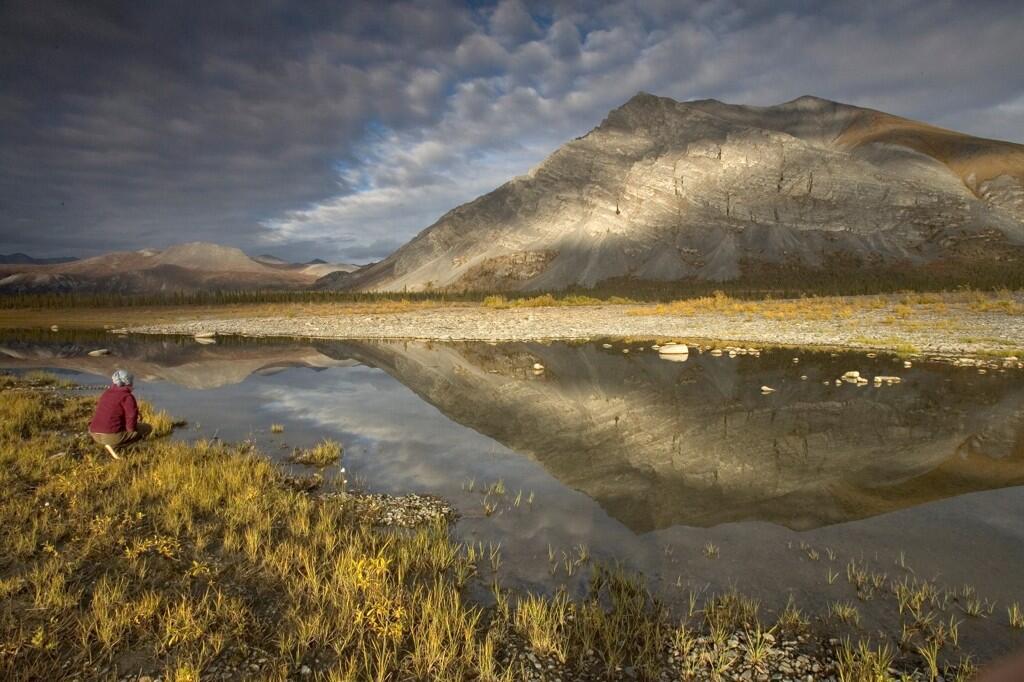
Happy birthday Arctic National Wildlife Refuge; 53 years

December 6, 2013

Icy day here in Dallas, we missed a lot of dates that should have been commemorated.

Let’s catch this one:  The Arctic National Wildlife Refuge (ANWR) was created 53 years ago today in the administration of Dwight Eisenhower, by Interior Secretary Fred A. Seaton.

Happy 53rd birthday to the Arctic National Wildlife Refuge! @USFWSHQ @USFWSRefuges #Alaska pic.twitter.com/2popb7EAvz

Photo probably not taken this week:  From the US Department of Interior: Happy 53rd birthday to the Arctic National Wildlife Refuge! @USFWSHQ @USFWSRefuges #Alaska pic.twitter.com/2popb7EAvz

ANWR finds itself the center of controversy, now, because of the possibility of oil underneath it, and the difficulty of getting that oil without destroying wildlife habitat, or the possibility of destructive oil spills.  For an understanding of the issues, visit ANWR’s website and the non-partisan discussion there.

Odd that land so severely beautiful, so far out of the way and so difficult to master, has its fate decided in marble halls in Washington, D.C., 3,172 miles distant. The United States is a big, sprawling nation.

Information on the ANWR:

History and Culture

Refuge Establishment: Legislation and Purposes

The Arctic Refuge was established in 1960 and expanded in 1980.


Refuge History

The Arctic Refuge has been providing for the physical and emotional well-being of humans for many thousands of years. It remains an important resource to help sustain local Eskimo and Indian cultures. The Refuge continues to be valued, even by those who never travel within it’s borders, as a symbol of America’s vast and remote wilderness – a place of inspiration and beauty – a promise for the future for all Americans.

Local Cultures

The lands of the Arctic Refuge continue to support the Inupiat Eskimo and Gwich’in Indian peoples who have lived here for centuries.

More:  

3,172 miles between the Arctic National Wildlife Refuge and Washington, D.C.

3,172 miles between the Arctic National Wildlife Refuge and Washington, D.C.


Selling wind energy leases off the coast of Virginia: Is this a good idea?

September 16, 2013

Contrary to the claims of President Obama’s critics, his administration is proceeding to develop energy resources in new areas.

Just a couple of weeks ago experimental wind energy sites off the coast of Virginia were auctioned off.

Wind power farm at sea; Clemson University image, of unidentified ocean-based wind farm.

Wind power farm at sea; Clemson University image, of unidentified ocean-based wind farm.

Can these tracts be developed responsibly?  I have not followed the issue, and I have not read the Environmental Impact Statement on this sale (surely there was one, since this is a “significant federal act” with great impact on these waters and the coast of Virginia).  Surely this is safer and cleaner than oil leases; enough cleaner?  Far enough away to avoid destructive effects on wildlife and other resources?

What do you think?

Here’s the press release from the Department of Interior:

Interior Holds Second Competitive Lease Sale for Renewable Energy in Federal Waters


Historic Sale for Wind Energy Development Offshore Virginia Advances President’s Climate Action Plan

09/04/2013

WASHINGTON, D.C. – As part of President Obama’s Climate Action Plan to create American jobs, develop domestic clean energy sources and cut carbon pollution, the Interior Department today completed the nation’s second competitive lease sale for renewable energy in federal waters, garnering $1,600,000 in high bids for 112,799 acres on the Outer Continental Shelf offshore Virginia.

Virginia Electric and Power Company is the provisional winner of the sale, which auctioned a Wind Energy Area approximately 23.5 nautical miles off Virginia Beach that has the potential to support 2,000 megawatts of wind generation – enough energy to power more than 700,000 homes.

The sale follows a July 31 auction of 164,750 acres offshore Rhode Island and Massachusetts for wind energy development that was provisionally won by Deepwater Wind New England, LLC, generating $3.8 million in high bids.

“This year’s second offshore wind lease sale is another major milestone in the President’s all-of-the-above energy strategy and demonstrates continued momentum behind a robust renewable energy portfolio that will help to keep our nation competitive and expand domestic energy production while cutting carbon pollution,” said Secretary of the Interior Sally Jewell. “Today’s sale is the result of a great deal of collaboration and planning with the Commonwealth of Virginia, which has been a leader in advancing offshore renewable energy for the Atlantic coast and an enthusiastic partner in this effort.”

“Today’s renewable energy lease sale offshore Virginia is another significant step forward in the President’s call for action to address climate change and the Administration’s all-of-the-above energy strategy,” said Bureau of Ocean Energy Management (BOEM) Director Tommy Beaudreau. “I congratulate Virginia Electric and Power Company and we look forward to overseeing their development of the Virginia wind energy area, which will create jobs, increase our energy security and provide abundant sources of clean renewable power.”

Efforts to spur responsible development of offshore wind energy are part of a series of Obama Administration actions to increase renewable energy both offshore and onshore by improving coordination with state, local and federal partners. The Virginia Renewable Energy Task Force has been a leading agent in intergovernmental collaboration for wind energy development offshore Virginia.

Since 2009, Interior has approved 47 wind, solar and geothermal utility-scale projects on public lands, including associated transmission corridors and infrastructure to connect to established power grids. When built, these projects could provide more than 13,300 megawatts – enough energy to power more than 4.6 million homes and support more than 19,000 construction and operations jobs.

As part of the President’s comprehensive Climate Action Plan, he has challenged Interior to re-double efforts on its renewable energy program by approving an additional 10,000 megawatts of renewable energy production on public lands and waters by 2020.

At the same time, under the Administration’s all-of-the-above energy strategy, domestic oil and gas production has grown each year President Obama has been in office, with domestic oil production currently higher than at any time in two decades; natural gas production at its highest level ever; and renewable electricity generation from wind, solar, and geothermal sources having doubled. Combined with recent declines in oil consumption, net oil imports in 2012 fell to the lowest level in 20 years.”

BOEM auctioned the Wind Energy Area offshore Virginia as a single lease, containing 19 whole Outer Continental Shelf blocks and 13 sub-blocks. For a map of the Wind Energy Area, click here.

The auction lasted 1 day, consisting of 6 rounds before determining the provisional winner. In addition to Virginia Electric and Power Company the following company participated in the auction: Apex Virginia Offshore Wind, LLC. Following the auction, the Attorney General, in consultation with the Federal Trade Commission, will have 30 days in which to complete an antitrust review of the auction.

The lease will have a preliminary term of six months in which to submit a Site Assessment Plan to BOEM for approval. A Site Assessment Plan describes the activities (e.g., installation of meteorological towers and buoys) the lessee plans to perform for the assessment of the wind resources and ocean conditions of its commercial lease.

After a Site Assessment Plan is approved, the lessee will have up to four and a half years in which to submit a Construction and Operations Plan (COP) for approval, which provides a detailed outline for the construction and operation of a wind energy project on the lease. If the COP is approved, the lessee will have an operations term of 33 years.

BOEM is expected to announce additional auctions for Wind Energy Areas offshore Maryland, New Jersey, and Massachusetts later this year and in 2014.

For more information on what’s going on offshore Virginia, visit BOEM’s website.

23 miles puts it far enough out that it’s generally out of sight from shore.  Out of sight, out of mind?  Out of danger?  Out of disaster potential?

Does a coal-power company’s winning these leases suggest a scheme to keep wind power from being developed, to improve the case for coal?

More: